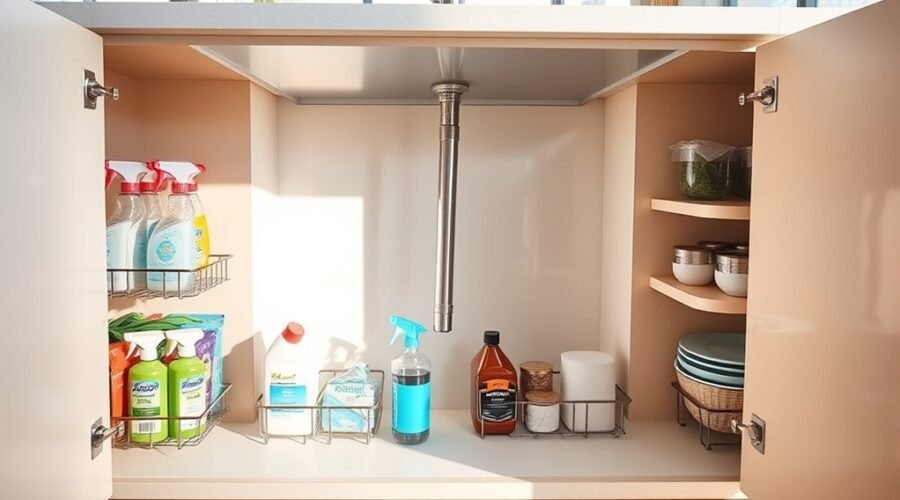
A corner kitchen sink cabinet can be difficult to organize because of deep corners, plumbing pipes, and limited door space. Cleaning supplies often disappear behind the sink, while bulky organizers block access to useful storage. The solution is to protect the cabinet, measure its awkward spaces, and choose storage that keeps everyday items easy to reach.
Quick Answer
To organize a corner kitchen sink cabinet, empty it, dry the base, and fit a waterproof liner. Measure around pipes, valves, and door hinges before choosing a narrow two-tier organizer or pull-out bin. Keep frequently used items at the front, use door hooks for lightweight tools, and leave plumbing easy to inspect.
At a Glance
| Difficulty | Easy for freestanding organizers; installing mounted pull-out shelves may require basic tools. |
| Tools Needed | Tape measure, cleaning cloth, waterproof liner, storage caddies, and optional two-tier organizer, pull-out tray, or door hooks. |
Protect Your Corner Kitchen Sink Cabinet
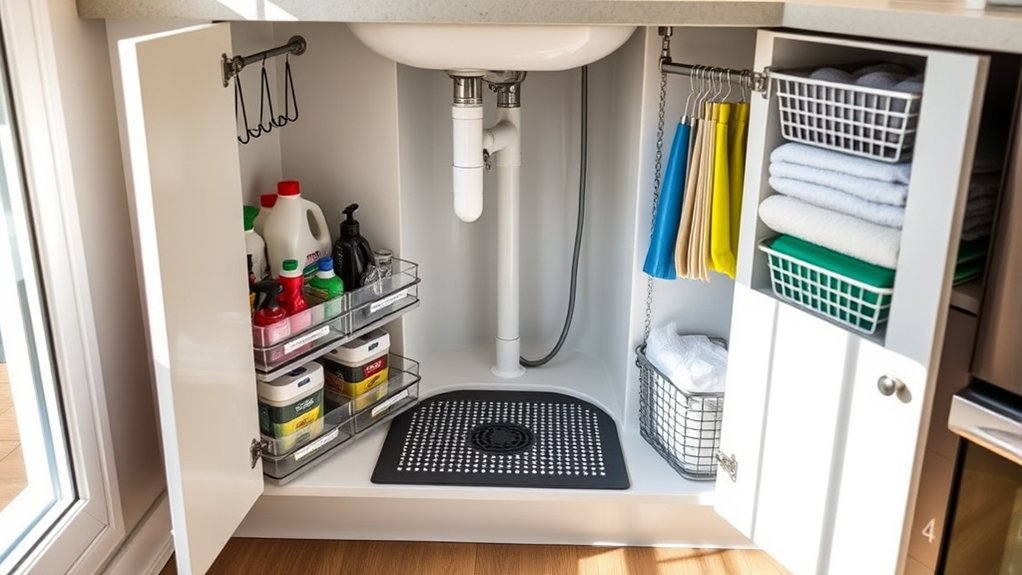
A waterproof liner or cabinet mat helps protect the base of your corner sink cabinet from minor drips, spills, and cleaning product stains. It also creates an easy-to-clean surface beneath your storage bins.
Start by removing everything from the cabinet. Wipe the floor and walls, inspect the plumbing connections, and let the surfaces dry completely before installing a liner.
Choose a flexible silicone mat with a raised lip if the cabinet shape allows it. The raised edge can contain small spills, while a smooth surface makes it easier to slide organizers in and out.
For an unusually shaped corner cabinet, a waterproof shelf liner that can be trimmed to size may work better. Cut carefully around fixed obstructions, but remember that cutting through a raised edge can reduce its ability to contain water.
A liner should sit flat without covering plumbing connections or hiding the condition of the cabinet base. Avoid leaving gaps where spills can seep underneath unnoticed.
Inspect the cabinet for damp spots, swelling, stains, or musty odors. According to the EPA’s kitchen cabinet moisture guidance, leaking pipes beneath a sink can lead to mold in cabinets and surrounding walls.
A waterproof mat does not repair a leak. If you discover dripping plumbing or repeated moisture, address the water problem before adding organizers.
Sort What Stays Under the Sink
The easiest way to organize a corner sink cabinet is to reduce the number of items inside it. A smaller collection of useful supplies leaves more space around pipes and makes everything easier to find.
Empty the cabinet and sort its contents into daily essentials, occasional supplies, and items that belong elsewhere.
- Keep everyday essentials together. Group dish soap, clean sponges, brushes, gloves, and other frequently used tools into portable caddies.
- Move backup supplies elsewhere. Store duplicates, bulk packages, and rarely used products in another suitable location to avoid overcrowding.
- Remove unnecessary items. Separate empty containers, worn cleaning tools, expired products, and anything you no longer use.
Use transparent or labeled caddies to separate cleaning categories. For example, one bin can hold dishwashing supplies while another holds surface-cleaning tools.
Keep cleaning chemicals in their original labeled bottles rather than transferring them into decorative containers. Labels provide important safety and handling instructions.
Dispose of unwanted products according to their labels and local collection rules. The EPA’s household hazardous waste guidance explains why some cleaners and other hazardous products should not be poured down drains or placed in ordinary trash.
Warning: An unlocked under-sink cabinet is not a safe place for hazardous cleaning chemicals when children can access it. Store these products in a locked cabinet or another secure location beyond children’s reach. The U.S. Consumer Product Safety Commission recommends keeping household cleaners locked up and out of children’s reach.
Give every remaining category a fixed location. This prevents the cabinet from becoming a collection point for unrelated household items.
Fit Organizers Around the Plumbing
The best corner kitchen sink storage works around existing plumbing rather than blocking it. Adjustable shelves, modular bins, and pull-out trays can make use of both vertical space and deep corners.
Before buying anything, check the location of the drain trap, water supply lines, shutoff valves, and garbage disposal if you have one. These features determine which organizers will fit.
Recommended Products

𝐌𝐚𝐱𝐢𝐦𝐢𝐳𝐞 𝐔𝐧𝐝𝐞𝐫 𝐒𝐢𝐧𝐤 𝐒𝐩𝐚𝐜𝐞 - Designed with a custom-fit silicone mat and L-shaped structure, this under sink organizer fits perfectly around plumbing while protecting cabinets from water, spills, and leaks. Measuring approximately 11.8"W x 15.9"D x 13.8-16.9"H, it’s ideal for most kitchen and bathroom cabinets.

C Shaped Design-Save Space: The Under Sink Organizer kitchen design with C-Shape which allowing you to put it under a kitchen or bathroom sink without hitting the plumbing, and the bottom tier leaves a suitable space for your tall bottles, which can solve your cabinet storage troubles.
Measure the Cabinet Before Choosing Organizers
Measure the usable space inside the cabinet, not just its outside dimensions. A large cabinet can still have a narrow opening or plumbing that prevents an organizer from sliding out.
- Measure the opening. Check the clear width between the cabinet frame and any door hinges.
- Measure the depth. Find the usable distance from the opening to the back of the cabinet.
- Measure the height. Check the clearance below the sink basin and around the drain assembly.
- Mark obstructions. Record where pipes, valves, hinges, and other fixtures limit storage.
- Check the movement. Make sure a drawer or tray can extend without striking the doors or plumbing.
In a corner cabinet, you should also consider the direction the doors open. A pull-out shelf may fit inside but still be difficult to use if its movement conflicts with a door or angled frame.
Adjustable Two-Tier Organizers
Adjustable two-tier organizers are useful when you need more storage without covering the cabinet floor. They create separate levels for small tools and taller cleaning bottles while leaving space for plumbing.
Look for a design with adjustable shelf height or a narrow upper tier. Some sliding organizers allow the upper basket to be positioned on either side to avoid pipes.
- Place clean sponges, brushes, and other small accessories on the upper tier.
- Keep taller bottles and heavier supplies upright on the lower tier.
- Choose a sliding or front-opening design if reaching the back of the cabinet is difficult.
Check the product’s weight limit before loading it. Some heavy-duty sliding models support up to 50 lbs overall, as shown in this manufacturer’s 50 lb specification. However, not every two-tier organizer has the same capacity.
A stable metal frame can help prevent sagging, while removable trays simplify cleaning. Confirm whether the organizer is freestanding, adhesive-mounted, or installed with screws before choosing it.
Plumbing-Friendly Shelf Layouts
A plumbing-friendly shelf layout uses the open areas beside and in front of pipes. It keeps cleaning supplies accessible while leaving enough room to inspect and maintain the plumbing.
Small modular bins are useful around irregular corners. For example, HÅLLBAR bins can be arranged for waste sorting where cabinet space allows. The under-sink storage guidance featuring HÅLLBAR also describes using different storage levels, turntables, and pull-out trays.
For very deep cabinets, choose removable bins or sliding trays rather than stacking everything directly on the floor. A small turntable can also make bottles easier to reach if it rotates without touching the plumbing.
A mounted pull-out system may offer more stable access to heavier supplies. For example, the HÅLLBAR pull-out frame is designed to mount at the bottom of a cabinet and provide access to recycling bins.
Such systems still require enough floor space and clearance. They may not suit every corner cabinet, particularly one with plumbing extending into the path of the sliding frame.
Pro Tip: Before installing a pull-out organizer, mark its planned footprint with removable tape on the cabinet floor. Check that the full sliding path stays clear of the drain trap, hinges, and shutoff valves. This can reveal fitting problems before you drill mounting holes.
Whichever system you use, keep shutoff valves reachable. You should be able to remove nearby storage quickly if a pipe leaks or needs repair.
Store Cleaning Supplies by Frequency
Organize cleaning supplies according to how often you use them. Everyday items belong near the front, while less frequently used tools can occupy deeper storage zones.
This method is particularly useful in corner cabinets because their back sections are harder to reach.
- Daily-use zone: Keep dish soap, clean sponges, brushes, and dishwashing accessories in a front caddy.
- Occasional-use zone: Place specialty cleaning tools and less frequently needed supplies in removable bins farther back or on accessible upper shelves.
- Backup zone: Use another suitable storage location for bulk supplies and duplicate products that would crowd the cabinet.
Use clear containers or simple labels so that each group is easy to identify. Keep bottles upright in caddies that can catch minor spills and be lifted out for cleaning.
In a household with children, chemical cleaning products should remain securely stored even if that means keeping them outside the under-sink cabinet.
Consider placing your most frequently used tools on the side closest to the door you normally open. This reduces the need to reach across the sink’s plumbing.
A well-planned arrangement keeps the cabinet useful without filling every available corner.
Use the Doors for Extra Storage
The inside of cabinet doors offers valuable storage for lightweight cleaning tools. Hooks and slim bins can free space on the cabinet floor without requiring another shelf.
Corner sink doors may be narrow or angled, so check their movement before attaching storage accessories.
Door-Mounted Hooks
Door-mounted hooks work well for lightweight items such as dish towels, cleaning gloves, small brushes, and sponge holders. They keep useful accessories visible and separate from larger supplies.
Choose adhesive hooks for a suitable smooth surface or screw-mounted hooks when the door construction allows secure installation.
- Choose a clear spot inside the door, away from hinges and the cabinet frame.
- Attach hooks according to the manufacturer’s instructions and weight rating.
- Hang lightweight tools so they do not interfere with closing the door.
Some hooks can also hold spray bottles by their triggers, but only when designed for that load. Avoid placing potentially hazardous cleaning products where children can reach them.
If using screws, check the cabinet door’s thickness and the recommended screw length. Screws that are too long can damage the outside surface.
Keep hooks clear of the plumbing so you can open the door fully and reach the stored items without obstruction.
Slim Door Bins
Slim door bins provide an easy way to store sponges, trash bags, small brushes, and other lightweight accessories. Their shallow shape helps preserve the space behind the door.
Transparent bins make it easier to see their contents. Bins with an open top can also make everyday tools quicker to remove and replace.
Depending on the product, you may be able to use adhesive backing, screws, or an over-door mounting design. Choose a mounting method compatible with the cabinet material and finish.
Before permanent installation, hold the bin in its planned position and slowly close the door. Check that it does not strike shelves, organizers, pipes, or the opposite door.
Also consider whether damp sponges and cloths can dry properly. Wet cleaning tools should not remain trapped in a closed container where moisture can collect.
Door storage is most effective when it holds small items that would otherwise clutter the cabinet floor.
Keep the Cabinet Easy to Maintain
A corner sink cabinet stays organized when every item has a place and the storage system is easy to clean. Removable bins, waterproof surfaces, and accessible pull-out trays make routine maintenance simpler.
Start by keeping the cabinet floor as clear as possible. A bottom pull-out drawer or tray makes it easier to retrieve supplies from deep spaces without reaching around pipes.
Stackable drawers can help use vertical space, but avoid arrangements that require removing several containers to reach an everyday item.
Follow this simple maintenance routine:
- Return supplies to their assigned caddies after each use.
- Remove empty containers and products you no longer need.
- Wipe spills from trays, shelves, and the waterproof liner.
- Lift the liner occasionally to check for hidden moisture.
- Inspect plumbing connections and cabinet surfaces for leaks, stains, or swelling.
Keep cleaning products closed and stored according to their labels. Avoid mixing chemicals or leaving leaking bottles inside the cabinet.
If you find dampness beneath the liner, remove the affected organizers and dry the cabinet. Resolve the source of the moisture before putting supplies back.
Check that your storage system still works by opening the doors fully and removing each caddy or drawer. Nothing should block the shutoff valves, prevent the doors from closing, or require excessive reaching.
The goal is not to fill every inch. It is to create a cabinet where supplies are visible, easy to retrieve, and simple to put away.
Key Takeaways
- Measure the clear door opening and the full movement of a sliding organizer, not just the cabinet’s interior dimensions.
- A liner helps contain minor spills, but plumbing leaks still need proper repairs.
- Organizer weight limits vary by model, so confirm the stated capacity before adding heavy bottles.
- Removable bins make deep corners easier to use and allow quicker access to plumbing.
- Keep hazardous cleaning products secured and in their original labeled containers.
Frequently Asked Questions
What to Do With the Space Behind a Corner Kitchen Sink?
Use the deep space behind the sink for a removable bin or a small turntable, provided it clears the pipes. Keep less-used, lightweight supplies there, and choose a container you can lift out without kneeling or reaching around the drain.
What Are the Drawbacks of a Corner Kitchen Sink?
A corner sink can reduce usable counter space and leave a deep, hard-to-reach cabinet. Angled doors, plumbing, and a garbage disposal may limit organizer size and make cleaning or repairs harder. An accessible pull-out can help, but it cannot change the cabinet’s basic shape.
How to Organize Space Under a Kitchen Sink?
Empty and sort the cabinet, clean and dry the base, then measure around the plumbing. Add a liner, put daily tools in a front caddy, and choose stackable shelves or pull-out trays for remaining space. Leave the shutoff valves visible.
What Is a Good Organiser for Under the Kitchen Sink?
An adjustable two-tier organizer is a good choice if it fits around the pipes and passes through the door opening. A pull-out bin, turntable, tension rod for light items, or wall-mounted shelf may work better in some cabinets. Check clearance and weight limits before installing.
Conclusion
Organizing a corner kitchen sink cabinet is easier when you work with its shape instead of trying to fill every gap. Protect the base with a waterproof liner, keep only useful supplies, and choose organizers that fit around the plumbing. Add lightweight door storage where space allows, and keep everything easy to remove and clean. Start by measuring your cabinet and sorting its contents before buying new organizers.
Sources
- EPA Mold House Tour: Plumbing leaks, cabinet moisture, and mold prevention.
- EPA Household Hazardous Waste Guidance: Safe storage and disposal of potentially hazardous cleaning products.
- CPSC Medication and Cleaner Storage Safety: Keeping household cleaners locked and away from children.
- Under-Sink Storage and Organization Guidance: Modular bins, plumbing-friendly layouts, pull-out storage, and door organizers.
- Sliding Under-Sink Organizer Specifications: Verified 50 lb overall capacity for a specific two-tier organizer.
- HÅLLBAR Pull-Out Frame Product Specifications: Cabinet-floor installation and access to recycling bins.