Affiliate disclosure: This article contains Amazon affiliate links. We may earn a commission from qualifying purchases at no extra cost to you.
Last updated: August 1, 2026.
For drying fruit at home in 2026, look for a food dehydrator with adjustable heat, steady airflow, enough usable tray space for your typical batch, and parts you can clean without difficulty. The four machines below are compact five-tray dehydrators designed for sliced fruit, herbs, vegetables, and other dried foods. The COSORI 5-Tray Food Dehydrator is the strongest all-around option for most beginners. The Magic Mill provides stainless steel trays and a 24-hour timer, the Chefman offers simple dial controls, and the OSTBA combines stainless steel trays with a timer of up to 48 hours.
How these dehydrators were compared
The selections are based on product relevance, temperature control, tray material, timer or operating limits, cleaning requirements, capacity, and suitability for routine fruit drying. This is a specification-based comparison rather than a claim of hands-on laboratory testing. Match the model details in this guide with the current Amazon listing and included manual before ordering.
Quick verdict
- Best Overall: COSORI Food Dehydrator Machine with 5 Trays
- Best Compact Stainless-Tray Pick: Magic Mill Food Dehydrator
- Best for Simple Dial Controls: Chefman 5-Tray Food Dehydrator
- Best for Long Timed Cycles: OSTBA Food Dehydrator
Quick Comparison
| Product | Best For | Trays | Temperature | Key Consideration | Amazon |
|---|---|---|---|---|---|
| COSORI 5-Tray | Beginners and everyday fruit drying | 5 BPA-free stackable trays | 95°F to 165°F | 48-hour timer; larger harvests may require extra trays or multiple batches | Check Price |
| Magic Mill 5-Tray | Small kitchens and stainless steel trays | 5 stainless steel trays | 95°F to 158°F | Timer runs up to 24 hours; tray checks may improve consistency | Check Price |
| Chefman 5-Tray | Shoppers who prefer straightforward dial controls | 5 adjustable-height plastic trays | 95°F to 158°F | No built-in timer; hand-wash trays and follow the 20-hour run limit | Check Price |
| OSTBA 5-Tray | Long drying cycles in a compact footprint | 5 stainless steel trays | 95°F to 160°F | 1-to-48-hour timer; five-tray capacity suits small or medium batches | Check Price |
Before you buy
- Match the Amazon ASIN and model number with the specifications in this guide.
- Check whether you prefer dishwasher-safe trays or are comfortable hand-washing them.
- Measure your counter and storage area, including ventilation space around the appliance.
- Confirm whether a fruit-leather liner or fine-mesh screen is included.
- Check both the timer duration and the manual’s maximum continuous operating time.
Cosori Food Dehydrator Machine with 5 Trays
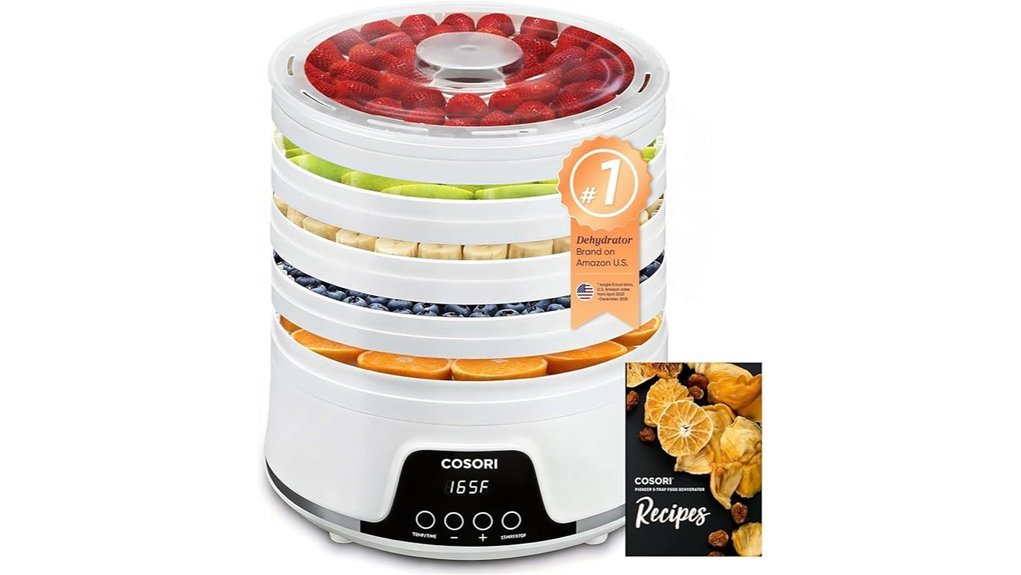
Best Overall: A practical beginner-friendly choice with precise adjustable heat, a 48-hour timer, dishwasher-safe trays, and manageable five-tray capacity.
The COSORI Food Dehydrator Machine is designed for small and medium batches of sliced fruit, herbs, vegetables, and homemade snacks. Its adjustable 95°F to 165°F range gives you useful control for delicate ingredients and fruit-specific drying directions. The timer can run for up to 48 hours, reducing the need to restart the machine during a longer cycle.
The five BPA-free stackable trays help keep the appliance manageable for a home kitchen. They are removable and dishwasher safe, which is useful after drying sticky fruit such as mangoes, bananas, pineapples, or ripe berries. The supplied five-tray capacity is enough for routine household use, but large garden harvests may require additional compatible trays or several drying cycles.
Why You’ll Like It
- Precise adjustable temperature and a long timer provide flexible control.
- Five dishwasher-safe trays simplify cleanup after sticky batches.
- The beginner-friendly controls are suitable for regular household fruit drying.
Who Should Buy This: Beginners, couples, and families making dried fruit in small or medium batches.
Who Should Avoid This: Anyone who regularly processes large harvests and needs a wide cabinet-style machine.
Pros:
- Flexible settings: Adjustable from 95°F to 165°F with a timer of up to 48 hours.
- Easy maintenance: The removable trays are dishwasher safe.
- Approachable design: Straightforward controls make it easier to repeat successful batches.
Cons:
- Limited included capacity: Five trays may require multiple cycles for bulk produce.
- Stacked layout: Checking lower trays requires lifting the trays above them.
- Plastic trays: Shoppers who specifically want stainless steel food-contact surfaces may prefer another option.
Magic Mill Food Dehydrator with 5 Stainless Steel Trays
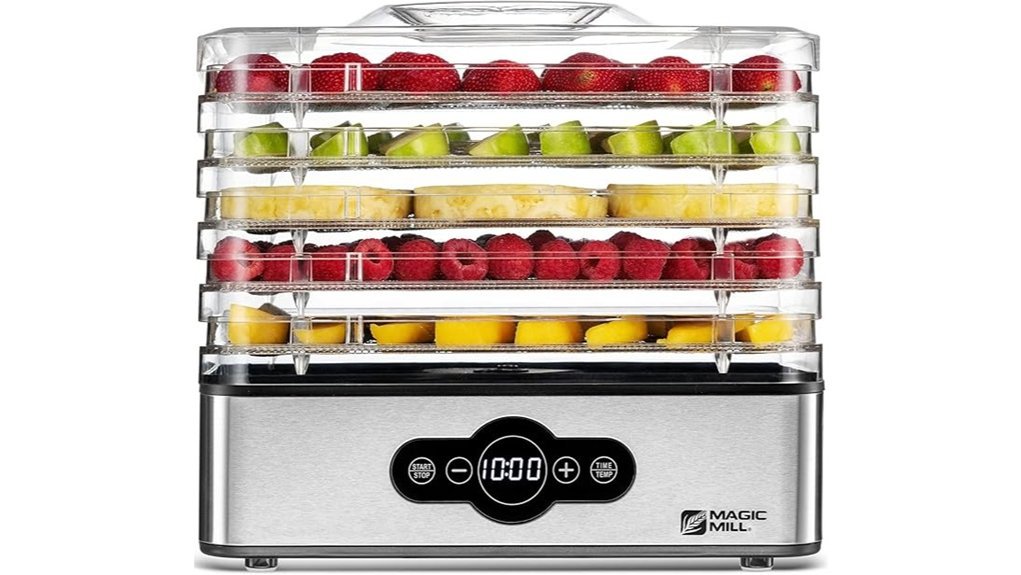
Best Compact Stainless-Tray Pick: A space-conscious option with removable metal trays, adjustable spacing, and digital controls.
The Magic Mill MFD-5000 Food Dehydrator combines five stackable stainless steel trays with digital time and temperature controls. Its verified temperature range is 95°F to 158°F, and its timer can be set for up to 24 hours. The 240-watt design is intended for compact household batches rather than high-volume food processing.
The tray spacing can be adjusted to accommodate thin apple slices or thicker pieces of produce. The stainless steel trays detach for cleaning and are dishwasher safe. Because this is a vertically stacked machine, inspect fruit on several levels during longer cycles and change tray positions when one level is drying noticeably faster.
Why You’ll Like It
- Stainless steel trays provide a sturdy food-contact surface.
- Adjustable tray spacing accommodates ingredients of different thicknesses.
- Digital controls make time and temperature settings easier to repeat.
Who Should Buy This: Small households that value compact storage, stainless steel trays, and a built-in timer.
Who Should Avoid This: Bulk dehydrators who need wide cabinet trays, horizontal airflow, or a timer longer than 24 hours.
Pros:
- Space-saving design: Easier to fit into a smaller kitchen than a large cabinet machine.
- Adjustable tray height: Provides additional room for thicker fruit pieces.
- Simple cleanup: The detachable stainless steel trays are dishwasher safe.
Cons:
- Small drying area: Not intended for a large harvest in one cycle.
- Shorter timer: Its 24-hour maximum is lower than the COSORI and OSTBA timers.
- Vertical airflow: Changing tray positions may help when levels dry at different speeds.
Chefman 5-Tray Food Dehydrator with Adjustable Temperature
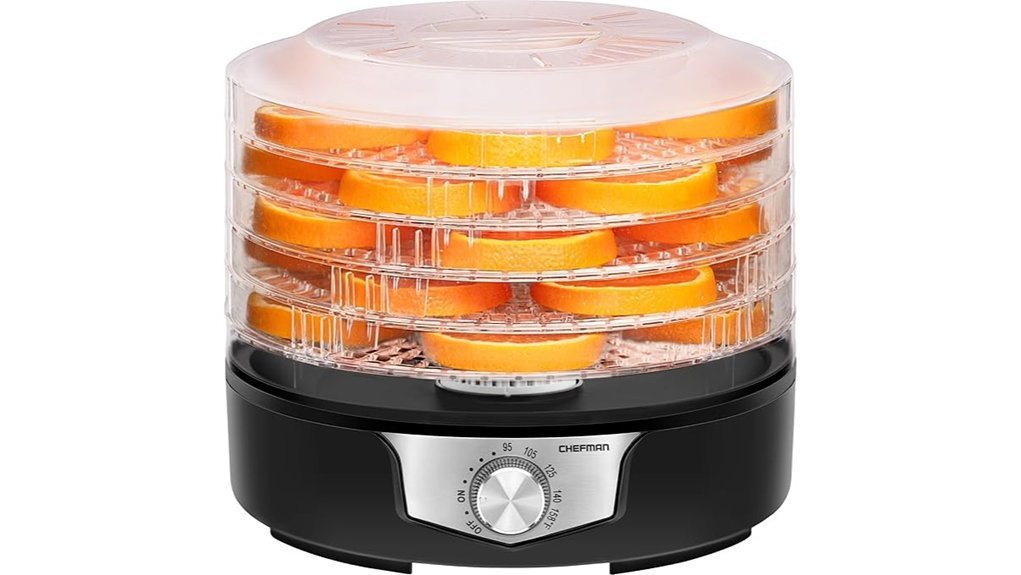
Best for Simple Dial Controls: A straightforward five-tray model for users who prefer a basic temperature dial instead of digital programming.
The Chefman 5-Tray Food Dehydrator uses five adjustable-height trays and a simple dial that controls both power and temperature. The applicable Chefman manual specifies a range of 95°F to 158°F. This makes it suitable for many fruit, vegetable, and herb-drying directions, but it does not provide the higher maximum temperature originally claimed in this article.
This model does not have a built-in timer. The manual also says not to operate it for more than 20 hours during one session and to let it cool before starting another cycle. Fruit on the bottom level will generally receive warmer, drier air, so periodically moving the lower tray toward the top can improve consistency. The trays and lid should be hand-washed rather than placed in a dishwasher.
Why You’ll Like It
- The dial provides uncomplicated temperature adjustment.
- Adjustable tray height creates more clearance for thicker pieces.
- The five-tray stack is suitable for modest household batches.
Who Should Buy This: Occasional users who prefer simple manual controls and do not need a programmed timer.
Who Should Avoid This: Shoppers who need automatic shutoff, dishwasher-safe trays, or unattended timed cycles.
Pros:
- Simple operation: A single dial controls the heater, fan, and temperature.
- Adjustable spacing: Tray height can be changed for different fruit thicknesses.
- Compact capacity: Five trays are manageable for small and medium batches.
Cons:
- No built-in timer: You must monitor the cycle or use a separate reminder.
- Operating limit: The manual limits one continuous session to 20 hours.
- More maintenance: Trays require hand-washing, and periodic tray rotation is recommended.
OSTBA Food Dehydrator with 5 Stainless Steel Trays
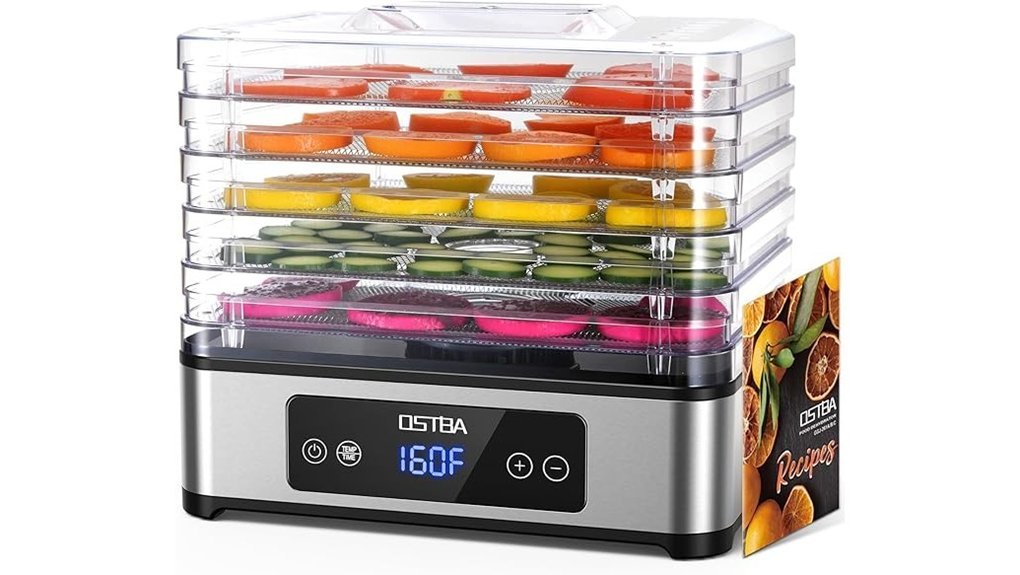
Best for Long Timed Cycles: A compact 400-watt model with five stainless steel trays and a timer of up to 48 hours.
The OSTBA Food Dehydrator offers five stainless steel trays, a 95°F to 160°F adjustable temperature range, and a 1-to-48-hour timer. Its compact body suits a smaller kitchen, while the 400-watt heating system provides useful power for routine fruit-drying sessions.
The adjustable trays can be repositioned to create more room for thicker ingredients. They are removable and dishwasher safe, which helps after drying sugary or sticky produce. OSTBA advertises circulating airflow for consistent drying, but fruit thickness, ripeness, room humidity, and loading can still affect results. Inspect pieces from several tray levels before ending the cycle.
Why You’ll Like It
- A 48-hour timer supports overnight and extended drying sessions.
- Stainless steel trays are removable and dishwasher safe.
- Adjustable tray spacing provides additional room for thicker fruit pieces.
Who Should Buy This: Users who want a compact stainless-tray machine with a long digital timer.
Who Should Avoid This: Anyone needing more than five included trays or a large front-loading cabinet.
Pros:
- Flexible controls: Adjustable heat and a 1-to-48-hour timer.
- Stainless steel trays: Durable, removable, and dishwasher safe.
- Compact build: Easier to store than a full-size cabinet dehydrator.
Cons:
- Limited capacity: Five trays may not handle a large harvest in one cycle.
- Stacked loading: Accessing a lower tray requires lifting the trays above it.
- Batch checks still matter: Circulating-air claims do not eliminate the need to inspect fruit for doneness.
Factors to Consider When Choosing a Food Dehydrator for Fruit
A good fruit dehydrator should provide controlled heat, steady airflow, enough usable tray area, and practical cleanup. Focus on the features that affect drying consistency and everyday convenience rather than choosing only by wattage or tray count.
1. Temperature Range and Control
Different fruits, slice sizes, and tested recipes can call for different settings, so an adjustable thermostat is more useful than a fixed-temperature machine. Many home-preservation directions finish fruit at approximately 135°F to 140°F, sometimes after beginning at a slightly higher setting when surface moisture is present. Follow the appliance manual and a tested fruit-specific recipe. Excessive heat can harden the outside before moisture escapes from the center.
2. Airflow Design
Food dehydrators generally use vertical or horizontal airflow. Compact stackable models usually move warm air upward through the trays. They save space, but fruit on some levels may dry faster than fruit on others. Horizontal-flow cabinet machines tend to distribute air more evenly but are usually larger and more expensive. With either design, leave space between pieces and inspect fruit from several tray positions.
3. Tray Capacity and Spacing
Five trays can be enough for snacks, weekly meal preparation, and small garden harvests. Real capacity also depends on tray diameter, shape, center openings, mesh spacing, and the amount of clearance between levels. Thin apple or banana slices need little height, while halved fruits, thick wedges, or raised fruit-leather sheets may need additional space.
4. Timer, Auto Shutoff, and Run Limits
Fruit often needs several hours to dry, and the exact time changes with thickness, moisture content, room humidity, and airflow. A timer with automatic shutoff reduces the need to watch the clock continuously. However, the timer setting does not override the operating limits in the manual. A model without a timer may still work well, but it requires a separate reminder and more active supervision.
5. Tray Material and Cleaning
Both food-safe plastic and stainless steel trays can work well. Stainless steel is sturdy and resists staining, while clear or light-colored plastic may make the batch easier to inspect. Do not assume removable trays are dishwasher safe. Check the manual, because some trays must be washed by hand. Never immerse the electrical base in water.
6. Fruit-Leather Accessories
Standard mesh trays cannot hold fruit purée. To make fruit leather, use a compatible solid liner or fruit-roll sheet. Check what is included and whether correctly sized accessories are available before buying. Do not cover the entire airflow path with improvised materials that are not approved for the appliance.
7. Counter Space and Storage
Measure the counter and storage area before ordering. Stackable five-tray machines are easier to store than wide cabinet models, but they still need clearance around their air intake and exhaust. Place the appliance on a dry, level, heat-resistant surface and follow the spacing instructions in its manual.
8. Warranty and Product Support
A clear manual, accessible support, replacement trays, and a written warranty can be more valuable than a long marketing feature list. Confirm current warranty terms on the manufacturer or retailer page because coverage can vary by seller, region, and product version.
9. Model Number and Listing Verification
Amazon titles and variations can change over time. Before ordering, compare the ASIN, model number, tray material, temperature range, timer, voltage, dimensions, and included accessories with the manufacturer manual. Do not assume every color or size variation has identical specifications.
How to Get Better Results When Drying Fruit
Food-preservation note: Use tested fruit-specific instructions from a trusted source such as the National Center for Home Food Preservation. Its guidance also explains how to condition and store dried fruit safely.
- Wash fruit and remove bruised, moldy, or spoiled areas.
- Slice pieces to a consistent thickness so they finish at a similar time.
- Arrange fruit in a single layer without overlapping pieces.
- Use a tested recipe for pretreatment, temperature, and doneness.
- Check fruit on several tray levels rather than relying only on the timer.
- Cool dried fruit completely before packaging so trapped heat does not create condensation.
- Condition cooled fruit in loosely packed, sealed glass or plastic jars for 7 to 10 days.
- Shake the conditioning jars daily and return the fruit to the dehydrator if condensation appears.
- Store finished fruit in clean, dry, airtight containers in a cool, dark place.
- Discard dried fruit if mold develops.
Frequently Asked Questions
Is a Food Dehydrator the Same as a Room Dehumidifier?
No. A food dehydrator uses controlled heat and airflow directly around food arranged on trays. A room dehumidifier is designed to remove moisture from indoor air and is not a food-preparation appliance. Use equipment specifically designed for food dehydration.
What Temperature Should I Use for Drying Fruit?
Many tested directions finish fruit at approximately 135°F to 140°F, although some begin slightly higher when the fruit has surface moisture. The correct setting depends on the fruit, slice thickness, pretreatment, and appliance. Follow a tested fruit-specific recipe and the dehydrator manual rather than applying one setting to every batch.
How Long Does Fruit Take to Dehydrate?
Drying time varies widely. Thin slices, lower-moisture fruit, strong airflow, and low room humidity can shorten a cycle. Thick pieces, full trays, and humid conditions can extend it. Use the estimated time as a starting point, then test several cooled pieces from different tray levels.
How Do I Know When Dried Fruit Is Done?
Properly dried fruit is usually pliable or leathery rather than wet. Cool several pieces before checking them because warm fruit feels softer and moister. Cut the pieces open and look for visible moisture. No liquid should squeeze from the center. If condensation appears during conditioning, dry the fruit longer.
Do I Need to Rotate the Trays?
It depends on the airflow design and how evenly the batch is loaded. If fruit on one level is drying faster, move lower trays upward and upper trays downward. The Chefman manual specifically recommends periodic rotation. Uniform slices, open spacing, and avoiding overloaded trays also improve consistency.
Is a Built-In Timer Necessary?
No, but it is convenient. A timer can stop the heater after a selected period, while a model without one requires a separate alarm and closer supervision. In either case, inspect the fruit for doneness and follow the maximum continuous operating time in the appliance manual.
How Should I Store Dehydrated Fruit?
Cool the fruit completely, condition it for 7 to 10 days, and pack it in clean, dry, airtight containers. Store the containers in a cool, dry, dark area. Check periodically for condensation or moisture. Redry fruit if condensation appears during conditioning, and discard any fruit that develops mold.
Conclusion
The COSORI Food Dehydrator Machine with 5 Trays is the best starting point for most households because it combines precise adjustable heat, a 48-hour timer, dishwasher-safe trays, and beginner-friendly controls. Choose the Magic Mill when compact storage and stainless steel trays matter most, the Chefman when you prefer uncomplicated dial controls and do not need a built-in timer, or the OSTBA when stainless steel trays and a 48-hour timer are your main priorities.
Whichever model you choose, consistent slicing, open tray spacing, fruit-specific temperature guidance, regular doneness checks, and proper conditioning after drying will have a major effect on the final result. Match the appliance to your typical batch size and cleaning preferences rather than selecting only by wattage or headline tray count.
Final recommendation
Start with the COSORI for the most balanced combination of controls and convenience. Pick Magic Mill or OSTBA when stainless steel trays are a priority, and choose Chefman only when simple manual operation matters more than automatic timing or dishwasher-safe cleanup.