Affiliate Disclosure: As an Amazon Associate I earn from qualifying purchases. When you buy through links in this article, we may earn a small commission at no extra cost to you. Product features and package contents can change, so confirm the exact model and current listing before ordering.
If you need reliable humidity control in a basement, bedroom, laundry room, or home office, the YTE PRO DH1800S and the hOmeLabs HME0088 are two popular portable home dehumidifiers that take very different approaches. The YTE PRO DH1800S advertises a higher 34-pint daily capacity in a compact body with simple onboard controls, while the hOmeLabs HME0088 delivers ENERGY STAR certification, Wi-Fi and voice-assistant controls, a nearly twice-as-large 1-gallon water tank, and a coverage rating up to 3,500 square feet. Both models support continuous gravity drainage and include a drain hose in the box, making your choice come down to tank capacity, test-rating standards, smart convenience, and room layout.
Quick Verdict
Choose the YTE PRO DH1800S if you want a compact, easy-to-move dehumidifier with simple push-button controls, a 34-pint listed capacity, and an included 6.56-foot drain hose for spaces up to 2,500 square feet. Choose the hOmeLabs HME0088 if you want verified Wi-Fi and voice control, ENERGY STAR efficiency, a larger 1-gallon (8-pint) water tank that requires fewer trips to the sink, and a model rated for spaces up to 3,500 square feet. Keep in mind that both rely on gravity drainage—meaning your floor drain must sit below the hose outlet—and square-foot ratings are manufacturer estimates rather than guaranteed whole-home performance.
Key Takeaways
- Capacity vs. test standards: The YTE PRO lists a higher 34-pint figure, whereas the hOmeLabs HME0088 carries a 25-pint rating backed by ENERGY STAR certification and a larger 3,500 sq. ft. coverage estimate.
- Bucket size matters for manual emptying: The hOmeLabs 1-gallon (8-pint) tank holds nearly twice as much water as the YTE PRO’s 2-liter (4.2-pint) tank.
- Smart vs. manual controls: Only the hOmeLabs HME0088 offers Wi-Fi app monitoring plus Alexa and Google Assistant compatibility.
- Drainage setup: Both models include a drain hose for continuous gravity drainage, but neither includes an internal condensate pump for upward draining.
Quick Comparison
| Model | Listed Capacity | Listed Coverage | Tank Size | Drain Hose | Smart Control | Best For | Amazon |
|---|---|---|---|---|---|---|---|
| YTE PRO DH1800S | 34 pints per day (manufacturer listed) | Up to 2,500 sq. ft. | 2 liters (~0.53 gal / 4.2 pints) | Included (6.56 ft.) | No verified Wi-Fi control | Compact footprint, simple controls, and continuous hose drainage | Check Price on Amazon |
| hOmeLabs HME0088 | 25 pints per day (ENERGY STAR) | Up to 3,500 sq. ft. | 1 gallon (3.79 L / 8 pints) | Included | Wi-Fi app, Alexa, and Google Assistant | Remote monitoring, ENERGY STAR efficiency, and fewer tank emptyings | Check Price on Amazon |
Important note on pint ratings: Why does a 25-pint hOmeLabs unit list a larger square-foot coverage (3,500 sq. ft.) and a larger tank than a 34-pint YTE PRO unit (2,500 sq. ft.)? ENERGY STAR certified dehumidifiers use the U.S. Department of Energy (DOE) test standard at 65°F and 60% relative humidity, whereas non-ENERGY STAR listings frequently advertise maximum capacity measured under much warmer saturation conditions (such as 86°F and 80% RH). Always weigh tank size, ENERGY STAR certification, and room layout alongside the headline pint number.
YTE PRO 34-Pint Dehumidifier for 2,500 Sq. Ft. Spaces
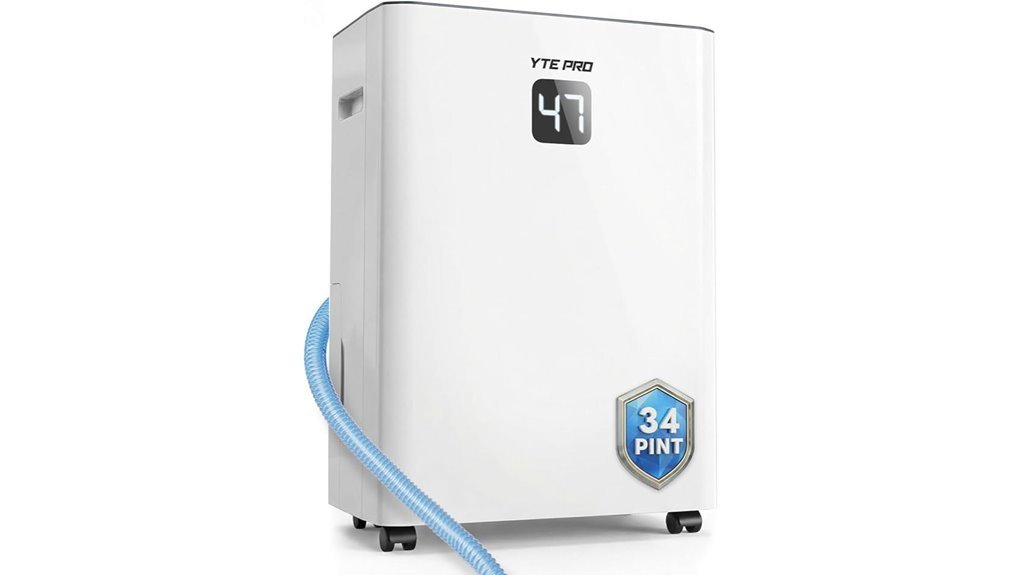
Best for Simple Controls and Hose Drainage: The YTE PRO DH1800S is a portable compressor dehumidifier listed for residential areas up to 2,500 square feet. With a listed capacity of up to 34 pints per day, it is built for damp bedrooms, home offices, laundry rooms, and finished basements where miniature Peltier (thermoelectric) desktop units fail to make a dent in indoor humidity.
The unit houses a 2-liter (approximately 0.53-gallon or 4.2-pint) removable water tank. Because a 4.2-pint bucket will fill quickly during peak summer humidity—up to several times a day in a damp room—the included 6.56-foot drain hose is a major practical advantage. Connecting the hose for continuous gravity drainage lets the appliance run uninterrupted over a floor drain or sump basin without manual bucket trips.
Onboard operation is straightforward: a front-facing LED display shows real-time humidity readouts, while three operating modes and two fan speeds let you balance moisture extraction against fan noise. Additional convenience features include a 24-hour timer, automatic full-tank shutoff, automatic defrost, a washable air filter, 360-degree caster wheels, and an integrated carry handle. The manufacturer rates noise as low as 40 dB, though real-world sound levels will rise on high fan speed or on hard basement floors.
Why You May Like It
- No app setup or Wi-Fi pairing required—just plug it in and set your target humidity on the LED panel.
- Includes a 6.56-foot drain hose in the box so you can set up continuous gravity drainage immediately.
- Compact footprint with caster wheels and a built-in handle makes room-to-room movement effortless.
Who Should Buy This: Shoppers who want a compact, straightforward compressor dehumidifier with an included 6.56-foot drain hose for a bedroom, laundry room, or medium basement with a nearby floor drain.
Who Should Avoid This: Shoppers who plan to empty the water bucket manually in a very damp space (where the 4.2-pint tank will fill frequently), or anyone who wants smartphone monitoring and ENERGY STAR certification.
Pros:
- Listed 34-pint daily capacity for spaces up to 2,500 square feet.
- Supports both manual bucket collection and continuous gravity drainage.
- Includes a 6.56-foot drain hose right in the box.
- Equipped with a 24-hour timer, automatic defrost, full-tank shutoff, and a washable filter.
- Smooth caster wheels and an integrated handle simplify moving it between rooms.
Cons:
- Small 2-liter (4.2-pint) tank requires frequent emptying if you do not use the drain hose.
- No Wi-Fi app or voice-assistant compatibility.
- Not ENERGY STAR certified, and the 34-pint figure reflects manufacturer test conditions rather than verified DOE 65°F ratings.
- Gravity drainage requires a continuous downward slope to a drain below the unit’s outlet.
Before You Buy: Because the 2-liter bucket holds only 4.2 pints of water, confirm that you have a floor drain, low sink, or sump pit below the dehumidifier outlet if you want hands-off operation in a damp basement.
hOmeLabs 25-Pint Wi-Fi Dehumidifier for 3,500 Sq. Ft. Spaces
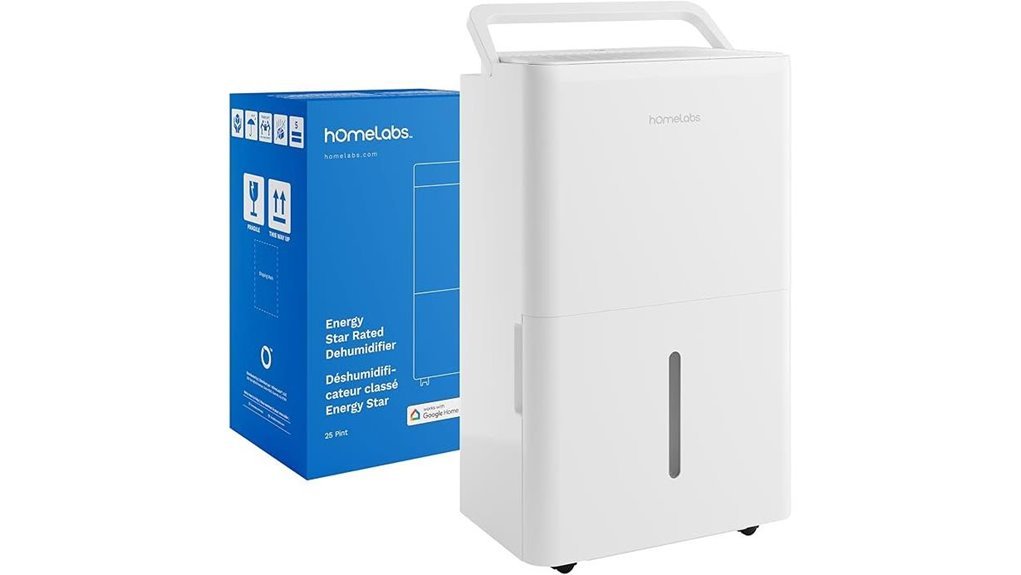
Best for Smart Control, Efficiency, and a Larger Tank: The hOmeLabs HME0088 is an ENERGY STAR certified 25-pint Wi-Fi dehumidifier rated for residential spaces up to 3,500 square feet. Its 1-gallon (8-pint / 3.79-liter) removable water tank holds nearly double the volume of the YTE PRO’s 2-liter bucket, cutting your trips to the sink roughly in half when you rely on manual water collection.
Everyday features include an adjustable digital humidistat, automatic defrost, full-bucket shutoff with alert, a programmable timer, a washable air filter, caster wheels, and integrated side handles. Because dehumidifiers often run for eight to twelve hours a day during muggy summer months, its ENERGY STAR certification is a meaningful advantage for keeping electricity bills under control.
What truly separates the HME0088 is its built-in Wi-Fi connectivity. Using a compatible smartphone app—along with supported Amazon Alexa and Google Assistant voice commands—you can check current basement humidity, change target percentages, switch modes, or see if the water bucket is full without walking downstairs.
When you prefer hands-off operation, the HME0088 also includes a continuous drain hose. Like the YTE PRO, it uses gravity drainage, so the hose must run steadily downward to a floor drain without kinks or upward loops.
Why You May Like It
- The 1-gallon (8-pint) tank holds nearly twice as much water as the YTE PRO’s 2-liter tank, reducing manual emptying frequency.
- Wi-Fi smartphone app plus Alexa and Google Assistant support let you monitor basement or crawl-space humidity remotely.
- ENERGY STAR certification helps lower long-term electricity costs during humid seasons.
- Includes a drain hose in the box for continuous gravity drainage.
Who Should Buy This: Homeowners who want remote app monitoring for a basement or multi-room space, fewer manual bucket emptyings thanks to the 1-gallon tank, and verified ENERGY STAR efficiency.
Who Should Avoid This: Buyers who need a built-in condensate pump to push water uphill into a utility sink, or shoppers who strictly want a basic non-Wi-Fi appliance.
Pros:
- Rated for larger residential areas up to 3,500 square feet.
- Generous 1-gallon (8-pint) removable water tank reduces manual emptying trips.
- Built-in Wi-Fi allows remote monitoring and control via smartphone app.
- Compatible with Amazon Alexa and Google Assistant voice commands.
- ENERGY STAR certified for lower seasonal power consumption.
- Includes a continuous drain hose, auto defrost, auto shutoff, timer, and washable filter.
Cons:
- 25-pint rating appears lower on paper than the YTE PRO’s 34-pint claim (though tested under stricter ENERGY STAR / DOE standards).
- Relies on gravity drainage; no internal condensate pump is included.
- Smart features require a compatible Wi-Fi network (typically 2.4 GHz) and initial app setup.
Smart Setup Note: Most smart home appliances require a 2.4 GHz Wi-Fi band during initial pairing. Also double-check that variation HME0088 (the Wi-Fi model) is selected on the Amazon product page before adding it to your cart.
YTE PRO DH1800S vs. hOmeLabs HME0088: Head-to-Head Breakdown
While both appliances are portable compressor dehumidifiers that come with a gravity drain hose, they differ significantly in daily usability. Here is how they stack up across the five factors that matter most in everyday home use.
1. Moisture Removal & Coverage Ratings
At first glance, the YTE PRO DH1800S looks stronger with its 34-pint listing compared to the hOmeLabs HME0088 at 25 pints per day. However, the hOmeLabs unit is rated for up to 3,500 square feet (versus 2,500 square feet for the YTE PRO) and carries ENERGY STAR certification. Under current U.S. Department of Energy (DOE) standards, a 25-pint ENERGY STAR dehumidifier is tested at a cooler 65°F and 60% relative humidity—roughly equivalent to a 35-to-40-pint dehumidifier under older 80°F ratings. Non-ENERGY STAR units frequently advertise their maximum moisture extraction under warm, saturated conditions (such as 86°F and 80% RH). For real-world basement conditions, the hOmeLabs HME0088 is every bit as capable as—and often more consistent than—budget models advertising higher saturation pint numbers.
2. Water Tank Size & Emptying Frequency
If you cannot use a floor drain, bucket size dictates how often you have to babysit your dehumidifier:
- YTE PRO DH1800S (2 Liters / ~4.2 Pints): At full moisture extraction, a 4.2-pint bucket can fill up 4 to 8 times per day. It is lightweight to carry, but inconvenient for manual emptying in a very damp room.
- hOmeLabs HME0088 (1 Gallon / 8 Pints): Holding 3.79 liters, this tank is 89% larger than the YTE PRO bucket. At 25 pints per day, it requires roughly 3 emptyings per 24 hours under maximum load.
Winner: hOmeLabs HME0088 by a wide margin for manual bucket collection; Tie if you connect the included continuous drain hose on either unit.
3. Controls & Remote Monitoring
The YTE PRO DH1800S keeps things strictly manual with an onboard LED display, three operating modes, two fan speeds, and a 24-hour timer. That simplicity is great if you keep the unit in a living area and dislike smartphone apps. The hOmeLabs HME0088 adds Wi-Fi app control plus Alexa and Google Assistant voice integration, allowing you to see when the bucket is full or adjust humidity targets from upstairs or away from home.
Winner: hOmeLabs HME0088 for basements and out-of-sight rooms; YTE PRO DH1800S for buyers who prefer simple, non-connected controls.
4. Energy Efficiency & Running Costs
Compressor dehumidifiers often run for hundreds of hours each summer. The hOmeLabs HME0088 is ENERGY STAR certified, meaning it removes more moisture per kilowatt-hour of electricity consumed than standard non-certified models. Over multiple humid seasons, those energy savings can easily offset a difference in upfront purchase price.
Winner: hOmeLabs HME0088.
| Use Case / Buyer Priority | Recommended Pick | Why It Wins |
|---|---|---|
| Manual Bucket Emptying (No Floor Drain) | hOmeLabs HME0088 | 1-gallon (8-pint) tank holds nearly twice as much water as the YTE PRO’s 2-liter (4.2-pint) tank. |
| Basement or Remote Monitoring | hOmeLabs HME0088 | Wi-Fi app alerts and voice-assistant support save you trips downstairs to check the bucket. |
| Lower Seasonal Electric Bills | hOmeLabs HME0088 | Verified ENERGY STAR certification reduces power draw during continuous summer operation. |
| Simple Controls With a Floor Drain Nearby | YTE PRO DH1800S | No Wi-Fi setup needed, compact body, and includes a 6.56-foot hose that bypasses the small 2L tank. |
When Neither Model Is the Right Fit
Before ordering either unit, check two common residential scenarios where a different type of dehumidifier is required:
- You need to drain water upward into a utility sink or window: Because both the YTE PRO DH1800S and hOmeLabs HME0088 rely on gravity drainage, neither can push water uphill. Either connect a separate external condensate pump to their drain hose or choose a dehumidifier with a built-in pump.
- Your space regularly drops below 41°F (5°C): Unheated winter garages, crawl spaces, and seasonal cabins are too cold for standard compressor coils, which ice over in near-freezing air. In spaces consistently below 41°F to 50°F, look for a desiccant dehumidifier instead.
Factors to Consider When Choosing a Home Dehumidifier
A good dehumidifier should match both the square footage of your space and the severity of the moisture problem. Compare the standardized pint rating, drainage method, tank capacity, operating temperature, noise level, and energy efficiency instead of relying on a single square-foot number.
Room Size and Layout
Start by measuring the area where the dehumidifier will operate, treating the advertised coverage rating as an upper estimate under ideal open-room conditions. A single open basement is much easier to dry out than several closed rooms with the same total square footage. Interior walls, closed doors, stairways, ceiling height, and ongoing dampness all restrict airflow.
For divided layouts, place the dehumidifier in the dampest central room and keep interior doors open when possible, rather than expecting one portable unit to pull moisture through closed doorways.
Moisture Removal Capacity
Moisture-removal capacity is measured in pints of water removed per 24 hours. However, always check the test standard behind the number. Under current U.S. Department of Energy (DOE) test procedures, dehumidifiers are tested at 65°F and 60% relative humidity to reflect cooler basement conditions. Older standards (80°F / 60% RH) and maximum saturation ratings (86°F / 80% RH) produce much higher pint numbers for the exact same compressor size.
According to the U.S. Environmental Protection Agency (EPA), keeping indoor relative humidity between 30% and 50% (and always below 60%) helps prevent mold growth, musty odors, and dust mites without overworking the appliance.
Continuous Drainage Setup
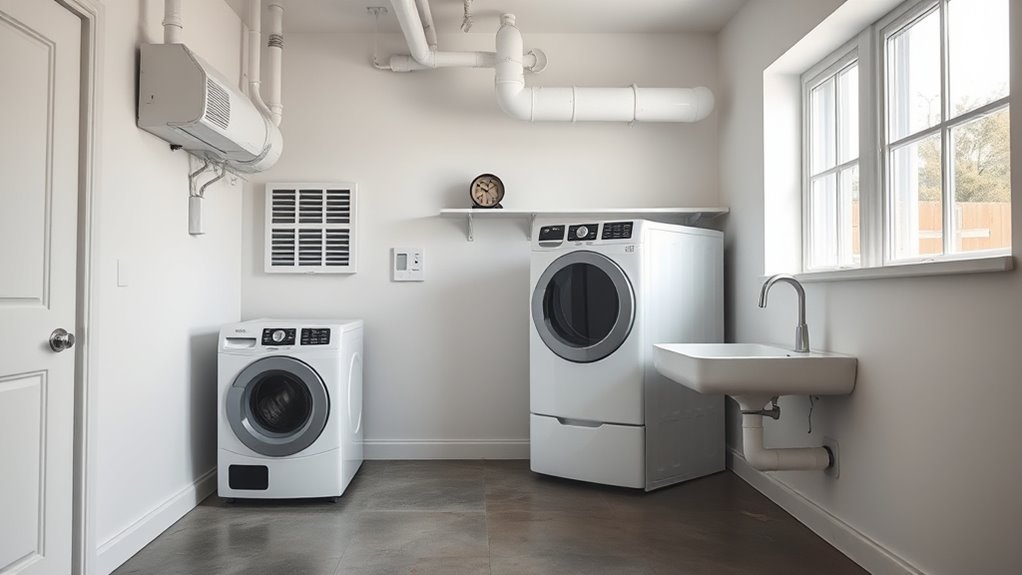
Continuous drainage eliminates daily bucket emptying, but most portable dehumidifiers rely solely on gravity. The drain hose must slope steadily downward from the appliance outlet to a floor drain or sump pit with no upward loops, kinks, or flat traps where water can back up. If your only available drain is an elevated laundry sink or basement window, you will need either a dehumidifier with a built-in condensate pump or an external condensate pump placed on the floor next to the unit.
Tank Size and Auto Shutoff
Remember that 1 US gallon equals 8 pints (3.79 liters). A larger 1-gallon tank means half as many trips to the sink as a 2-liter (4.2-pint) tank, though a full gallon of water adds roughly 8.3 pounds of weight when you carry it. If you plan to empty the bucket manually, look for a sturdy carry handle, a splash guard cover, a clear water-level window, and a reliable full-tank float switch with an audible alert.
Noise Level and Placement
Compressor dehumidifiers generate both airflow noise from the fan and a low hum from the refrigeration compressor. Use the low fan setting in bedrooms, nurseries, or home offices where quiet operation matters (~40 to 45 dB), and switch to high fan speed in basements or laundry rooms for faster moisture extraction.
Set the unit on a firm, level floor and leave at least 8 to 12 inches of clearance around the air intake and exhaust grilles so airflow is never restricted. Uneven floorboards or contact with drywall can amplify normal compressor vibration.
Cold-Room Operation
Standard compressor dehumidifiers extract moisture by drawing humid air across cold evaporator coils. When room temperature drops below 65°F (18°C), moisture removal slows down and frost can form on the coils. Automatic defrost temporarily cycles the compressor off while running the fan to melt frost buildup, but most residential compressor units stop working effectively below 41°F (5°C). Check the owner’s manual before placing a compressor dehumidifier in an unheated winter basement or garage.
Energy Efficiency
Because a dehumidifier can run for many hours every day from late spring through early fall, electricity consumption adds up quickly. ENERGY STAR certified models use more efficient compressors and fans to extract the same amount of moisture with less electricity.
You can also cut operating costs through smart habits: set your humidistat between 45% and 50% RH (setting it to 30% forces the compressor to run nonstop), keep exterior basement windows closed on humid days, and rinse the air filter regularly so the fan does not have to fight clogged mesh.
Controls and Maintenance
Look for practical everyday controls: a digital adjustable humidistat, programmable timer, auto-restart after power outages (crucial for unattended basements), full-tank indicator, multiple fan speeds, and automatic defrost. If you want remote status alerts on your phone, choose a Wi-Fi-equipped model like the hOmeLabs HME0088; if you prefer zero app setup, an onboard control panel like the YTE PRO DH1800S is simpler.
For routine maintenance, unplug the unit, inspect and rinse the washable air filter every two to four weeks, let the filter air-dry completely before reinstalling it, wash the collection bucket with mild soap and warm water to prevent slimy biofilm buildup, and check the gravity drain hose periodically for algae or kinks.
Before You Buy Checklist
- Measure the square footage and note whether the layout is an open basement or divided rooms.
- Identify whether indoor humidity is mild (55%–60% RH) or severe (above 65% RH with damp smells).
- Decide between manual tank emptying (favor a 1-gallon+ tank) and continuous hose drainage.
- Verify that a floor drain sits lower than the dehumidifier outlet for gravity drainage.
- Check that room temperatures stay above the unit’s minimum threshold (typically 41°F–65°F).
- Leave 8 to 12 inches of open airflow clearance around the intake and exhaust vents.
- Compare ENERGY STAR certification and smart Wi-Fi controls against upfront price.
- Fix active plumbing leaks, gutter overflow, or foundation seepage alongside running a dehumidifier.
Frequently Asked Questions
Which of These Two Dehumidifiers Is Better?
For most homeowners, the hOmeLabs HME0088 is the more versatile all-around choice because its 1-gallon (8-pint) tank requires half as many manual emptyings, its ENERGY STAR certification lowers running costs, and its Wi-Fi app lets you monitor basement humidity remotely. The YTE PRO DH1800S is the better pick if you want simple non-Wi-Fi controls, a compact body, and plan to use the included 6.56-foot gravity drain hose to bypass its smaller 2-liter (4.2-pint) bucket.
Can These Dehumidifiers Run Without Manual Emptying?
Yes. Both the YTE PRO DH1800S and the hOmeLabs HME0088 support continuous gravity drainage and include a drain hose in the box. Because neither unit has a built-in condensate pump, the hose must run on a continuous downward slope to a floor drain or sump pit located below the dehumidifier’s drain outlet.
Does the hOmeLabs HME0088 Have Wi-Fi?
Yes. The hOmeLabs HME0088 is the Wi-Fi-enabled variation, offering smartphone app monitoring and control as well as compatibility with Amazon Alexa and Google Assistant. Always verify that model number HME0088 is selected before checking out, as marketplace pages often group non-Wi-Fi variations on the same listing.
Are Square-Foot Coverage Ratings Guaranteed?
No. Advertised coverage ratings (such as 2,500 or 3,500 square feet) are manufacturer estimates based on an open floor plan with moderate humidity. Starting humidity levels, room temperature, ceiling height, closed interior doors, airflow obstructions, and damp concrete foundations all affect how much area a single portable unit can effectively dry.
How Often Should I Clean the Filter?
Inspect the air filter every two to four weeks during active seasonal use and clean it according to the owner’s manual—or more frequently if you have shedding pets or a dusty basement. Rinse the washable mesh with warm water and let it air-dry completely before reinstalling it so dampness does not restrict airflow.
Will a Dehumidifier Work in a Cold Basement?
Compressor dehumidifiers work best above 65°F and lose moisture-removal efficiency as temperatures drop. Both models include automatic defrost to melt light frost on the coils in cool basements, but standard compressor units generally stop extracting water effectively below 41°F (5°C).
Does a Dehumidifier Fix Mold or Water Leaks?
No. Keeping indoor humidity between 30% and 50% helps prevent new mold spores from thriving in damp air, but a dehumidifier cannot repair plumbing leaks, foundation cracks, or standing water, nor does it remove existing mold growth from surfaces. Always fix the source of water intrusion and clean existing mold properly.
Do I Need a Large Tank If I Use a Drain Hose?
No. When continuous gravity drainage is connected properly, water bypasses the removable bucket and flows straight into your floor drain. A larger tank (like the 1-gallon bucket on the hOmeLabs HME0088) matters primarily when you collect and empty water by hand.
Conclusion
Both of these portable dehumidifiers can tame damp indoor air, but they serve different household setups. The YTE PRO DH1800S pairs a 34-pint listed capacity with simple push-button controls and an included 6.56-foot drain hose for spaces up to 2,500 square feet—making it a straightforward option when you have a floor drain nearby to bypass its compact 2-liter (4.2-pint) tank. The hOmeLabs HME0088 justifies its place in larger or harder-to-reach rooms up to 3,500 square feet with a nearly twice-as-large 1-gallon (8-pint) tank, verified Wi-Fi and voice controls, ENERGY STAR efficiency, and an included drain hose.
Final Recommendation
Choose the YTE PRO DH1800S if you want simple onboard controls, a compact portable footprint, and plan to run the included 6.56-foot hose directly to a floor drain. Choose the hOmeLabs HME0088 if you empty the bucket by hand, want Wi-Fi alerts on your phone, or plan to run the unit daily and want ENERGY STAR electricity savings. Before ordering, confirm the exact model number in your Amazon cart and verify that your space has a downward drainage path if you intend to use the hose.