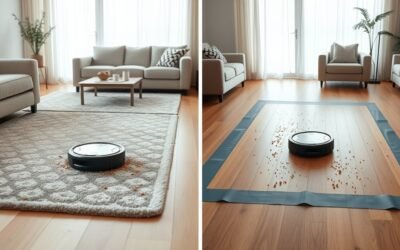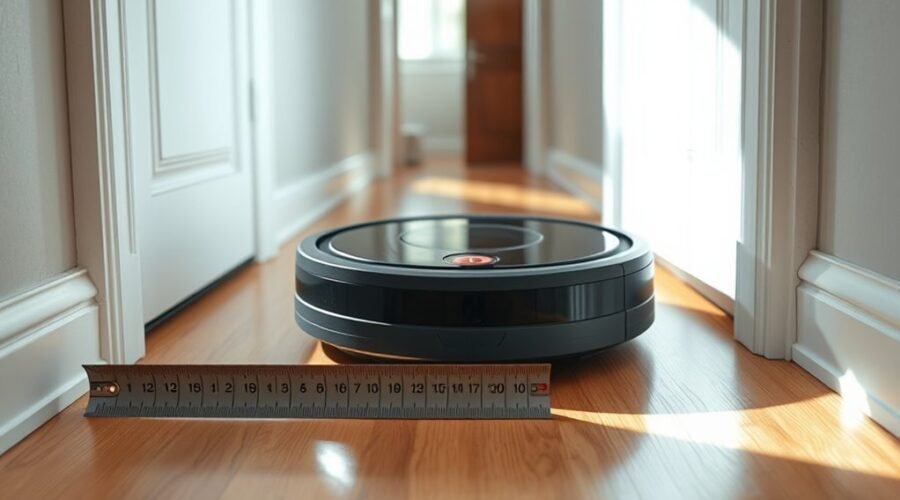
Robot vacuum performance often depends on one overlooked constraint: doorway width. A clear opening of at least 28 cm, with additional margin for height and protrusions, can determine whether a unit passes cleanly or stalls at the threshold. Furniture legs, raised strips, and narrow frames can all reduce usable access. The next step is to examine how to measure these limits accurately and identify the most common failure points.
What Doorway Width Do Robot Vacuums Need?
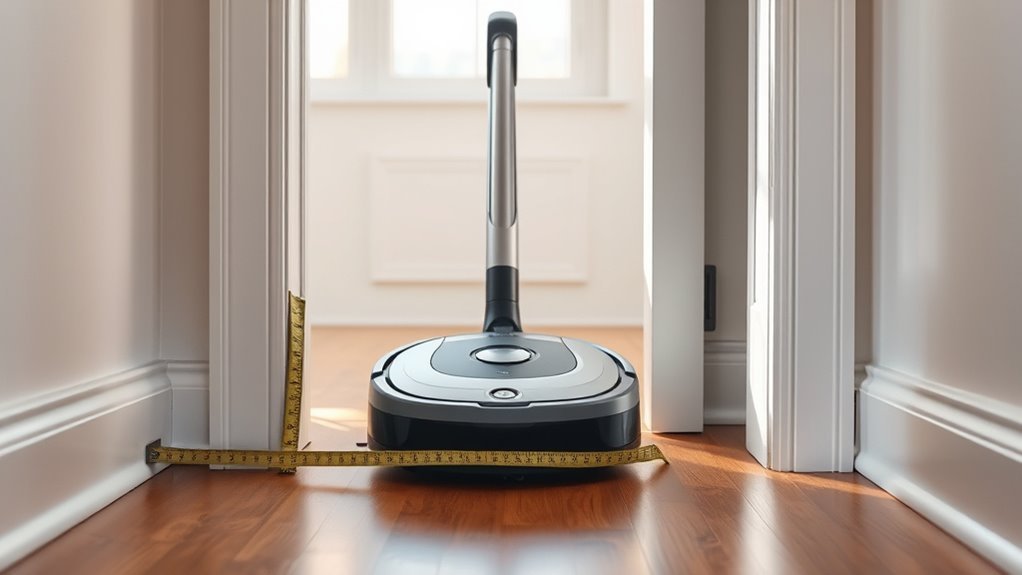
Most robot vacuums need a minimum doorway width of about 28 cm (11 inches) to pass through reliably, though wider openings improve maneuverability and reduce the risk of contact with door frames.
Most robot vacuums need about 28 cm of doorway width to pass through reliably, with wider openings improving maneuverability.
In practical terms, most homes provide 80–90 cm openings, which gives a robot vacuum adequate clearance for routine cleaning.
The decisive constraint is not only width but also body geometry: round units can be less effective in tight spaces, while D-shaped designs often track closer to edges.
A user should measure each doorway width where access is required, especially in older homes with irregular framing.
The threshold must also be examined, because a robot vacuum’s climbing capability is usually limited to 1.5–2 cm.
If the threshold exceeds that range, movement may stop, and cleaning becomes fragmented.
Proper clearance enables autonomous operation without intervention, supporting efficient, liberated household maintenance.
How Do You Measure Door Frames for Clearance?
How should clearance be verified before a robot vacuum enters a doorway? A measuring tape should be used to measure door frames at the narrowest width and full height, because dimensions govern navigation freedom. The Robot vacuum requires clearance that exceeds its body width, and vertical space should provide at least 0.2 inches, or 5 mm, above its height.
| Measurement | Target | Result |
|---|---|---|
| Width at narrowest point | Vacuum width + margin | Pass or fail |
| Height to top frame | Vacuum height + 5 mm | Pass or fail |
| Nearby obstacles | None within sweep path | Clear or restricted |
Additional protrusions, including handles and locks, should be recorded during inspection, since they may compress the effective opening. Regular checks near the doorway should note rugs or furniture, which can alter clearance without warning. This analytical routine gives the user measurable control over access, reducing dependence on guesswork and preserving movement through domestic space.
Which Doorway Obstructions Cause the Most Trouble?
Doorway obstructions most often create problems when they reduce the usable opening or block the vacuum’s path of travel. A Robot vacuum performs best when doorway widths remain near 28 inches, leaving margin beyond its body width for unobstructed transit.
The most disruptive obstructions are furniture legs, decorative objects, bags, shoes, and toys placed in the passage. These items force detours, trap the machine, or prevent access to cleaning areas entirely.
Raised thresholds also matter because they can exceed climbing limits, especially when paired with protruding moldings that narrow clearance. Low furniture positioned close to the opening can compress clear pathways and create dead zones where navigation becomes unreliable.
From a practical standpoint, liberation from repeated manual intervention depends on removing floor clutter and keeping edges open. Technical access is achieved not by force, but by maintaining stable, predictable geometry at every doorway.
How Do Robot Vacuum Size and Shape Affect Passage?
Vacuum body dimensions directly determine passage performance, since a robot around 13.8 inches in diameter can usually navigate narrow corridors and chair-leg clusters with less conflict.
A robot vacuum must also match doorway width; oversize housings reduce access even when motors are capable. Low-profile units, under 3.94 inches high, improve access beneath furniture and preserve movement freedom.
Shape matters as well: round bodies usually turn more easily, while D-shaped designs track edges and corners with greater precision. For users seeking liberated cleaning, this geometry affects whether every room remains reachable without manual intervention.
Round bodies turn with ease, while D-shaped designs trace edges and corners more precisely.
Ground clearance is equally important. Greater clearance improves traversal over high thresholds and uneven changes, reducing the chance of grounding.
In practice, size and shape form the primary constraints on route planning, more than suction ratings alone. A carefully chosen robot vacuum consequently expands access, minimizes hesitation at obstacles, and supports uninterrupted passage through varied domestic layouts.
How Can You Fix Tight Doorways Robot Vacuums Can’t Cross?
When a robot vacuum stalls at a doorway, the first corrective step is to measure the opening with a tape measure and verify that the clear passage is at least 13 inches wide, since most models need that margin for reliable movement.
If the doorway width is still inadequate, the effective opening should be audited for obstructions such as furniture, trims, or decorative objects that reduce clear access.
A robot vacuum with a slim profile, ideally under 3.94 inches high, may cross tighter spans with less restriction.
Where the geometry remains limiting, a threshold ramp can smooth the change, while a door frame extender or selective widening offers a more permanent correction.
Such adjustments restore autonomous home cleaning and reduce dependence on manual intervention.
Access should also be rechecked after renovations or new fixtures alter dimensions, because minor changes can block passage and compromise consistent navigation.
Frequently Asked Questions
How Much Clearance Does a Robot Vacuum Need?
A robot vacuum typically needs 3.94 inches of vertical clearance, 13.8 inches of floor width, and 12–20 inches near the dock. Cleaning efficiency depends on robot features, floor types, furniture arrangement, battery life, maintenance tips, navigation technology.
Can You Tell Robot Vacuum Areas Not to Go To?
Yes: virtual walls, no-go zones, and app-defined barriers can exclude areas. Through navigation systems, furniture placement, pet safety, carpet types, cleaning modes, and battery life, the robot vacuum avoids restricted spaces with precise, user-controlled mapping.
Can Robot Hoovers Go Over Door Thresholds?
Yes, many robot hoovers can cross door thresholds; success depends on threshold height, robot design, vacuum wheels, and floor types. Strong obstacle navigation preserves cleaning efficiency, while suction power matters less than chassis clearance.
How to Set Boundaries for a Robot Vacuum?
Forty-seven percent of smart-cleaning users report fewer missed spots after configuring Boundary settings. App controls, Room mapping, Virtual walls, Magnetic strips, Pet areas, and Furniture obstacles let the system chart precise limits, maximizing autonomous, liberated navigation.
Conclusion
In conclusion, a robot vacuum requires a clear doorway width of at least 28 cm, along with sufficient vertical clearance to accommodate its height plus a 5 mm margin. Accurate tape-measure checks, combined with inspection for thresholds, furniture legs, and other obstructions, provide the most reliable assessment. Doorways should be audited regularly, particularly after renovations. When clearance is verified, passage is as orderly as a key moving through a well-cut lock.