If you’re chemically sensitive, look for a dehumidifier with no fragrance or scent-diffuser feature, simple drainage, a washable filter, and a return policy that gives you time to check for odors. The two options below are full-size compressor dehumidifiers with adjustable humidity control and continuous-drain capability. However, neither listing provides independent VOC-emissions testing for the complete appliance, and no dehumidifier can be guaranteed suitable for every sensitive user. Unbox and test the unit in a ventilated area before using it in a bedroom or another regularly occupied space.
Quick Comparison
| Product | Best For | Moisture-Removal Claim | Tank and Drainage | Main Limitation |
|---|---|---|---|---|
| Waykar PD160B | Basements and larger rooms where verified energy efficiency matters | Manufacturer: up to 34 pints/day at 95°F and 90% RH; ENERGY STAR entry: 9.81 pints/day under its certification test | 2.5L (0.66-gallon) tank or included gravity-drain hose | No independent VOC-emissions or low-odor certification for the complete unit |
| Aiusevo AS280 | Bedrooms, laundry areas, and medium-size rooms where lower weight is useful | Manufacturer: up to 21 pints/day at 95°F and 90% RH | 2L tank or included 3.28-foot gravity-drain hose | The high-humidity capacity claim is not directly comparable with a standardized ENERGY STAR rating |
Waykar PD160B 34-Pint ENERGY STAR Dehumidifier with Hose
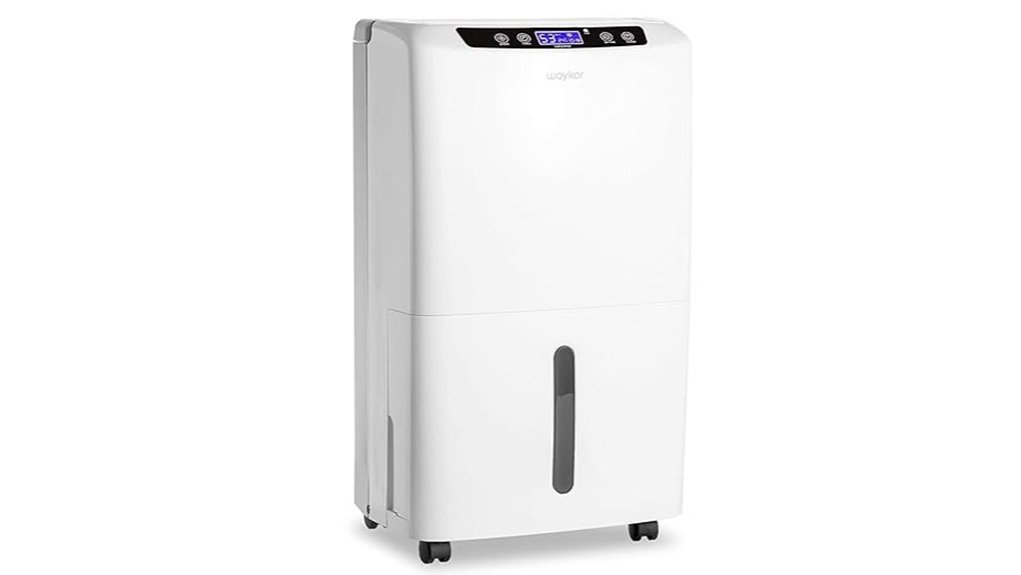
Best Overall for Larger Rooms: The Waykar PD160B is the strongest choice in this shortened list because it combines adjustable humidity control, dual drainage, a washable filter, and independently listed ENERGY STAR certification. The manufacturer advertises coverage up to 2,000 sq. ft. and up to 34 pints of moisture removal per day at 95°F and 90% relative humidity.
That 34-pint figure needs context. The official ENERGY STAR product entry for the PD160B lists a water-removal capacity of 9.81 pints per day under its certification test. Use the standardized figure when comparing it with other ENERGY STAR-certified models, and treat the 34-pint figure as a manufacturer result from much hotter and more humid conditions.
The unit provides a 30% to 80% humidity setting, two fan speeds, a 2.5L removable tank, continuous gravity drainage, automatic shutoff, automatic defrost, caster wheels, and carrying handles. The listing gives dimensions of 9 x 12.2 x 20.9 inches and a weight of about 28 pounds, so it is portable on one floor but not especially light for frequent stair carrying.
Best For: Basements, larger bedrooms, laundry areas, and living spaces with recurring humidity where a mini semiconductor unit would be too slow.
Who Should Avoid It: Buyers who require independently verified low-VOC materials, a very lightweight unit, or near-silent operation. The listing does not establish that the complete appliance is low-emission or odor-free.
Pros:
- ENERGY STAR certification is listed in the official product database.
- Adjustable 30% to 80% humidity range, two fan speeds, and manual 90-degree airflow direction.
- Includes a 2.5L tank, gravity-drain hose, washable filter, auto shutoff, and auto defrost.
- The listing states a one-year exchange warranty plus an additional year after registration.
Cons:
- The advertised 34-pint figure comes from 95°F and 90% RH conditions and should not be treated as a standardized room-performance result.
- At about 28 pounds, it is heavier than the Aiusevo AS280.
- The manual airflow adjustment is less convenient than an automatic swing system.
- No independent VOC-emissions or low-odor certification is stated for the complete appliance.
Aiusevo AS280 21-Pint Dehumidifier for Medium and Large Rooms
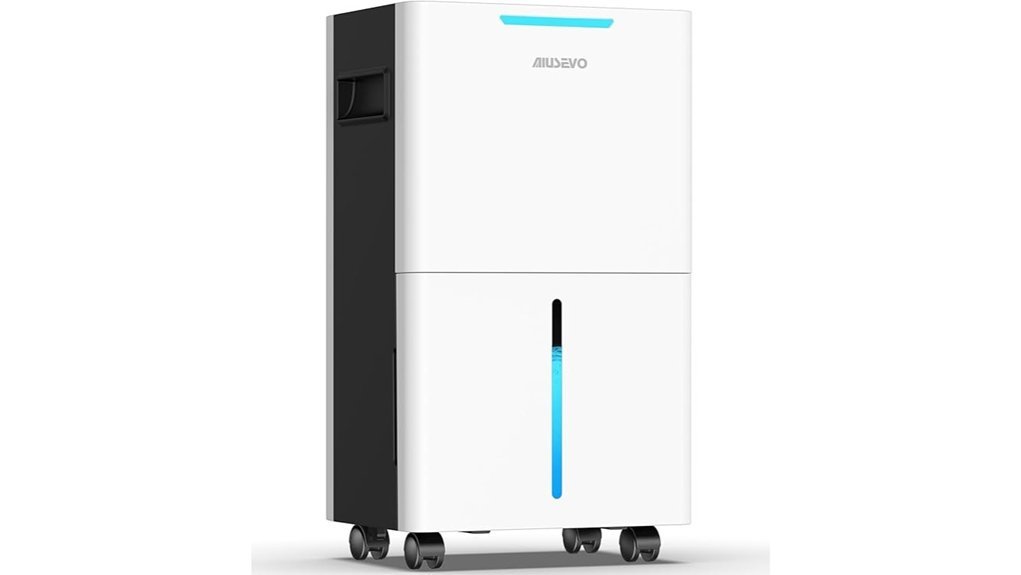
Best Lighter Full-Size Option: The Aiusevo AS280 is marketed for spaces up to 1,500 sq. ft. and is listed at about 17.6 pounds, making it easier to move than the Waykar. Its manufacturer-rated capacity is up to 21 pints per day at 95°F and 90% relative humidity, so the number should be read as a high-temperature, high-humidity claim rather than a standardized comparison with the Waykar’s ENERGY STAR result.
You can select DEHU, DRY, or CONTINUOUS mode and set the desired humidity from 30% to 80%. The 2L tank automatically stops the unit when full, while the included 3.28-foot hose supports continuous gravity drainage. A 24-hour timer, child lock, fan-speed control, wheels, carrying handles, washable filter, automatic restart, and automatic defrost add convenience.
Best For: Bedrooms, laundry rooms, bathrooms used with safe electrical placement, and medium-size living areas where portability matters.
Who Should Avoid It: Anyone who cannot set up gravity drainage and does not want to empty a 2L tank regularly, or anyone who requires verified low-emission materials.
Pros:
- Lower listed weight than the Waykar, with wheels and handles for easier repositioning.
- DEHU, DRY, and CONTINUOUS modes with adjustable 30% to 80% humidity control.
- Includes a 2L tank, 3.28-foot drain hose, washable filter, timer, child lock, and auto defrost.
Cons:
- The 21-pint claim is measured at 95°F and 90% RH and is not directly comparable with a standardized ENERGY STAR capacity.
- The 2L tank can require frequent emptying in a damp room.
- Compressor and fan noise may be more noticeable than a compact semiconductor unit.
- No published independent VOC-emissions testing for the complete appliance was identified.
Factors to Consider When Choosing a Dehumidifier for Chemically Sensitive Users
A dehumidifier can help control excess moisture, but it is not a VOC remover and should not be treated as a medical device. For a chemically sensitive household, the safer buying process is to review material and emissions information, avoid fragrance features, choose easy drainage, and test the appliance carefully before extended indoor use.
Avoid Fragrance and Scent-Diffuser Features
Skip any model with a built-in fragrance tray, essential-oil compartment, scent cartridge, or scent diffuser. Even when fragrance is optional, the extra reservoir and scent pathway create an unnecessary exposure concern. A plain dehumidifier with no scent feature is the more suitable starting point for this buyer intent.
Look for Complete-Appliance Emissions Information
Do not assume that “BPA-free,” “odorless,” “eco-friendly,” recycled-content certified, or “low VOC” language proves that an appliance has low emissions. Look for independent emissions certification or written manufacturer data that applies to the complete unit, including its housing, insulation, adhesives, wiring, filter, and drain hose. If the listing does not provide this information, contact the manufacturer and keep the return window in mind.
Test the Unit Before Bedroom Use
Unbox the unit in a well-ventilated area. Remove all film, foam, tape, and packaging, then inspect the power cord, tank, filter, and drain hose. Run the dehumidifier for a short period away from the sleeping area. Stop using it if you notice a strong, persistent plastic, electrical, rubber, or fragrance odor.
Compare Capacity Using the Same Test Conditions
Coverage claims can be misleading because room temperature, starting humidity, air leakage, ceiling height, and moisture sources affect real performance. Compare pints per day only when the test conditions use the same standard. Manufacturer results measured at 95°F and 90% RH should not be compared directly with an ENERGY STAR or DOE rating measured under milder conditions.
Check Noise at the Setting You Will Use
Check whether a stated decibel level applies to Sleep Mode, low fan, or maximum output. Larger compressor units usually remove moisture faster than mini semiconductor models, but they may produce more fan and compressor noise. Place the dehumidifier on a level, stable surface and keep the required clearance around the intake and exhaust.
Understand What the Washable Filter Does
A washable filter can reduce recurring purchases and make maintenance simpler. Clean it only as directed by the manufacturer, let it dry completely, and reinstall it correctly. A standard dehumidifier filter mainly catches larger dust and debris; it should not be confused with a sealed HEPA air cleaner. The EPA explains that HEPA filters are designed for particles, while gas or VOC control requires media intended for gases, such as substantial activated carbon. See the EPA guide to home air cleaners.
Confirm Auto Shut-Off and Electrical Safety
Choose a model that stops when the tank is full or incorrectly seated. Use a grounded outlet, keep the plug and controls away from splashing water, and never use a damaged cord or an undersized extension cord. Do not bypass the tank float or shutoff system.
Plan the Drainage Route Before Buying
Continuous drainage reduces contact with collected water and avoids frequent bucket emptying. Route a gravity hose downhill without kinks, make sure it ends at a suitable drain, and secure it so it cannot move. If gravity drainage is impossible, use only a compatible condensate-pump setup recommended for the installation.
Use a Separate Hygrometer
The EPA recommends keeping indoor humidity below 60%, ideally around 30% to 50%. Many households find a target near 40% to 50% comfortable. Use a separate hygrometer to confirm the room’s actual humidity because the sensor inside the dehumidifier measures air close to the appliance. Review the EPA mold and moisture guidance.
Before You Buy Checklist
- No built-in fragrance, scent cartridge, essential-oil tray, or scent diffuser.
- Clear return policy in case the unit has a persistent odor.
- Capacity stated with test conditions, not only a large square-foot claim.
- Tank size and drain-hose setup that match your maintenance needs.
- Washable filter and accessible water tank.
- Automatic shutoff, auto defrost, and a grounded power connection.
- Weight and dimensions suitable for the route between rooms.
- Manufacturer contact information for materials, warranty, or emissions questions.
Frequently Asked Questions
How Can I Tell if a Dehumidifier Emits VOCs?
You usually cannot confirm VOC emissions from smell alone. Check for independent emissions testing, ask the manufacturer for documentation covering the complete appliance, and review the materials used in the housing, insulation, adhesive, wiring, filter, and hose. A strong odor is a reason to stop and investigate, but the absence of odor does not prove zero emissions.
Does a Dehumidifier Remove VOCs?
No. A standard dehumidifier removes water vapor from the air. It does not replace source control, ventilation, or an air cleaner designed for gaseous pollutants. Some separate air cleaners use activated carbon or another sorbent, but effectiveness depends on the pollutant, the amount of gas-filter media, airflow, and replacement schedule.
Are HEPA Filters Important for Chemically Sensitive Users?
A true HEPA filter can reduce airborne particles, but it does not remove most gases or VOCs. Most dehumidifiers use a basic washable dust filter rather than a sealed HEPA system. Use a separate air cleaner when particle filtration is needed, and choose one that does not intentionally generate ozone.
Can a New Dehumidifier Have an Odor?
Packaging, plastic, rubber, adhesive, dust, or manufacturing residue can create an odor. Test the unit in a ventilated space first. If the odor is strong, irritating, electrical, or persistent, unplug the appliance and contact the manufacturer or seller rather than assuming continued operation will make it suitable.
What Humidity Level Should I Use?
Keeping indoor relative humidity below 60%, ideally in the 30% to 50% range, helps control moisture. A target around 40% to 50% is a practical starting point for many homes. Adjust for climate, condensation, and comfort, and avoid forcing the room excessively dry.
Should I Avoid Smart Features?
Smart controls do not remove VOCs or make a dehumidifier inherently more suitable for chemical sensitivity. Choose manual controls if you prefer a simpler appliance with fewer components. For a Wi-Fi model, confirm whether wireless functions can be disabled and whether all essential controls still work manually.
Can a Dehumidifier Fix a Mold Problem?
A dehumidifier can help control humidity after leaks and moisture sources are corrected, but it does not remove established mold or repair water-damaged materials. Fix the water source first, dry wet materials promptly, and seek qualified help for extensive contamination.
Conclusion
Neither product is independently certified as low-VOC for the complete appliance, so neither can be presented as universally safe for chemically sensitive users. Avoid fragrance features, compare capacities using matching test conditions, use continuous drainage when practical, and confirm room humidity with a separate hygrometer.