Disclosure: This article contains affiliate links. We may earn a commission at no extra cost to you.
Last reviewed: August 2026
Choosing a dehumidifier for a large home, basement, crawl space, or other high-humidity area starts with the installation type—not the largest advertised pint number. The AprilAire E100 Pro is the clearest residential whole-house choice, the CoAiro 120 is a specialized high-capacity option for professionally planned ducted or agricultural spaces, and the ALORAIR Sentinel Pro 35X is a compact commercial-grade unit with a built-in pump for smaller problem zones.
Compare each model by its capacity test conditions, drainage method, ducting requirements, realistic treatment area, electrical needs, and service access. AHAM, saturation, manufacturer-marketed, and current EPA ratings should not be treated as interchangeable.
Selection note: These recommendations are based on manufacturer-listed specifications, current certification information where available, installation type, drainage, stated coverage, and buyer use case. They are not presented as hands-on test results.
Quick verdict:
- Choose the AprilAire E100 Pro for a purpose-built ductable whole-house, basement, or sealed crawl-space system.
- Choose the CoAiro 120 for a professionally planned greenhouse, grow space, storage area, workshop, or specialized multi-duct installation.
- Choose the ALORAIR Sentinel Pro 35X for a basement, crawl space, garage, utility room, or other defined area around 1,000 sq. ft. where pump drainage is important.
Quick Comparison
| Product | Best For | Capacity Basis | Drainage | Installation Type | Check Details |
|---|---|---|---|---|---|
| AprilAire E100 Pro | Whole-home, basement, or sealed crawl-space control | 85 PPD on the current EPA Appendix X1 listing; marketed by the manufacturer as up to 100 PPD | Continuous gravity drain; an external pump may be needed when no lower drain is available | Ductable whole-house or standalone installation | View Product Details |
| CoAiro 120 | Greenhouses, grow spaces, storage, workshops, and specialized multi-duct applications | 104 PPD at AHAM conditions; advertised as up to 208 PPD at saturation | Continuous hose drainage; verify whether the exact seller package includes a pump | Large ducted or specialized installation | View Product Details |
| ALORAIR Sentinel Pro 35X | Basements, crawl spaces, garages, utility rooms, and smaller problem areas | 35 PPD at AHAM conditions; 70 PPD at saturation | Built-in pump or gravity drain | Standalone commercial-grade zone unit | View Product Details |
Important capacity note
The numbers above use different testing standards. For the fairest comparison, prioritize ratings measured under the same temperature and humidity conditions. Saturation testing uses hotter, wetter air and normally produces a much larger pint-per-day number than AHAM or current DOE Appendix X1 testing.
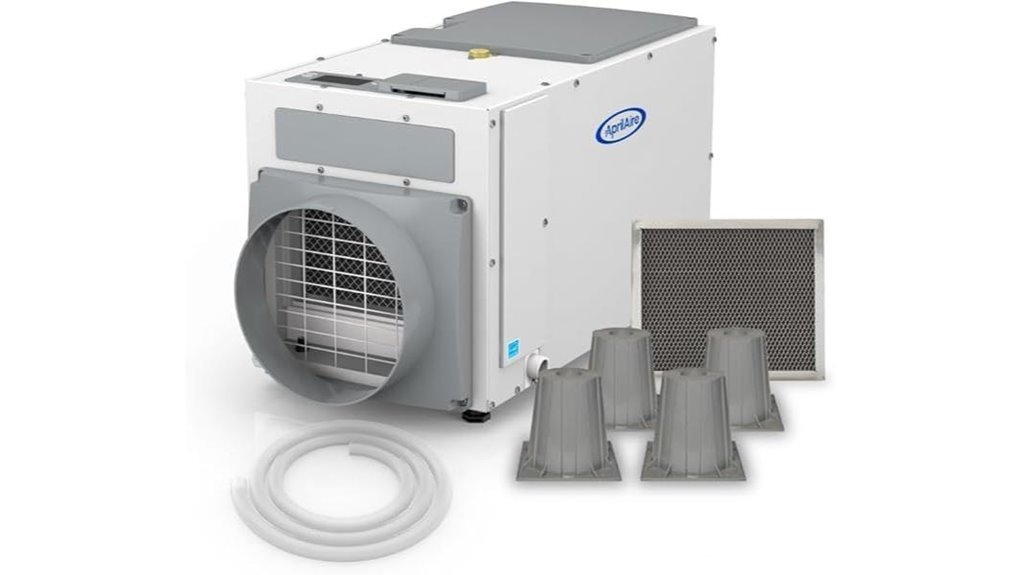
AprilAire E100 Pro 100 Pint Dehumidifier Bundle
Best Overall Whole-House Pick
The AprilAire E100 Pro is the strongest match for homeowners who want dedicated, automatic whole-house humidity control from a well-documented residential system. AprilAire markets the model as removing up to 100 pints per day and covering whole houses, basements, or sealed crawl spaces up to 5,500 sq. ft. The current EPA ENERGY STAR listing reports an 85-pint water-removal capacity under the newer Appendix X1 test procedure, so the two figures should not be treated as identical test results.
The E100 can operate as a standalone basement or crawl-space unit or connect to properly designed ductwork. Its built-in digital humidistat starts dehumidification when the measured humidity rises above the selected target. It also includes corrosion-resistant aluminum coils, automatic defrost, continuous drainage, and a washable MERV 8 filter that protects the equipment from airborne debris.
The linked Amazon bundle is advertised with additional setup accessories that may include a drain hose, extra filter, risers, and duct collars. Bundle contents can change between sellers, so confirm every included accessory before ordering. Professional installation is a sensible choice when connecting the unit to HVAC ductwork, adding an external condensate pump, or designing a return-and-supply airflow path.
Why You’ll Like It: It is a purpose-built residential whole-house dehumidifier with flexible ducting options, automatic humidity control, current ENERGY STAR certification, and established manufacturer documentation.
Best For: Larger homes, finished or unfinished basements, and sealed crawl spaces that need automatic, continuous moisture control.
Who Should Avoid It: Renters, buyers who need a lightweight portable appliance, or homes without a practical drain route or sufficient installation clearance.
Pros:
- Designed for whole-house, basement, and sealed crawl-space humidity control.
- Can be installed as a ducted system or used as a standalone unit.
- Includes digital humidity control, automatic defrost, continuous drainage, and a washable MERV 8 filter.
- Current EPA certification provides a standardized efficiency and capacity reference.
Cons:
- Installation is more involved than placing a portable room dehumidifier.
- Gravity drainage requires a continuously sloped route to a lower drain or a separately arranged condensate pump.
- The manufacturer’s 100-pint claim and current EPA 85-pint rating use different capacity references.
- The exact accessories and warranty conditions in the linked bundle should be confirmed before purchase.
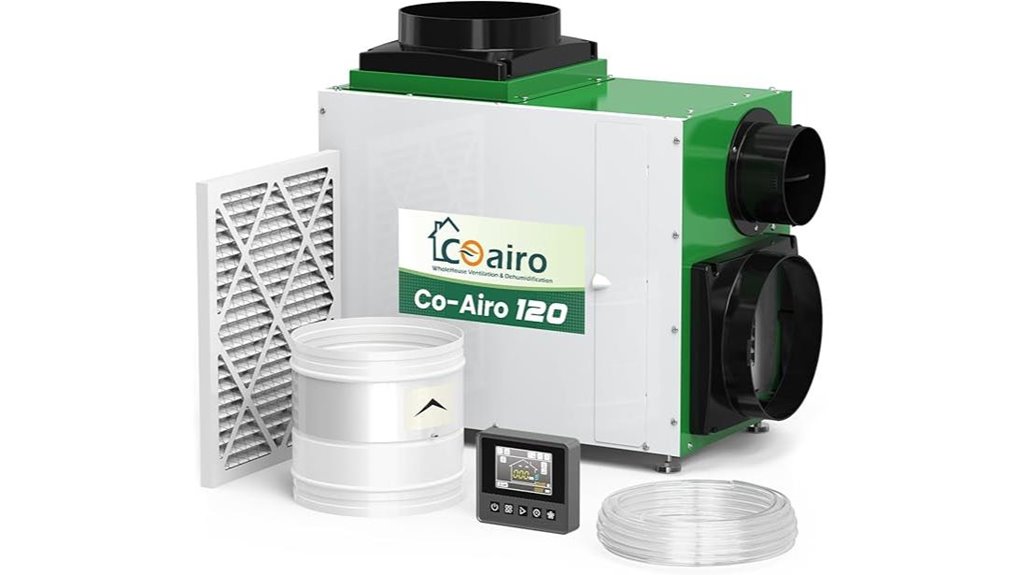
CoAiro 120 104-Pint AHAM Dehumidifier with Drain Hose
Best Specialized High-Capacity Pick
The CoAiro 120 is designed for large, demanding humidity-control applications. Current manufacturer information lists a moisture-removal capacity of 104 pints per day at AHAM conditions, while the linked product is promoted with a higher 208-pint saturation rating. For everyday sizing, the 104-pint AHAM figure is the more useful comparison point.
The manufacturer positions this model especially for greenhouses, crop storage, barns, hydroponic spaces, and other agricultural or commercial-style environments. It is also listed for spaces up to about 3,000 sq. ft. and offers two airflow settings, a wired controller, automatic restart, automatic defrost, continuous drainage, fresh-air capability, and support for multi-duct layouts.
The fresh-air and multi-duct functions create more installation flexibility, but they also require careful planning. Outdoor-air intake can add heat, cold, and humidity to a building. The intake location, filtration, duct diameter, return-air path, airflow balance, drainage, and electrical supply should therefore be designed for the actual space rather than treated like a plug-and-play portable installation.
Product descriptions for this model and its seller packages are not always consistent about pump drainage and included accessories. Confirm whether the exact Amazon offer includes only a gravity-drain hose or also includes a condensate pump, controller, filters, and duct components.
Why You’ll Like It: It provides higher AHAM-rated moisture removal than the other models in this comparison and supports flexible airflow, fresh-air, and multi-duct configurations.
Best For: Greenhouses, grow spaces, crop or general storage, workshops, barns, and professionally designed high-capacity or multi-zone installations.
Who Should Avoid It: Apartment residents, small-home owners, buyers seeking a simple portable appliance, or anyone without suitable space and professional installation planning.
Pros:
- Manufacturer-listed 104-pint AHAM capacity for demanding humidity loads.
- Two airflow settings, continuous drainage, automatic restart, and automatic defrost.
- Supports fresh-air intake and multi-duct installation arrangements.
- Suitable for specialized agricultural, storage, workshop, and commercial-style uses.
Cons:
- The 208-pint figure is a saturation rating and should not be compared directly with lower-condition capacity figures.
- Its installation requirements may be excessive for ordinary bedrooms, apartments, or small basements.
- Introducing outdoor air can increase the heating, cooling, and dehumidification load.
- Pump inclusion, filters, controller, duct accessories, warranty terms, and seller availability should be verified on the exact listing.
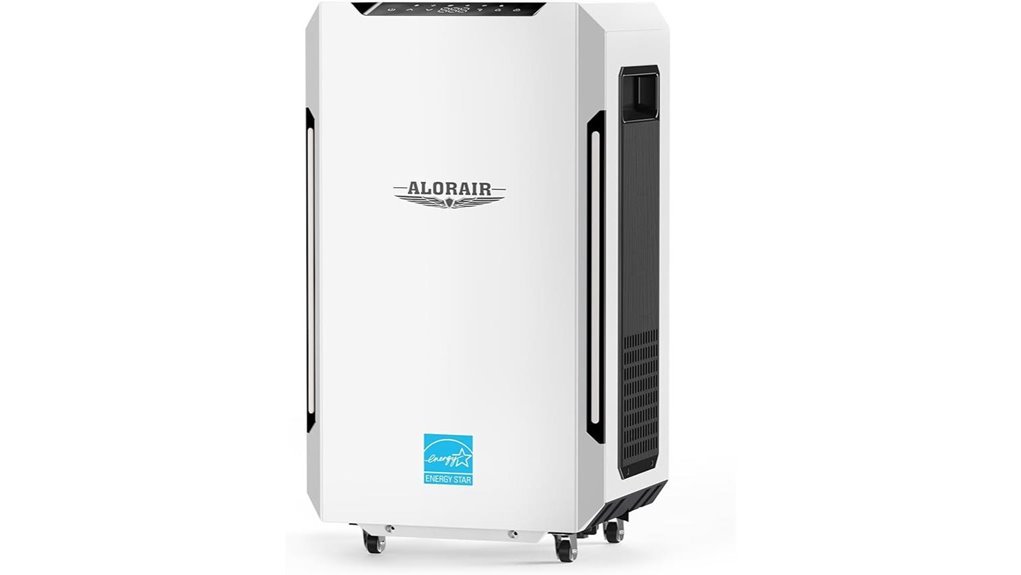
ALORAIR Sentinel Pro 35X Dehumidifier with Pump and Hose
Best Built-In Pump Pick
The ALORAIR Sentinel Pro 35X is a compact commercial-grade dehumidifier for basements, crawl spaces, garages, utility rooms, and other defined areas up to about 1,000 sq. ft. The manufacturer lists 35 pints per day at AHAM conditions, up to 70 pints at saturation, and 180 CFM airflow.
Its main advantage is the built-in condensate pump. The manufacturer lists a 19.6-foot pump-drain hose and pumping capability for upward or longer-distance drainage. Gravity drainage is also available, making the 35X more flexible than a gravity-only unit when the nearest sink, window, sump, or drain is above the installation point.
This is not the same type of product as a centrally ducted whole-house dehumidifier. Its standalone design and smaller rated treatment area make it better for a specific basement, crawl space, garage, utility room, or drying project than for balancing humidity throughout a large multi-story home.
The manufacturer lists a 52 dBA sound-pressure level, washable MERV 1 filter, automatic defrost, adjustable humidity control, restart memory, and a six-year limited warranty program. Sound measurements can vary by test method and distance, so buyers should not assume bedroom-quiet operation. Review warranty registration, exclusions, shipping responsibility, and maintenance requirements before purchase.
Why You’ll Like It: The built-in pump solves difficult drainage layouts without requiring a separate pump accessory.
Best For: Basements, sealed crawl spaces, garages, utility rooms, workshops, and restoration or drying zones around 1,000 sq. ft.
Who Should Avoid It: Buyers who need true central whole-house duct integration, near-silent bedroom operation, or coverage substantially beyond the manufacturer’s stated range.
Pros:
- Clearly labeled 35-pint AHAM and 70-pint saturation capacities.
- Built-in pump plus gravity-drain option for flexible water removal.
- 180 CFM airflow with automatic defrost and restart memory.
- Compact commercial-grade design for basements, crawl spaces, garages, and defined problem zones.
Cons:
- It is a standalone zone unit, not a centrally ducted whole-house HVAC dehumidifier.
- The manufacturer-listed 52 dBA sound level may be noticeable near bedrooms or living areas.
- The MERV 1 filter is primarily an equipment-protection filter and should not be treated as high-level air purification.
- Coverage will decrease when the moisture load, air leakage, or water intrusion is more severe than normal.
Factors to Consider When Choosing a High-Capacity Dehumidifier
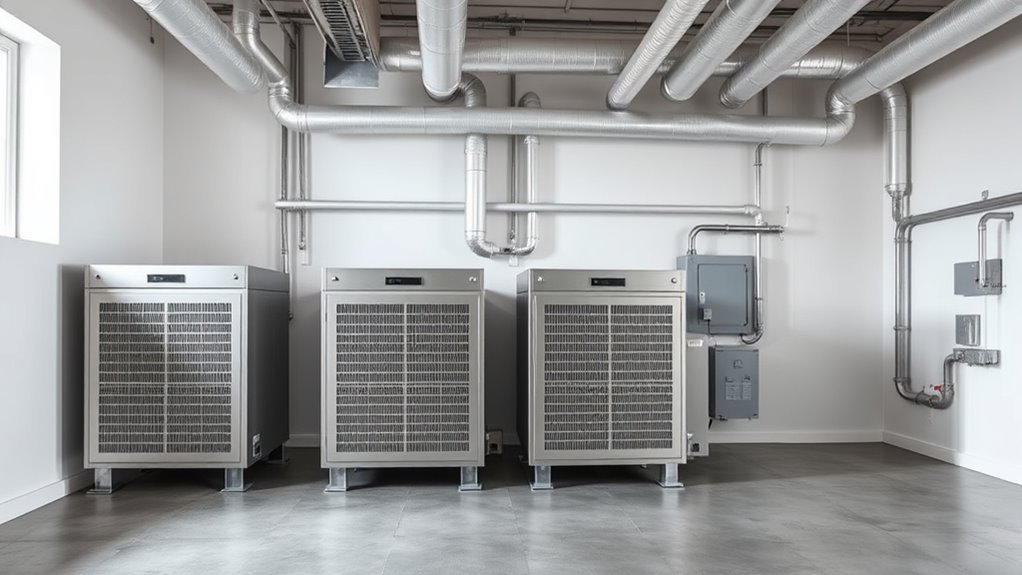
Start by deciding whether you need a true ducted whole-house dehumidifier, a specialized high-capacity system, or a standalone unit for one problem area. Then compare standardized capacity, realistic coverage, drainage, installation space, airflow, noise, filtration, electrical requirements, service access, and warranty support.
A large marketing coverage number does not guarantee good results. The unit must have enough moisture-removal capacity for the actual humidity load, a workable drain route, unrestricted airflow, and sufficient access for filter changes and repairs.
Whole-House, Specialized, or Standalone Installation
A ducted whole-house dehumidifier can treat air from multiple rooms and may connect to an HVAC return-and-supply layout. A specialized high-capacity unit may support multiple ducts, fresh-air intake, or agricultural applications but require more customized design. A standalone commercial-grade unit generally treats the basement, crawl space, garage, room, or zone where it is installed.
The AprilAire E100 is the clearest residential whole-house option in this comparison. The CoAiro 120 is better suited to specialized ducted, agricultural, storage, or workshop installations. The ALORAIR 35X should be treated as a pump-equipped zone dehumidifier. Confirm duct size, airflow direction, service clearance, electrical supply, return-air path, and condensate routing before installation.
AHAM, Appendix X1, and Saturation Capacity
Dehumidifier capacity is measured in pints of water removed per 24 hours, but listings do not always use the same conditions. AHAM ratings commonly use moderate standardized temperature and humidity conditions. Current DOE Appendix X1 ratings use another defined procedure intended to represent realistic operation. Saturation testing uses hotter, wetter air and produces a much higher number.
Compare products using the same test basis whenever possible. Do not assume that a 208-pint saturation model removes twice as much water in a normal basement as a unit carrying a 100-pint manufacturer rating or an 85-pint Appendix X1 rating.
Coverage Area and Moisture Load
Square-foot ratings are estimates rather than guarantees. Ceiling height, outdoor climate, water intrusion, air leakage, crawl-space encapsulation, basement temperature, ventilation, starting humidity, and the amount of wet building material all affect performance.
For persistent water entry, widespread condensation, or a large multi-story home, use the manufacturer’s sizing guidance and consider an HVAC or building-moisture professional. A dehumidifier can manage moisture in the air, but it cannot repair a plumbing leak, foundation crack, roof leak, failed drainage system, or other water source.
Drainage Options
Continuous drainage is essential for high-capacity operation. Gravity drainage is simple and dependable, but the hose must slope continuously toward a lower drain without dips that trap water. A built-in pump, such as the one in the ALORAIR 35X, can move condensate upward or across a longer route.
For gravity-only models, an external condensate pump may be needed. Check the drain fitting, hose diameter, maximum lift height, route length, freeze risk, overflow protection, and access for cleaning. Verify pump inclusion on the exact seller listing rather than relying only on a similar model’s description.
Fresh-Air Intake and Duct Planning
A fresh-air connection is not automatically beneficial in every climate. Outdoor air can introduce additional heat, cold, humidity, pollen, smoke, or other contaminants. The amount of fresh air should be controlled and filtered as part of a balanced ventilation design.
For multi-duct or fresh-air installations, confirm duct diameter, static pressure, airflow balance, intake location, backdraft protection, filter access, and how the system interacts with existing heating and cooling equipment.
Energy Efficiency
Look for a current ENERGY STAR certification when available and compare the Integrated Energy Factor or other standardized efficiency information. Correct sizing is equally important. An undersized unit may run continuously without reaching the target humidity, while an unnecessarily large or poorly installed unit may add cost without improving moisture control.
Automatic humidity control, clean filters, unrestricted airflow, sealed ducts, clear coils, and a reasonable humidity target can improve operating efficiency.
Noise and Placement
Noise matters most when a dehumidifier is near bedrooms, offices, or living areas. Manufacturer sound ratings are not always measured under identical conditions, so compare them cautiously.
A mechanical room, basement, sealed crawl space, garage, or remote ducted installation can reduce perceived noise. Install the unit on a level, stable base and follow all clearance requirements to reduce vibration and prevent restricted airflow.
Filter, Maintenance, and Service Access
Check the filter type, cleaning instructions, and replacement schedule before buying. A MERV 1 or MERV 8 filter helps protect the dehumidifier, but it is not a substitute for a correctly sized dedicated air purifier.
Leave enough room to remove the filter, inspect and clean the drain, access the coil, test the pump, and service the controls. Warranty length matters, but covered parts, labor coverage, shipping responsibility, registration requirements, and approved-installer conditions may be more important than the headline warranty period.
Before You Buy Checklist
- Confirm whether each capacity figure is AHAM, Appendix X1, saturation, or another manufacturer test.
- Measure the actual treatment area and ceiling height.
- Identify and repair active leaks or water intrusion before relying on a dehumidifier.
- Choose a gravity drain, built-in pump, or external condensate-pump route.
- Check the voltage, circuit requirements, operating amperage, and plug type.
- Measure installation and service clearances, including room to remove the filter.
- Verify duct collars, controllers, hoses, pumps, filters, risers, and other bundle contents.
- Review the current warranty terms, registration deadline, exclusions, and installer requirements.
- Confirm that the linked seller currently offers the exact model and package described.
Frequently Asked Questions
Which Product Is a True Whole-House Dehumidifier?
The AprilAire E100 is the clearest purpose-built residential whole-house option in this comparison because it supports ducted installation and is designed for whole-home, basement, or sealed crawl-space humidity control. The CoAiro 120 supports high-capacity ducted and multi-zone arrangements but is more specialized. The ALORAIR 35X is better treated as a standalone zone dehumidifier.
Which Product Has a Built-In Condensate Pump?
The ALORAIR Sentinel Pro 35X has a built-in pump as well as a gravity-drain option. The AprilAire E100 normally uses gravity drainage and may require an external pump when no lower drain is available. Confirm the exact drainage package included with the CoAiro seller listing before planning an uphill drain route.
What Is the Difference Between AHAM, Appendix X1, and Saturation Pints?
Each rating is based on defined temperature and humidity conditions. Saturation testing uses hotter and wetter air, allowing the machine to collect more water and display a higher pint-per-day number. AHAM and current DOE Appendix X1 ratings use lower or more realistic test conditions. Compare products using the same standard whenever possible.
Why Does the AprilAire E100 Have Two Capacity Numbers?
AprilAire markets the E100 as removing up to 100 pints per day, while the current EPA ENERGY STAR listing shows 85 pints per day under the Appendix X1 test procedure. The figures use different capacity references, so the EPA number is more useful when comparing it with other products carrying the same standardized rating.
How Often Should a Dehumidifier Filter Be Cleaned?
Inspect the filter monthly during heavy use and clean or replace it according to the manufacturer’s manual. Homes with pets, construction dust, workshop debris, or dirty crawl spaces may require more frequent service. Never reinstall a washable filter until it is completely dry.
Can These Dehumidifiers Be Used in Crawl Spaces?
The AprilAire E100 and ALORAIR Sentinel Pro 35X are suitable for crawl-space applications when the treatment area, temperature range, drainage, electrical supply, and service access meet the manufacturer’s requirements. A crawl space should normally be sealed or encapsulated and active water entry should be corrected before relying on a dehumidifier.
What Maintenance Does a Condensate Pump Require?
Check the reservoir, float switch, pump inlet, and discharge hose for slime, debris, kinks, freezing, or leaks. Test the pump periodically and follow the manual’s cleaning instructions. Disconnect power before servicing the equipment. A blocked pump line can cause shutdowns or water leakage.
Can a High-Capacity Dehumidifier Go in an Attic?
Only install a dehumidifier in an attic when the model’s approved temperature range, drainage protection, overflow protection, electrical requirements, structural support, airflow clearances, and service access can all be satisfied. Attic installations carry significant leak and freeze risks, so professional installation is recommended.
What Indoor Humidity Setting Should I Use?
A target around 45% to 55% relative humidity is a practical starting range for many homes. Avoid setting the unit lower than necessary because that can increase runtime and energy use. Adjust the setting based on comfort, condensation, outdoor conditions, building materials, and the manufacturer’s guidance.
Conclusion
Final recommendation
For a dedicated residential whole-home system, the AprilAire E100 Pro is the most convincing overall choice because its ducting support, controls, documentation, and intended application align clearly with whole-house moisture control.
Choose the CoAiro 120 when you need higher AHAM-rated capacity for a greenhouse, grow area, storage building, workshop, agricultural facility, or professionally designed multi-duct installation.
Choose the ALORAIR Sentinel Pro 35X when the main problem is a smaller basement, sealed crawl space, garage, utility room, or drying zone and a built-in pump will simplify drainage.
Before ordering, compare capacity under the same test conditions, confirm the drain route, verify the exact seller package and current warranty terms, and make sure the unit can be installed with adequate airflow, electrical capacity, service clearance, and access for future maintenance.