Affiliate disclosure: This article contains Amazon affiliate links. If you purchase through one of these links, we may earn a commission at no additional cost to you.
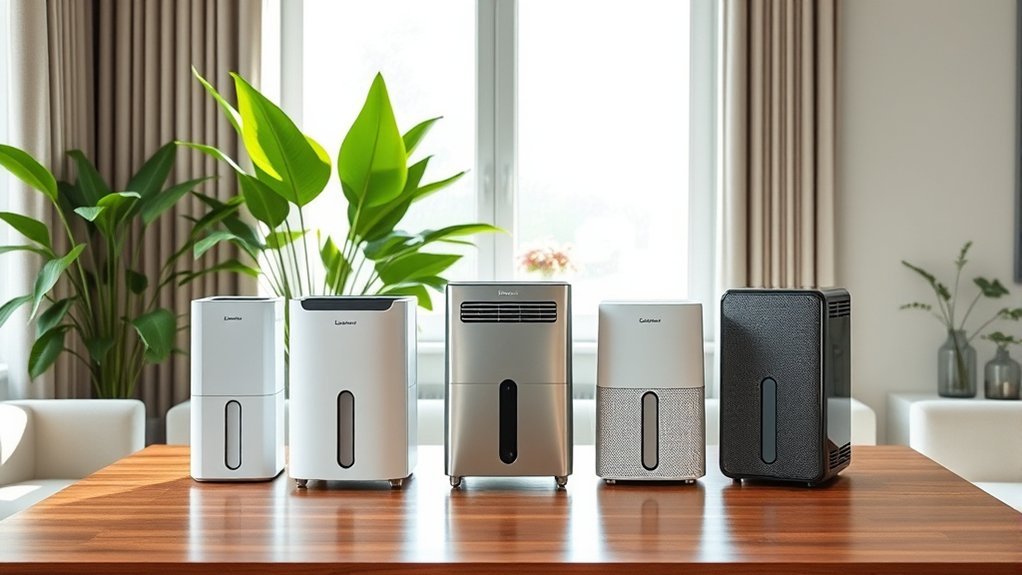
A dehumidifier with a built-in pump is useful when the nearest sink, standpipe, window, or drain is above the machine. Unlike gravity drainage, an integrated pump can move collected water upward through a hose, reducing the need to empty a bucket by hand.
This updated 2026 guide compares seven pump-equipped models for basements, large rooms, crawl spaces, garages, and utility areas. Capacity numbers require careful comparison: standardized, AHAM, and saturation ratings use different temperature and humidity conditions, so the largest advertised pint number is not automatically the most useful rating.
How We Selected These Models
The products below were evaluated by pump configuration, standardized capacity information, drainage flexibility, current product documentation, maintenance needs, smart controls, portability, and suitability for the intended space. Manufacturer square-foot claims are treated as comparison guidance rather than guaranteed coverage.
Quick Verdict
- Best Overall: Midea Cube 50 Pint for its standardized capacity, verified pump, smart controls, and space-saving nesting design.
- Best Efficiency-Focused Pick: AEOCKY LEO for pump drainage and ENERGY STAR Most Efficient 2025 recognition, with a standardized capacity of approximately 44.94 pints per day.
- Best Smart Option: GoveeLife Smart Dehumidifier Max for app control, five operating modes, a built-in pump, and a large water tank.
- Best for Crawl Spaces: MOISWELL Defender ME-7S for its compact metal body, 35-pint AHAM rating, and clearly stated pump lift.
- Best High-Capacity Utility Pick: HBN 125 Pint for demanding crawl spaces, storage areas, basements, and workspaces.
Quick Comparison of Dehumidifiers With Built-In Pumps
| Product | Best For | Comparable Capacity | Pump / Drainage Note | Important Limitation | Amazon |
|---|---|---|---|---|---|
| Midea Cube | Most homes and basements | 50 pints per day | Built-in pump plus gravity-drain and bucket options | About 41.5 pounds; advertised coverage is not a sizing guarantee | Check Price |
| AEOCKY LEO | Efficiency-focused basement use | 44.94 pints standardized; up to 80 pints advertised in hotter conditions | Integrated pump for drainage above the unit | The 80-pint maximum is not directly comparable with standardized ratings | Check Price |
| GoveeLife Smart Max | App-based humidity control | 50 pints per day | Built-in pump with approximately 16-foot hose | Large cabinet and approximately 860-watt listed input | Check Price |
| GE 50 Pint | Straightforward automatic control | 50 pints per day | Built-in pump with approximately 16-foot discharge reach | Several similar GE models exist; verify the exact model number | Check Price |
| MOISWELL ME-7S | Crawl spaces and compact installations | 35 pints AHAM / 70 pints at saturation | Pump lift and included hose are approximately 16.4 feet | Intended for about 1,000 square feet rather than a large divided home | Check Price |
| HBN 125 Pint | High-moisture utility and crawl-space use | About 60 pints AHAM / 125 pints at 95°F and 90% RH | Integrated pump plus gravity-drain connection | Less portable and supported by limited manufacturer documentation | Check Price |
| Sijipt Guardian SJ80P | Flexible pump and gravity drainage | Up to 80 pints under the seller’s stated conditions | Pump drainage up to approximately 16.4 feet plus gravity drainage | Standardized capacity should be confirmed for the exact unit | Check Price |
Capacity note: Standardized, AHAM, saturation, and maximum pint ratings use different test conditions. Compare standardized or AHAM figures whenever possible. A model advertised at 80 or 125 pints in extreme humidity is not automatically that much stronger than a standardized 50-pint model.
Midea Cube 50 Pint Dehumidifier with Built-in Pump
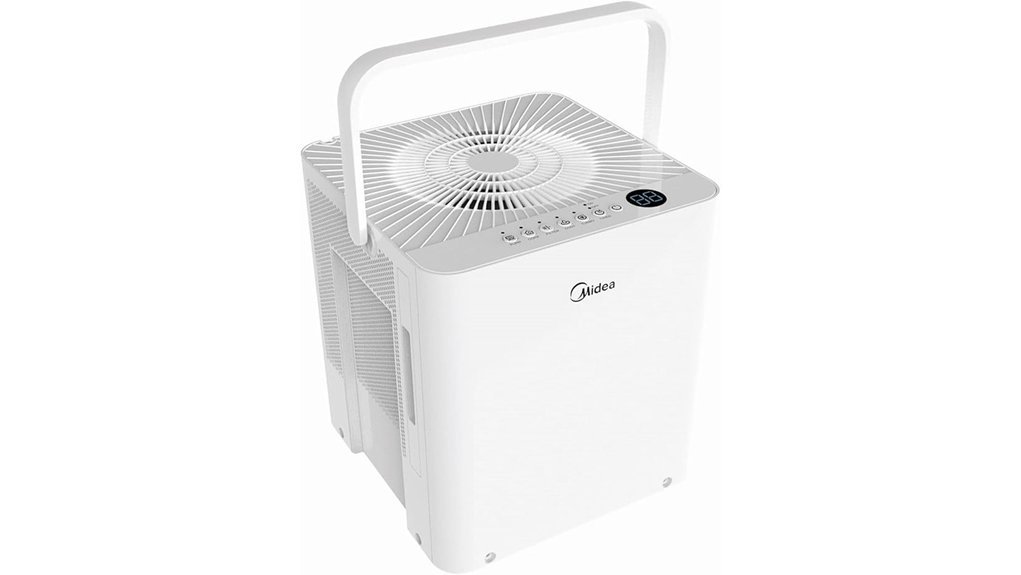
Best Overall
The Midea Cube 50 Pint Dehumidifier offers the strongest overall combination of standardized capacity, pump drainage, smart controls, and residential convenience. Its 50-pint daily rating is easier to compare than the hotter-condition maximum numbers used by several competing listings.
The built-in pump can discharge collected water to a suitable outlet above the machine. You can also use bucket collection or gravity drainage when the room setup allows it. Midea’s lift-and-twist design lets the upper section nest into the bucket, reducing the unit’s storage height when it is not in use.
The SmartHome app and compatible voice controls add remote monitoring and adjustment. However, smart connectivity should be treated as a convenience feature rather than a substitute for correct capacity and drainage setup.
Why You’ll Like It: It combines hands-free drainage, standardized performance, and useful smart features without using a low-profile commercial cabinet.
Who Should Buy This: Homeowners managing humidity in a basement, garage, large living area, or similar residential space.
Who Should Avoid This: Buyers who need a lightweight unit for frequent stair carrying or a small machine for one compact room.
Pros:
- Standardized 50-pint daily capacity.
- Built-in pump plus gravity-drain and bucket options.
- App and compatible voice-assistant support.
- Nesting Cube design simplifies seasonal storage.
- Wheels help with movement on level floors.
Cons:
- Weighs approximately 41.5 pounds.
- Initial Wi-Fi configuration may take extra time.
- Manufacturer square-foot language should not replace moisture-load sizing.
- The standard manufacturer warranty is relatively short.
AEOCKY LEO Energy Star Dehumidifier With Pump
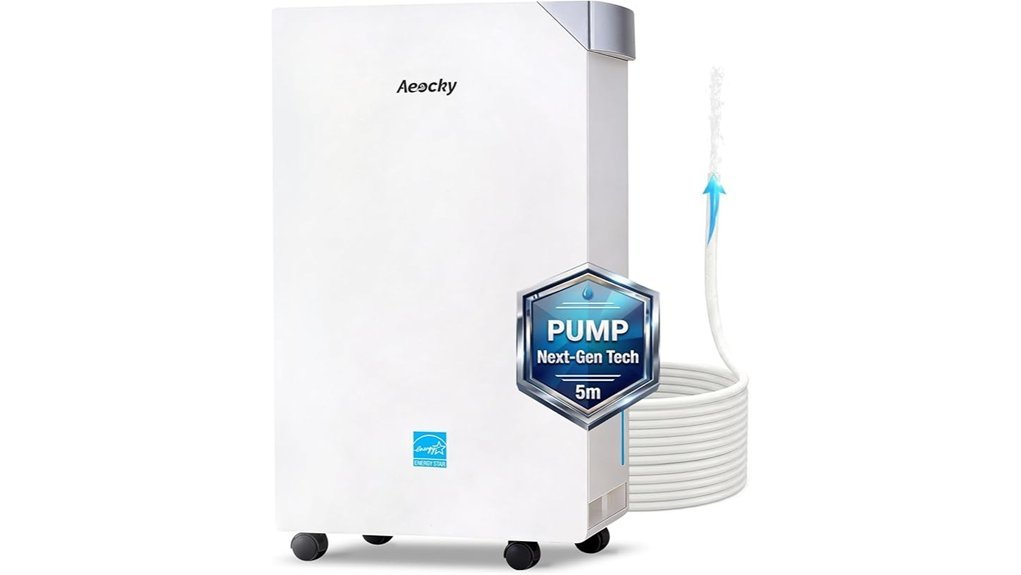
Best Efficiency-Focused Pick
The AEOCKY LEO is advertised for up to 80 pints per day under hotter, more humid conditions, but its standardized ENERGY STAR water-removal capacity is approximately 44.94 pints per day. That standardized figure is the more useful number when comparing it with modern 50-pint portable dehumidifiers.
The integrated pump is designed for situations where collected water must travel to a sink, window, standpipe, or other suitable outlet above the machine. Automatic humidity control, multiple fan settings, automatic defrost, and power-restoration memory support frequent basement operation.
The model received ENERGY STAR Most Efficient 2025 recognition. That is a certification-year distinction based on standardized efficiency requirements, not a guarantee that it will always cost less to operate than every alternative in every room.
Why You’ll Like It: It combines pump-assisted drainage with independently listed standardized capacity and efficiency information.
Who Should Buy This: Buyers who expect regular basement operation and place a high priority on energy efficiency.
Who Should Avoid This: Anyone choosing solely because the product title says 80 pints.
Pros:
- Integrated pump for drainage above the machine.
- Approximately 44.94-pint standardized daily capacity.
- ENERGY STAR Most Efficient 2025 recognition.
- Automatic humidity management and defrost.
- Power-restoration memory.
Cons:
- The advertised 80-pint maximum uses different conditions from the standardized rating.
- The 1.45-gallon tank may fill quickly when pump drainage is not active.
- Larger than a compact small-room dehumidifier.
- Pump tubing and the internal water path still require periodic inspection.
GoveeLife Smart Dehumidifier Max With Pump
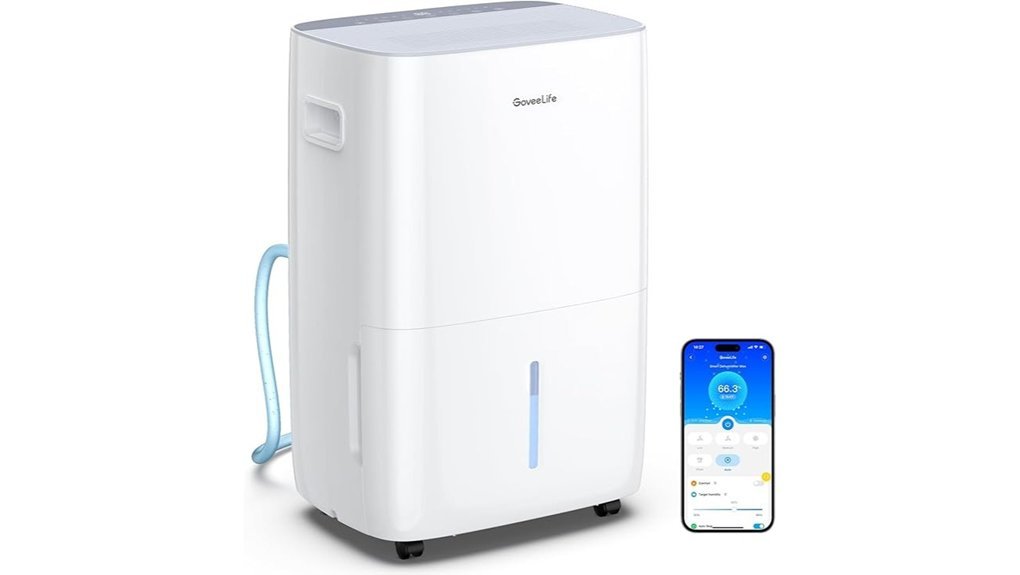
Best Smart Option
The GoveeLife Smart Dehumidifier Max, model H7152, is listed with a 50-pint daily capacity, built-in pump, approximately 16-foot drain hose, and 1.8-gallon water tank. These drainage choices make it useful both for permanent basement placement and temporary use in rooms without a fixed drain.
Five operating modes and app-based humidity monitoring provide more control than a basic push-button model. The app can be useful when the dehumidifier is in a basement, detached work area, rental property, or another location that is not checked frequently.
The listed electrical input is approximately 860 watts. Actual energy consumption depends on room temperature, starting humidity, fan setting, cycling time, and whether the machine is oversized or undersized for the moisture load.
Why You’ll Like It: The app, multiple modes, pump, and large tank offer flexible control for different humidity situations.
Who Should Buy This: Smart-home users who want to monitor a basement, garage, bathroom, or large room remotely.
Who Should Avoid This: Buyers who want the smallest cabinet, simplest controls, or lowest listed wattage.
Pros:
- 50-pint daily rating.
- Built-in pump with a long drainage hose.
- Five modes for different humidity situations.
- Large 1.8-gallon water tank.
- App-based monitoring and adjustment.
Cons:
- Approximately 860-watt listed power input.
- Large and relatively heavy.
- Smart features add setup steps some buyers may not need.
- Published square-foot coverage should be treated as a maximum marketing figure.
GE 50 Pint Portable Dehumidifier With Built-in Pump
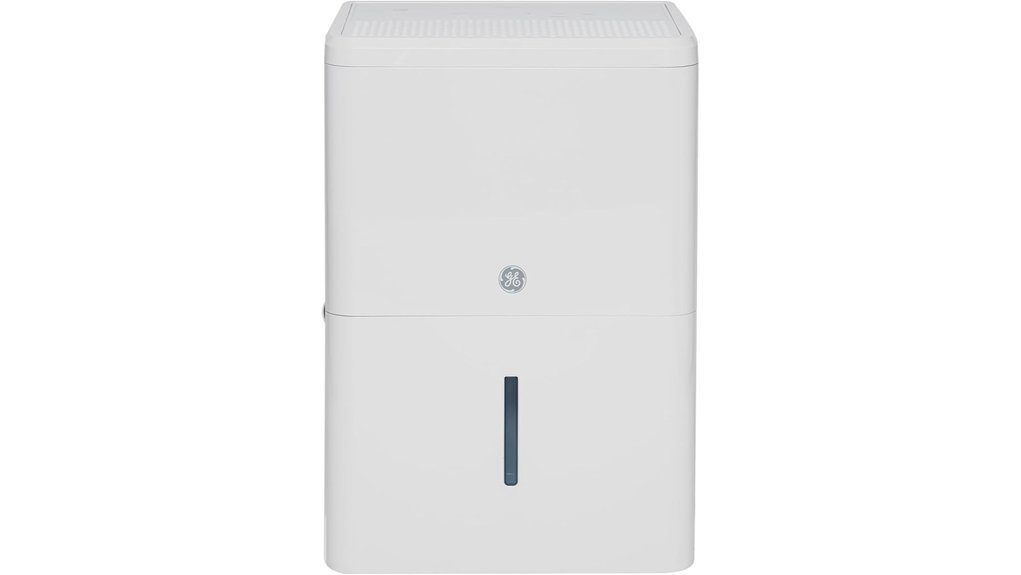
Best for Straightforward Automatic Control
GE’s current 50-pint pump-equipped portable dehumidifiers combine standardized daily capacity, automatic humidity control, and an included pump hose. Smart Dry adjusts fan operation in response to humidity conditions, reducing the need for repeated manual fan changes.
The pump hose can route collected water to a suitable discharge point approximately 16 feet away. That stated distance should not automatically be interpreted as 16 feet of vertical lift; follow the exact model’s installation instructions for maximum height, hose routing, and discharge placement.
GE has released several visually similar 50-pint pump models. Model numbers, colors, manufacturing periods, warranty terms, and connected features can differ even when product photos look nearly identical.
Why You’ll Like It: The automatic humidity response and pump drainage reduce routine adjustment and bucket handling.
Who Should Buy This: Buyers who prefer conventional appliance controls and access to an established manufacturer support system.
Who Should Avoid This: Anyone unwilling to verify the exact Amazon model number against GE’s current specifications and support page.
Pros:
- 50-pint daily moisture-removal rating.
- Built-in pump with included drainage hose.
- Smart Dry automatic fan adjustment.
- Bucket alarm and filter reminder on supported models.
- Manufacturer support pages and replacement-part resources are available for current models.
Cons:
- Several similar GE model numbers can make comparison confusing.
- Features may differ between current and older versions.
- High fan settings may be noticeable in quiet occupied rooms.
MOISWELL Defender ME-7S Dehumidifier With Pump
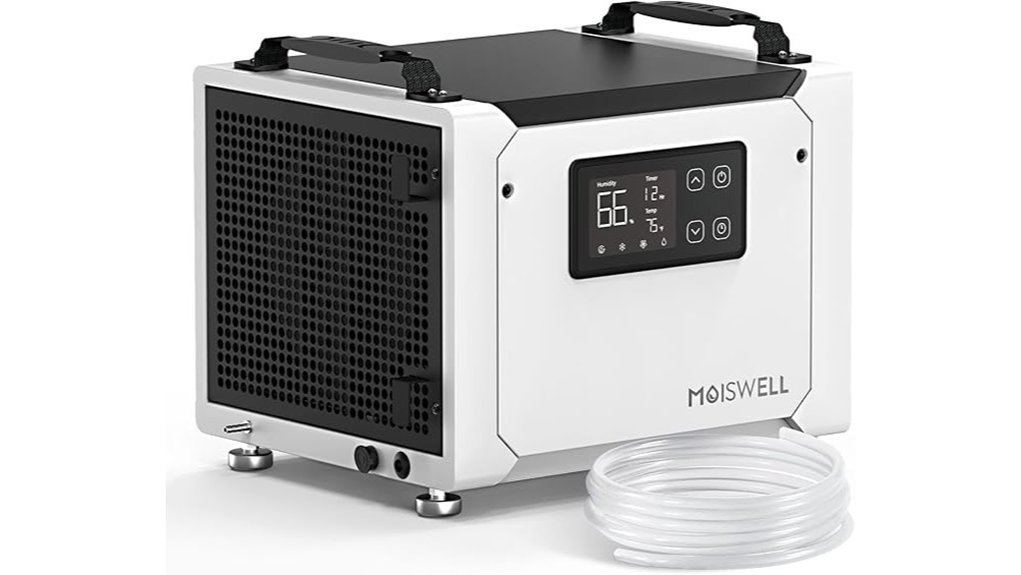
Best for Crawl Spaces
The MOISWELL Defender ME-7S provides one of the clearest capacity descriptions in this comparison. It is rated for 35 pints per day under AHAM conditions and up to 70 pints at saturation. The manufacturer positions it for crawl spaces, basements, attics, and utility areas of approximately 1,000 square feet.
Its built-in pump has a stated pumping height of approximately 16.4 feet and is paired with a hose of similar length. That makes the ME-7S useful where the only suitable discharge location is above or some distance from the machine.
The low-profile metal cabinet, two carrying handles, automatic defrost, and power-restoration restart are better suited to utility installations than the tall plastic cabinets used by many portable residential models.
Why You’ll Like It: The compact body fits installations where a conventional upright dehumidifier would be awkward or block access.
Who Should Buy This: Crawl-space, basement, attic, or utility-room users who need a compact pump-equipped machine.
Who Should Avoid This: Buyers expecting one small unit to control several thousand square feet of divided living space.
Pros:
- Clearly stated 35-pint AHAM and 70-pint saturation ratings.
- Approximately 16.4-foot pump lift and included hose.
- Compact metal housing.
- Automatic defrost and restart.
- Operating-temperature guidance is published by the manufacturer.
Cons:
- Recommended coverage is smaller than the broad claims attached to many residential units.
- Weighs approximately 40 pounds.
- Utility-focused cabinet may look out of place in a finished living room.
- It does not provide the large manual bucket found in many upright models.
HBN 125 Pint Crawl-Space Dehumidifier With Pump
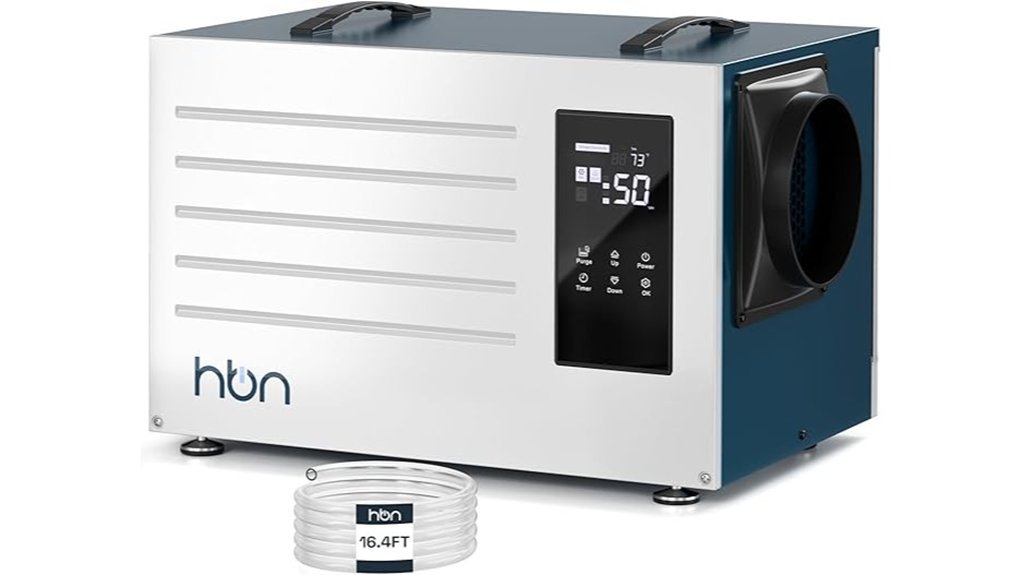
Best High-Capacity Utility Pick
The HBN crawl-space dehumidifier is advertised to remove up to 125 pints per day at approximately 95°F and 90% relative humidity. Current listing information also describes an AHAM capacity of approximately 60 pints per day, which is the more useful figure for comparison with standardized residential models.
The machine provides both pump-assisted and gravity drainage. Automatic defrost can help in cooler utility areas, while the digital panel provides target-humidity and timer controls without requiring a phone app.
This is a utility-focused machine for crawl spaces, storage areas, workshops, and persistently damp basements. It is not the most convenient choice for a bedroom or frequently occupied living room.
Why You’ll Like It: It combines higher standardized capacity with pump drainage in a low-profile cabinet intended for demanding moisture loads.
Who Should Buy This: Property managers, workshop users, or homeowners with a large crawl space or persistently damp utility area.
Who Should Avoid This: Buyers who need a lightweight residential machine, app controls, or extensive manufacturer documentation.
Pros:
- Approximately 60-pint AHAM capacity stated in current listings.
- Integrated pump plus gravity drainage.
- Automatic defrost for cooler operating conditions.
- Utility-focused controls and cabinet design.
- Suitable for continuous-drain installations.
Cons:
- The 125-pint headline uses extreme temperature and humidity conditions.
- More expensive and less portable than a basic residential model.
- Manufacturer documentation is less extensive than for the major appliance brands in this guide.
- Warranty, certification, pump height, and included accessories should be reconfirmed on the exact seller listing.
Sijipt Guardian SJ80P Dehumidifier With Pump
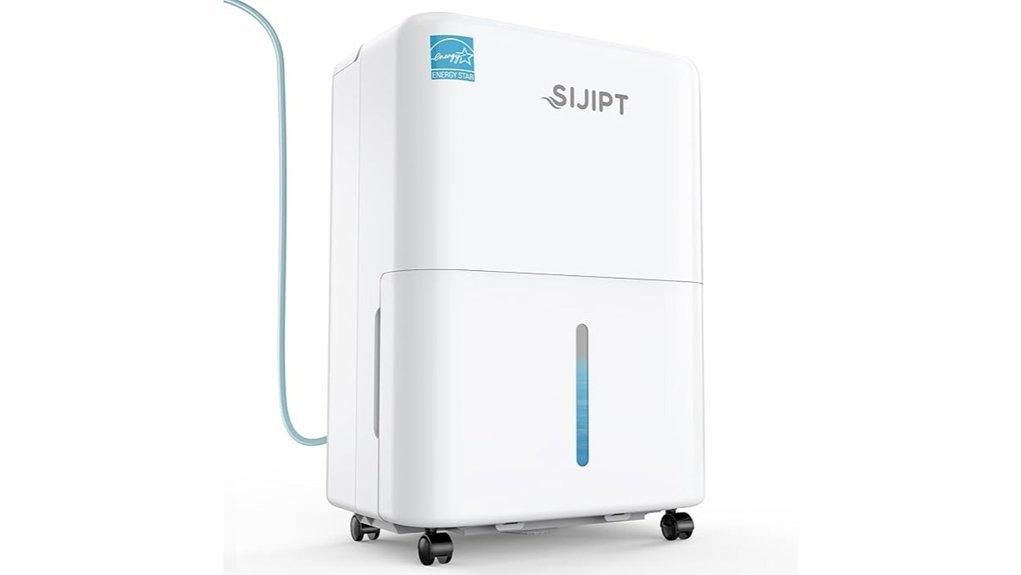
Best Flexible Drainage Setup
The Sijipt Guardian SJ80P is advertised for up to 80 pints of daily moisture removal. Its main advantage is drainage flexibility: the built-in pump can move water vertically or horizontally up to approximately 16.4 feet, while a separate gravity-drain connection can be used when the discharge point is below the unit.
The package is described as including a pump hose, gravity hose, removable tank, and washable filter. Standard dehumidification, continuous operation, drying modes, automatic shutoff, and timer controls cover the most common residential and basement needs.
Although some marketing calls it a whole-house dehumidifier, it is a portable unit rather than a permanently ducted HVAC appliance. Air still needs a reasonably open path between the machine and the area being dehumidified.
Why You’ll Like It: You can switch among bucket collection, gravity drainage, and pump-assisted drainage as the room configuration changes.
Who Should Buy This: Buyers who may move the machine between areas with different drain heights or hose routes.
Who Should Avoid This: Anyone who needs independently confirmed sound data or a clearly published standardized 80-pint rating.
Pros:
- Pump drainage up to approximately 16.4 feet.
- Separate gravity-drain connection.
- Multiple operating modes and timer.
- Washable filter.
- Automatic tank-full shutoff.
Cons:
- Advertised maximum capacity requires test-condition context.
- Standardized capacity should be checked for the exact model.
- “Whole house” wording may overstate what one portable unit can do in divided rooms.
- Filter, tank, pump reservoir, and drain lines require routine cleaning.
Factors to Consider When Choosing a Dehumidifier With a Built-In Pump
A pump is only one part of the buying decision. Capacity standards, pump height, hose routing, room conditions, energy use, noise, and maintenance access can have a greater effect on long-term satisfaction.
1. Understand Capacity Test Conditions
Do not assume every pint-per-day number uses the same test. A product may advertise:
- Standardized or DOE capacity: Water removal measured under defined test conditions used for modern portable-dehumidifier comparisons.
- AHAM capacity: A standardized rating frequently published for crawl-space and commercial-style equipment.
- Saturation or maximum capacity: Water removal measured in hotter and more humid conditions.
- Older rating language: Some listings show a larger historical rating alongside a newer standardized figure.
The MOISWELL model illustrates the difference clearly: it is described as 35 pints under AHAM conditions and 70 pints at saturation. The HBN listing similarly separates an approximately 60-pint AHAM rating from a 125-pint hotter-condition maximum.
2. Match Capacity to the Moisture Load
Square footage alone does not determine the correct size. A cool basement with persistent seepage may need more capacity than a larger but mildly humid living area. Consider:
- Ceiling height and room layout.
- Whether doors remain open or closed.
- Temperature of the space.
- Starting relative humidity.
- Standing water, plumbing leaks, or foundation seepage.
- Laundry drying and other indoor moisture sources.
- How quickly humidity needs to be reduced.
A dehumidifier controls airborne moisture. It does not repair a leaking foundation, broken pipe, roof leak, grading problem, or failed drainage system.
3. Check Pump Lift and Hose Routing
Confirm the maximum vertical pump lift, horizontal discharge distance, included hose length, and approved hose diameter. These measurements are related but are not always interchangeable.
A model may include a 16-foot hose without supporting 16 feet of vertical lift. Use the installation instructions for the exact model rather than assuming that the hose length equals maximum pumping height.
Avoid sharp bends, crushed tubing, freezing locations, and discharge points where water could flow toward the foundation. Secure the hose so it cannot fall out of a sink, standpipe, or utility drain.
4. Compare Pump, Gravity, and Bucket Drainage
A built-in pump is most valuable when water must travel upward. If a floor drain sits below the machine, gravity drainage is usually simpler, quieter, and dependent on fewer moving parts. Bucket collection remains useful for temporary placement but requires regular emptying.
- Pump drainage: Best when the discharge point is above the machine or the hose cannot maintain a continuous downhill slope.
- Gravity drainage: Best when the hose can run continuously downhill to a safe drain.
- Bucket collection: Best for temporary operation or rooms without a suitable permanent drain.
5. Review Energy Efficiency
Look for current ENERGY STAR information for the exact model number. Dehumidifier efficiency is measured with Integrated Energy Factor, expressed as liters of water removed per kilowatt-hour of electricity.
Do not rely only on broad claims such as “uses 30% less energy.” Compare standardized capacity, Integrated Energy Factor, annual energy-consumption estimates, listed wattage, room conditions, and the number of hours the compressor is likely to run.
6. Consider Temperature and Defrost
Compressor dehumidifiers generally remove less moisture as room temperature drops. Frost can form on the coils in cool spaces, reducing performance until the machine defrosts.
For a cool basement or crawl space, check the manufacturer’s minimum operating temperature and confirm that automatic defrost is included. Even with defrost, repairing water intrusion and improving drainage may be more important than buying a larger machine.
7. Consider Noise and Room Placement
Published decibel ratings may not include pump cycling, high fan speed, cabinet vibration, or room echo. A unit that is acceptable in an unfinished basement may still be distracting in a bedroom, office, or media room.
Place the machine on a firm, level surface and maintain the air-clearance distance stated in its manual. Poor airflow can increase noise, cause short cycling, and reduce water removal.
8. Evaluate Smart Controls
Wi-Fi can be valuable in a basement, rental property, detached garage, or work area. Useful functions may include:
- Current humidity monitoring.
- Target-humidity adjustment.
- Schedules and timers.
- Full-bucket or error alerts.
- Filter reminders.
- Automatic restart after a power interruption.
Smart features do not improve the compressor’s underlying capacity. Prioritize correct sizing, drainage, temperature range, and maintenance access before app functionality.
9. Plan for Maintenance
All dehumidifiers need periodic care. The filter, bucket, internal reservoir, pump inlet, and drain hose can collect dust, slime, or mineral deposits. Follow the exact manual’s cleaning schedule and unplug the machine before maintenance.
Periodically inspect the hose for kinks, loose fittings, buildup, and leaks. Test the pump before leaving the machine unattended for a long period so a blockage is discovered before water backs up.
10. Check the Exact Model and Warranty
Amazon listings can combine several capacities, colors, pump configurations, or model generations on one page. Before ordering, record the full model number and confirm:
- The built-in pump is included.
- The correct pump hose is supplied.
- The voltage and plug match your location.
- The standardized capacity matches the listing.
- The warranty applies to the seller and exact model.
- Replacement filters, hoses, and service information are available.
Which Pump Dehumidifier Should You Choose?
- Choose the Midea Cube when you want the most balanced residential option with a standardized 50-pint rating, pump, app, and compact storage design.
- Choose the AEOCKY LEO when standardized efficiency information is a priority and you want pump drainage for regular basement operation.
- Choose the GoveeLife H7152 when remote monitoring, schedules, and multiple smart modes matter most.
- Choose the GE 50 Pint when you prefer conventional controls and established appliance support, provided you verify the exact model.
- Choose the MOISWELL ME-7S when low clearance, a metal cabinet, and a clearly stated 16.4-foot pump lift are important.
- Choose the HBN for a larger persistent moisture load in a utility-focused space, not merely because its headline says 125 pints.
- Choose the Sijipt SJ80P when you expect to switch among bucket, gravity, and pump drainage in different locations.
Frequently Asked Questions
How Do Built-In Pumps Differ From Gravity Drainage Systems?
A built-in pump actively moves collected water through a hose and can send it to an approved drain above the dehumidifier. Gravity drainage has no pump and requires the hose to slope continuously downward from the unit to the drain.
Is a Built-In Pump Worth It?
It is worth considering when the only suitable discharge point is a sink, standpipe, window outlet, or drain above the machine. If a floor drain is already available below the unit, gravity drainage is usually simpler and has fewer components to maintain.
Does a 16-Foot Hose Mean the Pump Can Lift Water 16 Feet?
Not necessarily. Hose length, horizontal discharge distance, and vertical pump lift are separate specifications. Use the exact model’s instructions to confirm maximum height and approved routing.
What Maintenance Is Required for a Pump Dehumidifier?
Clean the air filter and bucket, inspect the internal reservoir, and check the pump hose for clogs, mineral deposits, leaks, or kinks. Test the pump periodically and follow the manufacturer’s cleaning instructions before leaving the unit unattended.
Can I Use a Pump Dehumidifier in a Small Room?
Yes, but a large unit may be unnecessary, noisy, or uncomfortable in a small room. Choose a model with an adjustable humidistat, maintain adequate airflow clearance, and avoid setting the target humidity lower than needed.
What Humidity Level Should I Use?
Many homeowners begin near 45% to 50% relative humidity and adjust based on comfort, condensation, room temperature, and building conditions. Avoid an unnecessarily low target, which can increase operating time and make the room feel overly dry.
Are Maximum Pint Ratings Comparable to AHAM or Standardized Ratings?
No. Maximum or saturation ratings are commonly measured under hotter and more humid conditions. AHAM and standardized ratings use defined test conditions. Compare like-for-like numbers whenever possible.
Can One Portable Dehumidifier Control an Entire House?
Sometimes it can help in a large open area, but closed doors, multiple floors, narrow hallways, and limited airflow reduce whole-home effectiveness. A product marketed as “whole house” may still be a portable appliance rather than a ducted HVAC dehumidifier.
Can a Dehumidifier Fix a Wet Basement?
It can control moisture in the air, but it cannot stop groundwater, foundation seepage, plumbing leaks, failed gutters, poor grading, or rainwater entry. Repair active water sources before relying on a dehumidifier for long-term control.
Do Pump Models Use More Electricity?
The pump consumes some electricity when it cycles, but the compressor and fan usually account for most of the machine’s energy use. Compare standardized capacity, Integrated Energy Factor, annual energy estimates, listed wattage, and expected operating hours.
How Often Does the Pump Run?
Most built-in pumps activate after an internal reservoir reaches a set level rather than running continuously. Pump frequency depends on room humidity, temperature, machine capacity, target setting, and the amount of moisture being collected.
Can I Drain a Dehumidifier Out a Window?
Only when the manufacturer permits that installation and the discharge point will not create a slipping hazard, foundation problem, freezing blockage, or water-entry risk. Secure the hose and direct water safely away from the building.
Final Recommendation
For most residential buyers, the Midea Cube 50 Pint offers the best balance of standardized capacity, built-in pump drainage, smart control, and practical storage. The AEOCKY LEO is the stronger efficiency-focused alternative because its standardized capacity and Integrated Energy Factor are clearly listed.
The GoveeLife Smart Dehumidifier Max is the best fit when app monitoring and multiple operating modes are priorities. Buyers who prefer traditional appliance controls may favor the GE 50 Pint, but they should verify the exact model number before ordering.
For a low-clearance crawl space, the MOISWELL Defender ME-7S is easier to evaluate because it clearly separates its 35-pint AHAM capacity from its 70-pint saturation rating and publishes its pump lift. The HBN 125 Pint is better suited to a demanding utility application, while the Sijipt Guardian SJ80P offers the most flexible combination of pump, gravity, and bucket drainage.
Before purchasing, verify the exact model number, standardized capacity, pump lift, hose length, operating-temperature range, warranty, certification status, and discharge location. The best choice is not necessarily the product with the largest pint or square-foot number. It is the model correctly matched to your moisture load, room layout, and drainage setup.