Humidity can encourage fungus, corrosion, condensation, and other moisture-related problems inside cameras and lenses. For most camera storage, aim for a stable 40% to 50% relative humidity rather than making the cabinet or case as dry as possible. Small collections may only need rechargeable silica gel and a hygrometer, while larger collections are easier to manage inside an electronic camera dry cabinet.
This guide compares 12 relevant options for 2026, ranging from compact desiccant packs for sealed camera cases to 180-liter cabinets for studio collections. Product specifications and available variations can change, so confirm the selected model, cabinet dimensions, and current reactivation instructions before ordering.
Quick Verdict
Best Compact Electronic Cabinet: The INTBUYING 30L Camera Dry Cabinet offers automatic humidity control, two storage levels, a digital display, and a locking glass door in a compact format.
Best for Sealed Camera Bags and Cases: Wisesorb Rechargeable Desiccant Packs are easy to distribute between several enclosed compartments when paired with a hygrometer.
Best for a Large Collection: The Lectronify 180L Electronic Dry Cabinet provides dual-zone storage and five adjustable shelves.
Best Buying Rule: Use passive desiccant only in a reasonably sealed container with a hygrometer. Choose an electronic cabinet when you want automatic humidity regulation and easier monitoring.
Quick Comparison of Camera Dehumidifiers and Dry Cabinets
| Product | Type | Best For | Details |
|---|---|---|---|
| Wisesorb 200g, 3-Pack | Rechargeable bags | Sealed camera cases and bags | Check on Amazon |
| HYDROSORBENT 2-Pack | Metal canisters | Compact hard cases | Check on Amazon |
| LotFancy 20g, 15-Pack | Small silica packets | Multiple compartments | Check on Amazon |
| FURWEY 100g, 6-Pack | Rechargeable bags | Several storage boxes | Check on Amazon |
| Wisesorb 40g Canisters | Metal canisters | Reusable rigid containers | Check on Amazon |
| Kiorafoto USB-C Desiccant Dehumidifier | Heated rechargeable desiccant | Travel and convenient reactivation | Check on Amazon |
| Silent Dry 4-Pack | Renewable moisture-absorbing blocks | Very small sealed cases | Check on Amazon |
| INTBUYING 30L | Electronic cabinet | Compact lockable storage | Check on Amazon |
| AUTENS AD-30L | Electronic cabinet | Compact digital control | Check on Amazon |
| INTBUYING 80L | Electronic cabinet | Growing collections | Check on Amazon |
| FORSPARK 125L | Electronic cabinet | Large collections | Check on Amazon |
| Lectronify 180L | Dual-zone electronic cabinet | Studio-size storage | Check on Amazon |
How We Selected These Camera Dehumidifiers
The products in this guide were evaluated by storage type, usable capacity, humidity monitoring, reactivation method, organization, security, power requirements, current model identity, and suitability for cameras or lenses. We favored products that make it easier to maintain stable conditions without relying on unsupported performance promises.
- Small sealed camera bags and cases: Rechargeable packets, blocks, or canisters are compact and inexpensive.
- Airtight storage boxes: Use indicating desiccant together with a separate hygrometer.
- Several bodies and lenses: A 30L to 80L electronic cabinet usually provides easier access and automatic control.
- Studio collections: Larger cabinets provide more shelf space but require careful measurement before purchase.
Wisesorb Rechargeable Desiccant Packs (3 pcs)

The Wisesorb Rechargeable Desiccant Packs provide three 200-gram moisture absorbers that can be placed in separate camera bags, hard cases, storage bins, or drawers. Their flexible fabric construction makes them easier to position around equipment than a rigid dehumidifier.
A viewing window and color-changing indicator help show when reactivation is needed. The packs can be renewed using an approved heating method, but you should follow the current manufacturer instructions rather than applying a universal time or temperature.
Best For: Photographers who store equipment in several sealed cases, dry boxes, or tightly closed camera-bag compartments.
Pros:
- Three relatively large packs for distributing between cases.
- Reusable design reduces the need for frequent disposable packets.
- Visible moisture indicator simplifies routine checks.
- Soft exterior is easier to position around camera equipment.
Cons:
- Cannot automatically hold a selected humidity level.
- Works best in a closed container, not an open room or closet.
- Requires periodic removal and heat reactivation.
HYDROSORBENT® Moisture Absorbers for Cameras (2-Pack)
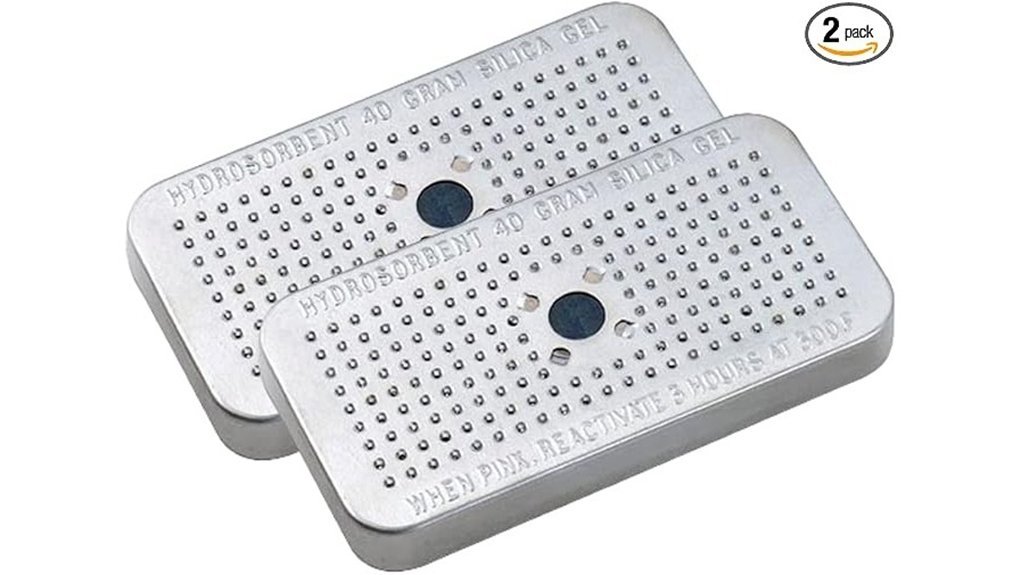
The HYDROSORBENT® Moisture Absorbers use reusable silica gel inside rigid 40-gram canisters. Their compact shape works well in hard camera cases, telescope cases, small safes, and sealed storage boxes where a loose fabric pouch may be less convenient.
The indicator changes from blue to pink as the silica gel absorbs moisture. Reactivation is performed in an oven according to the manufacturer’s instructions. Because the canisters contain metal, they should never be placed in a microwave.
Best For: Small hard cases that need a rigid, reusable moisture absorber.
Pros:
- Compact metal construction protects the silica gel from spills.
- Color indicator makes saturation easier to identify.
- Reusable through oven reactivation.
- Specifically marketed for cameras, telescopes, and safes.
Cons:
- Limited capacity compared with larger desiccant bags.
- Requires oven reactivation and cooling before reuse.
- Does not replace a hygrometer or automatic cabinet control.
LotFancy Rechargeable Silica Gel Packets (15 Pack)

LotFancy Rechargeable Silica Gel Packets come as fifteen 20-gram packs, making them useful when you need small absorbers for individual lens compartments, filter cases, camera drawers, or several sealed containers.
The indicating beads provide a visual reminder when the packets need reactivation. Their smaller size is convenient, but each packet has less moisture capacity than a large 100-gram or 200-gram bag. Use enough packets for the container and confirm performance with a hygrometer.
Best For: Photographers who need small packets for many individual compartments.
Pros:
- Fifteen packets provide flexible placement.
- Reusable instead of disposable after one saturation cycle.
- Color indicator helps with maintenance.
- Resealable outer packaging helps protect unused packets.
Cons:
- Individual packets have modest moisture capacity.
- Several packets may be needed in a larger box.
- Reactivation temperature and method must be followed carefully.
FURWEY Rechargeable Silica Gel Desiccant Packs (6-Pack)
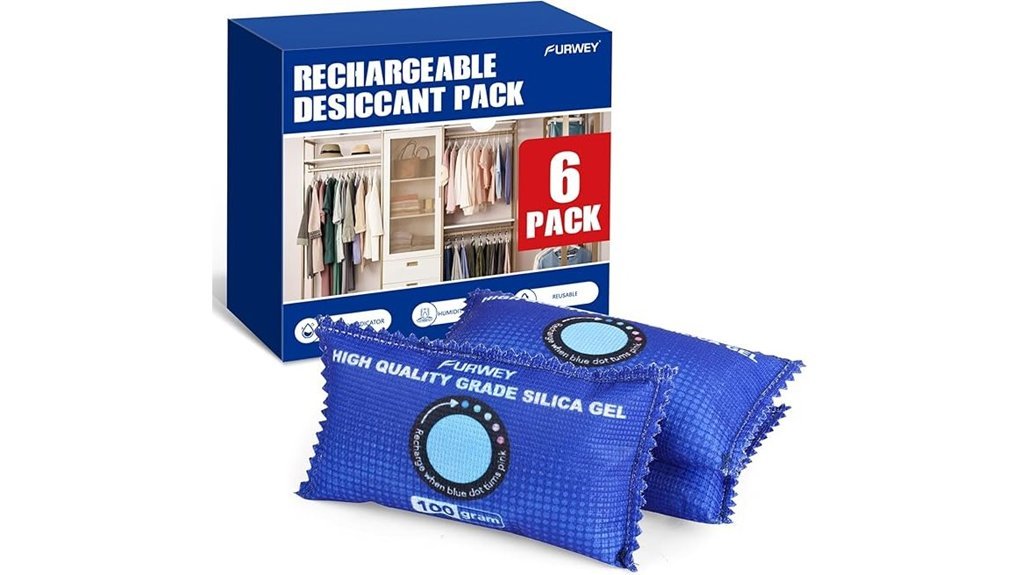
The FURWEY set includes six 100-gram rechargeable desiccant packs. This middle-size format offers more capacity per pack than small lens-compartment packets while remaining easier to distribute than one oversized bag.
A color indicator helps show when the silica gel needs drying. The current listing describes microwave reactivation, so follow the stated heating limits and timing carefully, then allow each pack to cool fully before returning it near camera gear.
Best For: Households or photographers maintaining several camera boxes, drawers, or cases.
Pros:
- Six medium-size packs provide flexible coverage.
- Each 100-gram pack offers more capacity than small compartment packets.
- Rechargeable with a visible status indicator.
- Useful for several sealed camera boxes or other enclosed storage areas.
Cons:
- Microwave reactivation requires careful adherence to the current heating instructions.
- Passive absorption cannot maintain an exact RH setting.
- Performance falls when the container is frequently opened or poorly sealed.
Wisesorb Silica Gel Canisters (Pack of 3)
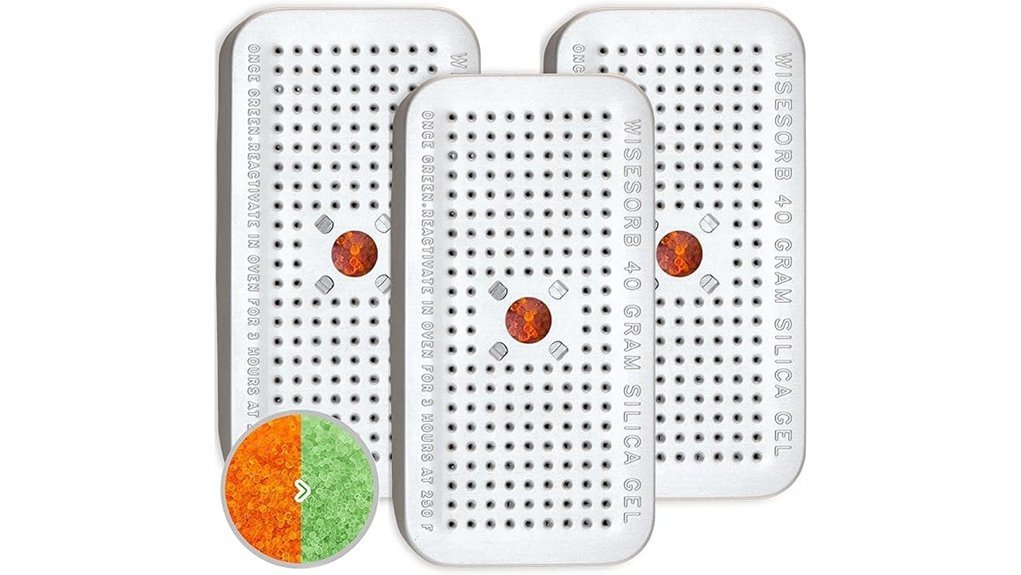
Wisesorb Silica Gel Canisters provide three rigid 40-gram units with indicator beads that change from orange to green. Their aluminum construction helps contain the beads and makes the units suitable for camera cases, document boxes, cabinets, and other small enclosed areas.
The transparent indicator window lets you check each canister without opening it. Reactivation requires an oven within the temperature range specified by the manufacturer. Let the canisters cool completely before returning them to a case with camera gear.
Best For: Photographers who prefer durable metal canisters over fabric packets.
Pros:
- Three reusable canisters for separate storage areas.
- Orange-to-green indicator is easy to inspect.
- Rigid construction reduces spill concerns.
- Compact enough for many hard cases and sealed boxes.
Cons:
- Must be reactivated in an oven, not a microwave.
- Small canisters are not intended for rooms or open shelving.
- A separate hygrometer is still recommended.
Kiorafoto Rechargeable Desiccant Dehumidifier with USB-C Cable
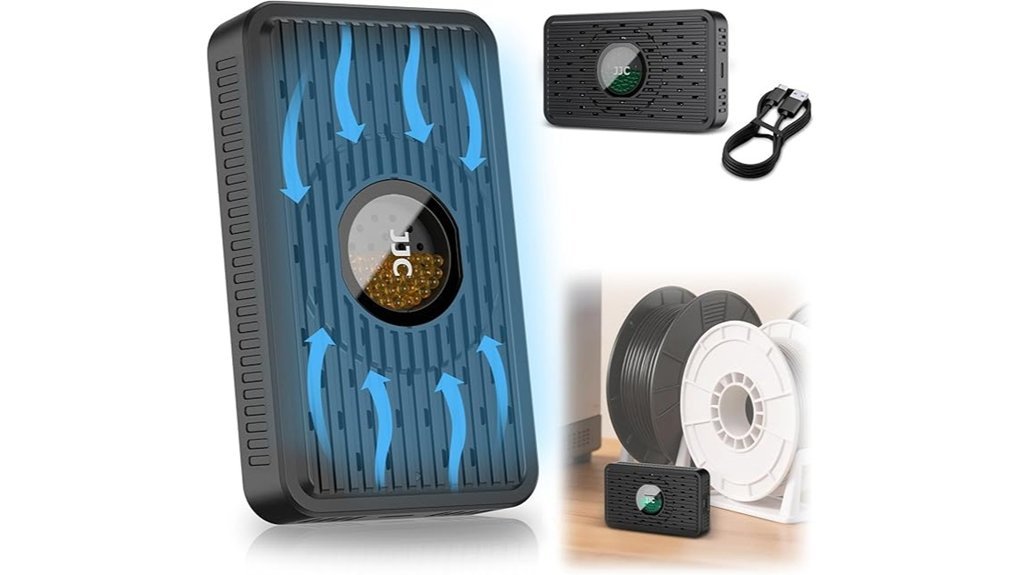
The Kiorafoto Rechargeable Desiccant Dehumidifier combines silica gel with a built-in heating system that is powered through USB-C during reactivation. It absorbs moisture passively while stored with your equipment, so it does not need to remain connected to power during normal use.
The color-changing indicator shows when the desiccant has absorbed moisture. Recharge time varies with saturation and environmental conditions. Remove the unit from the camera case before connecting it to power, place it in a ventilated area, and follow the listing’s charging instructions.
Best For: Travelers who want reusable desiccant without using an oven or microwave.
Pros:
- USB-C reactivation is convenient for travel.
- Compact design fits many sealed cases and storage boxes.
- Visible indicator helps identify saturation.
- No continuous power is required while absorbing moisture.
Cons:
- Cannot be used inside the case while it is heating.
- Manufacturer coverage figures depend heavily on container sealing and ambient humidity.
- Passive absorption cannot hold a selected RH set point the way an electronic dry cabinet can.
Silent Dry Rechargeable Small Dehumidifier
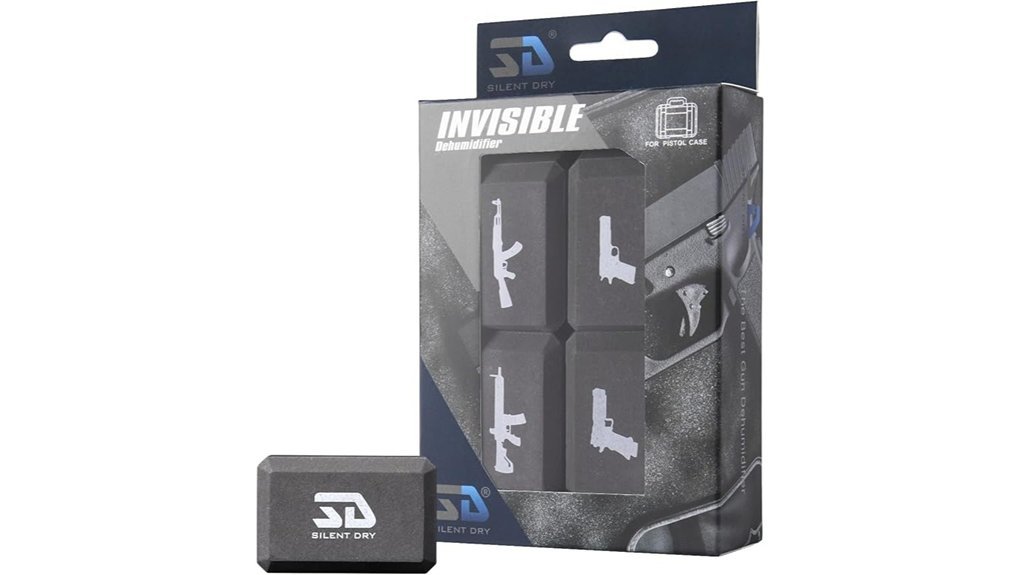
The Silent Dry set contains four compact renewable moisture-absorbing blocks for very small enclosed spaces, with the current listing specifying use in containers up to about 5 liters. Camera storage is included among its intended uses, making it most appropriate for accessory cases, filter containers, or very small sealed camera boxes.
They absorb moisture without cables or batteries and are renewed using the heating method specified by the manufacturer. Their limited coverage makes them unsuitable for a full-size cabinet, room, or loosely closed camera backpack.
Best For: Very small sealed containers up to about 5 liters holding filters, batteries, a compact camera, or other accessories.
Pros:
- Four small blocks can be divided between several containers.
- No power is needed during normal use.
- Compact shape takes up little storage space.
- Reusable when maintained according to the instructions.
Cons:
- Designed only for very small enclosed volumes.
- Does not provide automatic humidity regulation.
- Must be removed from the case for reactivation.
INTBUYING 30L Camera Dry Cabinet with Lock
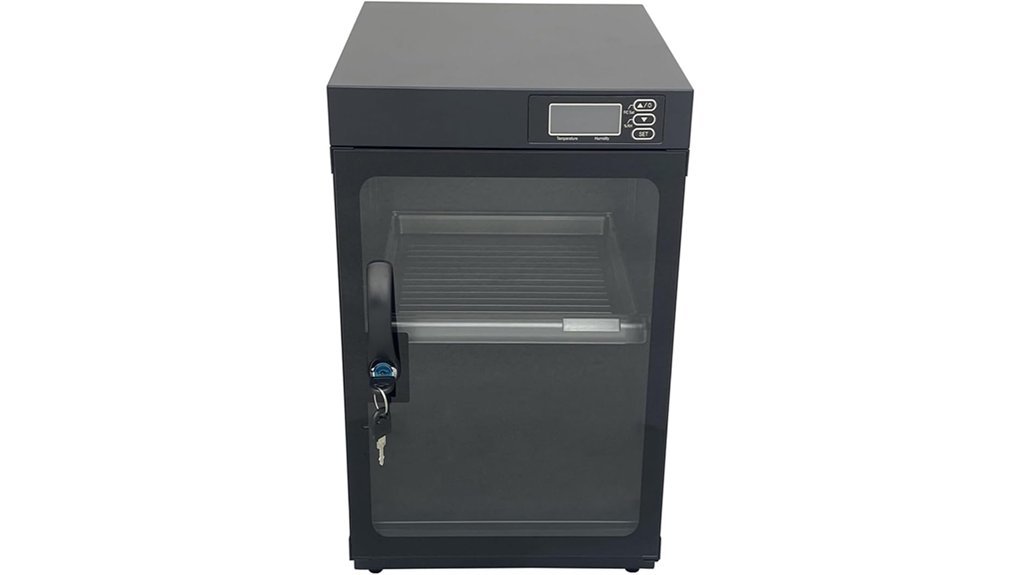
The INTBUYING 30L Camera Dry Cabinet offers electronic humidity control in a compact, locking enclosure. Its toughened glass door, magnetic seal, digital display, and adjustable interior make it suitable for a small camera setup that has outgrown portable desiccant packs.
The current listing specifies an adjustable 25% to 60% RH range and 8-watt operation. For normal camera and lens storage, use a moderate target near 40% to 50% RH, then compare the built-in display with a separate hygrometer after the cabinet has stabilized.
Best For: Photographers who want a small electronic cabinet with a lock and digital controls.
Pros:
- Compact 30-liter format.
- Electronic humidity control and digital monitoring.
- Locking glass door helps protect valuable gear.
- Adjustable interior organization.
Cons:
- Limited space for long lenses or multiple camera bodies.
- Requires an outlet and cannot regulate humidity during a prolonged power loss.
- The listing includes a tight humidity-accuracy claim, so an independent hygrometer is still useful for checking real-world readings.
AUTENS AD-30L Dehumidifying Dry Cabinet
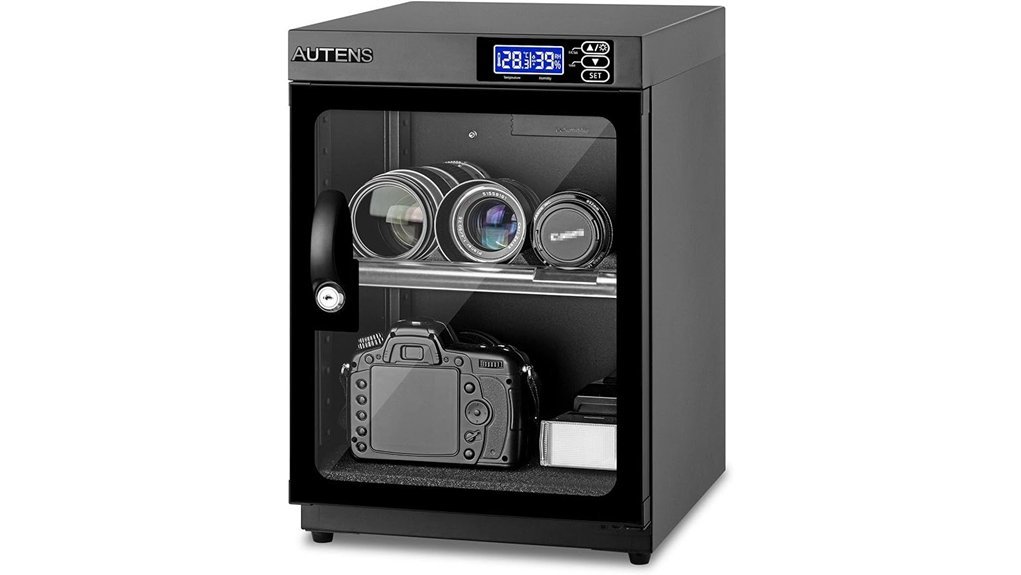
The AUTENS AD-30L Dehumidifying Dry Cabinet combines a digital humidity display, adjustable control, toughened glass, and removable interior storage. Its compact dimensions suit photographers who need more control than a basic dry box but do not have space for a tall cabinet.
Retailer metadata for this ASIN can show conflicting capacity fields. Confirm that the selected model is the AD-30L, then compare its listed dimensions and interior layout with your largest lens before purchasing.
Best For: Small collections that need an electronically regulated desktop cabinet.
Pros:
- Compact cabinet with digital temperature and humidity information.
- Adjustable shelf and protective interior pads.
- Low-power operation listed for the AD-30L model.
- Locking door helps limit accidental access.
Cons:
- Variation and capacity information should be checked carefully.
- Thirty liters may not provide enough expansion space for future equipment.
- Built-in humidity accuracy should be periodically compared with another hygrometer.
INTBUYING 80L Camera Dry Cabinet with Lock
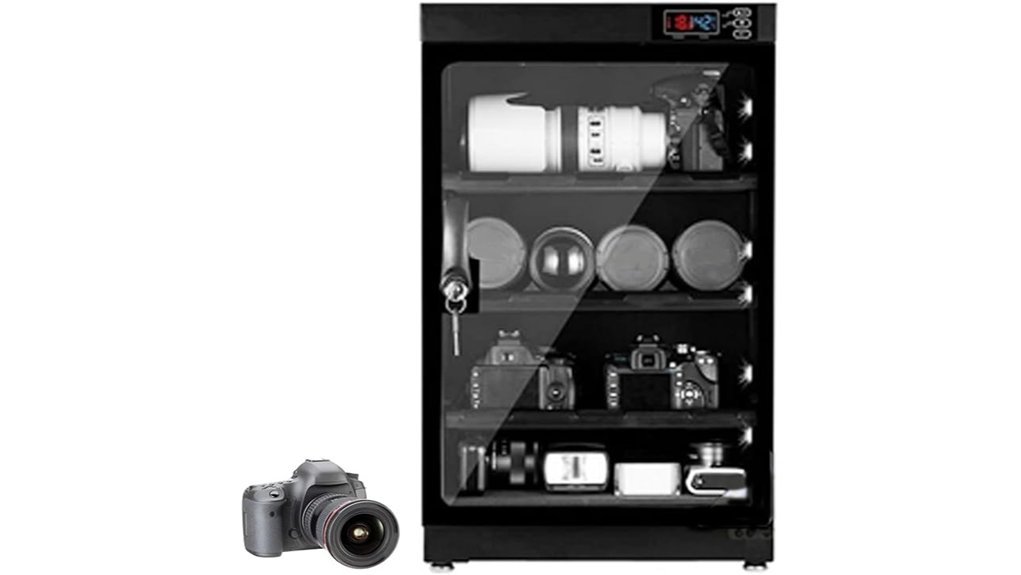
The INTBUYING 80L Camera Dry Cabinet provides substantially more room than a 30L model while remaining smaller than a full-height studio cabinet. Its four storage levels can accommodate several camera bodies, lenses, flashes, and related electronics.
The touch control panel lets you set the internal humidity within the cabinet’s supported range. The listing also describes low-power operation, a magnetic glass door, and a lock. Ignore unrelated dehumidifier-capacity fields that may appear in retailer metadata, as this is a storage cabinet rather than a room dehumidifier with a water tank.
Best For: Photographers expanding beyond one camera body and a few lenses.
Pros:
- Eighty-liter capacity with multiple storage levels.
- Electronic humidity control and digital monitoring.
- Lockable door and toughened glass construction.
- More expansion room than a compact desktop cabinet.
Cons:
- Heavier and harder to relocate than a 30L cabinet.
- Requires floor or sturdy furniture space near an outlet.
- Manufacturer accuracy claims should be checked with an independent hygrometer.
FORSPARK 125L Dual-Core Camera Dehumidifier Dry Cabinet
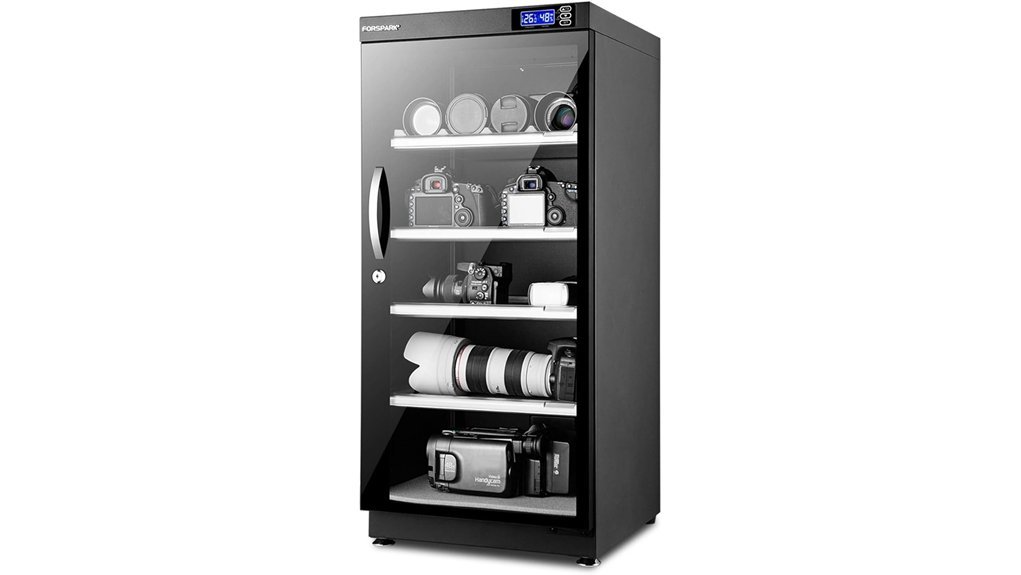
The FORSPARK 125L Dual-Core Camera Dehumidifier Dry Cabinet is intended for photographers with several bodies, large lenses, drones, or collectibles. Four adjustable shelves create five storage levels, making the cabinet easier to organize than one large open compartment.
The current listing specifies electronic humidity control from 25% to 60% RH, interior LED lighting, a key lock, and 15-watt operation. For camera storage, there is usually no need to use the lowest setting; choose a moderate target and verify it with a separate hygrometer.
Best For: Serious hobbyists and professionals who need organized storage for a large collection.
Pros:
- Large 125-liter interior.
- Four adjustable shelves provide flexible organization.
- LED lighting improves visibility.
- Locking door adds basic equipment security.
Cons:
- Requires more floor space than an 80L cabinet.
- Heavier and less convenient to move after loading.
- Large capacity may be unnecessary for a single-camera setup.
Lectronify 180L Electronic Dry Cabinet for Cameras & Electronics
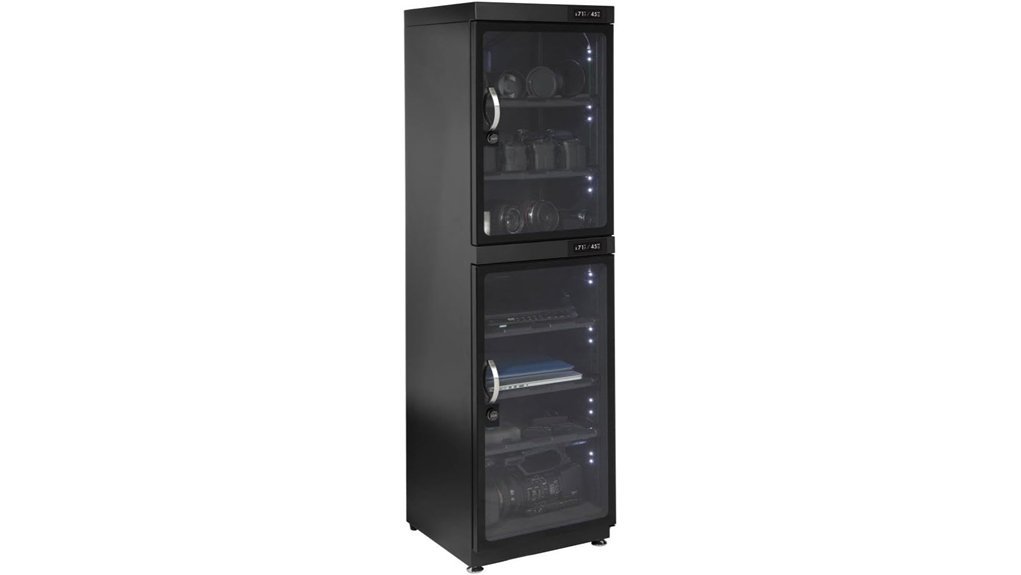
The Lectronify 180L Electronic Dry Cabinet is the largest option retained in this guide. Its dual-zone layout lets users organize different equipment groups separately, while five adjustable shelves provide room for cameras, long lenses, drones, audio equipment, and other moisture-sensitive electronics.
The current listing specifies independently controlled dual zones with a 35% to 60% RH range, plus a touchscreen, internal lighting, an airtight glass door, and a three-digit combination lock. Camera and lens users should normally select a moderate target near 40% to 50% RH.
Best For: Studios, collectors, and professionals with a substantial amount of equipment.
Pros:
- Large 180-liter storage capacity.
- Dual-zone humidity control.
- Five adjustable shelves and interior lighting.
- Combination lock avoids the need to manage cabinet keys.
Cons:
- Large footprint requires careful room measurement.
- Heavy cabinet may be difficult to relocate.
- Higher initial cost than compact cabinets or passive desiccant storage.
Factors to Consider When Choosing a Camera Dehumidifier
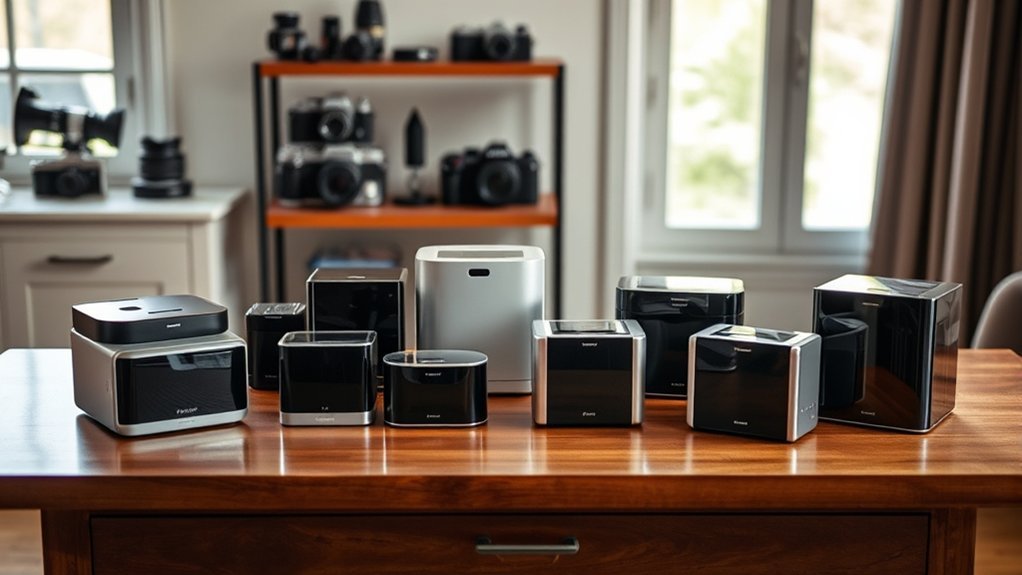
Choose the Right Storage Type
Rechargeable silica gel is a practical option for a tightly closed camera-bag compartment, hard case, drawer, or airtight plastic box. It is inexpensive and portable, but it cannot automatically hold an exact humidity level. Pair passive desiccant with a digital hygrometer and check it regularly.
An electronic camera dry cabinet is better for several bodies and lenses because it monitors and regulates humidity automatically. It also provides shelves, easier access, and better organization.
Target a Stable Humidity Level
For normal camera and lens storage, approximately 40% to 50% RH is a practical target. Prolonged high humidity can encourage lens fungus and corrosion, while pushing far below the normal recommended range usually offers no added storage benefit. Follow your camera or lens manufacturer’s storage guidance if it specifies a different range.
Place a separate hygrometer in passive storage boxes. With an electronic cabinet, use an independent hygrometer occasionally to check whether the built-in reading is reasonably accurate.
Match Capacity to Your Equipment
Measure your longest lens, tallest camera body, and widest accessory before buying a cabinet. Do not rely on liter capacity alone. Shelf spacing, door clearance, and internal depth determine whether mounted cameras and telephoto lenses will fit comfortably.
- Desiccant packs: Best for individual bags and small sealed boxes.
- 30L cabinet: Suitable for a modest collection.
- 80L cabinet: Better for several bodies, lenses, and flashes.
- 125L to 180L cabinet: Intended for large or studio collections.
Check the Seal and Airflow
Passive desiccant works poorly in an open cabinet or frequently opened backpack because humid room air continually replaces the dried air. Use a properly closed container and avoid overpacking it. Leave enough space around equipment for air to circulate.
Inspect electronic cabinet door seals before loading expensive gear. A damaged or misaligned seal can make it harder for the cabinet to reach and maintain the selected humidity.
Review Reactivation and Maintenance
Not every desiccant product uses the same reactivation method. Some fabric packets can be heated in a microwave, some require an oven, and metal canisters must never be microwaved. USB-C models use an internal heater and must be removed from the storage case before charging.
Follow the exact time, temperature, cooling, and safety directions supplied with the product. Replace desiccant that is damaged, leaking, discolored in an unexpected way, or unable to return to its ready-state indicator.
Consider Security and Access
A cabinet lock can discourage casual handling, but it is not a replacement for a rated security safe. Adjustable padded shelves, interior lights, and a clear humidity display often provide more day-to-day value than decorative features.
Frequently Asked Questions
What Is the Ideal Humidity Level for Camera Storage?
A practical target for most cameras and lenses is approximately 40% to 50% relative humidity. Stability matters more than forcing the cabinet to its minimum setting. Avoid prolonged high humidity, and follow the equipment manufacturer’s storage guidance if it specifies a different range.
How Often Should I Recharge My Desiccant Packs?
Recharge them when the product’s indicator shows saturation or when your hygrometer begins rising above the desired range. The interval may be days, weeks, or months depending on pack size, container sealing, local humidity, and how often the case is opened.
Can Camera Storage Be Too Dry?
It can be drier than necessary. A camera cabinet is not intended to create the driest environment possible. For ordinary camera and lens storage, maintain a moderate setting near 40% to 50% RH unless the equipment manufacturer recommends otherwise.
Are Desiccant Packs Enough for Long-Term Storage?
They can be sufficient for a small collection inside a well-sealed box, provided you also use a hygrometer and maintain the packs. An electronic dry cabinet is easier to manage when you own several cameras and lenses or live in a consistently humid climate.
Can I Store Camera Gear in Its Normal Bag?
A camera bag is convenient for transport but may not be well sealed enough for dependable humidity control. For long-term storage, place the equipment in an electronic cabinet or a sealed dry box. Store the empty bag in a ventilated, dry area.
Should I Remove the Battery Before Long-Term Storage?
Remove batteries for extended storage, especially if the camera will not be checked regularly. Use body caps and rear lens caps where available, and keep equipment away from direct sunlight, heaters, and rapid temperature changes.
What Happens to an Electronic Dry Cabinet During a Power Outage?
The cabinet will stop actively regulating humidity, but a well-sealed door can slow the change. Keep the door closed during the outage. After power returns, confirm the selected setting and allow the cabinet time to stabilize before judging its performance.
Do I Need a Separate Hygrometer?
A separate hygrometer is strongly recommended for passive dry boxes. It is also useful for occasionally checking an electronic cabinet’s built-in display, since humidity sensors can differ by several percentage points or drift over time.
Final Recommendation
The right camera dehumidifier depends mainly on the size of your collection and the container you use. For a sealed camera-bag compartment or hard case, the Wisesorb 200g packs, HYDROSORBENT canisters, or LotFancy packets provide flexible passive protection when paired with a hygrometer.
For compact automatic control, the INTBUYING 30L Camera Dry Cabinet is a practical starting point for a modest collection. Choose the INTBUYING 80L or FORSPARK 125L when you need more room, and consider the Lectronify 180L only when you have measured space for a studio-size cabinet.
Whichever option you choose, maintain approximately 40% to 50% RH, check the humidity regularly, and never place visibly wet equipment directly into sealed long-term storage.