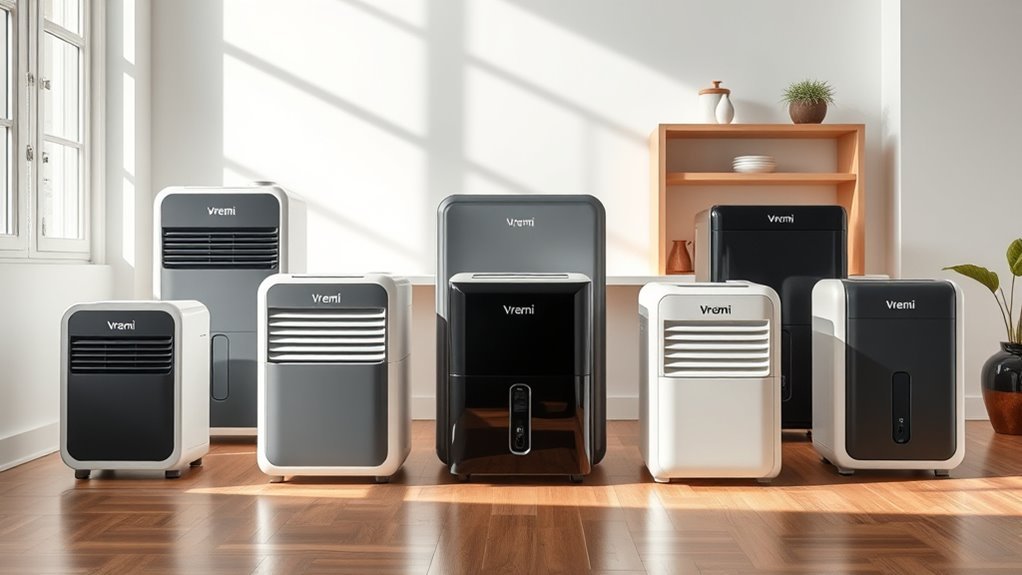
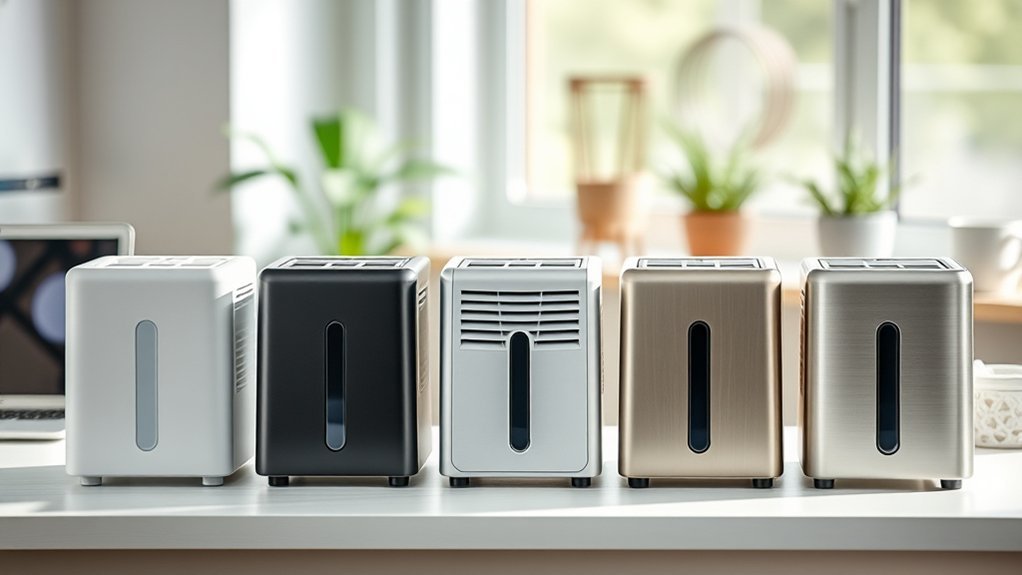
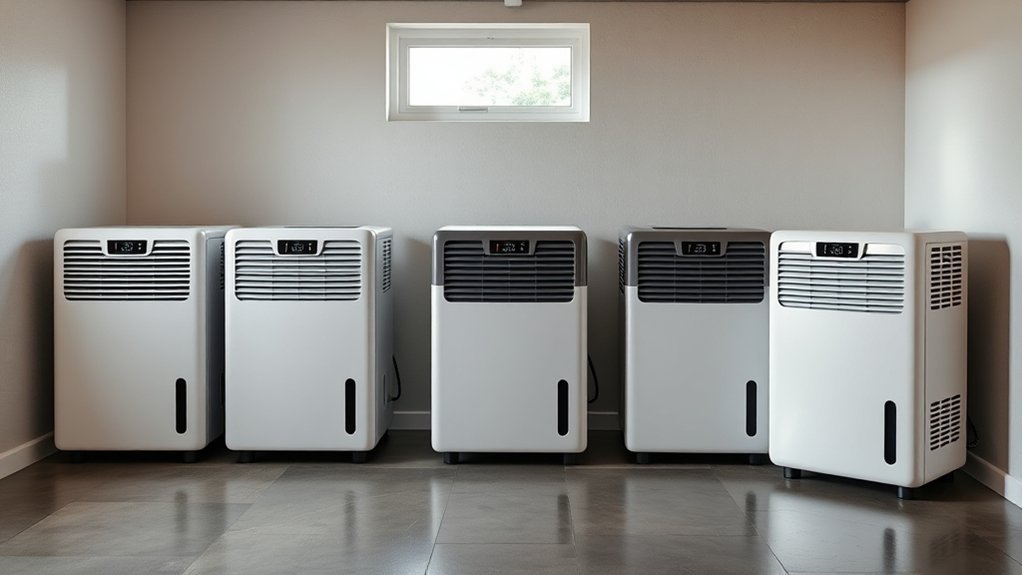
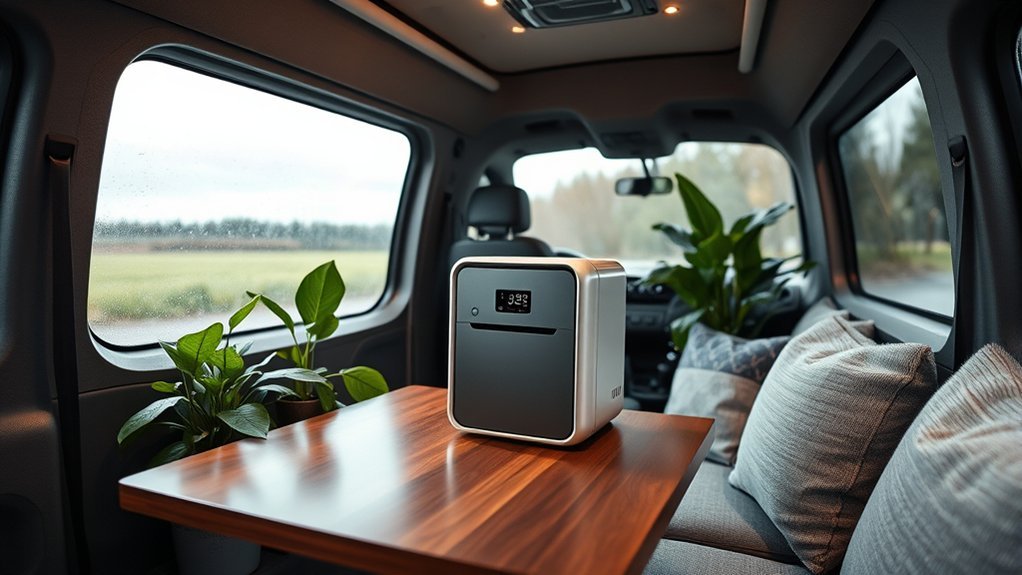
Looking for the best personal dehumidifiers for a bedroom, bathroom, closet, RV, or other small space? The right choice depends on more than the advertised room size. Daily moisture-removal capacity, tank size, operating noise, room temperature, and humidity all affect real-world performance. In this guide, the TENKER is the higher-capacity powered option, MORFY balances tank size and bedroom-friendly operation, TABYIK and Erizolt suit smaller rooms, and ATKMAYI is a cordless desiccant option for tiny enclosed spaces rather than an entire room.
Quick Verdict
Best overall for higher moisture removal: TENKER, thanks to its 77 oz tank, dual-fan design, and claimed removal of up to 35 oz per day under warm, humid test conditions.
Best balanced bedroom pick: MORFY, with a 60 oz tank and a compact design that is easier to place than a full-size compressor unit.
Best value for a small room: TABYIK, a simple 35 oz Peltier model with auto shut-off and low stated energy use.
Best for very quiet compact use: Erizolt, which is designed for bedrooms, bathrooms, offices, and RVs up to the manufacturer’s stated 350 sq ft coverage.
Best cordless option for closets: ATKMAYI, but only for tiny enclosed areas up to 35 sq ft. It is not a substitute for a powered room dehumidifier.
Quick Comparison of the Best Personal Dehumidifiers
| Product | Best For | Tank / Type | Claimed Maximum Removal | Check Details |
|---|---|---|---|---|
| TENKER | Higher-capacity compact use | 77 oz powered Peltier unit | Up to 35 oz/day in specified test conditions | Check on Amazon |
| MORFY | Bedrooms and medium-size enclosed rooms | 60 oz powered Peltier unit | Up to about 25 oz/day in favorable conditions | Check on Amazon |
| TABYIK | Small bedrooms, bathrooms, RVs, and closets | 35 oz powered Peltier unit | Up to 16 oz/day at 86°F and 80% RH | Check on Amazon |
| Erizolt | Quiet compact use in smaller rooms | 35 oz powered Peltier unit | Up to 16 oz/day at stated lab conditions | Check on Amazon |
| ATKMAYI | Closets, cabinets, cars, and other tiny enclosed spaces | Renewable silica-gel desiccant | Passive absorption; not directly comparable to powered units | Check on Amazon |
Dehumidifier for Home and Bathroom (35oz, White)
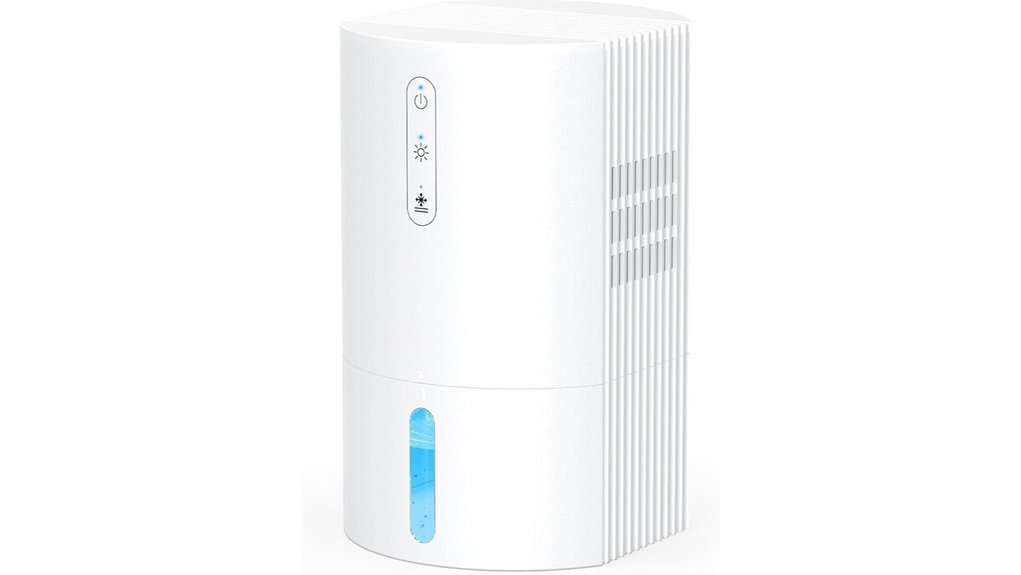
Best Quiet Compact Pick
The Erizolt 35 oz dehumidifier is a compact powered option for a bedroom, bathroom, office, closet, or RV. The manufacturer states coverage up to 350 sq ft and moisture removal up to 16 oz per day under warm, humid lab conditions. Its small footprint and approximately 2 lb weight make it easy to move between rooms.
The unit includes a 35 oz transparent collection tank, automatic shut-off when the tank is full, and a color-changing night light. Its stated low-noise operation makes it more suitable for sleeping areas than many larger compressor dehumidifiers, although actual sound can vary with placement and room acoustics.
Best For: Shoppers who want a portable mini dehumidifier for a smaller enclosed room and prefer simple controls, low noise, and auto shut-off.
Why You’ll Like It: It solves mild moisture problems without taking up much floor or counter space, and the visible tank makes it easy to know when it needs emptying.
Who Should Avoid It: Anyone dealing with a wet basement, ongoing leaks, heavy condensation, or a large open-plan area should choose a higher-capacity compressor dehumidifier instead.
Pros:
- Compact and lightweight for moving between rooms.
- Stated quiet operation of about 25 dB for bedroom-friendly use.
- Auto shut-off helps prevent tank overflow.
- Transparent 35 oz tank and optional color-changing light.
Cons:
- The 16 oz/day rating is a best-case claim and will be lower in cooler or less humid rooms.
- Not designed for serious water intrusion or whole-basement moisture control.
- No humidistat or continuous-drain hose for set-and-forget operation.
Dehumidifier for Bedroom and Home (35 OZ)
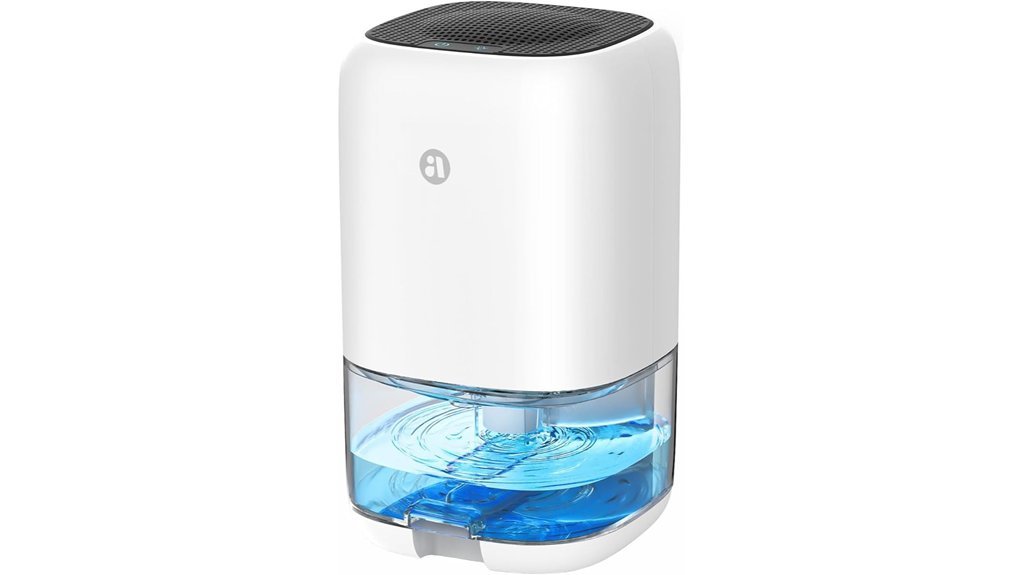
Best Value for Small Rooms
The TABYIK 35 oz Peltier dehumidifier is designed for small enclosed spaces such as bedrooms, bathrooms, closets, and RVs. It measures about 5.9 × 5.9 × 10.1 inches, weighs about 2.19 lb, and has a built-in handle, so it is easy to place on a shelf, counter, or small table.
According to the manufacturer, it can collect up to 16 oz (450 ml) of water in 24 hours at 86°F and 80% relative humidity while using less than 1 kWh per day. It has a 1,000 ml transparent tank, auto shut-off, a red full-tank warning, and a seven-color light that can be turned off.
Best For: Buyers who want an affordable, straightforward mini dehumidifier for mild humidity in a small room.
Why You’ll Like It: It combines a compact body, visible water level, simple one-button operation, and low stated energy use.
Who Should Avoid It: Buyers who need a humidity set point, app control, continuous drainage, or fast drying after a leak.
Pros:
- Low stated daily energy consumption for a plug-in mini dehumidifier.
- Quiet operation of about 28 dB under the manufacturer’s stated conditions.
- Compact design with a built-in handle.
- Auto shut-off and visible water level improve day-to-day convenience.
Cons:
- Single-speed operation offers limited control.
- No built-in humidistat or smart-home integration.
- The advertised 280 sq ft coverage should be treated as a maximum for mild humidity, not severe dampness.
MORFY Compact Dehumidifier for Bedroom and Bathroom
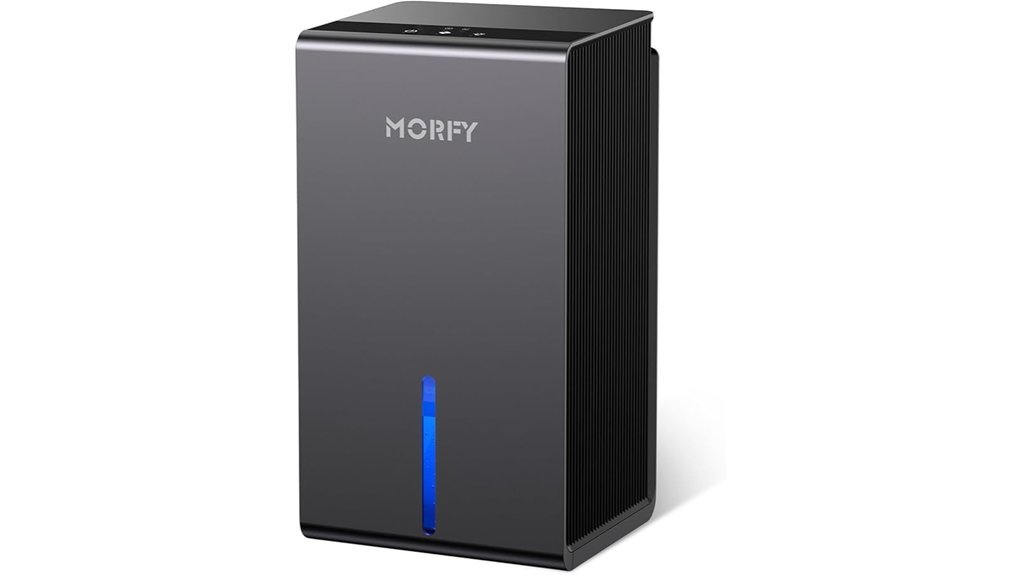
Best Balanced Bedroom Pick
The MORFY compact dehumidifier offers more tank capacity than the 35 oz models while remaining small enough for a bedroom, bathroom, kitchen, laundry area, or RV. It measures about 5.3 × 6.4 × 11.5 inches, weighs about 3.2 lb, and uses a 60 oz (1,800 ml) transparent collection tank.
Its listed maximum moisture removal is about 25 oz (roughly 0.74 L) per day in favorable conditions, with advertised coverage up to 500 sq ft. The unit also includes automatic shut-off, a visible water level, quiet operation, and seven ambient-light choices.
Best For: Buyers who want a larger tank than a typical mini dehumidifier without stepping up to a bulky compressor model.
Why You’ll Like It: The 60 oz tank reduces emptying frequency, while the narrow shape is easy to place in a bedroom or bathroom.
Who Should Avoid It: Choose a compressor dehumidifier if you need a verified pint-per-day capacity for a basement, continuous drainage, or reliable performance in cool conditions.
Pros:
- 60 oz transparent tank is larger than many compact Peltier models.
- Compact footprint suits counters, shelves, and smaller rooms.
- Automatic shut-off helps prevent overflow.
- Advertised quiet operation and switchable ambient lighting suit bedrooms.
Cons:
- The advertised 500 sq ft coverage may overstate real-world effectiveness in open or very damp rooms.
- No continuous drain connection or adjustable humidity target.
- Moisture removal drops as temperature and humidity decrease.
ATKMAYI Rechargeable Dehumidifier for Closets and Small Spaces
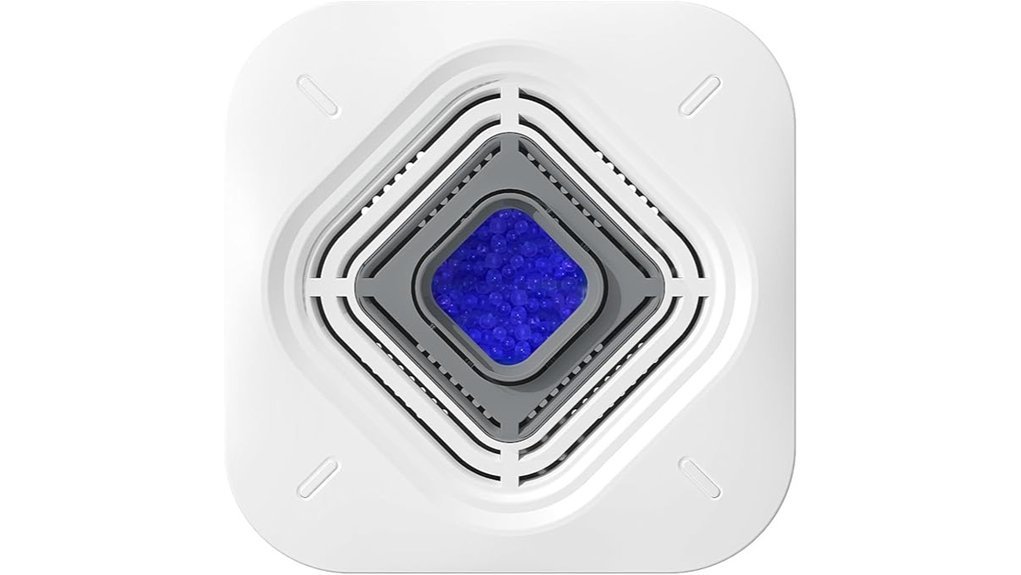
Best Cordless Closet Pick
The ATKMAYI is different from the other products in this guide. It is a renewable silica-gel desiccant unit, not a fan-driven Peltier room dehumidifier. Its compact 5 × 5 × 1.38-inch design and detachable hook make it suitable for closets, cabinets, wardrobes, cars, bookcases, and other enclosed spaces up to the manufacturer’s stated 35 sq ft.
The silica-gel beads passively absorb moisture without a fan, tank, or operating noise. A color indicator shows when the beads are saturated. The unit is then plugged in to heat and reactivate the desiccant; confirm the current reactivation time in the product instructions because listings can vary.
Best For: Cordless moisture control in a closet, cabinet, safe, car, or other tiny enclosed space.
Why You’ll Like It: It works silently without a cord during normal use and can be renewed instead of discarded after one cycle.
Who Should Avoid It: Anyone who needs measurable room-scale water removal, automatic humidity control, or rapid drying should choose a powered unit.
Pros:
- Silent passive operation with no fan or vibration.
- Compact, cordless design with a hanging hook.
- Reusable silica-gel system reduces disposable moisture-absorber waste.
- No water tank to spill.
Cons:
- Limited to very small enclosed spaces up to about 35 sq ft.
- Passive absorption is much slower than a powered dehumidifier.
- Requires periodic plug-in reactivation.
- Not suitable as the primary humidity solution for a bathroom, bedroom, or basement.
TENKER Dehumidifier for Home with 77oz Water Tank
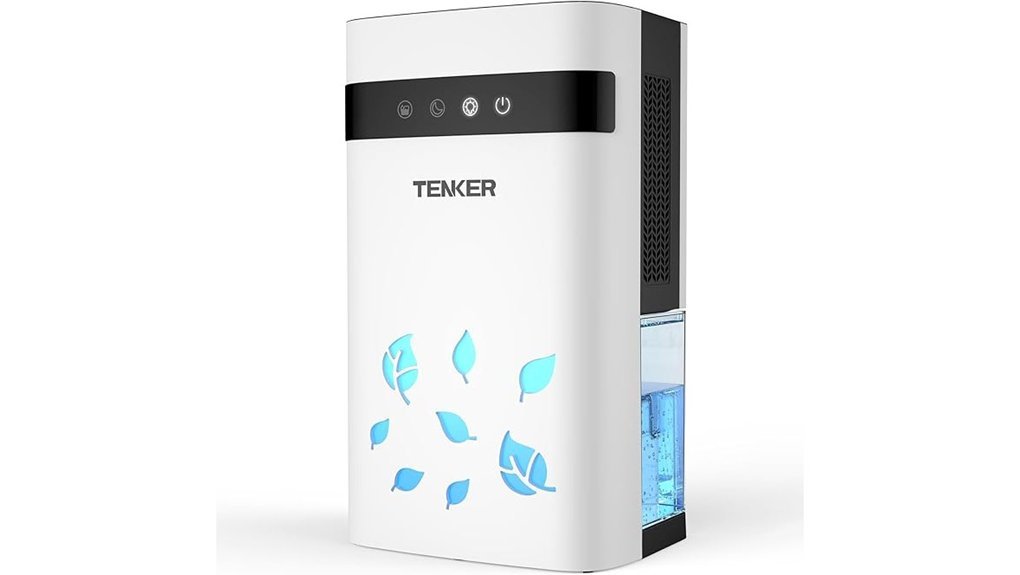
Best Overall Higher-Capacity Pick
The TENKER QIG-D05 is the most capable powered model in this comparison based on its listed maximum extraction rate and tank size. It uses dual semiconductor condensers and dual fans, has a 77 oz (2,200 ml) tank, and is rated to remove up to 35 oz (about 1.8 pints) of water per day at 86°F and 80% relative humidity.
It offers a higher-speed mode for faster moisture collection and a sleep mode listed below 30 dB. The unit also includes auto shut-off, a red full-tank warning, a recessed carrying handle, and a seven-color LED light that can be turned off.
Best For: Buyers who want the highest claimed moisture-removal rate and largest tank among these compact powered models.
Why You’ll Like It: The larger tank and two operating modes reduce two common mini-dehumidifier frustrations: frequent emptying and having only one fan speed.
Who Should Avoid It: Despite the advertised coverage up to 1,000 sq ft, its 1.8-pint/day maximum is still far below a typical full-size compressor dehumidifier. It is not the best choice for a wet basement or major moisture problem.
Pros:
- Largest tank in this comparison at 77 oz.
- Claimed removal up to 35 oz per day in warm, humid test conditions.
- Two modes, including a sleep setting listed below 30 dB.
- Auto shut-off, visible tank, carry handle, and switchable LED light.
Cons:
- The 1,000 sq ft coverage claim should not be treated as equivalent to a high-capacity compressor unit.
- No built-in humidistat or continuous drain connection.
- At about 88 watts, it uses more power than smaller single-condenser mini models.
Factors to Consider When Choosing a Personal Dehumidifier
A compact dehumidifier can help with mild humidity, condensation, and musty odors in a small enclosed area, but choosing the right type is essential. Use the points below to compare realistic performance rather than relying only on an advertised square-foot number.
Choose the Right Dehumidifier Type
Peltier or thermoelectric models use a cooled plate and fan to condense water. They are compact and usually quieter than compressor units, but their water-removal capacity is limited and falls in cooler conditions. Renewable desiccant units use silica gel and are best for closets, cabinets, safes, and cars. Compressor dehumidifiers are larger and louder but are the better choice for basements, laundry rooms, flood cleanup, or persistent high humidity.
Compare Daily Removal, Not Just Room Coverage
Daily moisture removal is the most useful performance number. Compare ounces, milliliters, or pints collected per 24 hours and note the test conditions. A claim measured at 80% relative humidity in a warm room represents a best-case scenario. The same unit will collect less water in a 65°F room at 55% relative humidity.
Advertised square-foot coverage is not standardized across every mini dehumidifier listing. Room layout, ceiling height, air leakage, temperature, and the moisture source all affect results. For a large open room or visible dampness, choose by verified pint-per-day capacity rather than the largest square-foot claim.
Match the Unit to the Moisture Problem
- Closet, cabinet, or car: A renewable silica-gel unit may be enough for mild trapped moisture.
- Small bedroom, bathroom, or RV: A 35 oz Peltier model can help with mild humidity when doors and windows stay mostly closed.
- Larger bedroom or medium enclosed room: A dual-condenser model with a 60–77 oz tank offers more useful capacity.
- Basement, leak, or persistent condensation: Skip mini models and use a properly sized compressor dehumidifier after fixing the moisture source.
Check Noise and Sleep Modes
For a bedroom, compare the stated decibel rating and check whether it applies to the normal mode or only the sleep mode. Placement also matters: a unit can sound louder on a hollow shelf or uneven surface. Set it on a stable, level surface with enough clearance around the air inlet and outlet.
Understand Tank Capacity and Emptying Frequency
Tank size does not equal dehumidification power, but it determines how often the unit may shut off. A 35 oz tank paired with a maximum 16 oz/day removal rate would take a little more than two days to fill at that maximum rate, not one day. A 77 oz tank paired with a 35 oz/day maximum also holds a little more than two days of collected water. In real rooms, fill time may be longer because extraction usually drops as humidity decreases.
Compare Power Use Carefully
Do not assume every compact thermoelectric model has an ENERGY STAR rating. ENERGY STAR certification is commonly used for refrigerant-based portable and whole-home dehumidifiers, while small Peltier and passive desiccant models may not be covered or certified in the same way. For these products, compare the listed wattage or daily kWh consumption, moisture removed per day, auto shut-off, and whether a lower-power mode is available.
Bathroom Safety and Placement
Keep any plug-in dehumidifier away from sinks, tubs, shower spray, and standing water. Follow the manufacturer’s clearance and electrical instructions, use a stable surface, and do not block the vents. A dehumidifier can help manage airborne moisture, but a working exhaust fan and repair of leaks remain the first steps for bathroom dampness.
- Measure the room and identify the actual moisture source.
- Check the maximum ounces or pints removed per day and the test conditions.
- Confirm tank size, auto shut-off, noise mode, wattage, and cord length.
- Choose a humidistat and continuous drain if you need long unattended operation.
- Use a hygrometer to track whether the room stays near 30%–50% relative humidity.
Frequently Asked Questions
How Often Should I Empty the Water Tank?
Empty it when the full-tank light appears or before leaving the unit unattended for a long period. The schedule depends on tank size, room humidity, temperature, and the unit’s actual collection rate. During the first few days, check the tank daily to learn how quickly it fills in your space.
Can Dehumidifiers Reduce Allergens in the Air?
A dehumidifier does not filter allergens out of the air. However, keeping indoor relative humidity around 30%–50% can make conditions less favorable for mold growth and dust mites. Existing mold must still be cleaned safely, and leaks or water damage must be repaired.
Are Personal Dehumidifiers Energy-Efficient?
Compact Peltier models usually draw less power than full-size compressor models, but they also remove far less water. Compare energy use with moisture-removal capacity rather than wattage alone. A low-watt unit is not efficient if it runs constantly without reaching the desired humidity.
Do They Produce Noise When Operating?
Powered mini dehumidifiers use a fan and produce some sound, often described by manufacturers as roughly 25–35 dB in low or sleep mode. Passive silica-gel units are silent during normal moisture absorption but require periodic plug-in reactivation.
What Maintenance Is Required for Personal Dehumidifiers?
Unplug the unit before cleaning. Empty and rinse the tank regularly, wipe dust from the air inlet and outlet, clean any removable filter according to the manual, and make sure the tank is seated correctly. Do not drink or cook with collected water.
Can a Mini Dehumidifier Prevent Mold?
It can help reduce excess humidity, but it cannot guarantee mold prevention or remove existing mold. Fix leaks, improve ventilation, dry wet materials promptly, and use a hygrometer to confirm that relative humidity stays below 60% and ideally around 30%–50%.
When Should I Buy a Compressor Dehumidifier Instead?
Choose a compressor model when you have a basement, a large open room, persistent condensation, visible dampness, laundry moisture, or a need for continuous drainage and a precise humidity setting. Mini Peltier units are best for mild moisture in smaller enclosed spaces.
Conclusion
The best personal dehumidifier depends on the size of the space and the seriousness of the moisture problem. The TENKER is the strongest compact powered option in this group based on its claimed 35 oz/day maximum and 77 oz tank. The MORFY is a balanced choice for a bedroom, while TABYIK and Erizolt are practical for smaller rooms where portability and quiet operation matter.
Choose the ATKMAYI only for a closet, cabinet, car, or similarly tiny enclosed area. For a wet basement, water leak, widespread condensation, or recurring mold problem, a compact personal dehumidifier is not enough—repair the moisture source and use a properly sized compressor unit. Confirm the current product listing, specifications, and warranty before purchasing.