Affiliate disclosure: This article contains Amazon affiliate links. We may earn a commission from qualifying purchases at no extra cost to you.
The best dehumidifier for a shed depends on more than advertised square-foot coverage. Shed size, air leaks, insulation, outdoor temperature, drainage access, and the amount of moisture entering the space all affect real-world performance. The four electric models below are practical candidates for an enclosed, weather-tight shed with a safe power supply. For many small or medium sheds with moderate dampness, a 34-pint-class model is a sensible starting point. The larger Waykar 80-Pint model is better suited to a larger, insulated workshop or an outbuilding with a heavier moisture load.
Quick Verdict
- Best for most sheds: Waykar 34-Pint Dehumidifier
- Best value 34-pint option: VEAGASO 2500 Sq.Ft Dehumidifier
- Best quiet alternative: KNKA 2500 Sq.Ft Dehumidifier
- Best for a large or persistently damp shed: Waykar 80-Pint Dehumidifier
Important: These are indoor-style compressor dehumidifiers. Use them only in a dry, enclosed shed and never expose them to rain, standing water, or temperatures outside the operating range stated in the exact product manual.
Quick Comparison
| Product | Manufacturer-Rated Capacity | Drainage | Best For | Main Limitation | Amazon |
|---|---|---|---|---|---|
| Waykar 34-Pint | Up to 34 pints/day in hot, very humid test conditions | 0.66-gallon tank or gravity hose | Most small and medium sheds | Real moisture removal falls in cooler conditions | Check Details |
| VEAGASO 34-Pint | Up to 34 pints/day under manufacturer test conditions | 0.53-gallon tank or gravity hose | Value-focused buyers | 2,500-sq.-ft. marketing coverage is not a shed sizing guarantee | Check Details |
| KNKA 34-Pint | Up to 34 pints/day at 95°F and 90% RH | 0.79-gallon tank or included gravity hose | Noise-sensitive workshops | 37 dB figure is a manufacturer claim | Check Details |
| Waykar 80-Pint | Up to 80 pints/day at 95°F and 90% RH; 62 pints/day at 86°F and 80% RH | Tank or gravity hose | Large, insulated, very damp sheds | More capacity than many ordinary garden sheds need | Check Details |
Waykar 80-Pint Energy Star Home Dehumidifier
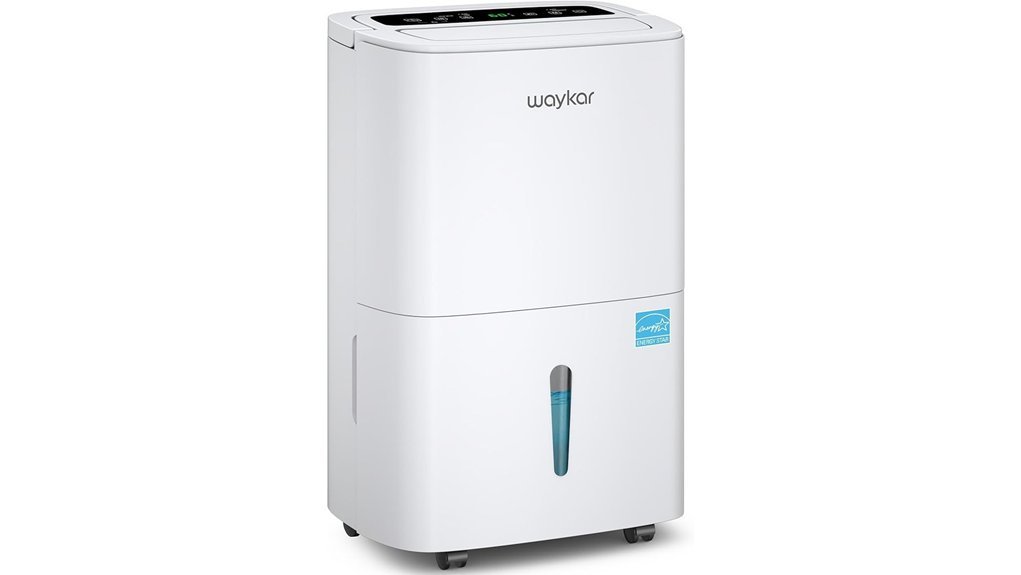
The Waykar 80-Pint model is the strongest option in this roundup for a large, insulated shed, workshop, or outbuilding with a persistent moisture load. The current listing rates this 80-pint variation to remove up to 80 pints per day at 95°F and 90% relative humidity, and up to 62 pints per day at 86°F and 80% relative humidity. Those are warm, humid conditions, so actual water removal can be substantially lower in a cool shed.
The current listing also describes adjustable humidity control, automatic defrost, portability, and continuous drainage. Continuous gravity drainage is usually the better setup for an unattended shed, provided the hose can run downhill to a safe discharge point without kinks, backups, or freezing risk.
Why You’ll Like It
- Higher advertised moisture-removal capacity for a larger space or heavier dampness.
- Continuous drainage can reduce the need to monitor and empty the bucket.
- Auto-defrost helps manage coil frost within the unit’s approved operating range.
- Adjustable humidity control lets you avoid running the machine continuously when it is not needed.
Best For: A large, weather-tight shed or workshop with electricity, drainage access, and a persistent moisture problem.
Who Should Avoid It: Buyers with a small garden shed, no safe drain route, active water leaks, or winter temperatures below the unit’s approved operating range.
Pros:
- Highest advertised moisture-removal capacity in this comparison.
- Current listing identifies the 80-pint variation as an ENERGY STAR model.
- Automatic humidity control and continuous-drain capability suit longer operating periods.
Cons:
- The headline 80-pint figure is based on hot, highly humid conditions.
- May be unnecessarily large for a typical small garden shed.
- Gravity drainage still requires a suitable downhill discharge point.
VEAGASO 2500 Sq.Ft Dehumidifier with Drain Hose
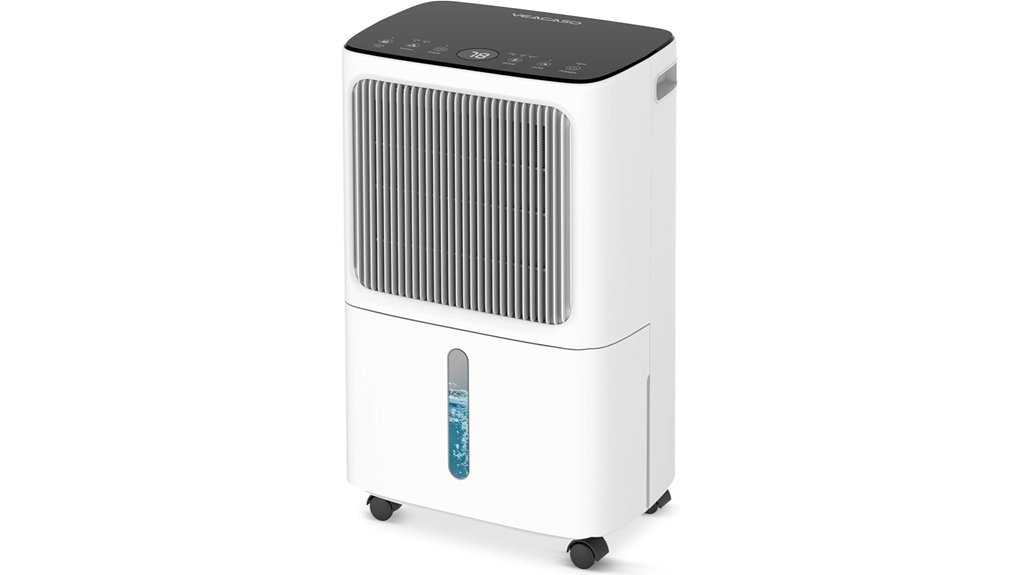
The VEAGASO is a practical 34-pint-class option for a small or medium enclosed shed. The manufacturer advertises coverage up to 2,500 square feet, but shed buyers should treat that number as a broad marketing limit rather than a sizing guarantee. Air leakage, low temperature, wet timber, frequent door opening, and an unsealed floor can create a much heavier moisture load than the same floor area inside a conditioned home.
The current listing describes DEHU, DRY, and CONT modes, a digital control panel, a 24-hour timer, a 0.53-gallon tank, and continuous drainage through an included hose. VEAGASO also advertises sound at no more than 40 dB in low-speed operation, although actual sound in a shed will depend on fan setting, vibration, placement, and room acoustics.
Why You’ll Like It
- Useful balance of capacity, controls, portability, and drainage choices.
- Continuous mode is convenient when humidity remains high for long periods.
- Compact format is easier to place in many tool sheds and hobby workshops.
- Washable-filter design can simplify routine maintenance.
Best For: Value-focused buyers who need active moisture control in a powered, weather-tight shed.
Who Should Avoid It: Buyers expecting the full advertised square-foot coverage in a cold, drafty, leaking, or visibly wet outbuilding.
Pros:
- Manufacturer advertises moisture removal of up to 34 pints per day.
- 0.53-gallon tank plus continuous gravity-drain option.
- Multiple operating modes and adjustable humidity control.
Cons:
- The 0.53-gallon tank can require frequent emptying during heavy moisture removal.
- Gravity drainage requires a lower discharge point and a continuously downward hose route.
- The 2,500-square-foot marketing claim should not replace moisture-load and temperature considerations.
KNKA 2500 Sq.Ft Dehumidifier with Drain Hose
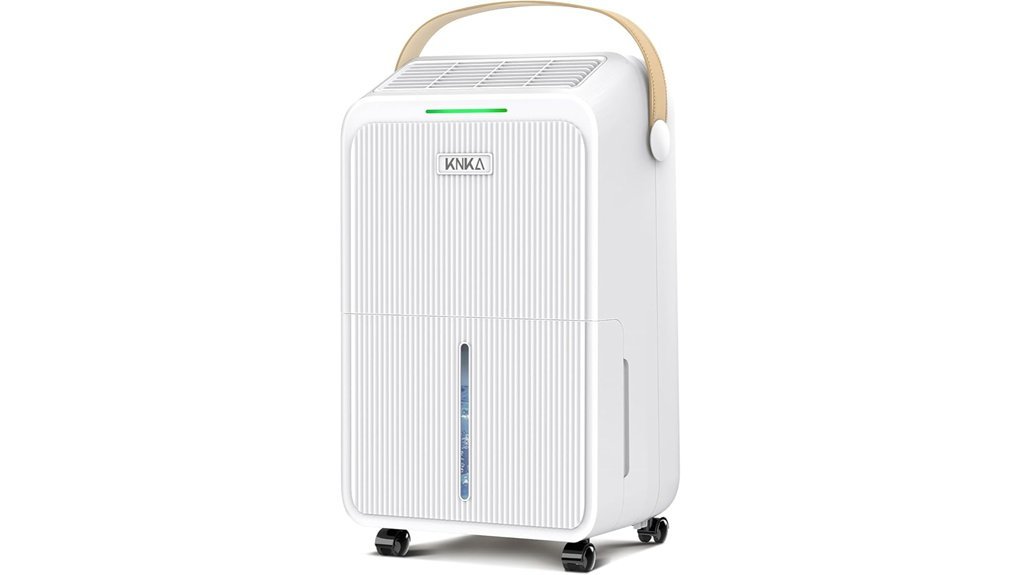
The KNKA is another 34-pint compressor model aimed at medium-size indoor spaces and similar enclosed areas. The manufacturer states a maximum moisture-removal rate of 34 pints per day at 95°F and 90% relative humidity. Its advertised 37 dB sound level makes it worth considering when a shed doubles as a hobby room or workshop, but that number should be treated as a manufacturer claim rather than an independent acoustic test.
The current listing describes DEHU, DRY, and CONT modes, adjustable humidity control, a washable filter, casters, a 0.79-gallon built-in tank, and an included gravity-drain hose. An optional larger external tank is also mentioned on the listing, but continuous gravity drainage is usually the most convenient choice when a suitable lower drain point is available.
Why You’ll Like It
- Advertised low-noise operation can be useful in a hobby room or workshop.
- Three operating modes provide flexible humidity and drying control.
- Continuous drainage supports lower-maintenance operation.
- The 0.79-gallon built-in tank is larger than the tanks listed for the two 34-pint alternatives above.
Best For: A small or medium powered shed where lower advertised operating noise and a larger built-in tank are useful.
Who Should Avoid It: Buyers who require independently verified noise performance, uphill pumped drainage, or operation below the exact model’s approved minimum temperature.
Pros:
- Manufacturer-rated to remove up to 34 pints per day at 95°F and 90% RH.
- Advertised 37 dB operating sound.
- 0.79-gallon built-in tank plus an included continuous-drain hose.
Cons:
- Real moisture removal and sound can differ in actual shed conditions.
- The included continuous-drain setup is gravity-based, so water needs a lower discharge point.
- Current warranty terms and included accessories should always be confirmed on the live listing before purchase.
Waykar 34-Pint Dehumidifier
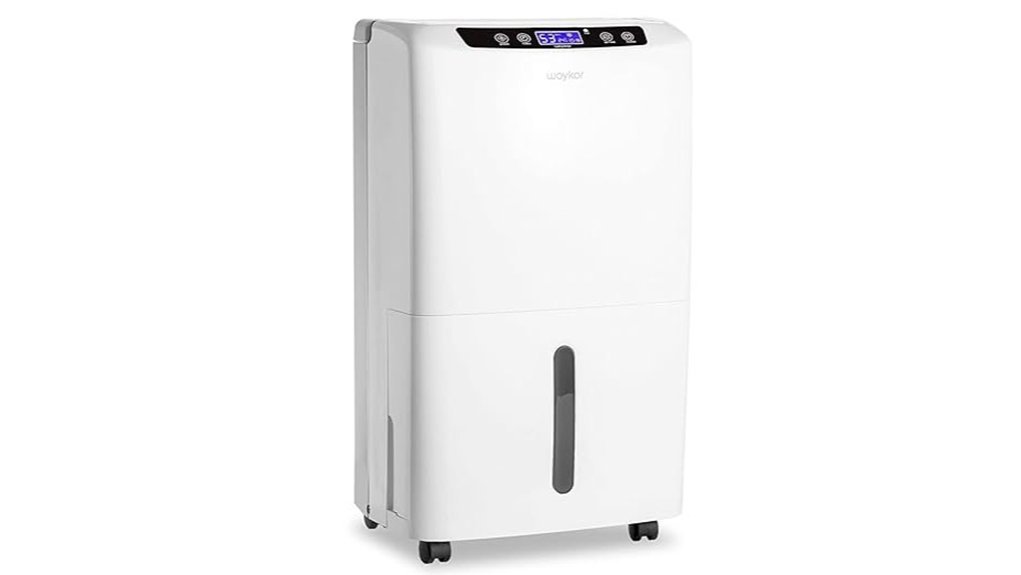
The Waykar 34-Pint Dehumidifier is the most balanced choice here for a typical small or medium shed with moderate seasonal humidity. The current Amazon listing identifies this ASIN as a 34-pint, 2,000-square-foot-class dehumidifier with adjustable humidity control, automatic defrost, an included drain hose, and a 0.66-gallon water tank. As with the other models in this guide, the advertised coverage should not be treated as a guarantee for a cold, leaky, or unusually damp shed.
Its 34-pint maximum is advertised under hot, very humid conditions, so performance will decline as temperature and relative humidity fall. The smaller format is easier to place in a crowded shed than the 80-pint model, but the air inlet and outlet still need the clearance specified in the product manual.
Why You’ll Like It
- Practical capacity for many garden sheds, storage sheds, and small workshops with moderate dampness.
- Automatic humidity control can reduce unnecessary runtime once the target humidity is reached.
- A 0.66-gallon tank and included drain hose provide two water-management options.
- Smaller footprint than the high-capacity Waykar option.
Best For: Most buyers who have a powered, enclosed shed with moderate seasonal humidity and no active water intrusion.
Who Should Avoid It: Buyers with flooding, roof leaks, groundwater entry, a large uninsulated outbuilding, or no safe way to drain or empty collected water.
Pros:
- Manufacturer advertises moisture removal of up to 34 pints per day.
- Current listing identifies the model as a 2025 ENERGY STAR dehumidifier.
- Adjustable humidity control, automatic defrost, and dual drainage options.
Cons:
- The advertised 34-pint maximum is based on hot, highly humid conditions.
- The tank may still need frequent emptying when the shed is very damp.
- Performance declines as shed temperature drops.
Factors to Consider When Choosing a Dehumidifier for a Shed
A shed can be harder to dehumidify than a similarly sized room when outdoor air, roof leaks, damp soil, unsealed flooring, or wet timber continually add moisture. Start by correcting water entry and obvious building-envelope problems. Then choose a dehumidifier based on measured humidity, temperature, drainage, and moisture severity rather than square footage alone.
Weather Protection and Electrical Safety
Use a portable home dehumidifier only inside a dry, enclosed shed. Keep it away from rain, roof drips, standing water, combustible dust, and flammable liquids. Plug it into a properly grounded outlet that meets the manual’s electrical requirements. Do not rely on an undersized extension cord, and consider a qualified electrician if the shed circuit, outlet, or grounding condition is uncertain.
Operating Temperature
Compressor dehumidifiers become less effective as air temperature falls and may develop frost on their coils. Auto-defrost can help manage frost within the approved operating range, but it does not make every residential unit suitable for a freezing shed. Check the exact minimum operating temperature in the product manual and stop using the unit when conditions fall outside its approved range.
Shed Size and Moisture Load
Measure the shed, but also assess the moisture source and severity. A musty but otherwise dry shed needs less moisture-removal capacity than one with condensation, wet walls, damp timber, an unsealed floor, or frequent door opening. A 34-pint-class unit is a reasonable starting point for many small and medium sheds with moderate humidity. A higher-capacity unit may be justified for a larger workshop, a humid climate, poor insulation, or a heavier ongoing moisture load.
Humidity Target and Monitoring
Use a separate hygrometer placed away from the dehumidifier’s air outlet to check the actual room condition. A practical starting target is around 50% relative humidity, with the goal of keeping humidity below 60% where possible to reduce conditions that support mold and condensation. Avoid setting the humidistat lower than necessary because an unnecessarily low target can increase runtime and electricity use.
Drainage Options
Bucket drainage is simple but requires regular checks. During the first week, inspect the tank daily so you learn how quickly it fills in your shed. Continuous gravity drainage is usually more convenient, but the hose must slope downward for its full length and terminate where water cannot back up, freeze, or damage the foundation. If water must move uphill, choose a model specifically equipped for pumped drainage rather than trying to force a gravity hose to work against elevation.
Energy Efficiency
Verify the exact model in the current ENERGY STAR product database rather than relying only on wording in a marketplace title. Integrated Energy Factor, measured in liters of water removed per kilowatt-hour, is the relevant efficiency metric for comparing portable dehumidifiers. Also remember that marketplace moisture-removal claims may be stated under different temperature and humidity conditions than standardized efficiency testing. Correct sizing, a clean filter, free airflow, sealed doors, and a reasonable humidity target can all reduce unnecessary runtime.
Noise Level
Noise matters when the shed is also a workshop, studio, or office. Manufacturer decibel claims can help with basic comparison, but fan speed, vibration, floor construction, and placement can change the sound you actually hear. Put the unit on a level, stable surface and keep it from touching walls, shelves, or loose tools that could vibrate or rattle.
Capacity Versus Coverage Claims
A broad “up to” square-foot figure should not be the only sizing criterion for a shed. Compare moisture-removal capacity, the conditions under which that capacity is stated, drainage method, minimum operating temperature, airflow requirements, and energy efficiency. A smaller sealed shed with an active leak can create a harder dehumidification job than a much larger dry room inside a house.
Portability and Placement
Handles and casters are useful, but airflow clearance matters more than convenience. Do not push the unit tightly against a wall or block its intake or exhaust. Keep tools, sawdust, fabric, and storage boxes away from the air path. Secure the drain hose so it cannot be pulled loose when stored items are moved.
Controls and Automatic Features
Useful shed features include an adjustable humidistat, auto-restart after a power interruption, full-tank shutoff, filter reminders, a timer, and auto-defrost. App control can be convenient but is not essential. For unattended operation, reliable drainage, suitable operating temperature, and safe electrical installation matter more than extra display modes.
Maintenance
Clean the reusable filter according to the manual, wipe dust from the intake and outlet, inspect the drain hose for algae or blockage, and check the bucket for residue. Sheds can be dustier than normal indoor rooms, so the filter may need attention more frequently. Always unplug the appliance before cleaning or moving it.
Before You Buy
- Confirm the shed is enclosed, weather-tight, and free of active leaks.
- Measure current humidity with a separate hygrometer.
- Check the exact model’s minimum operating temperature.
- Decide whether bucket drainage or a continuously downward gravity hose will work safely.
- Compare pint-capacity claims together with their stated test conditions.
- Verify the exact model number, certification, warranty terms, tank size, and included accessories on the current listing.
- Confirm the electrical outlet and circuit are suitable for the appliance.
Frequently Asked Questions
How Do I Maintain a Shed Dehumidifier?
Unplug it before maintenance, clean the filter according to the schedule in the manual, keep the intake and exhaust clear, rinse and dry the bucket, and inspect the drain hose for kinks or buildup. Check the filter more frequently in a dusty woodworking or garden shed.
Can I Use a Dehumidifier in an Unheated Shed During Winter?
Only when the shed temperature remains within the exact model’s approved operating range. Auto-defrost can help manage coil frost, but it does not make a residential compressor dehumidifier suitable for freezing conditions. A low-temperature solution designed for colder environments or seasonal shutdown may be more appropriate when temperatures fall below the rated minimum.
What Size Dehumidifier Is Best for My Shed?
Use shed size as a starting point, then factor in measured relative humidity, insulation, air leakage, temperature, visible dampness, and the moisture source. A 34-pint-class model is a sensible starting point for many small and medium enclosed sheds with moderate dampness. Consider more capacity when the space is large, insulated but persistently humid, or frequently exposed to moist outdoor air.
Are Dehumidifiers Efficient for Long-Term Shed Use?
They can be when correctly sized and controlled by a humidistat. ENERGY STAR certification and Integrated Energy Factor can help compare efficiency, but real operating cost also depends on how much moisture enters the shed, how long the unit runs, temperature, filter cleanliness, air leakage, and the humidity setting.
How Often Should I Empty the Water Reservoir?
Check it daily at first. A small tank can fill quickly in severe humidity, while mild conditions may produce much less water. Full-tank shutoff can help prevent overflow on models equipped with it, but continuous gravity drainage is generally more practical when the shed will be left unattended for long periods.
Will a Dehumidifier Stop Mold in My Shed?
A dehumidifier can reduce the humidity that supports mold growth, but it cannot repair leaks, remove trapped water behind building materials, or clean existing mold contamination. Fix the moisture source first, dry wet materials, improve airflow where appropriate, and deal with existing contamination safely.
Can I Run It With the Shed Door Open?
You can, but it is usually inefficient because the dehumidifier must continually treat incoming outdoor air. Keep doors and windows closed during normal dehumidification unless ventilation is specifically required to remove fumes, combustion gases, or hazardous dust.
Conclusion
For most enclosed sheds with moderate seasonal humidity, the Waykar 34-Pint Dehumidifier offers the most practical balance of capacity, footprint, tank size, and continuous-drain flexibility. The VEAGASO 34-Pint is a useful value alternative, while the KNKA 34-Pint is worth considering when advertised low-noise operation and its larger built-in tank are priorities. Choose the Waykar 80-Pint when the shed or workshop is large, enclosed, and persistently damp enough to justify substantially more moisture-removal capacity.
No portable dehumidifier can compensate for a leaking roof, groundwater entry, unsafe wiring, or temperatures outside its approved operating range. Correct those problems first, confirm the exact current model specifications, and use a hygrometer to maintain a stable humidity level without running the appliance harder than necessary.