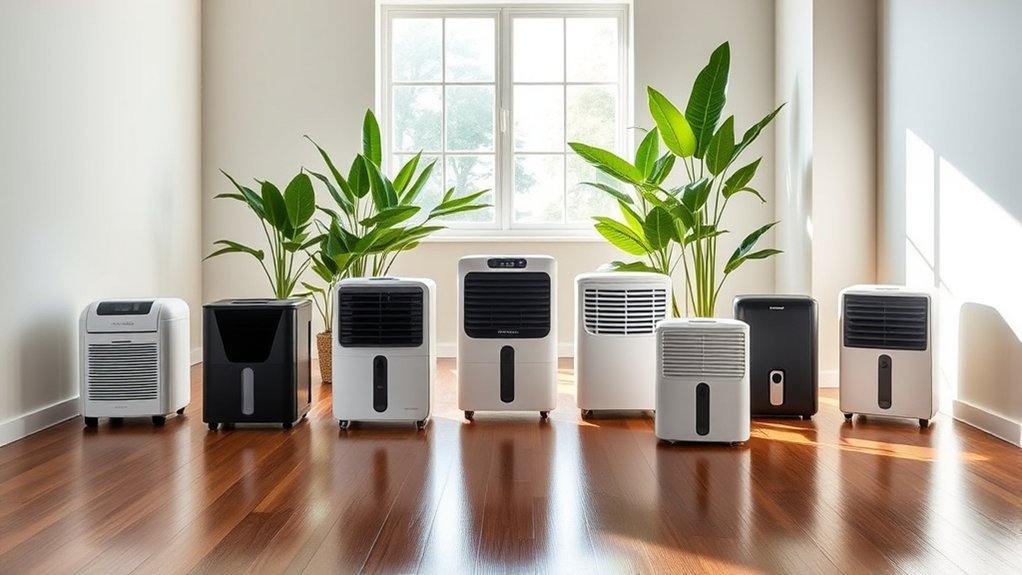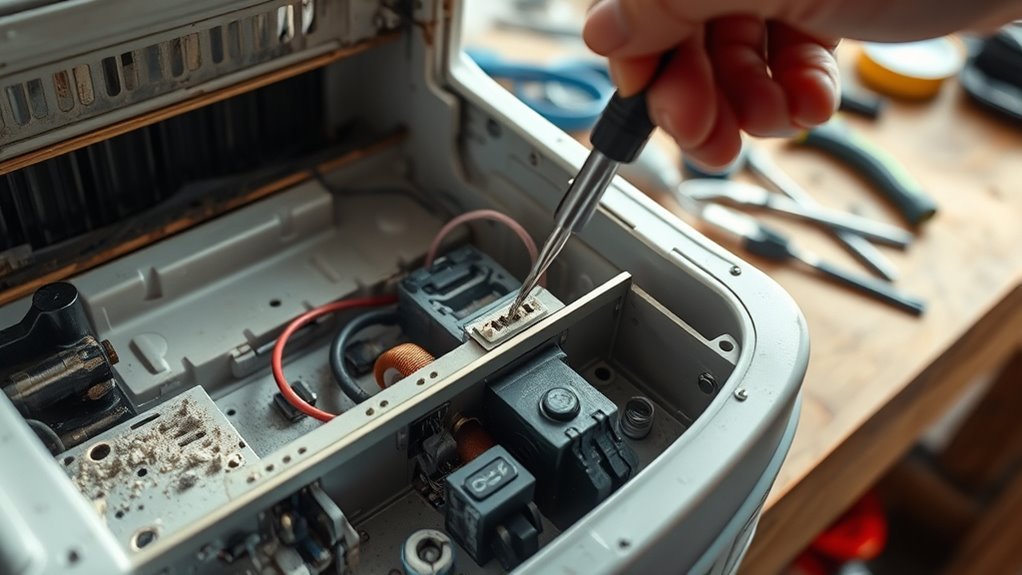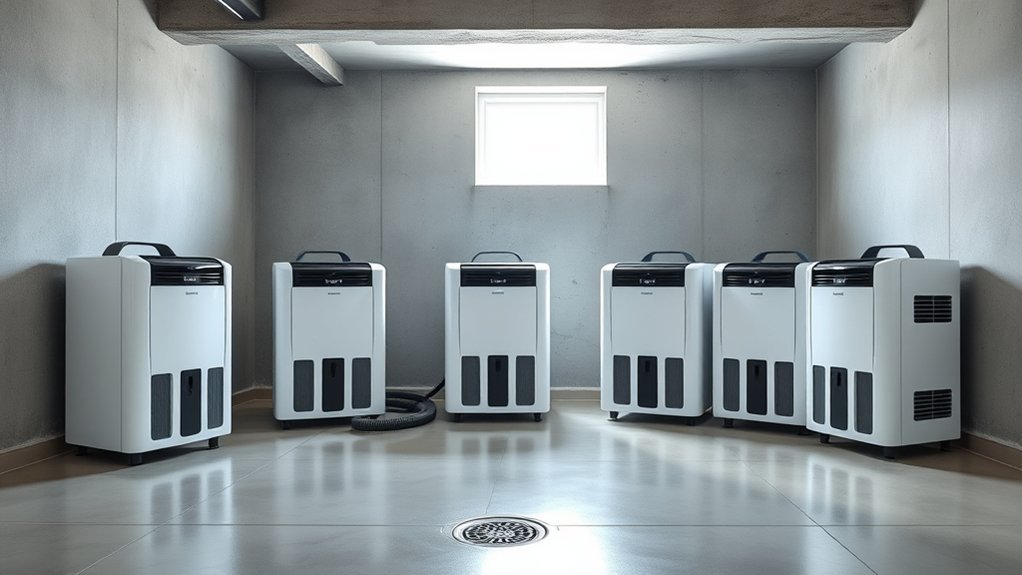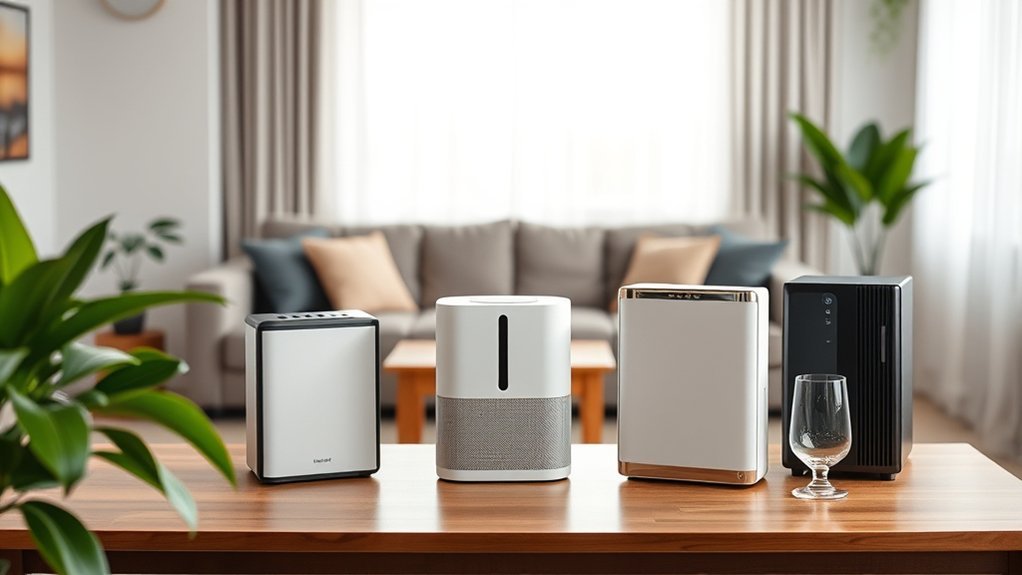
Wet filament wrecks prints. You get popping at the nozzle, stringing, a rough surface and layers that pull apart. The right dehumidifier for filament storage depends on one thing: are you rescuing a damp spool, or keeping a whole collection dry?
Our top pick is the Comgrow SH02 Filament Dryer Box, because its 150W PTC heater runs to 70°C and dries two 1 kg spools at once. If you are storing dozens of rolls instead, the RJOKMT 180L Filament Storage Cabinet holds up to 40 of them at an adjustable 25–60% RH.
Picks come from manufacturer spec sheets, owner reports on maker forums and retailers outside Amazon, and current safety records.
What is in this guide
Dehumidifiers for Filament Storage Compared
| Product | Best for | Moisture control | Capacity | Control range |
|---|---|---|---|---|
|
Premium
|
Large collections and long-term storage | Molecular adsorption core, no desiccant refills | 180L, up to 40 spools | 25–60% RH, adjustable |
|
Premium
|
Dry storage directly under a printer | Molecular sieve core, vents moisture outside | 180L, up to 40 spools | 25–60% RH, adjustable |
|
Budget
|
Drying spools that are already wet | 150W PTC heater with a 360° fan | Two 1 kg spools | 40–70°C, adjustable |
|
Budget
|
Sealed bins, vacuum bags and DIY dry boxes | Rechargeable silica gel, no power needed | Two 500g packets, about 35 cu ft each | Passive, no humidity set point |
Dehumidifier for Filament Storage: Our Top Picks
1. RJOKMT 180L Filament Storage Cabinet
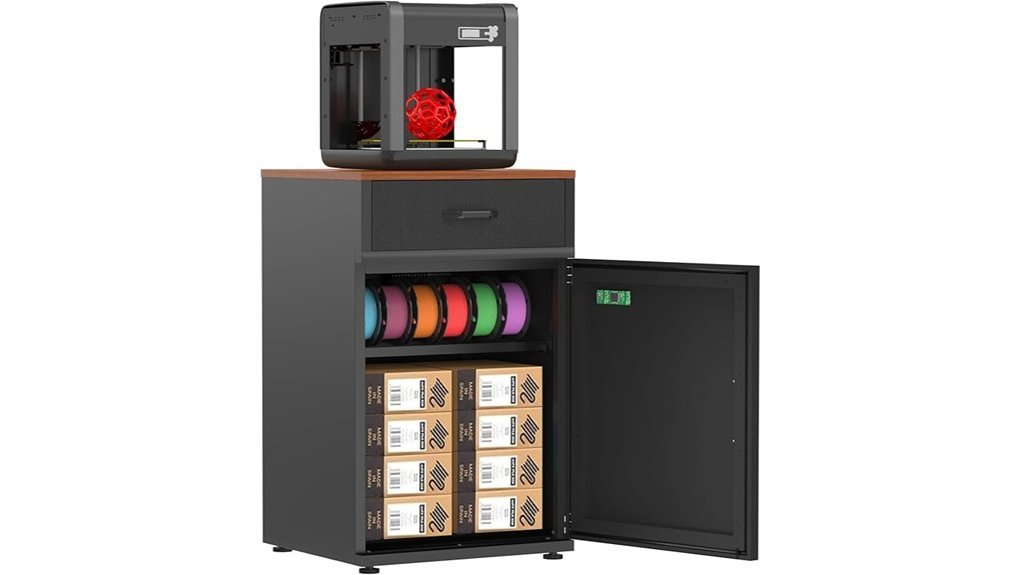
Bottom line: A sealed 180L cabinet that keeps a whole filament library at a set humidity and doubles as a printer stand. Buy it if you have outgrown bags and bins, not if you need to rescue one wet spool.
- Moisture control: molecular adsorption core, nothing to refill or bake dry
- Capacity: 180L for up to 40 spools, one home for a collection
- Control range: 25–60% RH, adjustable, so set it lower for nylon
- Filaments supported: PLA, PETG, ABS, TPU and nylon
- Printer top: reinforced 21 x 20 inch plate, fits Bambu Lab P1S and A1
The convenience is the point. Every opened spool of PLA, PETG, ABS, TPU or nylon lives in one place at one humidity, instead of scattered across a dozen boxes with desiccant packs you keep forgetting to recharge.
The adsorption core matters for running cost. There are no disposable sachets to buy and no trips to the oven, and high-density sealing strips around the door keep out room humidity and workshop dust between openings.
Be clear about what it does. RJOKMT says so plainly in its own listing: this is long-term preservation, not rapid drying. A spool that has sat open in a damp garage for a month still needs a heated cycle first.
- 180L sealed cabinet organises up to 40 spools in one place
- Adsorption core runs without disposable desiccant packs
- Humidity is adjustable across 25% to 60% RH for different materials
- High-density sealing strips block room humidity and workshop dust
- Reinforced 21 x 20 inch top turns the cabinet into a printer stand
- Needs dedicated floor space and assembly
- Preserves dry filament rather than drying a spool that is already wet
- Real spool count depends on spool width and shelf arrangement
2. VCGGAIP 180L Filament Dehumidification Cabinet
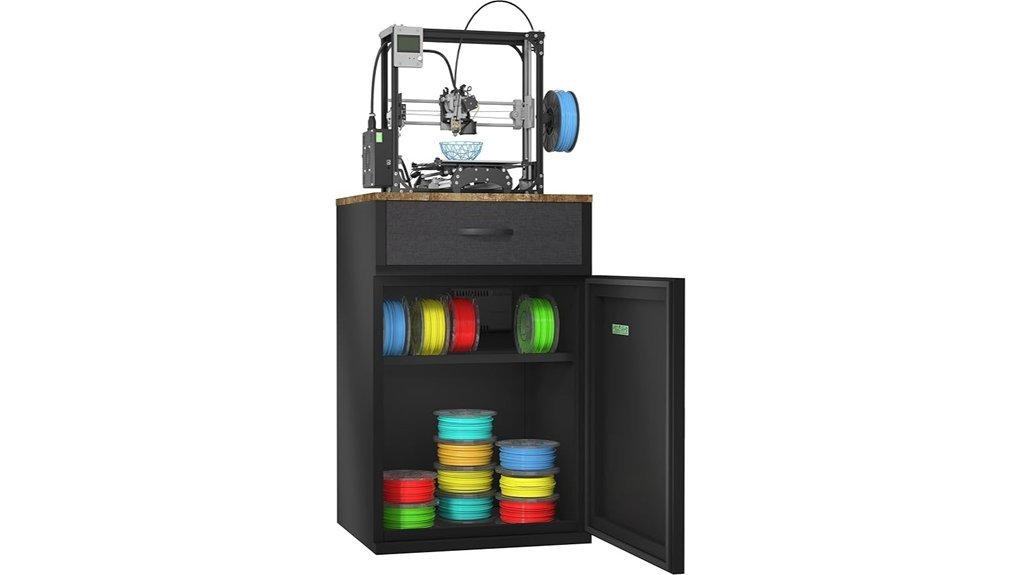
Bottom line: The same 180L, 40-spool idea built around a printer deck, with a near-silent core that pushes moisture out of the cabinet. Buy it if you want printer and filament in one column of floor space.
- Moisture control: molecular sieve core that exhausts moisture outside the cabinet
- Capacity: 180L for up to 40 spools, room for a full material library
- Control range: 25–60% RH on a digital display, matched to your materials
- Filaments supported: PLA, PETG, ABS, TPU and nylon
- Printer top: 18.9 x 21.26 inch deck, listed for Bambu Lab P1S and FLASHFORGE AD5X
The absorb, regenerate and vent cycle is what separates this from a box of silica gel. Damp air is driven out of the cabinet rather than parked inside it, and VCGGAIP rates the process as effectively silent, which matters if the cabinet lives in a home office.
Open doors beat stacked bins for a working collection. You can see every colour at once, pull the roll you want, and shut the door without breaking a seal on four other containers. The listing also describes a drawer for nozzles, tape and small tools.
It is still a preservation cabinet, not a dryer. If a spool has already taken on water, run a heated cycle first, then put it in here to stay that way.
- 180L of sealed storage for up to 40 standard 1 kg spools
- Molecular sieve core vents moisture out instead of trapping it
- Near-silent running suits a home office or shared room
- Digital display and a 25% to 60% RH range make the setting easy to match
- Top surface and listed tool drawer tidy up a cramped workspace
- Large and awkward to move once assembled
- Needs a permanent outlet for the humidity control to work
- Printer fit depends on the deck size and your printer’s weight
3. Comgrow SH02 Filament Dryer Box
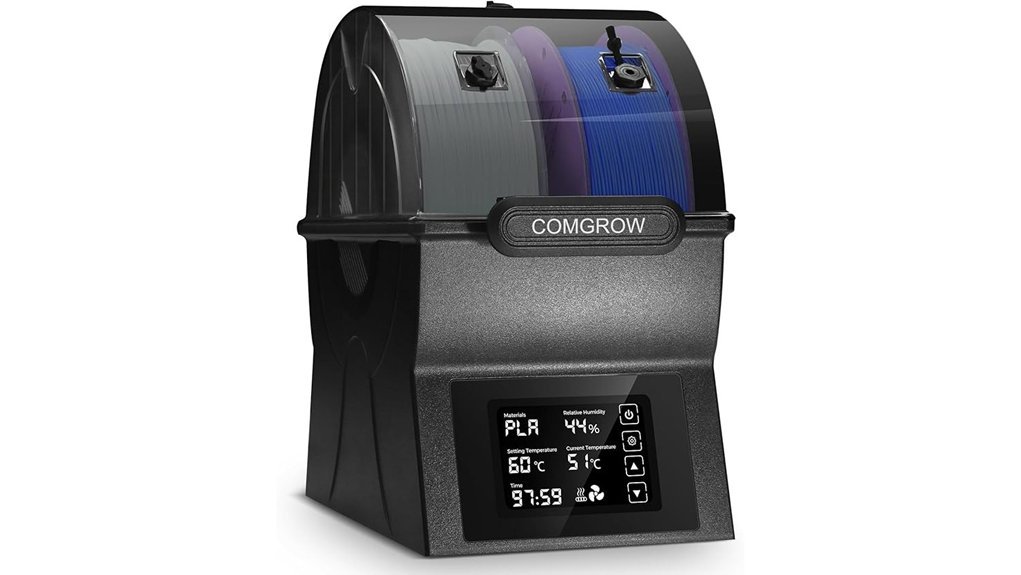
Bottom line: The one product here that actually removes moisture from a spool, at a fraction of a cabinet’s size and cost. Buy it if your prints have started popping and stringing and you want them fixed this week.
- Moisture control: 150W PTC heater and 360° fan, drives absorbed moisture out
- Capacity: two 1 kg spools in 1.75 mm or 2.85 mm, feeds two printers at once
- Control range: 40–70°C with a timer that runs up to 98 hours
- Filaments supported: nine one-key presets, from PLA and PETG to PC and PP
Heat-up is quick: Comgrow rates the SH02 at 50°C in about seven minutes and 70°C in about 25 minutes. That is warm-up, not a finished cycle. A real drying run takes hours, and nylon takes longer than PLA, which is why the 98-hour timer exists.
The presets remove most of the guesswork. Press the material you are drying and the box sets its own temperature and time, so you are not hunting through a manual mid-print. Safety is built in too: heating cuts off if the element passes 130°C and resumes below 90°C, and an alarm sounds if the fan stops.
Two spools also means two printers, or a dual-colour setup fed straight from the box through PTFE tubes. For most home workshops that is the whole job.
- 150W PTC heater reaches 50°C in about 7 minutes and 70°C in about 25
- Dries two 1 kg spools at once and can feed two printers
- One-key presets cover nine materials, including ASA, PVA, PC and PP
- Timer runs up to 98 hours for slow-drying materials like nylon
- Thermal cut-off at 130°C and a fan-stop alarm are built in
- Holds only two standard spools, so it is no help for bulk storage
- Owners report the small top vent traps moisture unless the lid is propped open
- The fan is audible in a quiet room
4. Wisedry 500g Rechargeable Silica Gel Packets

Bottom line: Not a cabinet and not a dryer, but the cheapest way to keep dry spools dry. Drop a packet into a sealed tote or vacuum bag and you have storage that costs a fraction of a 180L cabinet. Buy it if you own a handful of rolls, not if you need a set humidity you can read off a display.
- Moisture control: non-indicating silica gel, rechargeable in a microwave or oven
- Capacity: two 500g packets, each rated by the maker for roughly 35 cubic feet of enclosed space
- Control range: none, it pulls moisture down passively rather than holding a set point
- Power: none in use, so it works inside a sealed bin with no cable running out of it
- Form: flexible packets that sit between or under spools instead of taking shelf space
This is the route most people actually start on. An airtight storage tote plus one of these packets keeps opened PLA and PETG in the 30 percent range for a lot less than a floor cabinet, and the packets go back into service after a regeneration cycle.
The 500g version carries no colour indicator, so you weigh the packet to judge saturation instead of watching for a colour change. Wisedry warns against microwaving a packet that is not yet saturated, which makes a kitchen scale part of the kit rather than an optional extra.
Be honest about the ceiling. Silica gel pulls moisture out of the air around a spool, slowly. It will not rescue filament that has already drunk water in a damp garage, and it holds no set humidity, so a large collection is better served by a cabinet. For a deeper look at this tier, see our guide to the best dehumidifiers for a drying box.
- By far the cheapest way to store filament dry
- No power, no fan noise, nothing to site near an outlet
- Reusable through many regeneration cycles
- Works in any sealed container you already own
- Flexible packets fit around spools instead of displacing them
- No colour indicator on the 500g size, so you weigh it instead
- Holds no set humidity and gives you no reading
- Will not dry a spool that is already wet
- Needs a genuinely airtight container to do anything
Comgrow SH02 vs RJOKMT 180L Cabinet: Is the Upgrade Worth It?
These two are not really rivals. The SH02 fixes filament that has already gone wet; the RJOKMT cabinet stops it happening. Here is what the extra money buys.
- What it fixes: the SH02 pulls moisture out of a spool, the cabinet keeps moisture from getting in
- Capacity: two 1 kg spools against a sealed 180L cabinet holding up to 40 rolls
- Method: 150W heated air at 40–70°C against an adsorption core held at 25–60% RH
- Space: a desktop box you can move against a floor cabinet you assemble once
Which Filament Moisture Solution Should You Buy?
- Your filament is already damp: get the Comgrow SH02 Filament Dryer Box.
- You print two colours or materials at once: get the Comgrow SH02 Filament Dryer Box.
- You own dozens of opened rolls: get the RJOKMT 180L Filament Storage Cabinet.
- You want printer and filament in one footprint: get the VCGGAIP 180L Filament Dehumidification Cabinet.
- You print in a humid or coastal room: get the VCGGAIP 180L Filament Dehumidification Cabinet.
- You own a handful of rolls and want the cheapest fix: get the Wisedry 500g Rechargeable Silica Gel Packets and a sealed tote.
- You need both rescue and long-term storage: start with the Comgrow SH02 Filament Dryer Box and add a cabinet as the collection grows.
How We Chose
- We only kept units you can buy today, and we checked every spec against the manufacturer’s own product page or spec sheet.
- We split the category properly: active drying and dry storage are different jobs, and a product is judged on the one it is built for.
- We looked for verified control, meaning an adjustable humidity or temperature range and a readable display, rather than a vague “keeps filament dry” claim.
- We read owner reports on maker forums, community mod pages and retailers outside Amazon to find problems that repeat.
- We checked CPSC and manufacturer notices for open safety recalls. None of these four had one at the time of writing.
Factors to Consider When Choosing a Dehumidifier for Filament Storage

One decision comes before all the others: do you need active drying or dry storage? A heated dryer removes moisture already inside one or two spools. A dehumidification cabinet holds many already-dry spools in a controlled environment over time. Everything below follows from that split.
Active Drying vs. Long-Term Storage
Choose a heated dryer if you hear popping during extrusion, see unusual stringing, notice a rough surface finish, or know a spool has been sitting open in humid air. Choose a sealed cabinet if your real problem is storing many spools between jobs. Plenty of workshops run both: the Comgrow SH02 Filament Dryer Box for recovery, a cabinet for preservation.
Humidity Control and Monitoring
Below about 30% RH is a useful target for general filament storage, and the cabinets here reach 25%. There is no single perfect number for every polymer: highly hygroscopic materials want stricter storage, and some manufacturers publish their own limits. Look for a readable humidity display, a dependable seal and a range that covers the materials you actually print. If you already own a hygrometer or a cabinet and doubt its reading, here is how to test a humidity sensor at home.
Size and Capacity
Count your current spools, then allow for growth. Compare spool width and diameter too, because “up to 40 rolls” assumes standard 1 kg spools on an efficient shelf layout. For a cabinet, measure floor space, door clearance and nearby outlets, and measure the top surface if a printer will sit on it.
Temperature Range and Material Compatibility
For heated dryers, the maximum temperature is not automatically the right setting. PLA, PETG, TPU, ABS, nylon, PC and support materials all want different conditions. Follow the filament manufacturer’s recommendation, and confirm the spool itself can take the heat. Preset systems help here: the SH02 carries one-key settings for nine material types.
Seal Quality and Air Circulation
A dry cabinet needs a dependable door seal to slow moisture entry. A heated dryer needs somewhere for the released moisture to go. This is the single most common weakness in cheap dry boxes: the fan recirculates damp air and the hygrometer reading flatters the result. Venting, or an owner’s trick of propping the lid, makes a measurable difference.
Power Consumption and Noise
Storage cabinets run for long stretches, so average draw matters more than peak power. Heated dryers pull more but run in bursts. If the unit lives in a home office, check the fan: cabinets using adsorption cores are close to silent, while heated dry boxes are not, and that is a real difference day to day.
Ease of Use and Maintenance
Useful features include a clear humidity or temperature display, a timer, material presets, accessible shelves, a secure door latch and surfaces you can wipe. For a cabinet, check assembly time and support for the humidity module. For a dryer box, check spool clearance and where the filament exits, since a bad exit angle causes feed problems.
Warranty and Replaceable Parts
The dehumidifier core is the part that wears out, so ask what happens when it fails. VCGGAIP lists a one-year free core replacement plus a free cabinet replacement if the body arrives damaged, and RJOKMT lists a core replacement if the unit malfunctions. For a heated dryer, the fan, heater and touch screen are the parts to ask about.
Mistakes to Avoid When Buying a Filament Dehumidifier
- Buying a cabinet to fix wet filament: a cabinet preserves, a heated dryer removes moisture already absorbed.
- Trusting the built-in hygrometer alone: weigh a spool before and after a cycle if you want proof it dried.
- Sealing a dryer with nowhere for moisture to go: vent it or prop the lid, or the damp air simply circulates.
- Turning the heat straight to maximum: use the filament maker’s temperature, or you risk softening the spool.
- Measuring the cabinet but not the room: check floor space, door swing and a free outlet before you order.
Before You Buy Checklist
- Decide whether you need drying, storage, or both.
- Confirm spool capacity and internal dimensions.
- Check the supported temperature or humidity range.
- Verify your filament maker’s storage and drying guidance.
- Measure available floor or desk space.
- Confirm electrical requirements, assembly, warranty, and return terms.
FAQs
What Humidity Level Is Ideal for Filament Storage?
Below about 30% RH is a practical target for most common filaments, and the cabinets here can hold 25%. More moisture-sensitive materials such as nylon and PVA benefit from lower humidity. Always follow the filament manufacturer’s storage guidance rather than relying on one universal number for every polymer.
Is a Dehumidification Cabinet the Same as a Filament Dryer?
No. A dehumidification cabinet preserves filament that is already dry and slows future moisture absorption, using an adsorption core rather than heat. A heated filament dryer raises the spool temperature and circulates air to drive out moisture the material has already taken in. Many workshops end up using both.
Can I Use a Regular Room Dehumidifier for Filament Storage?
A room dehumidifier lowers the whole workshop’s humidity, but it cannot match the controlled conditions of a well-sealed dry cabinet or dryer box. Room air still sits well above the 25% to 30% RH range that opened spools want. Treat it as a supporting measure, not a replacement for enclosed storage. If you are building a sealed box instead of buying a cabinet, our drying box guide covers what to put inside it.
How Long Does Filament Take to Dry?
Several hours for most materials, and longer for nylon. Drying time depends on the polymer, spool size, how wet it is, the temperature and the airflow. Warm-up time is not the same thing: the Comgrow SH02 Filament Dryer Box reaches 70°C in about 25 minutes but runs timed cycles of up to 98 hours.
Should I Buy a Cabinet or a Two-Spool Dryer?
Buy a two-spool dryer if you keep a small number of active spools and need to recover wet filament. Buy a cabinet if you own many opened rolls and want organised, long-term humidity control. A cabinet will not rescue a spool that is already saturated, so heavy users often own both.
How Do I Know If Filament Has Absorbed Moisture?
Listen for popping or sizzling at the nozzle, and look for excess stringing, bubbles, a rough surface, weak layers or unusually brittle filament. These symptoms can have other causes, so check your temperature, extrusion settings and printer condition before assuming moisture is the only problem. Weighing a spool before and after drying settles it.
Can I Leave a Filament Dryer Running Overnight?
Most heated dryers are built for long unattended cycles. The Comgrow SH02 Filament Dryer Box accepts a timer setting of up to 98 hours, cuts the heater off if the element passes 130°C and resumes below 90°C, and sounds an alarm if the fan stops. Still run it on a hard, clear surface away from anything flammable.
Do Desiccant Packs Work as Well as a Dehumidifier Cabinet?
Desiccant works, but it saturates and then quietly stops. You have to spot the colour change, bake the beads dry and swap them, in every container. The adsorption cores in these cabinets regenerate themselves and hold a set humidity across 180L, which is why they suit large collections better. For a handful of spools in a sealed tote, desiccant is still the sensible call: see our budget pick above and the wider guide to dehumidifier packs.
Final Verdict
For most people, the answer is a heated dryer first and a cabinet later. The Comgrow SH02 solves the problem you can hear at the nozzle today, and it costs a fraction of a floor cabinet. Scale up to a sealed 180L cabinet once you have more rolls than you can keep track of.
Storing more than you print? The RJOKMT 180L Filament Storage Cabinet keeps up to 40 spools at a set humidity, and the VCGGAIP 180L Filament Dehumidification Cabinet does the same while doubling as a stand for your printer.