A hot, humid garage can expose tools, stored items, vehicles, and unfinished surfaces to condensation, rust, and musty odors. The best dehumidifier for a hot garage depends less on a huge advertised coverage number and more on the garage’s measured humidity, moisture load, drainage access, operating temperature, ceiling height, and how often the door opens.
For heavy moisture, the DECIUU 100 Pint models provide high maximum-condition ratings and flexible drainage choices, while the AEOCKY 80 Pint is a strong efficiency-focused option for a large garage. The Frigidaire 50 Pint WiFi and GoveeLife Smart Dehumidifier suit buyers who want remote control. For a smaller or moderately damp garage, the AEOCKY 50 Pint, Waykar, and PLUSCENT models may be easier to justify.
Quick verdict
- Best overall for a large hot garage: AEOCKY 4500 Sq.Ft Energy Star Dehumidifier
- Best when there is no floor drain: DECIUU Max 100 Pint Dehumidifier with Pump
- Best smart-control option: Frigidaire 50 Pint Dehumidifier w/Wifi
- Best for a moderately damp one- or two-car garage: Waykar 34 Pints Energy Star Dehumidifier
- Best quiet compact option: PLUSCENT 32 Pint Dehumidifier
Capacity note: Several listings use a maximum moisture-removal figure measured at unusually hot and humid conditions. A DOE- or ENERGY STAR-rated capacity is a better apples-to-apples comparison. Check the exact model number, test conditions, tank size, drainage method, and your garage’s real humidity before comparing headline pint numbers.
How these picks were evaluated
- Relevance to hot residential garages, workshops, and storage spaces.
- Moisture-removal rating and whether the number uses standard or maximum test conditions.
- Gravity drainage, pump drainage, tank size, and unattended-use practicality.
- Operating-temperature limits, automatic defrost, controls, noise, mobility, and maintenance.
- Brand clarity, current model identification, and the availability of useful product documentation.
Quick Comparison of Dehumidifiers for Hot Garages
| Product | Best use | Capacity context | Drainage | Key consideration |
|---|---|---|---|---|
| AEOCKY 80 Pint | Large, humid garages | Maximum 80-pint listing claim under hot, very humid conditions; compare the lower standardized figure for sizing | Tank or hose | Strong efficiency-focused choice, but the headline capacity needs context |
| DECIUU 100 Pint with Pump | Garages without a nearby floor drain | Maximum 100-pint claim; listing family identifies a lower 70-pint standard rating | Tank, gravity hose, or pump | Pump adds installation flexibility and additional maintenance points |
| Frigidaire 50 Pint WiFi | Remote monitoring and control | 50-pint rated model | Bucket or continuous drain | Established brand and useful controls, but relatively heavy |
| GoveeLife Smart Dehumidifier | App and compatible voice control | About 50 pints/day under standardized conditions; higher maximum claim under hotter conditions | Tank or hose | Large body and higher power demand than compact models |
| DECIUU 100 Pint | High-capacity gravity drainage | Maximum 100-pint claim; 70-pint standard listing figure | Tank or gravity hose | Needs a suitable lower drain point |
| AEOCKY 74 Pint | Large garage with moderate-to-heavy moisture | Up to 74 pints at 95°F/95% RH; listing also states 52 pints at 86°F/80% RH | Tank or hose | Useful alternative, but do not treat 74 pints as a universal daily result |
| AEOCKY 50 Pint | Medium-to-large garage | Advertised up to 50 pints/day; verify the exact test condition on the current listing | Tank or hose | Smaller tank than several large-capacity units |
| Waykar 34 Pint | Light-to-moderate moisture in a typical garage | Advertised up to 34 pints in hot conditions; ENERGY STAR lists 9.81 pints/day for model PD160B | Tank or hose | May run too long in severe humidity or high air leakage |
| PLUSCENT 32 Pint | Quiet operation in a smaller garage | Up to 32 pints at 95°F/90% RH | Tank or gravity hose | Compact body, but a small 2-liter tank |
AEOCKY 4500 Sq.Ft Energy Star Dehumidifier
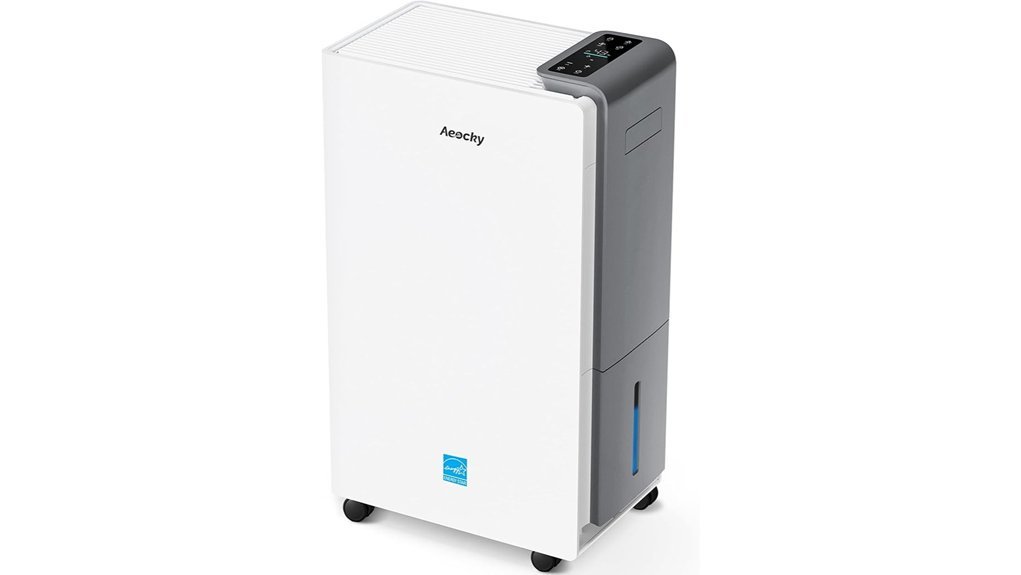
Best Overall for Large Hot Garages
AEOCKY’s 4500 Sq.Ft model is a strong match for a large garage that remains hot and humid for long periods. Its listing describes a maximum removal rate of 80 pints per day under hot, very humid test conditions, together with automatic humidity control, a drain hose, and a 1.45-gallon tank. The exact standardized capacity is lower, so use the current model documentation rather than the 80-pint headline alone when sizing it.
Why You’ll Like It: It combines high maximum-condition moisture removal with automatic humidity management, continuous drainage support, and efficiency-focused positioning.
Best For: Large garages, workshops, and storage areas where steady automatic operation and a hose drain are practical.
Who Should Avoid It: Buyers with a small garage, occasional humidity, or no suitable drain route may be paying for more capacity than they need.
Pros:
- High maximum moisture-removal claim for hot, humid conditions.
- Automatic humidity control and continuous drainage support.
- Large tank reduces how often manual emptying is needed.
Cons:
- The 80-pint figure is a maximum-condition rating, not a universal daily result.
- Its size and weight make frequent relocation less convenient.
- Confirm the exact model number, standardized capacity, and current warranty before purchase.
DECIUU Max 100 Pint Dehumidifier with Pump
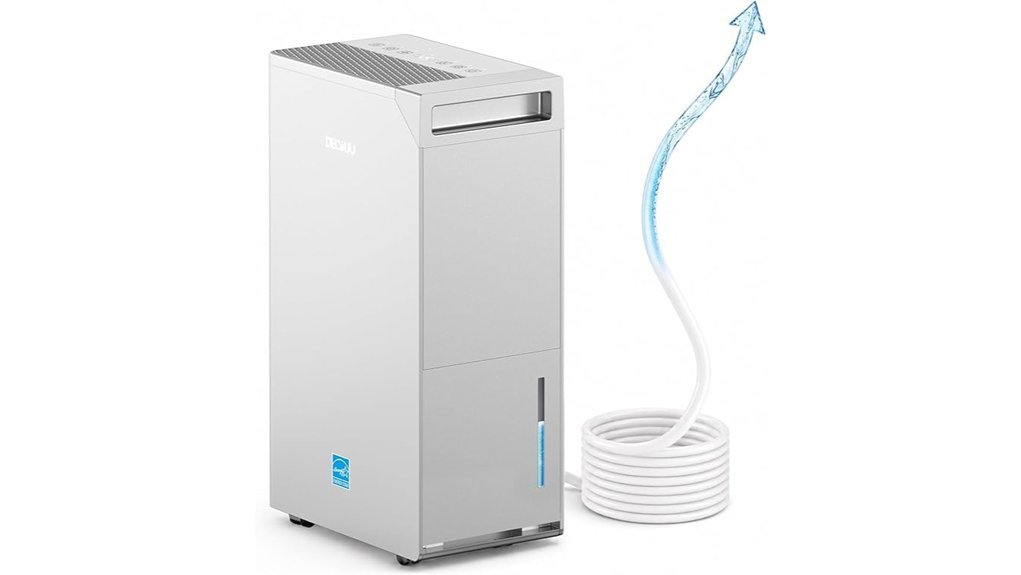
Best for Garages Without a Floor Drain
The DECIUU Max 100 Pint Dehumidifier with Pump is the most flexible drainage choice in this list when collected water must be lifted to a sink, window, or other higher discharge point. The product family is marketed with a maximum 100-pint figure under hot, highly humid conditions and a lower 70-pint standard rating. It also includes automatic humidity control and multiple drainage methods.
Why You’ll Like It: The built-in pump gives you more installation flexibility than a gravity-only unit when the garage floor has no useful drain.
Best For: Large, damp garages where the discharge point is above the dehumidifier or a continuously downward hose route is impossible.
Who Should Avoid It: Buyers with a convenient floor drain may prefer the simpler non-pump DECIUU model and avoid maintaining an additional pump system.
Pros:
- High maximum-condition moisture-removal rating.
- Built-in pump supports upward drainage.
- Tank, gravity-drain, and pump-drain choices improve installation flexibility.
Cons:
- Pump systems add parts that may require cleaning or maintenance.
- Noise may be more noticeable at higher fan settings.
- The headline 100-pint number should not be compared directly with a standardized 50-pint rating.
Frigidaire 50 Pint Dehumidifier w/Wifi
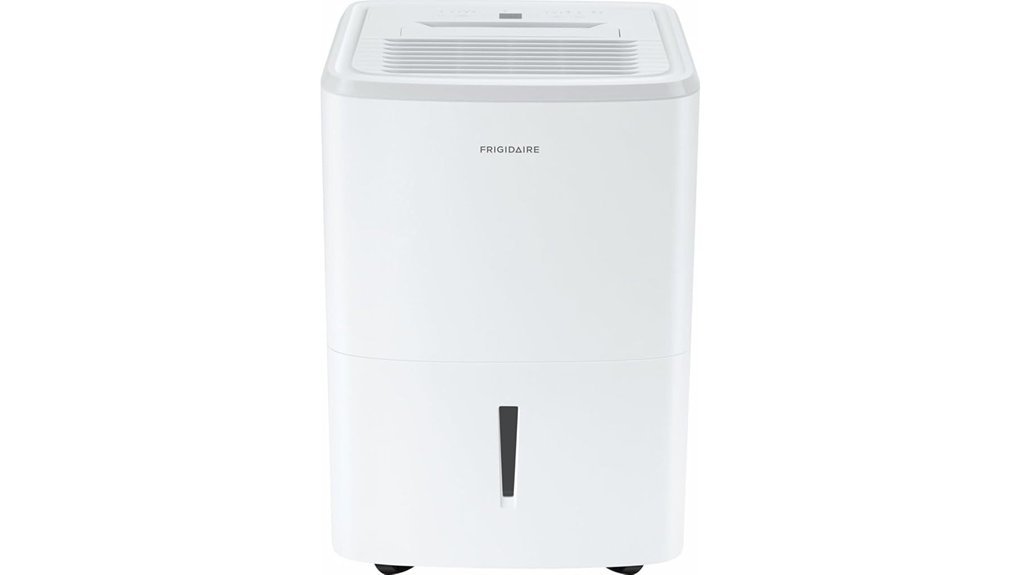
Best Smart-Control Option
The Frigidaire 50 Pint Dehumidifier w/Wifi, model FHDD5034Y1, suits buyers who want to check or adjust garage humidity without walking out to the unit. It combines a 50-pint rating with WiFi control, custom humidity settings, a washable filter, a front-loading bucket with a splash guard, and continuous-drain capability when installed according to the manual.
Why You’ll Like It: Remote adjustment is useful when the garage is detached, used mainly for storage, or left closed for long periods.
Best For: Buyers who prioritize a recognizable appliance brand, a standardized capacity figure, and smart-control convenience.
Who Should Avoid It: Anyone who will not use WiFi features may get better value from a simpler 50-pint model.
Pros:
- Clear 50-pint rated capacity with adjustable humidity control.
- WiFi-enabled monitoring and control.
- Washable filter and user-friendly bucket design.
Cons:
- At roughly 44 pounds, it is heavier than many compact models.
- Smart setup depends on a reliable compatible WiFi connection.
- Confirm whether a drain hose is included or must be purchased separately.
GoveeLife Smart Dehumidifier for Home (4,500 Sq.Ft)
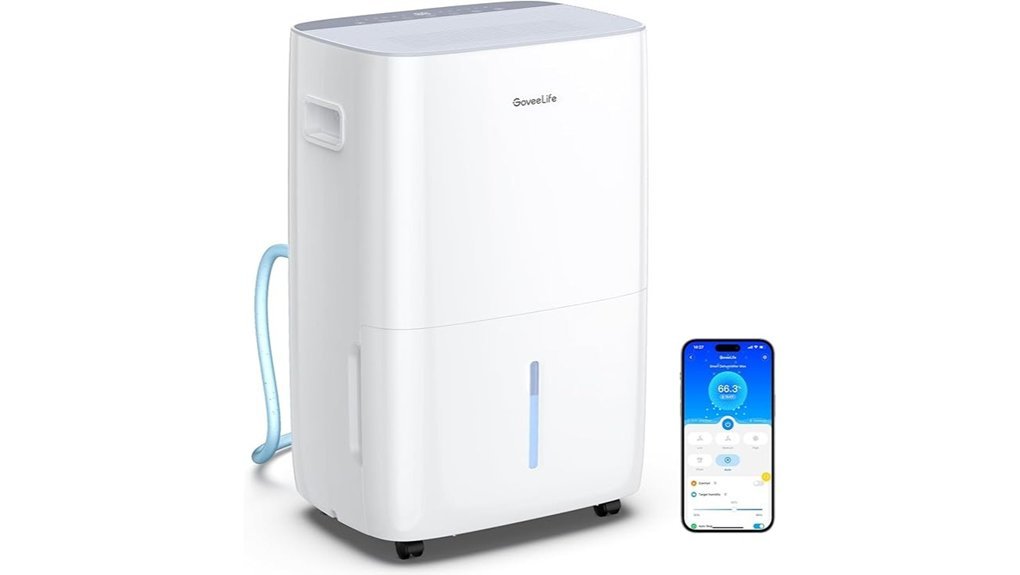
Best App and Voice-Control Choice
GoveeLife’s H7151 Smart Dehumidifier is designed for large indoor spaces and supports app, touch-panel, and compatible voice control. Its ENERGY STAR record lists a water-removal capacity of about 50 pints per day, while higher headline numbers refer to hotter and more humid test conditions. It also includes automatic humidity control, a washable filter, a 2-gallon bucket, and continuous drainage support.
Why You’ll Like It: The smart controls make it easier to check and change settings in a detached or infrequently visited garage.
Best For: Smart-home users who want remote humidity management and a large bucket.
Who Should Avoid It: Buyers seeking a compact, lightweight, or low-power unit should compare its size and electrical requirements carefully.
Pros:
- App, touch-panel, and compatible voice control.
- Standardized capacity of about 50 pints per day.
- Large bucket and continuous drainage option.
Cons:
- The higher maximum pint claim is not directly comparable with its standardized rating.
- Its roughly 40-plus-pound body is less convenient to move frequently.
- Smart functions require setup and a compatible network.
DECIUU Max 100 Pint Energy Star Dehumidifier
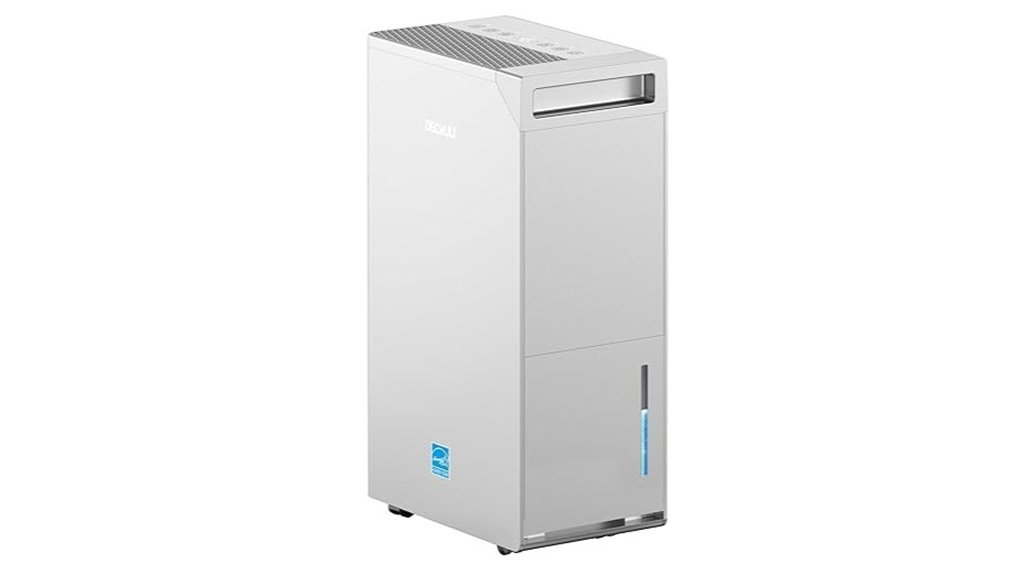
Best High-Capacity Gravity-Drain Option
The non-pump DECIUU Max is a practical choice when your garage has a nearby floor drain or another lower discharge point. Its listing identifies a maximum 100-pint rate under hot, very humid conditions and a 70-pint standard rating. It also includes automatic humidity control, auto defrost, auto restart, a large tank, and continuous drainage through a hose connection.
Why You’ll Like It: You get high-capacity moisture removal without paying for or maintaining a pump you may not need.
Best For: Large garages with a suitable gravity drain and a consistently high moisture load.
Who Should Avoid It: Garages that require water to be moved upward should use a pump-equipped model instead.
Pros:
- 70-pint standard listing figure with a higher maximum-condition claim.
- Large tank and continuous gravity drainage.
- Auto defrost, auto restart, controls, and a washable filter.
Cons:
- Gravity drainage requires a continuously downward hose route.
- Large capacity may be unnecessary for a small, mildly damp garage.
- Noise may be more noticeable at higher settings.
AEOCKY 74 Pint Energy Star Dehumidifier
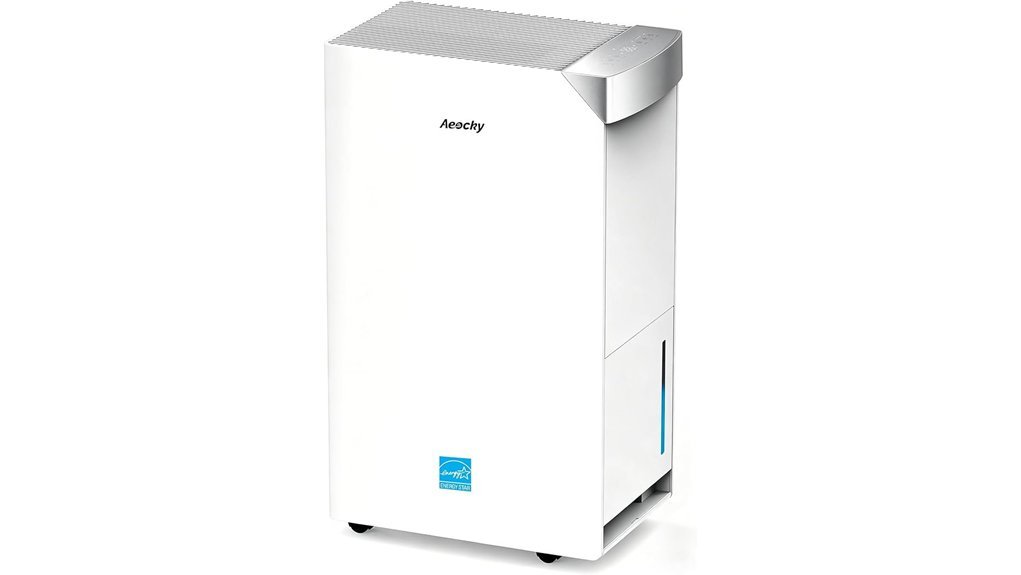
Best Efficiency-Focused Alternative
The AEOCKY 74 Pint model is another suitable option for a large garage, but its capacity needs clear context. The current listing describes up to 74 pints per day at 95°F and 95% relative humidity, along with 52 pints per day at 86°F and 80% relative humidity. It also promotes ENERGY STAR Version 6.0 compliance, automatic humidity control, a 1.45-gallon tank, a drain hose, casters, and automatic defrost.
Why You’ll Like It: It provides many of the same garage-friendly controls and drainage features as the 80-pint AEOCKY model with a slightly lower maximum-condition claim.
Best For: Large garages where efficiency, automatic control, and continuous drainage matter more than app connectivity.
Who Should Avoid It: Buyers who want one simple, standardized capacity number may find the multiple test-condition ratings confusing.
Pros:
- ENERGY STAR Version 6.0 positioning.
- Continuous drainage and automatic humidity control.
- Automatic defrost and portable casters.
Cons:
- The 74-pint figure applies to hot, extremely humid test conditions.
- Bulky for frequent room-to-room movement.
- Confirm the exact model, certification record, and warranty terms before ordering.
AEOCKY 50 Pint Compressor Dehumidifier (3500 Sq.Ft)
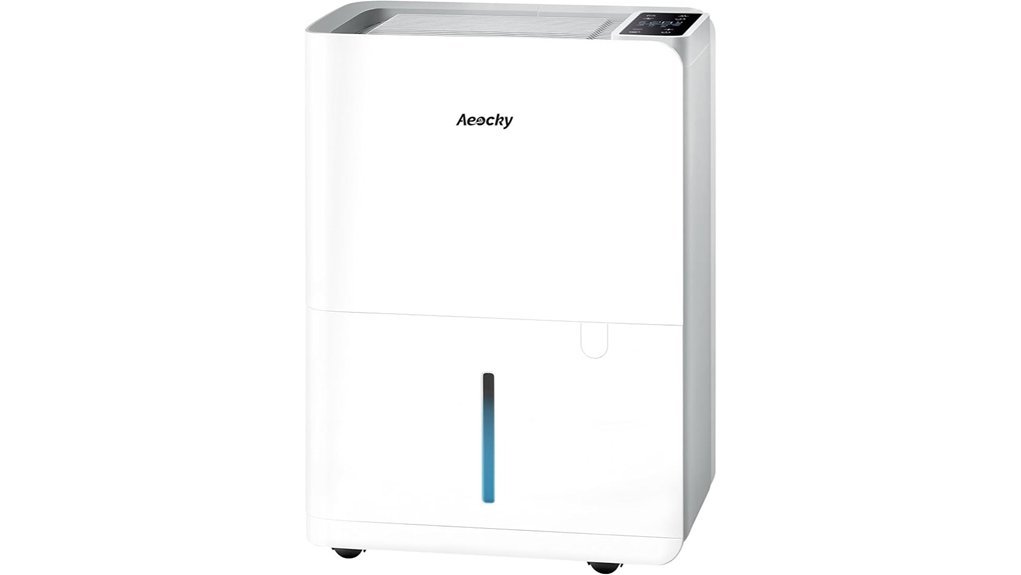
Best Mid-Size AEOCKY Option
The AEOCKY 50 Pint Compressor Dehumidifier sits between the compact 30-to-34-pint maximum-condition models and the larger 74-to-100-pint options. Its listing advertises up to 50 pints per day, coverage up to 3,500 sq. ft., an intelligent humidistat, a drain hose, a 0.8-gallon tank, and quiet operation. Because the test condition is not as clearly presented as it is for some competing models, confirm the current specification sheet before comparing it with standardized 50-pint units.
Why You’ll Like It: It offers useful mid-size capacity and automatic humidity control without the bulk of the highest-output models.
Best For: A moderately damp medium-to-large garage with a practical hose-drain route.
Who Should Avoid It: Very wet garages, major water intrusion, or spaces with frequent outside-air exchange may need a larger standardized capacity.
Pros:
- Balanced advertised capacity for mid-size spaces.
- Intelligent humidistat and continuous drainage support.
- Compact footprint compared with several large-capacity models.
Cons:
- Smaller tank than several large-capacity competitors.
- The 3,500-sq.-ft. claim should not replace moisture-load sizing.
- Verify the rating test condition and current warranty on the exact listing.
Waykar 34 Pints Energy Star Dehumidifier for Home
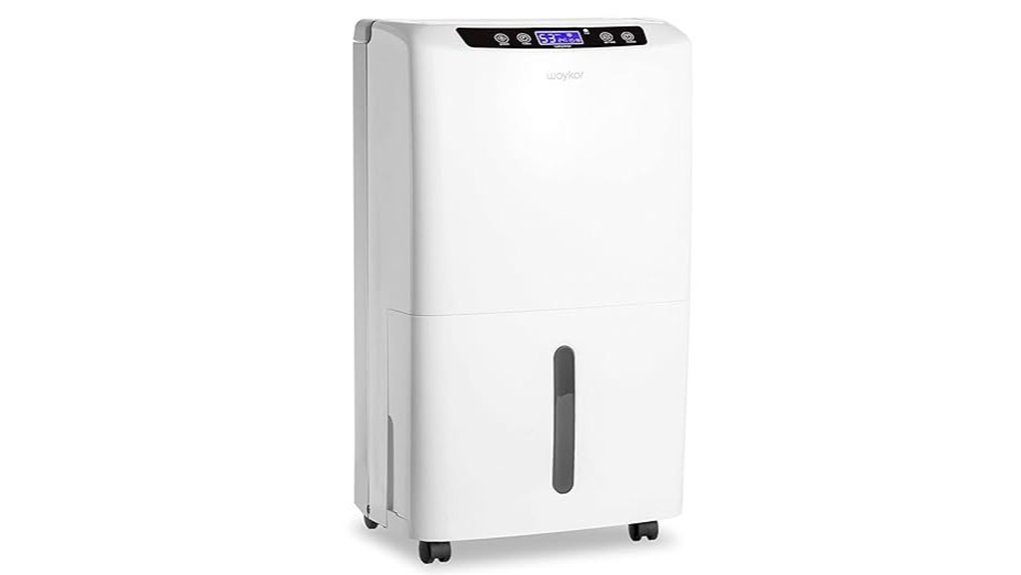
Best for Light-to-Moderate Garage Humidity
The Waykar PD160B is marketed with a maximum 34-pint figure for hot, humid conditions, but the ENERGY STAR product record lists a standardized water-removal capacity of 9.81 pints per day. That makes it a more defensible choice for a smaller or moderately damp garage than for severe moisture. The product includes adjustable humidity control, automatic defrost, a drain hose, a 0.66-gallon tank, fan settings, and a timer.
Why You’ll Like It: It is easier to place and move than many 50-to-100-pint maximum-condition units while still supporting continuous drainage.
Best For: A typical residential garage with light-to-moderate humidity, limited water entry, and reasonably controlled air leakage.
Who Should Avoid It: Large garages with standing moisture, seepage, very high humidity, or frequent open-door airflow should use a model with a higher standardized capacity.
Pros:
- ENERGY STAR certified model with automatic humidity control.
- Drain hose, timer, auto defrost, and portable design.
- Smaller and easier to position than many high-capacity units.
Cons:
- The standardized capacity is much lower than the 34-pint marketing headline.
- Small tank may fill quickly without continuous drainage.
- Not the best choice for severe moisture loads.
PLUSCENT 32 Pint Dehumidifier for Home
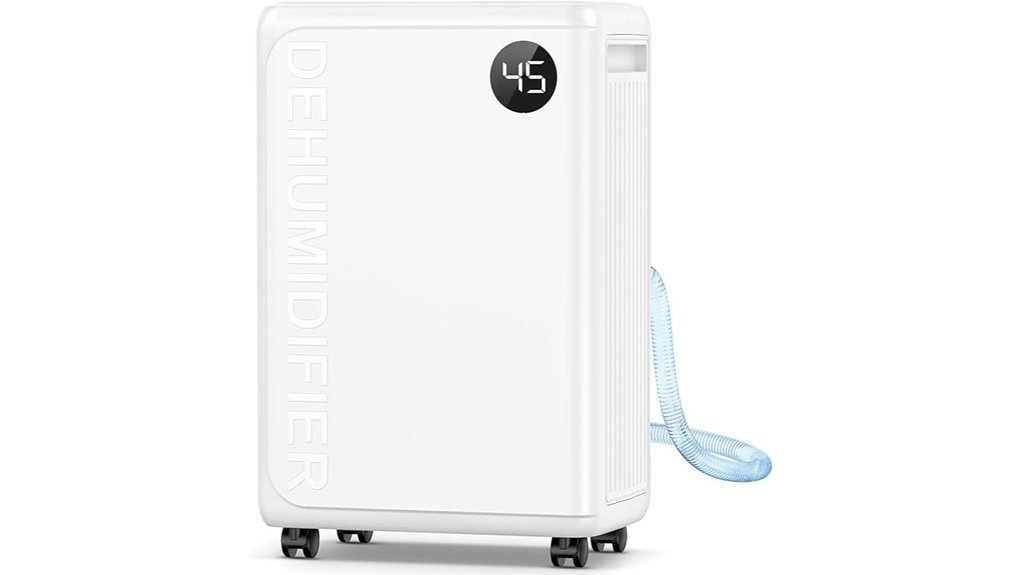
Best Quiet Compact Option
The PLUSCENT 32 Pint Dehumidifier is a better fit for a smaller garage or workshop than for a very wet oversized space. Its listing states that the 32-pint figure is measured at 95°F and 90% relative humidity. It includes DEHU, CONT, and DRY modes, a 24-hour timer, automatic defrost, a 2-liter tank, a washable filter, and a gravity drain hose.
Why You’ll Like It: Its compact body and quiet-operation positioning make it attractive for a garage that also serves as a hobby or work area.
Best For: Smaller garages, hobby rooms, and buyers who value a compact footprint and continuous drainage.
Who Should Avoid It: A very large, frequently opened, or visibly wet garage will likely need a model with a higher standardized capacity.
Pros:
- Compact design with quiet-operation positioning.
- Three modes, timer, humidistat, auto defrost, and continuous drainage.
- Easier to place in a crowded garage than large 50-to-100-pint models.
Cons:
- The 2-liter tank may require frequent emptying.
- Gravity drainage needs a lower drain point.
- The 32-pint maximum applies to hot, highly humid test conditions.
Factors to Consider When Choosing a Dehumidifier for a Hot Garage
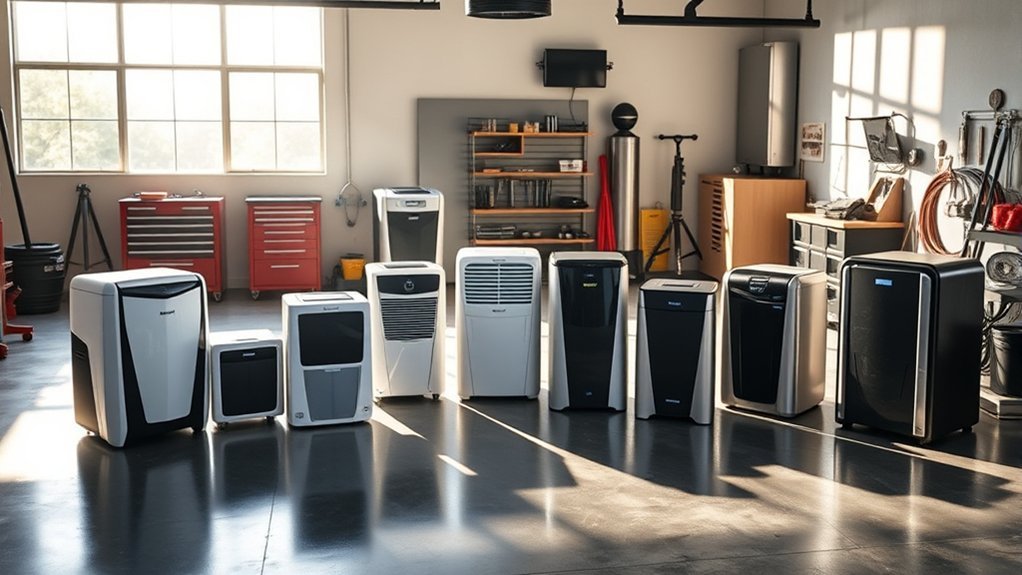
A garage creates a different moisture challenge from a bedroom or finished basement. Heat, air leaks, vehicle moisture, wet tools, concrete slabs, and frequent door openings can all increase the workload. Use the following factors to choose a unit that fits the real conditions rather than relying on one marketing number.
Measure the Garage and Humidity
Start with the floor area, ceiling height, and a separate hygrometer reading taken over several days. A small garage with seepage may need more capacity than a larger garage that is only mildly damp. Also consider how often the garage door opens, because outside air can force the unit to run much longer.
Compare Standardized Capacity, Not Just Headline Pints
A “100-pint” maximum-condition unit does not necessarily remove twice as much water as a standardized 50-pint model. DOE and ENERGY STAR capacities use defined test methods, while some marketplace listings advertise results measured at 95°F and 90% to 95% relative humidity. Use the standardized figure when available and treat hotter-condition numbers as supplemental information.
Check the Operating Temperature Range
A hot garage can approach the upper operating limit of a residential dehumidifier. Confirm the manufacturer’s permitted temperature range, leave the required clearance around the air intake and exhaust, and do not place the unit in direct rain or where it can be splashed. Automatic defrost is useful if winter garage temperatures also fall near the model’s lower limit.
Choose the Right Drainage Method
Continuous drainage is usually the most practical setup for a garage. A gravity hose must slope downward for its entire run. A built-in pump is better when the discharge point is higher than the unit. Check whether the hose and adapter are included, test the drainage route before leaving the unit unattended, and clean the hose periodically.
Consider Energy Use and Heat Output
Compressor dehumidifiers release warm air while removing moisture, so they can make an enclosed garage feel warmer. An ENERGY STAR certified model may reduce electricity use, but actual operating cost depends on standardized capacity, runtime, humidity setting, garage leakage, temperature, and local electricity rates.
Noise, Portability, and Maintenance
For a garage workshop, compare noise at more than one fan speed rather than relying on a single best-case number. Wheels and handles matter when floor space changes. Clean the filter on the schedule in the manual, keep the coils and intake free of dust, rinse the bucket, and inspect the drain hose for kinks or buildup.
Fix Moisture Sources First
A dehumidifier is not a substitute for repairing roof leaks, wall seepage, poor exterior drainage, or water entering under the garage door. Reducing the source of moisture and unnecessary outside-air leakage can shorten runtime, lower electricity use, and help a properly sized unit maintain the target humidity.
Garage Electrical and Placement Safety
Use the outlet type, circuit, clearances, and placement required by the product manual. Keep the unit upright on a stable surface, protected from vehicles, rain, and splashing. Do not use an extension cord unless the manufacturer specifically permits it, and disconnect power before cleaning or servicing the bucket, filter, or drain path.
Before you buy
- Confirm the garage size, ceiling height, typical temperature, and measured humidity.
- Identify water leaks, seepage, wet vehicles, or frequent door opening before sizing the unit.
- Choose gravity drainage only when the hose can slope downward continuously.
- Compare the DOE- or ENERGY STAR-rated capacity when available, not only the maximum hot-condition number.
- Verify the current seller, exact model number, warranty, included hose, and pump lift limit where applicable.
- Follow the manual for outlet type, clearance, extension-cord restrictions, and safe placement.
Frequently Asked Questions
What Size Dehumidifier Do I Need for a Hot Garage?
Use standardized capacity and measured humidity as the starting point. ENERGY STAR guidance suggests roughly 20 to 30 pints per day for a slightly to moderately damp space under 2,000 sq. ft., 25 to 40 pints for a very damp space, and 30 to 50 pints for a wet space. Larger spaces generally start at 30, 40, or 50-plus pints respectively. A garage with a high ceiling, seepage, or frequent door opening may need more capacity than its floor area suggests.
Will a Dehumidifier Cool a Hot Garage?
No. A dehumidifier can make the air feel less muggy, but a compressor model normally releases heat into the room and may raise the air temperature. Use ventilation, insulation, or air conditioning separately when temperature control is the main goal.
What Humidity Level Should I Use in a Garage?
A practical starting point is around 45% to 50% relative humidity, then adjust based on condensation, stored materials, runtime, and the manufacturer’s guidance. ENERGY STAR notes that a general indoor range of 30% to 50% is commonly considered appropriate, although the best garage setting depends on climate and use.
Can I Run a Garage Dehumidifier Continuously?
Many models support continuous operation, but a humidistat should let the compressor cycle rather than run at maximum output unnecessarily. Before unattended use, confirm stable placement, proper airflow clearance, a clean filter, and a leak-free drain route that has been tested under actual operation.
Do I Need a Pump or a Gravity Drain?
Choose gravity drainage when the hose can run downhill to a floor drain or other lower discharge point. Choose a pump when water must travel upward or across a route where a continuous downward slope is impossible. Confirm the pump’s permitted lift height in the exact model manual.
How Do I Maintain My Dehumidifier for Optimal Performance?
Clean the washable filter as directed, keep the intake and exhaust clear, rinse and dry the bucket, inspect the drain hose, and remove dust from around the unit. Disconnect power before cleaning and follow the maintenance instructions in the product manual.
What Is the Average Lifespan of a Dehumidifier?
There is no dependable lifespan that applies to every model. Build quality, runtime, garage temperature, dust exposure, drainage care, voltage conditions, and maintenance all affect service life. Compare warranty length, compressor coverage, seller support, and replacement-part availability instead of relying on one promised number of years.
Do Dehumidifiers Consume a Lot of Electricity?
Electricity use can be significant when a unit runs for long periods in a leaky, hot, or very humid garage. A correctly sized efficient model, a realistic humidity target, repaired water entry, sealed air leaks, and reliable continuous drainage can reduce unnecessary runtime.
Conclusion
The AEOCKY 4500 Sq.Ft 80 Pint model is the strongest all-around choice here for a large hot garage, provided you evaluate its lower standardized capacity rather than relying only on the 80-pint maximum-condition claim. The DECIUU Max 100 Pint with Pump is the better solution when water must be moved upward, while the non-pump DECIUU is more practical when a gravity drain is available.
Choose the Frigidaire 50 Pint WiFi or GoveeLife Smart Dehumidifier for remote control. Consider the AEOCKY 50 Pint, Waykar PD160B, or PLUSCENT 32 Pint for a smaller or moderately damp garage, but pay close attention to the difference between standardized and hot-condition capacity ratings.
Final recommendation
Measure the humidity first, correct active water entry, and plan the drain route before ordering. For most buyers, a clearly rated 50-pint class unit with continuous drainage is a safer starting point than choosing solely by a 4,500- or 5,000-square-foot coverage claim.