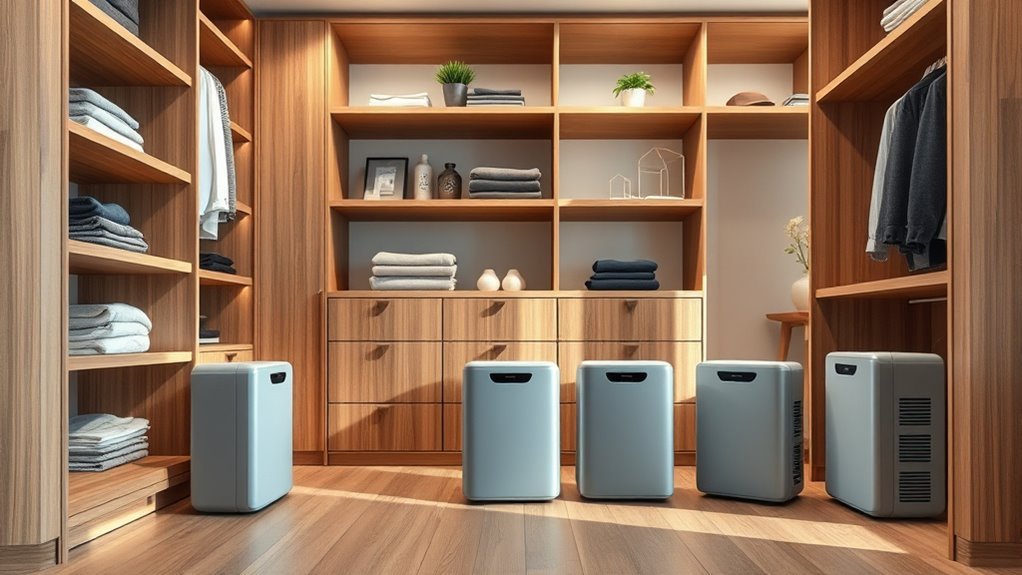
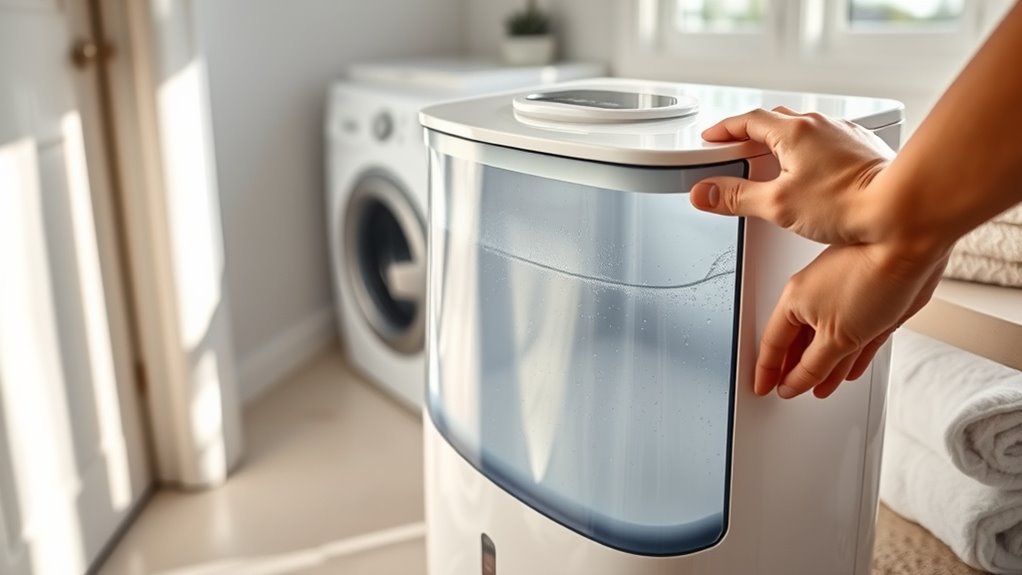
The best home dehumidifier with a HEPA filter for 2026 depends mainly on the amount of moisture in your room. Compact thermoelectric models such as the SOICARE 108 OZ, Hyintell DH16, Sefaul WiFi unit, and Tenergy Sorbi are designed for mild humidity in smaller enclosed spaces. The AIRCYAN 1500 Sq. Ft 32-Pint model uses a compressor and offers substantially more moisture-removal capacity for a larger or consistently damp room.
Compare the daily extraction claim and its test conditions before looking at advertised square-foot coverage. You should also check the filter documentation, tank size, drainage method, noise level, operating-temperature range, replacement-filter availability, and whether an included ionizer can be disabled.
Quick Verdict
- Best Overall for Larger Rooms: AIRCYAN 1500 Sq. Ft 32-Pint Dehumidifier for its compressor-based moisture removal, drain-hose support, adjustable humidity control, and combined particle and odor filtration.
- Best Compact Option: Tenergy Sorbi 1000ml for its documented H13 filter, 1-liter tank, two fan speeds, 22 CFM airflow, and simple controls.
- Best Smart Option: Sefaul 1000ml WiFi Dehumidifier for app-based control in a smaller enclosed room, provided you verify whether its filter performance meets your needs.
Important sizing note: A compact unit removing less than one liter per day is intended for light moisture control. It is not a substitute for a higher-capacity compressor dehumidifier in a wet basement, large open floor plan, or room with leaks, seepage, or an active water problem.
How These Products Were Evaluated
The comparison prioritizes moisture-removal capacity, stated test conditions, filter documentation, tank and drainage design, operating noise, maintenance needs, and suitability for the advertised room type. Manufacturer and seller claims are treated as claims rather than independent test results.
Quick Comparison
| Product | Best For | Claimed Maximum Removal | Tank | Key Features | Amazon |
|---|---|---|---|---|---|
| SOICARE 108 OZ | Closets, bedrooms, RVs, and small enclosed spaces where a larger tank is useful | Not clearly stated on the current product page | 3.2 L | HEPA filter, timer, auto-off, defrost, ambient light, carrying handle | Check Current Availability |
| Hyintell DH16 | Bedrooms, offices, closets, and small rooms needing continuous drainage | Seller claims 0.7–0.8 L/day at 86°F and 80% RH | 1.6 L | H13 filter, ionizer, drain hose, 24-hour timer, 35 dB low setting | Check Current Availability |
| Sefaul 1000ml WiFi | App-based control in a small enclosed room with mild humidity | Seller claims up to 0.75 L/day at 122°F and 80% RH | 1 L | WiFi app, auto-off, continuous mode, seller-described HEPA filtration | Check Current Availability |
| AIRCYAN 1500 Sq. Ft 32-Pint | Larger bedrooms, living areas, laundry rooms, and medium basements | Up to 32 pints/day at 95°F and 95% RH; 20 pints/day at 86°F and 80% RH | 0.53 gal | Compressor, seller-described HEPA and carbon filters, 39 dB sleep mode, drain hose | Check Current Availability |
| Tenergy Sorbi 1000ml | Closets, offices, bathrooms, bedrooms, and other compact spaces | Up to 0.75 L/day at 86°F and 80% RH | 1 L | H13 filter, 22 CFM airflow, two fan speeds, auto-off, 45 W maximum | Check Current Availability |
108 OZ Portable Room Dehumidifier with HEPA Filter
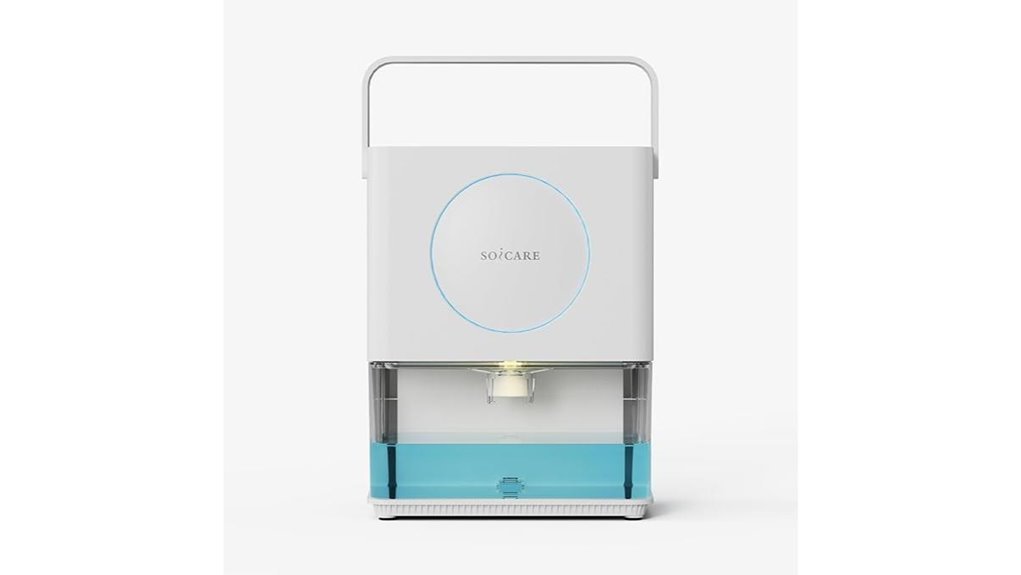
Best Large-Tank Compact Pick: The SOICARE SP-DH01 combines a 3.2-liter tank with a compact dehumidifier and filtration design. Its larger reservoir may require less frequent emptying than the 1-liter models in this comparison, making it convenient for a closet, bedroom, RV, or another small enclosed space with mild humidity.
Why You’ll Like It: The main advantage is the 108-ounce reservoir. The listing also includes a HEPA filter, timer, automatic shutoff, defrosting function, ambient lighting, and integrated carrying handle.
Who Should Buy It: Consider it when tank capacity and portability matter more than maximum moisture-removal speed.
Who Should Avoid It: Skip this model for a wet basement, large open room, or serious condensation problem. Its current product page does not clearly publish a standardized daily extraction figure, making it difficult to compare directly with higher-capacity models. Do not place it where it can be splashed or exposed directly to water.
Pros:
- Large 3.2L (108 oz) tank can reduce emptying frequency
- HEPA filter, timer, auto-off, defrost function, ambient light, and carrying handle
- Portable format for mild humidity in smaller enclosed spaces
Cons:
- Daily extraction capacity is not clearly stated on the current product page
- Not a replacement for a compressor dehumidifier in seriously damp rooms
- Filter efficiency and replacement-filter information should be confirmed before buying
Dehumidifier and Air Purifier Combo with HEPA H13 Filter
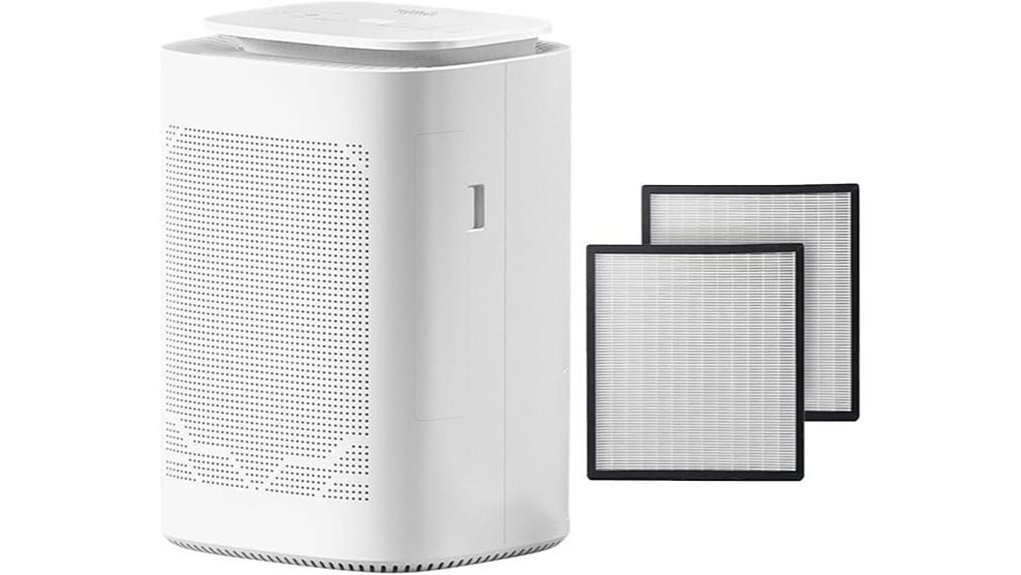
Best H13 Pick with Continuous Drainage: The Hyintell DH16 combines a compact dehumidifier, H13 filter, negative-ion function, 1.6-liter tank, and drain-hose support. It is designed for a bedroom, office, closet, or similar small room where you want light moisture control and particle filtration in one appliance.
Why You’ll Like It: The drain-hose option can reduce tank maintenance when the hose is installed correctly. The listing also includes a 24-hour timer, dual operating speeds, full-tank shutoff, and a low setting advertised at 35 dB.
Moisture-Removal Claim: The seller states that the unit can collect about 700 to 800 ml per day at 86°F and 80% relative humidity. Actual collection will normally be lower in cooler or less humid conditions.
Who Should Buy It: It suits buyers who want an H13-labeled filter, a larger tank than most mini units, and the option to use gravity drainage.
Who Should Avoid It: Buyers with a wet basement or large open-plan area need a higher-capacity compressor model. The unit also includes a negative-ion function. Confirm whether the ionizer can be switched off and whether the manufacturer provides recognized zero-ozone-emissions testing if this feature concerns you.
Pros:
- H13 filtration and light dehumidification in one compact unit
- 1.6L tank, full-tank auto-off, and drain-hose support
- 24-hour timer and seller-advertised 35 dB low setting
Cons:
- 700–800 ml per day is light-duty extraction, not wet-basement capacity
- Performance claim is based on warm, humid test conditions
- Ionizer emissions documentation and on/off control should be checked
1000ml Air Dehumidifier with WiFi and HEPA Filter
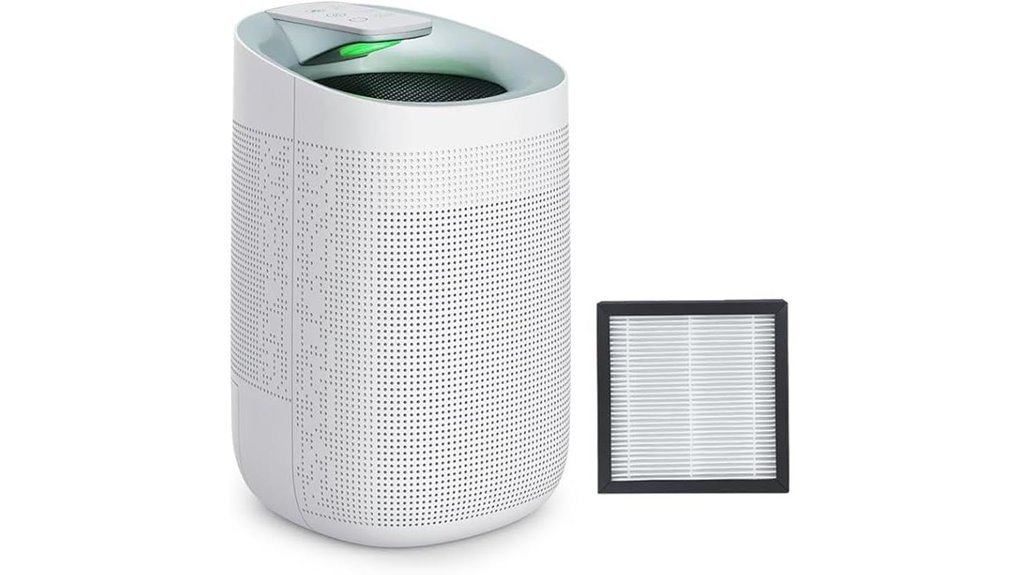
Best Smart-Control Pick: The Sefaul 1000ml model adds WiFi app control to a compact dehumidifier and particle-filtering design. It lets you adjust supported settings remotely and includes continuous operation and automatic shutoff when the tank fills or is installed incorrectly.
Why You’ll Like It: App control can be useful when the unit sits in a closet, home office, laundry area, or another location you do not want to check repeatedly. The removable 1-liter tank is also easier to carry and empty than a large compressor-model bucket.
Moisture-Removal Claim: The seller claims up to 750 ml of daily extraction at 122°F and 80% relative humidity. Because 122°F is far hotter than a typical indoor room, buyers should expect substantially different collection under ordinary conditions.
Filter Verification Note: The listing calls the filter “True HEPA” but states 99.7% filtration. The commonly recognized true-HEPA benchmark is 99.97% at 0.3 microns. Treat the filtration description as unverified unless the seller or manufacturer provides a complete test standard and supporting documentation.
Who Should Buy It: It is best for someone who values remote control and needs mild humidity management in a smaller enclosed area.
Who Should Avoid It: Do not choose it solely because the listing mentions coverage up to 800 square feet. Its extraction claim is more consistent with light-duty use than with drying a large or seriously damp room.
Pros:
- WiFi app control for remote adjustments
- Compact 1-liter tank with automatic shutoff
- Combines light dehumidification and particle filtration
Cons:
- Advertised 800 sq. ft. coverage is aggressive for a 750 ml/day unit
- Maximum extraction is measured at an unusually high temperature
- The listing’s 99.7% filtration statement does not match the normal true-HEPA benchmark
AIRCYAN 1500 Sq.Ft 32-Pint Dehumidifier with HEPA Filter
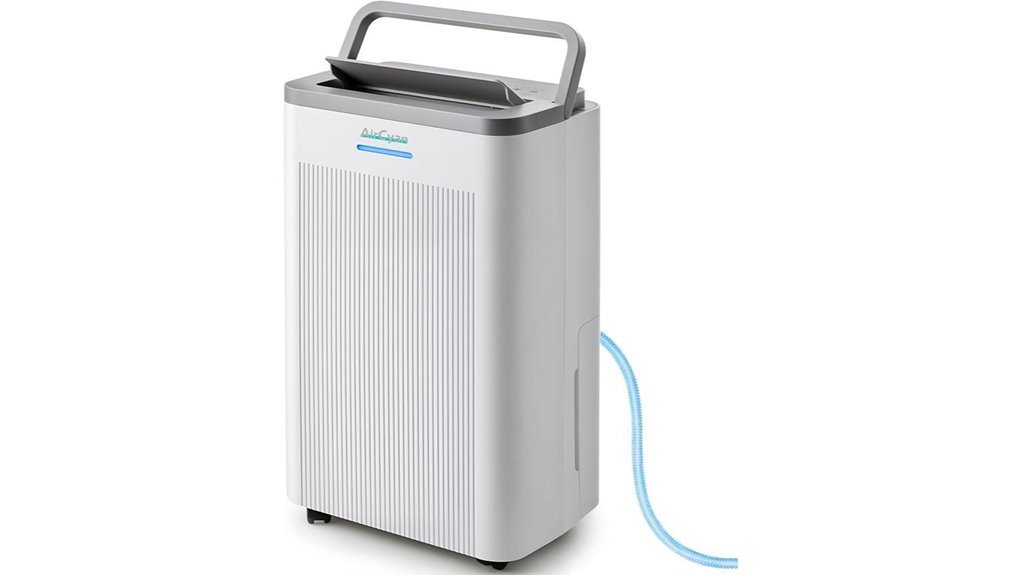
Best Overall for Larger Rooms: The AIRCYAN compressor dehumidifier is the strongest moisture remover in this group. It is marketed for areas up to 1,500 square feet and is more suitable for a larger bedroom, living area, laundry space, or medium basement than the compact thermoelectric models.
Why You’ll Like It: The unit includes adjustable humidity control, multiple operating modes, seller-described HEPA and activated-carbon filtration, a drain hose, automatic shutoff, timer, ambient humidity lights, hidden handle, and caster wheels. Its sleep mode is advertised at a minimum of 39 dB with reduced display lighting.
Moisture-Removal Claim: The listing states up to 32 pints per day at 95°F and 95% relative humidity and 20 pints per day at 86°F and 80% relative humidity. The lower figure is still far above the sub-one-liter output claimed by the compact models, but actual performance depends on room temperature, humidity, airflow, and the moisture source.
Who Should Buy It: Choose this model when meaningful moisture removal is more important than compact size or very low power consumption.
Who Should Avoid It: It is heavier and larger than the mini models, and its 0.53-gallon bucket can fill quickly if continuous drainage is not used. The current listing describes HEPA filtration but does not provide enough information to confirm that the complete appliance meets a recognized true-HEPA performance standard.
Pros:
- Substantially higher moisture-removal capacity than the compact models
- Adjustable humidity control, sleep mode, multiple operating modes, and combined filtration
- Drain hose, timer, auto shutoff, wheels, and hidden handle improve daily usability
Cons:
- The 32-pint maximum applies to extreme 95°F and 95% RH test conditions
- 0.53-gallon tank is small relative to the potential extraction rate
- Filter class, airflow performance, and replacement-filter cost require confirmation
Tenergy Sorbi 1000ml Air Dehumidifier with HEPA Filter
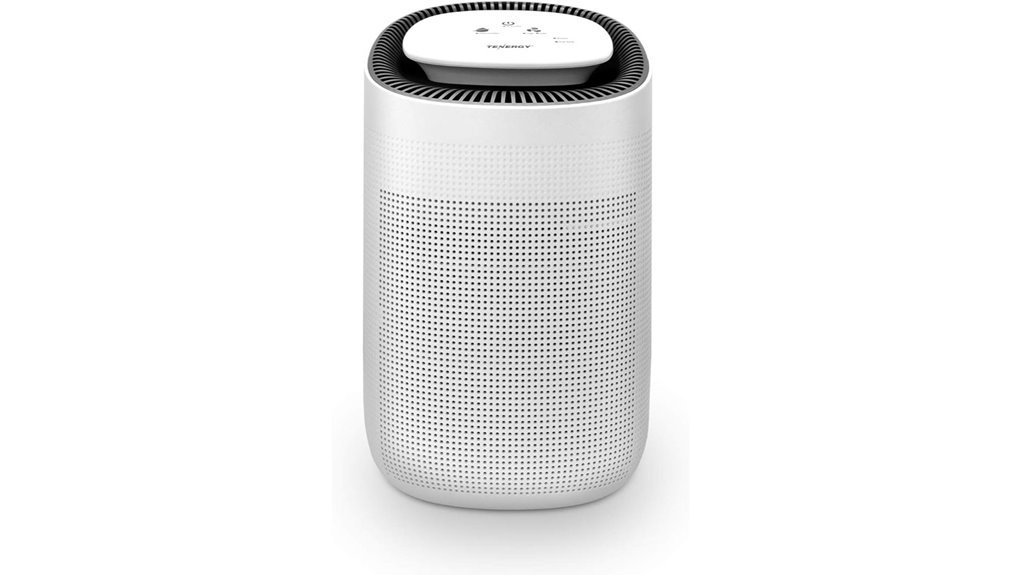
Best Established Compact Pick: The Tenergy Sorbi combines Peltier dehumidification, a 1-liter tank, an H13 filter, two fan speeds, touch controls, LED indicators, and automatic shutoff in a portable six-pound body.
Why You’ll Like It: The Sorbi is straightforward to operate and draws up to 45 watts. Its published specifications include a maximum moisture-removal rate of 750 ml per day, 22 CFM airflow, dual fan speeds, and a 1-liter removable reservoir.
Moisture-Removal Claim: The 750 ml daily figure is measured at 86°F and 80% relative humidity. It is suitable for mild humidity in a compact area but should not be interpreted as large-room or basement-level performance.
Who Should Buy It: It is a sensible choice for a closet, office, bathroom, small bedroom, or similar enclosed area where ease of use and documented filter specifications matter.
Who Should Avoid It: Avoid it for large rooms, cold seasonal spaces, or severe dampness. The published operating range begins at about 50°F, and thermoelectric units generally collect less water as room temperature and humidity fall.
Pros:
- Compact two-in-one design with an H13 filter
- 1-liter tank, auto shutoff, touch controls, and two fan speeds
- Published 22 CFM airflow, 45-watt maximum draw, and six-pound weight
Cons:
- Designed for mild moisture loads in compact areas
- 1-liter tank requires manual emptying
- Replacement-filter availability and cost should be checked before buying
Factors to Consider When Choosing a Home Dehumidifier With HEPA Filter
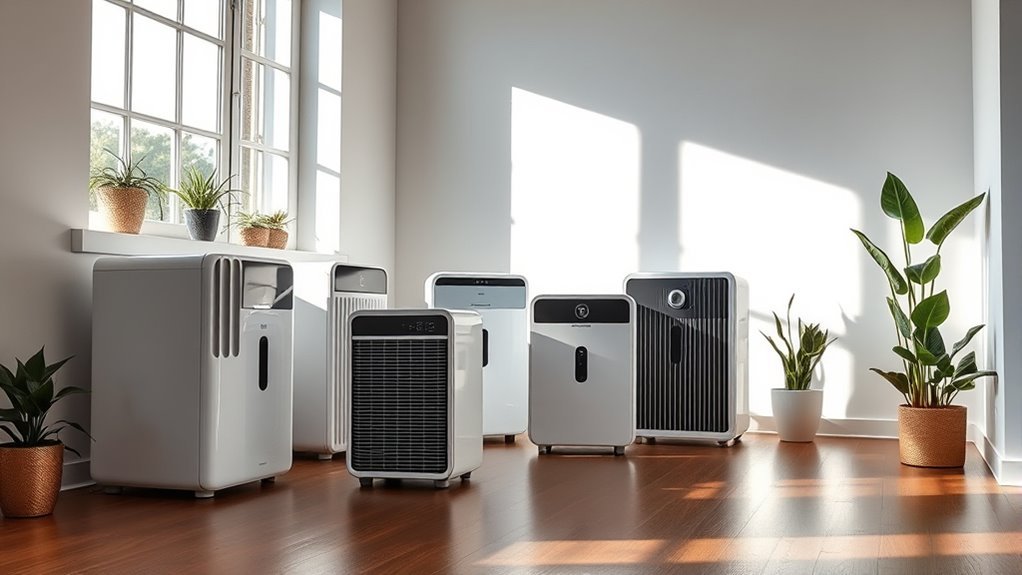
The best dehumidifier and air-purifier combo is not always the model with the largest advertised coverage number. Start with the daily water-removal capacity and test conditions. Then compare filter documentation, airflow, tank size, drainage, operating temperature, noise, energy use, warranty, and replacement-filter cost.
Daily Moisture Removal
Daily extraction is the most important specification. Compact thermoelectric models in this guide generally claim less than one liter per day under warm, humid test conditions. That level is intended for mild moisture in a small enclosed space. A compressor model rated in tens of pints per day is more appropriate for a larger or consistently damp room. Real-world collection will normally fall as temperature or relative humidity decreases.
Coverage Area
Treat square-foot coverage as a secondary marketing estimate rather than the main sizing number. Room layout, open doors, ceiling height, temperature, airflow, and moisture load all change performance. A mini unit advertised for hundreds of square feet but removing less than one liter per day remains a light-duty appliance.
Thermoelectric vs. Compressor Models
Thermoelectric or Peltier dehumidifiers are compact, relatively quiet, and low power, but they remove limited amounts of water and perform best in warm, mildly humid areas. Compressor dehumidifiers are heavier and use more electricity, but they remove far more moisture and are better suited to basements, laundry areas, larger bedrooms, and living spaces.
Tank Capacity and Drainage
A larger tank reduces emptying frequency, but it does not increase moisture-removal power. Compare the reservoir with the unit’s daily extraction rate. A drain hose is particularly useful for a compressor model because a small bucket may fill quickly. Confirm that a gravity-drain outlet remains above the destination drain and that the hose runs downhill without kinks.
HEPA Filtration
A true HEPA filter is generally defined as capturing at least 99.97% of particles at 0.3 microns under the applicable test method. Do not rely only on words such as “HEPA,” “HEPA-type,” or “high efficiency.” Look for the exact efficiency, particle size, testing standard, and airflow or CADR when available.
The filter alone does not determine how well the complete appliance cleans a room. A high-efficiency filter paired with very low airflow may provide limited room-level air cleaning. Also confirm that replacement filters are available and that all air drawn into the appliance passes through the filter rather than around it.
Ionizer Features
Some combination units include a negative-ion function. Ionization technology can produce ozone or other by-products unless the product is designed and tested to prevent them. Check whether the ionizer can be disabled and whether the manufacturer documents compliance with a recognized zero-ozone-emissions standard. Buyers who prefer purely mechanical filtration may wish to choose a model without an ionizer.
Noise Levels
For a bedroom or office, look for a clearly stated low-mode sound rating and a sleep mode that dims or turns off display lights. Compact models may advertise low settings near 35 dB, while the larger AIRCYAN model advertises a minimum of 39 dB in sleep mode. Actual sound changes with fan speed, room acoustics, floor type, and vibration.
Energy Efficiency
Do not judge efficiency by wattage alone. Compare the amount of water removed with the electricity used. For compressor dehumidifiers, an ENERGY STAR certification and Integrated Energy Factor can make efficiency comparisons easier. Timers, humidistats, automatic shutoff, and smart schedules can also reduce unnecessary runtime.
Smart Controls
WiFi control is useful when a unit sits in a closet, basement corner, or office, but it does not improve extraction capacity. Look for dependable manual controls, full-tank protection, automatic restart behavior, humidity-display accuracy, account-security options, and clear app privacy information.
Replacement Filters and Maintenance
Check replacement-filter availability before buying a combination unit. Empty and rinse the tank regularly, keep the air inlet clear, clean exterior dust, and inspect the drain hose for kinks or buildup. Follow the manufacturer’s instructions instead of using a fixed replacement schedule for every model.
Before You Buy Checklist
- Measure the room and decide whether the moisture problem is mild, damp, very damp, or wet.
- Compare liters or pints removed per day together with the stated test conditions.
- Confirm the filter efficiency, test standard, airflow, and replacement-filter source.
- Choose a tank and drainage setup that match how often you can maintain the appliance.
- Check the operating-temperature range, especially for a basement or seasonal room.
- Confirm whether any ionizer can be disabled and whether emissions testing is documented.
- Review noise, wattage, warranty, seller support, return terms, and current availability.
Frequently Asked Questions
How Often Should a HEPA Filter Be Replaced in a Dehumidifier?
Follow the manufacturer’s instructions because filter size, airflow, room dust, pet hair, smoke, and daily runtime all affect service life. Replace the filter sooner if it looks heavily soiled, develops an unusual odor, becomes damaged, or noticeably restricts airflow.
Can a Dehumidifier With HEPA Help Reduce Mold Spores Indoors?
It may support mold control by lowering humidity and capturing some airborne particles, but it cannot remove an established mold source or repair water damage. Fix leaks, dry wet materials promptly, clean or remove contaminated materials safely, and keep indoor relative humidity around 30% to 50% when practical.
Are HEPA Dehumidifiers Safe to Run Overnight in Bedrooms?
They are generally designed for extended operation when installed and operated according to the manual. Place the appliance on a stable, level surface, keep air inlets clear, use the specified electrical supply, install the tank correctly, and keep the unit away from splashing water. Automatic shutoff and a display-dimming sleep mode are useful overnight features.
Do Dehumidifiers With HEPA Filters Use More Electricity?
The filtration fan adds some electrical load, but total energy consumption depends more on the dehumidifier technology, compressor size, fan speed, humidity setting, room conditions, and runtime. Compare wattage with the amount of water removed rather than assuming every combination appliance has similar efficiency.
Can One Unit Effectively Cover Multiple Connected Rooms?
One unit may influence connected rooms when doors remain open and air circulates freely, but drying and filtration will be slower and less even farther from the appliance. Size the dehumidifier for the combined moisture load and consider a higher-capacity compressor model for an open layout.
What Capacity Dehumidifier Do I Need?
For a closet, RV, small bedroom, bathroom, or lightly humid office, a compact thermoelectric model may be adequate. For a larger room or a space that feels consistently damp, choose a compressor unit rated in pints per day. Wet walls, seepage, plumbing leaks, or recurring condensation require correcting the moisture source rather than relying only on a dehumidifier.
Is a HEPA Dehumidifier a Replacement for a Dedicated Air Purifier?
Not always. Many compact combination units move less air than a dedicated room air purifier. Compare the filter test standard and airflow or CADR rather than assuming that the presence of a HEPA-labeled filter provides the same room-cleaning performance as a full-size air purifier.
Conclusion
Final Recommendation
Choose the AIRCYAN 1500 Sq. Ft 32-Pint Dehumidifier when moisture removal is the priority in a larger or consistently damp room. Its compressor design and drain-hose support make it the only option here suited to more demanding humidity control.
Pick the Tenergy Sorbi for a compact combination of light dehumidification, an H13 filter, documented airflow, and straightforward controls. Choose the Sefaul WiFi model when remote operation matters most, but verify its filter documentation before relying on its true-HEPA wording.
Whichever model you select, base the decision on daily extraction capacity, test conditions, drainage, and the actual moisture problem—not the advertised coverage number alone.