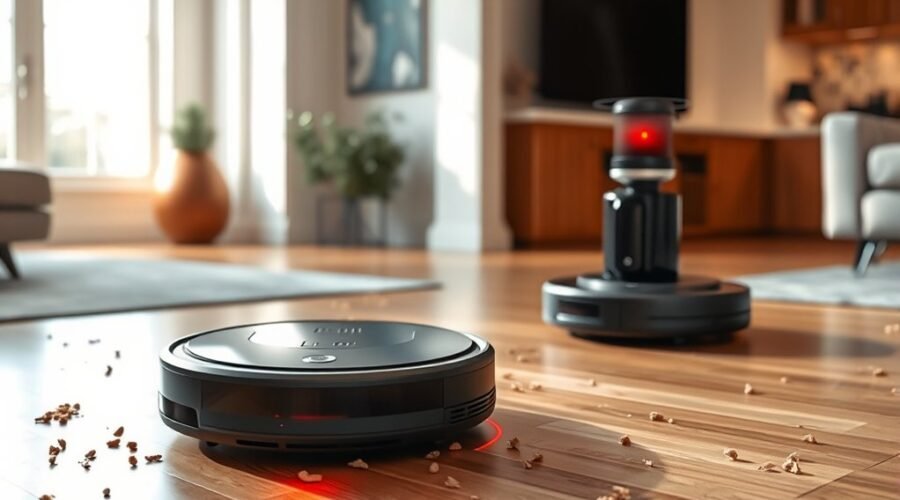
Infrared and LiDAR sensors serve the same broad task in robot vacuums, yet they operate on very different principles. Infrared systems rely on emitted light for basic proximity detection, while LiDAR uses pulsed laser measurements to build more detailed spatial maps. The difference affects accuracy, range, navigation in low light, and obstacle handling. The trade-offs are not minor, and the better choice depends on how the machine will be used.
Infrared vs LiDAR: What’s the Difference?
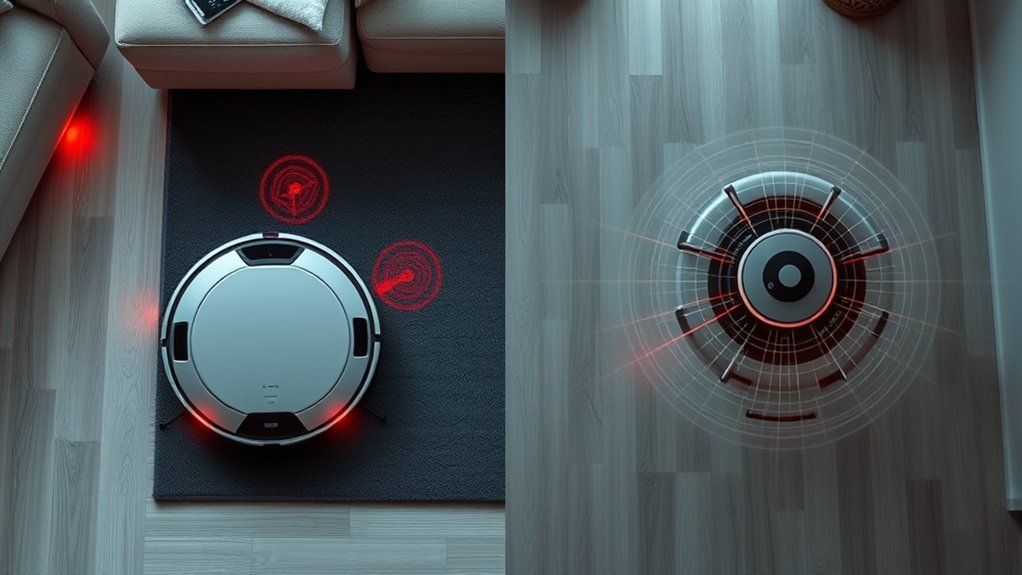
LiDAR and infrared sensors differ fundamentally in how they perceive space: LiDAR emits pulsed laser beams to calculate distance with millimeter-level precision, while infrared sensors rely on emitted or reflected infrared light for basic proximity detection.
In robot vacuums, this distinction determines distance measurement quality and mapping accuracy. LiDAR builds dense point clouds, enabling accurate navigation and obstacle avoidance across complex layouts. Infrared sensors, by contrast, offer limited depth information and are generally confined to short-range sensing.
LiDAR also maintains performance in low light and across harsher environmental conditions, while infrared sensors can degrade under bright illumination or with low-reflective surfaces.
LiDAR performs reliably in low light and harsh conditions, while infrared sensors struggle with bright light and reflective surfaces.
The tradeoff is practical: LiDAR demands more processing power and higher cost, whereas infrared sensors remain simpler and budget-friendly.
For users seeking autonomy rather than constraint, LiDAR represents a more capable spatial system; infrared sensors provide a narrower, lower-power alternative suited to basic detection rather than thorough environmental understanding.
How Infrared Sensors Work in Robot Vacuums
Infrared sensors in robot vacuums detect emitted or reflected infrared light to estimate the proximity of nearby objects, allowing the unit to register obstacles at short range. The system sends out emitted light and measures returned signals to support basic obstacle detection.
At short ranges, this method is sufficient for maneuvering through rooms, walls, and furniture in confined indoor spaces. Performance can degrade in bright light conditions, especially direct sunlight, because external light can interfere with signal interpretation.
Infrared sensors do not perform depth measurement or 3D mapping; they only infer closeness from changes in light intensity. That limitation keeps the hardware simple, yet effective for routine cleaning routes.
Because the technology is cost-effective and easy to integrate, it remains common in budget-friendly models. For users seeking practical autonomy without premium sensing complexity, infrared sensing offers a restrained, efficient, and accessible solution.
How LiDAR Navigation Works in Robot Vacuums
LiDAR navigation in robot vacuums relies on time-of-flight mapping, in which rapid laser pulses are emitted and their return times are measured to calculate precise distances.
These measurements support real-time path planning through continuously updated maps, typically generated with SLAM algorithms that adapt to changes in the environment.
The resulting point cloud improves obstacle detection accuracy, enabling efficient route selection and collision avoidance.
Time-of-Flight Mapping
By firing rapid laser pulses and measuring the return time of each reflection, these navigation systems calculate distances with high precision through time-of-flight mapping.
In LiDAR vacuum navigation, Time of Flight sensing converts each pulse into a distance value, producing accurate mapping of rooms and furniture. The resulting 3D spatial maps support efficient cleaning by aligning routes with cleaning needs and preserving obstacle avoidance in complex layouts.
Because the sensor measures millimeter-scale distance, it remains effective in low-light conditions and does not depend on ambient visual cues. Continuous scanning updates the map as the robot moves, allowing navigation to reflect changing surfaces and open areas.
This analytical process grants cleaner coverage and more autonomous operation, especially in larger homes where freedom from manual steering matters.
Real-Time Path Planning
Rapid laser pulses allow the navigation system to measure return times and construct a precise 3D map of the environment, which supports real-time path planning as the vacuum moves.
LiDAR navigation systems convert this sensor data into continuous mapping updates, enabling route adjustments without pause. Object recognition is derived from spatial patterns, helping the robot preserve obstacle avoidance while maintaining coverage.
Because the model can scan thousands of points per second, the path remains stable in complex rooms and narrow corridors. Performance in low-light conditions further expands operational freedom, letting the vacuum clean efficiently when illumination is poor.
Obstacle Detection Accuracy
Obstacle detection accuracy in robot vacuums depends on how precisely the navigation system can measure surrounding objects in real time.
LiDAR sensors emit rapid laser pulses and calculate return time to measure distances with millimeter-level accuracy, enabling reliable obstacle detection and precise mapping. This continuous scan, reaching thousands of points per second, lets robot vacuums identify furniture, walls, and narrow gaps before impact.
Unlike infrared systems, which can degrade in bright light or on reflective surfaces, LiDAR maintains stable navigation across varied environmental conditions, including dust or fog.
The result is more consistent path adjustment, fewer collisions, and less dependence on constrained, obscuring sensor limits. For users seeking liberated, hands-free cleaning, this technical advantage translates into more autonomous coverage and fewer interruptions.
Infrared vs LiDAR: Accuracy and Range
LiDAR provides substantially greater accuracy and range than infrared sensing because it uses pulsed laser light to measure distance with millimeter-level precision and generate detailed 3D maps of the environment. This gives LiDAR sensors a clear advantage in navigation, mapping, and obstacle avoidance, especially where precision determines autonomy.
Infrared systems typically detect proximity at centimeter-scale distance, which limits their accuracy in complex layouts. Their range is short, making them suitable for local sensing rather than broad environmental coverage.
LiDAR can extend to several hundred meters and maintains performance across varied lighting conditions, supporting reliable operation without dependence on ambient light. Infrared sensors, by contrast, are more vulnerable to direct sunlight and heat interference.
For users seeking liberated, efficient motion from a robot vacuum, LiDAR delivers the more robust sensing foundation, while infrared remains a lower-cost option for basic detection tasks, with fewer guarantees in demanding spaces and unpredictable room geometries.
Which Sensor Works Better in Dark Rooms?
Dark-room performance further separates the two sensing systems, since navigation reliability depends not only on range and accuracy but also on how independently a sensor operates from ambient light.
In dark rooms, LiDAR vacuum sensors generally outperform infrared because laser-based distance measurement and Time of Flight scanning do not rely on reflected room light. That independence supports continuous navigation and mapping, with millimeter-level accuracy that preserves detailed spatial models even in complete darkness.
Infrared sensors, by contrast, are constrained when reflected infrared light is weak, reducing obstacle detection and degrading positional certainty. The result is less dependable cleaning performance, especially where shadowed areas or unlit corridors dominate.
For users seeking autonomous operation without dependence on illumination, LiDAR offers a clearer technical advantage. Its real-time mapping enables efficient path planning, while infrared systems may miss critical environmental cues, limiting effective coverage.
In low light, LiDAR is the more robust choice among vacuum sensors.
Infrared vs LiDAR for Obstacle Avoidance
For obstacle avoidance, LiDAR generally offers superior performance because its pulsed laser system continuously measures distance and builds precise 3D environmental maps in real time.
Its millimeter-level accuracy in distance measurement supports reliable navigation around furniture, cables, and irregular edges, improving cleaning efficiency without depending on ambient light.
LiDAR also maintains strong environmental performance in fog, dust, and low-light conditions, where infrared sensors can be disrupted by direct sunlight, heat sources, or low-reflective surfaces.
LiDAR remains reliable in fog, dust, and low light, while infrared is more easily disrupted by sunlight and heat.
Infrared remains useful for basic proximity detection, but its limited range and weaker accuracy can cause missed obstacles and less stable mapping.
By contrast, LiDAR supplies continuous real-time data that strengthens obstacle avoidance and route correction, enabling more autonomous movement.
For users seeking technological independence from guesswork, LiDAR provides a more precise sensing architecture, while infrared offers a simpler, lower-cost option for constrained navigation tasks.
How to Choose the Right Robot Vacuum Sensor
Selecting the right robot vacuum sensor depends on the cleaning environment, mapping requirements, and budget constraints.
For robot vacuums operating in large or complex rooms, LiDAR offers millimeter-level accuracy, real-time navigation, and stronger obstacle detection through continuous scanning. Its mapping capability supports precise route planning across diverse cleaning needs, including low-light or harsh environmental conditions.
By contrast, infrared sensors suit simpler layouts where short-range detection is sufficient. They provide practical sensor integration and can support basic navigation, but their accuracy may decline under direct sunlight or on low-reflective surfaces.
Selection should thus align with the home’s spatial complexity, lighting consistency, and desired autonomy. Where freedom from repeated manual intervention matters, LiDAR is the more capable choice.
Where modest performance and straightforward deployment are enough, infrared sensors may be adequate. The ideal decision balances environment, mapping demands, and the level of precision expected from the robot vacuums.
Infrared vs LiDAR: Cost, Battery, and Maintenance
Cost, energy demand, and upkeep create a clear separation between infrared and LiDAR robot vacuum sensors. LiDAR delivers superior mapping and navigation accuracy, but its advanced optics and processing raise cost and integration complexity. Infrared sensors remain cheaper and more energy-efficient, supporting lower battery usage and simpler deployment. For users seeking liberated, low-friction automation, these tradeoffs matter.
| Factor | LiDAR | Infrared sensors |
|---|---|---|
| Cost | Higher | Lower |
| Battery usage | Higher | Lower |
| Maintenance | Regular cleaning/calibration | Minimal |
| Integration complexity | Complex | Simple |
| Performance longevity | Strong in varied conditions | Reduced in sunlight |
LiDAR’s active laser emission increases power draw, yet it sustains performance longevity in demanding environments. Infrared sensors offer modest maintenance and efficient operation, but their mapping degrades under direct sunlight or cluttered conditions. Selection thus hinges on whether long-term precision outweighs budget and energy constraints.
Frequently Asked Questions
Is Lidar Better for Robot Vacuums?
Yes—LiDAR is generally better for robot vacuums, given superior Lidar accuracy, mapping efficiency, and obstacle detection. However, Lidar cost, battery consumption, data processing, sensor durability, maintenance requirements, user experience, and technology trends remain relevant tradeoffs.
What Are the Downsides of Using Lidar?
Lidar drawbacks include cost implications, sensor maintenance, and data processing demands. Environmental factors and light interference can reduce mapping accuracy and obstacle detection, increasing battery consumption. Lidar limitations may exceed consumer preferences in compact spaces.
What Are the Key Differences Between Lidar and Ultrasonic Sensors?
LiDAR offers superior infrared accuracy, mapping capabilities, sensor range, and obstacle detection, but higher cost comparison, energy efficiency tradeoffs, and maintenance requirements. Ultrasonic sensing is cheaper, less precise, more affected by environmental impact, often matching user preferences.
What Can Lidar Not Detect?
LiDAR cannot reliably detect transparent, very dark, or low-contrast objects, plus small obstacle types like cables. Lidar limitations include reflective surfaces, range issues, environmental interference, data processing, cost factors, sensor integration, compatibility challenges, and low light performance.
Conclusion
Infrared and LiDAR each leave a distinct footprint on a robot vacuum’s path. Infrared acts like a narrow lantern beam, sensing nearby edges with limited reach, while LiDAR sweeps the room in measured pulses, sketching a precise map in darker, more complex spaces. The comparison shows a tradeoff between cost and capability. For simpler layouts, infrared may suffice; for sharper navigation and stronger obstacle awareness, LiDAR remains the more capable guide.