Wondering how to organize under a bathroom sink with plumbing taking up valuable space? Pipes, shutoff valves, and a deep cabinet can make ordinary storage bins difficult to use. The solution is to work around these obstacles while keeping daily essentials easy to reach. With a few careful measurements and the right layout, even a cramped vanity cabinet can become useful storage.
Quick Answer
To organize under a bathroom sink with plumbing, measure the cabinet around the pipes, remove clutter, and use narrow pull-out drawers or adjustable shelves on either side of the drain. Add clear, stackable bins for smaller items and lightweight door organizers for extra storage. Keep plumbing connections accessible and daily essentials near the front.
At a Glance
| Difficulty | Beginner-friendly |
| Tools Needed | Tape measure, cleaning cloth, and optional storage bins or organizers |
Measure Your Under-Sink Space First

Measure your bathroom sink cabinet before buying storage organizers. The most useful measurements are the interior width, depth, height, and clear space around the plumbing. Also measure the cabinet opening, which may be smaller than the space inside.
Use a tape measure to record these dimensions:
- Interior width: Measure from one side wall to the other, accounting for hinges and supports.
- Available depth: Measure from the front opening to the back wall, including any pipes that extend forward.
- Usable height: Measure from the cabinet floor to the underside of the sink basin or the lowest obstruction.
- Pipe clearance: Record the position of the drainpipe, curved P-trap, water supply lines, and shutoff valves.
- Door opening: Check whether a drawer or basket can pass through the opening without hitting the frame or hinges.
Some pull-out organizers require a cabinet opening of about 12 inches, while their full height may be greater. Always check both measurements.
Sketch the cabinet layout on paper, marking the open areas beside and below the pipes. Keep these measurements nearby when comparing organizers.
This simple preparation prevents buying drawers that cannot open or shelves that press against plumbing.
Recommended Products

𝐌𝐚𝐱𝐢𝐦𝐢𝐳𝐞 𝐔𝐧𝐝𝐞𝐫 𝐒𝐢𝐧𝐤 𝐒𝐩𝐚𝐜𝐞 - Designed with a custom-fit silicone mat and L-shaped structure, this under sink organizer fits perfectly around plumbing while protecting cabinets from water, spills, and leaks. Measuring approximately 11.8"W x 15.9"D x 13.8-16.9"H, it’s ideal for most kitchen and bathroom cabinets.

C Shaped Design-Save Space: The Under Sink Organizer kitchen design with C-Shape which allowing you to put it under a kitchen or bathroom sink without hitting the plumbing, and the bottom tier leaves a suitable space for your tall bottles, which can solve your cabinet storage troubles.

Larger Organizer for Maximum Efficiency: This under sink organizer, measuring 11.8"W x 15.9"D x (13.8"-16.9")H, providing more capacity for storing taller bottles, cleaning supplies and other essentials.Before purchasing, please double-check your cabinet dimensions to ensure this under cabinet organizer fits properly.
Clear Out Everything and Sort It
Remove everything from the under-sink cabinet before installing organizers. An empty cabinet makes it easier to see the available storage space, identify unnecessary products, and clean areas that are usually hidden.
Place everything on a clean surface and sort the contents into separate categories.
- Daily essentials: Toothpaste, skincare, hair products, and other frequently used supplies.
- Occasional-use items: Extra grooming accessories, travel toiletries, and first-aid supplies such as bandages.
- Backstock: Unopened replacement products that you regularly use.
- Items to remove: Empty containers, expired products, unwanted duplicates, and supplies that belong elsewhere.
Check expiration dates and product condition. Set aside unopened personal care products for donation only if they are suitable and accepted by the receiving organization.
Do not automatically throw hazardous cleaning chemicals or medicines into household trash. The EPA’s household hazardous waste guidance recommends following product labels and local disposal requirements for hazardous products.
For unused or expired medicines, the FDA recommends medicine take-back options for most products.
Once sorting is complete, keep only what fits the cabinet’s purpose. This leaves more room for organized storage around the plumbing.
Check for Leaks and Keep Plumbing Accessible
Before returning anything to the cabinet, inspect the plumbing and cabinet floor. Look for damp spots, water stains, swelling, musty odors, or moisture around pipe connections. Storage should never conceal a developing leak.
According to the EPA’s mold prevention guidance, leaking pipes can cause mold growth inside cabinets and nearby walls. A plumber or other qualified professional should repair leaking plumbing.
Wipe down the cabinet and allow damp surfaces to dry before adding containers.
Leave enough room to reach the shutoff valves and inspect drain connections without dismantling the entire storage system.
Pro Tip: Choose removable trays or lightweight bins near plumbing connections. If a leak develops, you can lift everything out quickly instead of unscrewing a fixed storage unit.
Choose Under-Sink Organizers That Fit Pipes
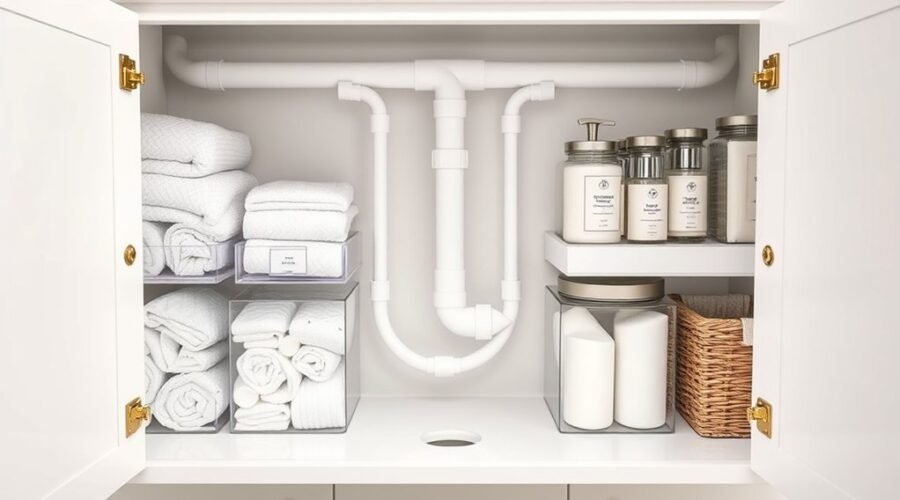
The best under-sink organizers fit beside, below, or around the plumbing without touching it. Adjustable shelves, narrow pull-out drawers, and stackable bins usually offer more flexibility than one large storage rack.
Choose the organizer based on the shape of your available space.
- Narrow pull-out drawers: Useful beside a central drainpipe because they bring products forward without reaching deep into the cabinet.
- Adjustable shelving: Helps make use of open vertical space while accommodating pipes at different heights.
- Stackable clear bins: Suitable for smaller products that can sit safely above one another.
- Shallow removable trays: Work well beneath low plumbing where taller organizers will not fit.
- Modular containers: Allow the layout to change when your storage needs change.
The original example, the FANHAO Pull Out Cabinet Organizer, illustrates why product dimensions matter. The listed unit measures 10.43 inches wide, 17.32 inches deep, and 14.56 inches high. Its manufacturer specifies a cabinet opening of at least 12 inches.
Those measurements apply to that model, not all pull-out organizers. A different cabinet or pipe arrangement may require a smaller option.
Before installing anything, place the organizer inside the empty cabinet and test its movement. Check that drawers slide freely, doors close properly, and plumbing remains accessible.
Clear or labeled bins also help you identify products without repeatedly shifting containers around.
Recommended Products

𝐌𝐚𝐱𝐢𝐦𝐢𝐳𝐞 𝐔𝐧𝐝𝐞𝐫 𝐒𝐢𝐧𝐤 𝐒𝐩𝐚𝐜𝐞 - Designed with a custom-fit silicone mat and L-shaped structure, this under sink organizer fits perfectly around plumbing while protecting cabinets from water, spills, and leaks. Measuring approximately 11.8"W x 15.9"D x 13.8-16.9"H, it’s ideal for most kitchen and bathroom cabinets.

【Sliding Drawer Design】The bottom drawer features a pull-out design, providing a convenient way to access items in a limited space.

Available in 2 Different Sizes: The smaller size (S) measures 8.27" x 13.19" x 9.06", and the larger size (L) measures 8.27" x 13.19" x 10.63". High-Low combos make this bathroom organizer versatile for multi-purpose storage and organization, such as kitchen organization, cabinet organizer and storage, bathroom organizer countertop, pantry organizer, under sink organizer, etc
Use Vertical Space Around the Plumbing
Vertical storage helps you use empty space above shorter products without crowding the pipes. The goal is to build upward in areas with enough clearance while leaving the plumbing and cabinet door free to move.
Consider these practical ways to use the available height:
- Stack short bins: Place small skincare bottles, spare soap, or grooming accessories in stackable containers beside the drain.
- Add tiered organizers: Use stepped shelves where the cabinet has enough height to keep products visible.
- Try a lazy Susan: A rotating tray can help in an open corner, provided it turns without hitting pipes or cabinet walls.
- Use cabinet-door hooks: Hang lightweight brushes, small accessories, or other suitable tools to free shelf space.
- Install modular drawers: Use separate units of different heights where a single tall organizer will not fit.
Check the weight rating and surface requirements before installing adhesive organizers. Bathroom-rated adhesives are preferable in damp areas, but their holding strength still depends on correct installation.
Make sure a door-mounted basket does not collide with shelves or stored products when the door closes.
A well-planned vertical layout uses the cabinet’s height without turning every open space into another crowded shelf.
Recommended Products

Stackable Storage Bins: The top of the drawer has groove design ensures stacking. Use these stackable drawers to save space, which is also keep organized

[Stackable Design] Come with 5 storage drawers, included 12.1" W and 4.4''H&7.6‘’H storage containers. The storage containers are stackable, vertical storage will save a lot of space. Put your small objects in acrylic drawers to make your countertop space more tidy.

Stackable Design for Space Optimization: The stackable design allows for maximizing space by creating vertical storage. It can be used individually or stacked together to save space on a vanity or bathroom cabinet, keeping items contained and organized
Keep Daily Bathroom Items Within Reach
Store the products you use most often at the front of the cabinet. Daily essentials should be accessible without moving backup supplies, bending around pipes, or removing several containers.
Separate frequently used products from occasional supplies so your daily routine stays simple.
Store Frequently Used Items
Give your most-used bathroom products a consistent, easy-to-reach location. A shallow drawer or front-facing bin is often enough to organize the items you need every morning and evening.
Useful categories include:
- Toothpaste and dental care supplies.
- Daily skincare products and moisturizers.
- Hairbrushes, combs, and grooming accessories.
- Hairdryers or curling irons, stored safely after use.
- Small replacement items needed for regular routines.
Store wet toothbrushes upright in a place where they can air-dry. The American Dental Association’s toothbrush guidance advises against routinely keeping toothbrushes covered or inside closed containers while damp.
If you store a hairdryer or curling iron under the sink, unplug it and allow it to cool completely before putting it away. The Electrical Safety Foundation International also recommends keeping electrical appliances away from water and unplugging them when not in use.
Warning: Never place a hot styling tool inside a closed cabinet or store a plugged-in electrical appliance near sink plumbing. Allow appliances to cool fully and keep their cords away from water.
Cabinet-door hooks can hold suitable lightweight tools, but heavier appliances should rest on a stable shelf unless the holder is designed for their weight.
Use Easy-Access Bins
Clear bins with handles make small bathroom cabinets easier to use. You can pull out one category of products, find what you need, and return the entire container without rearranging the cabinet.
Choose shallow bins for short items and deeper pull-out containers for taller bottles.
Use labels such as “Skincare,” “Dental,” “Hair Care,” or “Travel” when several containers look similar.
Stackable bins are useful for occasional supplies, while the most frequently used items should remain accessible without unstacking containers.
A simple layout might place skincare in a front drawer, hair products in a narrow side bin, and travel supplies in a labeled container toward the back.
Store Backstock Without Creating Clutter
Keep a small, dedicated section for replacement toiletries. Backstock should include products you regularly use, not large collections of duplicates or items you rarely need.
Store backups separately from daily essentials so extra bottles do not block access to frequently used products.
- Limit duplicates: Keep only a practical supply of regularly used replacements.
- Use clear containers: Make extra shampoo, soap, toothpaste, and similar products easy to identify.
- Stack carefully: Place smaller, lighter containers above stable lower bins.
- Follow one in, one out: Use an existing replacement before adding another.
- Review expiration dates: Remove expired or unwanted items using appropriate disposal methods.
If space is especially limited, keep only a small amount of backstock under the sink and move the rest to another suitable storage area.
Reserve the rear or an upper corner for backups that you do not need every day. Keep access to shutoff valves clear.
Keep Medicines and Hazardous Cleaners Out of Unsafe Storage
Not every bathroom product belongs under the sink. Medicines, strong cleaning chemicals, and moisture-sensitive items may need a safer location, even if the cabinet has unused space.
The FDA’s medicine storage guidance explains that damp bathroom cabinets can affect medicines before their expiration dates. Most medicines are better stored in a cool, dry location, following their labels.
Strong cleaners also require careful storage. Poison Control warns that unlocked lower bathroom cabinets are dangerous places for cleaning chemicals when children can access them.
Warning: Keep hazardous cleaners in their original labeled containers and store them securely, away from children and pets. Do not mix cleaning chemicals or transfer them into food or drink containers. Use a locked storage location when needed.
Dry first-aid items such as sealed bandages may fit inside a clean, protected container. Medicines should follow their separate storage requirements.
These precautions make the cabinet safer without sacrificing useful space for ordinary toiletries and grooming supplies.
Create a Simple Under-Sink System
A lasting under-sink organization system should be easy to use and maintain. Give each storage zone one purpose, keep everyday items accessible, and make sure everything can be removed when plumbing needs attention.
Use this final setup checklist:
- Choose a daily-use zone: Place the most frequently used toiletries near the front.
- Assign category bins: Keep skincare, dental products, grooming tools, and travel accessories in separate containers.
- Reserve one backstock zone: Store limited replacement supplies behind or above daily-use products.
- Use door storage carefully: Add suitable adhesive hooks or shallow holders for lightweight accessories.
- Test access: Pull out each drawer, close both cabinet doors, and confirm you can reach the plumbing.
- Maintain the system: Return items to their assigned places and remove empty or unwanted products during regular reviews.
If the cabinet becomes crowded again, remove unnecessary items before buying additional organizers.
A quick reset is usually easier than rebuilding the storage system. Keeping each container focused on one category also makes it simpler to spot excess supplies.
Pro Tip: Before committing to a permanent organizer, arrange your existing containers inside the empty cabinet. Use them for several daily routines to see which items need a better position. This helps you avoid buying storage that looks useful but makes access harder.
Key Takeaways
- Measure both the cabinet opening and interior space before choosing a pull-out organizer.
- Keep shutoff valves, drain connections, and potential leak areas accessible.
- Use vertical space for smaller items, but avoid crowding plumbing or cabinet doors.
- Store medicines and hazardous cleaners according to their safety requirements, not simply where space is available.
- A small backstock zone and regular decluttering help keep the system manageable.
Frequently Asked Questions
How Should I Organize Under My Bathroom Sink?
Organize your bathroom sink cabinet by measuring around the plumbing and grouping similar products. Use narrow pull-out drawers, clear bins, and stackable containers to make the most of available space. Keep daily essentials near the front, place limited backups farther back, and leave plumbing connections accessible.
How to Hide Under Sink Plumbing?
You can hide exposed under-sink plumbing with a removable cabinet panel, a decorative curtain, or suitable paint for visible pipes. Baskets and nearby organizers can also make the area look tidier. Never permanently block shutoff valves, cover leaks, or attach storage hardware directly to plumbing.
What Are Some Common Mistakes to Avoid When Organizing Under Sink Storage?
Common mistakes include buying organizers without measuring, blocking plumbing access, storing too many duplicate products, and using containers that hide their contents. Ignoring moisture or keeping hazardous cleaners in an unlocked low cabinet can also create problems. Choose accessible storage and review the contents regularly.
What Is the Best Under Sink Organizer?
The best under-sink organizer is one that fits around your plumbing and keeps products easy to reach. A narrow slide-out unit combined with clear, stackable bins works well in many cabinets. For very low clearance, shallow removable trays may be a better choice than tall drawers.
What Should You Not Store Under a Bathroom Sink?
Avoid storing medicines in damp bathroom cabinets and keep hazardous cleaning products out of unsecured lower cabinets. Do not store wet electrical appliances or hot styling tools in enclosed storage. Items that need a consistently dry environment should also be kept elsewhere if the cabinet is humid or prone to leaks.
How Do You Organize Under a Sink With Very Little Space Around the Pipes?
Use small removable bins in the open areas beside or below the pipes. Shallow trays can fit beneath low plumbing, while narrow containers work better in tight side spaces. Avoid forcing large organizers into the cabinet. Store less frequently used supplies elsewhere if there is not enough room.
Conclusion
Organizing under a bathroom sink around plumbing works best when every container fits the available space and serves a clear purpose. Measure carefully, use adjustable or removable organizers, and keep daily essentials within reach while limiting backstock. Leave plumbing accessible and store sensitive or hazardous products safely. Start by emptying the cabinet and measuring around the pipes before choosing any new storage.
Sources
- US Environmental Protection Agency: Interactive Mold House Tour: Explains the risks of leaking pipes and moisture-related mold.
- US Environmental Protection Agency: Household Hazardous Waste: Covers safe handling, storage, and disposal of hazardous household products.
- Poison Control: Top Tips for a Safe Spring Cleaning: Explains safe storage of household cleaners and child-access risks.
- US Food and Drug Administration: Don’t Be Tempted to Use Expired Medicines: Explains expiration dates and the effects of improper medicine storage.
- US Food and Drug Administration: Disposal of Unused Medicines: Explains safe disposal and medicine take-back options.
- FANHAO: Pull Out Cabinet Organizer Specifications: Provides product dimensions and minimum cabinet opening requirements.
- Electrical Safety Foundation International: Appliance Safety Tips: Covers safe handling of small electrical appliances near water.
- American Dental Association: Toothbrushes: Provides guidance on cleaning, drying, and storing toothbrushes.