
Affiliate disclosure: This article contains Amazon affiliate links. We may earn a commission from qualifying purchases at no extra cost to you.
Updated: August 2026
The best dehumidifier for a drying box is usually a reusable silica-gel desiccant, not a powered room dehumidifier. This guide focuses on passive humidity control inside sealed storage boxes, totes, equipment cases, cabinets, and similar enclosed spaces. It does not cover heated drying cabinets or products intended to dry soaking-wet items.
For most storage totes, the DryTote 100g rechargeable desiccant pack offers the most convenient balance of box-specific capacity, a visible saturation indicator, and simple regeneration. The larger Wisedry 500g packets suit high-volume containers, while the Eva-Dry E-333 provides a clean, rigid housing. The slim Wisesorb 40g canisters are better for camera cases, document boxes, toolboxes, and other compact spaces.
Important Scope Note
All four products below absorb moisture gradually from enclosed air. Remove standing water and towel-dry wet items before closing the box. A passive desiccant cannot replace drainage, ventilation, leak repair, or an active heated dryer.
Quick Verdict
Choose DryTote for most sealed storage totes, Wisedry for an unusually large box or cabinet, Eva-Dry for a self-contained rigid unit, and Wisesorb for a compact case or document box.
How These Products Were Compared
- Suitability for sealed boxes, totes, cases, and cabinets
- Spill risk around documents, electronics, tools, and photographs
- Capacity and physical size
- Saturation indicator or maintenance method
- Regeneration requirements and ease of reuse
- Honest limitations for passive moisture control
Quick Comparison of the Best Moisture Absorbers for Drying Boxes
| Product | Best For | Format | Saturation Check | Main Caution | Check Details |
|---|---|---|---|---|---|
| DryTote 100g Pack Best Overall |
Most sealed storage totes and bins | Rechargeable silica-gel pack | Blue-to-pink indicator dot | Published coverage is approximate and does not guarantee a specific humidity level | Check Price on Amazon |
| Wisedry 2 × 500g Packets Best High-Capacity Pick |
Large boxes, cabinets, and high-volume storage | Large rechargeable silica-gel packets | Packet weight; this version is non-indicating | Oversized for many household boxes and requires careful heat regeneration | Check Price on Amazon |
| Eva-Dry E-333 Best Self-Contained Pick |
Large boxes, cabinets, safes, and enclosed equipment storage | Renewable silica gel in a rigid housing | Color-changing bead window | Rigid body takes up space and requires a compatible outlet for regeneration | Check Product Details on Amazon |
| Wisesorb 40g Canisters Best Compact Canister |
Camera cases, document boxes, toolboxes, and small safes | Indicating silica gel in aluminum canisters | Orange-to-green indicating beads | Lower moisture capacity than larger packets | Check Price on Amazon |
DryTote Rechargeable Desiccant Pack, 100g
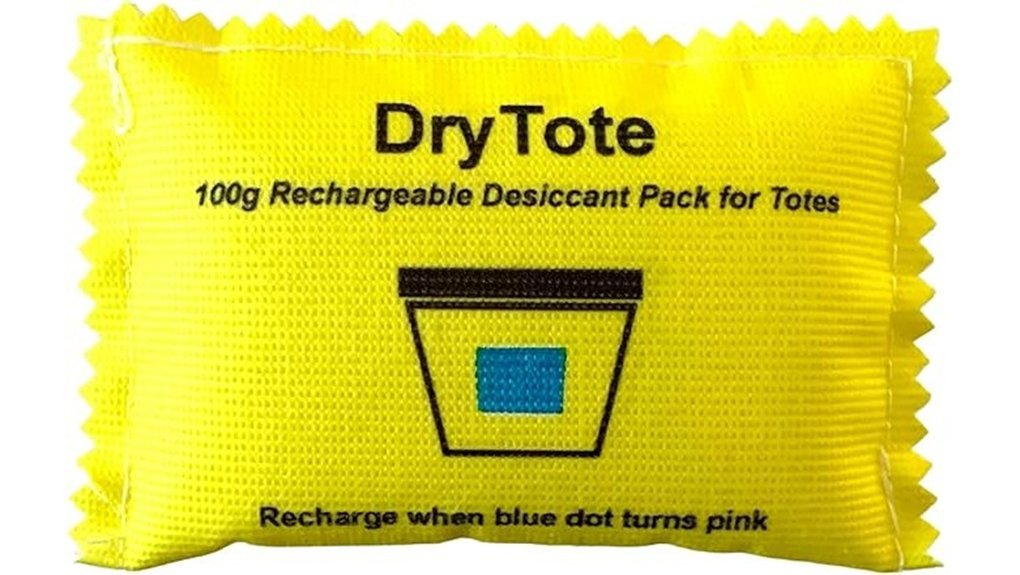
Best Overall: The DryTote 100g pack is designed specifically for enclosed storage totes, bins, cases, safes, and similar spaces. Its published rating of up to approximately 200 gallons makes it easier to match to a large household tote than a product described only by room coverage.
A built-in indicator dot changes from blue toward pink as the silica gel absorbs moisture. When regeneration is needed, remove the pack from the box and follow the product-specific microwave or low-oven directions. Let it cool completely before returning it to stored clothing, documents, photographs, electronics, or other contents.
Why You’ll Like It: The pack combines a box-focused capacity rating with an easy visual maintenance cue and does not create an open liquid reservoir.
Who Should Buy This: Choose it for a medium or large sealed tote when you want a reusable desiccant that is easier to monitor than a non-indicating packet.
Who Should Avoid It: A 100g pack may be unnecessary in a very small jewelry box or compact camera case. It is also not a substitute for a powered dryer when the contents are visibly wet.
Pros:
- Designed for totes, bins, cases, and other enclosed storage spaces.
- Color-change indicator provides a simple recharge cue.
- Reusable silica gel avoids a liquid collection chamber.
- Flexible pack is easier to position than a rigid absorber.
Cons:
- The maximum coverage claim does not guarantee a particular relative-humidity level.
- Requires removal, heating, cooling, and inspection before reuse.
- Passive absorption can be overwhelmed by wet contents or a poorly sealed box.
Wisedry Rechargeable Silica Gel Dehumidifier Packets
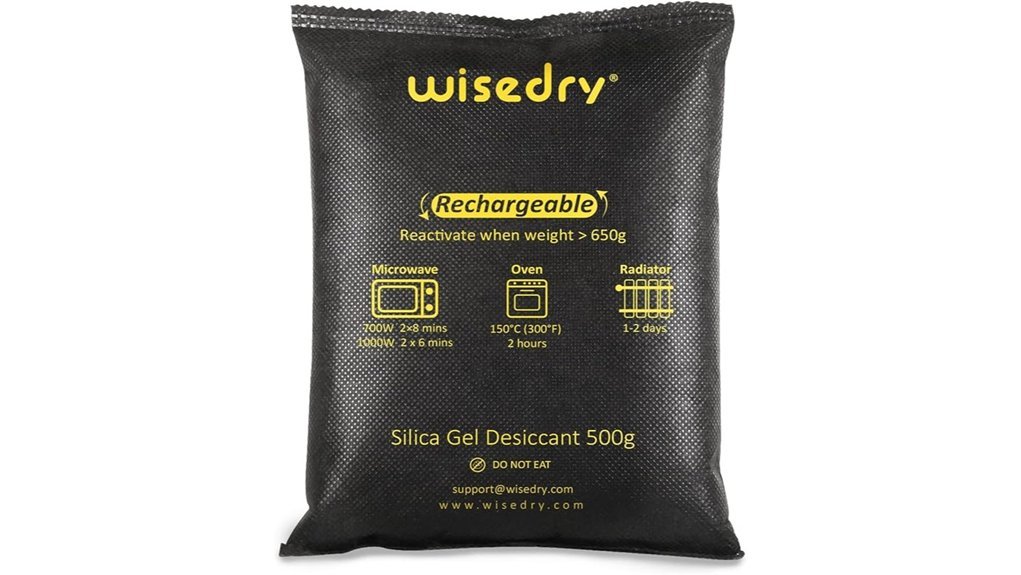
Best High-Capacity Pick: Wisedry’s two 500g packets are better suited to a large drying box, cabinet, vehicle-storage container, or other high-volume enclosed space than to a small household case. The manufacturer recommends one packet for an enclosed volume up to approximately 35 cubic feet, although actual performance depends on humidity, sealing, temperature, and the moisture already held by the contents.
This 500g version contains non-indicating silica gel. Instead of waiting for a color change, weigh the packet and follow the included saturation and regeneration instructions. Wisedry warns against microwave regeneration before a packet is sufficiently saturated, so access to an accurate scale makes maintenance safer and easier.
Why You’ll Like It: Each large packet offers substantial passive capacity and can be laid beside or beneath stored items without introducing a liquid reservoir.
Who Should Buy This: It is a practical option for an unusually large storage bin, cabinet, gear trunk, or enclosure where a 40g or 100g product would require frequent regeneration.
Who Should Avoid It: Skip this two-pack for a small dry box, or when you want a built-in visual saturation indicator. It is also unsuitable if you cannot follow the heating, weighing, and cooling directions carefully.
Pros:
- Large silica-gel capacity for high-volume enclosed storage.
- Flexible packets can be positioned around bulky contents.
- No liquid reservoir that could tip inside the box.
- Reusable by microwave or oven when the product instructions are followed.
Cons:
- No built-in color-change indicator on this 500g version.
- Two large packets are excessive for many ordinary storage boxes.
- Safe microwave regeneration depends on checking the packet’s weight first.
- The packets occupy more space than slim aluminum canisters.
Eva-Dry Wireless Mini Dehumidifier, White (E-333)
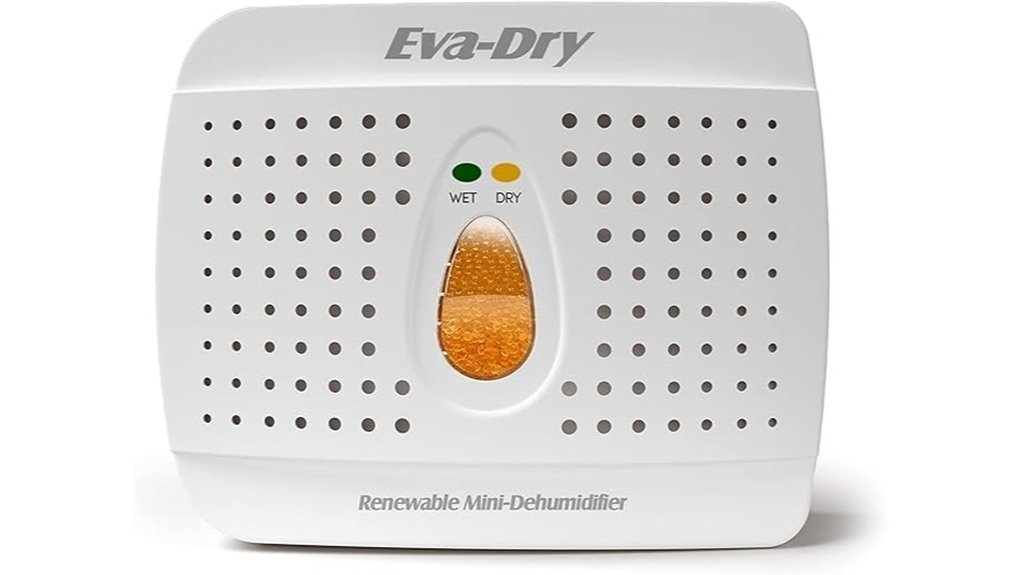
Best Self-Contained Pick: The Eva-Dry E-333 seals renewable silica gel inside a rigid housing. This makes it cleaner to handle than a flexible packet and reduces the chance of the desiccant rubbing directly against documents, camera equipment, tools, or other stored items.
The unit works without a cord or battery while it is absorbing moisture. Eva-Dry lists coverage up to 333 cubic feet, but this should be treated as a maximum enclosed-space rating rather than a promise that every box will reach a specific humidity. When the indicator shows saturation, remove the unit from the box and plug it into a compatible 110–120V wall outlet for regeneration. The current published recharge time is approximately 10–12 hours.
Why You’ll Like It: The enclosed design is tidy, silent during use, and easy to monitor through the color-changing window.
Who Should Buy This: Choose it for a large box, cabinet, safe, vehicle-storage area, or equipment enclosure where a rigid unit has enough clearance.
Who Should Avoid It: It can crowd a small box, and the recharge plug may not be electrically compatible outside regions using 110–120V power. Confirm the voltage on the exact unit before connecting it.
Pros:
- Self-contained housing keeps silica gel separated from stored contents.
- Cordless, silent, and powerless during normal moisture absorption.
- Color-changing window shows when regeneration is needed.
- No disposable refill or liquid collection reservoir.
Cons:
- Rigid housing uses more space than a flat packet.
- Approximately 10–12 hours may be needed for regeneration.
- Requires a compatible 110–120V outlet while recharging.
- Not designed for rapid removal of water from wet objects.
Wisesorb Moisture Absorbers 40g Desiccant Canisters, 2 Pack
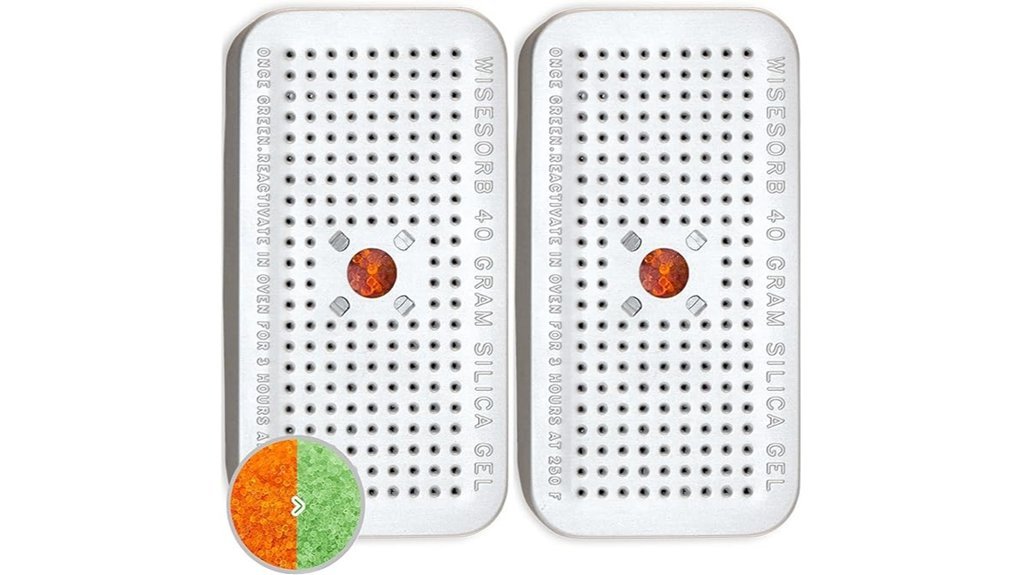
Best Compact Canister: Wisesorb’s two 40g aluminum canisters are shaped for compact toolboxes, camera cases, document boxes, equipment cases, safes, and other spaces where a large packet would be awkward. The metal body helps protect the silica gel while leaving the indicating beads visible.
The orange beads change toward green as the surrounding humidity rises. The manufacturer directs users to regenerate the canisters in an oven at 200°F–250°F for approximately 0.5–3 hours without exceeding the stated maximum temperature. Follow the instructions supplied with the exact canister because indicating colors and directions can vary between product versions.
Why You’ll Like It: The slim aluminum format is durable, tidy, easy to inspect, and more space-efficient than a large fabric packet or rigid plug-in unit.
Who Should Buy This: It is a good choice for documents, tools, camera equipment, collectibles, and other non-consumable items in a small or medium box.
Who Should Avoid It: Choose a higher-capacity packet for a very large tote or a desiccant specifically approved for the intended application when storing food or medicine.
Pros:
- Slim aluminum housing fits compact cases and boxes.
- Visible indicating beads simplify routine maintenance checks.
- Reusable through controlled oven regeneration.
- No open liquid reservoir near valuable contents.
Cons:
- Lower capacity than 100g and 500g packets.
- Oven regeneration requires temperature control and supervision.
- Not intended for direct food or pharmaceutical use.
- Several canisters may be needed for a large or frequently opened box.
How to Choose a Dehumidifier or Desiccant for a Drying Box
Start with the box volume, the initial moisture load, the sensitivity of the contents, and how often you can inspect or regenerate the desiccant. A sealed box holding dry camera equipment needs far less moisture-removal capacity than a tote containing damp clothing or recently washed gear.
Define the Type of Drying Box
The products in this guide are intended for passive humidity control in storage boxes and equipment cases. They are not heated drying cabinets, filament dryers, food dehydrators, hearing-aid dryers, or compressor dehumidifiers. Confirm that gradual moisture absorption is suitable for the item you plan to store.
Measure the Internal Box Volume
Measure the usable internal length, width, and height using the same unit, then multiply the three measurements. Do not rely on the container’s outside dimensions because thick walls, wheels, handles, and a raised base can reduce usable volume.
Published gallon or cubic-foot ratings are useful for rough comparison, but they are not precise humidity guarantees. Box leakage, temperature, starting humidity, lid-opening frequency, and moisture trapped in the contents can all change performance.
Choose the Right Desiccant Capacity
A small canister is easier to fit around compact equipment, while a larger packet generally takes longer to become saturated in a large enclosure. Oversizing is not always harmful, but an oversized packet can waste storage space and may lower humidity more than desired for materials such as wood, leather, or certain musical accessories.
When the stored items are valuable, use the product’s coverage guidance only as a starting point and confirm the result with a digital hygrometer.
Choose Passive Control or Active Drying
Passive silica gel is best for maintaining a controlled environment after surface moisture has been removed. It is not designed to absorb puddles, quickly dry soaked textiles, or compensate for a leaking lid. Use towels, airflow, drainage, or an appropriate active dryer before sealing a wet item inside the box.
Avoid Liquid Reservoirs Around Valuable Contents
Silica gel holds absorbed moisture within the desiccant instead of directing it into an open collection chamber. That generally makes a silica packet or canister a more practical choice around electronics, documents, photographs, tools, metal parts, and other items that could be damaged by a spill.
Check the Regeneration Method
Reusable silica gel may require a microwave, oven, built-in electric heater, or another product-specific method. Never apply one product’s temperature, timing, or power setting to a different packet or canister. Follow the exact saturation, heating, handling, and cooling instructions supplied with the product.
Inspect packets for burns, tears, open seams, damaged windows, or leaking beads after regeneration. Discard a damaged unit rather than returning it to a box with valuable contents.
Use an Indicator and a Hygrometer
A color-changing indicator is a convenient maintenance cue, but it does not measure humidity at every point inside a box. A non-indicating product may require weighing or another specified saturation check. Add a small digital hygrometer when you need to maintain a particular range.
Place the hygrometer where its display can be read without leaving the lid open for long. After opening or rearranging the box, allow the internal humidity time to stabilize before judging performance.
Protect the Contents
Keep each packet or canister from rubbing against sharp edges, oily tools, wet fabric, or anything that could puncture or contaminate it. Allow every regenerated product to cool completely before returning it to storage. Keep silica beads and small packets away from children and pets, and never treat a household desiccant as edible.
Before You Buy
- Measure the usable internal volume of the box.
- Confirm that the product fits without pressing against delicate contents.
- Check whether the product has an indicator or requires weighing.
- Confirm that you have the correct oven, microwave, or electrical setup for regeneration.
- Choose non-liquid silica gel around electronics, papers, photographs, and corrosion-sensitive items.
- Add a hygrometer when a specific relative-humidity range matters.
- Remove surface water and correct leaks before sealing the box.
Frequently Asked Questions
What Is the Best Dehumidifier for a Drying Box?
For most sealed household totes, a reusable silica-gel pack with a saturation indicator is the easiest option to manage. DryTote is the strongest general-purpose choice in this guide, Wisedry suits unusually large containers, Eva-Dry provides a rigid self-contained housing, and Wisesorb fits compact cases.
How Often Should Drying Box Desiccants Be Recharged?
Recharge a product when its indicator reaches the specified saturated color, its weight reaches the manufacturer’s stated threshold, or a hygrometer shows that the box humidity is rising above your chosen range. The interval can vary from days to months depending on the seal, climate, moisture load, box volume, and how often the lid is opened.
Do I Need a Hygrometer in a Drying Box?
A hygrometer is strongly recommended for cameras, electronics, documents, collectibles, instruments, and other humidity-sensitive contents. A desiccant indicator shows the condition of the desiccant, while a hygrometer measures the air inside the box more directly.
Are Moisture Absorbers Safe for Sealed Food Storage Boxes?
Use only a desiccant specifically labeled and approved for your intended food-storage application. Do not assume that a household moisture absorber, reusable canister, or fabric packet is suitable for direct food contact. Keep every desiccant physically separated from food unless the manufacturer expressly allows the intended use.
Can a Desiccant Damage Delicate Items Inside a Drying Box?
Yes. A damaged packet can release beads, a product returned while still hot can affect nearby materials, and excessively low humidity can harm some wood, leather, adhesives, textiles, and instruments. Separate the desiccant from the contents and use a hygrometer when the safe range is narrow.
What Humidity Level Is Ideal for a Drying Box?
There is no single correct target for every material. Electronics, photographs, paper, metal, leather, textiles, wood, and musical equipment can require different conditions. Follow the stored item manufacturer’s guidance when available and monitor the box rather than relying only on the desiccant’s capacity claim.
How Do I Know When a Desiccant Needs Regeneration or Replacement?
Use the product’s specified color change, weight threshold, or other saturation method. Regenerate a reusable unit exactly as directed. Replace any packet or canister that is torn, scorched, cracked, leaking beads, separating at the seams, or no longer returning to its dry condition after proper regeneration.
Can I Put Wet Items Directly in a Drying Box?
Remove as much water as possible first. Passive desiccants are designed to control moisture in enclosed air and support gentle final drying, not to absorb standing water or replace airflow. Sealing a very wet item can overwhelm the desiccant and increase the risk of odor, corrosion, staining, or microbial growth.
Can I Use a Powered Room Dehumidifier Inside a Plastic Box?
A conventional room dehumidifier is generally too large and requires airflow, electrical clearance, and safe drainage. Do not place a powered appliance inside a sealed plastic box unless the appliance manufacturer specifically approves that configuration. A passive silica-gel product is normally the simpler option for storage-box humidity control.
Conclusion
The DryTote 100g rechargeable desiccant pack is the best overall choice for most sealed storage totes because it combines box-specific published coverage with a visible saturation indicator. The Wisedry 500g packets provide substantially more capacity for large enclosures, although they require weight-based maintenance rather than a color indicator.
Choose the Eva-Dry E-333 when you prefer a rigid, self-contained unit and have enough room for it. The Wisesorb 40g canisters are the better fit for compact camera cases, document boxes, toolboxes, and small safes. Whichever format you choose, remove surface water first, follow the exact regeneration directions, let the product cool completely, and use a hygrometer when precise humidity control matters.
Final Recommendation
Start with DryTote for a typical sealed tote. Move up to Wisedry only when the container is unusually large, or choose Wisesorb when preserving usable space inside a compact case is more important than maximum capacity.


[…] Best Dehumidifier for a Drying Box: 2026 Picks Compared […]