Affiliate disclosure: This article contains Amazon affiliate links. We may earn a commission from qualifying purchases at no extra cost to you.
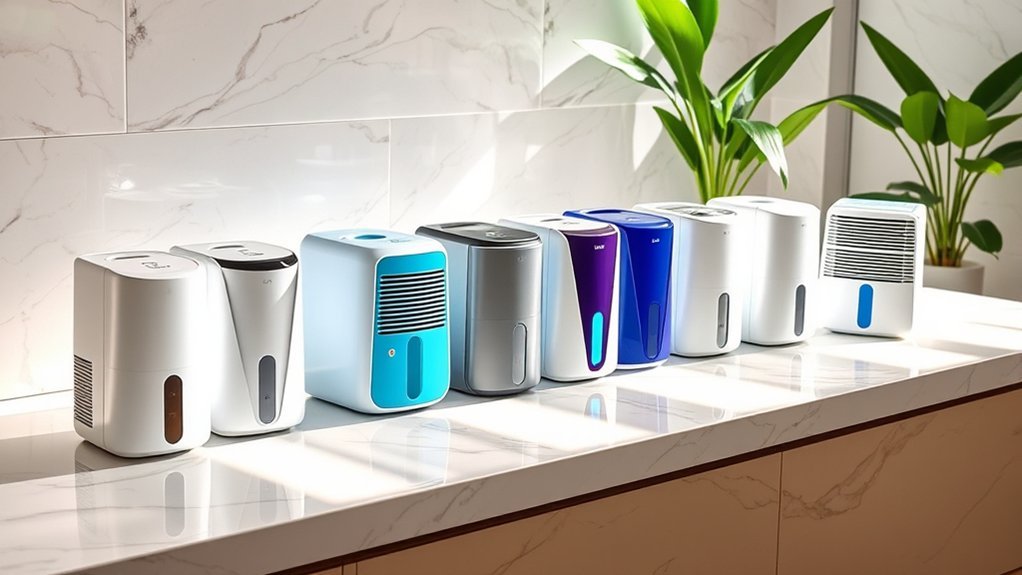
If you want to reduce mild excess moisture while filtering airborne dust and other particles, a 2-in-1 air purifier and dehumidifier can save space in a bedroom, bathroom, wardrobe, home office, or other small enclosed area. This comparison focuses on three compact US-market models that Australian shoppers may encounter online: the Tenergy Sorbi, THECOSKY DH16, and Hoomace VES596.
These are compact thermoelectric or Peltier appliances. They are generally quieter and easier to move than many compressor dehumidifiers, but they are best for mild moisture control in small spaces. They should not be treated as whole-home dehumidifiers or solutions for flooding, serious condensation, water leaks, or established mould.
Quick verdict
- Best overall for small rooms: Tenergy Sorbi 1000ml Air Dehumidifier with HEPA Filter
- Best for continuous drainage: THECOSKY DH16 Dehumidifier and Air Purifier
- Best for quiet bedroom use: Hoomace VES596 with basic G4 filtration
Important for Australian buyers
The supplied links lead to Amazon.com listings intended primarily for the US market. Before ordering, verify the exact unit and supplied power supply are suitable for Australian mains, have an appropriate Australian plug or approved power supply, and carry the required Regulatory Compliance Mark (RCM) where applicable. The Tenergy listing publishes a 110–240V AC input range, but that alone does not confirm Australian plug or RCM compliance.
Do not rely on a travel adaptor to make a 110–120V-only appliance suitable for Australian mains. The checked THECOSKY and Hoomace listings did not clearly establish Australian electrical suitability, so confirm voltage, plug, compliance, shipping, returns, warranty service, and replacement-filter availability with the seller before buying.
How these products were assessed
This comparison is based on manufacturer and seller documentation rather than hands-on testing. The main factors were product-category match, stated extraction test conditions, filter type, tank size, drainage, noise, controls, published airflow information, replacement-filter support, and suitability concerns for Australian buyers. Claims that could not be confirmed were not treated as buying advantages.
Quick Comparison of Air Purifier and Dehumidifier Combos
| Product | Best For | Filtration | Tank | Claimed Maximum Extraction | Key Limitation |
|---|---|---|---|---|---|
| Tenergy Sorbi | Balanced small-room moisture control and HEPA filtration | Manufacturer-described True HEPA | 1 litre | Up to 750ml/day at 30°C and 80% RH | No continuous drain; modest output |
| THECOSKY DH16 | Continuous drainage and overnight use | Manufacturer-described H13 HEPA | 54oz, approximately 1.6 litres | About 700–800ml/day at 30°C and 80% RH | Still far below compressor-model extraction |
| Hoomace VES596 | Quiet operation in compact sleeping areas | Basic G4 filter cotton | 1 litre | Up to 350ml/day at 30°C and 80% RH | Not a substitute for a dedicated HEPA purifier |
Tenergy Sorbi 1000ml Air Dehumidifier with HEPA Filter
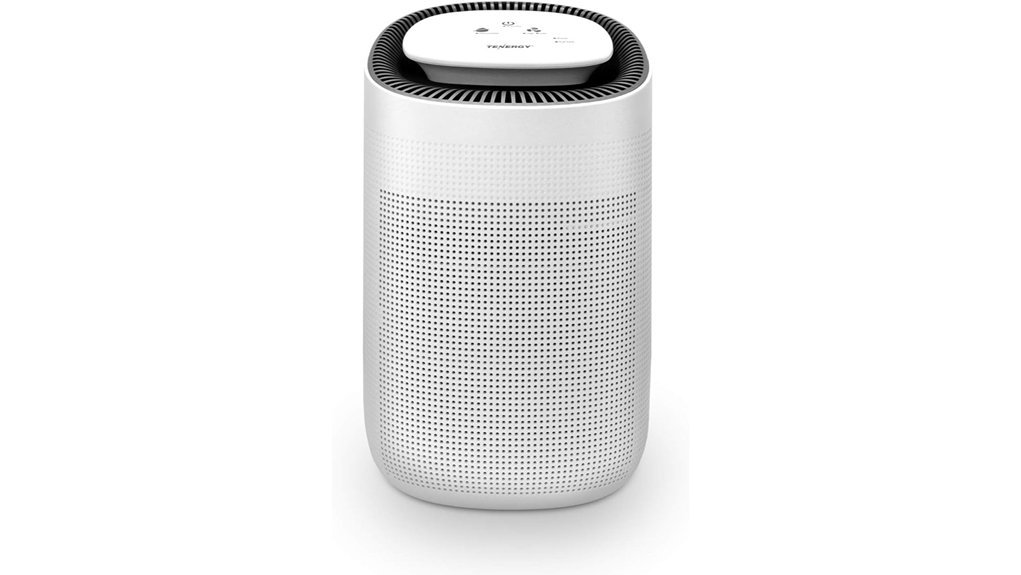
The Tenergy Sorbi is the most balanced option in this shortlist for buyers who need light moisture control and HEPA filtration in a compact room. It uses thermoelectric Peltier technology, a one-litre collection tank, touch controls, two fan speeds, automatic shutoff, and a manufacturer-published CADR of 22 CFM.
Tenergy states that the unit can collect up to 750ml of water per day at 30°C and 80% relative humidity and operates at approximately 35–42dB. Those are favourable test conditions, so everyday collection may be much lower in a cool or only moderately humid room.
Why It Stands Out
- Combines compact moisture collection with manufacturer-described True HEPA filtration.
- Touch controls are simpler than app-dependent operation.
- Two fan speeds let you balance airflow and noise, while the published 22 CFM CADR gives at least one useful airflow reference point.
- Automatic shutoff helps prevent overflow when the tank reaches capacity.
Who should buy it: Buyers seeking a straightforward small-room combination appliance without depending on WiFi or smartphone controls.
Who should avoid it: Anyone who needs continuous drainage, rapid extraction, or humidity control across a large open-plan area.
Best use: Run it in a closed small room, keep doors and windows reasonably controlled, and use a separate hygrometer to judge whether it is meaningfully lowering humidity.
Pros:
- Balanced combination of moisture control, HEPA filtration, and portability.
- Relatively quiet operation for bedrooms and offices.
- Simple controls and automatic shutoff reduce setup complexity.
Cons:
- One-litre tank may require frequent emptying in damp conditions.
- No continuous-drainage feature is supported.
- Not suitable for structural dampness, large basements, or whole-home dehumidification.
THECOSKY DH16 Dehumidifier and Air Purifier Combo
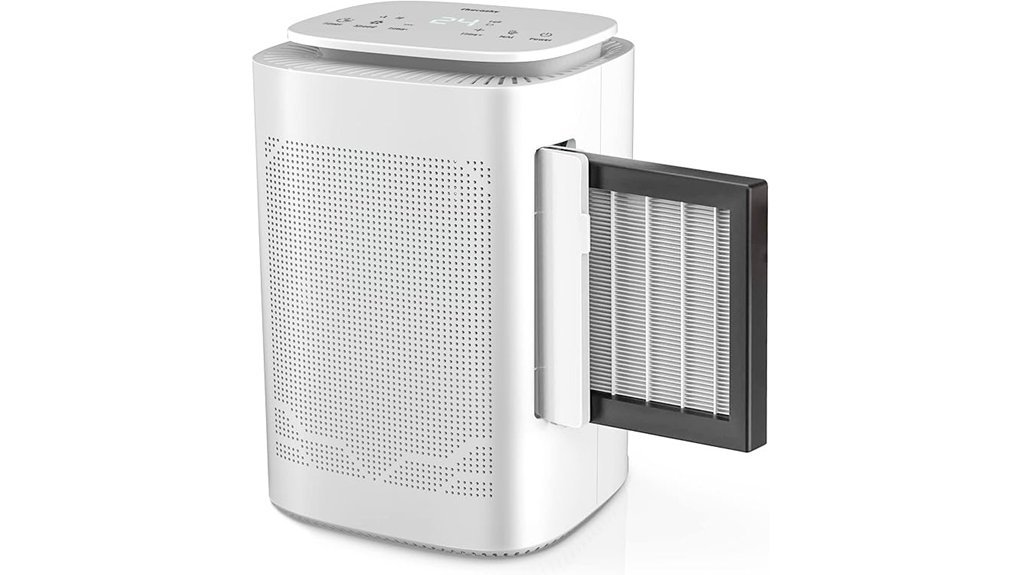
The THECOSKY DH16 combines compact moisture collection with manufacturer-described H13 HEPA filtration. It has a 54oz tank, approximately 1.6 litres, two operating speeds, and includes a drain-hose option that can reduce manual emptying when a suitable drain is nearby. The current product listing gives dimensions of about 9.8 x 9.8 x 12.6 inches.
The manufacturer documentation describes moisture collection of approximately 700–800ml per day at 30°C and 80% relative humidity. As with other Peltier models, real household results will vary, and it should not be expected to perform like a full-size compressor dehumidifier.
Why It Stands Out
- Continuous drainage can make it more practical for regular use in a bathroom or utility area.
- A 24-hour timer allows more flexible scheduling than basic fixed timers.
- The claimed 35dB low-speed mode suits buyers who prioritise low noise.
- Automatic shutoff provides protection when the tank fills during manual collection.
Who should buy it: People who want HEPA filtration, a larger tank than most one-litre models, and the option to use a drain hose.
Who should avoid it: Buyers trying to dry a large living area, control major condensation, or solve moisture caused by leaks or poor building ventilation.
Ion-function note: The product documentation mentions a negative-ion function. Buyers who plan to use it should review the manufacturer’s emissions and safety information. Mechanical filtration should remain the main reason for choosing an air-cleaning appliance.
Pros:
- Drain-hose support allows longer operation with less tank handling.
- Manufacturer-described H13 HEPA filtration adds fine-particle control.
- Timer, low-noise mode, dual speeds, and auto shutoff improve usability.
Cons:
- Performance remains modest compared with compressor dehumidifiers.
- The extraction figure depends on warm and highly humid conditions.
- Replacement-filter availability and Australian electrical compliance require confirmation.
Hoomace VES596 Small Dehumidifier with Basic Air Filtration
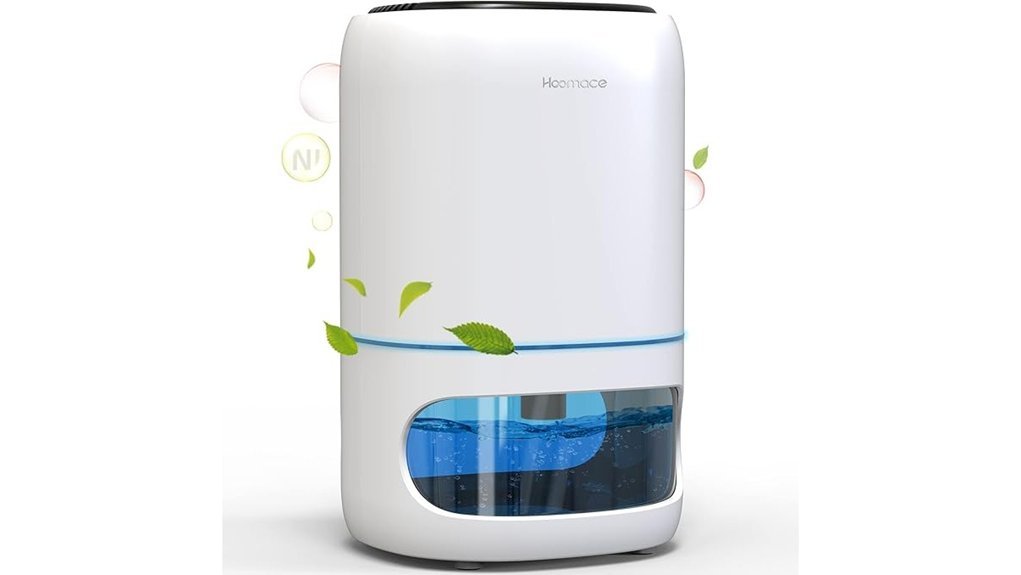
The Hoomace VES596 is designed for light moisture control in bedrooms, wardrobes, bathrooms, and other enclosed spaces. Its one-litre tank and Peltier system are paired with reusable G4 filter cotton intended to catch larger particles such as visible dust, hair, and pet debris. The product listing gives dimensions of about 7.3 x 7.01 x 11.09 inches.
The manufacturer documentation states that it can collect up to 350ml of water per day at 30°C and 80% relative humidity. Actual extraction will depend heavily on room temperature, humidity, ventilation, and how much moisture enters the room.
Why It Stands Out
- Claimed operating noise below 30dB makes it the quietest option in this shortlist.
- Automatic shutoff helps prevent tank overflow.
- Four-hour, eight-hour, and twelve-hour timer choices make overnight scheduling easier.
- A concealed tank handle can make emptying and cleaning more convenient.
Who should buy it: People who want a quiet, portable dehumidifier for a small sleeping area and only need basic particle filtration.
Who should avoid it: Buyers who need True HEPA filtration, fast moisture removal, continuous drainage, or control of serious dampness.
Important limitation: G4 filter cotton is not equivalent to a sealed True HEPA air purifier. Treat the filtering function as a useful extra rather than the product’s primary strength.
Ion-function note: The product documentation also describes a negative-ion function. Review the manufacturer’s safety and emissions information before using it, particularly in a bedroom.
Pros:
- Quiet design suited to bedrooms and home offices.
- Automatic shutoff and timer settings improve convenience.
- Compact dimensions, a one-litre tank, and a concealed handle make the appliance easier to move and empty.
Cons:
- Lowest extraction capacity in the comparison.
- No continuous-drainage option is described in the supplied information.
- Basic filter media will not provide the same fine-particle performance as a documented HEPA system.
How to Choose a 2-in-1 Air Purifier and Dehumidifier in Australia
A combined air purifier and dehumidifier can be convenient, but buyers should compare its moisture-removal system and filter performance separately. A HEPA label does not guarantee strong dehumidification, and a high water-extraction claim does not guarantee useful whole-room air cleaning.
Confirm That It Actually Dehumidifies
Some combination appliances pair an air purifier with a humidifier, which adds moisture rather than removing it. For damp rooms, condensation, or musty wardrobes, make sure the product includes a genuine water-collection tank, extraction rating, and full-tank shutoff.
Understand Peltier Performance
All three models in this comparison use thermoelectric Peltier technology. These appliances are generally quieter, lighter, and less mechanically complex than compressor models, but they remove much less water.
A Peltier unit can be useful for mild moisture in a wardrobe, small bedroom, caravan, bathroom, or home office. A compressor dehumidifier is normally more appropriate for persistent condensation, large rooms, laundries, basements, or serious dampness.
Use Realistic Room-Size Expectations
Do not judge suitability from a large advertised square-foot figure alone. Compare the extraction rate, tank size, test temperature, test humidity, airflow, and actual room conditions. Compact one-litre models generally perform most predictably in enclosed small rooms rather than large open-plan spaces.
Compare HEPA and Basic Filters
A manufacturer-described True HEPA or H13 filter is more suitable for fine dust, pollen, and pet dander than basic filter cotton. However, performance also depends on airflow, filter sealing, and replacement intervals.
Basic G4 filter cotton can catch larger debris but should not be presented as equivalent to a dedicated HEPA air purifier. Check whether replacement filters are readily available before choosing any combination appliance.
Check CADR and Airflow
Useful airflow data are limited in this category. Tenergy publishes a CADR of 22 CFM for the Sorbi, while the checked THECOSKY and Hoomace product information does not provide a directly comparable CADR figure. Without comparable airflow or CADR information, it is difficult to judge purification performance against a dedicated air purifier. Buyers with significant smoke, allergy, or fine-particle concerns should consider separate appliances with clearly documented airflow performance.
Check Moisture-Removal Test Conditions
Compact dehumidifier ratings are often measured at about 30°C and 80% relative humidity. Water collection can drop significantly in a cool bedroom or during less humid weather. Treat “up to” figures as best-case measurements, not guaranteed daily output.
Consider Tank Size and Drainage
A one-litre tank may be adequate for light use but can require frequent emptying during damp weather. A larger tank reduces interruptions, while continuous drainage is useful when the appliance will sit near a safe floor drain or sink.
Always install a drain hose according to the manufacturer’s instructions. It normally needs a continuous downward path without kinks or raised sections that could stop gravity drainage.
Check Noise for Bedroom Use
Claimed noise levels in this comparison range from below 30dB to approximately 42dB. Lower-speed modes will usually be quieter but may also collect moisture and filter air more slowly. Buyers sensitive to sound should check whether the fan tone, indicator lights, and button sounds can be reduced at night.
Check Australian Voltage, Plug, and Compliance
Before importing an appliance, ask for a clear photo of the rating label on the appliance and its power supply. Mains-operated household equipment for Australia should have an appropriate voltage rating for Australian supply, an appropriate plug or approved power supply, and the required Regulatory Compliance Mark (RCM) where applicable.
The Tenergy listing publishes 110–240V AC input, but that does not by itself establish Australian plug or RCM compliance. The checked THECOSKY and Hoomace listings did not clearly publish enough electrical information to confirm Australian suitability. Do not assume a travel adaptor makes a 110–120V appliance suitable for Australian mains. Also confirm warranty support, return options, shipping charges, and replacement-filter availability in Australia.
Plan for Cleaning and Filter Costs
The water tank should be emptied, rinsed, and dried regularly. Filters should be cleaned or replaced according to the manual rather than an arbitrary universal schedule. A product with unavailable or expensive replacement filters may provide poor long-term value even when the initial appliance looks convenient.
Before-you-buy checklist
- Does the unit remove moisture rather than add it?
- Is it appropriate for a small room or a larger damp area?
- What temperature and humidity were used for the extraction claim?
- Does it use a documented HEPA filter or only basic filter media?
- Is useful airflow or CADR information available?
- Are replacement filters available in Australia?
- Does the exact appliance or power supply have an input rating appropriate for Australian mains?
- Can the seller show the required Australian plug/power-supply compliance and RCM where applicable?
- Does it include automatic shutoff or continuous drainage?
- Can the tank and air intake be cleaned easily?
Frequently Asked Questions
Can a Purifier-Dehumidifier Combo Run Overnight?
Many compact units can run overnight when they are placed on a stable surface, kept away from bedding and curtains, and used according to the manual. Automatic shutoff is important when the unit relies on a removable water tank. Use a low-noise mode when available and keep the air intake and outlet unobstructed.
Are US Amazon Models Suitable for Australia?
Not automatically. Confirm the exact model’s rating label, input voltage and frequency, plug or power-supply compliance, and required Australian approval markings before ordering. A wide input-voltage range alone does not prove the supplied plug or appliance is compliant for Australia, and a travel plug adaptor does not make a 110–120V-only appliance suitable for Australian mains.
Can One Combination Unit Replace Separate Appliances?
It may replace two compact appliances in a small room with mild humidity and ordinary dust. Separate appliances are usually better when you need high airflow, documented HEPA purification, fast moisture removal, or control across a large room.
Will a Dehumidifier and Air Purifier Remove Existing Mould?
No. Lowering moisture may make conditions less favourable for future mould growth, and a suitable filter may capture some airborne particles. The appliance will not remove established mould, repair leaks, dry water-damaged building materials, or replace professional remediation.
How Often Should the Filter Be Replaced?
Follow the product manual and filter-condition indicator when supplied. Replacement frequency depends on operating hours, dust, smoke, pets, humidity, and filter size. Check the filter regularly and avoid washing disposable HEPA filters unless the manufacturer specifically says they are washable.
Why Is My Unit Collecting Less Water Than Advertised?
Compact extraction ratings are usually measured under warm and highly humid conditions. A cooler room, lower relative humidity, open doors, ventilation, or a large space can reduce collection. A hygrometer can help you determine whether the unit is lowering humidity even when the tank fills slowly.
Are Peltier Dehumidifiers Good for Bathrooms?
They can help with light residual moisture in a small bathroom, but they should be kept away from direct water spray and used only where the manufacturer permits. Strong exhaust ventilation is usually more important after showers. Persistent condensation may require a higher-capacity compressor model or improvements to ventilation.
What Humidity Level Should I Aim For?
Use a separate hygrometer and aim for a comfortable level that avoids persistent condensation without making the room excessively dry. Conditions vary by climate, season, building design, and occupant needs, so follow local guidance and the appliance manufacturer’s instructions rather than relying on a single universal setting.
Final Recommendation
Best overall: The Tenergy Sorbi is the most balanced choice for a small room when you want straightforward controls, portable moisture collection, and manufacturer-described HEPA filtration.
Choose THECOSKY DH16 when continuous drainage and a larger tank are more important.
Choose the Hoomace VES596 when low noise matters most and basic large-particle filtration is sufficient.
A compact air purifier and dehumidifier combo can be useful for mild humidity in a small bedroom, bathroom, wardrobe, or office. For Australian buyers considering these US-market listings, verify the exact unit’s electrical suitability and compliance before ordering. Keep expectations realistic: these appliances are space-saving convenience products, not replacements for high-capacity dehumidifiers, dedicated high-airflow purifiers, building repairs, or mould remediation.