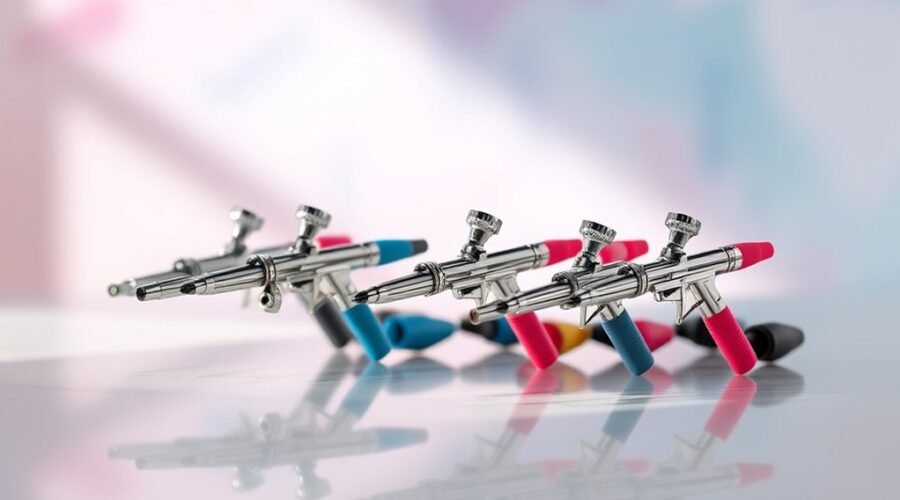
The five best airbrushes for 2026 include the Badger Sotar 2020-2F, ideal for precision work, and the Iwata Eclipse HP-CS, known for versatility. The Paasche TG#2L Talon excels in detailed applications, while the Master Airbrush Kit offers a complete setup for beginners. Finally, the Badger Model 105 Patriot provides an excellent balance of quality and performance. Each model presents unique features to cater to various needs in artistry. Below, we break down exactly who each airbrush is best for, what makes it stand out, and where it falls short — so you can match the right tool to your project.
Disclosure: This post contains Amazon affiliate links. As an Amazon Associate we may earn from qualifying purchases, at no extra cost to you.
Quick Verdict: Which Airbrush Should You Choose?
- Best for Ultra-Fine Detail: Badger Sotar 2020-2F — a hairline-to-3/4″ spray range built for illustrators and fine artists.
- Best Overall / Most Versatile: Iwata Eclipse HP-CS — moves smoothly between fine lines and broad coverage.
- Best for Detail-to-Wide-Coverage: Paasche Talon TG#2L — chrome-plated, USA-made, expands to a 3″ pattern with the optional fan head.
- Best Complete Kit for Beginners: Master Airbrush G22 Kit — airbrush, compressor, and accessories in one box.
- Best Reliable All-Rounder: Badger 105 Patriot — a single 0.5mm needle/nozzle that handles most mediums without swapping parts.
Quick Comparison Table
| Product | Best For | Fluid Cup | Spray Pattern | Skill Level | |
|---|---|---|---|---|---|
| Badger Sotar 2020-2F | Ultra-fine detail work | 1/12 oz. | Hairline to 3/4″ | Intermediate–Advanced | Check Price |
| Iwata Eclipse HP-CS | All-around versatility | 0.24 oz. (7 ml) | Fine line to broad spray | Beginner–Professional | Check Price |
| Paasche Talon TG#2L | Detail with optional wide coverage | 0.4 oz. | Hairline to 3″ (with fan head) | Intermediate–Advanced | Check Price |
| Master Airbrush G22 Kit | Complete beginner setup | 1/3 oz. | Hairline to 1-1/2″ | Beginner | Check Price |
| Badger 105 Patriot | Reliable single-nozzle all-rounder | 1/3 oz. | General-purpose (single nozzle) | Beginner–Intermediate | Check Price |
Badger Air-Brush Co. Sotar 2020-2F Large Gravity Feed Fine Airbrush, Black
Best for Ultra-Fine Detail
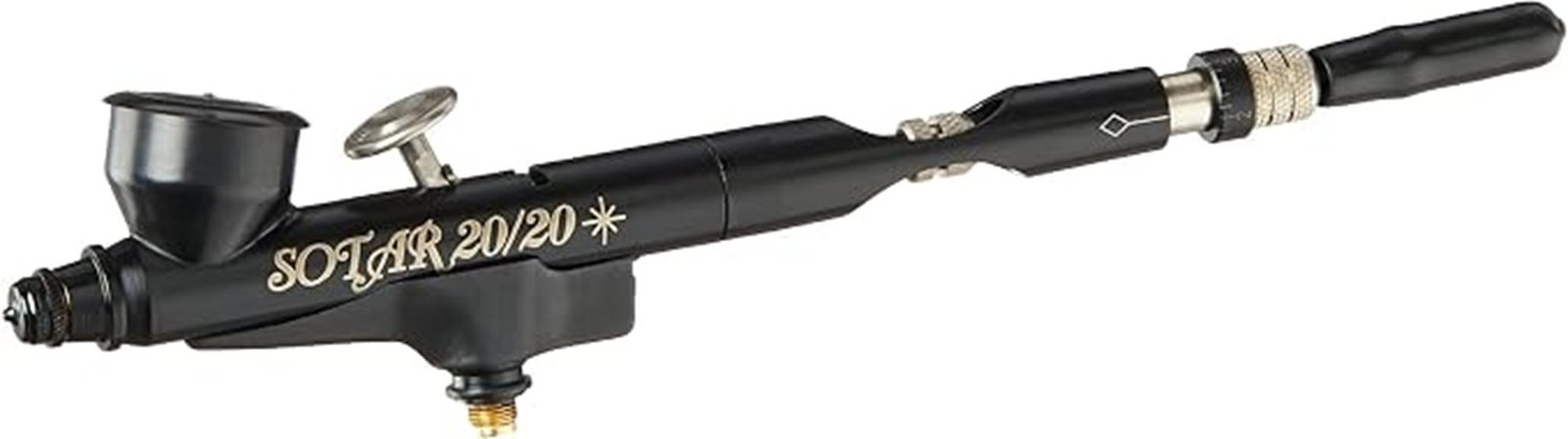
The Badger Air-Brush Co. Sotar 2020-2F is a large gravity feed fine airbrush designed for artists seeking precision. Capable of producing a spray pattern from hairline to 3/4-inch, it features a 1/12 ounce color cup for extended use. Developed by professionals, it includes a micrometer setting for easy adjustment of spray patterns. This dual-action, internal mix airbrush is compatible with finely pigmented paints, watercolors, and low viscosity acrylics. Built for durability, it comes with a one-year warranty on defects and a lifetime warranty on specific components, ensuring reliability for both fine and commercial artists alike.
Best For: The Badger Air-Brush Co. Sotar 2020-2F is best for professional artists and illustrators who require precision in their work.
Pros:
- Versatile Spray Patterns: Capable of spraying from hairline to 3/4-inch, allowing for detailed and broader applications.
- Durable Construction: Comes with a one-year warranty on defects and a lifetime warranty on certain components, ensuring long-term reliability.
- User-Friendly Design: Features a micrometer setting for easy adjustments and a rear needle release for convenience.
Cons:
- Small Color Cup: The 1/12 ounce capacity may require frequent refills for larger projects.
- Price Point: Higher cost compared to entry-level airbrushes, which may not suit all budgets.
- Learning Curve: May take time for beginners to master the dual-action mechanism effectively.
Not the best fit if: you want one all-purpose airbrush for both fine detail and heavy, thick paints — this one is optimized for detail, not bulk coverage.
Iwata Eclipse HP-CS Airbrush for Fine Detail
Best Overall / Most Versatile
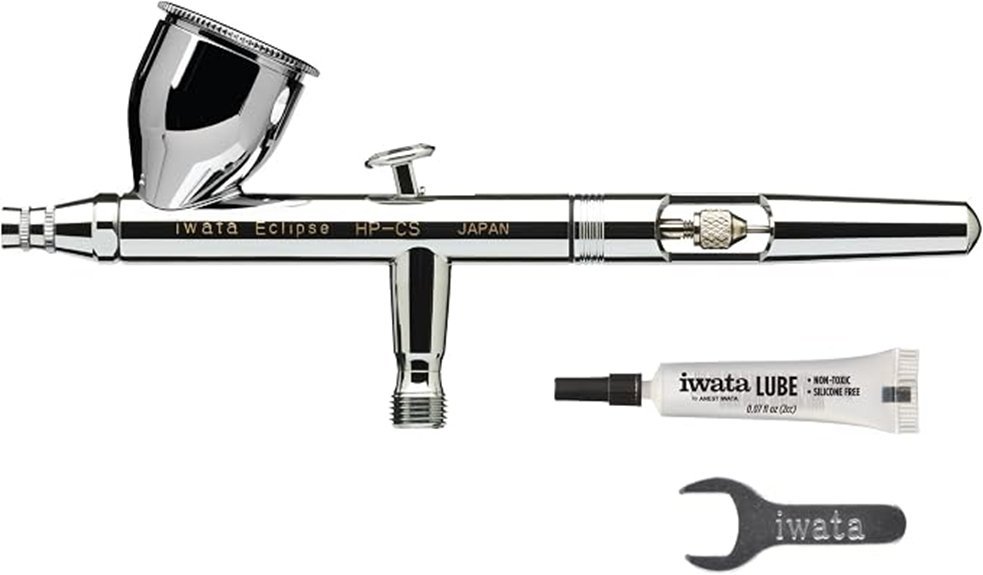
Ideal for artists seeking precision, the Iwata Eclipse HP-CS Airbrush excels in fine detail work. This gravity feed, dual action airbrush features a 0.24 oz (7 ml) fluid cup and an E3 nozzle designed for high-flow atomization. Versatile in application, it caters to model painting, auto graphics, and textiles, delivering ultra-fine lines to broad sprays. Maintenance is straightforward, thanks to its quick-flush cutaway handle and compression-fit nozzle. Constructed with a break-resistant spring-steel needle and solvent-resistant materials, this airbrush guarantees durability and longevity, making it suitable for both beginners and professionals.
Best For: Artists and hobbyists who require precision and versatility in fine detail work.
Pros:
- Easy maintenance with a quick-flush cutaway handle.
- Versatile applications for various art forms, from model painting to textiles.
- Durable construction with solvent-resistant materials for long-lasting performance.
Cons:
- Smaller fluid cup may require frequent refills for larger projects.
- Initial cost may be higher compared to entry-level airbrushes.
- Learning curve for beginners to master dual-action control.
Not the best fit if: you’re on a tight budget and just want the cheapest possible way to try airbrushing before committing.
Paasche TG#2L Talon Double Action Airbrush
Best for Detail-to-Wide-Coverage
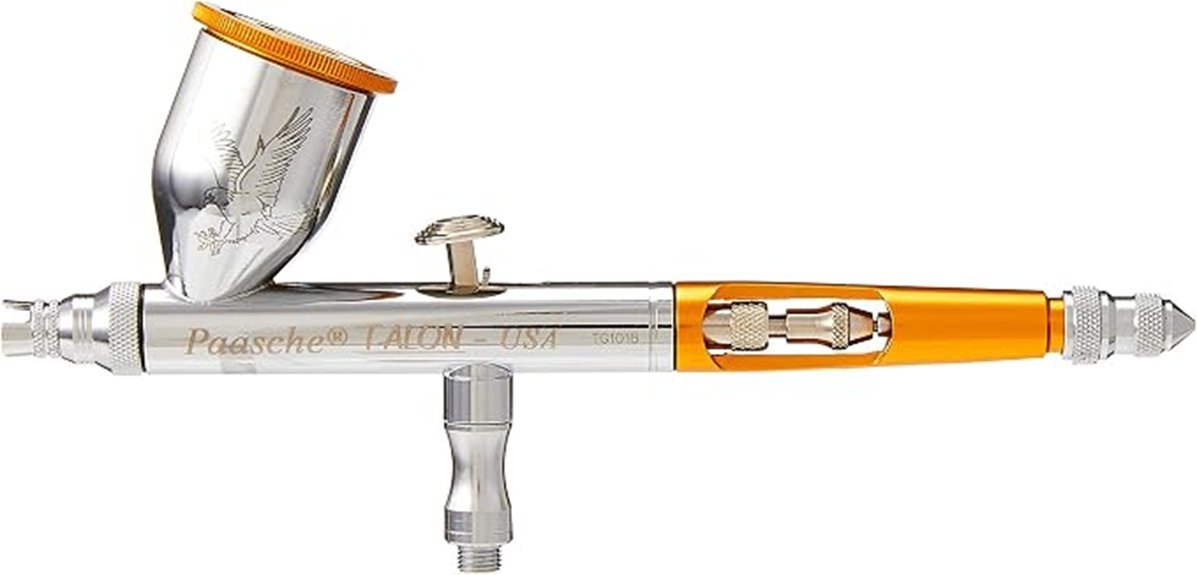
Crafted for precision artists, the Paasche TG#2L Talon Double Action Airbrush excels in delivering intricate detail. Made in the USA, its chrome-plated body and anodized aluminum handle guarantee durability. The double-action trigger mechanism paired with a gravity-feed system offers superior control over paint flow and air pressure. This airbrush is particularly versatile, suitable for applications ranging from automotive graphics to cake decorating. It achieves spray patterns from hairline to 3 inches wide with an optional fan head. With PTFE packing, it supports both water and solvent-based paints, while easy cleanup allows for quick shifts between projects.
Best For: Precision artists seeking a versatile airbrush for detailed applications across various mediums.
Pros:
- Durable construction with a chrome-plated body and anodized aluminum handle ensures long-lasting performance.
- Versatile use for a wide range of applications, including automotive graphics, cake decorating, and illustration.
- Easy maintenance with quick cleanup, allowing for efficient transitions between different paint projects.
Cons:
- Higher price point compared to entry-level airbrushes, which may not be suitable for budget-conscious beginners.
- Learning curve for those new to double-action airbrushes, requiring practice to master control.
- Optional fan head needed for wider spray patterns is sold separately, adding to the overall cost.
Not the best fit if: you want the full 3″ spray pattern out of the box — that width requires the optional fan head, sold separately.
Master Airbrush Gravity Feed Air Brush Kit
Best Complete Kit for Beginners
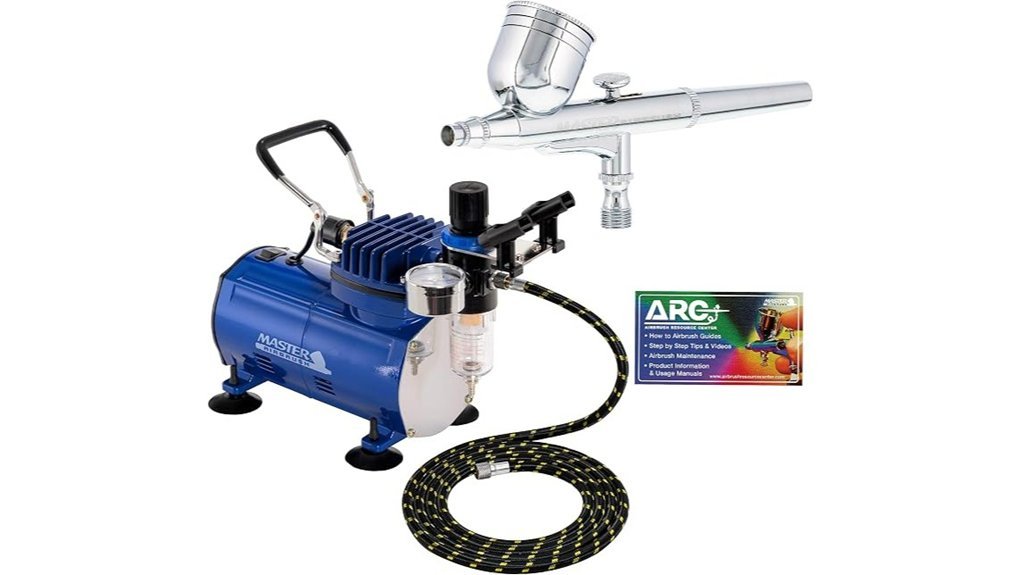
Featuring a precision 0.3mm fluid tip, the Master Airbrush Gravity Feed Air Brush Kit excels for both novice and seasoned artists. This multi-purpose kit includes the G22 gravity feed dual-action airbrush, which comes with a 1/3 oz. fluid cup, ensuring high performance across various applications. The accompanying 1/5 HP air compressor is equipped with an air filter, water trap, and pressure regulator, promoting consistent output. Ideal for tasks ranging from nail art to fine art, this kit balances professional quality with user-friendly design, making it suitable for aspiring artists and experienced professionals alike, supported by a thorough manual for beginners.
Best For: Aspiring artists and experienced professionals looking for a versatile airbrush kit for various applications.
Pros:
- High precision with a 0.3mm fluid tip for detailed work.
- User-friendly design suitable for both beginners and seasoned artists.
- Versatile applications ranging from nail art to fine art projects.
Cons:
- Requires some practice to master the dual-action functionality.
- The single-piston compressor produces some operating noise, as is typical for this style of compressor.
- Limited fluid cup capacity may necessitate frequent refills for larger projects.
Not the best fit if: you already own a good compressor — you’d be paying for compressor hardware you don’t need.
Badger Model 105 Patriot Fine Gravity Airbrush
Best Reliable All-Rounder
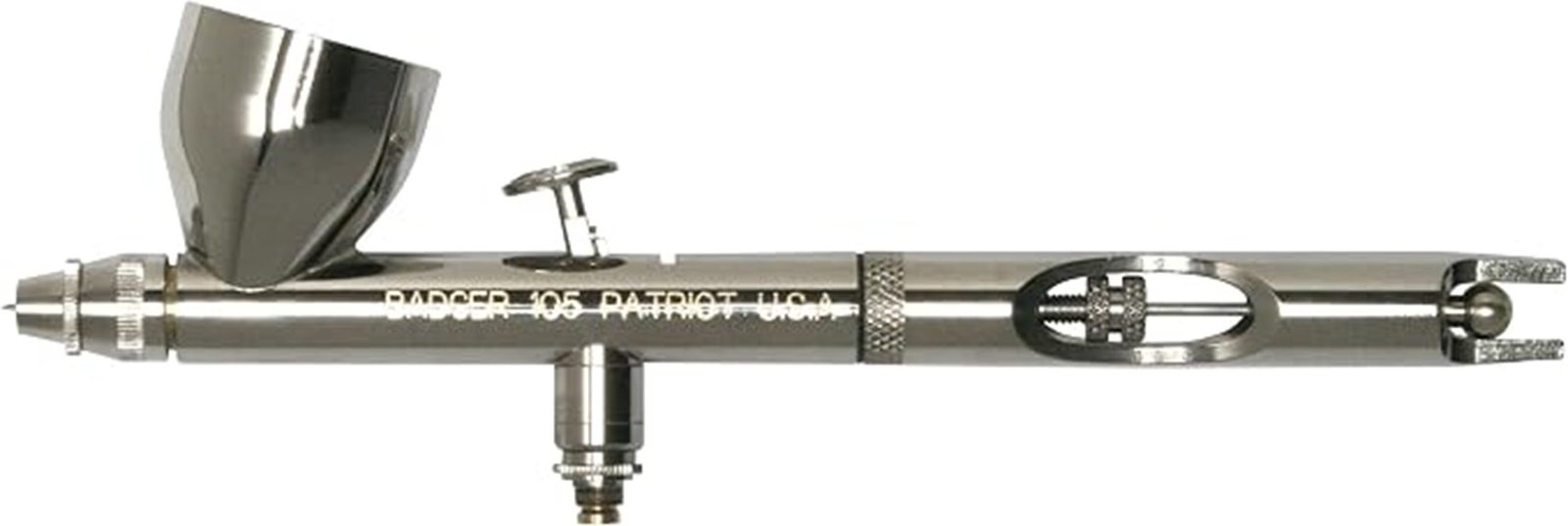
The Badger Model 105 Patriot Fine Gravity Airbrush stands out for artists and hobbyists seeking precision. This dual-action, gravity-feed airbrush features a stainless steel construction and a single (.5) needle/nozzle, making it versatile for various mediums, including inks, acrylics, and watercolors. Its acute tapered color well allows for efficient cleaning, enhancing usability. Maintenance is simplified with a self-centering nozzle design and a patented easy-access needle removal system. Additionally, the airbrush includes an instruction manual, providing essential guidance for users. Overall, the Model 105 Patriot is a reliable choice for those aiming for detail and quality in their work.
Best For: Artists, crafters, and hobbyists seeking precision and versatility in their airbrush applications.
Pros:
- Precision dual-action design allows for detailed work and control.
- Stainless steel construction ensures durability and easy maintenance.
- Compatible with a wide range of mediums, making it versatile for various projects.
Cons:
- Single needle/nozzle size may not suit all users’ preferences for different techniques.
- Learning curve for beginners, as dual-action airbrushes can be more complex to master.
- Requires regular maintenance to ensure optimal performance, which may be time-consuming for some users.
Not the best fit if: you frequently switch between ultra-fine detail and heavy paints — its single 0.5mm needle/nozzle is a general-purpose size, not swappable.
Factors to Consider When Choosing Airbrushes 2026: Top Picks and Buying Guide
When selecting an airbrush, several key factors come into play. The type of airbrush, fluid cup capacity, and spray pattern versatility greatly influence performance and usability. Additionally, considerations around maintenance and cleaning, as well as the build quality of materials, are essential for long-term satisfaction.
Airbrush Type Selection
Choosing the right airbrush involves careful consideration of various factors that impact functionality and performance. Airbrushes can be categorized mainly into gravity feed and siphon feed types; gravity feed models excel in fine detail work, while siphon feed versions accommodate larger projects due to their higher paint capacity. Additionally, users must decide between dual action and single action models, with dual action offering more control over paint flow and air pressure. Nozzle size is also essential; smaller sizes are ideal for detailed applications, whereas larger sizes handle thicker paints. Compatibility with different materials, such as water-based or solvent-based paints, and ease of maintenance, including quick-release features, further influence the selection process for best performance.
Fluid Cup Capacity
Selecting an airbrush with the appropriate fluid cup capacity is vital for optimizing performance and efficiency during painting tasks. The capacity directly affects the duration of use before refilling, with sizes ranging from 0.12 ounces to over 1 ounce. Smaller cups are ideal for detailed work, whereas larger cups accommodate broader applications, allowing for extended painting sessions without interruption. For projects requiring consistent color across larger areas, a larger fluid cup can greatly reduce the need for frequent refills. It is important to take into account the nature of the projects planned, as different capacities cater to varying levels of detail and coverage. Ultimately, the choice between smaller and larger cups depends on the user’s specific needs and preferences.
Spray Pattern Versatility
Fluid cup capacity plays a significant role in the overall performance of an airbrush, but equally important is the versatility of the spray pattern. Spray pattern versatility allows artists to create ultra-fine lines or broader strokes, accommodating both intricate details and expansive coverage. Many airbrushes come with adjustable spray patterns, enabling seamless shifts between hairline sprays and larger applications. The size of the nozzle and fluid tip is vital; smaller tips excel in fine detail, while larger tips are ideal for broader work. Gravity feed systems enhance consistent spray patterns through efficient fluid delivery. Additionally, some models offer interchangeable components, such as nozzles and fluid cups, further expanding their adaptability for various artistic techniques.
Maintenance and Cleaning
Maintaining an airbrush is essential for ensuring its longevity and peak performance. Regular cleaning after each use prevents paint buildup and clogging, which can hinder functionality. Many airbrush models come equipped with features such as a quick-flush cutaway handle or easy access needle removal systems, simplifying the cleaning process. Using the appropriate cleaning solutions tailored to the type of paint—whether water-based or solvent-based—can further enhance the lifespan of the airbrush components. Additionally, routine maintenance practices like lubricating needle packings and inspecting for wear are vital in extending the airbrush’s life. A well-maintained airbrush will deliver consistent performance and precision, making proper care important for both novice and experienced artists alike.
Build Quality Materials
When considering an airbrush, build quality and materials play an essential role in determining its effectiveness and longevity. Airbrushes constructed from stainless steel and chrome-plated components offer exceptional durability and corrosion resistance, making them suitable for various paint applications. The inclusion of anodized aluminum in handles contributes to a lightweight design while ensuring structural integrity, crucial for prolonged use. Additionally, airbrushes with PTFE packing enhance versatility and reduce wear, accommodating both water and solvent-based paints. A well-constructed airbrush typically features a self-centering nozzle design, promoting precision and simplifying maintenance. Dual-action mechanisms further enhance control over paint flow and air pressure, making them ideal for detailed artistic work across diverse applications.
Compatibility With Paints
Compatibility with various paint types is a crucial factor in selecting the right airbrush. Different airbrushes cater to specific mediums, including watercolors, inks, acrylics, and solvent-based paints. Artists should verify specifications to confirm peak performance. Airbrushes equipped with PTFE packing offer the flexibility to use both water-based and solvent-based paints, enhancing versatility. The fluid tip size also plays a significant role; finer tips are ideal for detailed work with thinner mediums, while larger tips accommodate thicker paints. Regular maintenance and easy cleanup are important to prevent clogs, especially when switching between mediums. Always consult the manufacturer’s guidelines regarding compatible paint types to avoid damage and guarantee effective operation of the airbrush.
User Skill Level
What factors should artists consider regarding their skill level when selecting an airbrush? Beginners often benefit from user-friendly designs, such as gravity feed systems and easy-to-clean components, which simplify the learning process. Intermediate users typically favor dual-action airbrushes that enhance control over paint flow and air pressure, providing versatility for various projects. Advanced artists may prefer high-performance models with precise atomization capabilities, allowing for intricate detailing and diverse spray patterns. Additionally, fluid cup capacity plays a role; beginners might opt for smaller cups for ease, while professionals often choose larger capacities for extended use. Maintenance requirements also vary, with beginners needing straightforward cleaning processes, while experienced users may appreciate advanced features for quick disassembly and cleaning.
Before You Buy: Quick Checklist
- Confirm the fluid cup size matches your typical project length — smaller cups need more frequent refills.
- Match the needle/nozzle size to your usual paint thickness: finer for detail, larger for thicker paints.
- Check whether you already own a compressor — some listings include one, others are airbrush-only.
- Decide if you want interchangeable needles/nozzles or are fine with a fixed single-nozzle design.
- Look for a quick-flush handle or easy-access needle removal if you switch colors often.
- Confirm the manufacturer’s paint compatibility (water-based vs. solvent-based) before buying extra supplies.
Frequently Asked Questions
What Types of Paints Can Be Used With Airbrushes?
Various types of paints can be used with airbrushes, including acrylics, watercolors, inks, and enamels. Each type requires specific thinning and techniques to achieve ideal results, catering to different artistic needs and surfaces.
How Do I Clean My Airbrush After Use?
To clean an airbrush after use, disassemble the parts, flush with appropriate cleaner, and use a soft brush to remove residue. Rinse thoroughly, reassemble, and store in a dry place for maximum performance.
What Is the Difference Between Single and Double Action Airbrushes?
Single action airbrushes control airflow with a fixed paint flow, while double action models let you simultaneously control both airflow and paint volume in one trigger motion. Most of the airbrushes in this guide are double action, since the added control makes them well suited to detail work and blending.
Can I Use an Airbrush for Makeup Applications?
Yes, an airbrush can be used for makeup applications. It provides a smooth, even finish and is ideal for achieving a flawless look. Many makeup artists prefer it for its precision and ability to create various effects.
What Compressor Specifications Are Ideal for Airbrush Use?
Ideal airbrush compressors typically deliver a pressure range of roughly 15 to 50 PSI, since fine detail work usually calls for the lower end (around 15–30 PSI) while broader coverage or thicker paints may need more. Quiet, consistent airflow is a plus, and a moisture trap or water separator helps keep water out of your airbrush line.
Conclusion
In the expansive world of airbrushing, selecting the right tool can feel like traversing a vibrant palette of possibilities. Each of the featured airbrushes offers unique features tailored to different artistic needs, ensuring that creators can find their perfect match. Whether you’re a seasoned pro or a budding artist, these top picks promise to elevate your craft, transforming your visions into stunning realities with every stroke. Choose wisely, and let your imagination take flight.