Affiliate disclosure: As an Amazon Associate I earn from qualifying purchases. This article contains paid Amazon links, and we may receive a commission at no additional cost to you.
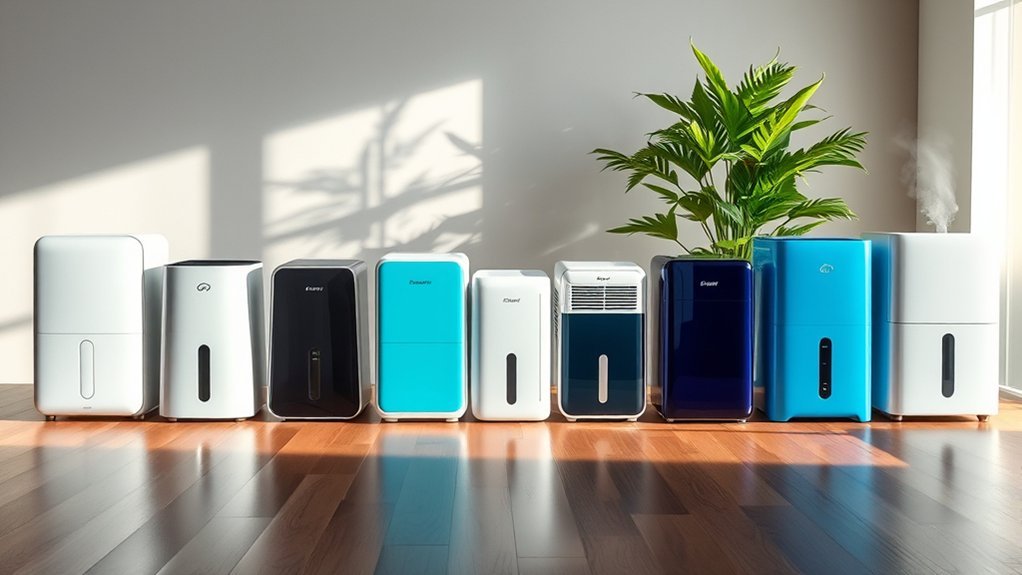
Damp spaces do not all need the same solution. A passive moisture absorber can work well in a closet, cabinet, stored RV, or other enclosed area, while a small electric dehumidifier is better when you want ongoing water collection in a bedroom, bathroom, or similar room. For heavier basement dampness, water intrusion, or widespread condensation, you may need a properly sized compressor dehumidifier instead of the compact products covered here.
How These Products Were Compared
This 2026 guide compares moisture-removal method, published capacity, tank or collection size, refill and recharge requirements, room-use fit, controls, maintenance, and important limitations. It is an editorial comparison of published specifications and product information, not a claim of hands-on testing.
Quick Verdict
- Best Refillable Passive Pick: DampRid Refillable Moisture Absorber
- Best Large-Capacity Multi-Pack: Vacplus Moisture Absorber Buckets, 4 Pack
- Best Compact Electric Pick: TABYIK 35 OZ Dehumidifier
- Best Cordless Renewable Pick: Eva-Dry E-333
- Best Electric Pick with Humidity Targets: NovaLivin CS19-W
Quick Comparison of the Best Options for Damp Spaces
| Product | Type | Best For | Main Limitation | Amazon |
|---|---|---|---|---|
| DampRid Refillable 6-Pack | Refillable calcium-chloride absorber | Closets, bathrooms, laundry areas, and under sinks | Needs emptying and replacement crystals | Check Amazon |
| Vacplus Buckets, 4 Pack | Large disposable absorber buckets | Several enclosed or lightly ventilated damp areas | Cannot maintain a precise room-wide humidity target | Check Amazon |
| Vacplus 2LB Bucket, 2 Pack | Large disposable absorber buckets | Two larger localized damp spots | Spent buckets require replacement | Check Amazon |
| TABYIK 35 OZ | Compact electric Peltier unit | Small bedrooms, bathrooms, closets, and RVs | Much lower extraction than a compressor model | Check Amazon |
| ZARPAX Charcoal 4-Pack | Disposable moisture and odor absorber | Closets, kitchens, bathrooms, and storage boxes | Single-use design | Check Amazon |
| Eva-Dry E-333 | Renewable silica-gel absorber | Cabinets, closets, safes, boats, and stored vehicles | Only suitable for very small enclosed spaces | Check Amazon |
| Vacplus Boxes, 3 Pack | Disposable calcium-chloride boxes | Small fragrance-sensitive spaces | Basic localized moisture control only | Check Amazon |
| NovaLivin CS19-W | Electric Peltier unit with humidity controls | Small rooms needing selectable humidity settings | Published extraction specifications are inconsistent | Check Amazon |
Fast Decision Guide
- Closet, cabinet, or stored RV: Start with DampRid, Vacplus, ZARPAX, or Eva-Dry.
- Small warm bedroom or enclosed room: Consider TABYIK or NovaLivin for active water collection.
- Wet basement or widespread condensation: Skip these compact options and size a compressor dehumidifier for the actual moisture load.
- Unknown humidity level: Check the space with a hygrometer before deciding what capacity you need.
Safety Note
Place every product on a stable surface and follow its instructions. Keep calcium-chloride absorbers away from children, pets, leather, metal, electronics, and delicate surfaces. Position electric models away from direct splashes, showers, tubs, sinks, and standing water. Auto shutoff can reduce overflow risk, but it does not replace safe placement or routine checks.
Best Refillable Pick: DampRid Refillable Moisture Absorber 6-Pack Fresh Scent
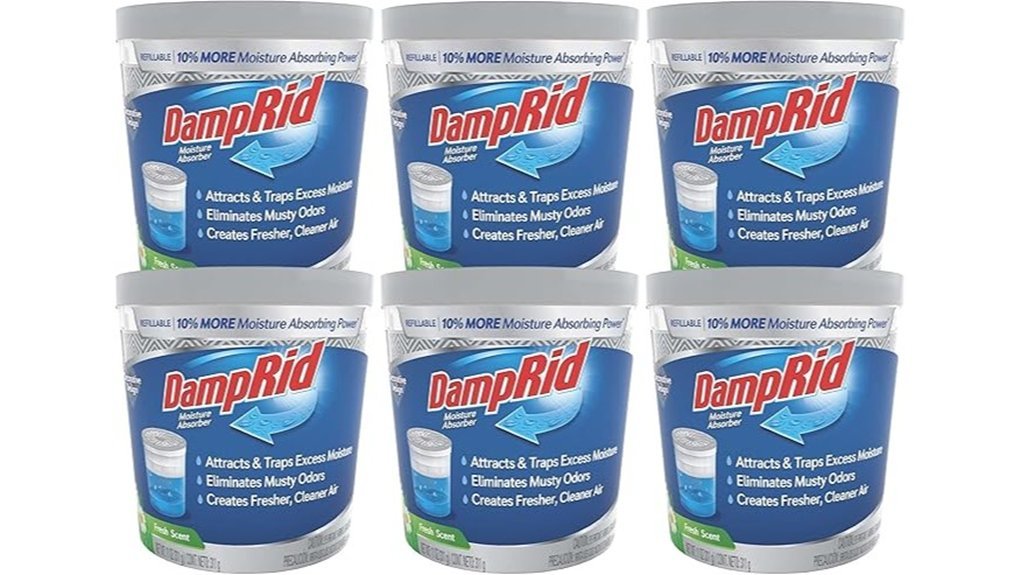
If you are dealing with localized dampness in closets, bathrooms, pantries, laundry rooms, or under sinks, the DampRid Refillable Moisture Absorber offers a simple option that does not need electricity. The pack contains six 11-ounce tubs that attract moisture and help reduce musty odors.
Each tub may work for up to 45 days depending on temperature, airflow, and humidity. DampRid also describes the product for areas up to 250 square feet, but that coverage figure should not be treated as proof that one passive tub can maintain a precise humidity level throughout an open room. When the crystals have dissolved, dispose of the collected liquid as directed and add a compatible DampRid refill.
Best For: Buyers who want refillable passive absorbers for several small damp areas.
Why You’ll Like It: It combines a reusable container with widely available refill crystals, reducing the need to replace the entire unit.
Who Should Avoid It: Anyone dealing with an actively wet basement, major condensation, or a room that needs measurable automatic humidity control.
Pros:
- Needs no outlet, battery, fan, or drain hose.
- Refillable tubs can be reused with compatible crystals.
- Helps manage localized moisture and musty odors.
Cons:
- Fresh scent may not suit fragrance-sensitive users.
- Collected liquid can damage some materials if spilled.
- Requires periodic disposal and refilling.
Best Large-Capacity Multi-Pack: Vacplus Moisture Absorber Buckets, 4 Pack
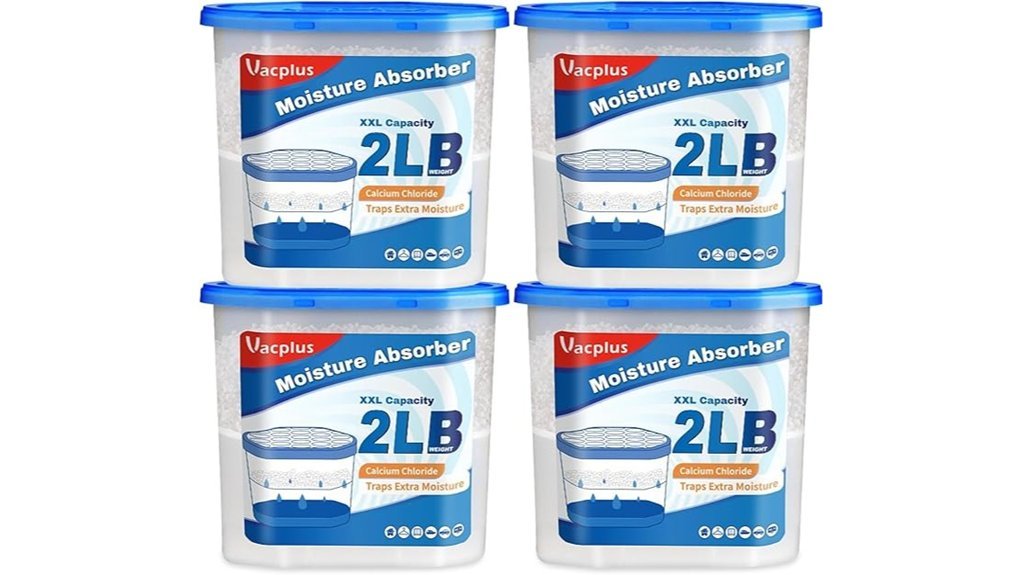
Vacplus Moisture Absorber Buckets are designed for buyers who want larger passive units in several enclosed or lightly ventilated spaces. Each bucket contains calcium chloride and has a stated collection capacity of up to 2,200 ml, giving it more room for collected liquid than a small moisture-absorber box.
The fragrance-free four-pack can be divided between closets, storage areas, bathrooms, laundry rooms, garages, or a stored RV. Setup is simple, but these buckets still provide localized moisture collection rather than powered whole-room humidity control.
Best For: Placing large passive absorbers in several enclosed or lightly ventilated damp areas.
Why You’ll Like It: The four-pack gives you more placement flexibility than a one- or two-bucket package.
Who Should Avoid It: Buyers who need a humidity display, automatic humidity target, continuous drain, or fast extraction from a large open room.
Pros:
- Large stated collection capacity of up to 2,200 ml per bucket.
- Fragrance-free design suits users who do not want added scent.
- Requires no electricity or operating controls.
Cons:
- Not designed to control humidity throughout a large open room.
- Each unit must be replaced after the material is spent.
- Needs stable, upright placement away from vulnerable surfaces.
Best Two-Bucket Pick: Vacplus 2LB Moisture Absorber Bucket 2-Pack
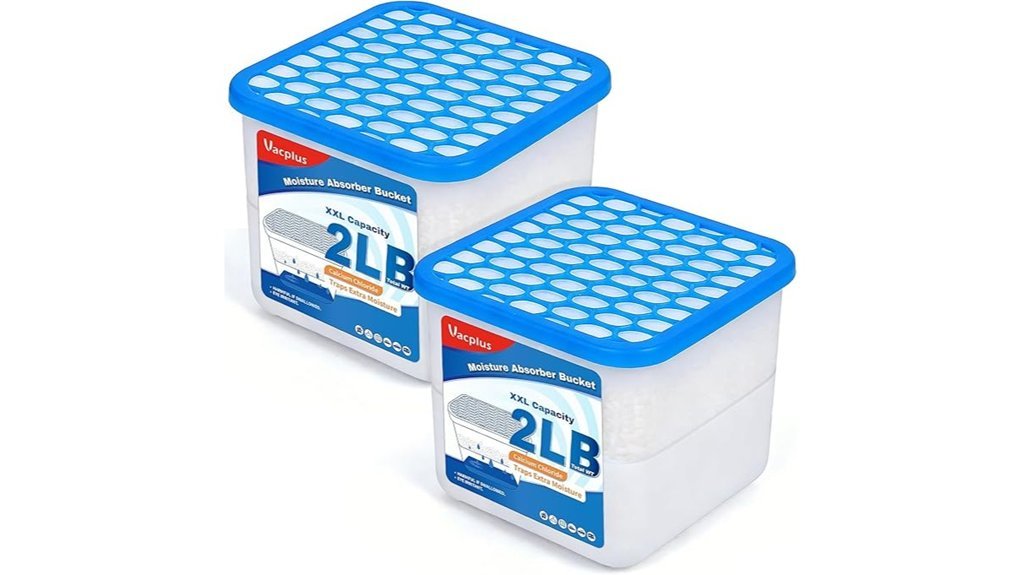
The Vacplus 2LB two-pack is a practical choice when you have two larger localized damp spots rather than several smaller areas. Each bucket contains calcium-chloride crystals and is designed to collect up to approximately 2,000 ml of liquid.
The wide container provides a larger exposed absorption area than a narrow moisture box. Use it in a closet, bathroom, storage room, garage, or stationary RV where passive moisture collection is appropriate, and keep each bucket level and upright.
Best For: Buyers who want two high-capacity passive buckets for specific damp locations.
Why You’ll Like It: It offers more collection capacity than small disposable tubs without requiring power or a drain.
Who Should Avoid It: Anyone expecting it to maintain a precise relative-humidity target or dry an actively wet basement.
Pros:
- Up to approximately 2,000 ml of stated collection capacity per bucket.
- Large container may reduce replacement frequency compared with small boxes.
- Simple peel-and-place operation.
Cons:
- Provides passive, localized moisture collection only.
- Spent units require replacement and proper disposal.
- Large bucket size may be awkward in narrow cabinets or shelves.
Best Compact Electric Pick: TABYIK 35 OZ Dehumidifier
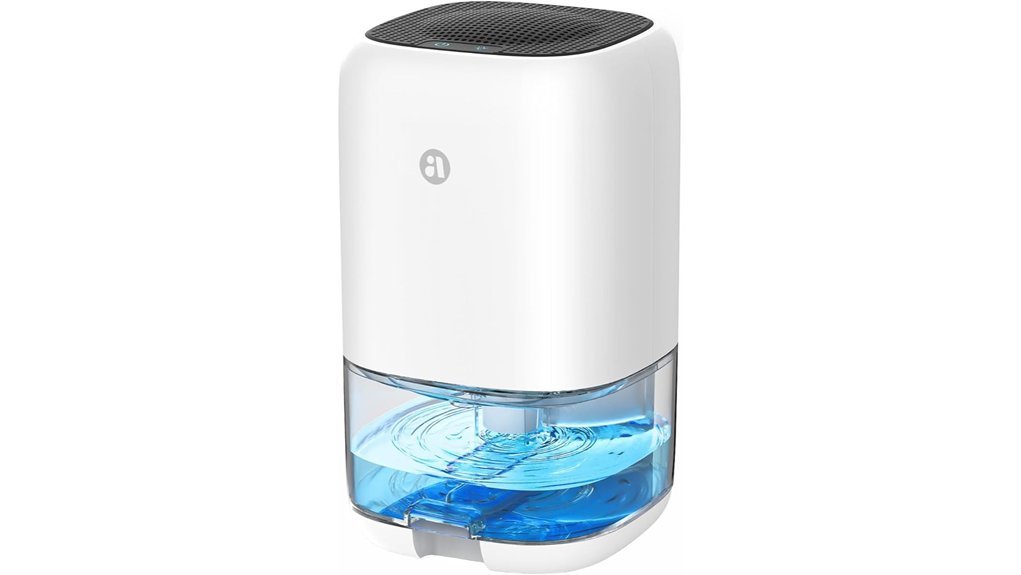
The TABYIK 35 OZ dehumidifier is better suited to buyers who want an electric unit that actively collects water in a small bedroom, bathroom, RV, or closet. Its compact Peltier system is quieter and easier to move than many compressor dehumidifiers, although it also removes moisture much more slowly.
The manufacturer states a maximum collection rate of about 16 ounces in 24 hours under test conditions of 86°F and 80% relative humidity. Everyday results can be considerably lower in cooler or less humid rooms, so prioritize the daily extraction figure and actual room conditions rather than relying only on the advertised square-foot rating. The transparent 35-ounce tank makes the water level easy to monitor, and the unit shuts off when the tank reaches its full-sensor level.
Best For: Moderately damp, enclosed small rooms where quiet operation matters more than high extraction capacity.
Why You’ll Like It: It provides active water collection without taking up the floor space of a full-size compressor unit.
Who Should Avoid It: Buyers with standing water, major basement moisture, large open spaces, or a need for rapid humidity reduction.
Pros:
- Compact dimensions make it easy to place on a shelf or counter.
- Transparent tank allows quick water-level checks.
- Auto shutoff helps reduce overflow risk when the tank fills.
Cons:
- Daily extraction depends heavily on room temperature and humidity.
- Small Peltier technology is much slower than a compressor system.
- The tank requires manual emptying.
Best for Moisture and Odor: ZARPAX Activated Charcoal 4-Pack
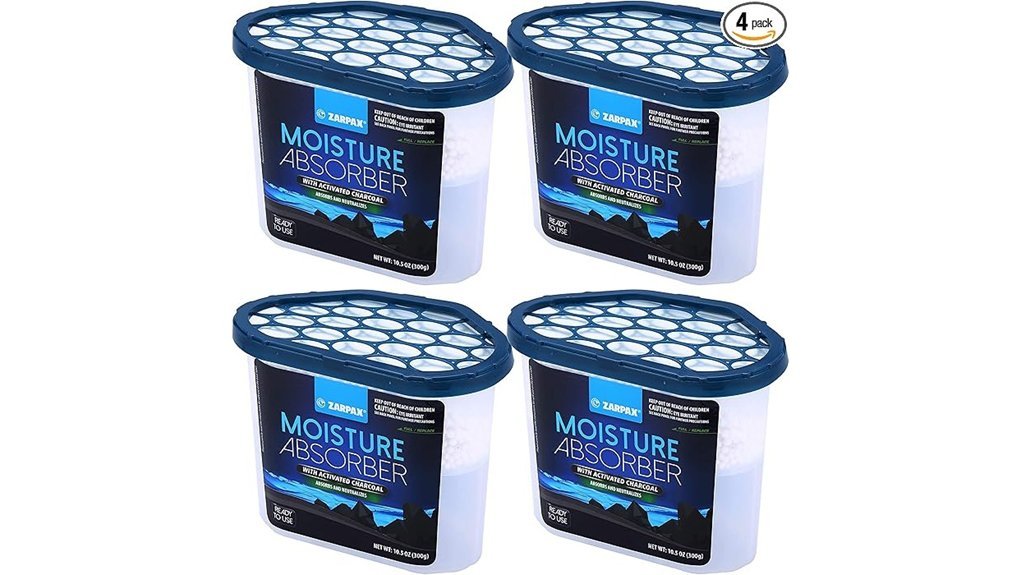
ZARPAX combines calcium chloride with activated charcoal, making it a useful choice when a small enclosed area has both dampness and stale odors. The four single-use containers can be placed in closets, kitchens, bathrooms, storage boxes, or cabinets.
Each 10.5-ounce unit has a stated capacity of up to approximately 600 ml of collected liquid and may remain in use for up to 45 days, depending on humidity and airflow. Remove only the outer seal, leave the moisture-locking membrane in place, and keep the container upright on a level surface.
Best For: Small areas where odor control is nearly as important as passive moisture absorption.
Why You’ll Like It: Activated charcoal gives it an additional odor-control function that standard unscented calcium-chloride tubs do not emphasize.
Who Should Avoid It: Buyers wanting a refillable, renewable, or powered solution.
Pros:
- Combines moisture absorption with activated-charcoal odor control.
- Compact containers fit easily in closets and storage spaces.
- No cord, battery, fan, or added fragrance is required.
Cons:
- Single-use containers create recurring replacement cost.
- Only suitable for small localized spaces.
- Incorrect placement can increase leak risk.
Best Cordless Renewable Pick: Eva-Dry E-333
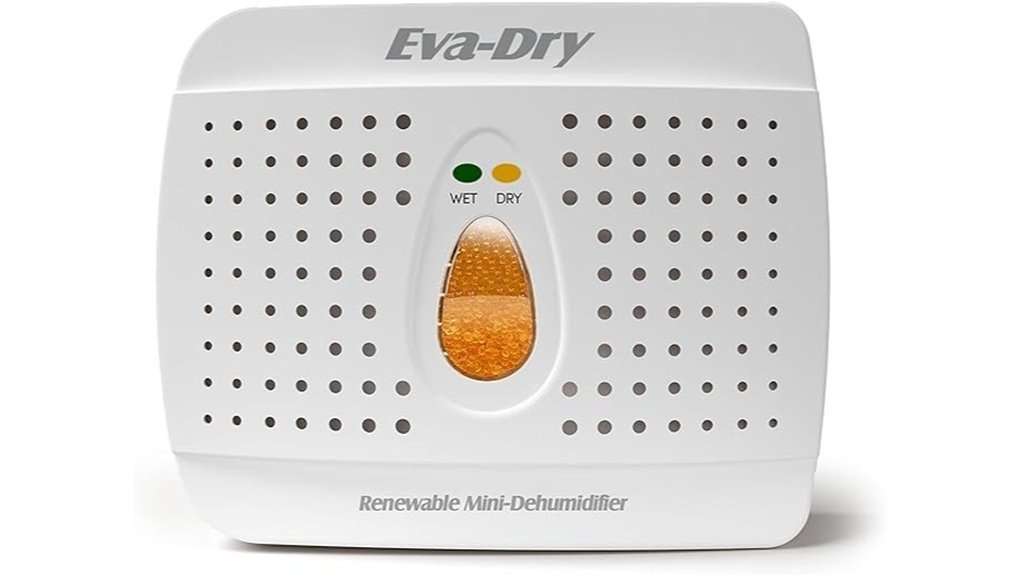
Eva-Dry’s E-333 is a reusable silica-gel moisture absorber for very small enclosed spaces. It operates without a cord or battery during the absorption cycle and is designed for areas up to 333 cubic feet, such as closets, cabinets, safes, boats, stored vehicles, and small storage compartments.
The indicator beads change color as they become saturated. When the indicator shows that recharging is needed, plug the unit into a suitable 110–120V outlet in a dry, ventilated area until the beads return to their ready color. The interval between recharges depends on the humidity and size of the enclosure.
Best For: Buyers who want a renewable option without disposable calcium-chloride liquid.
Why You’ll Like It: There is no liquid tank to empty and no refill material to purchase after each absorption cycle.
Who Should Avoid It: Anyone trying to control humidity throughout a normal-size bedroom, bathroom, basement, or other open room.
Pros:
- Cordless and silent during the moisture-absorption cycle.
- Renewable design avoids routine disposable refills.
- Color indicator provides a clear recharge reminder.
Cons:
- Only intended for very small enclosed spaces.
- Requires periodic outlet recharging.
- The unit becomes warm during recharge and needs open ventilation.
Best Compact Fragrance-Free Pack: Vacplus Moisture Absorber Boxes, 3 Pack
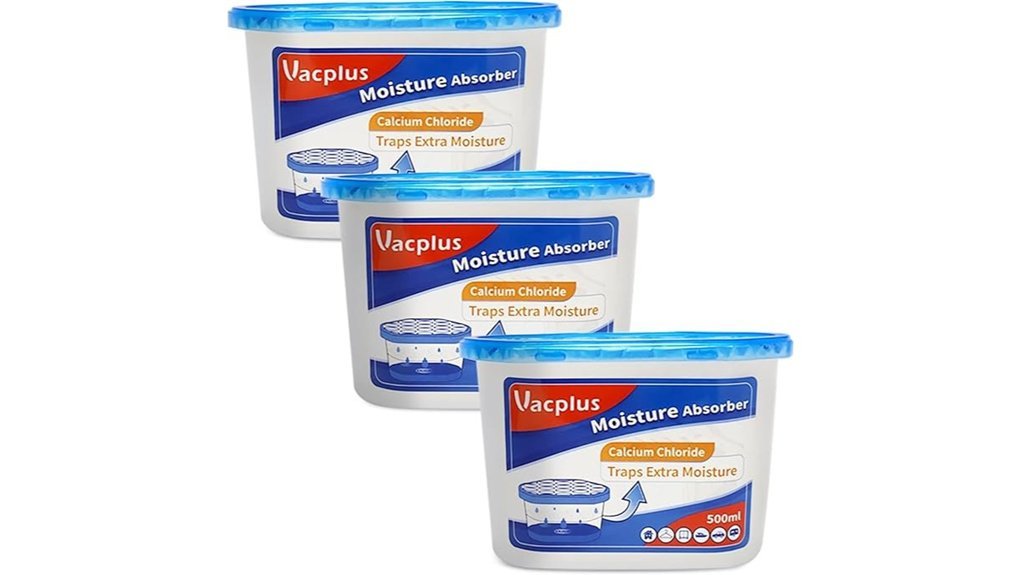
Vacplus Moisture Absorber Boxes are compact, fragrance-free units for closets, bathrooms, kitchens, studies, and other small indoor areas. Calcium-chloride particles absorb moisture and gradually dissolve, with the collected liquid moving into the translucent lower chamber.
The moisture-locking layer is intended to reduce spill risk if a box is disturbed, but every unit should still remain upright. Vacplus states that the boxes may work for at least 60 days under suitable conditions, although high humidity and airflow can shorten their useful life.
Best For: Buyers who want a compact passive format with fragrance-free moisture collection.
Why You’ll Like It: The transparent reservoir makes it easier to see when the absorbing material is spent.
Who Should Avoid It: Anyone needing high-capacity collection, automatic humidity settings, or powered room dehumidification.
Pros:
- Compact size works well on shelves and inside closets.
- Fragrance-free formula avoids added perfume.
- Visible lower chamber makes monitoring simple.
Cons:
- Provides basic localized moisture absorption only.
- Requires replacement after the crystals dissolve.
- Performance slows in cooler or less humid conditions.
Best Auto Humidity Control: NovaLivin CS19-W
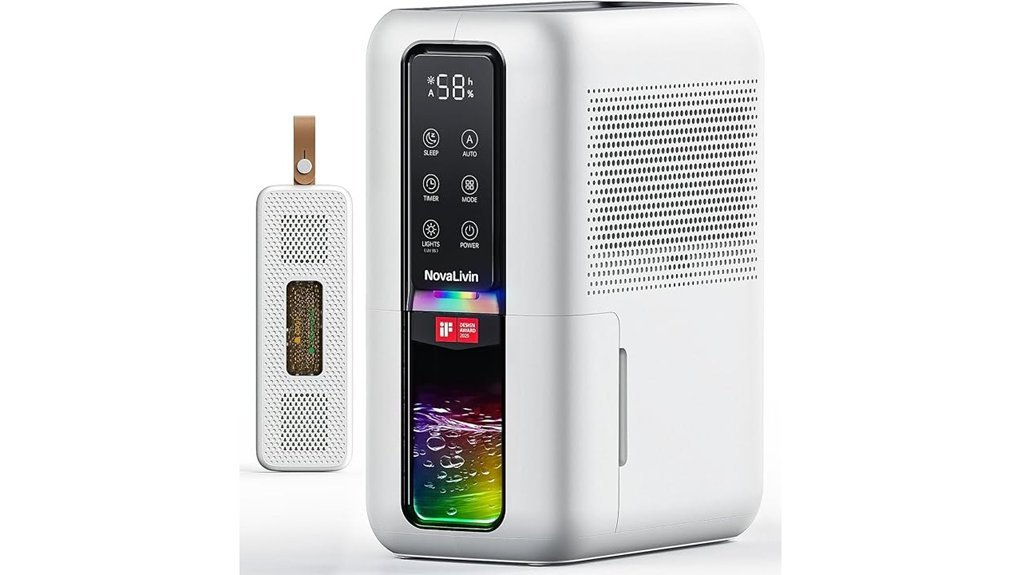
The NovaLivin CS19-W stands out from basic compact Peltier models because it includes selectable humidity targets. You can choose 40%, 50%, or 60% relative humidity in Auto mode, which gives you more control than a one-button mini dehumidifier.
It has a 68-ounce water tank, two operating levels, a sleep mode, a timer, a drying mode, and seven-color lighting. The Amazon listing advertises extraction of up to 34 ounces per day under test conditions of 86°F and 80% relative humidity, but a separate product-detail field lists 0.8 liters per day. Treat these as approximate best-case specifications and confirm the current listing before ordering. Actual collection will be lower in cooler or less humid rooms.
Best For: Small rooms where you want active water collection and selectable humidity settings.
Why You’ll Like It: Auto humidity targets can reduce unnecessary operation compared with a compact unit that runs continuously.
Who Should Avoid It: Buyers with a wet basement, large open floor plan, low-temperature space, or major water-intrusion problem.
Pros:
- Selectable 40%, 50%, and 60% humidity targets.
- Large 68-ounce tank reduces emptying frequency.
- Includes sleep mode, timer, auto shutoff, and multiple operating modes.
Cons:
- The listing contains inconsistent daily extraction specifications.
- Peltier technology remains less powerful than a compressor system.
- The tank still needs regular cleaning and emptying.
Factors to Consider When Choosing a Dehumidifier for Damp Spaces
Start by deciding whether you need localized moisture absorption or active room dehumidification. Then compare daily extraction, tank capacity, room conditions, drainage, noise, energy use, safety, maintenance, and replacement cost.
Passive Absorber vs. Electric Dehumidifier
A passive moisture absorber uses calcium chloride or silica gel and does not require continuous power. It works best in enclosed areas such as closets, cabinets, storage boxes, stationary RVs, and small bathrooms with mild dampness.
A compact electric Peltier dehumidifier actively condenses water and is more suitable for a small room. However, it normally removes much less water than a compressor dehumidifier. A wet basement, recurring wall condensation, or widespread high humidity usually calls for a larger compressor model and investigation of the moisture source.
Target Humidity Level
Use a separate hygrometer when you need to know whether the product is controlling the room rather than simply collecting some water. The U.S. Environmental Protection Agency recommends keeping indoor relative humidity below 60% and ideally between 30% and 50%. You can review the EPA’s mold and moisture guidance for additional information.
A passive absorber does not have a humidistat, so it cannot switch itself on or off at a chosen percentage. An electric model with a humidity sensor can provide more control, although compact-product sensor accuracy should not be assumed to match a calibrated standalone hygrometer.
Moisture Removal Capacity
Daily moisture-removal capacity tells you how much water an electric unit may extract in 24 hours. Always check the test conditions attached to that number. Compact models often publish maximum results measured in unusually hot and humid rooms, so normal household collection may be lower.
Do not confuse tank capacity with daily extraction. A 68-ounce tank does not mean the appliance removes 68 ounces every day. It only describes how much water the reservoir can hold before it must be emptied.
Room Size and Dampness Level
Square-foot ratings are useful for basic comparison, but they are not the only factor. Ceiling height, airflow, temperature, relative humidity, open doors, shower steam, and water intrusion all affect performance.
For a closet or cabinet, compare cubic-foot coverage and physical size. For a bedroom or bathroom, focus on daily extraction and whether the room can remain reasonably closed while the unit runs. For a basement, size the appliance for the actual moisture load rather than relying only on an advertised coverage number. ENERGY STAR provides capacity guidance for compressor dehumidifiers based on room size and dampness severity.
Noise Level
Noise matters in bedrooms, offices, and nurseries. Small Peltier dehumidifiers usually have quieter fans than compressor models, but manufacturer decibel claims can vary with operating mode, measurement distance, and room acoustics.
Look for a dedicated sleep mode, and remember that higher fan speeds generally produce more noise. Passive moisture absorbers and renewable silica-gel units are silent because they have no running fan.
Tank and Drainage Options
Most compact electric models collect water in a removable tank. Auto shutoff helps stop operation when the tank fills, but you still need to empty and clean it.
Continuous drainage is useful when an appliance supports a hose and you have a suitable gravity drain. Passive absorbers do not use a hose. Their liquid chamber or absorbing material must be replaced, emptied, refilled, or regenerated according to the manufacturer’s instructions.
Energy Use and Technology
Peltier dehumidifiers use semiconductor cooling. They are compact and quiet, making them convenient for small spaces with moderate moisture. Their tradeoff is lower water-removal capacity.
Compressor dehumidifiers use refrigeration components and are generally the more appropriate category for larger rooms, basements, and persistent humidity. Compare energy use together with the amount of water removed rather than assuming that the lowest-wattage unit will solve the problem most efficiently.
Safety Features
For an electric model, look for tank-full auto shutoff, a stable base, intact power equipment, and clear operating instructions. Keep air inlets and outlets clear, and never position the appliance where water can splash directly onto it.
For calcium-chloride absorbers, keep the container upright and away from children, pets, metals, leather, electronics, and delicate surfaces. Collected brine can cause damage if spilled. Renewable plug-in absorbers should recharge in an open, ventilated location and remain uncovered while warm.
Portability and Size
Measure the intended shelf, counter, closet, or floor space before buying. Compact electric models are easy to move, but they still need clearance around their air inlets and outlets.
Passive buckets offer more collection capacity but take up more room than slim boxes. A renewable mini unit may be the easiest option for a cabinet, safe, or stored vehicle where no outlet is available during normal use.
Maintenance and Replacement Cost
Disposable absorbers have no filter or motor to clean, but they create an ongoing replacement cost. Refillable tubs reduce container waste but still need new crystals. Renewable silica-gel units require periodic recharging.
Electric dehumidifiers need tank cleaning, vent cleaning, and filter care when a filter is included. Check the manual before washing any component, and never immerse the main appliance or power adapter.
Warranty and Current Product Configuration
Warranty terms, included accessories, sellers, package quantities, and product configurations can change. Confirm the exact model number and package shown on the current Amazon listing before ordering. Do not assume that a warranty mentioned for another size, color, or related ASIN applies to the version linked in this guide.
Before You Buy Checklist
- Is the dampness localized, room-wide, or caused by an active leak?
- Do you need passive absorption or measurable humidity control?
- Have you checked the current humidity with a hygrometer?
- Is the rated coverage listed in square feet or cubic feet?
- Is the daily extraction figure tied to specific test conditions?
- How often can you empty, refill, replace, or recharge the product?
- Is there a safe outlet or drain near the intended location?
- Will children, pets, leather, metal, or electronics be nearby?
- Have you confirmed the current package, seller, accessories, and warranty?
Frequently Asked Questions
What Indoor Humidity Level Should I Aim For?
Try to keep indoor relative humidity below 60% and ideally between 30% and 50%. A standalone hygrometer can help you measure the space. If humidity stays high despite using a compact product, investigate ventilation, leaks, room temperature, and whether you need a higher-capacity compressor dehumidifier.
How Often Should I Empty an Electric Dehumidifier?
Empty the tank whenever the full indicator activates or before the water reaches the maximum line. Frequency can range from every few days to more than once a day depending on tank size, temperature, humidity, and extraction rate. Clean the tank regularly to reduce residue and odors.
Can Dehumidifiers Help With Mold and Mildew?
Lowering excess humidity can make conditions less favorable for mold and mildew, but a dehumidifier does not remove established growth or repair the source of moisture. Fix leaks, improve ventilation, dry wet materials, and clean or remediate affected areas appropriately.
Which Type Fits a Closet or Small Basement?
For a closet, cabinet, or storage compartment, a passive calcium-chloride absorber or renewable silica-gel unit may be enough for mild dampness. A persistently damp basement usually needs a compressor dehumidifier sized for the room and moisture level. The compact electric models in this roundup are mainly intended for smaller, warmer rooms.
Do Electric Dehumidifiers Increase Electricity Bills?
Any electric dehumidifier adds to energy use. A small Peltier model generally draws less power than many compressor units but also removes less water. Operating cost depends on wattage, runtime, humidity setting, room conditions, and local electricity rates.
How Do I Maintain an Electric Dehumidifier?
Empty and rinse the tank, clean the filter if the model has one, remove dust from the vents, and keep the air inlet and outlet unobstructed. Inspect the power adapter and cord for damage. Follow the manual’s cleaning instructions and unplug the unit before maintenance.
Are Passive Moisture Absorbers Enough for a Damp Room?
They can help with mild, localized dampness in enclosed spaces. They are not usually enough for widespread condensation, a frequently used shower room, a wet basement, or water entering through a wall or floor. Those conditions require better ventilation, source repair, or a higher-capacity electric dehumidifier.
Can I Use a Small Electric Dehumidifier in a Bathroom?
Only use it where the manufacturer permits and where it will remain safely away from showers, tubs, sinks, splashes, and standing water. Keep the appliance and power connection dry, provide adequate airflow, and follow all electrical-safety instructions supplied with the model.
Why Is My Mini Dehumidifier Collecting Very Little Water?
Peltier dehumidifiers collect less water when the room is cool, only mildly humid, too open, or larger than the unit can handle. Make sure the vents are clear, doors and windows are reasonably closed, and the tank is seated correctly. Compare the room conditions with the test conditions used for the published extraction claim.
Conclusion
The right choice depends on the size and seriousness of the damp problem. Choose DampRid when you want refillable passive control, a Vacplus bucket when you need more collection capacity in an enclosed area, or ZARPAX when odor control also matters.
For active water collection in a small room, the TABYIK 35 OZ is the simpler compact pick, while the NovaLivin CS19-W adds selectable humidity targets and more operating controls. The Eva-Dry E-333 is the most convenient renewable choice for cabinets, closets, boats, stored vehicles, and other tiny enclosed spaces.
Final Recommendation
Choose a passive absorber for mild, localized dampness where there is no convenient outlet. Choose a compact electric model for ongoing collection in a small, warm room. For a wet basement, structural moisture, or recurring mold, correct the source and consider a properly sized compressor dehumidifier instead of relying on a mini unit.
Before ordering, open the relevant Amazon listing to confirm the current product configuration, package quantity, included accessories, seller, warranty information, and availability.