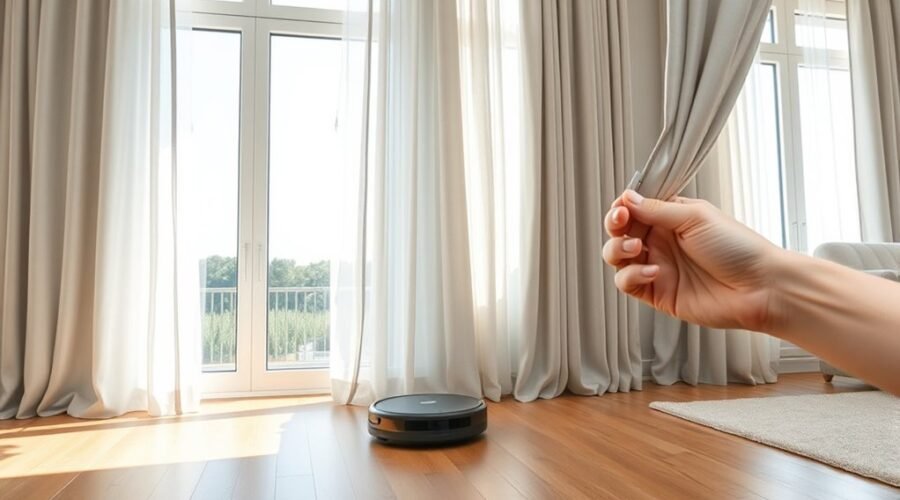
Floor-length curtains can interfere with a robot vacuum by catching in its brushes, blocking its route, or confusing its sensors. Learning how to keep curtains away from a robot vacuum can prevent these problems without changing your room’s style. A few simple adjustments can protect your curtains while helping the vacuum clean closer to walls and windows.
Quick Answer
To keep curtains away from a robot vacuum, lift loose hems with curtain clips or tiebacks, secure tassels and cords, and remove fabric from the cleaning path. Aim for enough clearance that the vacuum cannot catch the material. If curtains still cause trouble, use a compatible no-go zone or boundary strip and test the route.
At a Glance
| Difficulty | Easy |
| Tools Needed | Measuring tape, curtain clips or tiebacks, and compatible boundary controls if needed |
Why Curtains Snag Robot Vacuums
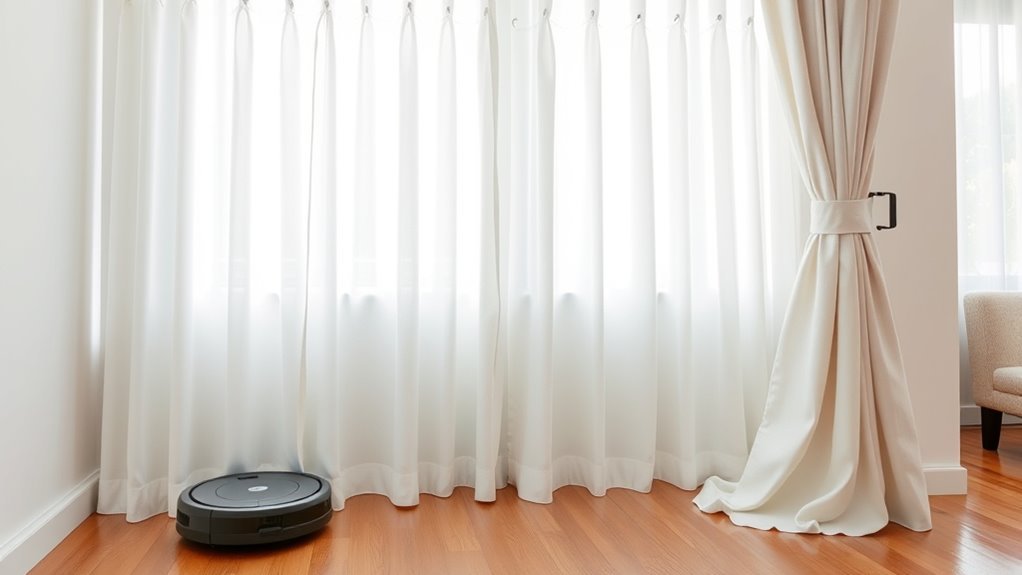
Robot vacuums can catch loose curtain hems because their rotating brushes and wheels pull in material that reaches the floor. Long fabric can also interfere with navigation, causing the vacuum to stop, turn away, or leave areas uncleaned.
Common problems include:
- Loose hems: Fabric can reach the main brush, side brush, or wheels.
- Tassels and fringe: Thin strands can wrap around rotating parts.
- Heavy drapes: Thick folds can block the machine’s route.
- Moving fabric: Curtains can sway into a path that appeared clear earlier.
- Sensor interference: Some navigation systems treat hanging curtains as obstacles.
For example, Xiaomi explains that its laser navigation system can identify curtains as inaccessible areas. This means the vacuum may avoid cleaning behind them, even when the floor itself is open.
YEEDI also identifies loose curtains and carpet fringe as common causes of entanglement.
The solution is to keep fabric outside the vacuum’s moving parts while leaving a clear route along the floor.
Check Curtain Length Before Cleaning
Start by measuring the distance between the curtain hem and the floor. Your curtains need enough clearance to stay beyond the robot vacuum’s brushes and wheels, even when the fabric moves.
At least 4 inches of clearance is a practical starting point for many setups. However, this is not a universal manufacturer requirement. The right height depends on your vacuum’s dimensions, brush position, and curtain material.
- Measure each curtain panel from the rod to its lowest edge.
- Check whether the hem touches or pools on the floor.
- Measure the vacuum’s full height, including any raised navigation sensor.
- Lift fabric that could reach the brushes, wheels, or bumper.
- Check for fraying, loose threads, and decorative trim.
Remember that a curtain hanging above the floor can still interfere with a raised sensor or bumper. A successful setup must account for the whole vacuum, not just the main cleaning brush.
If you plan to replace your curtains, shorter panels or streamlined fabrics may make the room easier to maintain.
Tuck Drapes Away From the Floor
Tucking long drapes into a secure fold is a quick way to remove excess fabric from the cleaning path. It works well when you want to keep your existing curtain length without permanent alterations.
For longer panels, 4–6 inches of floor clearance is a useful starting range. Adjust the height if the fabric still touches your vacuum.
- Gather the excess fabric near the bottom of the panel.
- Fold the hem upward without pulling the curtain off balance.
- Hold the fold with a suitable curtain clip or tie.
- Make sure no loose material can fall back onto the floor.
Fabric may also be tucked behind nearby furniture if it stays secure and does not interfere with moving parts or electrical equipment.
Avoid leaving a loose fold under furniture where the vacuum can enter and pull it free.
Secure Tassels and Loose Trim
Tassels, fringe, and decorative trim should stay outside the robot vacuum’s reach. Their loose strands can wrap around brushes or wheels, even when the main curtain panel is lifted.
Before cleaning:
- Gather tassels into a raised fold instead of leaving them on the floor.
- Use discreet clips or adhesive hooks to hold loose trim against the curtain.
- Keep curtain and blind cords away from the cleaning area.
- Inspect decorative edges for pulled threads and damaged stitching.
- Consider shorter trim if the same area causes repeated tangles.
A weighted curtain chain can help steady moving fabric. However, it should only be used when the weighted hem remains safely outside the vacuum’s path.
Do not rely on a weight to protect fabric that still trails across the floor.
For general preparation, Roborock recommends raising or tying curtain strings and tassels before cleaning.
Use Curtain Clips or Tiebacks
Curtain clips and tiebacks offer a simple way to keep fabric off the floor. Both methods let you adjust the curtains for cleaning and restore their normal appearance afterward.
The better choice depends on whether you want to raise the hem or draw the entire panel away from the cleaning route.
Secure Curtains With Clips
Curtain clips work well for long panels that need a small, temporary adjustment. They hold folded fabric above the floor without requiring you to shorten the curtains.
- Gather the excess fabric into an even fold.
- Attach clips along the folded hem.
- Adjust the height so the fabric stays beyond the vacuum’s reach.
- Check that the clips hold securely when the curtains move.
Choose clips that suit the curtain’s weight and material. Small clips may slip on heavy drapes, while unsuitable fasteners can mark delicate fabric.
If you use adhesive hooks, check that they are rated for the load and suitable for the wall surface.
Use Tiebacks for Clearance
Tiebacks hold curtain panels to the side, leaving an open route beside windows and walls. They are useful when a robot vacuum repeatedly pushes against the same hanging fabric.
Place the tieback high enough to keep the lowest folds out of reach. Then gather the curtain loosely and secure it against the wall.
Adjustable tiebacks allow you to change the position without altering the curtain itself. Wall-mounted options can provide a more consistent resting point for heavier panels.
After fastening the curtain, look at the floor from the vacuum’s direction of travel. Check that the gathered folds do not create a new obstacle.
Lift Long Curtains for Vacuum Runs
If you prefer curtains that touch the floor, you do not need to shorten them permanently. Lift them before a cleaning session, then release them after the vacuum finishes.
This approach works particularly well for decorative drapes that you want to preserve at their original length.
Raise Curtains Before Cleaning
Make lifting long curtains part of your room preparation. A consistent routine helps prevent fabric from falling into the vacuum’s path during an unattended cleaning cycle.
- Pull the curtain away from the floor.
- Fold or gather the loose material.
- Secure the fabric with clips, ties, or an appropriate hook.
- Check that tassels and cords are also raised.
- Confirm that the robot can pass the curtain area without contact.
If the same problem occurs every day, a higher curtain rod position or a shorter hem may provide a longer-term solution.
Secure Fabric Out of Reach
Raised curtains must stay secure throughout the cleaning cycle. A loose tie or sliding clip can allow fabric to drop after the robot has already started.
Command-style hooks, wall-mounted tiebacks, or suitable curtain clips can hold the material in place.
Adjustable curtain rods may also help change the hanging position where the installation allows it. However, do not place strain on the rod or mounting hardware.
If you tuck fabric behind furniture, check that it cannot fall back into the vacuum’s path.
Set a No-Curtain Cleaning Zone
A no-go zone prevents a compatible robot vacuum from entering an area where curtains create a repeated problem. This is useful when you cannot lift or secure the fabric consistently.
Many mapping robots offer virtual walls or restricted cleaning zones. However, the available controls vary by model.
- Open your robot vacuum’s app and select the saved floor map.
- Find the map-editing or restricted-area controls.
- Draw a no-go zone around the curtain area.
- Leave enough space so the vacuum does not touch loose fabric at the boundary.
- Save the map and test the restriction.
For example, Roborock’s S5 instructions explain how to create no-go zones and virtual walls in the map editor.
Magnetic boundary strips are another option, but only for models with compatible sensors. According to eufy’s boundary-strip compatibility guidance, support varies across its RoboVac models.
Do not assume that every robot vacuum recognizes magnetic strips.
If your model does not support virtual boundaries or compatible strips, use a secure physical barrier or keep the curtains raised.
Note: A no-go zone also prevents the vacuum from cleaning the protected area. You may need to clean the floor behind the curtains separately. Do not rely on a virtual boundary as the only protection around stairs or other serious hazards.
Run a Quick Test Pass
A supervised test run shows whether your curtain adjustments work under normal cleaning conditions. It can reveal loose fabric, navigation problems, or a boundary that needs moving.
After securing the curtains, start a cleaning cycle in the affected room.
- Watch the vacuum approach the curtain area.
- Check whether its brushes or bumper touch the fabric.
- Observe whether it stops, reverses, or repeatedly turns away.
- Confirm that it cleans the accessible floor and can leave the area.
- Adjust the curtain or boundary if any contact occurs.
A successful test means the vacuum can complete the route without pulling fabric, becoming trapped, or leaving an avoidable gap.
If the machine still catches the curtains, raise them further or move the no-go boundary away from the hem.
Check for Snags After Each Clean
Inspect the curtains after cleaning to catch minor damage before it becomes worse. Pay particular attention to the bottom edge, seams, and decorative trim.
- Look for pulled fibers, fraying, or loose stitching.
- Check tassels for twisted or tangled strands.
- Remove dust and hair with a lint roller or soft brush.
- Repair minor damage with suitable stitching or fabric glue when appropriate for the material.
Also inspect the robot vacuum if it touched the curtains.
Warning: If fabric becomes tangled in the vacuum, stop the machine and switch it off before removing the material. Do not pull forcefully against a trapped brush or wheel. Follow your model’s instructions for opening and cleaning the brush assembly.
Remove any trapped strands, then make sure the brush and wheels turn freely before restarting the vacuum.
Keep Sensors and Fabric in Clear View
Clean sensors and a clear route help a robot vacuum recognize obstacles and move around furniture. However, lifting fabric and cleaning sensors solve different problems, so both deserve attention.
A robot may still avoid curtains even when its sensors are clean. Some navigation systems treat hanging fabric as a wall or obstacle.
Sensor Line of Sight
Keep fabric away from the robot’s navigation sensors and bumper. There is no universal requirement to leave one meter of empty space in front of every robot vacuum.
Instead, use the clearance and maintenance guidance for your particular model.
- Keep loose curtains from covering or touching the sensor housing.
- Wipe accessible sensor surfaces with a clean, dry, soft cloth.
- Remove dust from the bumper and relevant navigation openings.
- Check the cleaning route if the robot repeatedly misidentifies an obstacle.
Manufacturer guidance supports regular maintenance. For example, Philips recommends cleaning dirty sensors with a soft, dry cloth when a robot has trouble recognizing obstacles.
Do not spray cleaning solution directly onto sensor openings.
Curtain Clearance Tips
If your vacuum still struggles near the curtains, compare the different ways of keeping fabric outside its route. Start with the simplest reversible adjustment.
| Method | Effect |
|---|---|
| Tuck long curtains | Clears the floor edge without permanent alterations |
| Curtain clips | Raises and holds loose fabric |
Tiebacks are useful when you need to move an entire panel away from the wall. Higher rod placement or shorter curtains may provide a permanent solution.
Regular checks are especially useful after washing the curtains or rearranging furniture, because the hanging position and cleaning route may change.
Frequently Asked Questions
What Are Some Creative Ways to Hide My Robot Vacuum?
You can place a robot vacuum beneath a suitable console table, inside a purpose-built docking cabinet, or on an open lower shelf. Keep its charging station accessible and leave the clearance required by the manufacturer. Avoid decorative baskets, furniture skirts, or plants that block the robot’s route or sensors. Follow iRobot’s dock placement guidance when using a Roomba.
What Are the Most Common Problems With Robot Vacuums?
Common robot vacuum problems include tangled brushes, blocked wheels, weak suction, navigation errors, and battery or charging issues. Loose cables, curtain hems, rug fringe, and floor clutter can also trap the machine. Regularly clean the brushes and sensors, remove loose objects, and inspect the cleaning route if the same problem keeps returning.
Should You Leave Your Robot Vacuum Plugged in All the Time?
Yes, for regular use on supported models. iRobot’s battery maintenance tips recommend leaving Roomba on its plugged-in base between cleaning runs. For long-term storage, follow your model’s battery instructions rather than unplugging it at random.
Do Robot Vacuums Go Over Rugs?
Yes, many robot vacuums can clean low-pile rugs, but performance depends on the model and rug construction. Thick pile, curled edges, and long fringe can cause the vacuum to become stuck. Secure loose fringe or set a compatible restricted cleaning zone if your vacuum repeatedly catches the rug.
How Far Above the Floor Should Curtains Hang for a Robot Vacuum?
Curtains should hang high enough to stay clear of the robot vacuum’s brushes, wheels, bumper, and navigation sensors. Four inches is a practical starting point, but the ideal clearance depends on the machine and the fabric. Test the route and raise the hem further if the vacuum makes contact.
Can a Robot Vacuum Clean Under Floor-Length Curtains?
Some robot vacuums can clean beneath hanging curtains, but others recognize the fabric as an obstacle and avoid the area. Temporarily lifting the panels is the simplest way to expose the floor. If you use a no-go zone, the protected area will usually need separate cleaning.
Conclusion
Keeping curtains away from a robot vacuum starts with lifting loose hems, securing decorative trim, and leaving a clear cleaning route. Curtain clips and tiebacks offer simple temporary fixes, while shorter panels or adjusted rod placement can provide a lasting solution.
If fabric continues to interfere with cleaning, use a compatible no-go zone and test the route. A quick inspection after each run can help protect your curtains and keep the vacuum working properly.
Sources
- YEEDI: Robot Vacuum Gets Stuck: Confirms that curtains and carpet fringe can cause entanglement.
- Xiaomi: Robot Vacuum and Curtains: Explains how laser navigation can identify hanging fabric as an inaccessible area.
- Roborock: Preparing Your Home: Supports raising curtain strings and tassels before cleaning.
- Roborock: No-Go Zones and Virtual Walls: Provides instructions for configuring restricted cleaning areas.
- eufy: Boundary Strip Compatibility: Identifies models that support magnetic boundary strips.
- Philips: Robot Vacuum Troubleshooting: Covers restricted zones, tangled items, and sensor cleaning.
- iRobot: Home Base Placement: Explains charging-station positioning and clearance.
- iRobot: Battery Maintenance: Provides guidance for regular charging and long-term storage.