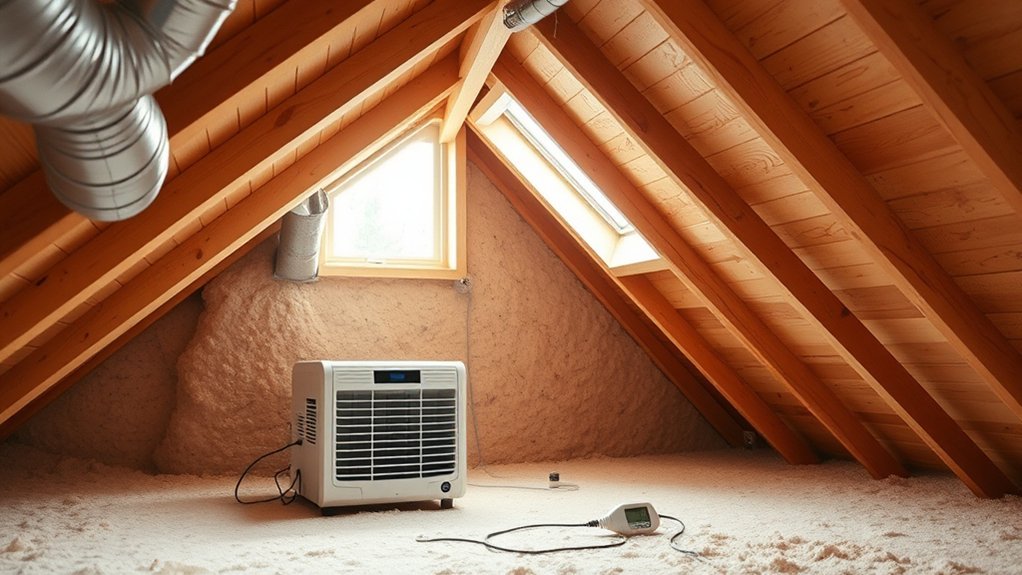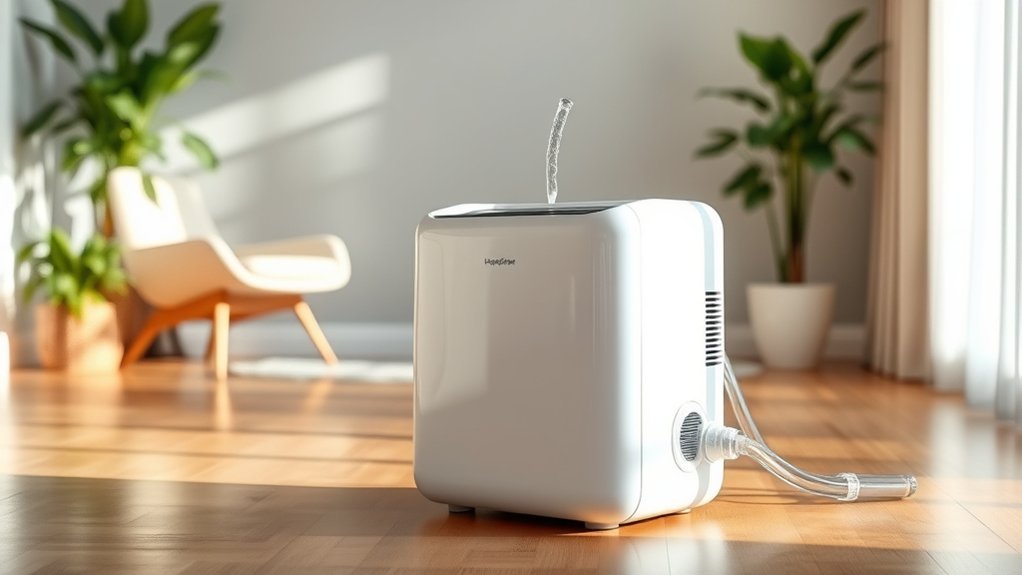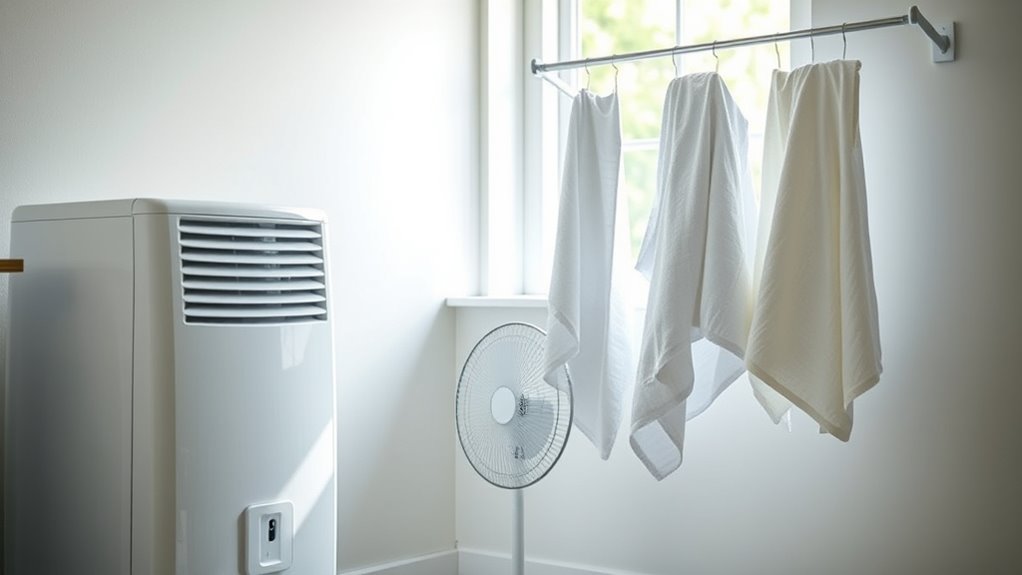
A fan can help a crawl space dehumidifier, but it is not required in every installation. Use one when walls, piers, ducts, stored materials, or a long floor plan create areas with little air movement. Before adding airflow, stop leaks, remove standing water, cover exposed soil, and confirm whether the crawl space is designed to be vented or sealed.
Quick Answer
Use a fan with a crawl space dehumidifier when the space has stagnant corners, partitions, active surface moisture, or uneven humidity readings. A separate fan may not be necessary in a small, open crawl space with a correctly sized unit. Do not open a sealed crawl space vent just to create airflow.
Key Takeaways
- A fan improves air distribution and surface drying, but it does not increase the dehumidifier’s rated moisture-removal capacity.
- Keep a sealed or encapsulated crawl space closed unless its approved design or local code requires another ventilation method.
- Place the fan where it breaks up a stagnant zone without blowing directly into the dehumidifier intake.
- For routine control, aim for approximately 45% to 55% relative humidity and keep readings below 60%.
- Fix leaks, drainage problems, and exposed-earth moisture before relying on fans or a dehumidifier.
At a Glance
| Time Required | 30–60 minutes for inspection and setup; drying may take one or more days |
| Difficulty | Easy for routine circulation; professional help may be needed for water damage, wiring, mold, radon, or structural problems |
| Tools Needed | Crawl space dehumidifier, hygrometer, optional low-profile fan or air mover, safe power supply, and continuous drain |
| Cost | No equipment cost if you already own a suitable fan; electricity cost depends on wattage, runtime, and your utility rate |
Do You Need a Fan in a Crawl Space?
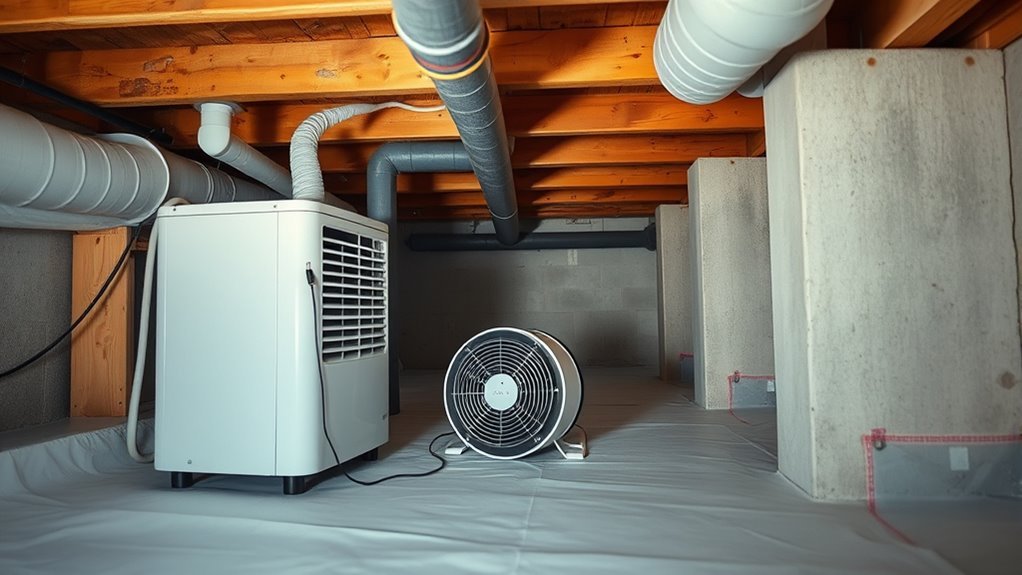
You may benefit from a fan in a crawl space when the dehumidifier cannot circulate air evenly through the entire area. Foundation piers, closed sections, ductwork, insulation, and stored materials can create stagnant pockets where humidity remains higher than it is near the unit.
A fan moves humid air out of those pockets and distributes the dehumidifier’s drier discharge air. This can help damp surfaces dry more evenly. However, a fan does not correct standing water, an active leak, exposed wet soil, poor drainage, or an undersized dehumidifier.
A separate fan may be unnecessary when the crawl space is open, the dehumidifier is properly sized, and hygrometers placed in different areas show similar readings. Many crawl space dehumidifiers already contain a strong internal blower and can also be connected to short supply ducts when the manufacturer allows it.
Warning: Do not enter a crawl space with standing water while electrical equipment is energized. Turn off power from a safe location and contact a qualified professional when water is near wiring, receptacles, appliances, or extension cords.
How a Fan Helps a Crawl Space Dehumidifier
A fan supports a crawl space dehumidifier by improving circulation around obstacles and across damp surfaces. Its main benefit is better distribution, not an increase in the dehumidifier’s published pint-per-day capacity.
Airflow Supports Surface Drying
Moving air across a damp surface encourages moisture in that material to evaporate into the surrounding air. The dehumidifier can then collect some of that water vapor. This is especially useful after a small, clean-water leak has been repaired or when one corner remains damp because air cannot reach it easily.
Airflow should be paired with adequate dehumidification. A powerful fan can release moisture from wet materials faster than an undersized unit can remove it, causing relative humidity to rise temporarily. Monitor readings instead of assuming that more airflow is always better.
The goal is not maximum fan speed. The goal is steady circulation with enough dehumidification capacity to keep relative humidity falling.
Even Coverage in Crawl Spaces
A fan is most valuable when humidity differs from one part of the crawl space to another. Place separate hygrometers near the dehumidifier and in the farthest or most obstructed area. If the remote reading stays several percentage points higher after the system has been running, additional circulation or ducting may help.
Large or divided spaces may need more than one small fan, but there is no universal number of fans per dehumidifier. Add airflow only where measurements show a persistent dead zone. In some layouts, a duct attached to the dehumidifier’s dry-air outlet is more effective and uses less space than several portable fans.
Fan Placement for Drying
Place the fan where it can sweep air through the damp or stagnant section and back into the crawl space’s main circulation path. Follow the clearances in both equipment manuals rather than relying on a fixed distance.
- Keep the dehumidifier intake and discharge fully open.
- Point the fan across damp surfaces or through an obstructed passage.
- Avoid aiming a high-speed stream directly into the dehumidifier intake.
- Keep plastic sheeting, insulation, cords, and debris away from fan blades and air openings.
- Recheck humidity in the affected zone after several hours and adjust the angle if needed.
A low-profile air mover is often easier to position in a short crawl space than a household pedestal fan. Use only equipment that is in good condition and suitable for the environment in which it will operate.
Where to Place the Fan and Dehumidifier
Position both devices according to airflow, access, drainage, and the manufacturer’s instructions. The best location is not automatically the geometric center of the crawl space.
Recommended Products
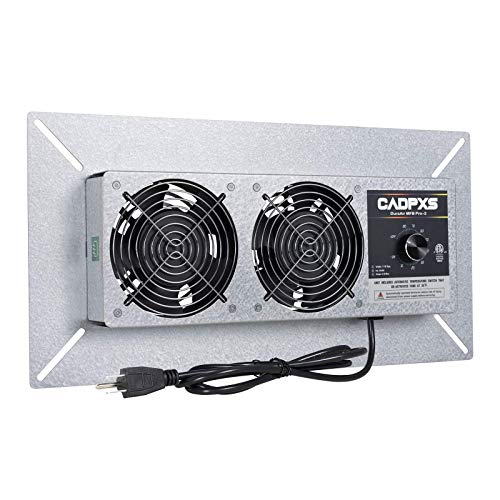
Crawlspace Vent Fan: Air Out. Airflow: 220 CFM. 18" x9" x2”. Dual fans with 6.56 foot grounded power cord. Ventilate a wet crawl space. Exchange the outdoor and indoor air, improve room air quality and balance the humidity

Functions & Applications:Airflow: 540 CFM, ventilation type: air out. The Ventilator fan for damp crawl spaces, basement, attic and garage to reduce humidity. It can increase air circulation to stop condensation and wood rot. Also, used for exhausting vent radon gas, treating wood gases and odors, and preventing them from entering living spaces.

Power ventilates and reduces moisture in crawl spaces through existing passive vents
Central Dehumidifier Placement
In an open crawl space, a central location can provide broad coverage. In other installations, it may be better to place the dehumidifier near a suitable drain, service access, or the area from which short ducts can distribute dry air.
- Place the unit on a stable, level surface or approved hanging system.
- Maintain the intake and outlet clearances listed in the manual.
- Use a continuous drain that slopes correctly or an approved condensate pump.
- Keep the filter and service panel accessible.
- Avoid locating the unit where roof, plumbing, or foundation leaks can drip onto it.
If the unit repeatedly turns on and off while the far side remains humid, its dry discharge may be returning directly to its intake. Repositioning the unit, redirecting the outlet, or adding a short distribution duct can reduce this short-circuiting effect.
Fan Direction and Clearance
Aim the fan along the longest practical airflow path or through a section blocked by piers and ducts. The fan can either push drier air toward a remote area or pull humid air out of it. Choose the direction that creates a complete loop instead of repeatedly circulating air through one small section.
Do not let boxes, fallen insulation, plastic sheeting, or construction debris cover either device. If the fan lifts dust or loose insulation, lower its speed and correct the debris problem before continuing.
Pro Tip: Put one hygrometer near the dehumidifier and another in the farthest damp area. Placement decisions based on two readings are more reliable than judging the entire crawl space from the dehumidifier’s built-in sensor.
Best Fan Speed for Crawl Space Drying
There is no single best fan speed for every crawl space. Use the lowest setting that removes stagnant zones and produces steady air movement throughout the affected area.
- Low speed: Best for routine circulation in a dry, encapsulated crawl space.
- Medium speed: Useful when remote humidity remains elevated or surfaces are slightly damp.
- High speed: Reserve for controlled drying of clean, wet materials when dust, mold, insulation, and contaminated water are not concerns.
Higher speed does not automatically make the dehumidifier remove more water. It may increase evaporation, noise, dust movement, and electricity use. Watch the humidity trend and reduce the fan speed once readings become even.
Temperature also affects performance. According to ENERGY STAR guidance, frost can form on some compressor dehumidifiers when the surrounding temperature falls below approximately 65°F. Use a model rated for low-temperature operation if the crawl space regularly becomes cooler than its normal operating range.
Fix Moisture Sources Before Adding Airflow
A fan and dehumidifier manage water vapor after it enters the crawl space. They should not be the first or only response to a moisture problem.
- Stop active leaks. Repair plumbing, foundation, roof, duct-condensation, and appliance leaks.
- Remove standing water. Correct sump, drainage, and groundwater problems before operating ordinary electrical equipment.
- Direct rain away from the foundation. Clean gutters, extend downspouts, and maintain grading that drains away from the building.
- Cover exposed soil. Install and seal an appropriate ground vapor barrier around seams, walls, piers, and penetrations.
- Seal obvious air leaks. Repair openings that allow humid outdoor air or unconditioned duct leakage to enter.
- Provide continuous drainage. A crawl space unit should not depend on a bucket that may fill and shut the system off.
The U.S. Department of Energy recommends covering crawl space soil with a continuous vapor barrier whether the crawl space is vented or unvented. Its crawl space moisture guidance describes sealing seams and extending the material around walls, piers, and penetrations.
Vented vs. Encapsulated Crawl Spaces
Do not open or close crawl space vents solely because you added a fan. Vent status is part of the building’s moisture-control design and may also be governed by local code.
| Crawl Space Type | Vent Approach | Role of a Circulation Fan |
|---|---|---|
| Traditional vented | Maintain the approved vent arrangement unless a qualified contractor designs a conversion. | May reduce stagnant pockets but cannot prevent humid outdoor air from entering. |
| Sealed or encapsulated | Exterior vents are normally sealed as part of a complete moisture-control system. | Optional when the dehumidifier cannot distribute air evenly. |
| Mechanically conditioned | Uses an approved conditioned-air, exhaust, or dehumidification method under applicable code. | Used only when needed to improve distribution. |
DOE research found that humid outdoor air can make traditionally vented crawl spaces wetter in humid climates. Its guidance on unvented, conditioned crawl spaces explains why sealing and conditioning are often more effective than relying on outdoor ventilation.
The 2024 International Residential Code section R408.3 permits unvented under-floor spaces when specified vapor-control and conditioning requirements are met. Local amendments and flood-zone requirements may differ, so verify the rules in your jurisdiction.
How to Set Up a Fan and Dehumidifier
- Inspect the crawl space. Look for standing water, plumbing leaks, foundation seepage, damaged ducts, fallen insulation, mold, pests, and exposed wiring.
- Correct the moisture source. Repair leaks and drainage problems and cover exposed earth before relying on equipment.
- Place the dehumidifier. Use a level, serviceable location with the required intake and outlet clearances.
- Connect continuous drainage. Route the hose to an approved drain or use a properly installed condensate pump.
- Place the fan in a dead zone. Aim it through the obstructed or damp section rather than directly into the dehumidifier intake.
- Set and monitor humidity. Start with a humidistat setting near 50% and compare readings in at least two locations.
- Adjust after 12–24 hours. Redirect or slow the fan when readings become even. Investigate capacity or moisture-source problems if RH does not decline.
Note: The dehumidifier’s display measures conditions near the unit. A separate hygrometer in the farthest section can reveal humidity pockets that the built-in sensor misses.
Warning: Stop and seek professional help if the crawl space contains sewage, contaminated floodwater, extensive mold, damaged electrical wiring, suspected asbestos, structural decay, or fuel-burning equipment that may backdraft. Do not use a circulation fan to spread contaminants through the space.
Recommended Products
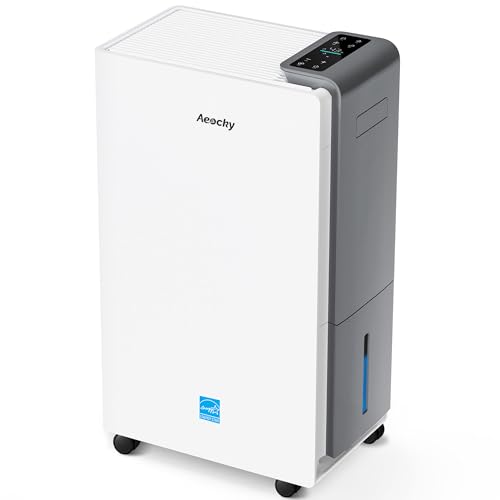
【ENERGY STAR 25 ≠ ENERGY STAR Most Efficient 2025】Don't fall for competitors' word games. With only 2.6% of ENERGY STAR models earning "Most Efficient 2025" title, these options are exceptionally rare on the market. RHEA-001 is one of the few to truly hold this top-tier certification. Many brands use misleading phrases like "Energy Star Efficient 25" or "Energy Star 25" to imply a standard they haven't met. Choosing them is a risk.With AEOCKY, you get verified performance and the peace of mind of authentic, top-tier efficiency.

▼ WHY USE A VENTILATION FAN: A ventilation fan benefits your home in several ways: ▼ Reducing radon level in lower areas.▼Keeping your crawl space and foundation dry, guards against condensation, and vents harmful gases and odors. ▼Enhancing indoor and outdoor air quality, controls humidity. Whether it's in crawl spaces, basements, attics, or garages, a ventilation fan is a valuable addition to your home.

Dual-Fan High-Efficiency Ventilation : Delivers powerful 240 CFM airflow to quickly remove damp air, radon, and odors—keeping crawl spaces, basements, attics, garages, laundry rooms, and bathrooms dry and healthy. Ideal for crawl space vent fans and crawlspace fans.
When to Run Both Devices Together
Run the fan and dehumidifier together when measurements show uneven humidity or when clean, damp materials need controlled drying. The fan releases and distributes moisture, while the dehumidifier removes water vapor from the air.
| Condition | Recommended Action |
|---|---|
| Small, open space with even RH readings | Run the dehumidifier alone unless circulation remains poor. |
| Far corner remains more humid | Add a fan or approved distribution duct to that zone. |
| Clean materials are damp after a repaired leak | Run both and monitor the humidity trend closely. |
| Standing water or active leak | Stop the source and remove water safely before ordinary equipment use. |
| Visible mold or contaminated water | Avoid spreading contaminants; arrange professional assessment. |
| RH remains above 60% despite continuous operation | Check leaks, vapor barriers, drainage, temperature, unit sizing, filter condition, and airflow obstructions. |
During an initial drying period, both devices may run continuously. Once the space is dry and readings are stable, let the dehumidifier’s humidistat cycle the compressor as needed. A circulation fan can then run at low speed, on a timer, or only when remote humidity begins to rise.
Monitoring Humidity and Drying Progress
EPA guidance recommends keeping indoor relative humidity below 60% and ideally between 30% and 50% where practical. In a crawl space, a dehumidifier setting around 45% to 55% is a useful starting range because sensor accuracy, temperature, and local conditions vary.
Record humidity near the unit and in the farthest section at the same time each day. The system is moving in the right direction when:
- relative humidity trends downward and remains below 60%;
- the difference between monitoring locations becomes smaller;
- visible condensation disappears;
- damp surfaces return to their normal dry condition;
- the musty odor decreases after the moisture source has been corrected; and
- the dehumidifier begins cycling instead of running without interruption.
If humidity drops near the dehumidifier but stays high elsewhere, improve distribution. If all readings remain high, adding more fans is unlikely to solve the main problem. Check for water entry, exposed soil, insufficient capacity, low operating temperature, clogged filters, blocked coils, or drainage failure.
Troubleshooting a Fan and Crawl Space Dehumidifier
Recommended Products

Stainless Steel Crawl Space Ventilation Fan: Air output: 300CFM, IP55 grade crawl space ventilation fan, with good dustproof, weatherproof, liquid resistance, do not worry about fan rust. With this crawl space fan, you can accelerate indoor and outdoor air circulation, improve indoor air quality, and balance humidity. Ventilation fans can also be used to vent radon gas, treat wood gas and other odors, and prevent them from entering living spaces.

Powerful Vent Fan: Size: 12.6" × 8.7" × 2.5"| Airflow: 300CFM | Noise: 40 dBa. This high-airflow vent fan improves indoor comfort by removing heat that collects inside the house and increasing air circulation. Idea for crawl spaces, basements, attics, garages, greenhouses and other confined spaces up to 550 sq. ft.

IMPROVE INDOOR AIR QUALITY: The majority of the air circulating in your home originates from the crawl space. With our dehumidification controller, by driving ventilator fans to effectively decrease moisture or radon levels in your house. This optimization aims to elevate the indoor air quality, providing you and your family with a breath of fresh air
Humidity Is Not Falling
Confirm that the drain works, the filter is clean, the crawl space is closed or vented according to its intended design, and no active water source remains. Compare the unit’s capacity and operating-temperature range with the manufacturer’s specifications.
The Dehumidifier Ices or Short Cycles
Low temperature, restricted airflow, a dirty filter, a blocked coil, or direct fan discharge into the intake may cause poor operation. Turn the unit off if the manual requires defrosting, correct the obstruction, and verify that it is rated for the crawl space temperature.
One Area Remains Damp
Move the fan to create a complete circulation loop. Remove barriers, open interior crawl space pathways where appropriate, or use an approved supply duct from the dehumidifier.
The Musty Odor Continues
Odor can remain when wet wood, insulation, cardboard, debris, pest material, or mold is still present. A fan can spread the odor without removing its source. Inspect the affected materials and arrange professional mold assessment when growth is extensive or hidden.
The Breaker Trips
Stop using the equipment. Do not place multiple high-draw devices on an unsuitable circuit or rely on damaged extension cords. Have the circuit, receptacle, and equipment checked by a qualified electrician.
Common Mistakes That Slow Drying
- Trying to dry an active leak. Fans and dehumidifiers cannot overcome continuous water entry.
- Opening a sealed crawl space vent. Humid outdoor air may increase moisture instead of reducing it.
- Using an arbitrary 15-foot spacing rule. Equipment clearances and airflow patterns matter more than a fixed distance.
- Blowing directly into the intake. This can cause the dehumidifier to sample its own dry discharge and cycle before remote areas are controlled.
- Running every fan at maximum speed. Excess speed can stir dust, disturb insulation, and release moisture faster than the dehumidifier removes it.
- Ignoring the ground vapor barrier. Exposed soil can continuously release moisture into the crawl space.
- Relying on one humidity reading. The area beside the dehumidifier may be much drier than a blocked corner.
- Using ordinary fans around mold or contaminated water. Air movement can spread spores, particles, and contaminants.
- Ignoring drainage. A full bucket, pinched hose, frozen line, or failed condensate pump can stop moisture removal.
- Treating a circulation fan as radon mitigation. Radon requires testing and a properly designed mitigation system.
Warning: A normal crawl space fan is not a radon-control system. EPA radon systems use sealed membranes, piping, and a purpose-built fan to collect soil gas and exhaust it outdoors. Test the home and consult a qualified radon professional when levels are elevated.
Frequently Asked Questions
Is it okay to use a fan while using a dehumidifier?
Yes. A fan can help distribute dry air and move humid air out of stagnant sections. Keep both devices clear of obstructions, avoid directing a strong stream into the dehumidifier intake, and use safe electrical connections. Monitor humidity to confirm that the fan is improving coverage.
Should crawl space vents stay open when using a dehumidifier?
It depends on the crawl space design and local code. Do not open vents in a sealed or encapsulated crawl space because outdoor humidity may increase the moisture load. A traditionally vented crawl space should not be converted by simply closing vents; the conversion should include appropriate ground sealing, drainage, insulation, air sealing, and an approved conditioning method.
What humidity should a crawl space dehumidifier maintain?
Keep measured relative humidity below 60%. A setting around 45% to 55% works well as a starting point for many crawl spaces, although sensor accuracy and climate vary. Avoid setting the unit unnecessarily low because that increases runtime and energy use.
Should you use a dehumidifier if you have COPD?
A dehumidifier may reduce dampness, mold, and dust-mite conditions when indoor humidity is high, but it does not treat COPD. Very dry air can also irritate some people. Keep humidity in a moderate range, follow your clinician’s care plan, and seek medical advice if breathing symptoms worsen. The National Heart, Lung, and Blood Institute recommends avoiding environmental triggers such as smoke, dust, fumes, and poor air quality.
How much does it cost to run a dehumidifier for 12 hours a day?
Use this formula: watts ÷ 1,000 × operating hours × electricity rate. At the May 2026 U.S. residential average of $0.1844 per kWh, a 500-watt dehumidifier costs about $1.11 for 12 hours, while a 700-watt unit costs about $1.55. A 60-watt fan adds about $0.13. Your local rate and actual compressor runtime may produce a different result. Current rate data are available from the U.S. Energy Information Administration.
Do dehumidifiers help with snoring?
A dehumidifier is not a treatment for snoring or sleep apnea. It may reduce irritation if a bedroom is excessively damp or moldy, but many cases of snoring result from upper-airway narrowing. Seek medical evaluation when snoring is loud, persistent, accompanied by gasping or breathing pauses, or linked with daytime sleepiness. The NHLBI sleep-apnea guide explains common airway-related causes.
Conclusion
You can use a fan with a crawl space dehumidifier when the space has stagnant sections, uneven humidity, or clean materials that need controlled drying. A fan is not automatically necessary, and it cannot replace leak repair, drainage, a sealed ground vapor barrier, correct dehumidifier sizing, or continuous drainage.
For routine moisture control, keep the dehumidifier’s airflow path open, place the fan where measurements show a dead zone, and use low or medium speed unless active drying requires more airflow. Keep relative humidity below 60%, with approximately 45% to 55% as a practical starting range. Do not open sealed crawl space vents, spread mold or contaminated water with a fan, or treat ordinary circulation equipment as a radon system.
Sources
- U.S. Environmental Protection Agency: Mold Course, Humidity — recommended indoor relative-humidity limits and mold prevention.
- U.S. Department of Energy: Unvented, Conditioned Crawl Spaces — effects of outdoor ventilation in humid climates and benefits of conditioned crawl spaces.
- DOE Building Science Education: Crawl Space Ground Vapor Barriers — covering exposed earth and sealing seams, walls, piers, and penetrations.
- 2024 International Residential Code, Section R408.3 — conditions for unvented under-floor spaces.
- U.S. Environmental Protection Agency: Radon-Resistant Systems — purpose-built piping and fan requirements for active radon control.
- ENERGY STAR: Dehumidifiers — operating-temperature, drainage, capacity, and efficiency guidance.