
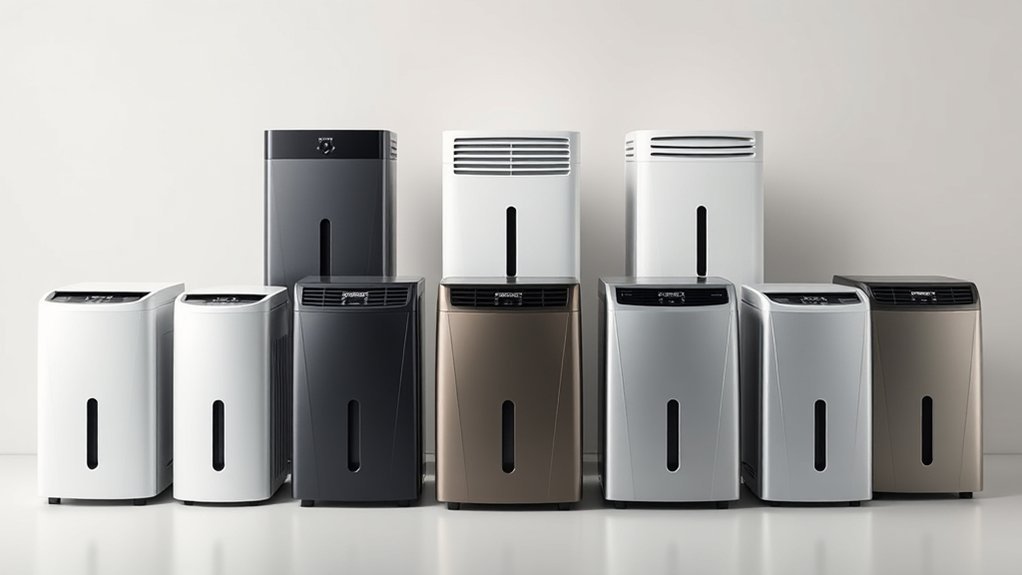
Your dehumidifier size refers to the volume of moisture the appliance extracts in 24 hours—measured in pints per day (PPD)—rather than the physical dimensions of the machine or the size of its water bucket. Choosing the right capacity depends on two primary factors: the total square footage of connected air space and how damp that area is before treatment. Because the U.S. Department of Energy (DOE) now tests portable units at a cooler 65°F basement standard rather than 80°F, matching current pint labels to your room size and relative humidity (RH) keeps your space dry without forcing the compressor to run nonstop. This guide covers exact sizing charts for small rooms, large basements, and whole-home layouts.
Quick Answer
Size a dehumidifier by measuring connected square footage and baseline relative humidity (RH). Under current ENERGY STAR guidance, spaces under 2,000 sq. ft. need 20–30 pints/day if slightly to moderately damp (50%–75% RH), 25–40 pints if very damp (75%–90% RH), and 30–50 pints if wet (90%–100% RH). Spaces over 2,000 sq. ft. require 30+, 40+, or 50+ pints respectively to hold indoor RH at 30%–50%.
At a Glance
| Time Required | 15–30 minutes to measure floor area and ceiling height, plus 24 hours to log baseline humidity |
| Difficulty | Easy |
| Tools Needed | Tape measure, digital hygrometer, grounded 120V outlet, and a 3/4-inch drain hose or condensate pump if draining continuously |
| Cost | Cost of a standalone hygrometer plus the dehumidifier; built-in pump models and ducted whole-home systems cost more |
What Size Dehumidifier Do You Need?
The right dehumidifier size is a daily extraction capacity that pulls your room down to 30%–50% relative humidity and cycles off rather than running 24 hours a day. Portable units are rated in U.S. liquid pints per 24 hours (where 1 pint equals 16 fluid ounces or 0.473 liters), meaning a 20-pint model extracts about 2.5 gallons (9.5 liters) daily under standard test conditions, while a 50-pint model extracts 6.25 gallons (23.7 liters).
ENERGY STAR divides portable dehumidifier sizing into two main floor-area categories—under 2,000 square feet and over 2,000 square feet—paired with three untreated dampness tiers. When your space sits near the top of a square-footage tier or has high ceilings, ENERGY STAR recommends oversizing rather than undersizing so the built-in humidistat can reach your target quickly and shut the compressor off between cycles.
The sizing humidity bands (50%–100% RH) describe untreated room conditions before dehumidification—not where you should set the machine. EPA guidance recommends keeping indoor humidity below 60% and ideally between 30% and 50%, while the CDC advises keeping RH at 50% or lower all day to prevent mold growth.
Dehumidifier Size Chart by Room Size and Dampness
Use this chart to match your space’s untreated dampness level and floor area to current DOE-tested portable dehumidifier capacities. Within the under-2,000-square-foot band, choose the lower half of the pint range for rooms under 1,000 square feet and the upper half for spaces between 1,000 and 2,000 square feet.
| Condition Without Dehumidification | Typical Signs & Untreated RH | Under 2,000 sq. ft. (Small to Large Rooms) | Over 2,000 sq. ft. (Open Floor Plans) |
|---|---|---|---|
| Slightly to moderately damp | Air feels clammy in humid weather; faint musty odor comes and goes; roughly 50%–75% RH | 20–30 pints/day (9.5–14.2 L/day) 20–22 PPD up to 800 sq. ft.; 25–30 PPD for 800–2,000 sq. ft. |
30+ pints/day (14.2+ L/day) |
| Very damp | Space consistently feels and smells damp; visible damp spots on concrete walls or floors; roughly 75%–90% RH | 25–40 pints/day (11.8–18.9 L/day) 25–30 PPD up to 800 sq. ft.; 35–40 PPD for 800–2,000 sq. ft. |
40+ pints/day (18.9+ L/day) |
| Wet | Walls or floors sweat with condensation, active seepage occurs, or wet laundry dries indoors; roughly 90%–100% RH | 30–50 pints/day (14.2–23.7 L/day) 30–35 PPD up to 800 sq. ft.; 40–50 PPD for 800–2,000 sq. ft. |
50+ pints/day (23.7+ L/day) |
After selecting a starting pint range from the table, verify the manufacturer’s minimum operating temperature, airflow clearance, and continuous drainage options for your specific room conditions.
Note: Pint labels are not directly comparable across older and newer model generations. Because the DOE’s current portable-dehumidifier test procedure uses 65°F instead of the pre-2019 80°F standard—and cooler air holds less removable water vapor—a current 30-pint unit performs similarly to an older 50-pint model.
How to Measure for a Dehumidifier
Sizing a dehumidifier accurately takes five steps: calculating connected floor area and ceiling volume, logging baseline relative humidity, classifying dampness severity, matching pint capacity, and setting up water disposal. Follow each step in order before comparing retail models.
1. Measure the Square Footage
Multiply the room’s length by its width in feet to get square footage (for example, a 20-foot by 25-foot basement equals 500 square feet). If the space opens into an adjacent hallway, utility room, or open stairwell without a closed door, add those connected areas to your total because moisture equalizes across shared air. Standard sizing charts assume an 8-foot ceiling; if your ceilings are 10 feet high, your room holds 25% more air volume (multiply your target pint capacity by 1.25).
2. Check Humidity with a Hygrometer
Place a standalone digital hygrometer near the center of the room—away from exterior doors, supply vents, and direct sunlight—and log readings over 24 to 48 hours. Check levels after showers, cooking, indoor laundry, or heavy rain rather than relying on a single snapshot. The EPA advises keeping indoor relative humidity below 60% and ideally between 30% and 50%, while the CDC recommends keeping indoor humidity no higher than 50% all day long to stop mold growth.
3. Rate the Dampness Level
Combine your peak hygrometer readings with sensory signs in the untreated room to pick your sizing tier:
- Slightly to moderately damp (50%–75% RH): the air feels muggy mainly during warm or rainy weather, and a light musty smell appears occasionally without visible wall stains.
- Very damp (75%–90% RH): the space smells musty year-round, cardboard boxes soften, and dark damp patches appear on concrete joints or slab floors.
- Wet (90%–100% RH): cold water pipes and walls sweat with condensation, water seeps through hairline cracks during storms, or high-moisture tasks like line-drying clothes occur indoors.
4. Choose the Pint Capacity
Match your connected square footage and dampness tier to the ENERGY STAR capacity range, then round up to the nearest standard retail size (typically 20–22, 30–35, or 50 pints per day). Step up to the top of your range if your space has unfinished concrete walls, poor weather-stripping, high ceilings, or warm humid outdoor air entering frequently.
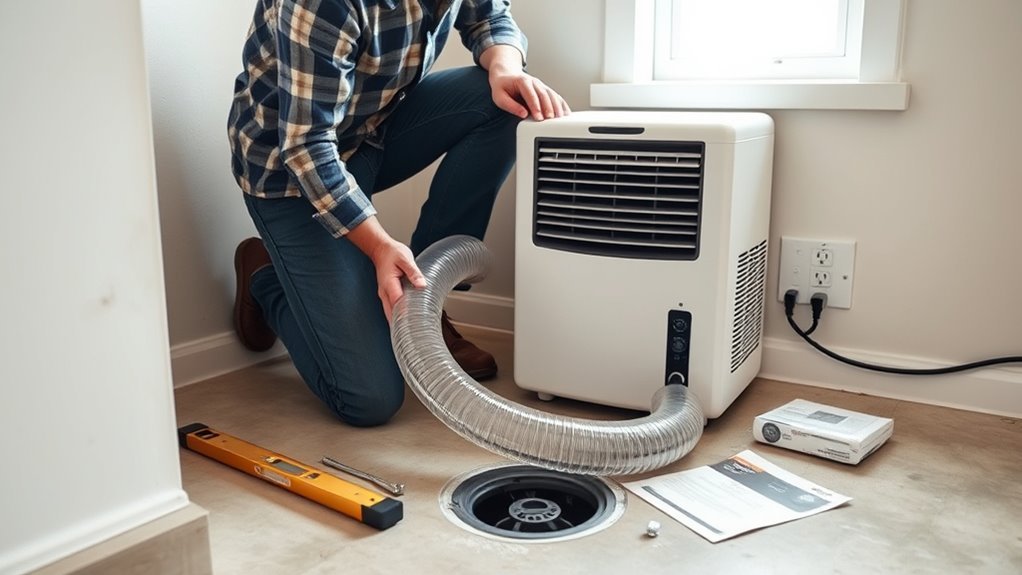
5. Plan the Drainage
Decide how collected water will leave the unit before buying, since a 50-pint dehumidifier usually comes with a 12- to 16-pint (1.5- to 2-gallon) bucket that can fill up three times a day in wet conditions. Use a removable bucket only for mild, occasional use. Connect a standard 3/4-inch garden hose or manufacturer drain tube for gravity drainage into a floor drain or sump pit located below the outlet port, or buy a model with an internal condensate pump (which typically pushes water 12 to 15 feet vertically) to drain into a utility sink or standpipe.
Pro Tip: Keep your standalone hygrometer 6 to 10 feet away from the dehumidifier after installation. Built-in humidistats sit directly inside the appliance casing and can read 3% to 5% lower than the rest of the room, so an external sensor verifies true room humidity.
A Simple Dehumidifier Sizing Framework
A practical sizing decision starts with the 2,000-square-foot threshold and your baseline RH, then adjusts for room geometry and airflow barriers. Two homes with identical square footage can need completely different dehumidifier setups depending on whether the floor plan is open or divided into closed rooms.
Use this three-part check to finalize whether one portable unit, two smaller units, or a ducted system fits your layout:
- Single open zone (such as an unfinished basement or studio): One properly sized portable dehumidifier can circulate dry air across the entire space. Pick the lower end of the ENERGY STAR pint band for tight, conditioned spaces under 800 square feet, and the upper end for 1,000 to 2,000 square feet.
- Divided floor plan with interior doors: Water vapor moves slowly through narrow doorways and cannot pass closed doors. Buying a 50-pint machine for one room will not dry a closed bedroom down the hall; instead, undercut or open interior doors, add a circulation fan, or place two 20- to 25-pint units in separate zones.
- Whole-house moisture across multiple levels (2,000+ sq. ft.): When high humidity affects both upstairs living spaces and the basement, a ducted whole-home dehumidifier integrated into your central HVAC return/supply plenum distributes dry air evenly and drains automatically without taking up floor space.
How Many Pints for Your Basement?
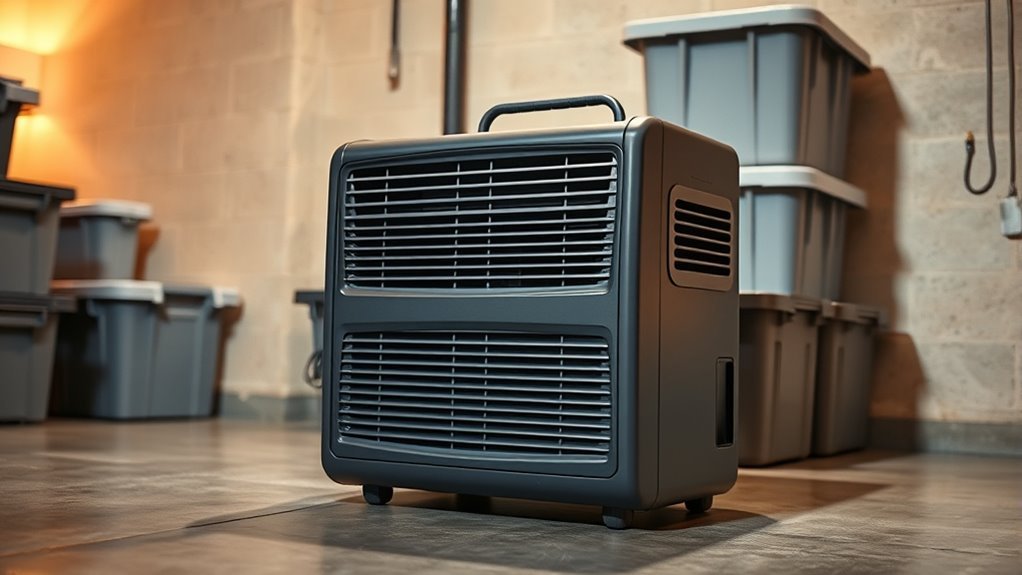
Most basements under 2,000 square feet need between 25 and 50 pints per day of current DOE-rated capacity, depending on whether the foundation is finished, how cool the air stays, and how much groundwater vapor migrates through the slab. You do not automatically need a 50-pint machine for a small, finished basement that only gets muggy in July and August, where a 22- to 30-pint unit can easily hold 45%–50% RH.
However, subterranean spaces introduce three challenges that often justify moving to a 35- to 50-pint model even under 1,500 square feet: bare concrete walls and slabs continually release moisture through capillary action, limited natural ventilation traps humid air, and cooler basement temperatures (often 55°F–65°F) slow down moisture extraction. If you see efflorescence (white chalky mineral powder on masonry), puddles, or damp corners after rain, fix exterior grading, clogged gutters, downspout extensions, and foundation cracks first. A dehumidifier can remove moisture from the air, but it cannot cure active liquid water intrusion.
Warning: If your basement has standing water, recurring wall seepage, or widespread visible mold, stop the water source before relying on a dehumidifier. After any flooding event, the CDC recommends pumping out standing water and drying the structure completely within 24 to 48 hours to prevent hazardous mold growth.
Check Basement Humidity First
Measuring your basement’s untreated relative humidity over several days prevents both underbuying and overspending. Because cold basement air holds less water vapor than warm upstairs air, relative humidity rises sharply when warm summer air leaks through rim joists or open cellar windows and cools against concrete surfaces.
Measure Basement Humidity
Set your hygrometer 3 to 5 feet above the floor in the middle of the basement, away from the dehumidifier’s warm exhaust, exterior doors, and furnace vents. Log morning and evening readings on both dry days and rainy days, then use the diagnostic table below to interpret what your numbers require.
| Basement RH Reading | What It Means | Recommended Action |
|---|---|---|
| 30%–50% RH | Healthy target range per EPA and CDC mold-prevention guidelines | Keep your humidistat set at 45%–50% RH; no additional capacity needed |
| 51%–75% RH | Above mold-safe target; matches ENERGY STAR’s slightly to moderately damp sizing condition | Seal air leaks and size at 20–30 pints/day (under 2,000 sq. ft.) or 30+ pints/day (over 2,000 sq. ft.) |
| 76%–90% RH | High mold and dust-mite risk; matches ENERGY STAR’s very damp sizing condition | Inspect for vapor intrusion and size at 25–40 pints/day (under 2,000 sq. ft.) or 40+ pints/day (over 2,000 sq. ft.) |
| Above 90% RH | Wet condition with condensation forming on cold surfaces | Fix leaks or seepage first, set up continuous drainage, and size at 30–50+ pints/day |
| 15%+ spike after rain | Surface runoff or groundwater is entering through foundation walls, window wells, or an open sump pit | Extend downspouts 6–10 feet from the house, regrade soil, and install a sealed sump basin cover |
Spot Moisture Sources
Before assuming you need a larger appliance, eliminate avoidable indoor moisture loads. Insulate sweating cold-water plumbing with foam pipe sleeves, cover open sump pump basins with an airtight lid, verify that your clothes dryer vents completely outdoors through rigid metal ducting, and seal gaps around rim joists and basement window frames.
Match Pint Capacity
Once preventable leaks are sealed, match your unit to the remaining steady-state moisture load. An unfinished 1,200-square-foot basement with bare concrete walls and 80% baseline RH warrants a 35- to 40-pint unit at the top of the very-damp range, whereas a finished 1,200-square-foot basement with a vapor barrier and 60% RH can run comfortably on a 25- to 30-pint model.
What Dehumidifier Pint Ratings Mean
A dehumidifier’s pint rating measures the maximum volume of water the unit can remove from the air over 24 hours in a controlled laboratory test chamber. Because real-world extraction varies with air temperature, relative humidity, and fan speed, the number on the box is a standardized comparison benchmark rather than a fixed daily guarantee.
Pint Ratings Explained
Compressor-based refrigerant dehumidifiers pull room air across cold evaporator coils to condense water vapor into liquid droplets. When room air is warm and humid, the coils extract moisture rapidly; as the room dries toward 45% RH or cools below 65°F, extraction slows down. If your space regularly drops below 65°F, frost can build up on the coils and cause the compressor to short-cycle unless you choose a model rated for low-temperature operation with automatic defrost.
Pint Capacity Is Not the Same as Tank Size
Do not confuse a dehumidifier’s daily pint rating with its removable bucket volume. A 50-pint dehumidifier removes up to 50 pints (6.25 gallons) of moisture in 24 hours, which would weigh over 52 pounds if held in a single tank. Instead, most 20- to 50-pint portable units use a manageable 8- to 16-pint (1- to 2-gallon) slide-out bucket equipped with a float switch that shuts the machine off when full, making a gravity hose or pump essential when humidity is high.
How Capacity Is Tested
Under federal U.S. Department of Energy test regulations (10 CFR Part 430, Subpart B, Appendix X1), portable dehumidifiers are tested at an ambient dry-bulb temperature of 65°F and 60% relative humidity (56.6°F wet-bulb), while ducted whole-home dehumidifiers are tested at 73°F. ENERGY STAR explains that before 2019–2020, portable units were tested at a warm 80°F and 60% RH. Because air at 65°F holds roughly 40% less moisture than air at 80°F at the same relative humidity, the newer test yields lower published pint numbers for the exact same physical hardware.
| Older Portable Rating (Tested at 80°F / 60% RH) | Approx. Current DOE Rating (Tested at 65°F / 60% RH) | Current Metric Equivalent |
|---|---|---|
| 30 pints/day | 20 pints/day | 9.5 Liters/day |
| 40 pints/day | 25 pints/day | 11.8 Liters/day |
| 50 pints/day | 30 pints/day | 14.2 Liters/day |
| 55 pints/day | 30–35 pints/day | 14.2–16.6 Liters/day |
| 60 pints/day | 35 pints/day | 16.6 Liters/day |
| 70 pints/day | 40–50 pints/day | 18.9–23.7 Liters/day |
| 90 pints/day | 55 pints/day | 26.0 Liters/day |
If you are replacing an older 50-pint dehumidifier bought before 2020 that kept your basement dry, look for a 30- to 35-pint model under current DOE labels rather than buying a larger unit than you need.
Best Dehumidifier Sizes for Small Basements
A small basement or enclosed cellar between 300 and 500 square feet usually performs best with a 20- to 35-pint dehumidifier unless active water seepage or indoor laundry pushes it into the wet tier (up to 50 pints). Because small rooms have limited air volume, matching capacity to actual dampness avoids excessive heat discharge and rapid compressor short-cycling.
Compact 20- to 25-pint units often come with smaller 4- to 8-pint collection buckets to save floor space. If you cannot check the bucket daily, connect a gravity hose to a floor drain or choose a small-footprint unit with a built-in pump so full-bucket shutoffs never leave the basement unprotected during humid weeks.
Recommended Products

Energy- Efficient Performance: avylo dehumidifier Certified ENERGY STAR Most Efficient 2025 with an EER of 2.05 L/kWh; Powered by a high-efficiency compressor and optimized airflow design, with a maximum daily dehumidification capacity of 90 pints(90°F,90% RH); Ideal for basements, home, living rooms, garages, and large areas up to 5000 sq. ft., keeping your home dry, comfortable
![Gasbye Energy Star 2026 Dehumidifier with [𝗥𝗲𝗽𝗹𝗮𝗰𝗲𝗮𝗯𝗹𝗲 Pump] for Basement – [44dB Quiet, Easy to Clean & Clog-Free], Max 75 Pints/Day, 16.5ft Drain Hose, Auto Shut-Off, Auto Restart, White](https://m.media-amazon.com/images/I/317F1ozlJcL._SL500_.jpg)
[Replaceable, Cleanable Pump – No Full Unit Replacement Needed] Unlike other dehumidifiers with built-in pumps that can’t be accessed or cleaned, our pump is easily removable for routine cleaning or quick replacement — preventing clogs and extending lifespan. No need to replace the entire unit if the pump fails
Best Dehumidifier Sizes for Most Rooms
Living spaces above grade vary widely in moisture generation, airflow, and noise sensitivity. Size any room under 2,000 square feet by its measured RH and specific moisture source rather than relying on the room label alone:
- Bedroom or home office (150–400 sq. ft.): A 20- to 22-pint compressor unit fits mild-to-moderate dampness (50%–75% RH) and runs quieter (often 45–50 dBA on low fan speed) than larger models. Avoid tiny 8- to 16-ounce thermoelectric (Peltier) mini dehumidifiers for full bedrooms; they extract less than 1 pint per day and only suit small closets.
- Bathroom (50–150 sq. ft.): Run an outdoor-vented exhaust fan during showers and for 20–30 minutes afterward to remove steam at the source. If ambient RH stays above 55% between showers, place a 20-pint portable unit outside the splash zone or in the adjoining hallway.
- Kitchen (150–350 sq. ft.): Use an exterior-vented range hood while boiling water or running the dishwasher. If open-concept kitchen and dining areas stay between 55% and 70% RH, size a 20- to 30-pint unit for the combined connected floor area.
- Laundry room (100–300 sq. ft.): Confirm the dryer vent is sealed and exhausted outdoors. If you hang wet clothes to air-dry indoors, treat the room as a wet condition and step up to a 30- to 50-pint unit to capture rapid evaporation.
- Living room or family room (400–1,200 sq. ft.): Add the square footage of all connected hallways, foyers, and dining areas that share open doorways, then select 25–35 pints for moderate dampness or 35–50 pints for very damp coastal or humid-climate homes.
Recommended Products
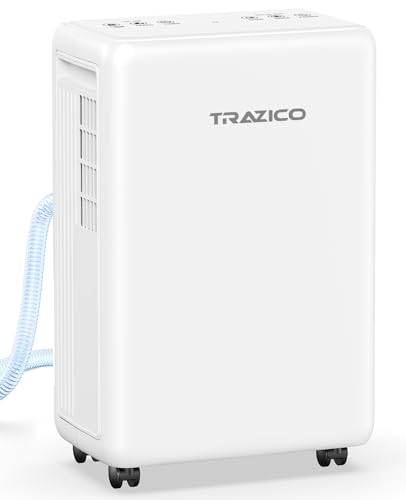
【Powerful Moisture Control — Covers Up to 2,000 Sq. Ft.】Eliminate stubborn dampness and cut down on energy bills year-round! This high-efficiency basement dehumidifier extracts up to 30 pints of moisture daily (under 95°F, 90% RH) to maintain a healthy 35%-55% humidity level effortlessly. It’s the ultimate climate-control solution for basements, living rooms, crawl spaces, and RVs, tackling excess moisture at the source to protect your home from structural water damage during humid summers or rainy seasons
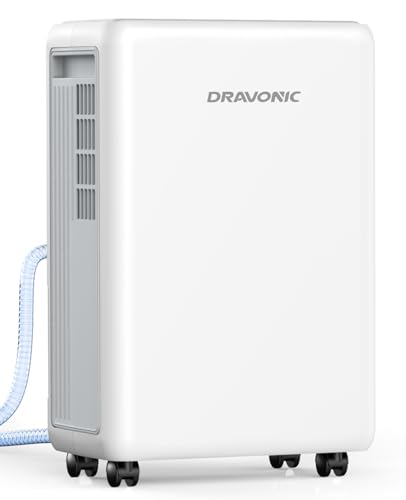
Rapid Water Extraction - Powered by an upgraded refrigeration compressor, this 30 pint dehumidifier gathers up to 30 pints of water per day under standard testing (95°F, 90% RH). Tailored for enclosed rooms up to 2,000 Sq.Ft, it quickly balances muggy air in cellars, garages, and storage areas. By maintaining comfortable air levels, this compact room dehumidifier keeps carpets dry and indoor fabrics crisp during humid seasons with windows and doors shut tight

【Powerful 30-Pint Dehumidifier for Basement, Bedroom & Whole Home】This high-capacity dehumidifier removes up to 30 pints per day (95°F, 90% RH) and 25 pints under normal conditions (86°F, 80% RH).conditions, making it the go-to dehumidifier for basement spaces with sweating walls, a musty dehumidifier for bedroom comfort, and a versatile choice among dehumidifiers for home use. Covers up to 2,000 sq. ft., eliminating condensation, odors, and damp air for a fresher living environment.(Dehumidification capacity≠Water Tank Volume)
Best Dehumidifier Sizes for Large Basements
Large basements between 1,000 and 2,000 square feet sit in the upper half of ENERGY STAR’s under-2,000-square-foot band, where a 30- to 35-pint model handles moderately damp conditions, a 35- to 40-pint model handles very damp conditions, and a 50-pint model tackles wet spaces. Once the connected footprint exceeds 2,000 square feet, start at 30+, 40+, or 50+ pints respectively and pay close attention to air circulation (CFM).
In basements over 1,500 square feet that are partitioned into a utility room, storage room, and rec room, a single high-capacity unit in one corner cannot pull moist air around drywall partitions. Either run two 25- to 35-pint units at opposite ends of the basement or install a high-capacity commercial Low Grain Refrigerant (LGR) or ducted whole-home dehumidifier (often rated 70 to 130 pints/day at 73°F) to move dry air into every zone.
When Is a 50-Pint Dehumidifier Enough?
A current 50-pint portable dehumidifier—which corresponds to an older 70-pint pre-2020 model—is the largest standard residential class and easily handles almost any single open room or wet basement up to 2,000 square feet. It also serves as the baseline starting capacity for wet spaces over 2,000 square feet when air can circulate freely.
Judge whether your 50-pint unit is sufficient by watching your external hygrometer after 48 hours of continuous operation with windows and doors closed. If the room drops to 45%–50% RH and the compressor cycles off periodically, a 50-pint machine is enough. If the unit runs 24/7 with an clean filter, ambient temperature above 65°F, and continuous drainage yet RH stays above 60%, you either have active water intrusion, unsealed outdoor air leaks, or a large multi-room footprint that needs a second unit or a whole-home system.
When to Choose a Bigger Dehumidifier
Stepping up to the next capacity tier—such as choosing a 35-pint unit instead of a 22-pint unit, or a 50-pint unit instead of a 35-pint unit—makes sense whenever your room has compounding moisture factors. Because ENERGY STAR units include an automatic humidistat, a higher-capacity model does not over-dry your room; instead, it reaches your 45%–50% RH setpoint faster and turns off, often using comparable or less total electricity per day than a small unit running non-stop.
| Room Scenario & Compounding Factors | Recommended Capacity Strategy |
|---|---|
| Under 2,000 sq. ft., standard 8-ft ceilings, 50%–75% RH | 20–30 pints/day (pick 30 PPD if over 1,000 sq. ft.) |
| Under 2,000 sq. ft., very damp (75%–90% RH) or bare concrete walls | 25–40 pints/day (size up to 35–40 PPD for unfinished basements) |
| Under 2,000 sq. ft., wet (90%–100% RH), indoor laundry, or humid Gulf/coastal climate | 30–50 pints/day (pick 50 PPD for heavy moisture loads) |
| High ceilings (9–12 ft) in any square footage band | Multiply base pint requirement by 1.12 (9 ft) or 1.25 (10 ft) and round up to the next retail tier |
| Over 2,000 sq. ft., open layout across dampness tiers | Start at 30+ PPD (moderate), 40+ PPD (very damp), or 50+ PPD (wet) |
| Divided rooms, closed doors, or multi-story home humidity | Use two smaller portable units in separate zones or install a ducted whole-home dehumidifier |
Pick the Right Dehumidifier Features
Once you know your target pint capacity, selecting the right hardware features reduces your electricity bill and prevents maintenance headaches. Prioritize efficiency ratings, drainage automation, and cold-room protection when comparing models:
- High Integrated Energy Factor (IEF): IEF measures liters of water removed per kilowatt-hour of electricity consumed (L/kWh), including fan-only standby cycles. Under the ENERGY STAR Version 6.0 efficiency criteria (effective October 1, 2025), certified portable dehumidifiers must achieve an IEF of at least 1.70 L/kWh for capacities up to 25.00 pints/day, 2.01 L/kWh for 25.01 to 50.00 pints/day, and 3.30 L/kWh for models above 50.00 pints/day (whole-home units require 2.22 L/kWh up to 8.0 ft³ case volume and 3.81 L/kWh above 8.0 ft³).
- Built-in adjustable humidistat: Standard on all ENERGY STAR models, a digital humidistat lets you set a specific target (such as 45% or 50% RH) so the compressor and fan cycle off once the air is dry.
- Continuous gravity drain port: Allows a standard garden hose or vinyl tube to carry condensate straight to a floor drain or sump pit without bucket emptying.
- Internal condensate pump: Essential when your nearest drain sits above the unit, such as a basement utility sink, laundry standpipe, or ejector basin.
- Auto-restart after power outages: Restores your saved RH setpoint and pump mode automatically if a summer storm briefly knocks out electricity.
- Auto-defrost and low-temperature operation: Protects evaporator coils from icing over in basements and crawlspaces that drop below 65°F; for unheated spaces consistently below 50°F, consider a desiccant dehumidifier instead of a standard compressor unit.
- Washable slide-out air filter: Traps dust and pet hair before they coat the wet condenser coils and restrict cubic-feet-per-minute (CFM) airflow.
Warning: Plug your dehumidifier directly into a properly grounded 3-prong wall outlet rather than a power strip or surge protector. If a temporary extension cord is allowed by your owner’s manual, use a UL 817-listed heavy-duty cord rated for the appliance’s amperage (at least 16 AWG, or 18 AWG with integral fuse protection); the U.S. Consumer Product Safety Commission warns that undersized or damaged extension cords can overheat and cause electrical fires.
Recommended Products

4,500 SQ. FT. DEHUMIDIFIER – Removes up to 50 pints of moisture per day with an adjustable humidity setting from 35% to 85%. Perfect for use in basement, bathroom, bedroom, office, kitchen, cellar, or crawlspace. Maintain a healthy 45%-55% humidity range

【The Undisputed Champion — Industry‑Leading Dehumidifier Brand】When you choose AEOCKY, you get double market validation. In 2025, AEOCKY was an industry‑leading dehumidifier brand on Amazon US. This means you’re not just choosing a flagship from a market leader, but the top choice proven by millions of real users—representing the ultimate combination of performance, quality, and trust.
Where to Place a Dehumidifier
Proper placement ensures your dehumidifier can draw in damp air and circulate dry air across the entire room without short-cycling. Set the machine on a level surface near the center of the dampest zone or along an open wall where air moves freely between connected areas.
Leave at least 6 to 12 inches of clearance around side or rear air intakes and exhaust louvers (units with top-mounted exhaust can sit closer to a back wall if the manual permits). Keep curtains, storage bins, and furniture away from the grille, avoid placing the unit right beside a heat register or open bathroom door, and keep exterior windows and doors closed while the unit operates so outdoor humidity does not continuously reload the room.
Common Dehumidifier Sizing Mistakes
Avoiding these seven sizing and setup mistakes prevents wasted energy, noisy continuous operation, and lingering musty odors:
- Buying by room name instead of measured conditions: A “basement” or “bedroom” label does not dictate pint capacity; always size from connected square footage and hygrometer RH readings.
- Confusing 24-hour pint capacity with bucket volume: A 50-pint rating means daily moisture extraction under 65°F test conditions, whereas the removable bucket holds only 1 to 2 gallons.
- Comparing pre-2020 and current pint labels 1-to-1: Replacing an old 70-pint (80°F-rated) unit does not require a commercial 70-pint machine today; a current 45- to 50-pint (65°F-rated) model matches that output.
- Ignoring ceiling height and open stairwells: Rooms with 10-foot ceilings or open staircases to upper floors contain significantly more air volume than a flat square-footage measurement suggests.
- Expecting one portable unit to dry closed rooms: Dry air cannot penetrate closed interior doors; use separate smaller units or undercut/open doors with fans to connect zones.
- Skipping continuous drainage in very damp or wet spaces: Relying on a 14-pint bucket when a unit extracts 35 to 50 pints per day leaves the machine shut off for hours every time the tank fills.
- Ignoring cold basement temperatures: Standard refrigerant units lose extraction capacity rapidly below 65°F and can ice up below 50°F without auto-defrost or low-temp engineering.
How to Maintain the Right Size Unit
Routine maintenance keeps even a well-sized dehumidifier extracting at its rated pint capacity and prevents mold or bacterial slime inside the water reservoir. Turn off and unplug the unit before inspecting the filter, coils, and drain line:
- Clean the air filter every 2 to 4 weeks: Slide out the washable mesh screen, vacuum loose dust, rinse with warm water, and let it dry completely before reinstalling.
- Wash and sanitize the collection bucket every 2 to 3 weeks: Even if you use a drain hose, rinse the bucket with warm water and mild detergent, then wipe it dry so standing water does not grow biofilm.
- Inspect the gravity drain hose and pump line monthly: Confirm that gravity hoses slope downward continuously with no kinks or air traps, and flush condensate pump tubing annually per the manual.
- Vacuum the evaporator and condenser coils seasonally: Use a soft brush attachment to clear dust buildup and confirm frost is not forming on the coils during cooler months.
Key Takeaways
- Measure connected floor area and multiply pint capacity by 1.25 if your ceilings are 10 feet high rather than the standard 8 feet.
- Use a standalone hygrometer away from the appliance to verify your room stays within the EPA’s 30%–50% RH target and at or below the CDC’s 50% mold ceiling.
- Current DOE 65°F test labels read lower than pre-2020 80°F labels: a modern 30-pint unit replaces an older 50-pint model, and a modern 50-pint unit replaces an older 70-pint model.
- Look for ENERGY STAR Version 6.0 models with an Integrated Energy Factor (IEF) of at least 1.70 L/kWh (≤25 pints), 2.01 L/kWh (25.01–50 pints), or 3.30 L/kWh (>50 pints).
- Fix active water intrusion—such as clogged gutters, poor grading, or foundation seepage—before relying on a dehumidifier, and dry flooded spaces within 24–48 hours.
Frequently Asked Questions
How many pints is good for a dehumidifier?
For most rooms and basements under 2,000 square feet, 20–30 pints per day is right for slightly to moderately damp spaces (50%–75% RH), 25–40 pints for very damp spaces (75%–90% RH), and 30–50 pints for wet spaces (90%–100% RH). Spaces over 2,000 square feet should start at 30+, 40+, or 50+ pints per day depending on dampness.
Is a 50-pint dehumidifier enough for a basement?
Yes, a current 50-pint dehumidifier (equivalent to an older 70-pint unit) is enough for almost any open basement under 2,000 square feet, even in wet conditions, and serves as the starting size for wet basements over 2,000 square feet. However, if the basement is divided into closed rooms or has active water seepage, you will need to improve airflow, use two units, or fix the water leak first.
Is pint capacity the same as tank size?
No, pint capacity and tank size are completely different measurements. Pint capacity tells you how much moisture the dehumidifier can extract from the air in 24 hours under 65°F test conditions, whereas tank size (usually 8 to 16 pints, or 1 to 2 gallons) tells you how much water the removable bucket holds before the float switch shuts the unit off.
Is it bad to get too big of a dehumidifier?
Modest oversizing is better than undersizing, and ENERGY STAR explicitly recommends choosing a larger capacity when in doubt. Because modern dehumidifiers have a built-in humidistat that shuts the compressor off once your target RH is reached, a slightly larger unit dries the room faster and cycles off rather than running nonstop.
What size dehumidifier do I need for 1,000 or 2,000 square feet?
Both 1,000 and 2,000 square feet use ENERGY STAR’s 2,000-sq.-ft. sizing chart based on dampness: under 2,000 sq. ft. (including 1,000 sq. ft.), choose 20–30 pints/day if moderately damp, 25–40 pints if very damp, or 30–50 pints if wet. At or above 2,000 sq. ft., start at 30+, 40+, or 50+ pints/day, and remember that a whole house divided by doors may need multiple units or a ducted whole-home system to distribute dry air evenly.
What humidity should I set my dehumidifier to?
Set your dehumidifier between 45% and 50% relative humidity for the best balance of mold prevention and energy efficiency. This setting keeps your room squarely inside the EPA’s ideal 30%–50% indoor range and meets the CDC’s recommendation to keep household humidity no higher than 50% all day long.
Why is my dehumidifier running but humidity is not dropping?
Humidity usually stays high when windows or doors are left open, the air filter is clogged, room temperature drops below 65°F (causing coil frost), or groundwater seepage continuously adds moisture. Verify the reading with a separate hygrometer 6–10 feet away; if the setup and maintenance are sound and the unit still runs 24/7 above 55% RH, its pint capacity is too small for the moisture load.
Why are newer dehumidifier pint ratings lower than older ones?
Newer portable dehumidifier ratings are lower because the U.S. Department of Energy lowered the mandatory test chamber temperature from 80°F to 65°F (at 60% RH) to reflect real basement conditions. Because 65°F air holds less water vapor than 80°F air, a machine that removed 50 or 70 pints at 80°F is now labeled at 30 or 45–50 pints at 65°F without any drop in actual performance.
Conclusion
Selecting the right dehumidifier size comes down to measuring your connected floor area, logging your untreated relative humidity for 24 to 48 hours, and matching those numbers to the current 65°F DOE pint ratings. Start with 20–30, 25–40, or 30–50 pints per day for spaces under 2,000 square feet (and 30+, 40+, or 50+ pints above 2,000 square feet), then set up continuous gravity or pump drainage and verify with a standalone hygrometer that your room holds steady at 45%–50% RH.
Sources
- U.S. Environmental Protection Agency: A Brief Guide to Mold, Moisture and Your Home: Supports the below-60% and ideal 30%–50% indoor relative humidity targets and source-moisture control rules.
- Centers for Disease Control and Prevention: Mold: Supports the 50% maximum all-day humidity guidance, leak repair, and 24–48 hour post-flood drying timeline.
- ENERGY STAR: Dehumidifiers: Supports current portable dehumidifier capacity ranges (under and over 2,000 sq. ft.), 65°F operating-temperature guidance, drainage options, humidistats, and placement clearances.
- ENERGY STAR: Dehumidifier Testing and Capacity: Supports the 65°F vs. 80°F DOE test-procedure explanation and old-to-current approximate pint capacity correlations.
- ENERGY STAR: Dehumidifiers Key Efficiency Criteria: Supports Version 6.0 Integrated Energy Factor (IEF) minimums (1.70, 2.01, and 3.30 L/kWh for portables; 2.22 and 3.81 L/kWh for whole-home units) effective October 1, 2025.
- U.S. Department of Energy / Federal Register: Test Procedure for Dehumidifiers: Provides federal test-procedure requirements under 10 CFR Part 430, Subpart B, Appendix X1 (65°F portable and 73°F whole-home test conditions).
- U.S. Consumer Product Safety Commission: Extension Cords: Supports electrical fire and shock warnings, UL 817 safety requirements, and wire-gauge guidance.

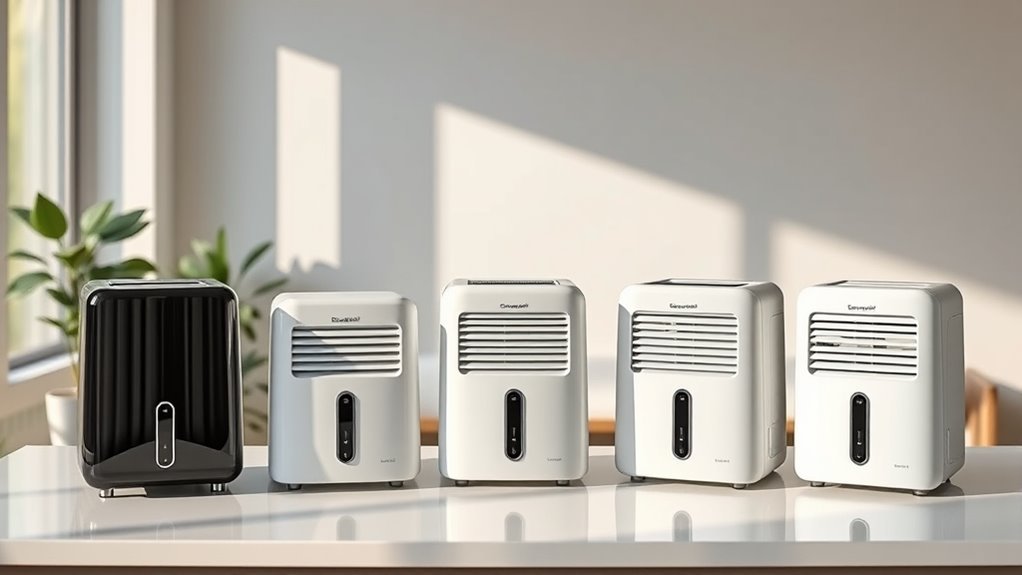
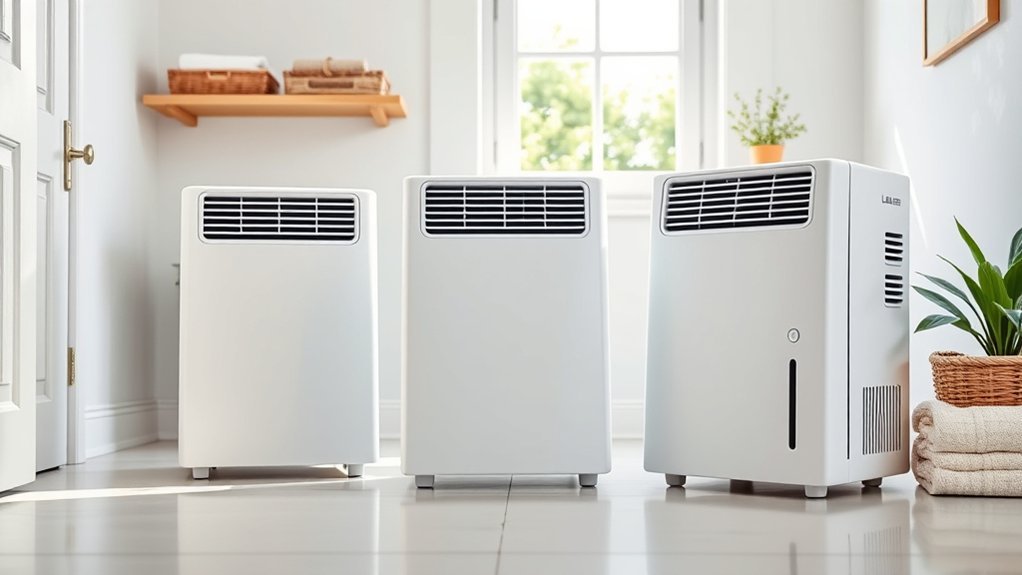

[…] Start with this practical sizing guide, then adjust based on your hygrometer readings. For a general method, see how many pints a dehumidifier should be. […]
[…] Once you know how many independent moisture zones you are treating, choose each unit’s capacity in pints per day (PPD)—the volume of water the machine removes in 24 hours under standardized federal test conditions. Under ENERGY STAR buying guidance, portable dehumidifiers are grouped into spaces under 2,000 square feet and spaces over 2,000 square feet across three dampness tiers. For a deeper pint-only breakdown, see our dehumidifier size and pint-capacity guide. […]
[…] Dehumidifier Size Guide 2026: 20–70 Pint Chart by Room […]