
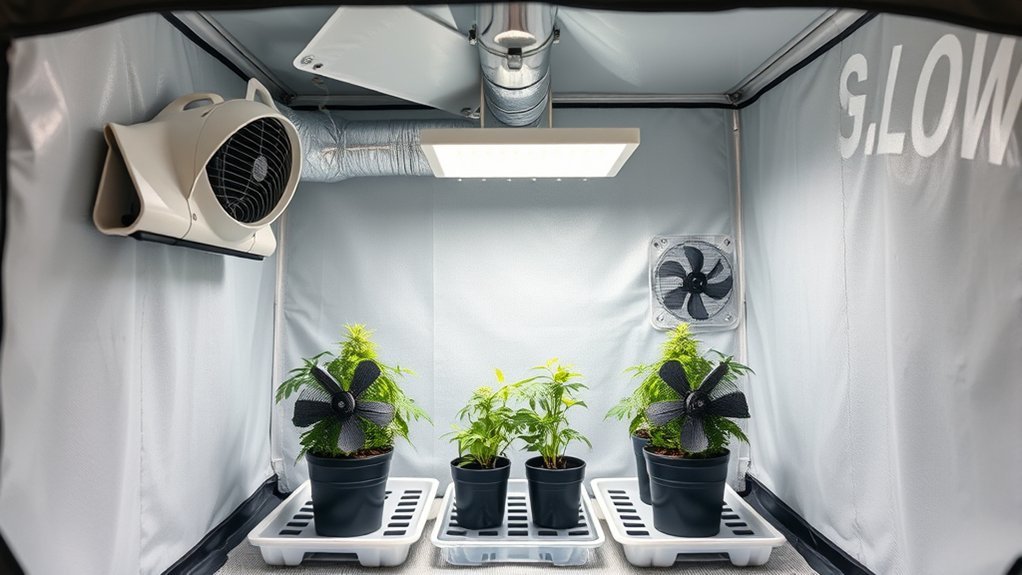
To lower grow tent humidity without a dehumidifier, move moist air out of the whole growing area, not just around inside the tent. Humidity usually comes from plant transpiration, wet growing media, standing runoff, weak exhaust and humid air in the room around the tent. Measure where and when the spike happens before you change any equipment.
The fixes below work in this order: measure, exhaust, intake air, watering, canopy, then the room.
Quick Answer: What Lowers Grow Tent Humidity
- Exhaust humid air to a drier room or outdoors, and give the tent a clear intake.
- Run gentle fans through and below the canopy.
- Water only when the plants and medium need it, and remove runoff.
- Track humidity at canopy height, especially after the lights turn off.
- Fix the room outside the tent, since a tent cannot get much drier than its intake air.
Why Grow Tent Humidity Spikes
Humidity rises when plants and wet surfaces release water faster than ventilation removes it. Plants release moisture through transpiration, and water also evaporates from growing media, open reservoirs, drainage trays, damp floors and wet leaves.
- Excess irrigation: saturated media and heavy runoff keep releasing moisture.
- Weak exhaust: humid air leaves too slowly.
- Humid intake air: a fan cannot dry the tent if it keeps drawing in damp air.
- Dense foliage: leaves trap humid air in the canopy and block circulation.
- Lights-off cooling: relative humidity rises as air cools, even with no new water.
- Recirculated exhaust: air dumped into a closed room can come back through the intake.
- Wet materials: cardboard, towels, wood and plant debris release water slowly.
Relative humidity depends on temperature. A cooler tent can read higher RH even when the water vapor has not changed. UMass Extension explains that condensation on plants occurs when the leaf surface is below the dew point, and that keeping the canopy dry, especially from dusk to dawn, is key to suppressing disease.
Measure Grow Tent Humidity Correctly
Do not change equipment based on one reading.
- Put the main sensor at canopy height, out of direct light and away from fan outlets, wet soil and reservoirs.
- Use a second meter outside the tent to see whether the problem starts in the tent or in the room.
- Log lights-on and lights-off readings, before and after watering and near the end of the dark period.
- Compare the meters side by side for a few hours. A big gap means one needs replacing.
- Look for condensation on walls, ducting, leaves and equipment.
If the tent and room read the same high RH, the room is the main problem. If only the canopy is high, work on spacing and circulation. If RH jumps after watering, reduce wet surfaces and adjust irrigation. If it jumps after lights-out, focus on nighttime ventilation and temperature.
How to Lower Grow Tent Humidity With Fans and Exhaust
An exhaust fan removes humid air from the tent. A clip or oscillating fan only moves the air already inside. You usually need both.
- Mount the exhaust high, where warm, moist air collects.
- Open a low intake on the opposite side so fresh air crosses the plants.
- Move air through and below the canopy with enough force to make leaves flutter slightly, not whip or curl.
- Keep ducting short and smooth. Sharp bends, crushed duct and clogged filters cut airflow.
- Check real airflow. A loud fan can still move little air through a restricted filter.
Estimate a base exhaust fan size
Start with tent volume: length x width x height in feet. A 4 ft x 4 ft x 6.5 ft tent is about 104 cubic feet, so a base rating near 104 CFM equals roughly one air exchange per minute.
That is only a starting point. The AC Infinity ventilation guide uses tent volume as the base CFM, then raises the requirement for ducting, carbon filters, silencers and light heat, and suggests a fan rated at least 25% above the minimum. Adjust fan speed using your actual temperature and humidity readings.
Circulation prevents humid pockets around leaves, but only ventilation, cooling or dehumidification removes water vapor from the growing area.
Control Humidity in the Room Outside the Tent
A tent cannot get much drier than its intake air unless cooling or dehumidification is involved. The room that supplies intake air is often called the lung room.
- Route exhaust outdoors where that is safe and appropriate for the building.
- Do not discharge moist air into an attic, wall cavity, crawl space or other enclosed area where it can condense.
- If outdoor air is drier, ventilate the room with a window or room exhaust fan.
- If outdoor air is hotter or more humid, use air conditioning or room-level dehumidification instead of pulling that air into the tent.
- Keep the tent intake separate from the exhaust outlet.
- Cover reservoirs and remove wet items from the room.
If the room stays humid, a dehumidifier there is often more effective than one squeezed inside the tent. See where a dehumidifier goes for a grow tent and the grow tent dehumidifier size guide.
Stop Overwatering and Remove Standing Water
Cut moisture at its source, but do not rely on one rule such as “let the top 1 to 2 inches dry.” Seedling cells, large containers, coco coir, peat mixes and hydroponic systems hold water differently.
- Feel the medium at a depth that suits the container.
- Lift the pot and compare its weight when freshly watered and when ready to water.
- Use a moisture probe if it suits your medium.
- Watch for slow drainage and roots sitting in runoff.
WVU Extension advises watering only when needed and notes that poor drainage deprives roots of air and promotes fungal growth.
Reduce evaporation after watering
- Water early in the light period when practical so surfaces can dry before the cooler dark period.
- Water slowly enough for the medium to absorb it without flooding trays.
- Empty runoff from saucers and trays promptly.
- Fix leaking hoses, reservoirs and fittings.
- Remove wet cardboard, towels, dead leaves and spilled medium.
Do not cut water so far that plants wilt or salts build up. The aim is to remove unnecessary wetness, not to keep roots dry.
Open and Thin a Dense Canopy
UMass Extension notes that the highest relative humidity in a greenhouse is generally found inside plant canopies. Crowded leaves can sit in much damper air than your sensor shows.
- Space containers so air can move between plants.
- Train branches to avoid one solid wall of foliage.
- Remove dead, yellowing or diseased leaves.
- Prune only as appropriate for the species and stage.
- Put a low fan under the canopy when leaves block lower airflow.
- Keep foliage off wet tent walls.
More air is not always better. Strong, constant airflow aimed at one plant can dry leaf edges and stress it. Use broad, indirect movement.
Warm the Tent Slightly, Then Vent the Moisture
A small temperature rise lowers the RH reading because warmer air holds more moisture, but it does not remove any water. Heat can also speed evaporation from media and leaves.
- Stay within the safe temperature range for the crop.
- Increase exhaust before or shortly after the lights turn off.
- Add gentle warmth only if nighttime cooling is pushing surfaces toward the dew point.
- Vent the moisture-laden air instead of trapping it.
- Keep monitoring RH and leaf condensation.
Electrical safety: keep power strips, plugs and controllers elevated and away from runoff. Use equipment suited to the environment, follow local electrical rules and replace damaged cords. A GFCI can reduce shock risk but does not make wet connections safe.
Use Moisture Absorbers Carefully
Passive absorbers may slightly reduce humidity in an empty tent or tiny enclosure between cycles. They rarely keep up with irrigated media and transpiring plants.
- Silica gel: useful for equipment boxes and seed storage. A few packets in a running tent have little effect. Keep packets away from media, children and pets.
- Calcium chloride products: they absorb water and turn into liquid brine. Use only a stable, covered container, and keep it away from plants, fans, nutrients and electrical equipment.
- Household remedies: baking soda, rice, coffee grounds and salt are not dependable humidity control for a planted tent, and can add dust, odors or pests.
If an absorber fills quickly, you have a bigger moisture problem. Improve exhaust, drainage or room conditioning instead of replacing small absorbers.
Choose a Humidity Target for Your Plants
There is no single ideal RH for every tent. Species, stage, temperature, canopy density and disease risk all matter. Tracking stable RH, plant response and condensation is a good start.
| Plant situation | General guidance | Main concern |
|---|---|---|
| Seeds and unrooted cuttings | May need higher humidity; follow crop-specific propagation instructions | Drying before roots form, or damping-off if wet and stagnant |
| Vegetative seedlings and transplants | WVU Extension gives 60% to 70% RH as an indoor vegetative reference | Edema or weak transpiration when humidity is excessive |
| Many established plants | WSU Extension says 50% to 70% satisfies most plants’ moisture needs | Large swings or persistent leaf wetness |
| Dense, flowering or fruiting canopies | Often kept toward the lower end of the crop’s range | Condensation, gray mold and mildew |
WSU Extension also warns that high humidity with resulting condensation can lead to increased disease problems. So 70% RH is not automatically unsafe, but it may be too high for a dense canopy with weak airflow.
Troubleshoot Persistent Grow Tent Humidity
| Symptom | Likely cause | What to do |
|---|---|---|
| RH jumps after lights-out | Falling temperature, ongoing transpiration, late watering | Increase exhaust at lights-off, water earlier, avoid a sharp temperature drop |
| Tent and room RH both high | Humid intake air or recirculated exhaust | Vent or condition the room and redirect the exhaust |
| RH spikes after watering | Excess runoff or wet surfaces | Adjust volume, improve drainage, remove runoff |
| Only the canopy reads high | Dense foliage or a stagnant pocket | Space or train plants and add airflow above and below |
| Condensation on walls or leaves | Surfaces at the dew point | Vent moisture, reduce nighttime cooling, keep leaves off cold walls |
| Loud fan but RH stays high | Restricted filter or duct, poor intake, undersized fan | Inspect the airflow path, clean the filter, open the intake |
When You Need a Dehumidifier or Air Conditioner
Ventilation cannot take a tent below the moisture level of its intake air. Mechanical conditioning may be needed when:
- The room stays above the crop’s target RH most of the day.
- Outdoor air is too humid to help.
- Condensation continues despite good exhaust and careful watering.
- A large, dense canopy releases more moisture than the fan can remove.
- The fan speed required causes unacceptable temperature swings or noise.
Condition the surrounding room first when practical. Keep running canopy circulation and exhaust, because mechanical drying does not clear stagnant air around leaves. For more detail, see how to dehumidify a grow tent for healthier plants and how to dehumidify a tent and stop condensation overnight.
Related Guides
- Lower humidity in a grow tent: airflow, water, dehumidifier
- Can you put a dehumidifier in a grow tent?
- Grow tent dehumidifier size guide
- How to dehumidify a tent and stop condensation
Frequently Asked Questions
How do you get humidity down in a grow tent without a dehumidifier?
Exhaust humid air into a drier room or outdoors, provide an unrestricted intake, circulate air through the canopy, remove runoff and water only when the crop and medium need it. Measure RH at canopy height and in the room outside the tent to find the real moisture source.
What naturally soaks up moisture?
Silica gel and salts such as calcium chloride absorb moisture, but their capacity is limited. They may help in tiny enclosed spaces or between grow cycles. Household bowls of rice, coffee grounds, baking soda or salt are not effective primary controls for a planted tent.
Is 70% humidity too high for plants?
Not always. Some seedlings and vegetative plants do well near 70%. It becomes a concern when the canopy is dense, airflow is weak, condensation forms or the crop is flowering, fruiting or disease-prone. Follow guidance for the specific plant and stage.
Why does grow tent humidity spike when the lights turn off?
The air cools, so relative humidity rises, and plants and wet media keep releasing moisture. Increase exhaust around the light transition, avoid watering right before darkness and keep the tent from cooling so far that leaves or walls reach the dew point.
Can an oscillating fan lower grow tent humidity by itself?
No. It reduces humid pockets and helps leaf surfaces dry, but it does not remove water vapor from a closed tent. You need exhaust ventilation, cooling, dehumidification or another method that moves or condenses the moisture.
Sources
- UMass Extension: Reducing Humidity in the Greenhouse
- Washington State University Extension: Greenhouse Construction and Management
- West Virginia University Extension: Common Problems in Seedlings and Transplants
- AC Infinity: Grow Tent Ventilation Guide


[…] can often lower grow tent humidity without a dehumidifier if the lung room is reasonably dry. The goal is to reduce moisture at the source and move damp air […]