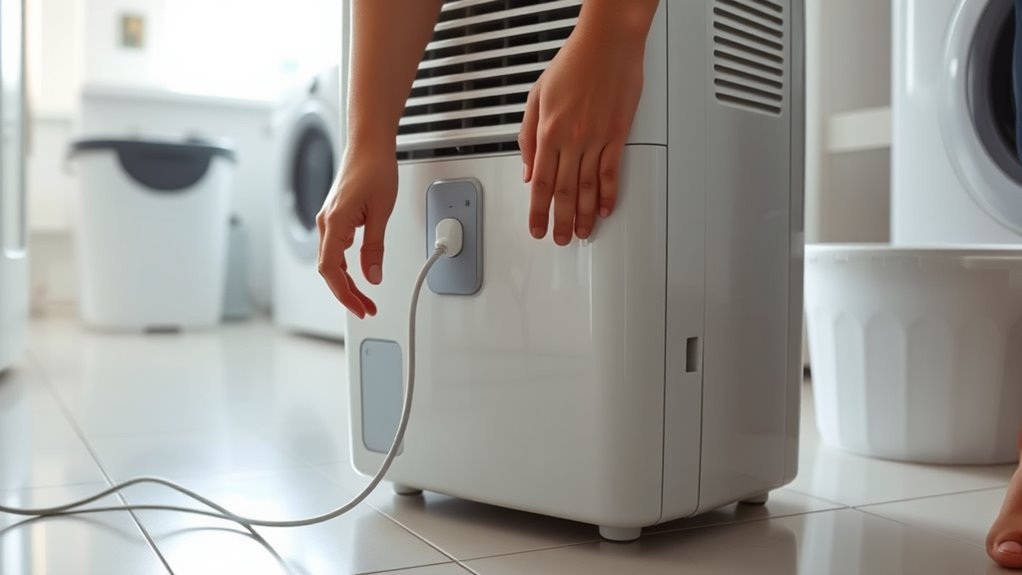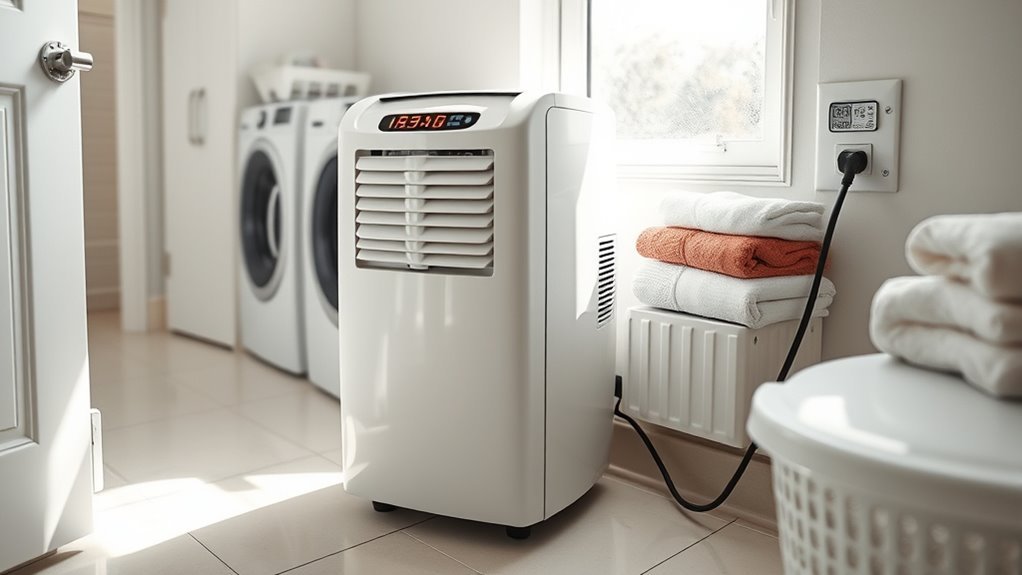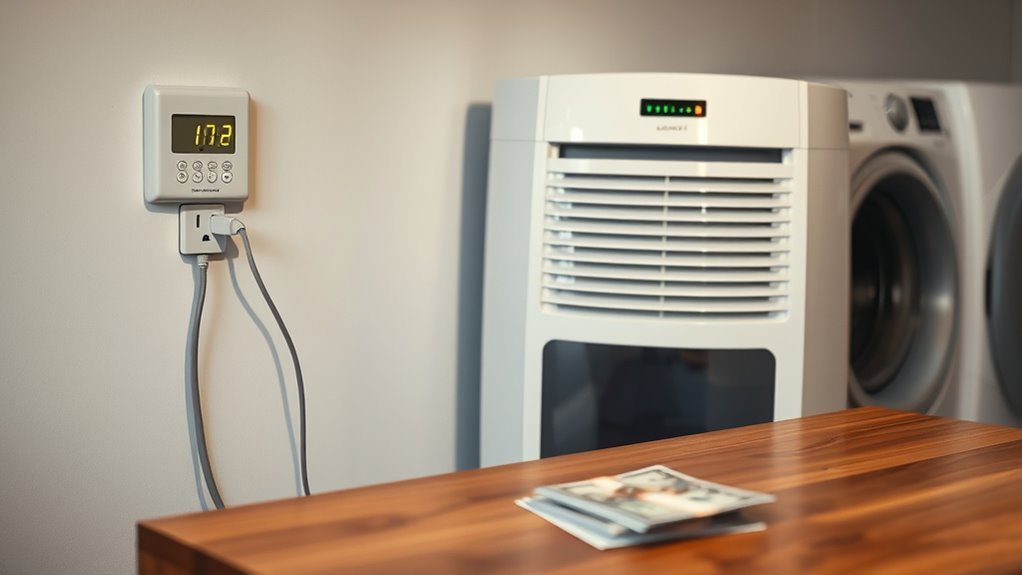
Dehumidifiers are moderate electricity users, not usually the biggest electrical load in a home, but they can add a noticeable amount to the bill when they run for many hours. The cost depends on the model’s wattage, compressor runtime, humidity setting, room conditions, and electricity price. The latest U.S. Energy Information Administration data available for May 2026 puts the average residential electricity price at 18.44 cents per kWh, so a 500-watt unit drawing its full rated power for 8 hours a day would cost about $22.13 over 30 days. Actual use may be lower when the humidistat cycles the compressor off.
Last updated: August 19, 2026. Electricity-rate benchmarks, ENERGY STAR criteria, DOE capacity-test language, and operating-cost examples were rechecked against current U.S. sources.
Quick Answer
A portable dehumidifier commonly uses a few hundred watts while its compressor is running. At the May 2026 U.S. residential average of $0.1844 per kWh, a 500-watt unit drawing full rated power costs about $0.74 for 8 hours, $22.13 for 8 hours a day over 30 days, or $2.21 for 24 hours. Your actual cost depends on compressor cycling and your local electricity rate.
Key Takeaways
- Use the formula watts ÷ 1,000 × operating hours × electricity rate to estimate cost.
- Pint capacity measures moisture removal, not electricity use. Check watts, annual kWh, and Integrated Energy Factor when comparing models.
- A lower humidity setting, severe dampness, air leaks, blocked airflow, and an undersized unit can increase runtime.
- ENERGY STAR says certified dehumidifiers use about 20% less energy than similarly sized conventional models.
- EPA recommends keeping indoor relative humidity below 60% and ideally between 30% and 50%.
- Actual consumption is best measured with a compatible plug-in electricity meter.
At a Glance
| Time Required | About 5 minutes to estimate cost |
| Difficulty | Easy |
| Tools Needed | Appliance label or manual, electricity bill, calculator, and optionally a compatible plug-in electricity meter |
| Cost | No cost with a calculator; the price of an optional electricity meter varies |
Why Do Dehumidifiers Use Electricity?
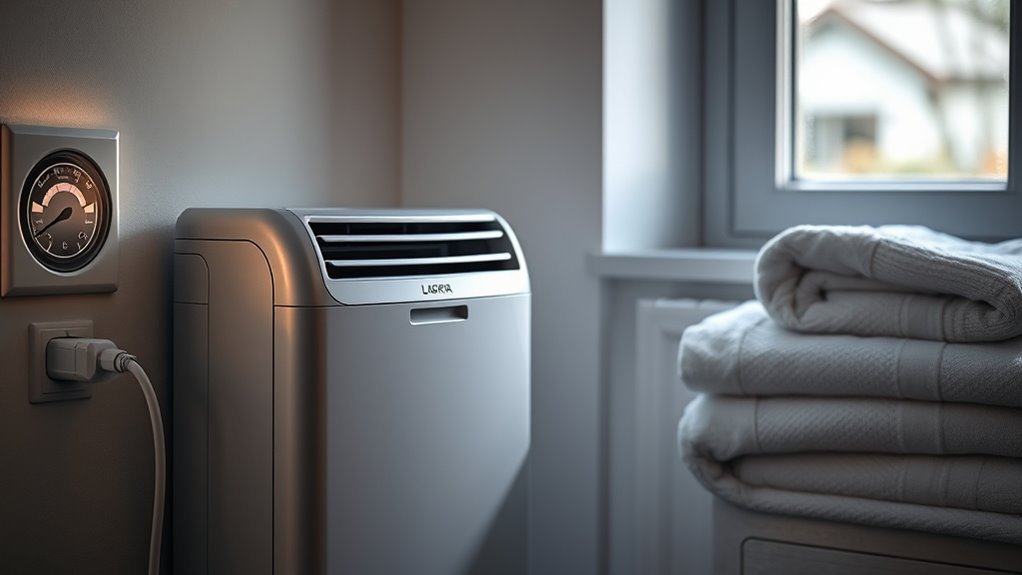
A compressor-style dehumidifier uses electricity to run a refrigeration system, fan, humidistat, display, and electronic controls. The fan pulls humid air across a cold evaporator coil. Water vapor condenses on the coil, drains into a bucket or hose, and the drier air returns to the room.
The compressor normally accounts for much of the running load. However, the unit may not draw its full rated power every minute because the compressor can switch off after the target humidity is reached. The fan may continue running on some models, and standby controls also use a small amount of electricity.
Dehumidifier efficiency is measured using Integrated Energy Factor, or IEF. IEF shows how many liters of water the machine removes per kilowatt-hour of electricity under standardized test conditions. A higher IEF means the unit removes more moisture for each unit of energy. Current ENERGY STAR dehumidifier criteria use IEF and include energy consumed during operating, standby, and off modes. Version 6.0 requirements took effect October 1, 2025.
ENERGY STAR says certified dehumidifiers use about 20% less energy than similarly sized conventional models.
How Much Power Does a Dehumidifier Use?
Many portable compressor dehumidifiers draw a few hundred watts while actively removing moisture, but exact wattage varies by capacity, efficiency, fan speed, temperature, and design. Small specialty units may use less, while large portable, commercial, or whole-home machines may use considerably more.
Do not estimate power from pint capacity alone. Pint capacity tells you how much water the unit can remove in 24 hours under a specified test condition. It does not directly state how many watts the machine draws.
Is That a Lot of Electricity?
For a portable household appliance, a few hundred watts is a moderate running load. The bigger bill driver is usually how many hours the compressor operates. A 500-watt unit drawing full power for 4 hours uses 2 kWh, while the same unit drawing full power for 12 hours uses 6 kWh. That is why daily and monthly kWh matter more than wattage alone.
For deeper explanations of the two measurements, see how many kWh a dehumidifier uses and how many watts a dehumidifier uses.
Where to Find the Correct Wattage
Check these locations in order:
- Appliance nameplate: Look on the back, side, inside the bucket compartment, or near the power cord.
- Owner’s manual: Search for rated input power, watts, amperage, or electrical specifications.
- Manufacturer specification sheet: Match the complete model number, not only the brand or pint rating.
- ENERGY STAR product listing: Certified listings may provide annual energy consumption and IEF.
- Plug-in electricity meter: This is the best way to measure actual household consumption over several days.
If the label gives voltage and amperage but not watts, multiplying volts by amps gives volt-amperes (VA), not necessarily true watts. Compressor motors can have a power factor below 1, so VA and actual watts may differ. Use the manufacturer’s watt rating or a compatible electricity meter when accurate power or cost calculations matter.
Pro Tip: Measure the unit for at least three to seven typical days. A one-hour reading may be misleading because humidity and compressor cycling change throughout the day.
Watts, Kilowatt-Hours, Capacity, and IEF
- Watts: The rate at which the appliance uses electricity while operating.
- Kilowatt-hours: The amount of electricity used over time. One kilowatt-hour equals 1,000 watts used for one hour.
- Pints per day: The amount of water a dehumidifier can remove during a standardized 24-hour test.
- Integrated Energy Factor: Liters of water removed per kilowatt-hour under the applicable test procedure.
DOE’s newer dehumidifier efficiency standards took effect in June 2019, and ENERGY STAR says consumers began seeing the revised capacity ratings in early 2020. The newer test uses cooler conditions, so comparable machines can show lower pint ratings than they did under the old procedure. ENERGY STAR’s rough comparison shows that an older 70-pint portable unit corresponds to about a current 40- to 45-pint model, although the exact change varies by product. The ENERGY STAR testing and capacity guide explains the change. For more detail on current labels, see the dehumidifier ratings guide.
What Affects Dehumidifier Energy Costs?
Your operating cost depends on both the appliance and the moisture load in the building. Two identical machines can produce different electric bills when used in different rooms.
Recommended Products

Semiconductor dehumidifiers use thermoelectric cooling to remove moisture from the air. They create a drier, more comfortable environment by reducing humidity and improving air quality.

【The Undisputed Champion — Industry-Leading Dehumidifier Brand】When you choose AEOCKY, you get double market validation. According to data independently verified by Stackline, a leading third-party data analytics company, AEOCKY was an industry‑leading dehumidifier brand on Amazon U.S. in 2025. This means you’re not just choosing a flagship product from a market leader, but a top-performing brand backed by independent market data and trusted by millions of real users, delivering the ultimate combination of performance, quality and trust.

【𝐄𝐍𝐄𝐑𝐆𝐘 𝐒𝐓𝐀𝐑 𝐂𝐞𝐫𝐭𝐢𝐟𝐢𝐞𝐝 𝐟𝐨𝐫 𝐄𝐟𝐟𝐢𝐜𝐢𝐞𝐧𝐭 𝐏𝐞𝐫𝐟𝐨𝐫𝐦𝐚𝐧𝐜𝐞】Delivers consistent dehumidification across a variety of real-life conditions. Designed for energy-efficient operation, helping reduce excess power consumption and lower long-term energy costs without sacrificing performance
Rated Wattage and Efficiency
A high-wattage unit costs more per operating hour than a lower-wattage unit. However, wattage alone does not show how efficiently the machine removes water. Compare IEF, capacity, and annual energy consumption together.
Runtime
A unit that runs for 12 hours consumes about twice as much electricity as the same unit running at the same power for 6 hours. Runtime is affected by the humidistat setting, incoming moisture, room temperature, and whether the unit can reach its target.
Humidity Setting
Lower settings normally require more moisture removal and longer compressor operation. For general indoor moisture control, the U.S. Environmental Protection Agency recommends keeping indoor relative humidity below 60% and ideally between 30% and 50%. A target near 45% to 50% works well in many damp homes without asking the machine to remove more moisture than necessary.
Room Dampness and Moisture Entry
Leaks, groundwater seepage, wet foundations, unvented clothes dryers, indoor laundry drying, cooking, showers, and humid outdoor air can keep adding moisture. A dehumidifier then runs longer because it is treating the symptom while new water continues entering the space.
Doors, Windows, and Air Leakage
Leaving windows open in humid weather can make the machine work continuously. Close exterior doors and windows while the dehumidifier runs unless outdoor air is drier and intentional ventilation is appropriate.
Room Temperature
Cool air contains less moisture, and frost can form on the coils of some compressor dehumidifiers in a cold basement. ENERGY STAR advises checking for a model designed for lower temperatures when the space commonly falls below about 65°F. Repeated freezing and defrosting can reduce moisture removal and waste operating time.
Airflow and Maintenance
A dirty filter, blocked intake, dusty coil, or furniture placed too close to the discharge can reduce airflow. The machine may run longer while removing less water. Follow the manual’s cleaning schedule and maintain the required clearance around the unit.
Drainage Setup
Continuous drainage does not automatically reduce wattage, but it can prevent a full bucket from stopping the machine before humidity is controlled. Make sure a gravity hose slopes correctly and that a pump hose is installed according to the manufacturer’s instructions.
Note: Running a dehumidifier during off-peak hours lowers the bill only if your electric utility uses time-of-use pricing. It does not reduce the number of kilowatt-hours consumed.
How Much Does It Cost to Run One?
For a current U.S. reference point, the U.S. Energy Information Administration reported an average residential electricity price of 18.44 cents per kWh for May 2026. Your utility rate may be substantially higher or lower, so use the total per-kWh rate from your own bill whenever possible.
Use this formula:
Operating cost = watts ÷ 1,000 × operating hours × electricity rate per kWh
For monthly cost, multiply the daily result by the number of days used.
Recommended Products
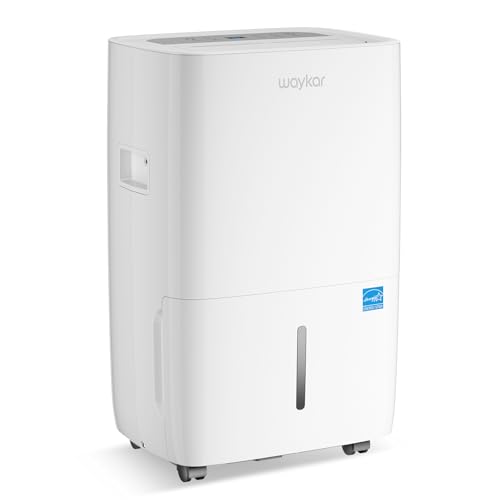
【80 Pint Capacity for Up to 5,000 Sq.Ft Spaces】Quickly removes excess moisture from basements, bathrooms, bedrooms, RVs, and other large living areas, delivering 80 pints per day (95°F, 90% RH).conditions. Designed as a powerful dehumidifier for basement, home, and large spaces, it helps eliminate damp air, condensation—and pet-related odors caused by excess humidity. Even during humid seasons, it works continuously to maintain a dry, comfortable, and healthier indoor environment.

【𝐆𝐨𝐨𝐝𝐛𝐲𝐞 𝐃𝐚𝐦𝐩𝐧𝐞𝐬𝐬, 𝐇𝐞𝐥𝐥𝐨 𝐅𝐫𝐞𝐬𝐡𝐞𝐫-𝐅𝐞𝐞𝐥𝐢𝐧𝐠 𝐀𝐢𝐫】 Say goodbye to muggy basements, damp storage rooms, and bathrooms that stay wet for hours. Designed for spaces up to 4,000 sq.ft., Vellgoo removes up to 64 pints of moisture per day under peak conditions (90°F, 90% RH), helping create a drier, more comfortable home all year long.
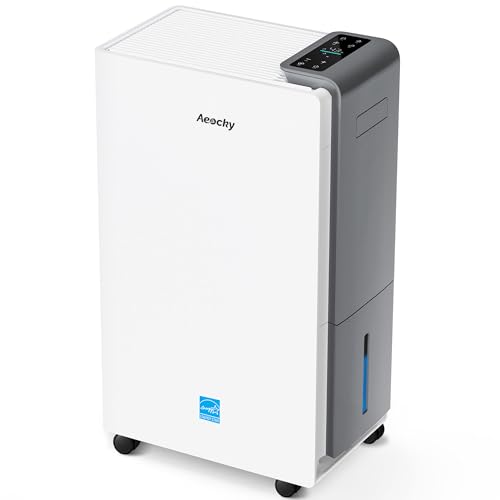
【ENERGY STAR 25 ≠ ENERGY STAR Most Efficient 2025】Don't fall for competitors' word games. With only 2.6% of ENERGY STAR models earning "Most Efficient 2025" title, these options are exceptionally rare on the market. RHEA-001 is one of the few to truly hold this top-tier certification. Many brands use misleading phrases like "Energy Star Efficient 25" or "Energy Star 25" to imply a standard they haven't met. Choosing them is a risk.With AEOCKY, you get verified performance and the peace of mind of authentic, top-tier efficiency.
Example: 400-Watt Dehumidifier
A 400-watt unit used at full stated power for 6 hours per day consumes:
400 ÷ 1,000 × 6 = 2.4 kWh per day
At $0.1844 per kWh:
2.4 × $0.1844 = about $0.44 per day
For a 30-day month:
about $0.44 × 30 = $13.28 per month
Estimated Monthly Cost at $0.1844 per kWh
| Rated Power | 8 Hours Daily | 12 Hours Daily | 24 Hours Daily |
|---|---|---|---|
| 300 watts | $13.28 | $19.92 | $39.83 |
| 500 watts | $22.13 | $33.19 | $66.38 |
| 700 watts | $30.98 | $46.47 | $92.94 |
These figures assume that the stated wattage is drawn for every operating hour. A humidistat-controlled machine may consume less when the compressor cycles off, while a severely damp room may keep it running nearly continuously. Use measured kWh for the most accurate estimate.
Using Annual Energy Consumption
Some certified product listings provide estimated annual energy consumption. Multiply the listed annual kWh by your electricity rate:
Annual kWh × electricity rate = estimated annual cost
As checked August 19, 2026, the ENERGY STAR Product Finder includes portable models rated at about 49.43 pints per day with annual energy consumption of 471 kWh. At $0.1844 per kWh, 471 kWh equals about $86.85 per year under the standardized annual-use estimate. Your result may differ because test assumptions cannot reproduce every climate, basement, humidity setting, or usage pattern.
How Can You Cut Dehumidifier Electricity Use?
- Choose enough capacity: Match the unit to both the room area and its dampness. ENERGY STAR generally advises that it is better to oversize than undersize a portable unit because an undersized model may run continuously without reaching the target. See the dehumidifier size guide for capacity planning.
- Compare IEF: Among units with suitable capacity, a higher IEF indicates more moisture removal per kWh. The dehumidifier ratings guide explains how to compare current labels.
- Use a practical humidity target: Start near 50% and lower it only when necessary to control condensation, musty odors, or a known moisture issue.
- Close the space: Keep windows and exterior doors closed during humid weather so the machine is not constantly treating incoming outdoor air.
- Fix moisture sources: Repair plumbing leaks, improve foundation drainage, vent clothes dryers outdoors, and use bathroom and kitchen exhaust fans.
- Clean the filter: Follow the manual’s maintenance interval. A blocked filter reduces airflow and moisture removal.
- Allow air circulation: Keep the intake and discharge clear. Follow the manufacturer’s wall-clearance instructions.
- Use built-in controls: A humidistat, auto mode, and built-in timer can prevent unnecessary operation. Do not bypass the manufacturer’s electrical instructions.
- Consider continuous drainage: A correctly installed hose or pump helps the unit operate without repeated bucket shutoffs.
- Measure before replacing: A plug-in meter can show whether the problem is high wattage, excessive runtime, or both.
Recommended Products

【The Undisputed Champion — Industry-Leading Dehumidifier Brand】When you choose AEOCKY, you get double market validation. According to data independently verified by Stackline, a leading third-party data analytics company, AEOCKY was an industry‑leading dehumidifier brand on Amazon U.S. in 2025. This means you’re not just choosing a flagship product from a market leader, but a top-performing brand backed by independent market data and trusted by millions of real users, delivering the ultimate combination of performance, quality and trust.

【The Undisputed Champion — Industry‑Leading Dehumidifier Brand】When you choose AEOCKY, you get double market validation. In 2025, AEOCKY was an industry‑leading dehumidifier brand on Amazon US. This means you’re not just choosing a flagship from a market leader, but the top choice proven by millions of real users—representing the ultimate combination of performance, quality, and trust.
How to Measure Actual Electricity Use
A compatible plug-in electricity meter records kilowatt-hours directly. This is more accurate than multiplying rated wattage by clock time because it captures compressor cycling, fan-only operation, and standby consumption.
- Confirm that the meter’s voltage, amperage, and wattage rating can safely handle the dehumidifier.
- Follow the dehumidifier manual and meter instructions.
- Reset the meter’s kWh reading.
- Operate the unit normally for at least three days, preferably a full week.
- Divide total kWh by the number of measured days to find average daily use.
- Multiply daily kWh by your electricity rate and by 30 for an estimated monthly cost.
Example: If the meter records 18 kWh over 6 days, average use is 3 kWh per day. At $0.1844 per kWh, that equals about $0.55 per day or $16.60 per 30-day month.
What Does Your Meter Reading Tell You?
| What You Observe | Likely Meaning | What to Check Next |
|---|---|---|
| Normal power draw but high daily kWh | The unit is probably running for many hours | Humidity setting, leaks, open doors or windows, airflow, temperature, and sizing |
| High power draw but reasonable runtime | The model may simply have a higher operating input | IEF and annual kWh when comparing a future replacement |
| High power draw and long runtime | Both the appliance and room moisture load may be contributing | Moisture sources first, then capacity and efficiency |
| Daily kWh falls after the room dries | The humidistat is likely reducing compressor runtime after reaching the target | Continue monitoring under typical weather before changing settings |
Why Is My Dehumidifier Using More Electricity Than Expected?
Check these common causes:
- The target humidity is set very low.
- The unit is too small for the space or dampness level.
- Windows or exterior doors are open during humid weather.
- A plumbing, roof, drainage, or foundation leak is adding moisture.
- Laundry is drying indoors without ventilation.
- The filter or coil is dirty.
- The intake or outlet is blocked.
- The room is too cold for efficient compressor operation.
- The humidistat is inaccurate or located where it senses unusually damp air.
- The compressor does not shut off after the target is reached.
- The model is old or has a low IEF compared with current certified units.
If the compressor runs continuously after the room reaches the displayed target, the bucket repeatedly freezes, the power cord becomes hot, the unit smells like burning plastic, or it makes unusual electrical noises, turn it off and follow the manufacturer’s service guidance.
Warning: Dehumidifiers from several manufacturers have been recalled because they could overheat or catch fire. Check your brand, full model number, and date code on the U.S. Consumer Product Safety Commission dehumidifier recall page. Stop using any recalled unit and follow the official remedy instructions.
Frequently Asked Questions
Will a Dehumidifier Run Up Your Electric Bill?
It can create a noticeable increase if it runs many hours each day. A 500-watt unit drawing full rated power for 8 hours daily costs about $22.13 per 30-day month at $0.1844 per kWh. Actual cost may be lower or higher depending on compressor cycling, humidity, efficiency, and your electricity rate.
How Much Does It Cost to Run a Dehumidifier for 24 Hours?
At $0.1844 per kWh, continuous full-power operation costs about $1.33 for a 300-watt unit, $2.21 for a 500-watt unit, or $3.10 for a 700-watt unit over 24 hours. These examples assume the stated wattage is drawn for the full 24 hours.
How Many kWh Does a Dehumidifier Use per Hour?
Divide its wattage by 1,000. A 300-watt dehumidifier uses 0.3 kWh during one full hour at that power, a 500-watt unit uses 0.5 kWh, and a 700-watt unit uses 0.7 kWh. Actual hourly averages may be lower when the compressor cycles off.
What Humidity Setting Saves Electricity?
Start near 50% relative humidity and lower the setting only when needed for condensation or moisture control. EPA recommends keeping indoor humidity below 60% and ideally between 30% and 50%. Setting the humidistat unnecessarily low can increase compressor runtime and electricity use.
What Is the Downside of a Dehumidifier?
The main drawbacks are electricity use, fan and compressor noise, heat released into the room, filter and bucket maintenance, and the possibility of over-drying the air. A poorly sized or poorly maintained unit may also run for long periods without solving the underlying moisture source.
Should a Dehumidifier Run All Day?
It may run for most of the day when first drying a very damp room. Once the target humidity is reached, a working humidistat should reduce compressor operation. Continuous long-term running can indicate a low setting, an undersized unit, incoming moisture, poor airflow, or a control problem.
Does a Larger Dehumidifier Always Cost More to Run?
A larger unit may draw more power while the compressor is on, but it can also remove moisture faster and shut off sooner. Compare suitable capacity, rated watts, IEF, and measured runtime rather than assuming the smallest model will have the lowest total cost.
Sources
- ENERGY STAR: Dehumidifiers — certified-unit efficiency, sizing, placement, drainage, temperature, humidistat, and buying guidance.
- ENERGY STAR: Dehumidifier Efficiency Criteria — current IEF definitions and Version 6.0 qualification thresholds.
- ENERGY STAR: Dehumidifier Testing and Capacity — DOE test-method and capacity-rating changes.
- U.S. Energy Information Administration: Electric Power Monthly — current U.S. residential electricity-price benchmark used in the cost examples.
- U.S. EPA: Indoor Air Quality — recommended indoor relative-humidity range.
- U.S. Consumer Product Safety Commission: Dehumidifier Recalls — recalled models and fire-hazard information.
Conclusion
Dehumidifiers are moderate electricity users, but the bill depends much more on wattage and runtime than on the pint number printed on the box. At the May 2026 U.S. residential average of $0.1844 per kWh, a 500-watt machine drawing full rated power for 8 hours a day costs about $22.13 per 30-day month. Choose enough capacity, compare IEF, use a practical humidity target, maintain airflow, and fix moisture sources so the machine does not run longer than necessary. For the most reliable answer, measure actual kWh over several typical days and multiply that amount by the rate on your utility bill.