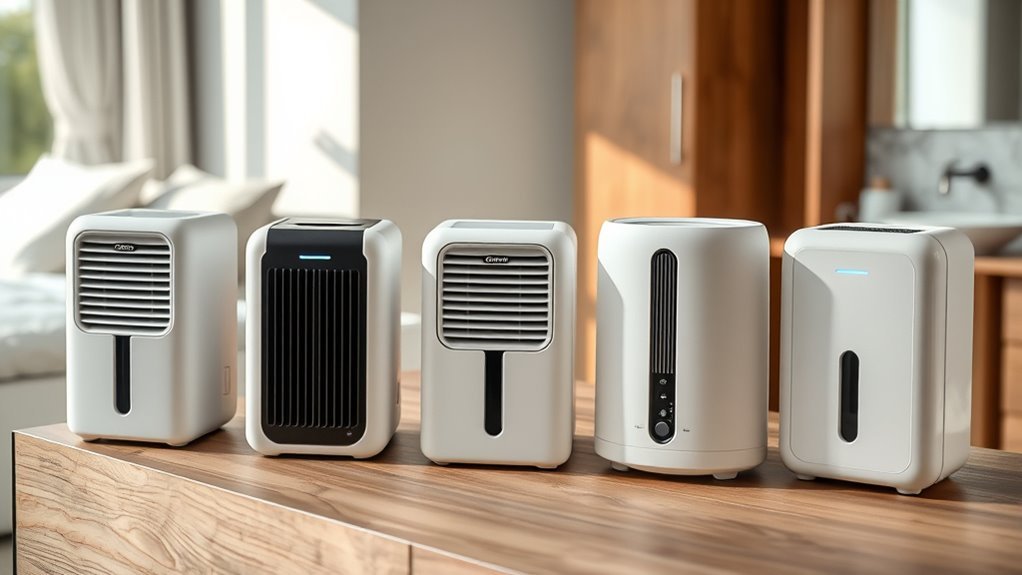
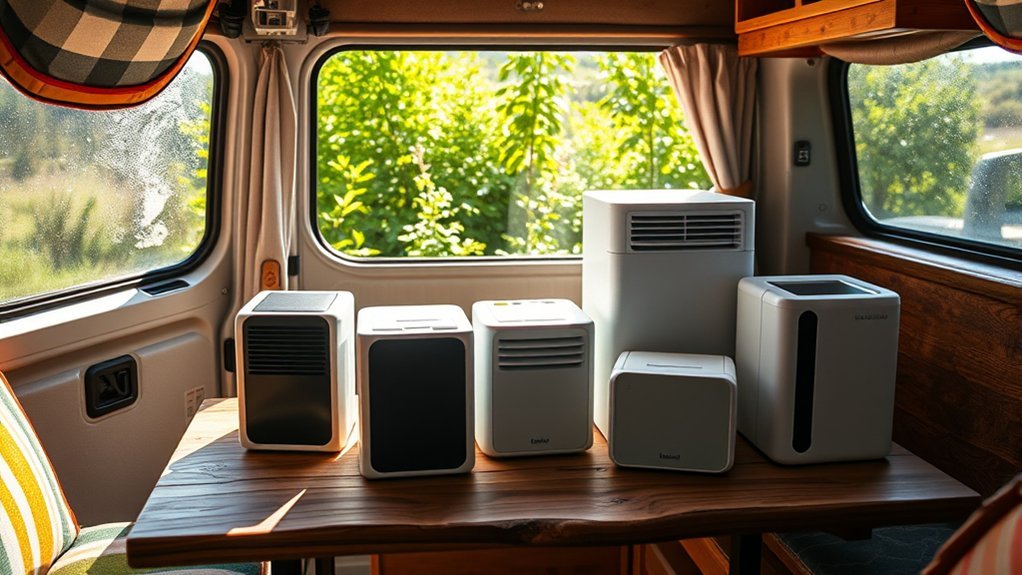
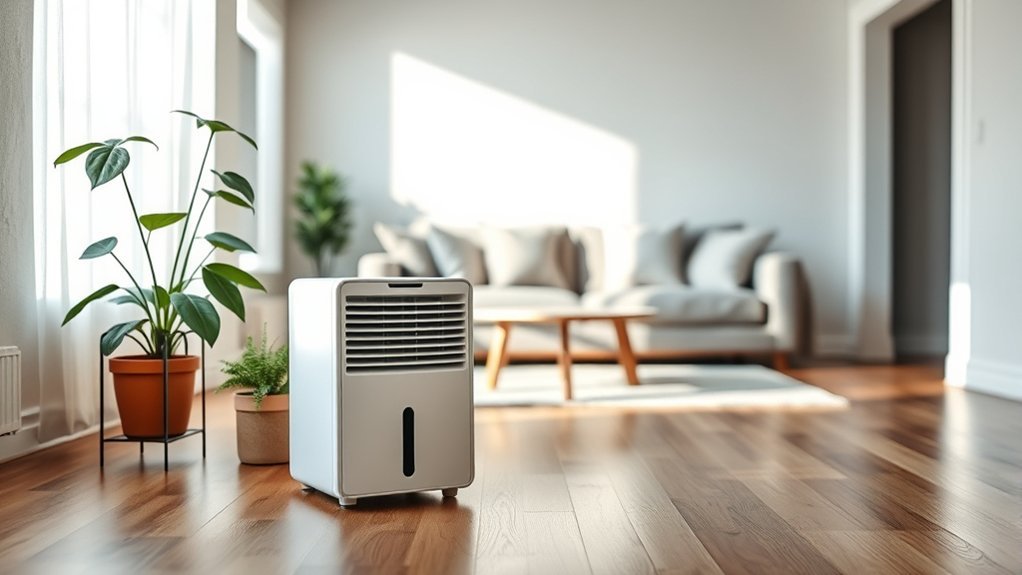
If you want a 2-in-1 air purifier and dehumidifier for 2026, start by matching the unit to your room and moisture problem. The Tenergy Sorbi offers the best-balanced compact setup, the THECOSKY DH16 adds a drain hose, the AIRCYAN 32-pint model brings compressor power for larger rooms, the Sefaul 1000ml adds WiFi control, and the Hoomace VES596 is a quiet bedroom option with basic filtration and a night light. Remember that compact Peltier models are designed for localized dampness, while compressor units handle heavier humidity.
Quick Verdict
- Best Overall Compact: Tenergy Sorbi for True HEPA filtration and quiet small-room use.
- Best with Continuous Drainage: THECOSKY DH16 for a larger tank and included drain hose.
- Best for Larger Rooms: AIRCYAN 32-Pint for compressor dehumidification plus H10 HEPA and carbon filtration.
- Best Smart Pick: Sefaul 1000ml for WiFi and app control.
- Best for a Quiet Bedroom: Hoomace VES596 for sub-30 dB operation, a G4 filter, and adjustable LED lighting.
Quick Comparison of the Best 2-in-1 Air Purifier and Dehumidifier Combos
| Product | Best For | Filtration | Moisture Removal | Drainage | Amazon |
|---|---|---|---|---|---|
| Tenergy Sorbi | Balanced compact use | True HEPA | Up to 750ml/day in optimal conditions | 1-liter tank | Check Price |
| THECOSKY DH16 | Small rooms needing a drain hose | H13 HEPA plus optional negative ions | Up to 700–800ml/day in humid conditions | 54oz tank plus drain hose | Check Price |
| AIRCYAN 32-Pint | Larger bedrooms, living areas, and basements | H10 HEPA plus carbon layer | Up to 32 pints/day in extreme test conditions | 0.53-gallon tank plus 39-inch hose | Check Price |
| Sefaul 1000ml | WiFi and remote control | HEPA filtration | Up to 750ml/day in hot, humid conditions | 1-liter tank | Check Price |
| Hoomace VES596 | Quiet bedroom use and ambient lighting | G4 filter plus optional negative ions | Up to 350ml/day at 86°F and 80% RH | 1-liter tank | Check Price |
Tenergy Sorbi 1000ml Air Dehumidifier with HEPA Filter
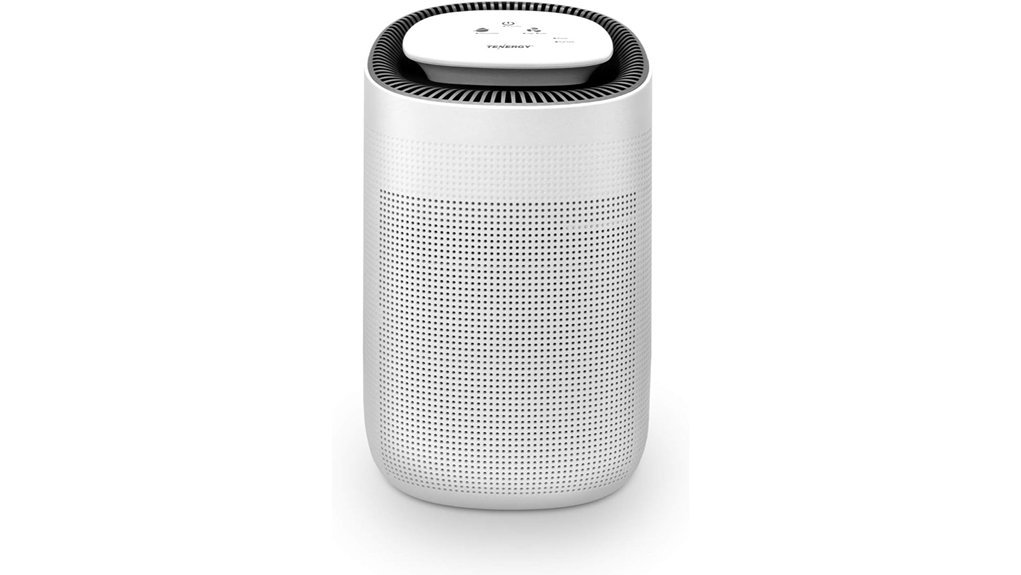
Best Overall Compact Pick: The Tenergy Sorbi is the most balanced choice here for a closet, bathroom, small office, or compact bedroom. Its Peltier system is rated to remove up to 750ml of moisture per day under hot, humid test conditions, while the True HEPA filter captures fine airborne particles. The 1-liter tank, water-level sensor, touch controls, and 35–42 dB operating range make it easy to use in quiet spaces.
Why You’ll Like It: You get meaningful particle filtration and light dehumidification in one small appliance without the noise and size of a compressor model.
Who Should Avoid It: Skip it for a wet basement, persistent condensation across a large room, or any space that needs continuous hose drainage.
Pros:
- True HEPA filtration is a stronger air-cleaning option than a basic dust screen.
- Compact size and 35–42 dB operation suit small, quiet spaces.
- Auto shutoff and a water-level sensor help prevent tank overflow.
Cons:
- The 750ml daily rating applies to favorable temperature and humidity conditions; normal-room extraction may be lower.
- The 1-liter tank can fill quickly during humid weather.
- No continuous-drain hose or built-in smart-home control.
THECOSKY DH16 Dehumidifier and Air Purifier Combo
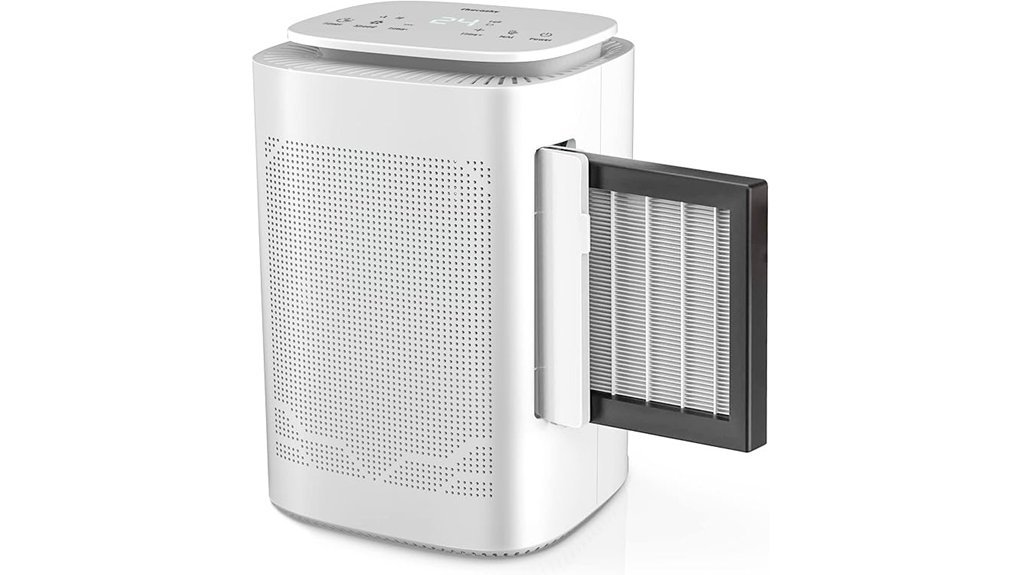
Best with Continuous Drainage: The THECOSKY DH16 is a practical small-room choice when you want H13 HEPA filtration and the option to send collected water through a drain hose. The manufacturer rates moisture removal at up to 700–800ml per day in humid conditions. Its 54oz tank, 35 dB low setting, dual fan speeds, timer, auto shutoff, and optional negative-ion mode add flexibility for bedrooms, bathrooms, closets, and RVs.
Why You’ll Like It: The drain-hose connection reduces one of the biggest frustrations with compact dehumidifiers: frequent tank emptying.
Who Should Avoid It: Do not choose it for severe basement dampness or whole-home humidity control. Its thermoelectric system is still much smaller than a compressor dehumidifier.
Pros:
- H13 HEPA filter supports finer particle capture than coarse pre-filters.
- Includes a drain-hose option for lower-maintenance operation.
- Quiet low mode, timer, and auto shutoff work well for bedrooms.
Cons:
- Actual extraction changes with room temperature and relative humidity.
- The advertised room-size figure should not be treated as a guarantee in very damp spaces.
- Households that prefer filter-only purification may want to leave the optional ion function off.
AIRCYAN 1500 Sq.Ft Dehumidifier with HEPA Filter and Drain Hose
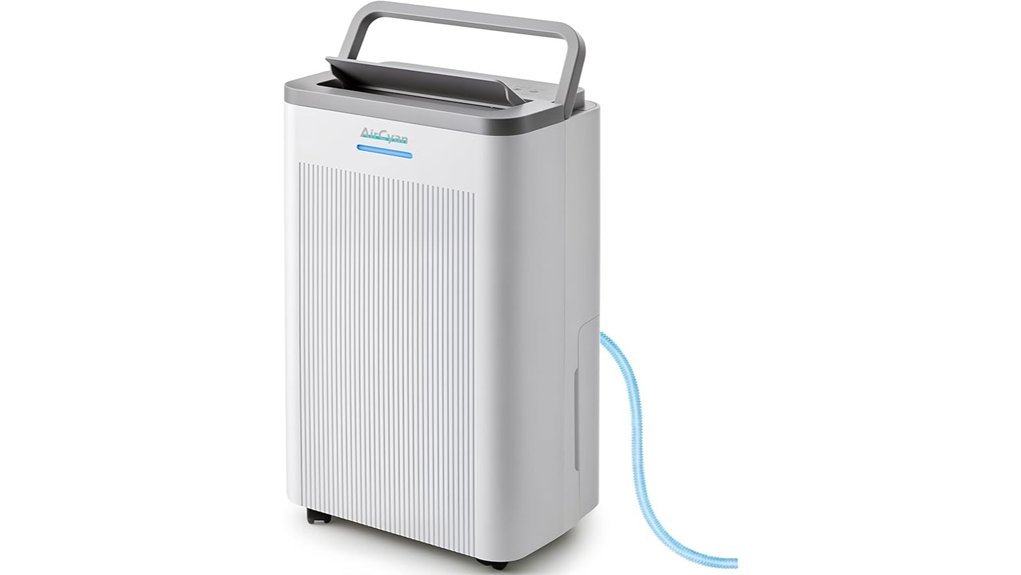
Best for Larger Rooms: The AIRCYAN model is the only compressor dehumidifier among these retained picks, making it the better choice for heavier moisture loads in a larger bedroom, living area, or basement. The manufacturer rates it at up to 32 pints per day at 95°F and 95% RH, with a lower 20-pint rating at 86°F and 80% RH. It also combines an H10 HEPA filter with a carbon layer, a 39 dB sleep mode, auto humidity control, caster wheels, and a 39-inch drain hose.
Why You’ll Like It: It provides substantially more moisture-removal power than the compact Peltier models while still adding particle and odor filtration.
Who Should Avoid It: It is larger, heavier, and more power-hungry than a desktop unit. H10 filtration is also less efficient than H13 or True HEPA media for fine particles.
Pros:
- Compressor system is better suited to persistent dampness and larger rooms.
- H10 HEPA and carbon layers address particles and some household odors.
- Continuous drainage, wheels, sleep mode, and adjustable humidity improve daily usability.
Cons:
- The 32-pint figure is based on extreme test conditions, not a typical bedroom environment.
- The 0.53-gallon tank is relatively small if the drain hose is not used.
- H10 filtration is not equivalent to H13 or True HEPA performance.
Sefaul 1000ml Air Dehumidifier with Purifying Function and WiFi
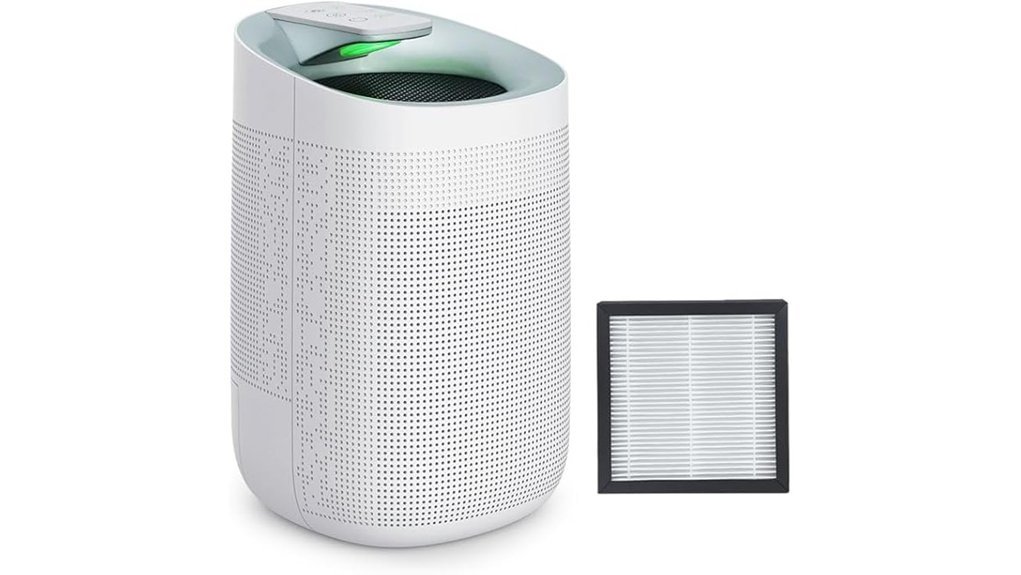
Best Smart Pick: The Sefaul 1000ml is the option to consider when app control matters more than maximum moisture removal. It combines a HEPA filter, WiFi control, a 1-liter removable tank, and auto shutoff. The manufacturer rates it to remove up to 750ml per day under hot, very humid conditions.
Why You’ll Like It: Remote control makes it easier to check or adjust the unit when it is placed in a closet, laundry area, spare room, or other space you do not visit often.
Who Should Avoid It: The advertised 800 sq. ft. coverage is ambitious for a 750ml-per-day Peltier unit. Choose it for localized humidity control, not for drying a large open floor plan.
Pros:
- WiFi and app control add convenience that the other compact picks lack.
- HEPA filtration and dehumidification operate in one small unit.
- Auto shutoff helps protect against overflow when the tank is full or incorrectly seated.
Cons:
- The 1-liter tank may require frequent emptying during humid weather.
- Real-world extraction is likely to be lower than the maximum laboratory-style rating.
- Headline coverage should be treated cautiously because no standardized room-performance data is provided.
Hoomace Small Bedroom Dehumidifier with Air Purifying Function
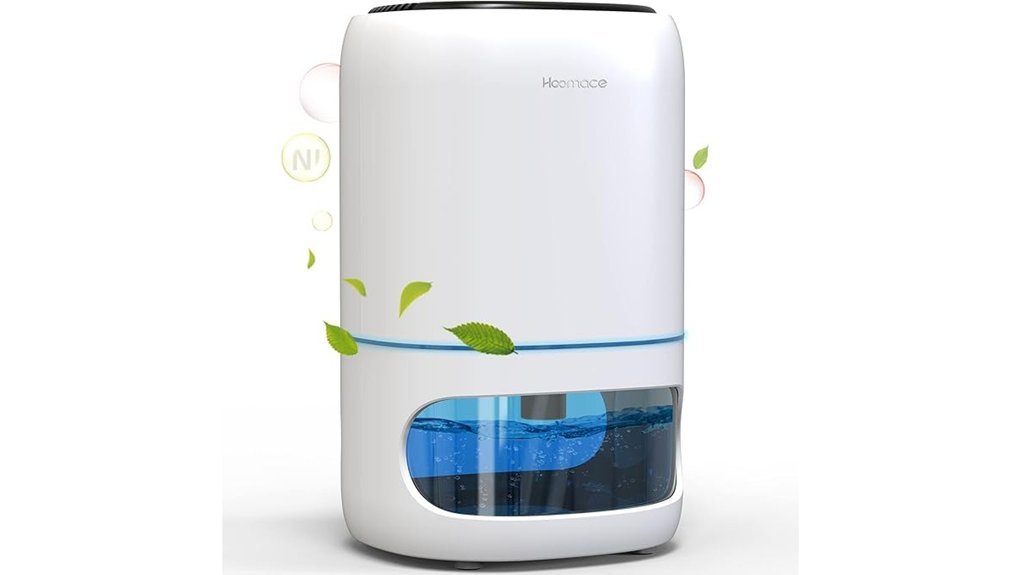
Best for Quiet Bedroom Use: The Hoomace VES596 is a compact 3-in-1 option with dehumidification, a G4 filter, optional negative ions, and seven-color LED lighting. Its Peltier system is rated for up to 11oz or 350ml of moisture per day at 86°F and 80% RH. It runs below 30 dB and uses a 1-liter tank with automatic shutoff.
Why You’ll Like It: It is the quietest and lightest-duty option in this guide, making it suitable for a bedside area, closet, or small room with mild humidity.
Who Should Avoid It: A G4 filter is designed mainly for larger dust, hair, and dander. It is not a substitute for True HEPA filtration, and the 350ml extraction rating is too low for serious dampness.
Pros:
- Sub-30 dB operation is well suited to sleeping and studying.
- Compact 3-in-1 design includes basic filtration, dehumidification, and a night light.
- Timer settings and auto shutoff add convenience.
Cons:
- G4 filtration is much less effective for fine particles than H10, H13, or True HEPA media.
- Maximum moisture removal is only 350ml per day under favorable conditions.
- No drain hose or smart control.
Factors to Consider When Choosing a 2-in-1 Air Purifier and Dehumidifier
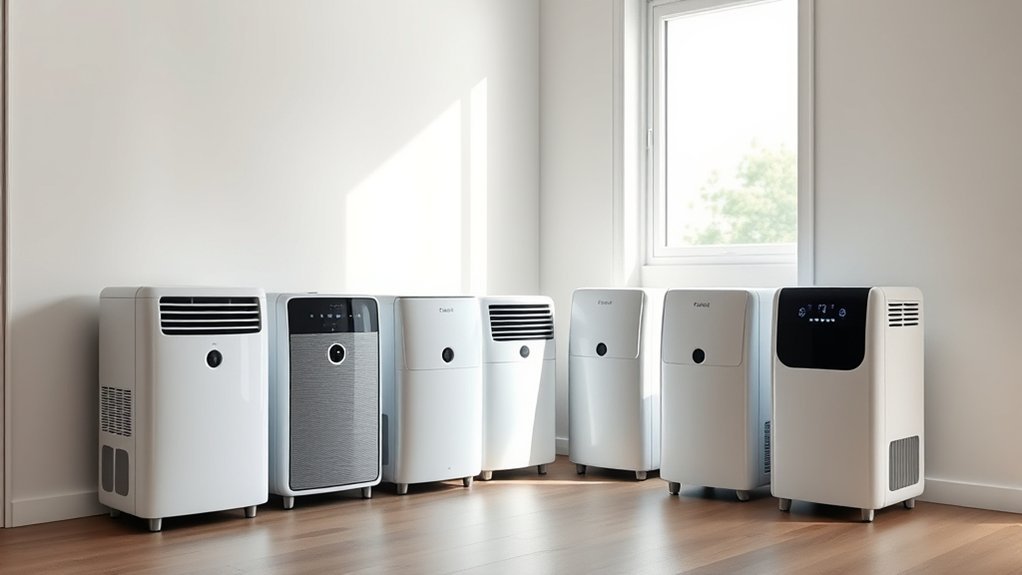
A combination unit can save floor space, but the air-cleaning and moisture-removal sides still need to match your room. Compare the filter class, daily extraction rate, test conditions, tank size, drainage method, noise, and controls before buying.
Filtration Type and Airflow
Do not treat every “air-purifying” filter as equal. A G4 filter mainly catches larger dust, hair, and debris. H10 HEPA provides better particle capture, while H13 or True HEPA media is the stronger choice for fine airborne particles. Also look for airflow or CADR information when available. A compact combo without a stated clean-air delivery rate may help with nearby particles, but it may not replace a dedicated room air purifier.
Dehumidifying Capacity and Test Conditions
Daily extraction is usually listed in milliliters, liters, or pints. Check the temperature and relative humidity used for that rating. Compact Peltier models often reach their maximum only in warm, very humid conditions, so they may collect far less water in a cool bedroom. For persistent basement humidity, condensation, or laundry drying, a compressor model is usually the more suitable category.
Room Size and Humidity Load
Coverage claims are useful only when paired with extraction capacity. A tiny unit advertised for hundreds of square feet may circulate air across that room without removing enough moisture to control severe dampness. Consider ceiling height, doors, outdoor humidity, leaks, shower steam, and how quickly moisture returns. When in doubt, size by pints or liters per day rather than the largest square-foot number on the listing.
Noise Level
For bedrooms and offices, look for a low mode around 30–40 dB and a display-off or sleep setting. Compressor units generally make more noticeable fan and compressor noise than Peltier units, but they remove much more moisture. Choose the quietest model that still has enough capacity for the job.
Tank Capacity
A larger tank reduces how often you need to empty collected water, but tank size does not increase the unit’s extraction power. Compact models here use roughly 1 to 1.6 liters, while the AIRCYAN tank is about 0.53 gallon. Always confirm that the unit has automatic shutoff and that the tank seats securely after cleaning.
Drainage Options
A drain hose is valuable in a basement, bathroom, or laundry area where the unit may run for long periods. Gravity drainage requires the hose to slope continuously downward to a suitable drain. Models without a hose need regular tank checks, especially during the first few days when you are learning how quickly the reservoir fills.
Smart Controls
WiFi control can be useful for a remote room, but it should not outweigh capacity and filtration. Confirm what the app actually controls, whether it shows current humidity, and whether core functions still work from the physical panel if the network is unavailable.
Negative-Ion Features
Some compact models include an optional negative-ion function. Buyers who prefer filter-only air cleaning should choose a model that allows the ion feature to be switched off and should review the manufacturer’s safety and emissions information before use around sensitive occupants.
When Two Separate Appliances May Be Better
A combo is convenient for light humidity and basic particle control. Separate appliances may be better when you need high dehumidification capacity, a verified CADR for allergy or smoke control, independent placement, or the ability to run one function without the other. In large or challenging rooms, two purpose-built machines can be easier to size correctly.
Before You Buy
- Measure the room and identify whether the moisture problem is mild, moderate, or severe.
- Compare extraction rates using the listed temperature and humidity test conditions.
- Choose G4, H10, H13, or True HEPA filtration based on the particles you want to reduce.
- Check replacement-filter cost and availability before ordering.
- Decide whether you need a drain hose, WiFi control, sleep mode, or a child lock.
- Plan a stable location with clear airflow around the inlet and outlet.
Frequently Asked Questions
Can These Units Run Continuously?
Only run a model continuously when the manufacturer permits it and the tank or drain hose is set up correctly. Keep the air inlet and outlet clear, place the unit on a level surface, and monitor it during the first long operating cycle. Stop using it if you notice unusual heat, noise, odor, or leaking.
How Often Should the Filter Be Replaced?
Follow the schedule in the product manual because filter type and operating time vary. Inspect the filter regularly, remove loose dust as directed, and replace it sooner if airflow drops, odors remain, or the filter is damaged. Do not wash a HEPA filter unless the manufacturer specifically says it is washable.
How Much Electricity Does a 2-in-1 Model Use?
Electricity use depends on wattage and runtime. Estimate daily use by multiplying watts by operating hours and dividing by 1,000 to get kilowatt-hours. Compact Peltier models usually draw less power but also remove less moisture, while compressor models use more power and work faster in damp rooms.
Are They Safe Around Pets and Children?
They can be used safely when installed according to the manual. Keep cords and the water tank out of reach, prevent vents from being blocked, and use a child lock when available. For models with an ion feature, review the manufacturer’s emissions information and use filter-only mode when that better fits your household.
Can They Help Reduce Musty Odors?
Lowering humidity can reduce the damp conditions that contribute to musty smells, and a carbon layer may help with some odors. However, a combo appliance will not repair leaks, remove hidden mold, or replace proper ventilation. Fix the moisture source if the odor keeps returning.
Do Combo Units Work as Well as Separate Appliances?
They work well when convenience and space saving are the main goals. A dedicated dehumidifier usually offers more moisture-removal capacity, while a dedicated purifier often provides clearer airflow or CADR data. Choose separate units when either humidity control or particle removal is a high-priority problem.
Conclusion
The right 2-in-1 air purifier and dehumidifier depends on the size and severity of your problem. Choose the Tenergy Sorbi for balanced compact performance, the THECOSKY DH16 when a drain hose matters, the AIRCYAN 32-Pint for larger and damper rooms, the Sefaul 1000ml for WiFi control, or the Hoomace VES596 for quiet bedroom use with basic filtration. Treat maximum extraction and coverage figures as manufacturer ratings, then choose the model whose real capacity, filter class, drainage, and noise level best match your room.