Updated August 2026
Shopping for a 50 pint dehumidifier is confusing because the rating system changed. ENERGY STAR explains that an older 50-pint portable dehumidifier is roughly comparable to a newer 30-pint model tested under cooler conditions. Some listings also lead with much higher “maximum” figures measured in hot, saturated air, so two products labeled 50, 74, or 80 pints may perform very differently in a normal basement.
This guide focuses on three defensible 50-pint-class dehumidifiers: two AEOCKY model families with current ENERGY STAR capacity records of 32 pints per day and one HBN model with a manufacturer-stated 53-pint “standard” figure. We compared standardized capacity, rating transparency, drainage, tank size, controls, efficiency, noise claims, and best use case. Models with substantially lower normal-condition output were excluded.
Quick verdict
Best overall: AEOCKY LEO-Lite. Its associated ENERGY STAR family record lists 32 pints per day under the current test method, placing it close to the old 50-pint class, while its feature set emphasizes efficient operation, auto-defrost, continuous drainage, and lower-speed quiet use. Choose the HBN FDD25-5259 for the largest bucket and the highest manufacturer-stated capacity in this comparison, but treat its 53-pint “standard” figure cautiously because the test condition is not clearly disclosed. The AEOCKY RHEA-001 is the strongest alternative when you prefer its cabinet and control package.
How We Compared Capacity
We prioritized the current DOE Appendix X1-style capacity used in ENERGY STAR records, which measures portable dehumidifiers under cooler conditions intended to better represent basement use. See ENERGY STAR’s dehumidifier testing and capacity explanation. Maximum ratings from hotter, more humid conditions are shown only as secondary manufacturer claims.
Quick Comparison
| Product | Most Useful Capacity Figure | Tank | Best For | Main Limitation | Amazon |
|---|---|---|---|---|---|
| AEOCKY LEO-Lite Best Overall |
32 pints/day for the associated ENERGY STAR LEO family; up to 74 pints/day is a hot, high-humidity maximum claim | About 1.45 gal. | Legacy 50-pint-class buyers who prioritize efficiency, auto-defrost, and quieter low-speed operation | The retail model label or UPC should be matched to the certification record | Check Price on Amazon |
| HBN FDD25-5259 Largest Tank |
Manufacturer states 53 pints/day “standard” and up to 80 pints/day, but the reviewed documentation does not clearly define the 53-pint test condition | About 1.7 gal. | Buyers who want a larger bucket, flexible controls, and a higher stated capacity | Capacity documentation is less transparent than an ENERGY STAR product record | Check Current Amazon Availability |
| AEOCKY RHEA-001 Feature-Rich Alternative |
32 pints/day for the associated ENERGY STAR RHEA family; higher 52- to 80-pint figures use warmer or more humid conditions | About 1.45 gal. | Cooler basements, long seasonal run times, and buyers who want auto-defrost and memory features | The maximum marketing number is not its current standardized output | Check Product Details on Amazon |
AEOCKY LEO-Lite 50-Pint-Class Energy Star Dehumidifier
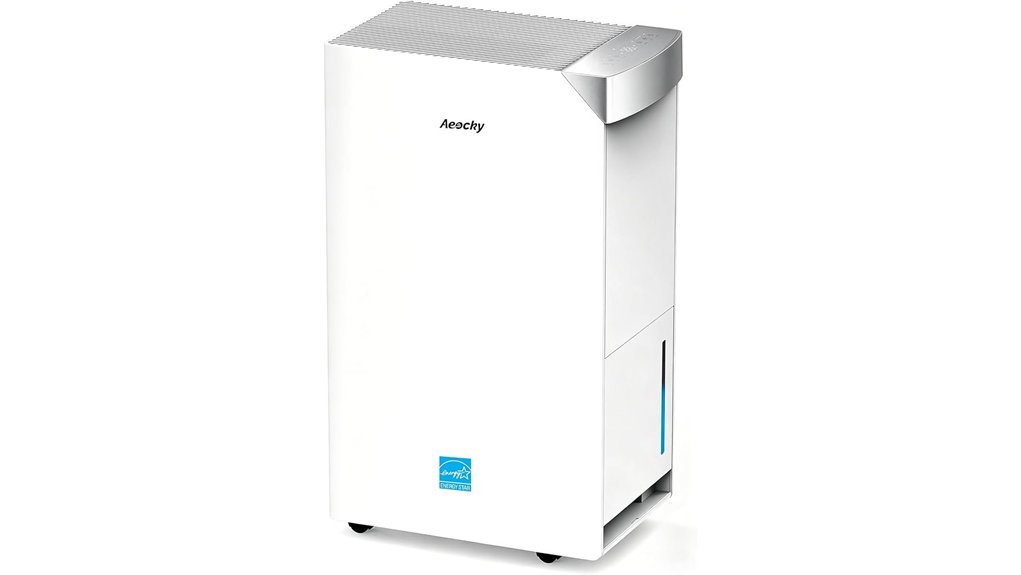
Editorial label: Best overall for documented efficiency and everyday basement use. The AEOCKY LEO-Lite is marketed with a maximum output of up to 74 pints per day in extreme heat and humidity. The more useful comparison point is the associated AEOCKY LEO family’s current ENERGY STAR record, which lists 32 pints per day under the Appendix X1 test method. ENERGY STAR’s conversion guidance places that output near the old 50-pint class.
Its strongest reasons to buy are Energy Star certification, auto-defrost, continuous gravity drainage, a large bucket, humidity sensing, power-off memory, and a claimed low-speed noise level around 44 dB. It is a sensible choice for long seasonal run times in a basement or large room when you want an efficiency-focused compressor model without relying on app controls.
Why You’ll Like It: It combines a relatively slim cabinet with a roughly 1.45-gallon tank, drain-hose support, automatic frost management, humidity control, and a lower-noise fan setting.
Who Should Buy This: Homeowners replacing an older 50-pint unit or shopping for a current 30- to 35-pint dehumidifier for a damp basement, laundry area, or large living space.
Who Should Avoid This: Buyers who need a verified current-standard 50-pint-per-day machine for a wet space with seepage or a built-in pump for upward drainage.
Pros:
- The associated ENERGY STAR family record provides a clearer 32-pint current-standard comparison point.
- Includes continuous-drain capability, auto-defrost, humidity control, and power-off memory.
- Claimed low-speed operation around 44 dB can suit occupied areas better than louder high-speed units.
Cons:
- The 74-pint maximum is measured under conditions that do not represent a typical cool basement.
- The retail model label or UPC should be checked against the ENERGY STAR family record before relying on certification details.
- No built-in pump is stated, so gravity drainage requires a drain below the outlet.
HBN FDD25-5259 Dehumidifier with Drain Hose and Timer
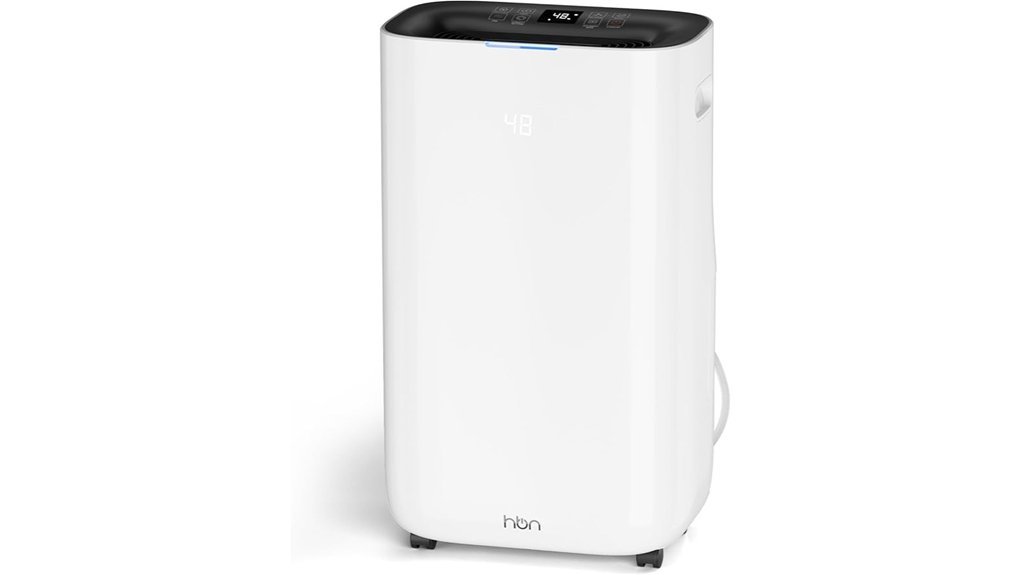
Editorial label: Best for a large tank and higher manufacturer-stated capacity. HBN materials advertise the FDD25-5259 at up to 80 pints per day and also describe a 53-pint-per-day “standard” figure. That sounds closer to a true current 50-pint machine than the other models in this guide, but the reviewed documentation does not clearly identify the exact temperature, relative humidity, or DOE appendix behind the 53-pint claim. Treat it as a manufacturer figure rather than a fully verified apples-to-apples result.
The practical advantage is its roughly 1.7-gallon tank, three fan speeds, four operating modes, child lock, sleep setting, 24-hour timer, washable filter, wheels, and included six-foot drain hose. The larger bucket helps when a floor drain is unavailable, while continuous gravity drainage is still the better setup for a persistently wet basement.
Why You’ll Like It: It offers the largest water bucket in this comparison and a broad control set for changing room conditions.
Who Should Buy This: Buyers who prioritize fewer bucket-emptying trips, flexible settings, and a higher claimed removal rate for a basement, laundry area, office, or large damp room.
Who Should Avoid This: Buyers who require third-party certified current-standard capacity data, Energy Star certification, an integrated condensate pump, or a compact bedroom unit.
Pros:
- The roughly 1.7-gallon tank reduces manual emptying compared with the two AEOCKY models.
- Includes a drain hose, four modes, three fan speeds, timer, sleep function, and child lock.
- Wheels and a handle make room-to-room movement easier.
Cons:
- The exact conditions behind the 53-pint “standard” figure are not clearly disclosed.
- No Energy Star certification was confirmed in the reviewed documentation.
- The larger cabinet may be less convenient in a bedroom or narrow hallway.
AEOCKY RHEA-001 50-Pint-Class Energy Star Dehumidifier
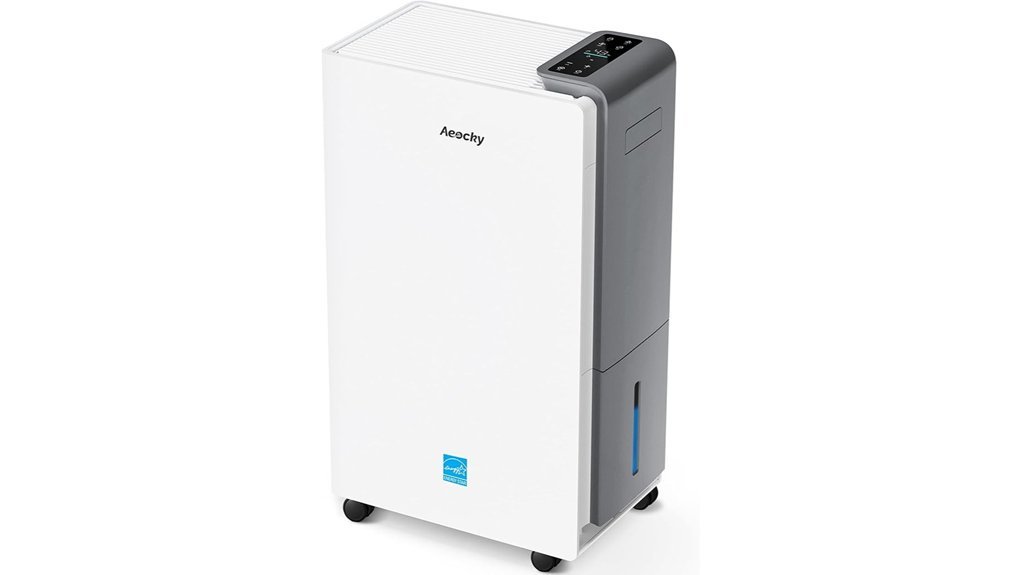
Editorial label: Best feature-rich alternative. The RHEA-001 is marketed with higher 52- to 80-pint figures under warmer or more humid test conditions. The associated AEOCKY RHEA family’s current ENERGY STAR record lists 32 pints per day under Appendix X1, making it a modern 30- to 35-pint unit that sits near the older 50-pint class rather than an 80-pint everyday basement machine.
The main reasons to consider it are Energy Star certification, smart humidity control, auto-defrost, power-off memory, continuous drainage, a roughly 1.45-gallon tank, and claimed low-speed noise near 44 dB. Product materials also describe low-temperature operation, but every compressor dehumidifier removes less water as temperature and humidity fall.
Why You’ll Like It: It provides a strong convenience package for long seasonal use and can restart with saved settings after a brief outage.
Who Should Buy This: Buyers who want an efficiency-focused, feature-rich dehumidifier for a basement or large living area and prefer the RHEA cabinet or controls.
Who Should Avoid This: Shoppers who only need light bedroom dehumidification, require a pump, or expect 80 pints per day in cool, moderate-humidity conditions.
Pros:
- The associated ENERGY STAR family record lists 32 pints/day with a 2.09 L/kWh integrated energy factor.
- Includes auto-defrost, humidity control, memory, gravity-drain support, and caster-style mobility.
- Claimed low-speed operation near 44 dB is attractive for occupied rooms.
Cons:
- The maximum 80-pint claim is not its current standardized output.
- The retail model label or UPC should be matched to the applicable certification record.
- Warranty language may vary by listing, seller, and purchase date.
How to Choose a 50-Pint-Class Dehumidifier
The most important buying step is not choosing the largest number on the box. Compare capacity under the same test conditions, then check moisture severity, drainage, room temperature, tank size, energy efficiency, noise, controls, and warranty support.
Legacy 50-Pint Versus Current Capacity
DOE changed portable-dehumidifier testing to cooler conditions that better represent basement use. ENERGY STAR’s approximate conversion table shows that an older 50-pint model may correspond to a newer 30-pint model. That is why a current certified 32-pint unit can be a reasonable replacement for an older machine labeled 50 pints. The conversion is approximate, so use the current certified figure for direct comparisons.
Capacity and Test Conditions
A pint-per-day number is meaningful only when the temperature and relative humidity are stated. Current Appendix X1 capacity is based on cooler conditions, while output measured near 95°F and 90% RH can be several times higher. When a listing uses “maximum,” “standard,” “DOE,” “AHAM,” or “Appendix X1,” check the manual or certification record instead of assuming those labels are interchangeable.
Coverage Area and Moisture Load
Square-foot coverage is a marketing estimate, not a guarantee. A 1,000 sq. ft. basement with seepage can require more capacity than a much larger mildly damp open area. Consider standing water, wall dampness, laundry drying, exterior drainage, air leaks, ceiling height, and whether doors stay open. Fix active leaks first; a portable dehumidifier manages airborne moisture but does not repair the source.
Target Humidity
The U.S. EPA recommends keeping indoor relative humidity below 60% and ideally between 30% and 50%. For many basements, starting around 45% to 50% RH balances moisture control and runtime. A separate hygrometer can help you check whether the built-in sensor is reasonably accurate.
Energy Efficiency
Energy Star certification is more useful than vague savings claims because certified capacity and integrated energy factor use a defined test method. Compare the certification record, keep the filter clean, close windows and exterior doors, maintain clear airflow, and avoid setting the humidistat lower than needed.
Drainage Options
Manual tanks work for occasional use, but a high-capacity dehumidifier can fill a bucket quickly. A gravity hose is the simplest hands-free option when the drain is below the outlet and the hose slopes continuously downward. Choose a built-in pump model when water must travel upward to a sink or window. None of the three retained products clearly includes an integrated condensate pump.
Tank Size
A larger bucket does not increase moisture-removal capacity, but it extends the time between emptying. The HBN has the largest tank in this comparison at about 1.7 gallons. The two AEOCKY models hold about 1.45 gallons, which is still practical for intermittent use but less important when a hose is connected.
Temperature and Auto-Defrost
Compressor dehumidifiers collect less water as the room becomes cooler. Auto-defrost helps manage normal coil frost, but it does not make a standard portable unit suitable for a freezing space. Check the manual’s operating-temperature range and use equipment designed for lower temperatures when the room regularly falls below the stated limit.
Noise Level
Noise claims are approximate unless the listing explains the fan setting and measurement method. A low-speed figure around 44 dB may suit a living room or finished basement, but compressor cycling and high fan speed will sound louder. Place the unit on a level floor and keep the filter clean to reduce avoidable vibration and airflow noise.
Controls and Restart Features
Useful controls include an adjustable humidistat, timer, multiple fan speeds, continuous mode, child lock, auto-restart, display-off or sleep mode, and power-off memory. Preset modes are convenient, but they do not replace correct sizing. For unattended use, confirm that the hose is secure, the drain path is clear, and the outlet is properly grounded.
Warranty and Support
Warranty terms can vary by seller, purchase date, registration, and region. Save the order record and model label, then read the written terms for parts, labor, shipping, replacement, and compressor coverage. Also check whether replacement buckets, filters, and drain fittings are available.
Before You Buy Checklist
- Decide whether you mean an old 50-pint class or a current 50-pint Appendix X1 model.
- Compare current pint ratings under the same test method.
- Measure the room and classify it as moderately damp, very damp, or wet.
- Confirm the minimum operating temperature.
- Plan bucket, gravity-hose, or pump drainage before choosing the installation spot.
- Check tank size, filter access, noise setting, warranty terms, and replacement-part availability.
- Match the Amazon listing, model label, and UPC to any cited certification record.
Frequently Asked Questions
What Does “50 Pint Dehumidifier” Mean Today?
It should describe the amount of water removed in 24 hours under a stated test method. However, older 50-pint ratings were measured under warmer conditions, and some current listings use extreme-condition maximums. For direct comparison, look for the current DOE Appendix X1 or ENERGY STAR capacity.
Is a Current 32-Pint Model Equal to an Old 50-Pint Model?
It can be in roughly the same class. ENERGY STAR’s conversion guidance estimates that an old 50-pint portable unit corresponds to about 30 pints under the newer test. The relationship is approximate, so compare the exact model’s current certified capacity and your room’s moisture load.
How Often Should I Clean the Filter?
Inspect the filter about every two weeks during regular use and follow the manual’s cleaning instructions. Dusty homes, pets, construction debris, and continuous operation may require more frequent checks. Let a washable filter dry completely before reinstalling it.
Can I Use One in a Freezing Basement?
Do not run a portable compressor dehumidifier below its stated operating range. Auto-defrost can handle normal frost in cool conditions, but it does not make the unit safe or effective in a freezing room. Warm the space or choose equipment designed for lower temperatures.
Do 50-Pint-Class Dehumidifiers Work in Laundry Rooms?
Yes, when the unit is sized for the moisture load and has enough airflow around it. A continuous drain is helpful when drying clothes indoors. Keep the dehumidifier away from direct splashes and do not block the inlet or outlet with laundry.
Is It Safe to Run a Dehumidifier Overnight?
It can be when the manufacturer permits continuous operation and the unit is on a firm, level surface with proper clearance, a clean filter, a grounded outlet, and a correctly seated tank or secure drain hose. Do not use a damaged cord, an unsuitable extension cord, or a hose that can back up and leak.
What Humidity Setting Should I Use?
Start around 45% to 50% RH and adjust based on comfort, condensation, and the room’s moisture source. A separate hygrometer can help verify the built-in reading. Setting the target extremely low may cause unnecessary runtime without solving leaks or water intrusion.
Will a Dehumidifier Remove Existing Mold?
No. Lower humidity can make conditions less favorable for new growth, but a dehumidifier does not remove established mold or repair wet materials. Correct the water source and clean or replace affected materials using appropriate remediation guidance.
What Maintenance Helps a Dehumidifier Last Longer?
Clean the filter, keep the intake and outlet clear, rinse and dry the tank, inspect the drain hose for kinks or buildup, place the unit level, and store it clean and dry when not in use. Follow the manual before opening any panel or cleaning internal components.
Final Recommendation
Best overall: AEOCKY LEO-Lite
Choose it when you want a current 32-pint ENERGY STAR-class unit that aligns closely with the older 50-pint category and includes auto-defrost, continuous drainage, humidity control, and a quieter low-speed setting.
Choose the HBN FDD25-5259 when bucket size and a higher manufacturer-stated capacity matter most, but verify the rating condition before treating its 53-pint figure as current Appendix X1 capacity. Choose the AEOCKY RHEA-001 when you want a feature-rich alternative with an associated 32-pint ENERGY STAR family record.
Before buying, match the machine to the room’s actual moisture load, compare ratings under the same test method, plan the drain route, and verify the current Amazon listing, model label, warranty, and included accessories. That process is more reliable than choosing the largest pint number in the product title.