Coastal California homes can develop excess indoor moisture from foggy weather, limited ventilation, showers, cooking, laundry, condensation, or hidden water problems. A properly sized dehumidifier for mold prevention can help maintain a controlled humidity level, but it cannot repair a leak or remove mold that is already growing.
For most damp rooms, the Waykar 34-Pint Dehumidifier offers the best balance of moisture-removal capacity, automatic humidity control, and continuous drainage. The larger Waykar 80-Pint Dehumidifier is better suited to open or persistently damp areas. The CLEVAST CL-DH04 is a compact choice for mild humidity in small rooms or RVs, while the Eva-Dry E-333 is intended only for enclosed spaces such as closets and cabinets.
Quick Verdict
- Best Overall: Waykar 34-Pint Dehumidifier for bedrooms, living areas, offices, and moderately damp basements.
- Best for Large Damp Areas: Waykar 80-Pint Dehumidifier for larger rooms and heavier moisture loads.
- Best for Small Rooms and RVs: CLEVAST CL-DH04 for mild humidity in warm, enclosed spaces.
- Best for Closets and Cabinets: Eva-Dry E-333 for passive moisture control without a cord during use.
Important: Fix roof leaks, plumbing leaks, water intrusion, and recurring condensation before relying on a dehumidifier. Use a separate hygrometer and aim for approximately 30%–50% relative humidity. A dehumidifier helps control moisture but does not remove established mold from building materials.
Quick Comparison of the Best Dehumidifiers for Coastal California
| Product | Best For | Type | Listed Moisture Capacity | Drainage | Amazon |
|---|---|---|---|---|---|
| Waykar 34-Pint Best Overall |
Medium rooms and moderately damp basements | Compressor | 34 pints/day at listed high-humidity test conditions | Bucket or gravity hose | Check on Amazon |
| Waykar 80-Pint Large-Area Pick |
Large or persistently damp areas | Compressor | Advertised 80 pints/day at 95°F and 90% RH | Bucket or gravity hose | Check on Amazon |
| CLEVAST CL-DH04 Small-Room Pick |
Small bathrooms, bedrooms, RVs, and campers | Thermoelectric | Up to about 10 oz/day at 86°F and 85% RH | Manual 30-oz tank | Check on Amazon |
| Eva-Dry E-333 Enclosed-Space Pick |
Closets, cabinets, safes, vehicles, and storage spaces | Renewable silica gel | Up to about 6 oz per renewal cycle | No water tank | Check on Amazon |
Waykar 34-Pint Dehumidifier
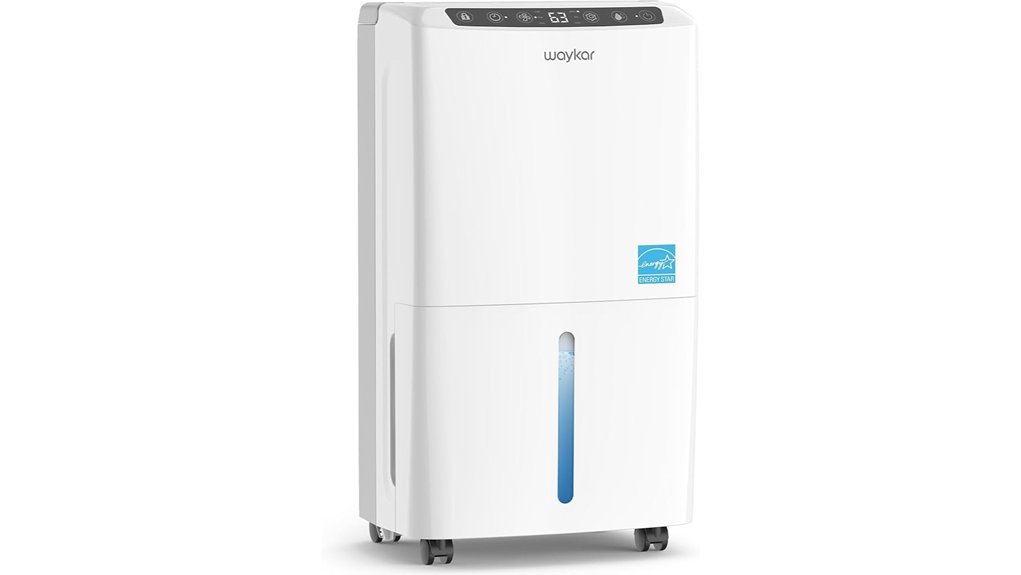
The Waykar 34-Pint Dehumidifier is the strongest all-around option in this guide for a bedroom, living area, office, laundry area, or moderately damp basement. Unlike a small thermoelectric unit, it uses a compressor to remove a meaningful amount of moisture and includes controls for maintaining a selected humidity level.
The manufacturer lists a capacity of 34 pints per day at 95°F and 90% relative humidity. Those are warm, highly humid test conditions, so the amount collected in an ordinary home will usually vary. Its approximately 0.6-gallon bucket can be emptied manually, or the included drainage connection can be used where a suitable lower drain is available.
Why You’ll Like It
- Useful room-scale capacity: Better suited to persistent indoor humidity than a mini thermoelectric model.
- Automatic humidity control: Helps the unit cycle instead of running continuously after the selected level is reached.
- Continuous-drain option: Reduces bucket emptying when the unit can drain safely by gravity.
- Automatic defrost: Helps protect performance when the coil begins to frost in cooler conditions.
- Portable design: A handle and casters make it easier to move between rooms.
Best For: Coastal California homeowners who need ongoing moisture control in a normal room or moderately damp lower-level space.
Who Should Avoid It: Buyers who need a tiny cordless solution for a closet, or anyone who has active water intrusion that must be repaired before dehumidification.
Pros:
- Compressor-based moisture removal for room-scale humidity control.
- Manual bucket collection and gravity-hose drainage options.
- Washable filter and automatic defrost for routine household operation.
- More appropriate for mold-prevention humidity control than low-capacity mini models.
Cons:
- The listed capacity is measured under warm, very humid conditions.
- The bucket can fill quickly if continuous drainage is not available.
- A compressor unit is larger and more noticeable than a small thermoelectric model.
- Certification and warranty terms should be confirmed on the current listing before purchase.
CLEVAST Mini Dehumidifier for Home and RV
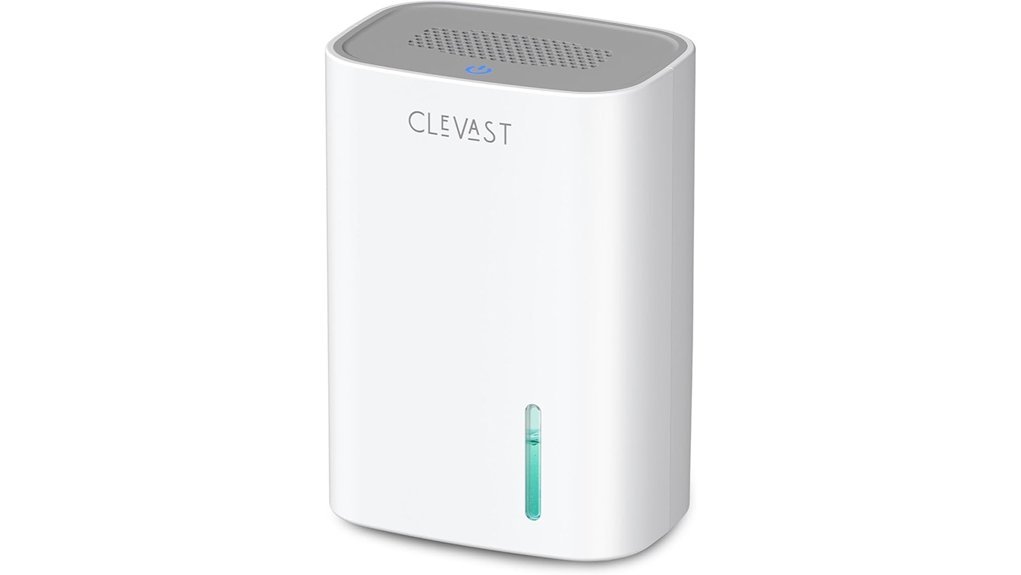
The CLEVAST CL-DH04 Mini Dehumidifier is designed for mild moisture control in a small bathroom, bedroom corner, RV, camper, or similarly enclosed space. At approximately 2.1 pounds, it is easy to carry and takes up much less floor space than a compressor dehumidifier.
Its listed moisture-removal capacity is up to approximately 10 ounces per day at 86°F and 85% relative humidity, with a 30-ounce collection tank. Because it uses thermoelectric technology, it works best in warm and humid conditions. It should not be treated as a substitute for a compressor unit in a damp basement, large bedroom, or open-plan living area.
Why You’ll Like It
- Compact footprint: Fits more easily on a counter, shelf, or small floor area.
- Low listed noise: The manufacturer lists operation around 24 dB under its test conditions.
- Automatic shutoff: Stops collection when the tank is full to reduce overflow risk.
- Simple controls: Suitable for buyers who do not need a humidistat, app, or complex operating modes.
Best For: Mild condensation or stuffiness in a small, warm, enclosed room, RV, or camper.
Who Should Avoid It: Anyone trying to control widespread dampness, a cold garage, an open basement, an active leak, or recurring visible mold.
Pros:
- Lightweight and easy to relocate.
- Quiet listed operation for bedrooms and RV sleeping areas.
- Automatic full-tank shutoff.
- Removable tank for straightforward emptying and cleaning.
Cons:
- Much lower moisture-removal capacity than a compressor dehumidifier.
- Performance can decline in cooler or less humid conditions.
- No continuous-drain hose or adjustable humidistat.
- Not appropriate for serious mold-prevention work across a large room.
Eva-Dry Wireless Mini Dehumidifier, White (E-333)
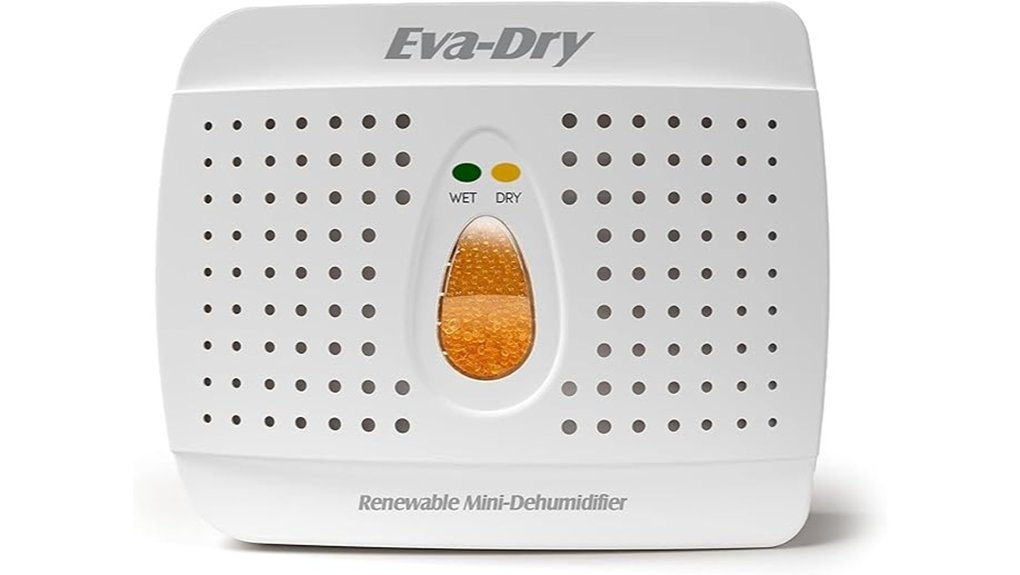
The Eva-Dry E-333 is a renewable silica-gel moisture absorber for small enclosed spaces. It does not use electricity while absorbing moisture, and it has no bucket, fan, compressor, or operating noise. Typical uses include closets, cabinets, safes, storage compartments, vehicles, boats, and similar spaces up to approximately 333 cubic feet.
The unit can absorb up to approximately 6 ounces of moisture before renewal. Eva-Dry states that a cycle commonly lasts around 20–30 days, although the actual time depends on the enclosure and humidity level. When its indicator beads show saturation, the unit must be plugged into a suitable outlet to dry the beads before it can be used again.
Why You’ll Like It
- Cordless during normal use: Can be placed where a power outlet is unavailable.
- No water tank: Moisture is held by renewable silica-gel beads.
- Silent operation: There is no fan or compressor.
- Reusable design: The beads can be renewed instead of replacing disposable moisture-absorber refills.
Best For: A closet, cabinet, safe, stored vehicle, boat compartment, or other small enclosed area.
Who Should Avoid It: Buyers who need to lower humidity in a bedroom, bathroom, basement, laundry room, or other occupied room.
Pros:
- Compact and easy to hang or place on a shelf.
- Silent and cordless while absorbing moisture.
- Color-changing indicator shows when renewal is needed.
- Manufacturer currently advertises a five-year limited warranty.
Cons:
- Designed for cubic-foot enclosures, not full-size rooms.
- Absorbs only a limited amount before renewal is required.
- The unit becomes warm during the plug-in renewal cycle.
- Cannot maintain a selected relative-humidity setting.
Waykar 80-Pint Dehumidifier for Home
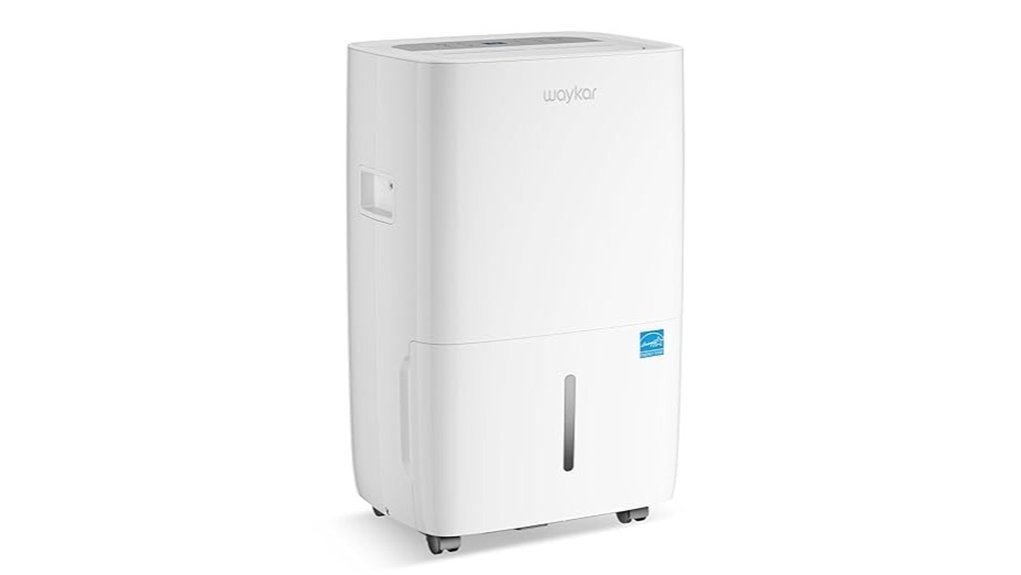
The Waykar 80-Pint Dehumidifier is the higher-capacity choice for a large room, open basement, workshop, or other persistently damp area. The manufacturer advertises moisture removal of up to 80 pints per day at 95°F and 90% relative humidity and coverage up to 5,000 square feet.
Those figures should be treated as manufacturer ratings under specified conditions rather than guaranteed household performance. Actual collection depends on temperature, starting humidity, air circulation, ceiling height, doors, moisture sources, and whether the area is divided into multiple rooms.
The unit includes automatic humidity control, automatic defrost, a washable filter, a manual bucket, and a gravity-drain connection. Continuous drainage is particularly useful when the dehumidifier will operate for long periods in a damp Coastal California space.
Why You’ll Like It
- Higher moisture capacity: More suitable than a mini model for larger or wetter areas.
- Automatic humidity control: Lets the unit respond to changing indoor conditions.
- Continuous drainage: Helps avoid frequent emptying when a properly positioned drain is available.
- Automatic defrost: Supports operation when cooler conditions cause frost to form.
- Portable construction: Casters and a handle make room-to-room movement easier despite its larger size.
Best For: Large rooms, open basements, workshops, laundry areas, or homes with a heavier ongoing moisture load.
Who Should Avoid It: Buyers with only a small closet or bathroom, or anyone without enough clearance and floor space for a full-size compressor appliance.
Pros:
- Higher listed capacity for larger or persistently humid areas.
- Manual bucket and continuous gravity-drain options.
- Adjustable humidity controls and automatic defrost.
- Washable filter and portable caster design.
Cons:
- The advertised 80-pint rating uses warm, highly humid test conditions.
- The manufacturer’s square-foot coverage is not a guarantee for every floor plan or moisture condition.
- The approximately 1.14-gallon bucket may fill frequently during heavy operation.
- It requires more floor space and produces more operating noise than a mini unit.
Factors to Consider When Choosing a Dehumidifier for Mold Prevention in Coastal California
The best dehumidifier is not necessarily the model with the biggest tank or highest advertised floor coverage. Match the unit to the size of the connected space, the severity of dampness, the operating temperature, and the amount of water it can remove per day.
Authoritative guidance
The U.S. Environmental Protection Agency recommends keeping indoor relative humidity below 60%, ideally between 30% and 50%, and repairing moisture sources promptly. Review the EPA mold and moisture guide and the ENERGY STAR dehumidifier sizing guide before choosing a capacity.
Fix the Moisture Source First
A dehumidifier can remove water vapor from the air, but it cannot stop rain penetration, plumbing leaks, groundwater seepage, roof damage, or water entering around a window. Repair the source first and dry affected materials promptly. Otherwise, the unit may run continuously without solving the underlying problem.
If mold keeps returning, a wall remains wet, paint is bubbling, flooring is lifting, or a musty smell seems to come from inside a wall, consider having the building inspected by a qualified professional.
Humidity Control Capacity
Prioritize the listed moisture-removal capacity rather than relying only on a square-foot number. Capacity is normally expressed in pints per day for compressor models and ounces or milliliters per day for small thermoelectric units.
- Compressor dehumidifiers are normally the better choice for bedrooms, living rooms, basements, laundry areas, and persistent humidity.
- Thermoelectric dehumidifiers work best for mild moisture in small, warm, enclosed spaces.
- Renewable silica-gel units are intended for closets, cabinets, safes, and storage compartments rather than occupied rooms.
Also check the test conditions behind the capacity. A rating measured at 95°F and 90% RH will usually be higher than a standardized rating measured in cooler, more realistic conditions.
Room Layout and Coverage
Advertised coverage is only a starting point. A dehumidifier may perform differently in an open room than in several rooms separated by doors and hallways. High ceilings, damp concrete, laundry drying, frequent showers, and outdoor air leakage can also increase the moisture load.
When one unit serves multiple rooms, keep interior doors open and place the machine where air can circulate freely. Do not block its intake or exhaust with furniture, curtains, or walls.
Humidity Setting and Hygrometer
A compressor model with an adjustable humidistat can cycle automatically around a selected humidity level. For mold prevention, a practical target is generally between 30% and 50% RH, while avoiding unnecessarily dry air.
Use a separate hygrometer to check the room because built-in sensors can be influenced by air immediately surrounding the machine. Place the hygrometer away from the dehumidifier, shower, stove, window, or exterior door.
Drainage Options
A small bucket may need frequent emptying during damp weather. Most full-size compressor models offer two options:
- Manual collection: Water enters a removable bucket and the machine shuts off when it is full.
- Gravity drainage: A hose directs water continuously to a drain located below the outlet.
A gravity hose cannot normally push water uphill. If the drain is higher than the dehumidifier, look for a model with a built-in pump or use a separately approved condensate-pump arrangement.
Noise Level Considerations
Noise specifications are useful for comparison, but actual sound depends on fan speed, floor type, vibration, room acoustics, and measurement distance. Mini thermoelectric models are usually quieter, while compressor models provide much stronger moisture removal.
For a bedroom, look for adjustable fan speeds, a display-off function, and a sleep-oriented mode. Placing the unit on a stable, level surface can also reduce vibration.
Energy Efficiency Ratings
A dehumidifier may operate for many hours during damp weather, so efficiency matters. ENERGY STAR-certified models meet defined efficiency requirements, but certification does not mean every model will use the same amount of electricity.
Energy use depends on capacity, room conditions, runtime, fan speed, and the humidity setting. Avoid unsupported claims that a model will save a specific dollar amount each year. For an accurate estimate, multiply the unit’s wattage by expected operating hours and your local electricity rate.
Operating Temperature and Defrost
Compressor coils can collect frost in cooler rooms. An automatic-defrost feature pauses or adjusts operation to help the frost melt. This is useful in basements, garages, or other spaces that become cool at night.
Thermoelectric units also lose effectiveness in cooler or less humid conditions. Check the manufacturer’s recommended temperature range before placing one in an unheated area.
Tank Size and Capacity
Tank size controls how often the bucket must be emptied; it does not show how powerful the dehumidifier is. A unit with a large tank can still remove moisture slowly, while a high-capacity compressor model with a smaller tank may fill rapidly.
For persistent humidity, prioritize moisture-removal capacity and a safe continuous-drain route rather than choosing solely by bucket size.
Portability and Placement
Look for casters, a strong handle, manageable weight, and adequate cord length if the unit will move between rooms. Always unplug the machine before moving it, and empty the bucket first to prevent spills.
Leave the manufacturer’s recommended clearance around the air intake and outlet. Operating a dehumidifier inside a closed cabinet or directly against a wall can reduce airflow and performance.
Maintenance and Cleaning Needs
Routine cleaning helps maintain airflow and prevents collected water from developing odors or residue.
- Clean the washable air filter according to the manual.
- Empty and rinse the bucket regularly.
- Inspect the drain hose for kinks, buildup, and loose connections.
- Wipe dust from the intake and exhaust openings.
- Keep the area around the machine dry and unobstructed.
- Unplug the unit before cleaning or moving it.
Coastal California Use Tips
- Run bathroom exhaust fans during showers and for a period afterward.
- Vent clothes dryers outdoors and check that the duct is not blocked.
- Close windows when outdoor air is damp; open them only when outdoor conditions are drier.
- Do not operate the dehumidifier continuously with exterior doors or windows open.
- Check closets, exterior-wall corners, window frames, and areas behind furniture for condensation.
- Use continuous drainage when long operating periods are expected and a safe drain is available.
Before You Buy: Quick Checklist
- Have you repaired leaks and other direct water sources?
- What is the current humidity according to a separate hygrometer?
- Is the space one open room or several divided rooms?
- Is the area mildly humid, very damp, or actively wet?
- Is a compressor, thermoelectric, or passive desiccant product appropriate?
- Can the unit drain continuously by gravity?
- Will it operate in a cool basement or garage?
- Can you clean the filter and bucket regularly?
- Have you checked the exact model number, current certification, and warranty terms?
Frequently Asked Questions
How Often Should I Empty My Dehumidifier’s Water Tank?
Empty it whenever the full-tank indicator appears. In a very damp room, that may be once or several times per day. A continuous gravity-drain hose can reduce manual emptying when it is installed according to the manufacturer’s instructions.
Can a Dehumidifier Remove Existing Mold?
No. A dehumidifier can lower airborne moisture and make future mold growth less likely, but it does not remove established mold or repair water-damaged materials. Correct the water source and clean or remediate affected materials properly.
What Humidity Level Is Optimal for Mold Prevention?
Aim for approximately 30%–50% relative humidity and keep it below 60%. Use a separate hygrometer to confirm conditions in the room instead of relying only on how the air feels.
Are Mini Dehumidifiers Powerful Enough for a Basement?
Usually not. Small thermoelectric models are intended for mild humidity in small, warm, enclosed areas. A damp basement normally needs a properly sized compressor dehumidifier with a rated pints-per-day capacity and, ideally, continuous drainage.
How Do I Choose the Right Capacity?
Consider both the connected floor area and how damp it is. A musty but slightly damp room needs less capacity than a room with visible condensation, damp walls, or laundry drying. Compare standardized pint ratings where available and avoid choosing solely by advertised square-foot coverage.
How Noisy Are These Dehumidifiers During Operation?
Passive silica-gel products are silent, and thermoelectric models are generally quiet. Compressor dehumidifiers are more audible because they use a fan and refrigeration system, but they also remove much more moisture. Actual sound can differ from the listed laboratory figure.
Do Dehumidifiers Consume a Lot of Electricity?
Electricity use depends on wattage, capacity, humidity setting, and runtime. An appropriately sized efficient model may reach the target humidity faster than an undersized unit that runs continuously. Check the current ENERGY STAR record and the product’s wattage instead of relying on a promised dollar-saving figure.
Should Windows Be Open While a Dehumidifier Is Running?
Usually not when the outdoor air is humid. Open windows only when outdoor conditions are drier than the indoor air. Otherwise, the dehumidifier will continually process incoming moisture and may struggle to reach the selected humidity.
Conclusion
The Waykar 34-Pint Dehumidifier is the best overall choice in this guide for normal rooms and moderate dampness. Choose the Waykar 80-Pint Dehumidifier when the connected area is larger or the moisture load is heavier. The CLEVAST CL-DH04 is suitable only for mild humidity in a small, warm room or RV, while the Eva-Dry E-333 is a specialized option for closets, cabinets, and other enclosed storage spaces.
Final Recommendation
Start by measuring the room with a hygrometer and repairing any direct source of water. Then choose a unit by moisture-removal capacity, room conditions, drainage, and operating temperature—not by tank size or square-foot marketing alone. Maintain approximately 30%–50% relative humidity and inspect recurring mold or water damage instead of relying on a dehumidifier as the only solution.