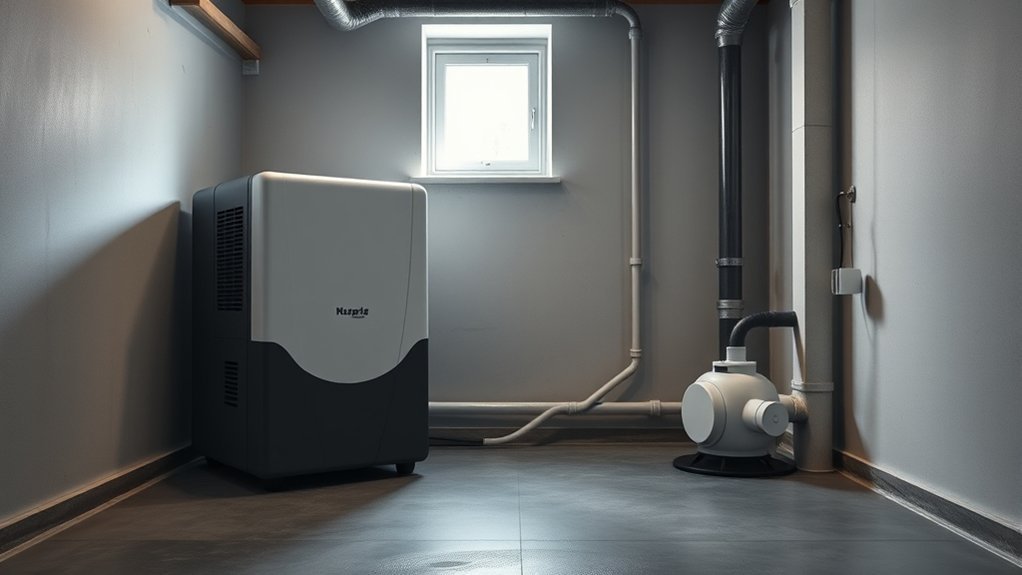
Choosing the best dehumidifier with a pump for a basement means looking beyond the largest square-foot number on the box. Moisture-removal capacity, the conditions used to calculate that capacity, pump lift, hose routing, basement temperature, noise, and maintenance all affect real-world performance. This updated 2026 guide compares eight pump-equipped models, ranging from compact crawl-space units to high-capacity residential and commercial dehumidifiers.
Quick verdict
The AEOCKY 4500 Sq.Ft Dehumidifier with Pump is the strongest balanced choice for many large residential basements because it combines an integrated pump, published performance at more than one humidity condition, efficient operation, and straightforward humidity control.
Choose the MOISWELL Defender ME-7S for a compact basement or crawl space, the Waykar 150 Pints for a large residential area, or the Airzentti 155 Pints when you need a commercial-style unit with a disclosed 70-pint AHAM rating.
Important capacity note:
A model advertised as 80, 100, 150, or 155 pints may reach that figure only under hot, extremely humid, or nearly saturated conditions. Compare pints per day only when the test temperature and relative humidity are the same. Advertised square-foot coverage should be treated as general guidance rather than a guarantee.
Quick Comparison of Basement Dehumidifiers With Pumps
| Product | Published Capacity | Advertised Coverage | Pump Detail | Best For | Check Details |
|---|---|---|---|---|---|
| AEOCKY 4500 Sq.Ft | Max 80 pints; listing also states 56 pints at 86°F and 80% RH | Up to 4,500 sq. ft. | Integrated pump with up to 5 m of upward drainage | Balanced residential performance | Check on Amazon |
| DECIUU Max 100 Pint | Max 100 pints at 95°F and 90% RH; 70 pints at 86°F and 80% RH | Up to 5,000 sq. ft. | Built-in pump with up to 16.4 ft. vertical lift | Large basements without a floor drain | Check on Amazon |
| MOISWELL Defender ME-7S | 70 pints at saturation; 35 pints under AHAM conditions | Up to 1,000 sq. ft. | Built-in pump with vertical drainage | Compact basements and crawl spaces | Check on Amazon |
| Airzentti 155 Pints | 155 pints near saturation; 70 pints under AHAM conditions | Up to 7,500 sq. ft. | Built-in pump and continuous drainage | Commercial or restoration-style use | Check on Amazon |
| Waykar 150 Pints | Max 150 pints under hot, very humid conditions | Up to 7,000 sq. ft. | Built-in pump with up to 9.84 ft. upward drainage | Large residential basements | Check on Amazon |
| Uhome 150 Pints | Max 150 pints under hot, very humid conditions | Up to 7,000 sq. ft. | Pump, gravity drain, and bucket options | Large rooms needing flexible drainage | Check on Amazon |
| Gasbye DryPrime | Max 75 pints per day | Up to 4,500 sq. ft. | Removable pump and 16.5 ft. pump hose | Easier pump cleaning and servicing | Check on Amazon |
| Sijipt 80 Pints | Max 80 pints at 95°F and 90% RH | Up to 5,000 sq. ft. | Built-in pump with up to 16.4 ft. vertical lift | Simple automatic pump drainage | Check on Amazon |
AEOCKY 4500 Sq.Ft Dehumidifier with Pump
Best Overall
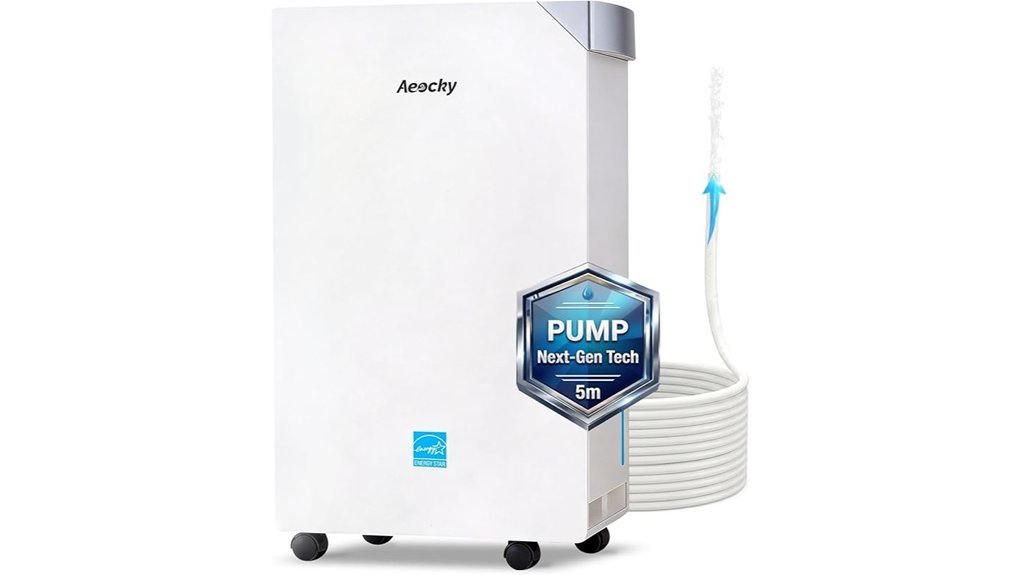
The AEOCKY 4500 Sq.Ft Dehumidifier with Pump offers a useful balance of residential capacity, automatic drainage, and energy-conscious operation. Its listing states a maximum removal rate of 80 pints per day under extreme summer conditions and 56 pints per day at 86°F and 80% relative humidity. Publishing both figures makes it easier to understand how performance may change outside the most favorable test environment.
The integrated pump can move collected water upward through the included hose, which is useful when the nearest sink, standpipe, or drain is above the unit. Smart humidity control and power-off memory also make it suitable for unattended basement operation when installed correctly.
Best For: Homeowners who want a balanced pump-equipped unit for a medium or large basement without relying only on a maximum saturation rating.
Why You’ll Like It:
- Provides both a maximum rating and a lower-condition moisture-removal figure.
- Integrated pump supports upward drainage where gravity drainage is impractical.
- Humidity controls and restart memory support routine basement use.
Consider Before Buying:
- The 4,500-square-foot claim is a general coverage guide, not a performance guarantee.
- The highest 80-pint figure is measured under very warm, humid conditions.
- Confirm the required vertical lift and total hose route before installation.
DECIUU Max 100 Pint Dehumidifier with Pump
Best Value for Large Basements
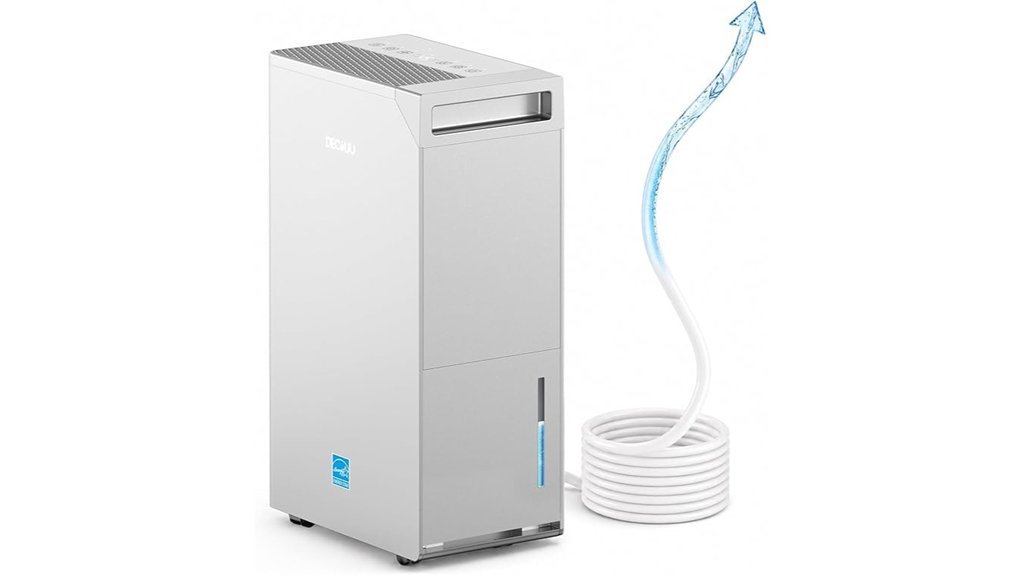
The DECIUU Max 100 Pint Dehumidifier is designed for large basements, garages, laundry rooms, and other persistently damp indoor spaces. Its listing states that it removes up to 100 pints per day at 95°F and 90% relative humidity and up to 70 pints at 86°F and 80% relative humidity.
The built-in pump can move water vertically by up to 16.4 feet, according to the listing. You can also use gravity drainage or the removable tank, giving you three ways to manage collected water. Casters, a digital control panel, auto defrost, and automatic restart improve everyday usability.
Best For: Large basements where a drain is above the dehumidifier or where flexible drainage options are important.
Why You’ll Like It:
- Maximum and lower-condition performance figures are both provided.
- Built-in pump supports substantial vertical drainage.
- Offers pump, gravity, and tank drainage options.
Consider Before Buying:
- The 100-pint rating is measured under hot, extremely humid conditions.
- The compact tank may fill quickly if pump or gravity drainage is not used.
- The filter and pump drainage path require routine inspection and cleaning.
MOISWELL 70 Pints Portable Commercial Dehumidifier
Best for Compact Basements and Crawl Spaces
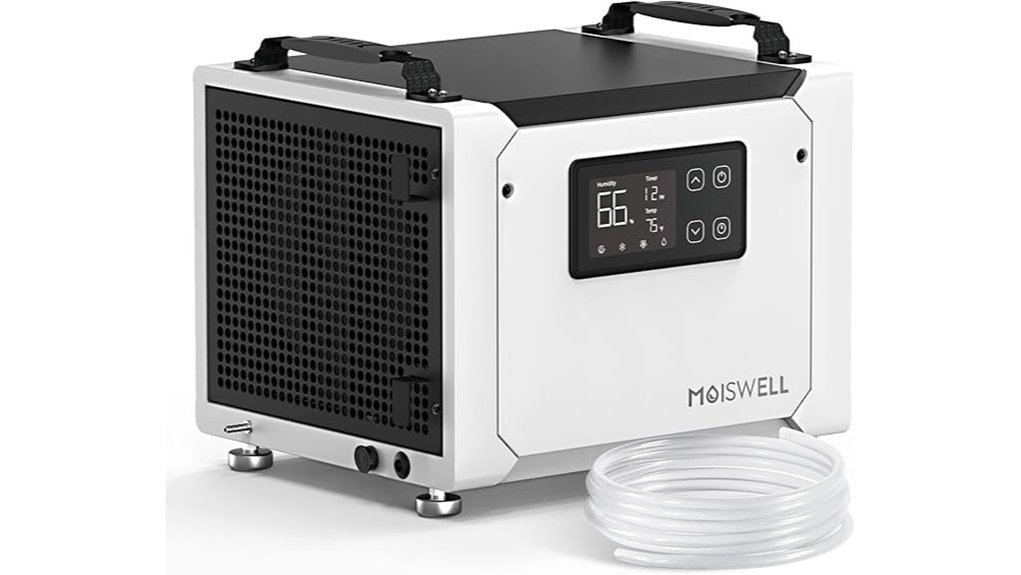
The MOISWELL Defender ME-7S is a compact commercial-style dehumidifier designed for basements, crawl spaces, storage rooms, and other areas where a taller residential unit may be inconvenient. The listing distinguishes between a 70-pint saturation rating and a 35-pint-per-day AHAM rating, making it easier to compare its practical capacity with other models.
Its built-in pump can move water upward when a nearby floor drain is unavailable. Automatic defrost supports operation in cooler spaces, while the compact horizontal cabinet is easier to position in low-clearance areas.
Best For: Basements or crawl spaces up to about 1,000 square feet where compact dimensions matter more than a large advertised maximum capacity.
Why You’ll Like It:
- Clearly separates saturation and AHAM moisture-removal ratings.
- Compact commercial-style design fits lower-clearance spaces.
- Built-in pump reduces dependence on a floor-level drain.
Consider Before Buying:
- The practical AHAM rating is 35 pints per day, not 70 pints.
- Its 1,000-square-foot coverage is smaller than the residential tower models.
- At about 40 pounds, it is portable but not lightweight.
Airzentti 155 Pints Commercial Dehumidifier
Best Commercial Pick
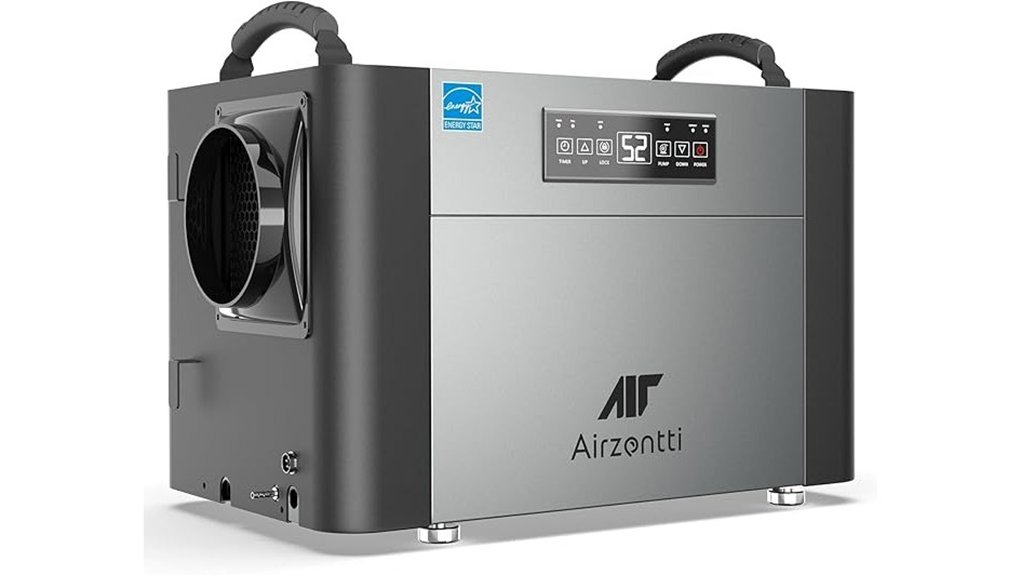
The Airzentti 155 Pints Commercial Dehumidifier is aimed at large basements, crawl spaces, garages, warehouses, water-damage projects, and other demanding applications. It is advertised to remove up to 155 pints per day in nearly saturated conditions and 70 pints per day under AHAM conditions.
Its horizontal commercial-style cabinet includes a built-in pump, automatic defrost, automatic restart, continuous drainage, and a published airflow rate of 220 CFM. A duct collar also provides more installation flexibility than a typical residential tower unit.
Best For: Large or persistently damp spaces where commercial construction, ducting support, and a disclosed 70-pint AHAM rating are priorities.
Why You’ll Like It:
- Provides a 70-pint AHAM figure in addition to the 155-pint saturation claim.
- Commercial-style cabinet supports crawl-space and ducted applications.
- Built-in pump and auto defrost support continuous moisture control.
Consider Before Buying:
- The 155-pint headline figure is a near-saturation rating.
- At roughly 60 pounds, it is heavier than residential tower models.
- Its commercial format may be unnecessary for an average finished basement.
Waykar 150 Pints Energy Star Dehumidifier with Pump
Best for Large Residential Basements
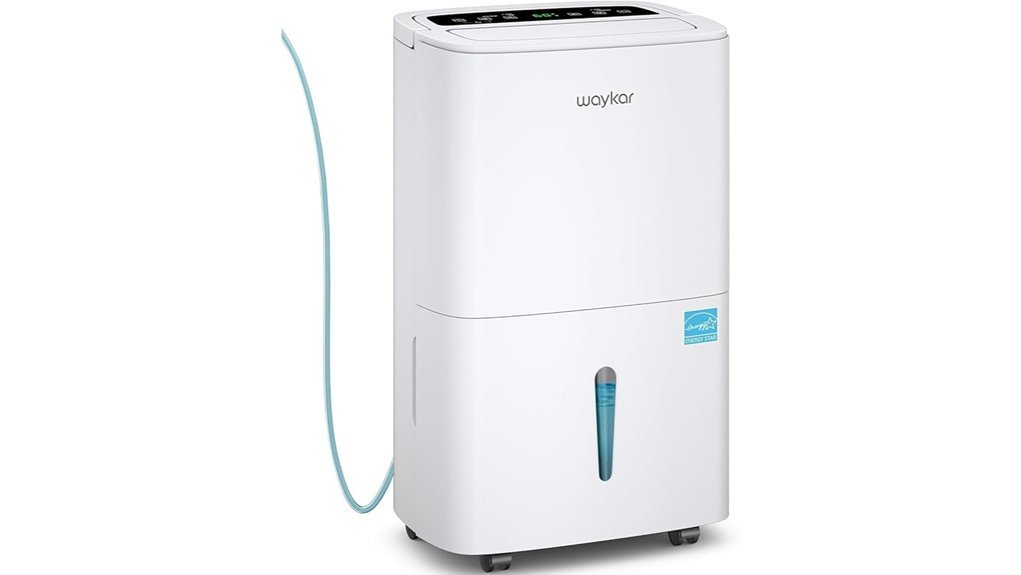
The Waykar 150 Pints Energy Star Dehumidifier with Pump targets large residential, commercial, and storage spaces. Its maximum 150-pint rating is based on hot, very humid conditions, so it should not be compared directly with an AHAM-rated 150-pint commercial unit.
The built-in pump can move water upward by up to 9.84 feet, according to the current listing. The unit also supports gravity drainage and tank collection. A 1.85-gallon tank, adjustable humidistat, timer, auto defrost, automatic restart, washable filter, and casters provide familiar residential controls.
Best For: Large residential basements where high maximum capacity and three drainage methods are more important than a low-profile commercial cabinet.
Why You’ll Like It:
- Large advertised capacity and coverage for expansive spaces.
- Built-in pump, gravity hose, and bucket collection provide flexibility.
- Residential controls and casters simplify routine operation.
Consider Before Buying:
- The 150-pint figure is a maximum rating under hot, humid conditions.
- The pump’s stated upward lift is lower than some 16.4-foot pump models.
- The cabinet is relatively large for a small or lightly damp basement.
Uhome 150 Pints Dehumidifier with Pump for Large Rooms
Best Flexible High-Capacity Option
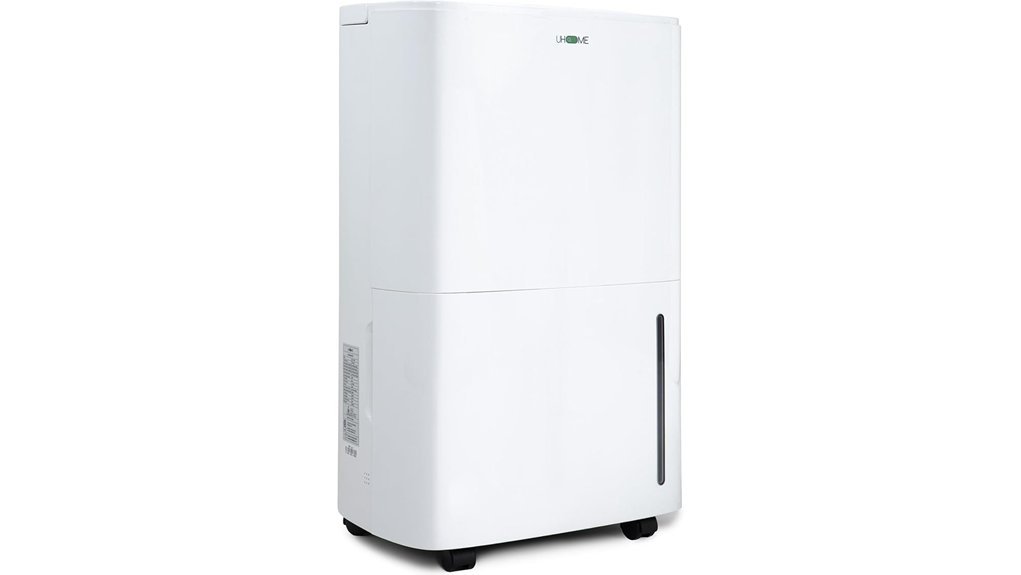
The Uhome 150 Pints Dehumidifier with Pump is designed for large basements, storage areas, and other spaces where manual tank emptying would be inconvenient. It is advertised for spaces up to 7,000 square feet and can be set between 30% and 80% relative humidity in 5% increments.
Users can choose pump drainage, gravity drainage, or the removable 1.85-gallon tank. This makes it easier to adapt the unit to different drain locations, although the maximum lift and approved hose route should be confirmed in the manual before installation.
Best For: Large rooms where the owner wants multiple drainage methods and broad humidity adjustment.
Why You’ll Like It:
- Pump, gravity, and bucket drainage support different basement layouts.
- Wide humidity adjustment range offers more control.
- Large advertised capacity suits persistently damp spaces.
Consider Before Buying:
- The 150-pint rating is a maximum figure measured under hot, humid conditions.
- The tank may fill quickly if automatic drainage is not connected.
- Confirm pump lift, hose dimensions, and warranty terms on the current listing.
Gasbye Energy Star Dehumidifier for Basement
Best Serviceable Pump Design
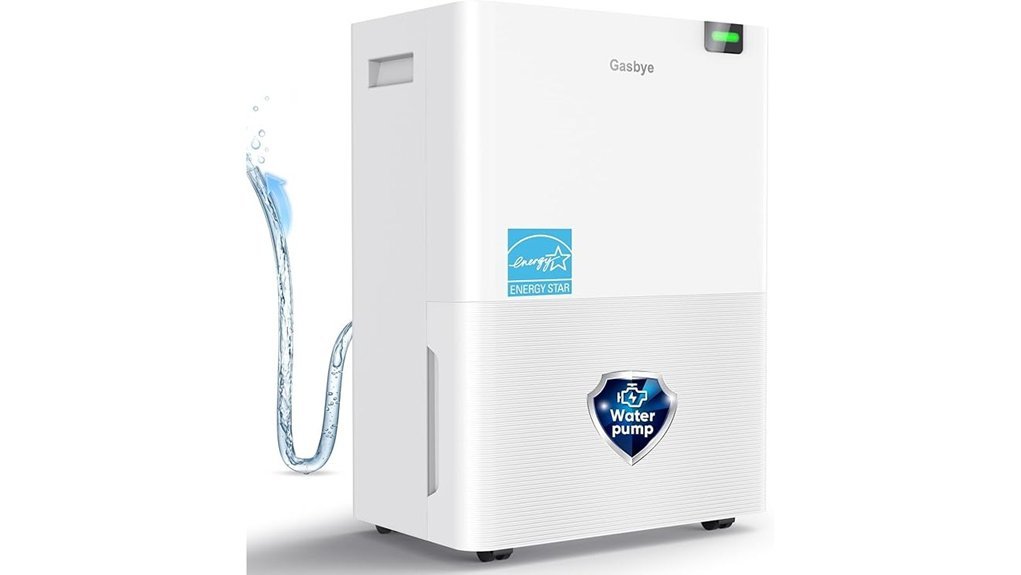
The Gasbye Energy Star Dehumidifier with Pump is notable for its removable and cleanable pump assembly. Most buyers will still need to follow the manufacturer’s maintenance instructions, but easier pump access may be attractive in a dusty basement where drain-path buildup is a concern.
The listing states a maximum capacity of 75 pints per day, coverage up to 4,500 square feet, a 1.45-gallon tank, automatic shutoff, automatic restart, and a 16.5-foot pump hose. The hose length should not be confused with vertical pump lift; check the manual for the permitted rise and total routing distance.
Best For: Buyers who prioritize access to the pump for cleaning or replacement.
Why You’ll Like It:
- Removable pump design may simplify cleaning and servicing.
- Supports pump drainage and manual tank collection.
- Published 44 dB operating claim may suit a finished basement.
Consider Before Buying:
- The 75-pint figure is a maximum rating rather than a disclosed AHAM figure.
- A 16.5-foot hose does not necessarily provide 16.5 feet of vertical lift.
- The removable pump still needs regular inspection to reduce clog risk.
Sijipt 80 Pints Dehumidifier with Pump
Best Straightforward Pump Option
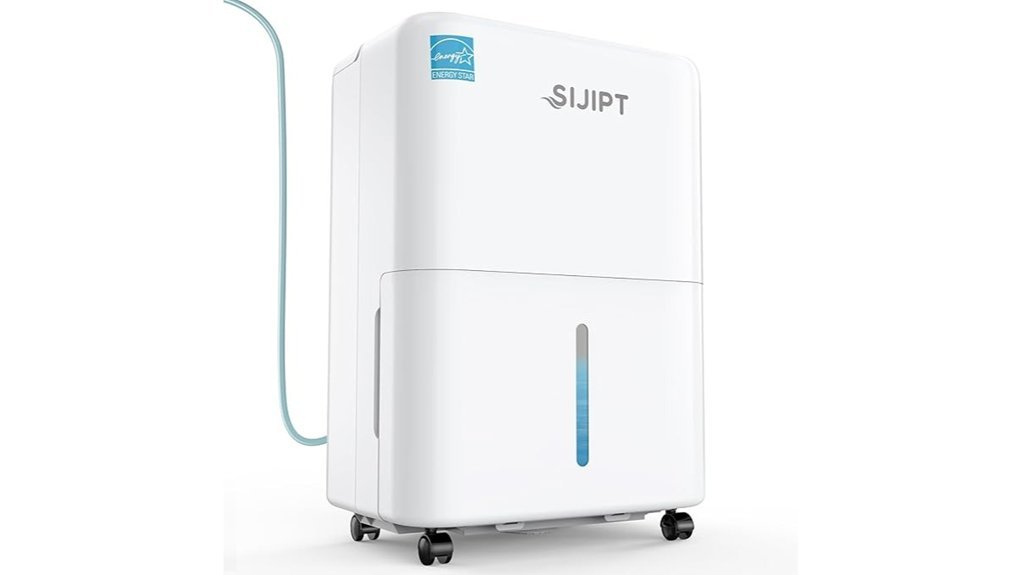
The Sijipt 80 Pints Dehumidifier combines a familiar residential tower design with a built-in pump that can move condensate sideways or vertically by up to 16.4 feet. Its maximum 80-pint rating is measured at 95°F and 90% relative humidity.
The unit is advertised for spaces up to 5,000 square feet and includes adjustable humidity control, automatic defrost, power-off memory, a 24-hour timer, two fan speeds, and a 5-liter tank. It also supports gravity drainage when a suitable lower drain is available.
Best For: Buyers who want straightforward controls and a pump with a clearly stated maximum vertical lift.
Why You’ll Like It:
- Built-in pump supports up to 16.4 feet of vertical drainage.
- Automatic restart and timer support unattended operation.
- Tank and gravity-drain options remain available as alternatives.
Consider Before Buying:
- The 80-pint capacity is measured under extreme heat and humidity.
- Only two fan-speed settings are provided.
- Confirm the supplied gravity-hose dimensions because listing descriptions may be inconsistent.
Factors to Consider When Choosing a Basement Dehumidifier With a Pump
A built-in condensate pump can eliminate frequent tank emptying, but the pump alone does not make a dehumidifier suitable for every basement. Use the following factors to compare models more accurately.
Compare Capacity Under the Same Conditions
Do not compare a saturation rating from one model directly with an AHAM or lower-condition rating from another. A dehumidifier can collect substantially more water in hot air at 90% relative humidity than it will in a cool basement at moderate humidity. Look for the temperature and relative humidity shown beside each pints-per-day figure.
When two models use different conditions, treat the larger number as a maximum marketing figure rather than proof that one model will remove twice as much water in your basement.
Treat Square-Foot Coverage as a Starting Point
Advertised coverage helps separate compact units from larger models, but it does not account for every basement. A 2,000-square-foot basement with minor seasonal dampness may require less capacity than a 1,000-square-foot basement with seepage, wet walls, poor air circulation, or frequent laundry drying.
Consider the floor area, ceiling height, starting humidity, temperature, number of rooms, open or closed doors, and whether water is entering through a leak or foundation problem.
Check Pump Lift and Hose Routing
Vertical pump lift is the height the pump can move water upward. Hose length is simply the amount of tubing supplied. These figures are not interchangeable.
Measure the vertical rise from the dehumidifier outlet to the highest point of the hose. Then measure the complete route to the sink, standpipe, sump basin, or drain. Avoid sharp bends, pinched tubing, frozen discharge points, and any routing method prohibited by the manual.
Understand Gravity and Pump Drainage
Gravity drainage is usually the simplest method when a suitable drain is lower than the dehumidifier. It uses no pump and has fewer moving parts. Pump drainage is useful when water must travel upward, but the pump, intake area, and hose require inspection to prevent buildup or blockage.
A model with both options provides a useful backup if the pump needs cleaning or service.
Consider Basement Temperature and Auto Defrost
Compressor dehumidifiers become less effective as temperatures fall. Frost may form on the coils in a cool basement, temporarily stopping moisture removal. An automatic defrost function helps the unit manage frost, but it does not make every model suitable for near-freezing conditions.
Check the manufacturer’s published operating-temperature range if your basement becomes cold in winter.
Consider Noise and Placement
A compressor, fan, and condensate pump each produce sound. Published decibel figures may also be measured on the lowest fan setting or under controlled conditions. Leave enough space around the air intake and outlet, keep the cabinet level, and avoid placing it against loose paneling or furniture that can amplify vibration.
Look for Useful Humidistat Controls
A digital humidistat lets the dehumidifier cycle on and off around a target humidity. Many basements are comfortable around 45% to 55% relative humidity, although the best setting depends on temperature, building materials, stored items, and condensation risk.
Automatic restart, power-off memory, continuous mode, a timer, and a child lock may also be useful depending on where the unit is installed.
Plan for Maintenance
Clean or inspect the air filter according to the manual. Also check the pump inlet, internal collection area, drain hose, fittings, and discharge point for dust, slime, kinks, or leaks. A clogged hose can cause the tank to fill or the unit to stop even when the pump itself still works.
Review Warranty and Support Terms
Warranty duration alone does not tell the full story. Check whether the pump, compressor, labor, shipping, and replacement parts are covered. Determine whether product registration is required for extended coverage and save the order confirmation, model number, and serial number.
Before you buy
- Measure the basement and note the current humidity and temperature.
- Identify whether the drain is above or below the dehumidifier.
- Measure the required vertical lift and complete hose route.
- Confirm capacity under comparable test conditions.
- Check the operating-temperature range and auto-defrost feature.
- Confirm the pump hose, gravity hose, and required fittings are included.
- Review pump, compressor, and shipping coverage in the warranty.
Moisture and electrical safety note
A dehumidifier can manage moisture in the air, but it cannot repair a plumbing leak, foundation seepage, failed sump pump, poor exterior drainage, or flooding. Do not place the unit or its power connection in standing water. Use the outlet type, clearances, hose routing, and installation method specified by the manufacturer.
Frequently Asked Questions
Do I Have to Empty a Dehumidifier With a Pump?
Normally, no. When pump mode is installed and working correctly, the unit collects condensate internally and automatically pumps it through the discharge hose. You may still need to empty the tank if you use bucket mode, the pump is disabled, the hose is blocked, or the pump develops a fault.
How High Can a Dehumidifier Pump Water?
It depends on the model. Some units in this guide advertise approximately 9.84 feet of upward lift, while others advertise up to 16.4 feet. Measure vertical rise separately from total hose length and follow the exact limits in the product manual.
Is a 150-Pint Dehumidifier Always Stronger Than an 80-Pint Model?
Not necessarily. One model may advertise 150 pints under near-saturated conditions while another publishes 80 pints under a different temperature and humidity. Compare ratings only when the testing conditions match. An AHAM or lower-condition rating is often more useful than a saturation figure for a typical basement.
What Humidity Should I Set in My Basement?
A setting around 45% to 55% relative humidity is a practical starting range for many basements. Raise or lower the setting based on condensation, temperature, stored materials, comfort, and how often the unit runs. Extremely low settings may make the unit operate continuously without providing a meaningful benefit.
Can I Drain the Pump Into a Sink or Standpipe?
Often, yes, provided the drain location, vertical lift, hose routing, and connection method comply with the manual and local requirements. Secure the hose so it cannot fall out, kink, or create a trip hazard.
Can I Use a Basement Dehumidifier Outdoors?
Do not use a standard indoor dehumidifier outdoors unless the manufacturer explicitly rates it for that environment. Rain, direct sunlight, temperature extremes, insects, and unprotected electrical connections can damage the unit or create a safety risk.
How Often Should I Clean the Filter and Pump?
Follow the maintenance schedule in the manual. Inspect the filter more frequently in a dusty basement, and regularly check the pump inlet, collection area, hose, and discharge point. Reduced water flow, unexpected tank filling, leaks, or pump alarms can indicate that the drainage path needs attention.
Final Recommendation
For a typical large residential basement, the AEOCKY 4500 Sq.Ft Dehumidifier with Pump offers the most balanced combination of automatic drainage, published capacity at multiple humidity conditions, and residential controls.
Choose the MOISWELL Defender ME-7S for a compact basement or crawl space, the Waykar 150 Pints when you need a large residential tower unit, or the Airzentti 155 Pints for commercial-style construction and a disclosed 70-pint AHAM rating.
Before ordering, compare capacity under matching test conditions and confirm that the pump can handle the actual vertical rise and hose route in your basement.