Affiliate disclosure: This article contains Amazon affiliate links. If you buy through a qualifying link, we may earn a commission at no extra cost to you.
Last reviewed: August 2026. Product specifications and availability can change, so confirm the current Amazon listing before ordering.
Moisture can build up quickly inside an Airstream after cooking, showering, sleeping, or camping in humid weather. The right dehumidifier depends less on advertised room coverage and more on how serious the moisture problem is, how much space you have, and what electrical supply is available.
This focused guide compares two different approaches. The TABYIK 35 OZ is a compact thermoelectric dehumidifier for mild, localized condensation, while the KNKA 34-Pint is a larger compressor model for stronger humidity control during extended parked stays. Neither replaces ventilation, exhaust fans, air conditioning, leak repair, or prompt drying of wet materials.
Quick Verdict
- Best for Routine Condensation: TABYIK 35 OZ if you mainly want help with mild window condensation, a damp closet, or moisture near a sleeping area.
- Best for Persistent High Humidity: KNKA 34-Pint if humidity stays elevated throughout the trailer during stationary use and you have stable AC power, adequate floor space, and a suitable drainage setup.
Simple decision: Choose the TABYIK for light and localized moisture management. Choose the KNKA when you need substantially faster moisture removal across the trailer while parked.
Quick Comparison of Airstream Dehumidifiers
| Product | Best Use | Type | Key Advantage | Amazon |
|---|---|---|---|---|
| TABYIK 35 OZ | Mild condensation, closets, and sleeping areas | Thermoelectric | Compact, quiet, and easy to place | Check Product Details |
| KNKA 34-Pint | Persistent humidity during extended parked stays | Compressor | Higher extraction, humidistat, and continuous drainage | Check Current Availability |
Important: Daily extraction and square-foot figures are manufacturer-listed ratings measured under specific conditions. Actual performance inside an Airstream varies with temperature, outdoor humidity, ventilation, occupancy, cooking, showering, and other moisture sources. Do not use advertised square-foot coverage as an exact RV-sizing rule.
How We Selected These Models
This is a specification-and-use-case comparison rather than a claim of hands-on laboratory testing. We focused on two products that address different Airstream moisture problems: a compact thermoelectric model for routine localized moisture and a higher-capacity compressor model for persistent humidity during stationary use.
Selection factors included physical size, water-removal capacity, tank design, drainage options, humidity control, noise, electrical requirements, automatic shut-off, maintenance needs, and whether the product is realistically usable inside an RV. We also prioritized honest limitations rather than relying on broad square-foot marketing claims.
TABYIK 35 OZ Small Dehumidifier
Best for Routine Condensation
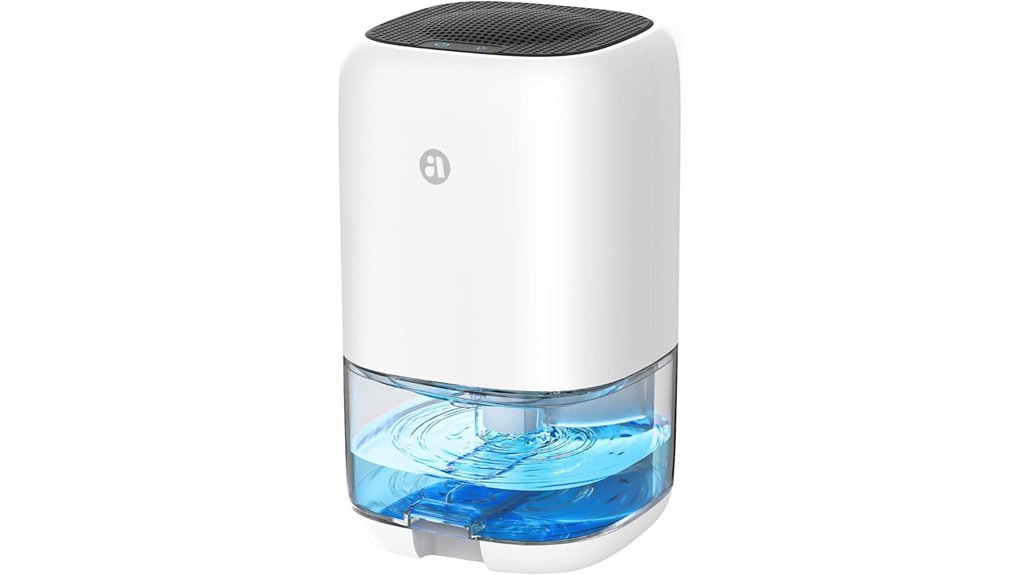
The TABYIK 35 OZ Dehumidifier is the easier starting point for an Airstream owner dealing with mild window condensation, a damp closet, or localized moisture near a sleeping area. Its small footprint, transparent tank, automatic shut-off, carrying handle, and low listed noise level make it easier to accommodate in tight RV living spaces.
The manufacturer lists maximum collection of up to 16 ounces, or 450 milliliters, per day at 86°F and 80% relative humidity. Because that rating comes from a warm, highly humid test condition, real collection can be considerably lower in cooler or less humid conditions. It is best treated as a maintenance dehumidifier rather than equipment for rapidly drying a wet trailer.
Key Specifications
- Type: Peltier thermoelectric
- Tank: 35 oz / 1,000 ml
- Listed maximum extraction: 16 oz / 450 ml per 24 hours at 86°F and 80% RH
- Dimensions: approximately 5.9 × 5.9 × 10.1 inches
- Listed noise level: 28 dB
- Drainage: removable tank; no built-in continuous-drain hose
Why You’ll Like It
- Its 5.9-by-5.9-inch footprint is much easier to place than a full-size compressor model.
- The transparent tank lets you see collected water without removing it.
- Automatic shut-off helps reduce overflow risk when the tank reaches its shut-off level.
- The ambient light has a separate control, so the light does not need to stay on overnight.
- The built-in handle makes it easier to relocate when the trailer layout changes.
Who Should Buy It: Airstream owners dealing mainly with mild condensation, damp cabinets or closets, and localized humidity who value compact size and quieter operation.
Who Should Avoid It: Buyers dealing with plumbing leaks, exterior water intrusion, wet flooring, soaked upholstery, persistent whole-trailer humidity, or situations that require rapid moisture removal.
Pros:
- Compact design suits tight RV spaces.
- Quiet thermoelectric operation for close living quarters.
- Transparent 35-ounce tank is easy to monitor.
- Automatic shut-off adds convenience for tank-based operation.
- The product listing specifically includes RVs among its intended small-space uses.
Cons:
- Removes far less moisture than a compressor dehumidifier.
- No built-in humidistat.
- No continuous-drain connection.
- The tank may need regular checking during humid weather.
- Advertised room coverage does not guarantee whole-Airstream humidity control.
KNKA 34-Pint Dehumidifier with Drain Hose
Best for Parked High Humidity
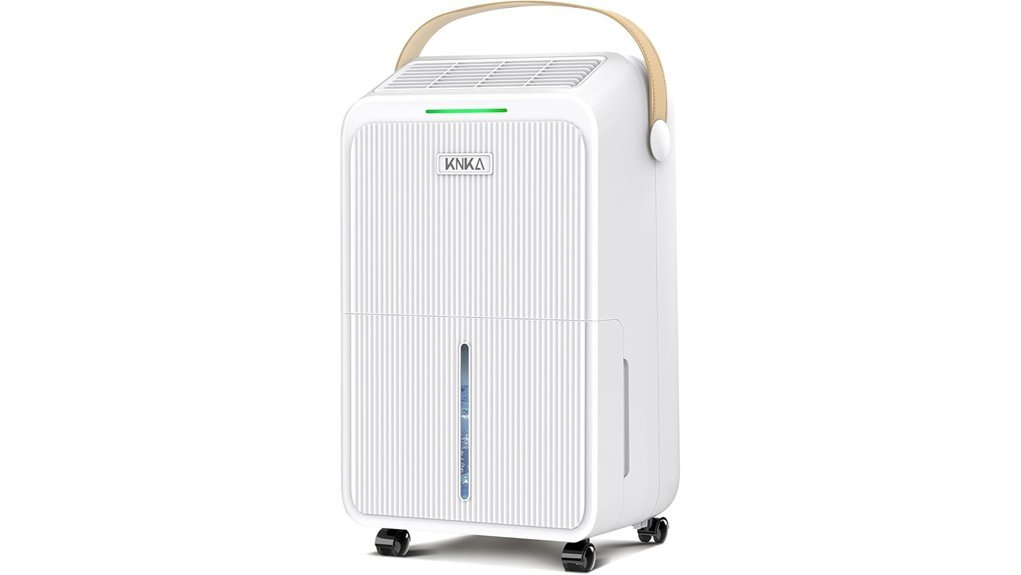
The KNKA is the stronger of these two choices for an Airstream that remains parked in a hot, humid climate and has reliable AC power. Its compressor is listed to remove up to 34 pints per day at 95°F and 90% relative humidity. It also provides adjustable humidity control, a digital display, automatic defrost, automatic shut-off, a washable filter, tank drainage, and continuous drainage.
The unit is approximately 13.23 inches deep, 10.31 inches wide, and 20.87 inches high, so it requires much more floor space than the TABYIK. Amazon lists its rated power at 230 watts and its weight at about 8 kg. Those figures make checking placement, outlet capacity, inverter capacity, and storage space particularly important before ordering.
Key Specifications
- Type: Compressor
- Listed maximum extraction: 34 pints per day at 95°F and 90% RH
- Tank: approximately 3 liters / 0.79 gallon
- Dimensions: approximately 13.23 × 10.31 × 20.87 inches
- Rated power: 230 watts
- Listed noise level: 37 dB
- Drainage: removable tank or included continuous-drain hose
- Humidity setting range: 30% to 80% in dehumidification mode
Why You’ll Like It
- Its compressor provides substantially higher water-removal capacity than a mini thermoelectric unit.
- Adjustable humidity control lets the unit respond to a selected humidity setting.
- Continuous drainage can reduce tank-emptying during long stationary stays.
- Automatic defrost supports operation as conditions change.
- A washable filter reduces the need for disposable filter replacements.
- Sleep mode and a listed 37 dB operating level are useful considerations in a compact living environment.
Who Should Buy It: Airstream owners facing persistent humidity during extended parked stays who have enough floor space, stable AC power, airflow clearance, and a suitable drainage arrangement.
Who Should Avoid It: Frequent movers, campers with limited inverter or battery capacity, and owners who cannot provide adequate floor space, stable placement, ventilation clearance, or a practical drainage setup.
Pros:
- Much higher listed extraction capacity than the TABYIK.
- Adjustable humidity control.
- Tank and continuous-drain options.
- Automatic defrost and washable filter.
- Two fan speeds and multiple operating modes.
- Drain hose is included with the current listing.
Cons:
- Much larger and heavier than a mini thermoelectric unit.
- 230-watt rated power requires more electrical capacity than a small thermoelectric model.
- Requires dedicated floor or storage space inside an Airstream.
- Compressor and fan operation will generally be more noticeable than the TABYIK’s listed 28 dB operation.
- The advertised 2,500-square-foot figure should not be treated as a precise Airstream sizing rule.
Factors to Consider When Choosing a Dehumidifier for an Airstream
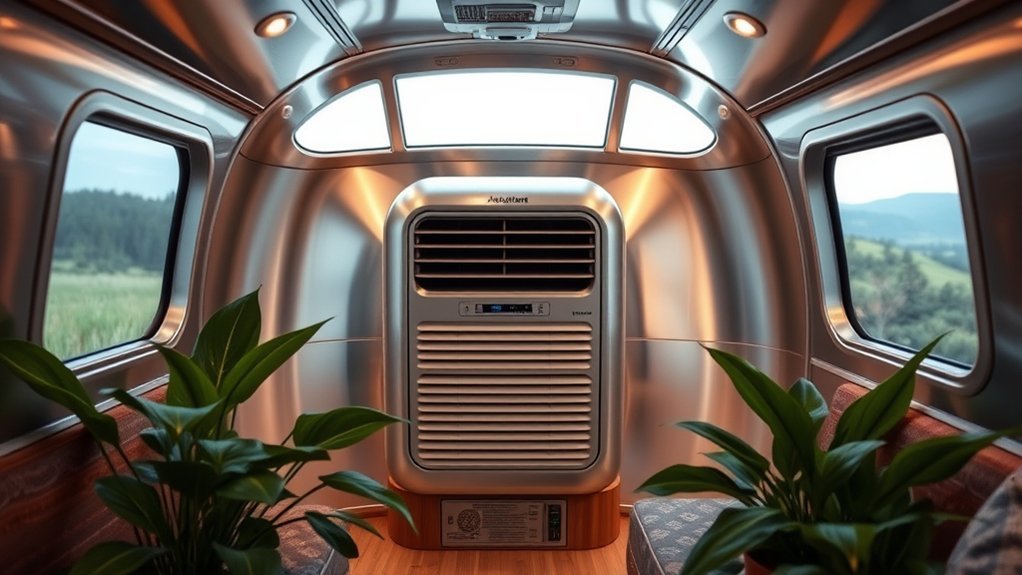
The right choice depends on the severity of the moisture problem, available space, electrical capacity, expected runtime, noise tolerance, and how often you can empty the tank. A mini thermoelectric model can help with light condensation, but it will not replace ventilation, leak repair, air conditioning, or higher-capacity drying when materials are already wet.
Match Capacity to the Moisture Problem
Do not choose an Airstream dehumidifier by advertised square footage alone. First determine whether you are dealing with occasional window condensation, localized moisture in a closet or sleeping area, or persistent humidity throughout the trailer.
A compact thermoelectric model is better suited to mild localized moisture. Rapidly returning condensation, wet surfaces, soaked materials, or persistent musty conditions require immediate investigation of the moisture source and may call for higher-capacity drying.
Thermoelectric vs. Compressor
Thermoelectric dehumidifiers are compact and generally quieter, but they collect water relatively slowly and work best under warm conditions. Compressor models are larger and require more power, but they can remove substantially more moisture and often include adjustable humidity control and continuous drainage.
For an Airstream, choose between these technologies according to the actual moisture load, placement space, electrical supply, and how long the trailer will remain stationary.
Placement and Airflow
Measure the intended shelf, counter, or floor location before ordering. Leave the clearance required by the manufacturer’s instructions around air inlets and outlets. Keep the unit upright on a stable surface and avoid blocking airflow with bedding, curtains, cabinet doors, bags, or other camping equipment.
Do not place a dehumidifier where collected water could easily spill onto electrical equipment. During travel, turn the appliance off and store or secure it upright so it cannot shift around the trailer.
Power Draw and Camping Setup
Check the appliance’s rated wattage and make sure your shore-power, generator, inverter, or battery system can handle it together with other loads. Lower-power thermoelectric models remove moisture more slowly. A compressor model is usually easier to accommodate when the trailer is stationary and connected to stable AC power.
The KNKA is currently listed at 230 watts, so buyers relying on an inverter or limited electrical service should include that load when planning their camping setup.
Noise Level Considerations
Noise is more noticeable inside a travel trailer than in a large house. The TABYIK is manufacturer-listed at 28 dB, while the KNKA is listed at 37 dB. These figures are useful for comparison, but perceived sound can still change with fan speed, compressor cycling, vibration, placement, and the surface beneath the unit.
A stable vibration-resistant mat may reduce transmitted vibration, provided it does not obstruct airflow or make the appliance unstable.
Tank Size and Drainage
A larger tank can reduce emptying frequency but also takes up more space. Automatic shut-off is especially valuable when using a removable tank. The TABYIK uses tank collection, while the KNKA provides both a removable tank and an included hose for continuous drainage.
For any continuous-drain installation, follow the manufacturer’s hose-routing instructions and make sure collected water reaches an appropriate drain or container without leaks, kinks, accidental disconnection, or overflow.
Humidity Target and Monitoring
Use a separate hygrometer or a dehumidifier with a humidity display. Airstream’s moisture guidance recommends keeping relative humidity at 60% or less. In cold climates, humidity may need to be around 35% or less to help prevent window condensation.
Monitor actual conditions inside the trailer rather than relying on one humidity setting throughout the year. Outdoor temperature, occupancy, showers, cooking, ventilation, and surface temperatures can all affect condensation.
Ventilation Still Matters
Use bathroom and range exhaust fans while showering or cooking. In hot and humid weather, use the air conditioner as appropriate and avoid waiting until the trailer is already excessively humid. Opening closets and cabinets can improve air circulation, and wet surfaces should be dried promptly.
A portable dehumidifier is one part of moisture management. It cannot repair plumbing leaks, exterior water intrusion, failed seals, or other sources that continuously introduce water into the trailer.
Before You Buy
- Measure the intended shelf, counter, or floor location.
- Check required airflow clearance around the appliance.
- Confirm rated wattage, voltage, and outlet requirements.
- Make sure your shore-power, generator, inverter, or battery setup can handle the added electrical load.
- Check whether the tank can be removed easily in the available space.
- Decide whether you need a built-in humidistat or a separate hygrometer.
- Decide whether tank drainage or continuous drainage better fits your camping style.
- Verify the current warranty, included accessories, and drain-hose details before ordering.
- Plan a secure upright storage location for travel days.
Frequently Asked Questions
How Do I Maintain My Dehumidifier in an Airstream?
Empty and rinse the tank regularly, clean the air inlet, outlet, and filter as directed, and inspect any drain hose for buildup, leaks, or kinks. Keep the unit upright on a stable surface with adequate airflow. Follow the manufacturer’s instructions for cleaning intervals, restart procedures, and storage.
Can a Dehumidifier Help Reduce Mold and Mildew Risk?
Lowering excess humidity can help reduce moisture conditions that support mold and mildew, but a dehumidifier cannot stop active water intrusion. Fix leaks, dry wet materials promptly, ventilate moisture-producing areas, and deal with existing mold appropriately rather than relying on a dehumidifier alone.
What Is the Ideal Humidity Level for an Airstream?
Airstream recommends keeping relative humidity at 60% or less. In cold weather, roughly 35% or lower may be necessary if condensation continues forming on windows or other cool surfaces. A hygrometer makes it easier to monitor conditions inside the trailer.
Will a Mini Dehumidifier Dry a Wet Airstream?
Not quickly. Mini thermoelectric units are better suited to routine moisture management and localized condensation. Active leaks, wet carpet, soaked cushions, or widespread dampness require immediate source control and may require fans, ventilation, air conditioning, or higher-capacity drying equipment.
When Do I Need a Compressor Dehumidifier?
Consider a compressor model when humidity remains high despite normal ventilation and air conditioning, when moisture returns faster than a mini unit can remove it, or when the trailer will remain parked in a humid climate for an extended period. Make sure there is sufficient floor space, stable power, airflow clearance, and a practical drainage arrangement.
Can I Run a Dehumidifier Overnight?
Many portable dehumidifiers are designed for extended operation, but always follow the specific manufacturer’s instructions. Make sure the unit is stable, has unobstructed airflow, and is connected to an appropriate electrical supply. If you are using tank collection, check the tank before sleeping.
Are Portable Dehumidifiers Suitable for Outdoor Use?
Household portable dehumidifiers are generally intended for enclosed indoor areas rather than exposed outdoor conditions. Use the unit inside the parked trailer according to its instructions and protect it from rain, spray, freezing conditions, and unstable surfaces.
How Noisy Are These Dehumidifiers When Operating?
The TABYIK is manufacturer-listed at 28 dB, while the KNKA is listed at 37 dB. Actual perceived sound can vary with fan speed, compressor cycling, vibration, placement, and the small interior volume of an Airstream.
Should I Choose an Airstream Dehumidifier by Square-Foot Rating?
No. Advertised coverage can be useful as a general product description, but it is not an exact RV-sizing standard. Compare water-removal capacity, temperature and humidity test conditions, physical dimensions, power consumption, drainage, and the actual severity of your moisture problem.
Do I Still Need Ventilation If I Use a Dehumidifier?
Yes. Use exhaust fans during cooking and showering, manage indoor temperature and air conditioning appropriately, improve airflow through closets and cabinets, and dry wet surfaces promptly. A dehumidifier works best as part of a broader moisture-control strategy.
Conclusion
Final Recommendation
Choose the TABYIK 35 OZ if your main problem is mild window condensation, a damp closet, or another localized moisture issue and you want a compact, quiet unit that is easy to place.
Choose the KNKA 34-Pint when humidity remains high throughout the Airstream during extended parked stays and you have enough floor space, reliable AC power, airflow clearance, and a practical drainage setup.
Whichever model you choose, monitor relative humidity, ventilate while cooking and showering, inspect the tank or drainage setup regularly, and address leaks or wet materials immediately. That combined approach is more effective than relying on any single dehumidifier.