Last reviewed: August 2026.
A capable basement dehumidifier can help control the excess moisture that contributes to musty odors and recurring mold growth. The Yaufey JD025Q-80 offers the best overall balance for many large basements, the DECIUU Max 100-Pint model provides the highest verified standardized removal rating in this comparison, and the KNKA 34-Pint is a more proportionate choice for a smaller or moderately damp basement.
Quick verdict
Best Overall: Yaufey JD025Q-80 for balanced standardized capacity, ENERGY STAR certification, drainage flexibility, and straightforward humidity control.
Best for Very Damp Large Basements: DECIUU Max 100-Pint for the highest verified standardized removal rating in this comparison.
Best for Smaller Basements: KNKA 34-Pint for moderate moisture loads where a larger compressor model may be unnecessary.
Quick Comparison
| Product | Capacity Details | Claimed Coverage | Tank | Best For | Amazon |
|---|---|---|---|---|---|
| Yaufey 80-Pint | 80-pint max claim at 95°F/90% RH; 24.93 pints/day ENERGY STAR rating | Up to 5,000 sq. ft. | 1.06 gallons | Balanced large-basement use | Check Current Amazon Availability |
| DECIUU 100-Pint | 100-pint max claim at 95°F/90% RH; 32 pints/day ENERGY STAR rating | Up to 5,000 sq. ft. | 1.45 gallons | Very damp or high-load spaces | Check Current Amazon Availability |
| KNKA 34-Pint | Up to 34 pints/day seller claim; standardized rating not verified | Up to 2,500 sq. ft. | 3 liters | Smaller or moderately damp basements | Check Current Amazon Availability |
How We Compared These Dehumidifiers
We focused on features that matter in a damp basement rather than decorative extras. The main comparison points were standardized and advertised pint capacity, test conditions, drainage options, tank size, humidity controls, automatic shutoff, automatic defrost, portability, maintenance requirements, and whether the product’s capacity matched the needs of a mold-prone basement.
- Moisture-removal capacity: Standardized ratings are more useful for comparison than maximum claims measured in unusually hot, humid conditions.
- Continuous drainage: A drain hose reduces the need to empty a bucket during long periods of operation.
- Humidity control: An adjustable humidistat helps the unit cycle instead of running continuously when it is not needed.
- Cold-basement operation: Automatic defrost can help protect performance when basement temperatures are low.
- Honest limitations: Coverage figures are not a substitute for evaluating the actual moisture load and source of water.
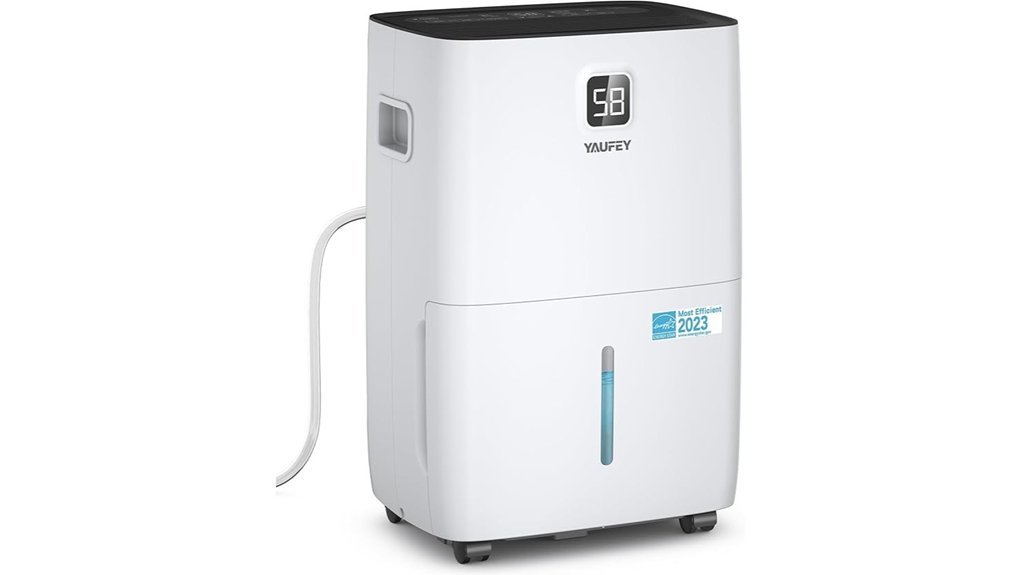
Yaufey JD025Q-80 ENERGY STAR Dehumidifier
Best Overall
The Yaufey JD025Q-80 is the most balanced option in this roundup. The seller advertises up to 80 pints per day at 95°F and 90% relative humidity and up to 5,000 square feet of coverage. For a fairer cross-model comparison, the current ENERGY STAR listing rates this exact model at 24.93 pints per day under standardized test conditions.
Its 30% to 80% humidity range, three fan speeds, automatic shutoff, timer, removable tank, and continuous drainage connection give homeowners several ways to manage basement moisture. The 1.06-gallon bucket is adequate for occasional manual use, but gravity drainage will usually be more convenient in a basement with a steady moisture load.
Best For: Homeowners who need a full-size compressor dehumidifier for a large, damp basement and have access to a suitable drain.
Who Should Avoid It: Buyers who need a built-in pump to move water upward or across a long distance should confirm whether a gravity drain will work in their basement before ordering.
Pros:
- Current ENERGY STAR standardized rating of 24.93 pints per day.
- Maximum seller claim of 80 pints per day at 95°F and 90% RH.
- Seller-claimed coverage of up to 5,000 square feet.
- Continuous drainage and removable-tank operation.
- Adjustable humidistat, timer, automatic shutoff, and three fan speeds.
- Wheels and handles can make repositioning easier.
Cons:
- The 1.06-gallon tank may fill quickly in very humid conditions.
- Gravity drainage requires a suitable drain below the hose outlet.
- The 80-pint headline is a maximum high-temperature claim, not the standardized ENERGY STAR capacity.
- This model does not include a built-in pump, so the drain path must slope downward.
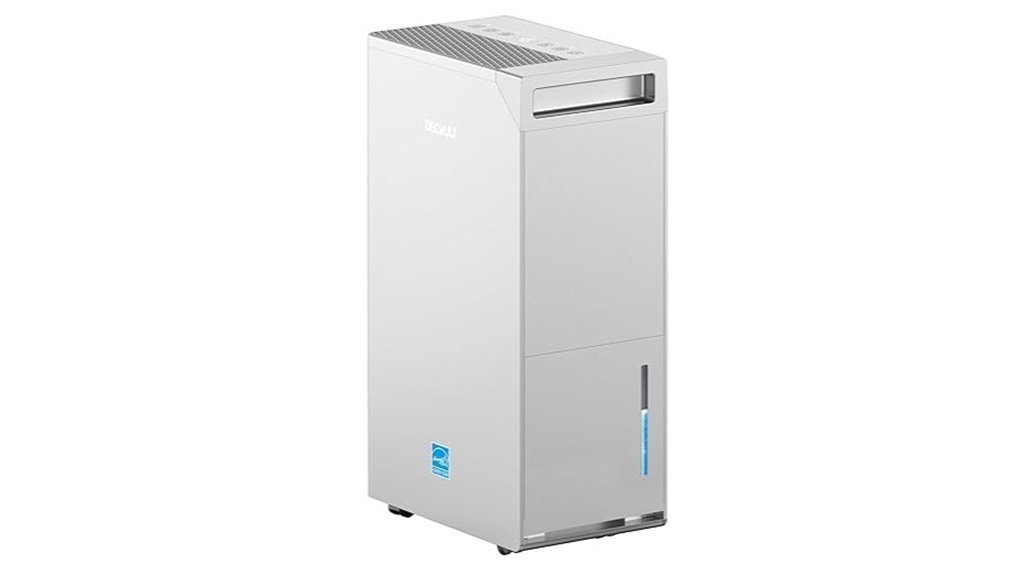
DECIUU Max 100-Pint ENERGY STAR Dehumidifier
Best High-Capacity Pick
The DECIUU is the highest-capacity option in this comparison. Its Amazon listing claims up to 100 pints per day at 95°F and 90% relative humidity, 70 pints per day at 86°F and 80% RH, and coverage up to 5,000 square feet. The current ENERGY STAR database lists the associated DER32S01-50 model family at 32 pints per day under standardized conditions, which is still higher than the Yaufey rating in this comparison.
The unit includes adjustable humidity control, automatic defrost, automatic restart, a timer, and three fan speeds. Drainage is available through the 1.45-gallon bucket or gravity drainage using the included hose or a compatible garden-hose connection. The linked version should not be confused with DECIUU’s separate pump-equipped model.
Best For: Large, very damp basements, laundry areas, garages, or other spaces where a lower standardized-capacity model may be undersized.
Who Should Avoid It: It may be more machine than necessary for a small basement with only occasional seasonal humidity. The linked ASIN is the gravity-drain version, so buyers who need water lifted uphill should choose a verified pump model instead.
Pros:
- Highest verified standardized capacity in this roundup at 32 pints per day.
- Maximum seller claim of 100 pints per day at 95°F and 90% RH.
- Seller-claimed coverage of up to 5,000 square feet.
- Bucket drainage plus two gravity-hose connection choices.
- Automatic defrost and restart are useful in basement environments.
- Three fan speeds and adjustable humidity control.
- The seller advertises up to two years of product protection; confirm registration requirements and exclusions before purchase.
Cons:
- Larger physical size than lower-capacity alternatives.
- Higher fan settings may be noticeable in a quiet living area.
- The 100-pint headline is a maximum high-temperature claim; the standardized rating is 32 pints per day.
- The “Most Efficient 2024” wording is dated; the current ENERGY STAR listing shows certification but not a current Most Efficient designation.
- Extra warranty coverage may require registration within the specified period.
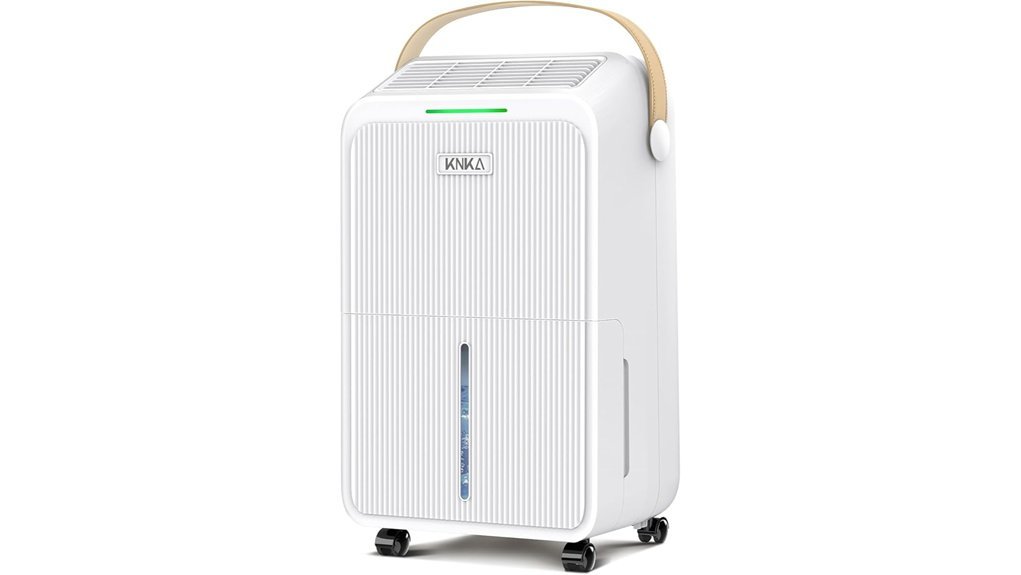
KNKA 2500 Sq.Ft Dehumidifier for Home
Best for Smaller Basements
The KNKA 34-Pint Dehumidifier is a more proportionate choice for a small or moderately damp basement. Its listing advertises up to 34 pints per day and coverage up to 2,500 square feet, but a directly comparable DOE or ENERGY STAR standardized capacity was not verified. Treat both figures as seller claims and size the unit around the actual moisture load.
The unit offers DEHU, DRY, and CONT modes, adjustable humidity control, automatic defrost, a timer, automatic shutoff, two fan speeds, a washable filter, and continuous drainage. The seller also advertises operation as low as 37 dB. The 3-liter bucket is smaller than those of the higher-capacity picks, so a drain hose is especially useful during humid weather.
Best For: Smaller basements, finished lower-level rooms, or moderately damp spaces without active seepage or an extreme moisture load.
Who Should Avoid It: Choose a higher-capacity model when walls or floors stay wet, laundry regularly dries in the basement, water enters after storms, or the space remains above the target humidity while the unit runs continuously.
Pros:
- Seller-advertised capacity of up to 34 pints per day.
- Continuous drainage and a removable 3-liter tank.
- DEHU, DRY, and CONT operating modes.
- Automatic defrost, timer, child lock, and automatic shutoff.
- Washable filter and caster wheels support routine maintenance and movement.
Cons:
- A standardized removal rating was not verified, so its capacity cannot be compared directly with the ENERGY STAR-rated models.
- The 3-liter tank may require frequent emptying without continuous drainage.
- Not the best choice for a severely wet or very large basement.
- The 37 dB noise figure is a seller claim and may vary by mode and room conditions.
- A directly comparable standardized pint rating and detailed warranty terms were not verified.
Factors to Consider When Choosing a Dehumidifier for a Moldy Basement
The right dehumidifier for a mold-prone basement depends on more than floor area. Start with the seriousness of the moisture problem, then compare pint capacity, drainage, temperature performance, tank size, controls, noise, and maintenance.
Capacity and Basement Condition
Dehumidifier capacity is measured in pints of water removed during 24 hours, but the number is meaningful only when the test conditions are known. The Yaufey and DECIUU use 80- and 100-pint marketing labels based on 95°F and 90% RH, while their current ENERGY STAR standardized ratings are 24.93 and 32 pints per day. The KNKA advertises 34 pints per day, but a directly comparable standardized rating was not verified.
Do not use square footage or headline pint labels alone. A 1,000-square-foot basement with seepage, wet laundry, poor drainage, and high humidity may need more capacity than a larger basement that is only mildly damp during summer. Compare exact model numbers, standardized ratings when available, drainage needs, temperature limits, and whether the unit can reach the target humidity without running continuously.
Fix the Moisture Source First
A dehumidifier should support a moisture-control plan, not replace one. Check for plumbing leaks, foundation cracks, clogged gutters, incorrect grading, window-well leaks, sump-pump problems, condensation, and unvented appliances. A unit that runs continuously while water keeps entering the basement treats the symptom without correcting the cause.
Target Humidity Range
A practical target for many basements is about 30% to 50% relative humidity, which is consistent with EPA indoor-air guidance. Avoid setting the humidity unnecessarily low because the unit may run longer, consume more electricity, and make the space uncomfortably dry.
Use a separate hygrometer to confirm the actual humidity in another part of the room. The sensor near the dehumidifier may read differently from a damp corner or closed storage area.
Continuous Drainage
Continuous drainage is one of the most useful basement features. A gravity-drain hose normally needs a clear downward path from the dehumidifier to a floor drain, sump, or approved discharge point. Avoid loops, kinks, and upward sections that can stop water flow.
If the only drain is higher than the dehumidifier, look for a model with a built-in pump or use a suitable external condensate pump. Do not assume that a drain hose means the unit can move water uphill.
Tank Size and Automatic Shutoff
A larger bucket reduces how often it must be emptied, but it also becomes heavier when full. Automatic shutoff helps prevent overflow when the bucket reaches capacity. Even with this feature, inspect the tank and float mechanism regularly so dirt or improper seating does not interfere with operation.
Automatic Defrost and Temperature
Basements can be cooler than the rest of the home. Compressor coils may collect frost in low temperatures, reducing moisture removal. Automatic defrost allows the machine to pause dehumidification and clear frost before resuming.
Check the manufacturer’s minimum operating temperature when the basement becomes cold during winter. A portable compressor dehumidifier may not perform normally below its rated temperature range.
Energy Efficiency
Compare the exact model number rather than relying only on a logo or general product title. ENERGY STAR certification and standardized water-removal ratings apply to specific models and test procedures. The current database confirms certification for Yaufey JD025Q-80 and the DECIUU DER32S01-50 model family, but neither is currently listed as Most Efficient. Efficient controls, an accurate humidistat, a clean filter, appropriate sizing, and unobstructed airflow can also reduce unnecessary runtime.
Noise and Placement
Noise matters in a finished basement, office, bedroom, or media room. Lower fan settings may be quieter but can also reduce air circulation. Place the machine on a level surface with the recommended clearance around its intake and exhaust, and avoid placing it directly against a wall or behind furniture.
Portability and Basement Layout
Wheels and handles help, but one machine may not control humidity evenly across several closed rooms. Keep interior doors open when practical, improve air circulation, or use more than one appropriately sized unit when the basement is divided into isolated areas.
Before You Buy: Basement Dehumidifier Checklist
- Measure the basement and note whether it is mildly damp, very damp, or wet.
- Repair leaks, seepage, drainage faults, and condensation sources.
- Compare standardized pint ratings and test conditions, not only headline capacity or claimed square-foot coverage.
- Confirm the minimum operating temperature for a cold basement.
- Decide whether bucket drainage, gravity drainage, or pumped drainage is required.
- Measure the route from the unit to the drain before relying on the included hose.
- Check the exact model number, warranty terms, certification, and included accessories.
- Allow enough clearance around the air intake and exhaust.
- Plan how the filter, tank, coils, and drain hose will be cleaned.
- Use a separate hygrometer to verify humidity across the basement.
Frequently Asked Questions
Will a Dehumidifier Remove Existing Mold?
No. A dehumidifier can reduce the moisture that supports mold growth, but it does not remove established colonies or make contaminated materials safe. Existing mold must be cleaned or remediated, damaged porous materials may need removal, and the source of moisture must be fixed.
Can a Dehumidifier Help Prevent Mold From Returning?
It can help after leaks and existing contamination have been addressed. Maintaining lower humidity makes the basement less favorable for new mold growth, but the machine cannot compensate for continuous water entry, flooding, or wet building materials.
What Is the Ideal Humidity Level for a Basement?
A target of roughly 30% to 50% relative humidity works for many homes. Keep the basement below 60%, monitor several locations with a hygrometer, and adjust the setting according to comfort, season, and condensation.
What Pint Capacity Do I Need?
Capacity depends on the basement’s size, temperature, and moisture condition. Use standardized ratings when available: the Yaufey JD025Q-80 is currently rated at 24.93 pints per day and the DECIUU model family at 32 pints per day. The KNKA’s 34-pint figure is a seller claim that was not verified under the same standard. Choose more capacity when the unit would otherwise run continuously without reaching the target humidity.
Why Do Advertised Pint Ratings Differ From ENERGY STAR Ratings?
Advertised maximum ratings may be measured in unusually hot, humid conditions such as 95°F and 90% RH, which lets the machine collect more water. ENERGY STAR and DOE ratings use standardized conditions designed for fairer model-to-model comparison. Always compare the test conditions, exact model number, and standardized rating when one is available.
How Often Should I Empty the Water Tank?
Empty it whenever the full-tank indicator appears. During humid weather, a bucket can fill more than once per day. Continuous drainage is usually the better choice for an unattended basement, provided the hose has a secure and unobstructed route to an approved drain.
Can a Gravity Drain Hose Run Uphill?
No. A gravity hose needs a continuous downward slope. Use a dehumidifier with a built-in pump or a compatible condensate pump when water must travel upward to a sink, window, or elevated drain.
How Do I Maintain a Basement Dehumidifier?
Clean the washable filter according to the manual, rinse and dry the bucket, inspect the drain hose, remove dust from the air intake, and check that the float and automatic shutoff move freely. Unplug the unit before cleaning and never spray water into the electrical housing.
Why Is My Dehumidifier Running Without Lowering Humidity?
The unit may be undersized, the basement may have ongoing water entry, airflow may be blocked, the filter may be dirty, doors or windows may be open, or the temperature may be too low for normal compressor operation. Confirm the reading with a separate hygrometer before assuming the built-in sensor is inaccurate.
Can a Dehumidifier Help With Mold-Related Allergens?
Reducing humidity may help limit future mold growth, but a dehumidifier is not an air purifier or medical treatment. Existing spores and contaminated materials still need proper cleanup. Anyone experiencing breathing difficulty, severe allergy symptoms, or worsening asthma should seek appropriate medical advice.
Final Recommendation
Choose the Yaufey JD025Q-80 when you want the best overall balance of verified ENERGY STAR performance, humidity control, and gravity drainage for a large damp basement.
Choose the DECIUU Max 100-Pint when the basement carries a heavier moisture load and you want the highest verified standardized capacity in this comparison.
Choose the KNKA 34-Pint for a smaller or moderately damp basement where a lower-capacity unit is more proportionate and you are comfortable relying on seller-stated capacity.
Whichever model you select, treat the dehumidifier as one part of a complete basement moisture plan. Repair water entry, remove existing mold safely, maintain airflow, use continuous drainage where practical, and monitor humidity with a separate hygrometer. Those steps—and comparing capacity under equivalent test conditions—matter more than choosing a product based only on a large headline pint or square-foot number.