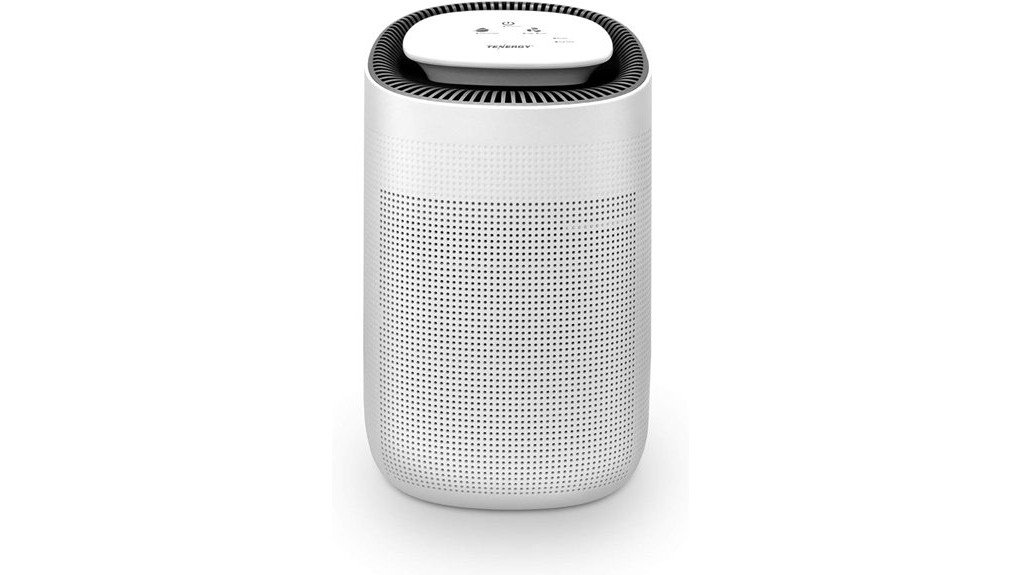
If you are comparing the best whole house dehumidifier systems for 2026, prioritize true duct-ready, bucketless equipment rather than portable room units. A whole-home model should support continuous drainage and either connect to central HVAC ductwork or use dedicated return and supply ducts to control humidity across multiple rooms.
The five systems below fit that buyer intent, but their pint ratings are not directly interchangeable. For most homeowners, the AprilAire E100 offers the strongest balance of DOE-rated moisture removal, residential coverage guidance, straightforward controls, and flexible installation. The AprilAire E080 is the practical mid-size alternative, while the ALORAIR Sentinel WHD 100 stands out for adjustable airflow and duct orientation. The Moiswell Marshal WD160 adds fresh-air and wired-control features, and the Waykar AFD2.5D is best treated as a crawl-space-first, duct-ready option.
Quick Verdict
- Best Overall: AprilAire E100 for 85-pint DOE capacity, up to 100 pints at warmer test conditions, and broad residential installation flexibility.
- Best for Mid-Size Homes: AprilAire E080 when its 65-pint DOE rating and manufacturer coverage guidance fit the calculated moisture load.
- Best Flexible Duct Layout: ALORAIR Sentinel WHD 100 for 70-pint DOE capacity, two airflow settings, and configurable inlet/outlet orientation.
- Best Fresh-Air and Remote-Control Option: Moiswell Marshal WD160 for a 65-pint DOE rating, 330 CFM airflow, wired control, and an outdoor-air intake function.
- Best for Crawl-Space Integration: Waykar AFD2.5D for a low-profile, duct-ready cabinet with a separate humidity sensor and wired controller.
Whole House Dehumidifier Comparison
| Model | Best For | Published Capacity by Test Condition | Published Coverage | Notable Installation Feature | Amazon |
|---|---|---|---|---|---|
| AprilAire E100 | Best overall | 85 pints/day (DOE Appendix X1); up to 100 pints/day at 80°F/60% RH | Up to 5,500 sq. ft. | 10-inch duct collars and continuous drain | Check Amazon Details |
| AprilAire E080 | Mid-size homes | 65 pints/day (DOE Appendix X1); up to 80 pints/day at 80°F/60% RH | Up to 4,400 sq. ft. | Compact whole-home or standalone drain setup | Check Amazon Details |
| ALORAIR Sentinel WHD 100 | Flexible duct layouts | 70 pints/day (DOE); 90 pints/day at 80°F/60% RH | Up to 2,300 sq. ft. | Selectable airflow and adjustable inlet/outlet orientation | Check Amazon Details |
| Moiswell Marshal WD160 | Fresh-air intake and remote control | 65 pints/day (DOE Appendix X1); 160-pint maximum rating | Up to 2,500 sq. ft. | 330 CFM airflow and wired controller | Check Amazon Details |
| Waykar AFD2.5D | Crawl-space-based whole-home setups | 48.5 pints/day at 65°F/60% RH; 74 at 80°F/60% RH; 158 at 95°F/90% RH | Up to 6,500 sq. ft. under manufacturer guidance | Duct-ready inlet/outlet with wired sensor and controller | Check Amazon Details |
Important capacity note: Compare ratings only when the test conditions match. DOE Appendix X1 figures can be lower than manufacturer capacities measured at 80°F and 60% RH, while saturation ratings measured at 95°F and 90% RH are much higher. Use the DOE or closest comparable figure first, then review airflow, drainage, efficiency, and an HVAC moisture-load calculation.
How We Selected These Systems
These recommendations focus on buyer-relevant specifications rather than headline capacity alone. Each remaining model is designed for ducted, crawl-space, basement, or whole-home use; supports continuous condensate drainage and automatic humidity control; and has enough published information to explain its intended installation. We also considered DOE or comparable capacity, airflow, coverage guidance, filter access, controller placement, fresh-air capability, efficiency data, warranty clarity, and the amount of professional installation likely to be required.
AprilAire E100 Whole-House Dehumidifier
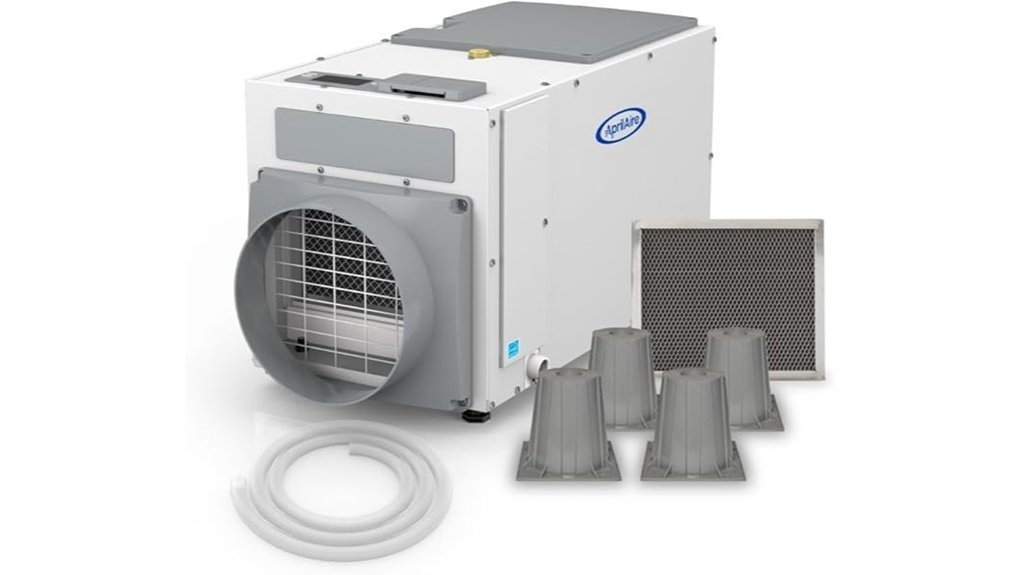
The AprilAire E100 is the strongest all-around choice for homeowners who want a purpose-built whole-house dehumidifier from an established indoor-air-quality brand. AprilAire markets it as removing up to 100 pints per day at 80°F and 60% RH for homes, basements, and sealed crawl spaces up to 5,500 square feet. For a more standardized comparison, the current DOE/ENERGY STAR listing reports 85 pints per day under Appendix X1.
The bucketless design sends condensate to a floor drain or suitable condensate system, so it can operate without routine tank emptying. It includes 10-inch inlet and outlet collars, a built-in digital control, a washable MERV 8 filter, and corrosion-resistant coils. The Amazon title may describe a “Pro” bundle, but buyers should verify the exact accessories included with the linked seller package; the underlying dehumidifier is the AprilAire E100.
Why You’ll Like It
- The 85-pint DOE rating gives it more standardized capacity than the smaller E080 while the manufacturer also publishes a 100-pint figure at warmer test conditions.
- It is designed specifically for whole-home, basement, and sealed crawl-space applications rather than adapted from a portable room unit.
- The onboard control, washable filter, drain fitting, backdraft damper, and 10-inch collars give an HVAC installer a well-documented platform.
Who Should Buy This
Choose the E100 if you have a large home, persistent summer humidity, a sealed crawl space, or an air conditioner that reaches the thermostat setting before removing enough moisture. It is also a strong upgrade for homeowners replacing an older 90- to 100-pint ducted dehumidifier.
Who Should Avoid This
Skip it if you only need to dry one enclosed room, cannot provide a permanent drain, or do not have enough mechanical-room or crawl-space clearance for the unit and its duct bends. Homes with a modest moisture load may be adequately served by the smaller E080.
Pros:
- 85-pint DOE capacity and up to 100 pints per day at 80°F/60% RH.
- Purpose-built whole-home design with included 10-inch inlet and outlet collars.
- Automatic humidity control, continuous drainage, and a washable MERV 8 filter.
Cons:
- Professional sizing and duct installation are recommended for whole-home use.
- A drain hose is not included with the base E100, and Amazon bundle contents can vary.
- Its capacity and project cost may be unnecessary for a smaller, well-sealed home with a light moisture load.
AprilAire E080 Whole House Dehumidifier (80-Pint)
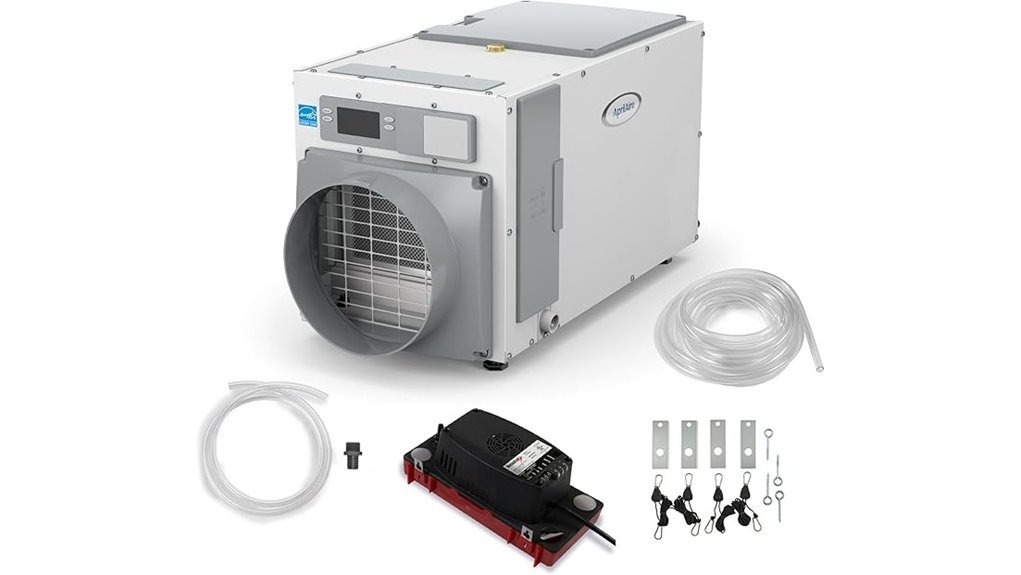
The AprilAire E080 uses the same general whole-home platform as the E100 but with lower capacity. AprilAire markets it at 80 pints per day at 80°F and 60% RH and recommends it for whole houses, basements, and crawl spaces up to 4,400 square feet. The current DOE/ENERGY STAR listing reports 65 pints per day under Appendix X1, which is the better figure for standardized comparisons.
Like the larger model, the E080 has a bucketless continuous-drain design, a built-in digital humidistat, 10-inch duct collars, corrosion-resistant coils, and a washable MERV 8 filter. Its cabinet is compact enough for many crawl spaces and utility areas, although the final installation still needs room for service access, filter removal, drainage slope, and smooth duct transitions.
Why You’ll Like It
- It provides true whole-home functionality in a smaller-capacity package.
- The standardized duct connections and onboard control support several installation approaches.
- It can run independently over a drain or be integrated with dedicated or HVAC ductwork.
Who Should Buy This
The E080 is best for a moderately sized home, basement, or sealed crawl space where humidity is persistent but the load does not justify the larger E100. It is also a good fit when cabinet size and installation space matter.
Who Should Avoid This
Choose a higher-capacity model if the home is very large, has substantial outdoor-air infiltration, contains an indoor pool or spa, or regularly remains above 60% RH despite air-conditioning use. Capacity should be confirmed through a moisture-load calculation rather than square footage alone.
Pros:
- 65-pint DOE capacity and up to 80 pints per day at 80°F/60% RH.
- Purpose-built whole-home design with continuous drainage and 10-inch duct collars.
- Washable MERV 8 filter and accessible digital controls.
Cons:
- May be undersized for a very humid, leaky, or unusually large home.
- Professional duct design is still important for balanced room-to-room performance.
- Optional wall controls, drain hoses, or installation accessories may add to total project cost.
ALORAIR Sentinel WHD 100 Whole House Dehumidifier
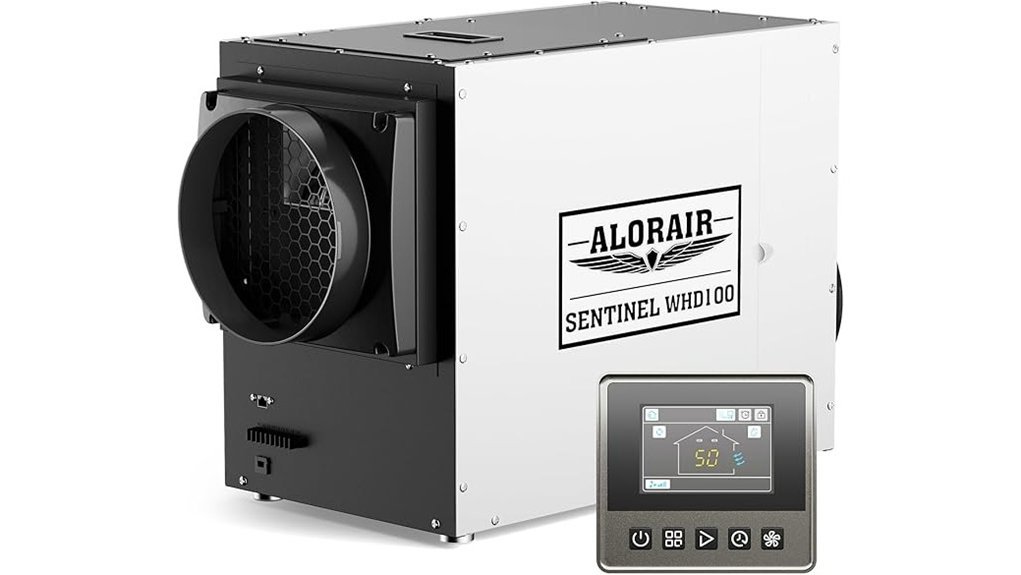
The ALORAIR Sentinel WHD 100 is a ducted whole-house model rated at 70 pints per day under DOE conditions and 90 pints per day at 80°F and 60% RH, with manufacturer coverage guidance up to 2,300 square feet. Its strongest advantage is installation flexibility: the unit offers two airflow levels, listed at 229 and 309 CFM, and supports multiple inlet and outlet orientations.
It also provides continuous gravity drainage, automatic defrost, auto restart, memory functions, a timer, fresh-air capability, and MERV 10 filtration. A compatible wired controller is available for this platform, but buyers should confirm whether it is included with the linked Amazon package. Warranty eligibility, registration, shipping damage procedures, and labor coverage should also be checked before installation.
Why You’ll Like It
- Multiple duct orientations can solve tight mechanical-room or crawl-space layout problems.
- Two airflow settings let an installer better match the duct system and available static pressure.
- The published 70-pint DOE figure and 90-pint 80°F/60% RH figure make its capacity easier to interpret than a saturation-only rating.
Who Should Buy This
This is a strong choice for homeowners or contractors who need more duct-routing freedom than a fixed-inlet cabinet provides. It also suits a basement, crawl space, garage, storage area, or smaller whole home where its 70-pint DOE capacity and available airflow are appropriately sized.
Who Should Avoid This
Avoid relying on the coverage number alone if the building is very leaky or located in an exceptionally humid climate. Also check whether the controller, duct collars, drain parts, and fresh-air accessories shown in a listing are included or sold separately.
Pros:
- 70-pint DOE capacity, 90-pint capacity at 80°F/60% RH, and two published airflow settings.
- Flexible inlet and outlet configurations for custom duct layouts.
- Fresh-air capability, auto defrost, memory, timer, MERV 10 filtration, and continuous drainage.
Cons:
- Coverage is lower than some competing 100-pint residential systems.
- Accessory inclusion and remote-control configuration can vary by seller.
- Fresh-air intake must be designed carefully because outdoor air can add humidity load.
Moiswell Marshal WD160 Whole-Home Dehumidifier
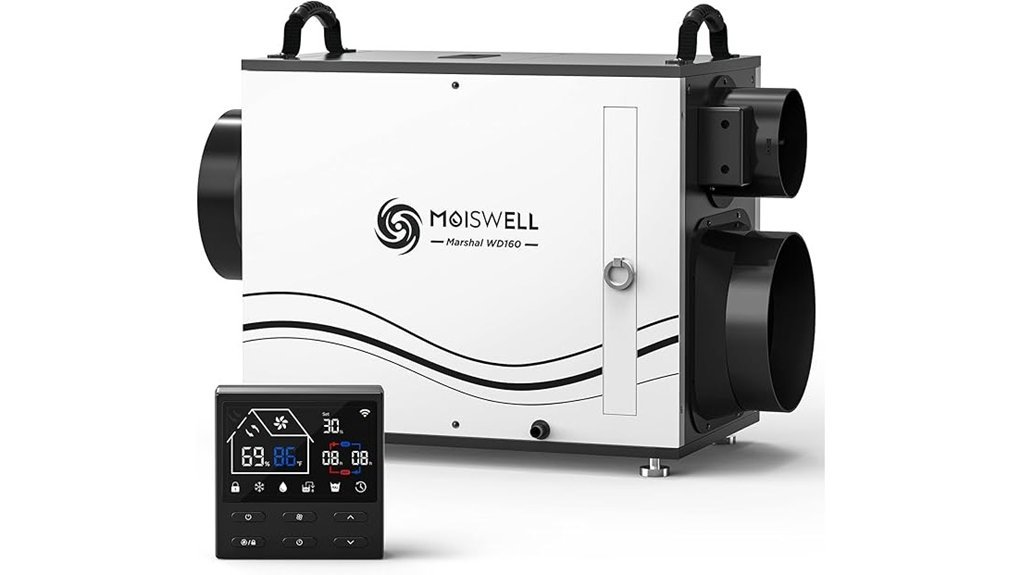
The Moiswell Marshal WD160 is marketed with a maximum removal rate of 160 pints per day, but its standardized DOE/ENERGY STAR capacity is 65 pints per day. It is designed for whole homes, basements, and crawl spaces up to about 2,500 square feet and moves up to 330 CFM, giving it strong published airflow for distributing dry air through properly sized ducts.
A wired remote controller makes it easier to monitor and adjust a unit installed in an attic, crawl space, or mechanical room. The fresh-air damper can introduce outdoor air when the system is configured for ventilation, but this feature should be commissioned by an HVAC professional. Bringing in warm, humid outdoor air can increase the latent load, so ventilation airflow must be balanced with the unit’s 65-pint DOE capacity.
Why You’ll Like It
- The wired controller reduces the need to enter a difficult installation area for routine adjustments.
- Its 330 CFM airflow can support broader air distribution when the ducts are sized correctly.
- The fresh-air option combines ventilation and humidity-control planning in one system.
Who Should Buy This
Consider the WD160 when remote access, higher airflow, and an outdoor-air connection are more important than having the highest standardized moisture-removal capacity. It may work well in a tightly constructed home where ventilation and humidity control are designed together.
Who Should Avoid This
Do not choose it solely because the name says 160 pints. For sizing, compare the 65-pint DOE figure with the calculated moisture load. A home with severe moisture infiltration may need more standardized capacity even if the maximum-condition number looks impressive.
Pros:
- Wired remote control and 330 CFM published airflow.
- Fresh-air intake option for professionally designed ventilation setups.
- Auto defrost, auto restart, error detection, and continuous gravity drainage.
Cons:
- The 160-pint headline rating is measured under more favorable conditions than the 65-pint DOE figure.
- Fresh-air operation can add moisture if the system is poorly balanced.
- The 65-pint standardized capacity may be too low for some large, leaky, or very damp homes.
Waykar AFD2.5D Crawl-Space Whole-House Dehumidifier
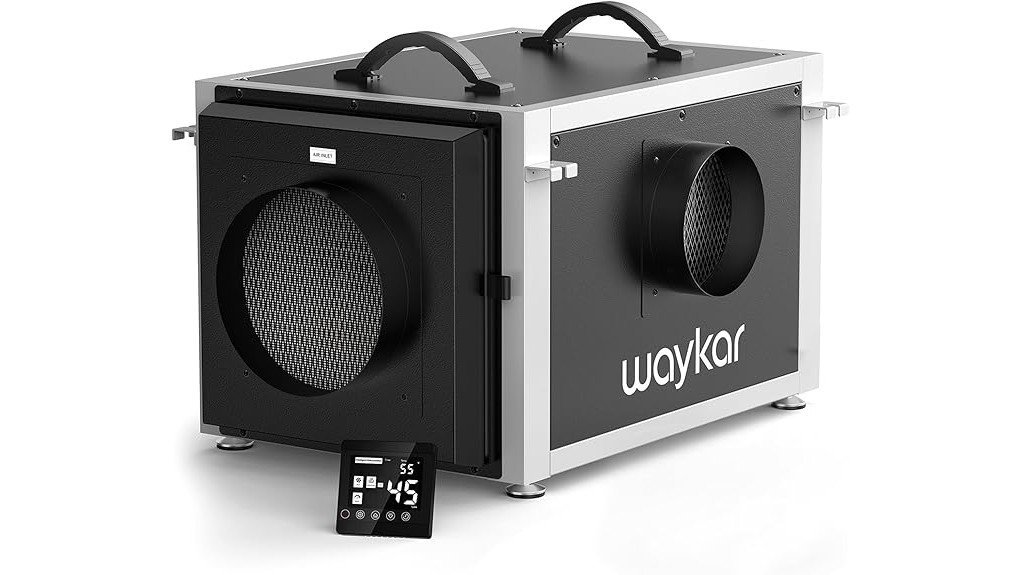
The Waykar AFD2.5D is a low-profile crawl-space dehumidifier that can also support ducted whole-home installations. Its manual publishes 48.5 pints per day at 65°F/60% RH, 74 pints per day at 80°F/60% RH, and a 158-pint maximum at 95°F/90% RH. It moves about 206 CFM and carries manufacturer coverage guidance up to 6,500 square feet, but the coverage figure should be treated as a best-case guide rather than a substitute for a latent-load calculation.
The model includes a separate wired humidity sensor and a controller with a 33-foot cable, plus inlet and outlet connections for optional ducting. It supports continuous gravity drainage, automatic defrost, and hanging or floor-mounted installation. Waykar lists this model as non-ENERGY STAR, and it does not include a condensate pump, so the drain route deserves extra attention.
Why You’ll Like It
- The low cabinet and remote sensor/controller suit hard-to-access crawl spaces.
- Duct-ready inlet and outlet connections allow inline or bypass installation approaches.
- Continuous drainage and auto defrost support unattended operation in damp areas.
Who Should Buy This
Choose the Waykar if your humidity problem begins in a sealed crawl space or basement and you want the option to distribute treated air through ducts. It is also useful when the control panel must be mounted in a more accessible room.
Who Should Avoid This
Skip it if you need current ENERGY STAR certification, an integrated condensate pump, or standardized efficiency data comparable with the certified residential models above. Its 48.5-pint figure at 65°F/60% RH is much more useful for conservative sizing than the 158-pint saturation number.
Pros:
- Duct-ready, low-profile design for crawl-space and basement installations.
- Separate wired humidity sensor and remote control panel with a long cable.
- Gravity drain, auto defrost, washable filter, and hanging capability.
Cons:
- The 158-pint headline is measured at 95°F and 90% RH; published output drops to 74 pints at 80°F/60% RH and 48.5 pints at 65°F/60% RH.
- The 6,500-square-foot claim may be optimistic when rooms are closed off or moisture infiltration is high.
- No built-in pump and no current ENERGY STAR certification for this model.
Factors to Consider When Choosing Whole House Dehumidifier Systems
A whole-home dehumidifier is an HVAC project, not just an appliance purchase. The right model must match the building’s moisture load, duct layout, drainage route, available space, electrical supply, and maintenance access. The following factors matter more than a large marketing number on the product title.
True Whole-Home Design
Look for dedicated inlet and outlet collars, continuous drainage, automatic humidity control, and manufacturer instructions for ducted operation. A portable dehumidifier with wheels, a collection bucket, and a room fan may advertise thousands of square feet, but that does not make it a whole-home system. Without a planned return and supply path, closed doors and separate floors can prevent even moisture control.
Capacity and Test Conditions
Capacity is measured in pints of water removed over 24 hours, but the test environment changes the result. Do not use “AHAM,” “DOE,” and “maximum” as interchangeable labels. Many manufacturer capacities use 80°F and 60% RH, current DOE Appendix X1 certification can produce a lower figure, and saturation ratings at 95°F and 90% RH describe far more favorable moisture-removal conditions. Compare the DOE figure first when available, then match airflow and capacity to the home’s latent load.
Coverage and Moisture Load
Square footage is only a starting point. Climate, air leakage, crawl-space condition, ceiling height, number of occupants, showering, cooking, laundry, outdoor-air ventilation, and HVAC runtime all affect moisture load. A smaller tight home in a hot-humid climate can need more dehumidification than a larger home in a mild, dry region. For permanent systems, ask an HVAC professional to calculate the latent load and confirm whether one unit can serve every zone.
Ducting and Airflow
Whole-home systems may use a dedicated return and supply, connect to the HVAC return and supply, or operate in a bypass arrangement. Each method has different static-pressure, backdraft, and blower-interlock requirements. Check collar size, airflow in CFM, available external static pressure, filter resistance, duct length, and the manufacturer’s approved diagrams before installation.
Drainage Requirements
These systems produce a steady stream of condensate and normally do not use a bucket. A gravity drain needs a continuous downward slope to an approved drain. If the unit sits below the drain point, a condensate pump may be necessary. Include an overflow strategy, trap or vent where required by the manual, and freeze protection for any drain line routed through a cold area.
Fresh-Air Function
A fresh-air port does not automatically improve a home. Outdoor air can dilute indoor pollutants, but in humid weather it can also add a large moisture load. The intake should be sized, filtered, dampered, and commissioned as part of a ventilation plan. Do not leave a fresh-air damper fully open without confirming that the dehumidifier and HVAC system can handle the added load.
Energy Efficiency Ratings
Look up the exact model in the current ENERGY STAR database and compare Integrated Energy Factor (IEF), expressed in liters of water removed per kilowatt-hour. A higher IEF indicates better tested efficiency, but operating cost still depends on climate, set point, infiltration, airflow, and runtime. Do not assume every model in a product family is certified, and do not treat an old “Most Efficient” year badge as proof of current status.
Controls and Zoning
A built-in humidistat is convenient when the unit is accessible. For an attic or crawl space, a wall-mounted or wired remote control is easier to use. Place the humidity sensor where it represents the conditioned space rather than directly in the dry discharge air. Larger homes may need zoning dampers or separate equipment if one duct path cannot serve all floors evenly.
Noise and Placement
Whole-home units are usually installed away from bedrooms, but compressor and airflow noise can still travel through ducts and framing. Use vibration isolation, correctly sized ducts, gradual transitions, and adequate return-air area. Avoid placing a high-airflow unit directly above a quiet room unless the installation plan addresses vibration and sound transmission.
Maintenance and Upkeep
Leave enough clearance to remove the filter, inspect the drain, clean the coil area, and service the compressor. Check the filter on the schedule in the manual, keep intake grilles clear, inspect the drain for clogs or biofilm, and confirm that the humidity sensor remains accurate. A yearly HVAC inspection is sensible for a permanently ducted system.
Professional Installation
Standalone operation over a floor drain may be simple for some models, but whole-home duct integration can involve sheet-metal work, electrical requirements, condensate management, controls, and HVAC blower interlocks. Poor installation can cause pressure imbalances, reduced airflow, water leaks, short cycling, or air-conditioner performance problems. Follow the manufacturer’s instructions and local codes, and use a qualified HVAC contractor when connecting the unit to central ductwork.
Before You Buy: Quick Checklist
- Measure the intended installation space and include filter and service clearance.
- Confirm the DOE, 80°F/60% RH, and maximum-condition capacities instead of relying on the largest number in the title.
- Identify where return air will enter and where dry air will be supplied.
- Verify duct collar sizes, airflow, and approved installation diagrams.
- Plan a gravity drain or condensate pump with overflow protection.
- Check the electrical circuit and plug requirements.
- Check the exact model number in the current ENERGY STAR database when efficiency certification matters.
- Confirm which controller, sensor, filter, drain hose, collars, and dampers are included.
- Review the complete warranty, registration deadline, labor exclusions, and service process.
- Use a separate hygrometer to confirm actual indoor humidity after commissioning.
Frequently Asked Questions
What Size Whole House Dehumidifier Do I Need?
Start with the DOE or closest comparable capacity, then adjust for climate, air leakage, crawl-space moisture, occupancy, ventilation, and HVAC behavior. Square footage alone is not enough. A qualified HVAC contractor can calculate latent load, check duct static pressure, and determine whether one unit can serve every zone.
What Indoor Humidity Should I Set?
A practical starting target is around 45% to 50% RH during humid weather. The U.S. EPA recommends keeping indoor relative humidity below 60% and ideally between 30% and 50% when possible. Avoid setting the dehumidifier unnecessarily low, because that increases runtime and may make the home feel dry.
Can I Install a Whole House Dehumidifier Myself?
You may be able to operate some models as standalone units over a drain, but a true whole-home installation usually requires duct design, condensate planning, electrical work, and control integration. Unless you have relevant HVAC experience and the installation is permitted locally, professional installation is the safer choice.
Do Whole House Dehumidifiers Have Tanks?
Most purpose-built whole-home models are bucketless. They drain continuously through a hose, PVC connection, or condensate pump. This is one reason they can run unattended, but the drain still needs regular inspection for clogs, leaks, freezing, or improper slope.
How Much Does a Whole House Dehumidifier Cost to Run?
Operating cost depends on the unit’s wattage, daily runtime, local electricity rate, humidity target, and moisture load. Estimate it by multiplying input kilowatts by operating hours and your electricity price per kWh. Do not rely on a fixed monthly cost or a large savings claim that does not use your climate and utility rate.
Can a Whole House Dehumidifier Connect to Existing HVAC Ducts?
Yes, many models can connect to the central return and supply ducts, but the approved configuration varies. Some require a dedicated return, a bypass duct, backdraft dampers, or an HVAC blower interlock. Use the exact diagram in the installation manual rather than assuming every unit connects the same way.
Is a Fresh-Air Function the Same as Dehumidification?
No. Fresh-air ventilation brings outdoor air indoors, while dehumidification removes water vapor. In a humid climate, outdoor air can increase the amount of moisture the dehumidifier must remove. Fresh-air features should be balanced and commissioned rather than treated as a free air-quality upgrade.
How Often Should I Maintain the System?
Inspect the filter and drain regularly and follow the manufacturer’s cleaning schedule. Check more often during the first humid season so you can see how quickly the filter loads and whether the drain stays clear. A yearly professional inspection is reasonable for ducted systems, especially when they share controls or airflow with central HVAC equipment.
Conclusion
The best whole house dehumidifier is the one that matches your home’s actual moisture load and can be installed with balanced airflow, reliable drainage, and easy service access. The AprilAire E100 is the strongest all-around recommendation for larger residential applications, while the AprilAire E080 is the better fit when 65-pint DOE capacity is enough. Choose the ALORAIR Sentinel WHD 100 for flexible duct routing, the Moiswell Marshal WD160 for fresh-air and wired-control features, or the Waykar AFD2.5D for a crawl-space-centered setup where its lower-condition capacity and gravity-drain requirements are acceptable.