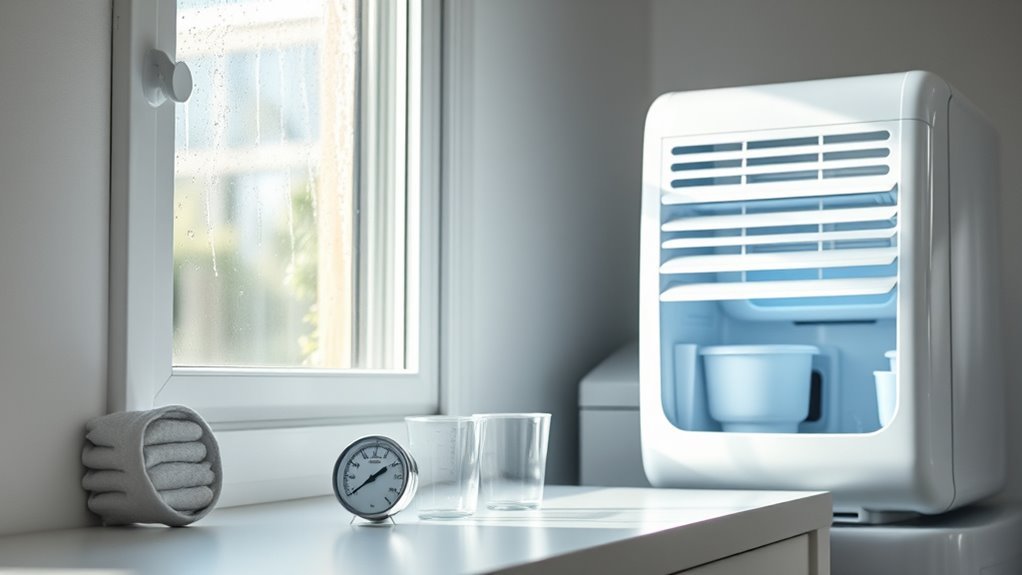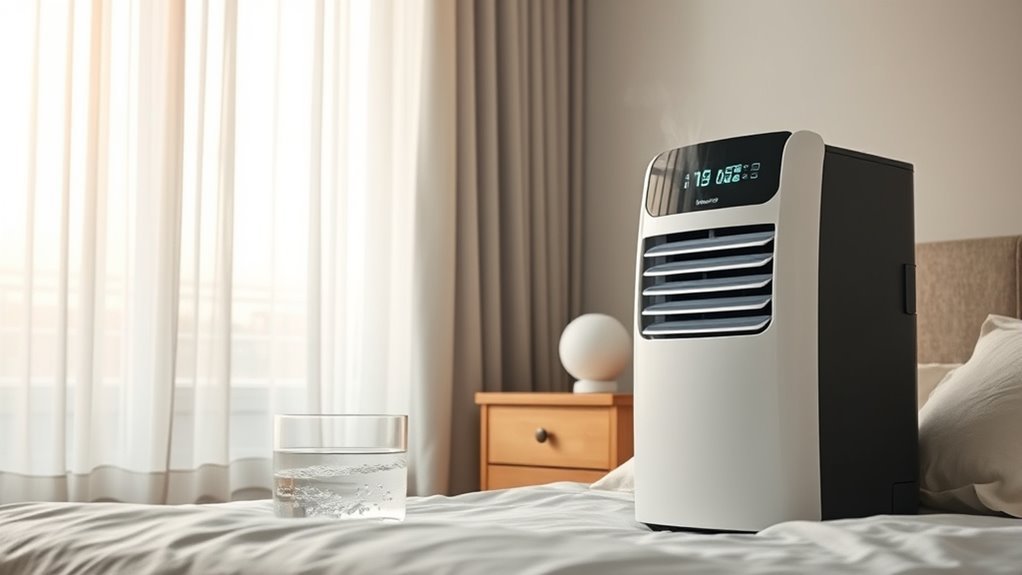
Muggy indoor air can make a room feel sticky and uncomfortable even when the temperature is mild. Using dehumidifier mode on a portable air conditioner pulls excess moisture out of the air without blasting full-strength cold air. Whether you are dealing with rainy-day dampness or a clammy bedroom, the right setup, drain connection, and venting habits will help your unit dry the room efficiently.
Quick Answer
Select Dry or Dehumidify mode (the water-droplet icon), keep windows and doors shut, and set your humidity target to 45% RH (within the 30% to 50% healthy range) if your unit has a humidistat. Keep the window exhaust hose attached, and connect a gravity hose to the upper drain port or empty the tank before it shuts off.
At a Glance
| Time Required | 5 to 10 minutes for setup (2 to 6 hours of runtime to lower room humidity) |
| Difficulty | Easy |
| Tools Needed | Window exhaust kit, continuous drain hose or shallow pan, standalone digital hygrometer |
| Cost | $0 (uses built-in portable AC controls and included adapters) |
How to Use Dehumidifier Mode on a Portable Air Conditioner
To use dehumidifier mode on a portable air conditioner, seal the room, vent the exhaust hose outdoors, press the Mode button until Dry or the water-droplet symbol appears, and set up water drainage. Most units begin condensing moisture within a few minutes and noticeably reduce stickiness within two hours.
- Position the unit with proper clearance. Roll the portable AC onto a level floor in the damp room and leave at least 20 inches (50 cm) of open space around the intake grilles and air outlet so airflow is never restricted.
- Connect and seal the exhaust hose and window kit. Keep the exhaust hose under 9 feet long and as straight as possible. Seal any gaps around the window slider with foam tape so humid outdoor air cannot leak back inside.
- Select Dry or Dehumidify mode. Press the Mode button on the control panel or remote until you see Dry, Dehumidify, or the water-droplet icon on your portable AC display. Wait about 3 minutes if the compressor delays startup after switching modes.
- Set the humidity target or allow auto-dry operation. If your model has a built-in humidistat, set it to 45% relative humidity (RH) as a starting point within the 30% to 50% comfort range. If your model locks the fan to low speed and does not display humidity percentages, let it run automatically until the room reaches your desired reading.
- Set up continuous drainage or monitor the tank. Rely on the internal reservoir only for short sessions. For multi-hour runs, uncap the upper continuous drain port and run a downward-sloping hose to a floor drain or bucket.
- Verify room humidity with a standalone hygrometer. Place a digital hygrometer 5 to 6 feet away from the AC discharge vent to confirm the whole room is drying evenly, since the sensor inside the unit only reads air right next to the intake.
How Portable AC Dry Mode Works
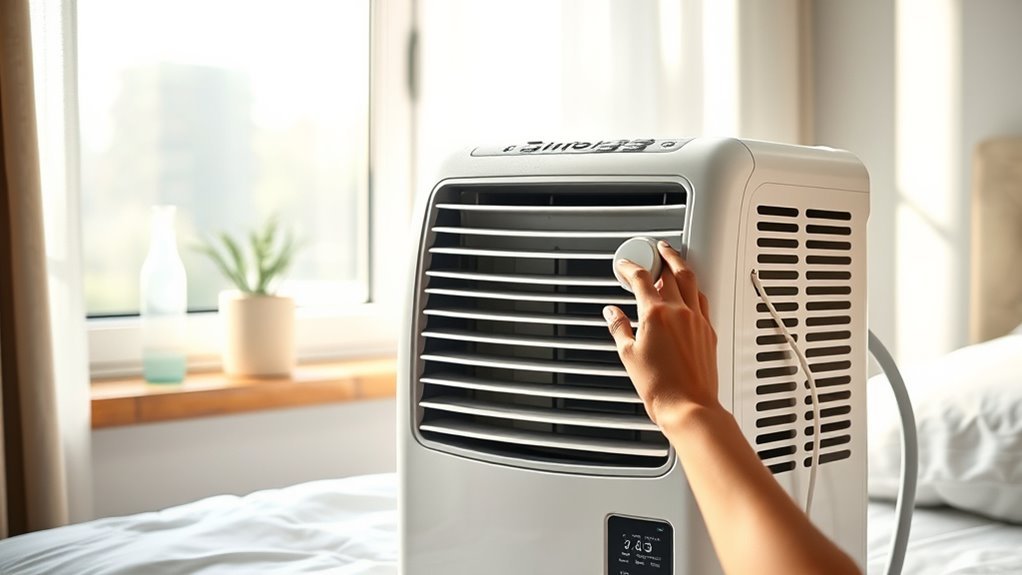
When you switch a portable air conditioner to dry mode, the machine prioritizes moisture condensation over rapid temperature drops. Warm, muggy room air is pulled across cold evaporator coils (typically running around 35°F to 40°F). Water vapor condenses into liquid droplets on those cold fins and drips into the collection tray instead of staying in the air.
Dry mode still cools the room slightly because the refrigeration compressor is active, but it changes how the fan and compressor behave. According to Haier’s portable air conditioner dehumidify mode documentation, the indoor blower runs at its slowest fan speed so damp air stays in contact with the cold evaporator coil longer, pulling out more water per pass without over-chilling the space.
Why Portable AC Controls Differ in Dry Mode
Portable air conditioners handle Dry mode settings in one of two ways depending on the manufacturer:
- Fixed auto-dry models (common on Haier, LG, Midea, and Whynter units): You cannot set a relative humidity percentage or change the fan speed. The unit locks the fan to low and cycles the compressor based on room temperature (often locking low fan speed whenever room temperature is below 77°F).
- Humidistat-equipped models (common on select Danby, Friedrich, and smart units): You can use the up and down arrows to pick a specific target between 30% and 50% RH (or 35% to 85% RH in 5% steps), and the compressor cycles off once the room hits your setpoint.
| Feature | Cool Mode | Dry (Dehumidify) Mode | Fan Mode |
|---|---|---|---|
| Primary Goal | Lower room temperature fast | Maximize moisture condensation | Circulate indoor air only |
| Compressor Operation | Runs continuously until target temp is met | Cycles intermittently to keep coils cold | Off (no cooling or drying) |
| Indoor Fan Speed | User-adjustable (Low, Med, High, Auto) | Locked to Low (or Auto-Low) | User-adjustable |
| Best Weather Scenario | Hot weather above 78°F (25.5°C) | Muggy, rainy days between 65°F and 77°F | Mild, dry days needing breeze |
Think of dry mode as a comfort setting for light to moderate humidity when temperatures are above 65°F (18°C). Below 60°F to 65°F, portable AC evaporator coils can frost over, making a dedicated low-temperature dehumidifier necessary for chilly basements or crawl spaces.
What Humidity Setting Should You Use?
Keep your indoor relative humidity between 30% and 50%, starting with a target of 45%. According to the US EPA’s Care for Your Air indoor humidity guidance, maintaining 30% to 50% RH inhibits mold growth and dust mites while keeping your skin, eyes, and airways comfortable.
If windows fog up, bedding feels clammy, or the room air still feels heavy, lower the target to 40%. Conversely, if your throat, nasal passages, or skin feel dry and static electricity increases, raise the setpoint toward 50%.
Rule of thumb
Target 45% RH for everyday living spaces, 35% to 40% RH when cold outdoor weather causes window condensation, and 50% RH if the air feels overly dry. Never let indoor humidity stay above 60% RH, which is the threshold where mold spores begin germinating on household surfaces.
Avoid setting your portable AC to its lowest possible humidity number (such as 30%) in a leaky room. Chasing an ultra-low number forces the compressor to run nonstop, fills the water tank rapidly, and wastes electricity without fixing outdoor air infiltration. Close bathroom and kitchen doors, run exhaust fans when cooking or showering, and verify room conditions with your hygrometer.
How to Drain or Empty the Water Tank
To prevent automatic shutoffs in dehumidifier mode, either empty the internal collection reservoir regularly or attach a drain hose to the unit’s upper continuous drain port. Because dry mode pulls far more water out of the air than standard cooling, even “self-evaporative” portable ACs that normally mist water across the hot condenser coil often fill their internal tank in 5 to 6 hours on humid days.
Recommended Products

MULTIFUNCTIONAL UNIVERSAL DRAIN HOSE: This drain hose has multiple uses, in addition to being suitable for dehumidifier drainage, it is also suitable for air conditioner drainage as well as being suitable for a variety of gardening tasks. Additionally our dehumidifier drain hose can be cut to your desired length to customize it for different situations.

Premium Material: Constructed from high-performance polyethylene, this drain hose features great corrosion resistance, high flexibility, and lightweight weather-resistant properties. It has passed pressure, anti-corrosion, thermal insulation and air-blowing tests, with its drainage performance verified through repeated trials.

Extra Long Hose:The air conditioning drain hoses are 10 feet long. The long hose will meet the requirements of drainage at different heights.
Upper Continuous Drain Port vs. Lower Bottom-Tray Drain Port
As explained in Hisense’s guide on how portable air conditioners handle moisture, units collect water internally unless drained continuously. Most portable air conditioners feature two separate drain ports on the rear panel:
- Upper (or middle) drain port for Dry mode: Sits higher on the back cabinet right below the evaporator coil tray. Uncap this port in Dehumidify mode to let water flow continuously by gravity into a floor drain or bucket before it ever reaches the bottom pan. On standard units, the upper dehumidify drain port measures 11/16 inch (17.8 mm) in inside diameter and 15/16 inch (24.5 mm) in outside diameter, often accepting either an included push-on hose or a standard 3/4-inch garden hose adapter.
- Lower (bottom) drain port for full-tank emptying: Sits flush with the bottom base pan (often 5/16 inch / 8.5 mm inside diameter) to drain accumulated water when the bottom float switch triggers a shutoff code or before seasonal storage.
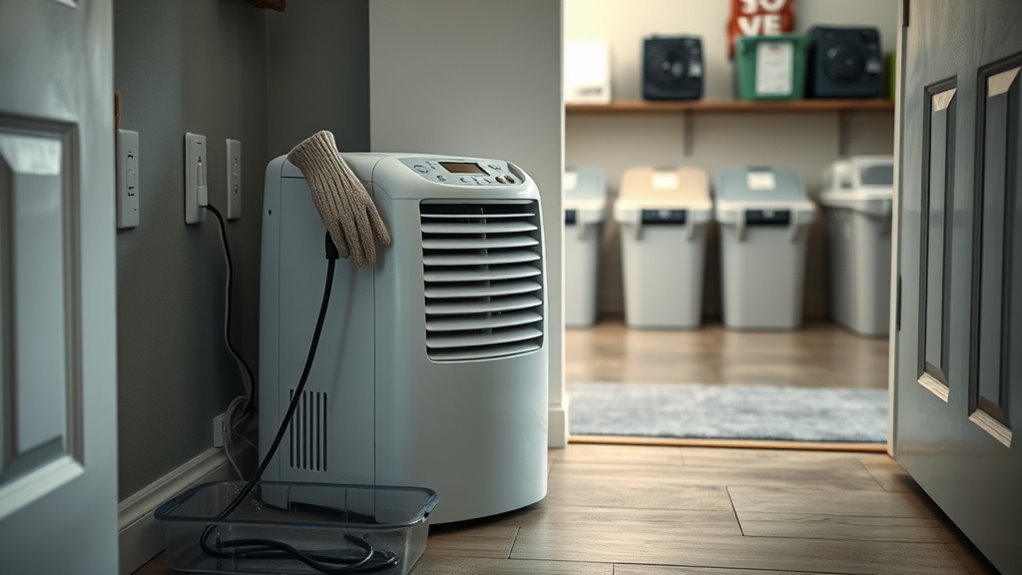
Keep a gravity drain hose sloping strictly downward with no kinks or upward loops; only models equipped with an internal condensate pump can push water uphill into a sink or window opening. Test the connection for 15 minutes after setup to confirm no water drips around the cap or fitting.
How to Clear P1, FL, or E4 Full-Tank Codes
When the bottom pan fills completely, the safety float stops the compressor, beeps, and displays an error code such as P1 (Frigidaire, Midea, Danby), FL (LG, Hisense, Black+Decker), or E4. Follow Frigidaire’s P1 full bottom tray error code reset steps: turn the unit off, wheel it carefully to a floor drain or place a shallow pan under the bottom plug, drain the tray completely, reinstall the plug tightly, and unplug the power cord for 30 seconds if needed to clear the display.
Warning: Never tilt a portable air conditioner sharply while the bottom tray is full or move it over thick carpet before draining; spilled water can contact internal electrical components and wet organic flooring, where mold can germinate within 24 to 48 hours.
Does a Portable AC Need Venting in Dehumidifier Mode?
In almost all everyday situations, yes, you should keep the exhaust hose vented outdoors in dehumidifier mode. A portable air conditioner uses a refrigeration compressor (drawing roughly 800 to 1,400 watts) to chill its evaporator coil, and all the heat pulled from the room air—plus heat from the compressor motor itself—must leave through the exhaust hose.
If you disconnect the exhaust hose, the unit dumps that hot condenser air straight back into your room. A few manufacturer manuals (such as certain Whynter models) note that venting in dehumidifying mode is optional if the room is chilly (below 77°F) and you specifically want the warm exhaust air recirculated indoors so the room does not cool down. However, running unvented warms the space by several degrees and requires much more frequent draining because moisture is no longer evaporated out the window.
Why Single-Hose vs. Dual-Hose Venting Matters for Humidity
If your portable AC uses a single exhaust hose, blowing air out the window creates single-hose negative air pressure inside the room. That pressure drop sucks warm, humid replacement air in through gaps under doors and around window frames, forcing Dry mode to work harder. Dual-hose portable ACs solve this by using a second intake hose to draw outdoor air across the condenser and push it right back outside without depressurizing your room.
Pro Tip: If you use a single-hose portable AC in Dry mode, place a draft stopper along the bottom of the hallway door and seal your window slider kit with foam weatherstripping to cut humid air infiltration.
When Dry Mode Is Enough vs. When You Need a Dehumidifier
Use portable AC dry mode for temporary, warm-weather stickiness in a single bedroom or living space, and choose a dedicated dehumidifier for persistent dampness, cool basements, or high moisture loads. As highlighted in LG’s comparison of a dehumidifier vs. AC dry mode, Dry mode is a secondary comfort feature rather than a full-time moisture-control appliance.
|
Situation or Spec |
Use Portable AC Dry Mode |
Use a Dedicated Dehumidifier |
|---|---|---|
|
Room feels sticky on a warm day (68°F–78°F) |
Good choice; dries and slightly cools the room |
Usually unnecessary unless humidity stays above 60% |
|
Brief humidity spike after rain |
Good for 2- to 4-hour sessions |
Better if dampness returns as soon as the AC stops |
|
Cool basement, crawl space, garage, or laundry room |
Poor fit; coils can freeze below 60°F–65°F and require a window vent |
Best choice; operates without window venting and includes auto-defrost |
|
Musty smell, window condensation, or damp walls |
Not enough by itself |
Required (30 to 70 pints/day capacity), plus fix the leak or moisture source |
|
Moisture removal rate & power draw |
Roughly 5 to 20 pints/day while cycling; draws 800 to 1,400 watts |
20 to 70+ pints/day continuous; draws 300 to 700 watts (13% less with ENERGY STAR) |
|
Effect on room temperature |
Slightly cools the air |
Discharges warm dry air around 100°F–106°F (38°C–41°C), warming the room 1°F–2°F |
Because a dedicated dehumidifier houses both its cold evaporator and hot condenser inside the room without an exhaust hose, it removes far more water per kilowatt-hour and never creates negative pressure that pulls outdoor humidity indoors.
Recommended Products

120-Pint/Day Dehumidifier for Large Spaces Up to 6,000 Sq. Ft.: This powerful dehumidifier for basement removes 120 pints/day in humid conditions (95℉, 90% RH) and 90 pints/day in warm, damp environments (86℉, 80% RH). Ideal for spaces up to 6,000 sq. ft., including offices, bedrooms, kitchens, living rooms, garages, and RVs. The ENERGY STAR certified dehumidifier maintains humidity between 30%–80%, providing a wider range than most models, which typically range from 40%–80%.

Semiconductor dehumidifiers use thermoelectric cooling to remove moisture from the air. They create a drier, more comfortable environment by reducing humidity and improving air quality.

【Dual-Function Dehumidifier and Aromatherapy】Our dehumidifier efficiently removes excess moisture using semiconductor condensation technology. Enjoy a fresh, fragrant environment while reducing humidity—ideal for creating a calming bedroom ambiance or refreshing your living space. For optimal results, keep all doors and windows closed during use.
Fix Common Portable AC Dry Mode Problems
When your portable air conditioner fails to lower room humidity, start by verifying the unit is in Dry (water-droplet) mode rather than Fan mode, then check room sealing, filter cleanliness, and drainage flow. Fan mode only circulates air without running the compressor, so zero water condenses on the coils.
- Humidity stays above 55% to 60%: Seal gaps around the window kit, shut exterior and bathroom doors, and verify your hygrometer is at least 5 feet away from the unit. If a single-hose unit is pulling humid air from adjacent rooms, run it in shorter cycles or switch to a dual-hose or dedicated dehumidifier.
- The internal tank fills every few hours (P1, FL, or E4 error): Switch from the internal tank to a continuous gravity drain hose on the upper drain port so water exits before reaching the bottom float switch.
- The room gets noticeably warmer: Inspect the rear exhaust hose to make sure it has not popped loose from the unit adapter or window bracket, and ensure it has no sharp bends or crushes trapping condenser heat.
- Airflow feels unusually weak or coils ice up: Remember that Dry mode intentionally locks the fan to low speed. However, if airflow barely registers or frost appears on the coils, turn the unit off, wash and dry the mesh air filters (clean every 2 weeks), and verify room temperature is at least 65°F.
- Water leaks onto the floor: Check that the unit sits flat on a level floor, the bottom drain plug is seated tightly, and any continuous hose slopes downward with no upward loops.
- A sour or musty smell blows from the vents: Drain the bottom pan completely, flush the drain line with warm water and mild dish soap, and let the unit run on Fan mode for 30 minutes after Dry sessions to dry off the internal evaporator fins.
Recommended Products

HANDY AND PORTABLE: The SereneLife Portable Air Conditioner System features a lightweight, handy, sleek body design intended to be used in the bedroom, living room or garage at home or office. It features rolling wheels for easy portability

Three-in-One Unit: Our 10,000 BTU (5,550 DOE) air conditioner also functions as a dehumidifier & fan. This portable air conditioner has a full function remote control & top mounted control panel with LED display

Three-in-One Unit: Our 9000 BTU (5,300 BTU SACC) air conditioner also functions as a dehumidifier & fan. This portable air conditioner has a full function remote control & top mounted control panel with LED display
Related Guides
Note: If you manage asthma, allergies, or COPD, consult your physician about your ideal home humidity target. Keeping indoor air between 30% and 50% RH helps curb mold and dust mites without over-drying sensitive airways.
Frequently Asked Questions
How do you use a portable AC as a dehumidifier?
Select Dry or Dehumidify mode (the water-droplet symbol), keep the window exhaust hose attached, close doors and windows, and set the humidity target around 45% RH if your unit has a humidistat. Connect a hose to the upper continuous drain port or empty the tank when full.
What humidity should I set my portable AC to?
Set your portable AC between 30% and 50% relative humidity, starting at 45% RH. Lower the setting to 40% if the air still feels sticky or windows fog up, or raise it toward 50% if your skin, eyes, or throat feel dry.
Why can’t I change the fan speed or humidity percentage in Dry mode?
Many portable air conditioners do not have a built-in humidistat and automatically lock the indoor fan to low speed in Dry mode. Slowing the fan keeps damp air on the cold evaporator coil longer to maximize condensation; monitor the room with a separate hygrometer and turn the unit off when comfortable.
Can I run my AC on dry mode all day?
Yes, you can run dry mode for extended periods as long as a continuous drain hose is attached, the air filter is clean, and room humidity remains above your target. Check a standalone hygrometer so you do not run the compressor all day after the room is already dry.
Does a portable AC need venting in dehumidifier mode?
Yes, in most cases a portable AC still requires its window exhaust hose in dehumidifier mode to expel condenser heat outside. Running the unit without an exhaust hose dumps warm air back into the room and increases how fast the internal water tank fills.
What do P1, FL, or E4 error codes mean in Dry mode?
Error codes P1, FL, and E4 indicate that the internal bottom water collection tray is full and the safety float switch has paused the compressor. Turn the unit off, place a shallow pan or floor drain under the lower drain plug to empty the water, and secure the cap to resume operation.
Is dry mode as good as a real dehumidifier?
No, portable AC dry mode is designed for light, occasional dampness in warm living spaces. A dedicated dehumidifier removes 30 to 70 pints of water per day using roughly half the electricity (300 to 700 watts), needs no window vent, and works far better in cool basements and mold-prone areas.
Should you use a dehumidifier if you have COPD?
Ask your clinician for guidance tailored to your symptoms, but Cleveland Clinic respiratory humidity guidance recommends keeping indoor humidity between 30% and 50%. This moderate range helps suppress mold and dust mites while preventing overly dry air below 30% RH that can irritate airways.
Conclusion
Use your portable AC’s dehumidifier mode whenever warm, muggy weather makes a room feel clammy without needing aggressive cooling. Aim for 45% RH on a standalone room hygrometer, keep the window exhaust sealed, and hook a downward-sloping hose to the upper drain port so the tank does not shut the compressor down. If indoor humidity repeatedly climbs back above 60% or the space is cool and chronically damp, fix the underlying moisture source and switch to a dedicated dehumidifier.
Sources
- EPA: Care for Your Air indoor humidity guidance: Supports the 30% to 50% relative humidity recommendation and 24-to-48-hour mold prevention window.
- Haier: Portable Air Conditioner Dehumidify Mode: Supports slowest indoor fan speed operation and lack of adjustable RH% setpoints on fixed auto-dry portable ACs.
- LG: When to Use a Dehumidifier vs AC Dry Mode: Supports differences in moisture control consistency, cooling effect, and 60% RH upper threshold.
- Hisense: How Portable Air Conditioners Work: Supports internal removable bucket vs. self-evaporation moisture handling.
- Danby: Using a Portable Air Conditioner as a Dehumidifier: Supports water-droplet mode icon and 30% to 50% RH settings on humidistat-equipped portable ACs.
- Haier: Portable Air Conditioner Drain Plug and Drain Hose Sizes: Supports upper dehumidify drain port (11/16-inch ID) vs. lower cooling drain port (5/16-inch ID) specifications.
- Frigidaire: Room Air Conditioners Error Code P1: Supports full bottom tray shutoff behavior, draining steps, and 30-second power reset.
- GE Appliances: Single-Hose vs. Dual-Hose Portable Air Conditioners: Supports negative room air pressure and outdoor air infiltration on single-hose units.
- Cleveland Clinic: Respiratory and Wheezing Indoor Humidity Guidance: Supports maintaining 30% to 50% indoor humidity for sensitive airways.