Affiliate disclosure: As an Amazon Associate I earn from qualifying purchases. This article contains Amazon affiliate links, meaning we may earn a small commission at no extra cost to you.
Last updated: October 2026
If you need a dehumidifier for a small greenhouse or grow tent, look past advertised square-footage claims and compare actual daily moisture-removal capacity, drainage options, minimum operating temperature, humidity controls, and electrical safety. The three compact thermoelectric (Peltier) models reviewed below are built for micro greenhouses, propagation cabinets, seedling domes, and tightly sealed 2×2 or 2×4 grow tents with light moisture loads (removing roughly 240 to 360 mL, or 8 to 12.2 fl oz, of water per day). A walk-in greenhouse, a densely planted flowering tent, or an unheated structure with heavy overnight condensation requires a full-size compressor or desiccant dehumidifier paired with active exhaust ventilation.
Quick Verdict
Choose the LAVTAIOA HSCS-25WP Auto Small Dehumidifier when you need a built-in humidistat and ultra-compact mounting inside a tiny grow cabinet or enclosure. Pick the Eva-Dry EDV-1100 if you want a whisper-quiet, simple plug-in unit for a warm propagation cabinet where emptying a small tank is easy. Go with the Litever Small Portable Dehumidifier for the highest documented extraction rate in this mini class (up to 360 mL / 12.2 fl oz per day), an included continuous gravity drain hose, and auto-restart memory that works seamlessly with external humidity controllers.
How these products were selected
This guide evaluates compact dehumidifiers based on documented daily moisture extraction under stated temperature and relative humidity (RH) test conditions, drainage practicality, control features, and physical footprint. These are technical recommendations matched to specific small-enclosure use cases, not claims of hands-on laboratory testing.
Important greenhouse electrical safety note
Compact consumer dehumidifiers are indoor-rated appliances, not weatherproof horticultural equipment. Keep the appliance body, AC/DC power adapter, plug, and cord completely away from rain, foliar misting, irrigation spray, dripping roof condensation, and standing water. Always plug greenhouse equipment into a properly rated Ground Fault Circuit Interrupter (GFCI) receptacle with an in-use weatherproof cover, follow the manufacturer’s manual, and immediately unplug any unit with a wet or damaged cord or adapter.
Can a Mini Dehumidifier Handle a Small Greenhouse?
A mini thermoelectric dehumidifier can effectively stabilize humidity in a warm, tightly enclosed micro greenhouse, clone cabinet, or small grow tent when the daily watering volume is modest. Because plants transpire roughly 90% to 95% of the water you pour into their root zone, a mini unit rated at 240 to 360 mL (8 to 12.2 fl oz) per day can only keep up if total daily transpiration and evaporation stay near or below that threshold.
A mini unit will not control humidity in a leaky outdoor structure, a heavily watered tent with multiple mature plants, or an unheated greenhouse where night temperatures drop below 60°F (15.5°C). Always place an independent digital hygrometer at plant-canopy height and judge performance by both the relative humidity drop and the actual volume of water collected over a 24-hour light and dark cycle.
Quick Comparison of Small Greenhouse Dehumidifiers
| Product | Best Use Case | Stated Moisture Removal | Tank & Drainage | Controls & Power | Main Limitation | Check Price |
|---|---|---|---|---|---|---|
| LAVTAIOA Auto Small Dehumidifier (HSCS-25WP) | Automatic setpoint control in tiny grow cabinets and sealed enclosures | Up to 250 mL (8.5 fl oz) per day | Direct hose drainage (tubing included; no internal tank) | Built-in digital humidistat; automatic cycling | Requires mounting/installation planning and external drain routing | Check Price on Amazon |
| Eva-Dry EDV-1100 | Quiet, warm micro-enclosures and propagation shelves | Approx. 240 mL (8 fl oz) per day at 86°F, 80% RH | 473 mL (16 fl oz) removable tank only | 22.5W; manual on/off switch (works with external plug-in humidistats) | No continuous drain hose port; weak extraction below 60°F | Check Price on Amazon |
| Litever Small Portable Dehumidifier | Small tents and cabinets needing unattended gravity drainage | Up to 360 mL (12.2 fl oz) per day at 86°F, 80% RH | 800 mL (27 fl oz) tank or included 4 ft silicone drain hose | 22W; power-off memory function and full-tank auto shutoff | Still limited to light moisture loads in warm conditions | Check Price on Amazon |
LAVTAIOA Auto Small Dehumidifier for Confined Spaces (HSCS-25WP)
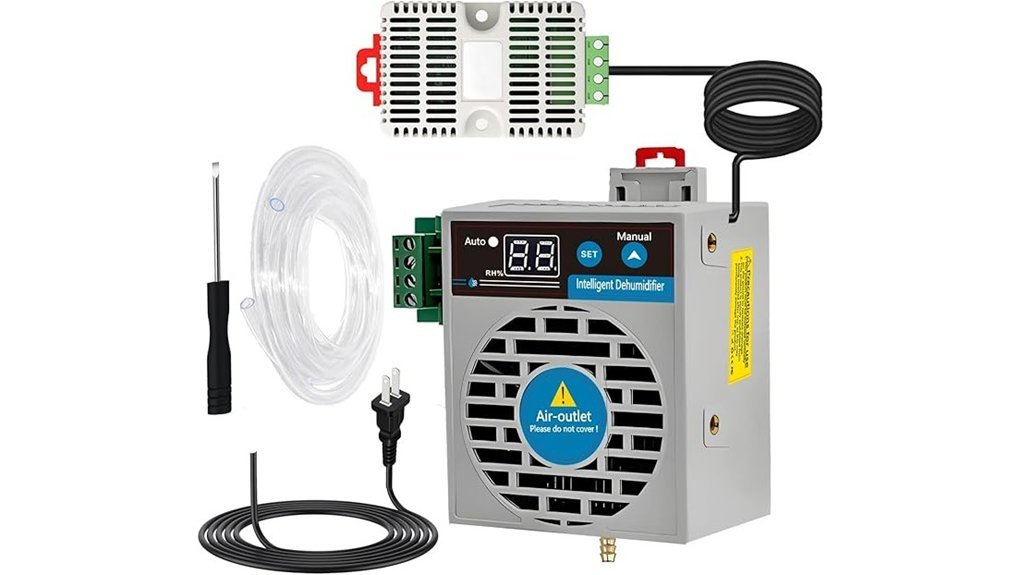
Best for automatic control in tiny grow tents and cabinets: The LAVTAIOA HSCS-25WP is an ultra-compact cabinet-style semiconductor dehumidifier originally engineered for confined enclosures such as grow cabinets, utility boxes, safes, and terrarium-sized spaces. Unlike standard tabletop units that store water in a bulky reservoir, it condenses moisture and channels it directly out through an attached drain tube while using an integrated digital humidistat to cycle on and off automatically.
Key Specifications:
- Stated Moisture Removal: Up to 0.25 L (250 mL / 8.5 fl oz) per day
- Dehumidification Type: Thermoelectric (semiconductor condensation)
- Drainage Method: Direct continuous gravity drain via included tubing (no internal water tank)
- Humidity Controls: Built-in digital display with adjustable humidity setpoint
- Form Factor: Ultra-compact enclosure mount (preserves floor space)
Why you’ll like it: Floor space inside a micro grow tent or Ikea-style plant cabinet is precious. Because the HSCS-25WP eliminates the water collection tank in favor of direct tubing and can be mounted vertically on a wall or frame, it fits where tabletop appliances cannot. The onboard digital humidity controller also saves you from buying a separate plug-in humidistat.
Who should buy this: Growers running a tightly sealed propagation cabinet, micro greenhouse, or compact 2×2 grow tent who want set-and-forget humidity cycling and can route a drain tube downward into an external bottle or tray.
Who should avoid it: Anyone looking for a simple freestanding tabletop unit with a removable water bucket, or anyone managing a walk-in greenhouse or multi-plant flowering tent. Before ordering, verify the current listing’s power cord setup, mounting brackets, and drainage routing requirements to ensure they match your enclosure.
Pros:
- Purpose-built micro footprint preserves valuable canopy and floor space.
- Integrated digital humidistat provides automatic humidity setpoint control.
- Direct tubing drainage eliminates daily tank emptying inside cramped enclosures.
- Low heat output will not overheat a small, enclosed cabinet.
Cons:
- 250 mL (8.5 fl oz) daily capacity only handles very light transpiration loads.
- Requires vertical mounting and a continuous downward path for the drain tube.
- No internal backup reservoir if the drain tube becomes kinked or blocked.
Verdict: If you are building out a custom micro-grow cabinet or tiny tent where every square inch counts and you want built-in digital humidity control with direct hose drainage, the LAVTAIOA HSCS-25WP is the most space-efficient tool in this lineup.
Eva-Dry EDV-1100 Whisper-Quiet Dehumidifier for Small Spaces
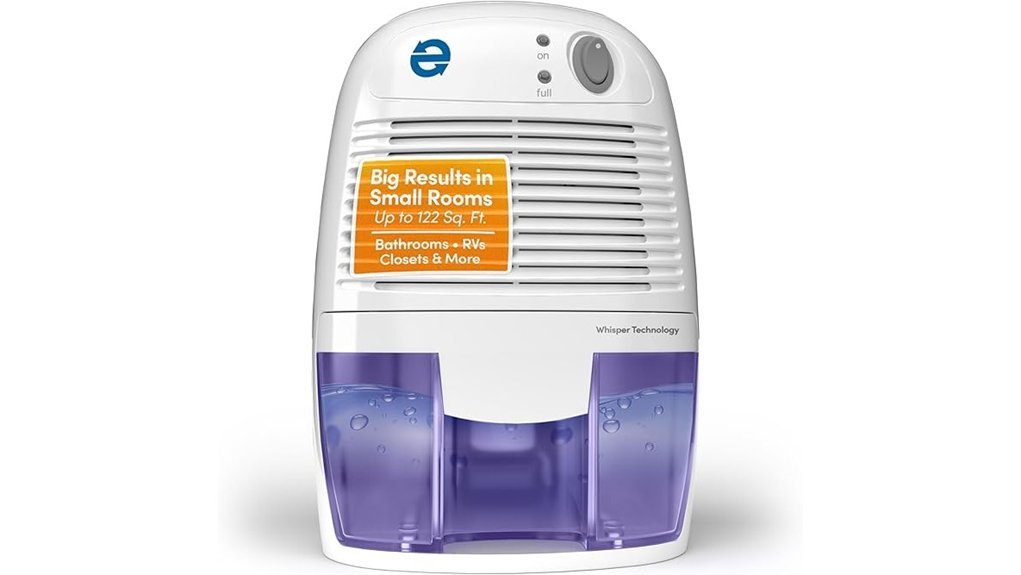
Best quiet plug-in option: The Eva-Dry EDV-1100 is a proven, freestanding petite thermoelectric dehumidifier built for quiet operation in small enclosed areas. Its manufacturer specifications list a moisture extraction rate of approximately 8 fluid ounces (240 mL) per day at 86°F and 80% RH, paired with a 16-ounce (473 mL) slide-out water reservoir and automatic full-tank shutoff.
Key Specifications:
- Stated Moisture Removal: Approx. 240 mL (8 fl oz) per day (tested at 86°F and 80% RH)
- Water Tank Capacity: 473 mL (16 fl oz) removable reservoir
- Continuous Drain Hose Port: No
- Power Consumption: ~22.5 Watts (DC adapter included)
- Controls: Simple mechanical On/Off switch with full-tank LED indicator and auto shutoff
Why you’ll like it: Simplicity and reliability are the main strengths of the EDV-1100. Because it uses a physical rocker switch rather than a capacitive touch button that resets on power loss, you can plug it directly into an external digital humidity controller (such as an Inkbird humidistat with a sensor hung at plant height) to automate cycling. Its whisper-quiet Peltier fan also makes it ideal for indoor plant cabinets located in bedrooms or living spaces.
Who should buy this: Indoor growers and hobbyists who want a quiet, zero-hassle plug-in appliance for a warm propagation shelf, terrarium room, or micro tent and do not mind emptying a half-liter tank every two to three days.
Who should avoid it: Growers who leave their enclosure unattended for days at a time or who need continuous hose drainage. Like all Peltier dehumidifiers, its extraction rate drops noticeably when ambient temperatures fall below 60°F (15.5°C).
Pros:
- Whisper-quiet compressor-free operation suits indoor living areas.
- Physical power switch works reliably with external plug-in humidity controllers and smart plugs.
- Automatic shutoff and indicator light prevent reservoir overflow when full.
- Transparent, well-documented manufacturer test ratings and low 22.5W energy draw.
Cons:
- Lacks a continuous drain port—must be emptied manually.
- 473 mL (16 fl oz) tank fills in roughly 48 hours under peak humidity.
- Not effective in cool or unheated seasonal greenhouses.
Verdict: For a warm, indoor micro-enclosure where quiet operation and plug-and-play simplicity matter more than hose drainage, the Eva-Dry EDV-1100 is a dependable classic that pairs easily with an external canopy humidistat.
Litever Small Portable Dehumidifier with Drain Hose
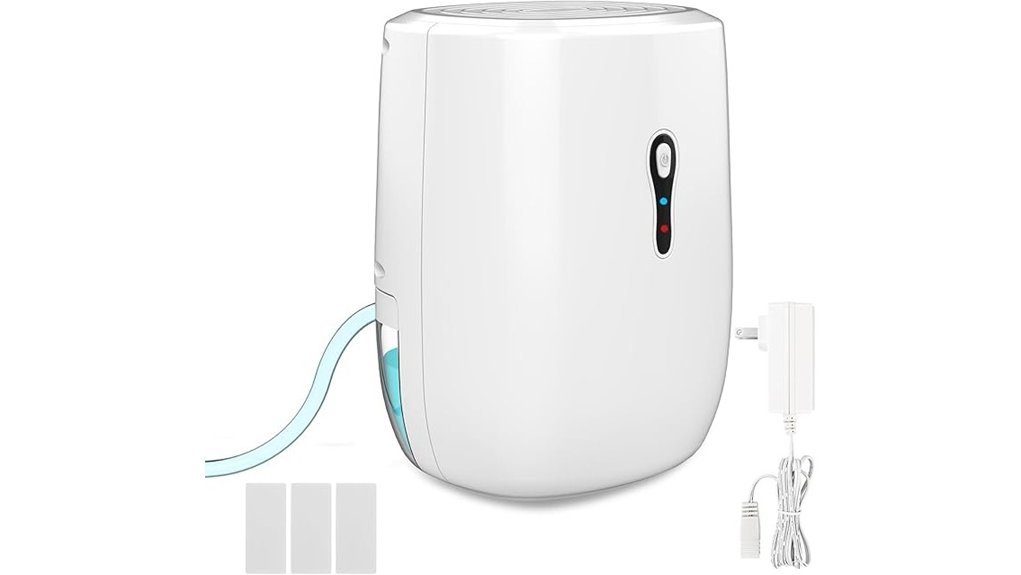
Best for continuous drainage and overall mini capacity: The Litever Small Portable Dehumidifier combines the highest documented moisture-removal rate in this trio—up to 360 milliliters (12.2 fl oz) per day at 86°F and 80% RH—with both an 800-milliliter (27 fl oz) removable tank and an included 4-foot (1.2 m) silicone drain hose. Running on a 22-watt low-voltage DC adapter, it also includes a power-off memory function that automatically resumes operation after power is restored.
Key Specifications:
- Stated Moisture Removal: Up to 360 mL (12.2 fl oz) per day (tested at 86°F and 80% RH)
- Water Tank Capacity: 800 mL (27 fl oz) tank
- Drainage Method: Removable tank or continuous gravity drain via included 4 ft silicone hose
- Power & Temp Range: 22 Watts; stated operating range of 41°F to 104°F (most effective above 60°F)
- Controls: Auto shutoff when full, plus power-interruption memory restart
Why you’ll like it: The Litever solves the two biggest frustrations of mini dehumidifiers: tiny tanks and power-reset amnesia. It extracts roughly 45% to 50% more moisture per day under test conditions than 240–250 mL units, holds nearly 27 ounces in its internal reservoir, and lets you attach the 4-foot hose for hands-free gravity drainage into a floor bucket or drain. Because of its built-in memory function, you can also plug it into an external digital humidistat outlet and have it turn back on automatically whenever canopy humidity rises.
Who should buy this: Growers managing a small, protected grow tent or indoor greenhouse shelf who want the maximum extraction available in a 22W mini unit alongside flexible tank-or-hose drainage.
Who should avoid it: Anyone expecting closet or bathroom square-footage ratings to translate directly to a wet greenhouse. Heavy watering schedules, multiple medium-to-large plants, or chilly nighttime temperatures will still overwhelm a 360 mL/day thermoelectric unit.
Pros:
- Highest documented daily extraction rate (360 mL / 12.2 fl oz) among these three compact picks.
- Includes a 4-foot silicone hose for unattended continuous gravity drainage.
- Generous 800 mL (27 fl oz) internal tank if you prefer not to run a hose.
- Power-off memory function allows seamless automation with external plug-in humidistats.
Cons:
- Gravity drain hose requires elevating the unit above the collection vessel with no upward loops.
- Despite its 41°F–104°F safe operating rating, Peltier water extraction slows dramatically in cool air below 60°F.
- Still undersized for dense plant canopies or walk-in structures.
Verdict: Overall, the Litever Small Portable Dehumidifier offers the best balance of extraction capacity (360 mL/day), tank volume (800 mL), continuous hose drainage, and external controller compatibility for a small grow tent or micro greenhouse.
Factors to Consider When Choosing a Dehumidifier for a Small Greenhouse
Unlike a bedroom or hallway closet, a greenhouse or grow tent actively generates moisture every hour through irrigation, damp potting media, plant foliar transpiration, and day-to-night temperature swings. Because residential square-foot coverage claims do not account for live plants, evaluate your setup using the technical factors below.
1. Calculate Your Real Transpiration and Moisture Load
A practical rule of thumb in controlled-environment horticulture is that 90% to 95% of the water you pour into your pots eventually evaporates or transpires into the air. If you water your plants with 1 liter (1,000 mL, or about 34 fl oz) of water per day inside a sealed grow tent, and your ventilation system isn’t exhausting that moisture, your dehumidifier must extract nearly 1,000 mL every 24 hours just to keep relative humidity flat.
Place an independent digital hygrometer with a min/max memory log at plant-canopy height. Record humidity during peak daytime heat, right after watering, 30 minutes after grow lights turn off (or after sunset), and just before sunrise. When warm daytime air cools by 15°F at night, its capacity to hold water vapor drops sharply—causing relative humidity to spike even if no extra water was added.
2. Match Dehumidifier Technology to Capacity and Temperature
The compact models reviewed above remove 240 to 360 mL (0.24 to 0.36 L) of water per day under warm, humid test conditions (86°F and 80% RH). At a more typical grow tent condition of 72°F and 60% RH, a Peltier unit removes roughly half of its peak rating. Use the comparison table below to see whether your space suits a mini thermoelectric unit or requires stepping up to a compressor or desiccant machine:
| Dehumidifier Type | Typical Daily Extraction | Best Operating Temp | Heat Added to Space | Ideal Greenhouse / Tent Setup |
|---|---|---|---|---|
| Mini Thermoelectric (Peltier) | 240–750 mL/day (0.5–1.5 pints) | Above 65°F (18°C); poor below 60°F | Negligible (20W–40W) | Propagation cabinets, micro greenhouses, and 2×2 tents with 1–2 small plants |
| Refrigerant Compressor | 10–24+ L/day (20–50+ pints) | Above 60°F (15.5°C); coils ice below 55°F unless auto-defrosting | Moderate to high (200W–550W; warms air by 3°F–6°F) | 3×3 to 5×5+ grow tents (often placed in the lung room outside the tent) and warm walk-in greenhouses |
| Desiccant Rotor | 6–12 L/day (12–25 pints) | 34°F to 95°F (1°C to 35°C); excels in cold air | Moderate to high (350W–650W; provides helpful winter warmth) | Unheated or cool-season outdoor greenhouses in fall, winter, and early spring |
3. Check Nighttime Operating Temperatures
Thermoelectric Peltier plates cool a small internal aluminum heat sink to condense moisture out of passing air. When greenhouse temperatures fall below 60°F (15.5°C) overnight, the dew point drops close to freezing, causing Peltier extraction efficiency to plummet. If you grow in an unheated backyard greenhouse where night temperatures drop into the 40s or 50s (°F), choose a desiccant dehumidifier instead—it absorbs moisture chemically using a silica rotor regardless of cold air temperatures and releases gentle warmth that helps protect plants from chill stress.
4. Prioritize Continuous Gravity Drainage
When humidity spikes after watering, a small reservoir can fill up while you are asleep or at work, triggering auto-shutoff right when your plants need protection most. A continuous drain hose (included on both the LAVTAIOA HSCS-25WP and Litever models) lets water flow out automatically. Because mini dehumidifiers rely on gravity rather than an internal condensate pump, follow three rules:
- Elevate the dehumidifier on a stable shelf or bracket higher than your collection jug or floor drain.
- Cut or route the hose so it maintains a smooth, continuous downward slope with zero upward loops or kinks (which trap air pockets and back water up into the appliance).
- Direct the discharge safely away from electrical power strips, cords, walkways, and plant trays.
5. Target the Right Humidity by Growth Stage (and Automate It)
Running a dehumidifier nonstop without a target setpoint can over-dry young plants or waste electricity. While exact requirements depend on your specific crop and leaf temperature (Vapor Pressure Deficit, or VPD), most greenhouse and indoor tent crops thrive within these general relative humidity ranges:
| Plant Growth Stage | Target Relative Humidity (RH) | Why It Matters |
|---|---|---|
| Unrooted Clones & Cuttings | 70% – 80% RH | Cuttings lack roots and absorb moisture through foliage; rarely needs dehumidification. |
| Seedlings & Early Sprouts | 65% – 70% RH | Supports gentle transpiration without drying out delicate root systems. |
| Vegetative Growth | 55% – 70% RH | Balances steady nutrient uptake with healthy leaf expansion; prevent nighttime spikes above 70%. |
| Flowering & Fruiting | 40% – 50% RH (up to 55% early bloom) | Critical for preventing Botrytis (bud rot/gray mold), powdery mildew, and blossom-end issues inside dense canopies. |
Pro Tip for Grow Tents: Even if your mini dehumidifier lacks a built-in humidistat (like the Eva-Dry EDV-1100 and Litever), you can automate it by plugging it into an external digital humidity controller outlet and hanging the controller’s wired sensor probe right at canopy level. Because the Eva-Dry uses a mechanical power switch and the Litever has an auto-restart memory function, both units will power right back on whenever the external controller energizes the outlet.
6. Combine Dehumidification With Canopy Airflow
A dehumidifier can only dry air that actually reaches its intake grill. Even if ambient tent humidity reads 50%, stagnant air trapped inside a dense plant canopy can sit at 80%+ RH right against the leaf surface, inviting fungal spores to germinate. Pair your dehumidifier with a gentle clip-on oscillating fan to keep boundary-layer air moving across the leaves, and maintain at least 6 to 8 inches of unobstructed clearance around the dehumidifier’s air inlet and outlet.
7. Know When a Mini Unit Is Undersized
Watch for these five warning signs that your moisture load has outgrown a mini thermoelectric appliance:
- Relative humidity barely drops (less than 2%–3%) after several hours of continuous operation.
- Heavy condensation still forms on tent walls, greenhouse glazing, or leaf tips right after lights-off.
- The dehumidifier collects its maximum daily rating (240–360 mL) every 24 hours, yet canopy RH remains above your target.
- Damp microclimates persist inside the plant canopy despite running circulation fans.
- You find yourself considering buying two or three mini units for the same enclosure (a single properly sized compressor or desiccant unit outside or inside the space will be far more effective).
8. Electrical and Water Safety in Damp Enclosures
Treat electrical safety as non-negotiable whenever water and plants share an enclosed space. Mount power strips and DC power bricks high up on the tent frame or outside the enclosure so they can never sit in runoff water. Plug all equipment into a GFCI-protected circuit, avoid daisy-chaining light-duty indoor extension cords, and form a “drip loop” in every power cord so any water running down a cable drips safely to the floor before reaching the receptacle.
Before You Buy Checklist
- Measure enclosure volume and watering rate: Confirm how many milliliters or ounces of water you add to your plants daily.
- Log 24-hour humidity swings: Track peak RH after watering and during the coolest pre-dawn hours with a canopy-level hygrometer.
- Check your lowest night temperature: Verify that your enclosure stays above 60°F (15.5°C) if choosing a thermoelectric unit.
- Compare extraction at matched test specs: Compare daily mL/oz ratings tested at 86°F and 80% RH, recognizing real-world extraction at 70°F/60% RH will be lower.
- Plan your drainage path: Decide whether a removable tank (Eva-Dry) or a downward-sloping gravity drain hose (LAVTAIOA, Litever) fits your schedule.
- Check controller compatibility: Choose a built-in humidistat (LAVTAIOA) or a model with power-restart memory/mechanical switches (Litever, Eva-Dry) for external humidistat automation.
- Verify electrical protection: Ensure a dry mounting spot with 6+ inches of airflow clearance and a GFCI-protected outlet.
Frequently Asked Questions
How Do I Maintain My Dehumidifier for Optimal Performance?
Always unplug the appliance before cleaning. Every one to two weeks, wash the water reservoir with warm water and mild dish soap to prevent biofilm, algae, or mold buildup, then dry it thoroughly. Vacuum or brush dust and perlite particles off the air intake and exhaust grills weekly, and inspect continuous drain hoses for kinks, algae blockages, or lost downward slope. Never submerge or spray the main appliance housing, DC adapter, or power cord.
Can Dehumidifiers Make a Greenhouse Too Dry?
Yes. Over-drying the air (driving relative humidity below 40% during vegetative growth or below 60% for seedlings and unrooted cuttings) spikes Vapor Pressure Deficit (VPD), forcing plants to close their leaf stomata, curling leaf margins, and stunting growth. Because mini thermoelectric units only extract 240 to 360 mL per day, they rarely over-dry an active grow tent, but larger compressor units should always be regulated by a humidistat set for your crop’s current growth stage.
What Size Dehumidifier Do I Need for My Greenhouse?
Size your dehumidifier by daily water input rather than floor area alone. Since plants transpire roughly 90% to 95% of irrigation water, a sealed enclosure receiving 250 mL (1 cup) of water daily can use a 250–360 mL/day mini thermoelectric unit. If you water your plants with 2 liters (about 4 pints) per day and cannot exhaust that humidity outdoors, you need a dehumidifier capable of removing at least 4+ pints per day under your actual greenhouse temperature and RH conditions.
Are Low-Watt Mini Dehumidifiers Energy Efficient?
They draw very little power (typically 22 to 30 watts, costing only pennies per day), but low wattage does not equal high energy efficiency per liter of water removed. Thermoelectric units use more electricity per milliliter of extracted water than compressor dehumidifiers. However, in a tiny 2×2 tent or propagation cabinet where a 300-watt compressor unit would overheat the plants and cycle rapidly, a 22-watt mini unit is much more practical.
How Often Should I Empty the Water Reservoir?
Check the reservoir daily during your first week of operation, especially the morning after watering. At peak extraction, the Eva-Dry EDV-1100 (16 oz / 473 mL tank) fills in about two days, while the Litever (27 oz / 800 mL tank) takes roughly two to three days. Attaching a continuous gravity drain hose eliminates daily emptying, though you should still check the external collection vessel and hose slope every few days.
Can I Use an Indoor Dehumidifier in a Greenhouse?
Only if the appliance is placed inside a dry, weather-protected enclosure or indoor grow tent where temperatures stay within the manual’s rated range and water can never splash the unit. Never expose an indoor-rated dehumidifier, power brick, or plug to overhead misting systems, hose spray, roof leaks, or puddling runoff, and always use a GFCI-protected receptacle.
Should the Dehumidifier Go Inside or Outside a Grow Tent?
A low-wattage mini thermoelectric dehumidifier (like the three models in this guide) should go inside the grow tent or cabinet, because it produces almost no heat and its small extraction capacity would be wasted in a larger room. Conversely, if you step up to a large 30-to-50-pint compressor dehumidifier, place it outside the tent in the surrounding “lung room” so your tent’s intake fan draws in dry air without subjecting your plants to the compressor’s hot exhaust air or sacrificing tent floor space.
Conclusion
When managing humidity inside a micro greenhouse, propagation cabinet, or tightly sealed small grow tent with a light moisture load, matching the right compact unit to your setup makes daily maintenance much easier:
- Choose the Litever Small Portable Dehumidifier as the best overall mini option when you want the highest documented extraction rate (up to 360 mL / 12.2 fl oz per day), an 800 mL tank, an included 4-foot continuous drain hose, and auto-restart memory for external humidistat control.
- Choose the LAVTAIOA Auto Small Dehumidifier (HSCS-25WP) when floor space is practically nonexistent and you want an enclosure-mounted unit with a built-in digital humidistat and direct hose drainage.
- Choose the Eva-Dry EDV-1100 for a quiet, simple freestanding unit in a warm indoor cabinet where emptying a 16-ounce removable tank every couple of days is convenient.
Whichever model you select, pair it with a canopy-height hygrometer, steady oscillating airflow, smart watering habits (watering early in the light cycle rather than right before lights-off), and GFCI electrical protection to keep your plants healthy and mold-free.