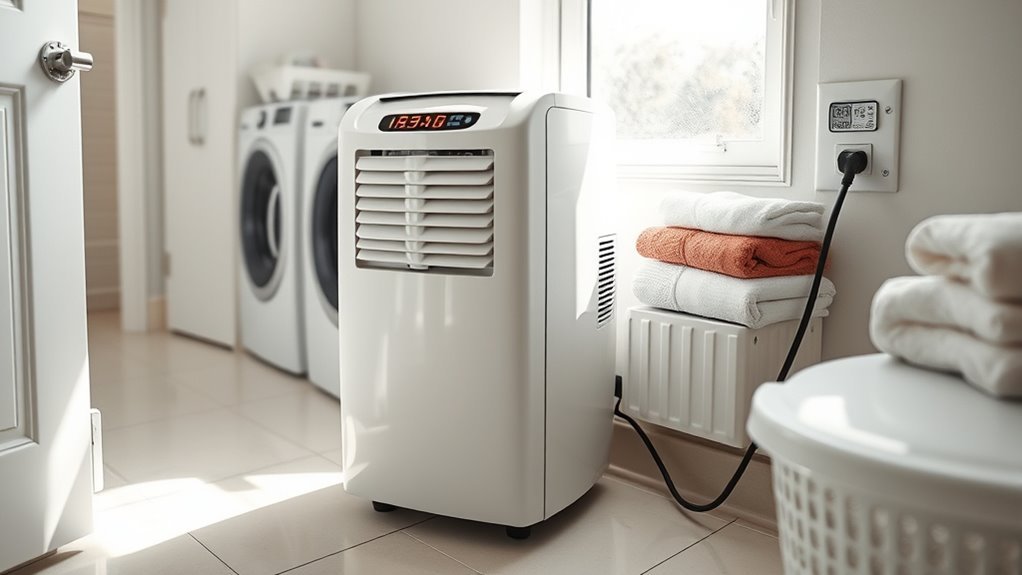
A home dehumidifier can draw anywhere from about 200 to 700 watts during normal operation, although some compact models use less and large whole-home or commercial units may use more. The exact number depends on the model, operating mode, room temperature, humidity, and whether the compressor is running.
Quick Answer
Most portable home dehumidifiers draw roughly 200 to 700 watts while operating. A typical unit may use about 300 to 500 watts, but pint capacity alone does not reveal its exact power draw. Check the nameplate or manual, then calculate energy use as watts ÷ 1,000 × operating hours.
Key Takeaways
- Watts measure the unit’s immediate power draw. Kilowatt-hours measure the electricity used over time.
- A 500-watt dehumidifier running for 12 hours uses 6 kWh, while the same unit running for 24 hours uses 12 kWh.
- ENERGY STAR-certified dehumidifiers use about 20% less energy than comparable conventional models.
- For the most accurate answer, read the appliance label or measure the unit with a properly rated plug-in watt meter.
What Does a Dehumidifier Use in Watts?
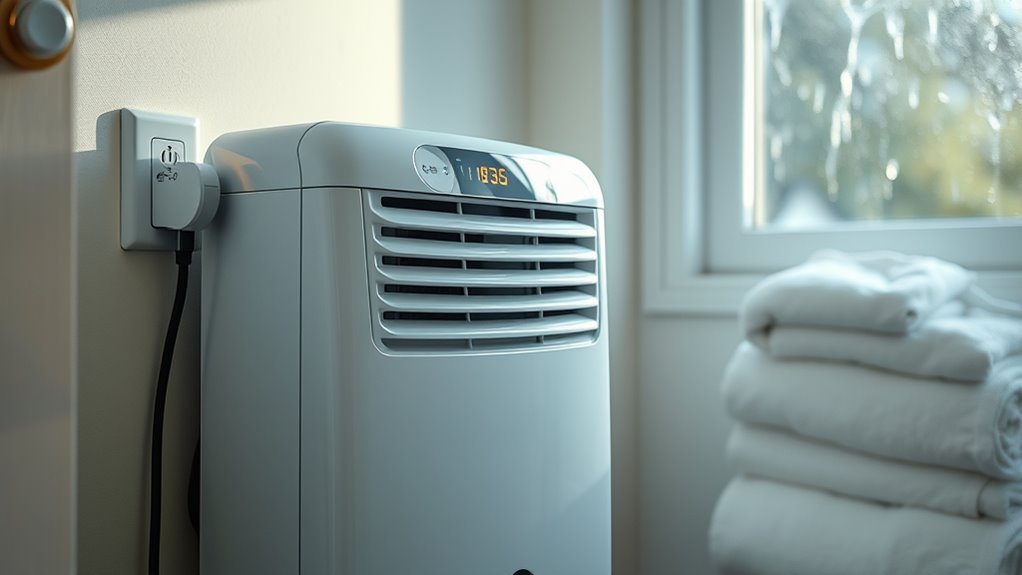
Most portable compressor dehumidifiers use roughly 200 to 700 watts while actively removing moisture. Some efficient current models may fall near the bottom of that range, while older, larger, desiccant, whole-home, or commercial machines can draw more.
There is no dependable wattage that applies to every 20-, 35-, or 50-pint unit. Two dehumidifiers with the same moisture-removal capacity can have different compressors, fans, controls, and efficiency ratings. Always check the model’s specification sheet instead of relying on capacity alone.
| Dehumidifier type | Approximate running power | Important note |
|---|---|---|
| Compact or efficient portable unit | About 200 to 400 watts | Actual draw can change with fan speed and compressor cycling. |
| Standard portable room unit | About 300 to 700 watts | Check the nameplate because pint capacity does not determine wattage by itself. |
| Desiccant unit | Often several hundred watts | An internal heater can raise power draw, but performance remains stronger in cold spaces. |
| Whole-home or commercial unit | About 500 watts to well above 1,000 watts | Capacity, airflow, ducting, pumps, and installation affect consumption. |
Note: These are broad planning ranges, not substitute specifications. The exact wattage printed on the product label or measured at the outlet is the number to use for circuit, cost, generator, or battery calculations.
Watts vs. Kilowatt-Hours
Watts measure power at a moment in time. A 500-watt dehumidifier is drawing power at a rate of 500 watts while it is operating at that level.
Kilowatt-hours measure energy consumed over time. Your utility charges for kilowatt-hours, not watts.
Energy used in kWh = wattage ÷ 1,000 × operating hours.
For example:
- 500 watts for 1 hour = 0.5 kWh
- 500 watts for 10 hours = 5 kWh
- 500 watts for 12 hours = 6 kWh
- 500 watts for 24 hours = 12 kWh
How Much Wattage Does a Dehumidifier Use by Size?
Larger-capacity dehumidifiers often have larger compressors and fans, but capacity does not increase wattage in a perfectly straight line. A newer efficient 50-pint unit may use less power than an older or less efficient 35-pint unit.
Small Dehumidifier Wattage
Small portable compressor units often use approximately 200 to 400 watts. Very small thermoelectric models may draw less, but they also remove far less moisture and are not suitable substitutes for compressor units in a damp basement or large room.
A 300-watt unit that runs for eight hours uses:
300 ÷ 1,000 × 8 = 2.4 kWh per day
At an electricity rate of $0.1844 per kWh, that equals about $0.44 per day or $13.28 over 30 days.
Large Dehumidifier Wattage
Large portable residential units commonly use roughly 400 to 700 watts, although an efficient model may use less. Whole-home and commercial machines can exceed 1,000 watts because they move more air and remove much more moisture.
A 700-watt unit running for 10 hours uses 7 kWh. At $0.1844 per kWh, it costs about $1.29 for that day. At $0.26 per kWh, it costs about $1.82.
Do not compare models by wattage alone. A higher-capacity unit may finish the job sooner, while an undersized machine may run almost continuously.
Compressor vs. Desiccant: Which Uses Less Power?
A compressor dehumidifier usually offers lower operating costs in a warm indoor room. It cools a coil so moisture condenses from the air, much like the moisture-removal process in an air conditioner.
A desiccant dehumidifier uses an absorbent wheel and an internal heater to release the captured moisture. Its rated wattage can be higher, but it can remove moisture more consistently in cold garages, boats, storage rooms, and other spaces where a refrigerant unit spends substantial time defrosting.
- Choose a compressor model for most heated rooms and warm basements.
- Consider a low-temperature compressor model or desiccant unit for a cold space.
- Compare moisture removed per kWh, not wattage alone.
- Check the manufacturer’s specified operating-temperature range.
ENERGY STAR warns that frost can form on refrigerant coils when a room falls below about 65°F. A low-temperature model may include automatic defrost, but its useful moisture removal can still decline as conditions get colder.
Recommended Products

【The Undisputed Champion — Industry-Leading Dehumidifier Brand】Choose AEOCKY, getting double market validation. According to data independently verified by Stackline, a leading third-party data analytics company, AEOCKY was an industry‑leading dehumidifier brand on Amazon U.S. in 2025. Meanwhile, it stands as a technology-leading rotary desiccant dehumidifier brand on Amazon. This isn’t just an appliance—it’s a complete humidity-control solution for small spaces. Skip low-performance alternatives and trust a brand recognized by the market.

Widely used: You can protect your documents and files, memories and photos, arts and craft supplies, clothing and luggage, safes and drawers, sensitive electronics, and Many Other Valuables.

COLD-RATED TO 34°F — WORKS WHERE COMPRESSORS QUIT: Rotary desiccant technology pulls moisture at temperatures that shut conventional compressor dehumidifiers down. Unheated crawl spaces, garages, basements, and cabins stay dry through fall and winter, not just summer.
What Changes a Dehumidifier’s Wattage?
A unit’s rated wattage is mainly determined by its compressor, fan, pump, heater, and controls. Its measured draw may change during operation as different components switch on or off.
Unit Size and Capacity
Higher capacity often requires more airflow and compressor power. However, efficiency varies enough that capacity should not be used as a shortcut for calculating watts.
Compare these specifications when shopping:
- Rated input watts
- Rated current in amps
- Moisture-removal capacity in pints per day
- Integrated Energy Factor in liters per kWh
- Estimated annual energy consumption
- Operating-temperature range
Humidity and Temperature
High humidity normally makes a dehumidifier run for more hours. This increases total kWh even when the unit’s running wattage stays about the same.
Cold air can reduce the moisture-removal performance of a compressor model. The machine may enter defrost mode or cycle the compressor off while the fan continues running. This changes both its power draw and the amount of water removed.
A desiccant unit may be more effective in a cold room, but its internal heater can use substantial electricity. Compare the complete model specifications for the temperature in which you plan to use it.
Efficiency and Run Time
Efficiency and runtime primarily affect energy consumption in kWh, not the appliance’s labeled wattage.
A humidistat helps by cycling the compressor after the target relative humidity has been reached. The fan may continue briefly or periodically on some models, so the unit can still consume a smaller amount of power when the compressor is off.
The current ENERGY STAR Version 6.0 criteria use Integrated Energy Factor, or IEF. A higher IEF means the unit removes more liters of water for each kWh consumed under the official test procedure.
How to Find Your Dehumidifier’s Exact Wattage
Use the following methods, starting with the easiest:
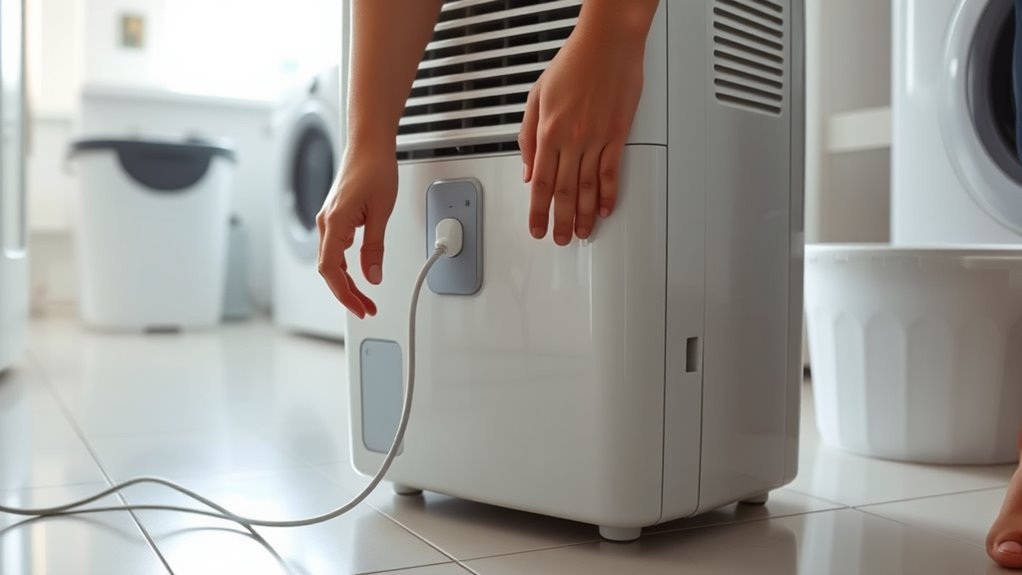
- Check the nameplate. Look on the back, side, bottom, or inside the bucket compartment for input watts or amperage.
- Read the manual or specification sheet. Search using the complete model number, not only the brand.
- Check the ENERGY STAR product listing. Certified listings may show capacity, IEF, and estimated annual energy use.
- Use a plug-in watt meter. A properly rated meter can show compressor-on draw, fan-only draw, and accumulated kWh.
If the label gives volts and amps but not watts, you can make a rough upper estimate:
Watts ≈ volts × amps
For example, 115 volts × 5 amps equals 575 volt-amperes. The actual watts may be lower because an AC motor’s power factor affects the relationship between amps and true power. Use the manufacturer’s watt rating or a watt meter when accuracy matters.
Pro Tip: Measure accumulated kWh for several normal days instead of multiplying the highest displayed wattage by 24 hours. This captures humidistat cycling, fan operation, defrost cycles, and changing room conditions.
How Much Does a Dehumidifier Cost to Run?
Operating cost depends on wattage, actual runtime, and your electricity rate.
Daily cost = watts ÷ 1,000 × hours used × electricity rate
Monthly cost = daily cost × number of days
The latest U.S. Energy Information Administration data available at the time of this update reports a May 2026 U.S. residential average of 18.44 cents per kWh. Local rates vary widely, so use the total per-kWh rate shown on your utility bill.
| Example | Daily energy | Daily cost at $0.1844/kWh | 30-day cost |
|---|---|---|---|
| 300W for 8 hours | 2.4 kWh | $0.44 | $13.28 |
| 500W for 12 hours | 6 kWh | $1.11 | $33.19 |
| 700W for 24 hours | 16.8 kWh | $3.10 | $92.94 |
At a higher example rate of $0.26 per kWh, a 500-watt unit costs $1.56 for 12 hours, $3.12 for 24 hours, and $93.60 for 30 days of continuous operation.
How Many kWh Does a Dehumidifier Use Per Day?
Daily consumption can range from less than 1 kWh for a small unit that cycles occasionally to more than 12 kWh for a high-wattage unit running continuously.
- 300 watts × 12 hours ÷ 1,000 = 3.6 kWh
- 500 watts × 12 hours ÷ 1,000 = 6 kWh
- 700 watts × 12 hours ÷ 1,000 = 8.4 kWh
- 500 watts × 24 hours ÷ 1,000 = 12 kWh
These examples assume the unit draws the stated wattage for every operating hour. A humidistat-controlled unit may use less because the compressor cycles off after the target humidity is reached.
Do ENERGY STAR Dehumidifiers Use Less Power?
Yes. According to ENERGY STAR, a certified dehumidifier uses about 20% less energy than a comparable conventional model while removing the same amount of moisture.
Certification is based on efficiency rather than a universal maximum wattage. The key measurement is Integrated Energy Factor, expressed as liters of water removed per kWh. A higher IEF is better.
Under the Version 6.0 requirements effective October 1, 2025, certified portable dehumidifiers must meet different minimum IEF values based on their tested capacity. Therefore, compare models within the appropriate capacity category.
Recommended Products

True ENERGY STAR Most Efficient 2025 Compressor Dehumidifier (2600 Sq.Ft) - High-Efficiency Dehumidifier - Dr.Prepare dehumidifier features a high-performance and quiet compressor that removes up to 38 pints of moisture per day (at 95°F, 90% RH). Ideal for basements, living rooms, bathrooms, bedrooms, garages, or travel trailers. Being able to adjust humidity from 30%RH to 80%RH, and cut costs bills year-round. (You can verify Dr. Prepare models DDH12LA on the official ENERGY STAR Product Finder.)

【Ideal for Large Homes & Basements (Up to 5,000 Sq. Ft)】The Waykar 80 pint dehumidifier efficiently removes up to 80 pints of moisture per day in high-humidity conditions (95°F, 90% RH). In warmer, damp spaces like basements (86°F, 80% RH), it removes 62 pints/day. This dehumidifier for basement is perfect for large areas such as basements, bathrooms, bedrooms, and living rooms. Customize your space by adjusting the humidity level from 30% to 80%, creating a drier and healthier environment

【Compact Size, Big Efficiency】 The upgraded 2025 Waykar dehumidifier features cutting-edge rotary compressor technology. It’s more compact but still powerful, capable of removing up to 34 pints of moisture per day (at 95℉, 90% RH), ideal for spaces up to 2,000 sq. ft. such as living rooms, basements, bedrooms, and offices. The adjustable humidity range from 30% to 80% helps you easily maintain the ideal indoor humidity
How Can You Lower Dehumidifier Electricity Use?
You can reduce electricity use without allowing the room to become damp:
- Set the humidistat around 40% to 50% RH for many normal indoor situations.
- Use a hygrometer to confirm the actual room humidity.
- Close exterior doors and windows while the unit is running.
- Keep the air inlet, outlet, filter, and coils clean.
- Leave the clearance required by the manufacturer.
- Use continuous drainage so a full bucket does not stop the unit unexpectedly.
- Repair leaks, improve drainage, and vent showers, cooking, and clothes dryers.
- Choose enough capacity for the moisture load instead of relying only on advertised coverage area.
The U.S. Environmental Protection Agency generally recommends keeping indoor relative humidity between 30% and 50%. Extremely low settings can waste energy and may make the room uncomfortably dry.
Warning: Plug the dehumidifier into a properly grounded outlet and follow its manual. Keep cords, plugs, power stations, and electrical connections away from collected water and drain hoses. Do not use an undersized extension cord or power strip, and do not bypass the grounding pin.
Can a Solar Generator Run a Dehumidifier?
A battery-based solar generator can run a dehumidifier only when the inverter can handle both the unit’s continuous wattage and its compressor startup demand.
Check four specifications:
- Continuous inverter output: It must exceed the dehumidifier’s normal running watts.
- Surge output: It must accommodate the compressor’s startup demand for the required duration.
- Battery capacity: This is listed in watt-hours or kilowatt-hours.
- Charging input: Solar production must be sufficient if you expect extended operation.
A practical battery-runtime estimate is:
Runtime in hours ≈ battery watt-hours × usable-efficiency factor ÷ appliance watts
Using an 85% allowance for inverter and system losses, a 1,000Wh power station running a steady 500W load may provide approximately:
1,000 × 0.85 ÷ 500 = 1.7 hours
| Power station | Official rated AC output | Suitability for a 500W dehumidifier |
|---|---|---|
| Jackery Explorer 300 Plus | 300W | No. A steady 500W load exceeds its rated output. |
| Jackery Explorer 500 | 500W maximum appliance input | Not a safe general recommendation. A 500W running load leaves no continuous-output headroom, and compressor startup may trigger an overload. |
Choose an inverter with meaningful headroom above the measured running wattage and confirmed surge support. Do not assume that a brief “peak” rating can support a compressor startup unless the manufacturer specifies the duration and the dehumidifier remains within its limits.
How Do You Choose the Right Dehumidifier for Your Space?
Match the unit to both the floor area and the room’s moisture condition. A musty room at 60% RH does not require the same capacity as a wet basement with seepage, even when both spaces have the same square footage.
Recommended Products

4,500 SQ. FT. DEHUMIDIFIER – Removes up to 50 pints of moisture per day with an adjustable humidity setting from 35% to 85%. Perfect for use in basement, bathroom, bedroom, office, kitchen, cellar, or crawlspace. Maintain a healthy 45%-55% humidity range

EASY TO CLEAN WASHABLE FILTER: Capture dust from the air and keep your dehumidifier working efficiently with our easy-to-clean washable filter.
Room Size Matters
Current ENERGY STAR buying guidance uses the following minimum portable-dehumidifier capacity ranges:
| Condition without dehumidification | Below 2,000 sq. ft. | Above 2,000 sq. ft. |
|---|---|---|
| Slightly to moderately damp, about 50% to 75% RH | 20 to 30 pints per day | 30 or more pints per day |
| Very damp, about 75% to 90% RH | 25 to 40 pints per day | 40 or more pints per day |
| Wet, about 90% to 100% RH, sweating surfaces, or seepage | 30 to 50 pints per day | 50 or more pints per day |
These ranges are starting points. Laundry drying, water intrusion, an open stairway, poor air sealing, or unusually low temperatures may require more capacity or a different equipment type.
Match Capacity to Moisture
Do not buy solely from a large “covers up to” square-foot number. Compare the tested pints-per-day rating and the room’s untreated humidity condition.
An undersized unit may run continuously without reaching the target RH. ENERGY STAR advises that it is generally better to choose at least the required capacity and modestly oversize rather than undersize.
However, selecting an unnecessarily large machine can increase purchase cost, noise, and instantaneous circuit load. Choose the smallest capacity that comfortably meets the official sizing guidance and your actual moisture load.
Pick Efficient Features
Useful efficiency and convenience features include:
- A digital humidistat
- ENERGY STAR certification
- A high Integrated Energy Factor
- Automatic defrost for cooler rooms
- A washable or easily accessible filter
- Continuous gravity drainage or a built-in pump
- Auto-restart after a power interruption
- A timer or scheduling control
Also check the noise rating, minimum operating temperature, bucket size, drainage arrangement, warranty, and rated electrical input.
Frequently Asked Questions
How much does it cost to run a dehumidifier 24 hours a day for a month?
A 500-watt unit uses 12 kWh per day and 360 kWh over 30 days. At the May 2026 U.S. residential average of $0.1844 per kWh, that costs about $66.38. At $0.26 per kWh, it costs $93.60. Actual cost may be lower if the compressor cycles off.
Does a dehumidifier use a lot of power?
It can. A portable dehumidifier may draw about 200 to 700 watts while operating. Total use depends mainly on runtime. A 500-watt unit running for 12 hours uses 6 kWh, while continuous operation uses 12 kWh per day.
How much does a dehumidifier cost to run for 24 hours?
At $0.26 per kWh, a 300-watt unit running continuously costs $1.87, a 500-watt unit costs $3.12, and a 700-watt unit costs $4.37. Multiply the unit’s kWh use by your own electricity rate for an accurate figure.
Will a dehumidifier help dry out plaster?
Yes. A dehumidifier can help remove moisture released while plaster or other construction materials dry. Use it with suitable ventilation and moderate room conditions, follow the plaster manufacturer’s instructions, and repair any active leak first. Avoid forcing fresh plaster to dry excessively fast because rapid surface drying can damage the finish.
Does a dehumidifier use electricity when the compressor is off?
It may. The display, control board, humidity sensor, and fan can continue using electricity. Some models periodically run the fan to sample the room air. A watt meter can show the compressor-on, fan-only, and standby consumption.
Can I run a dehumidifier on a normal household circuit?
Most portable residential models are designed for a standard grounded household outlet, but you must check the voltage and amperage on the product label. Consider other devices sharing the circuit, and follow the manual’s instructions about dedicated outlets, extension cords, and ground-fault protection.
Conclusion
Most portable home dehumidifiers use approximately 200 to 700 watts while operating, but the exact power draw must come from the product label, manual, or a watt meter. Wattage alone does not determine the electric bill. Runtime, humidity, temperature, capacity, and efficiency determine how many kilowatt-hours the unit uses.
For lower operating costs, select enough capacity for the room’s moisture condition, use a humidistat, keep the filter and airflow path clean, address leaks and other moisture sources, and compare ENERGY STAR models by Integrated Energy Factor. When using a battery power station, verify continuous output, startup surge, and battery runtime rather than relying on the advertised peak wattage.
Sources
- ENERGY STAR: Dehumidifiers — efficiency savings, capacity guidance, operating temperature, humidistats, placement, and moisture-control advice.
- ENERGY STAR: Dehumidifier Key Efficiency Criteria — Version 6.0 requirements and Integrated Energy Factor thresholds.
- U.S. Energy Information Administration: Electric Power Monthly — May 2026 residential electricity-price data.
- U.S. EPA: Care for Your Air — recommended indoor relative-humidity range.
- U.S. Consumer Product Safety Commission: Extension Cords — electrical-cord fire and shock safety.
- Plymouth City Council: Keeping Homes Free From Damp and Mould — construction moisture, ventilation, leak repair, and dehumidifier-assisted drying.