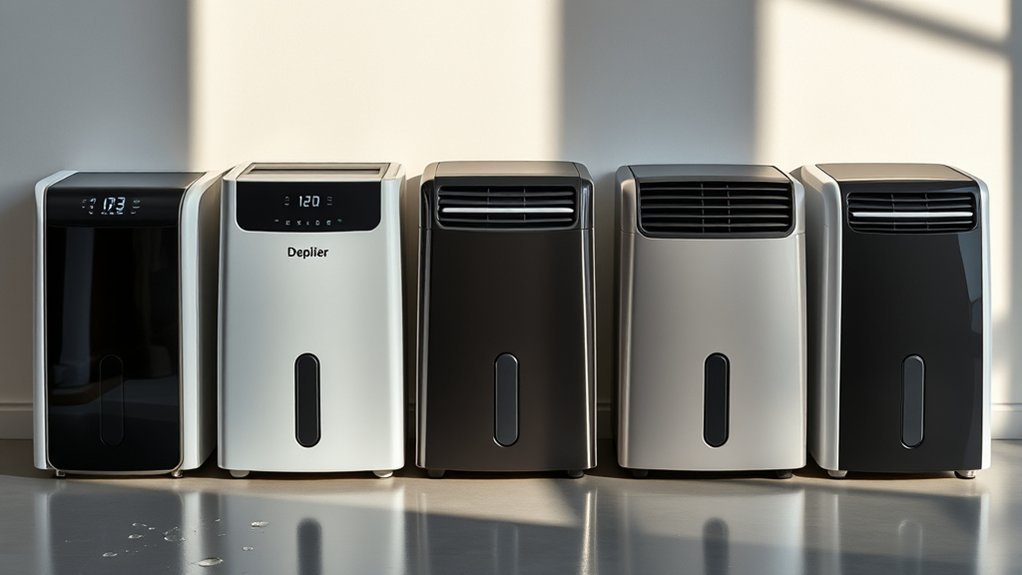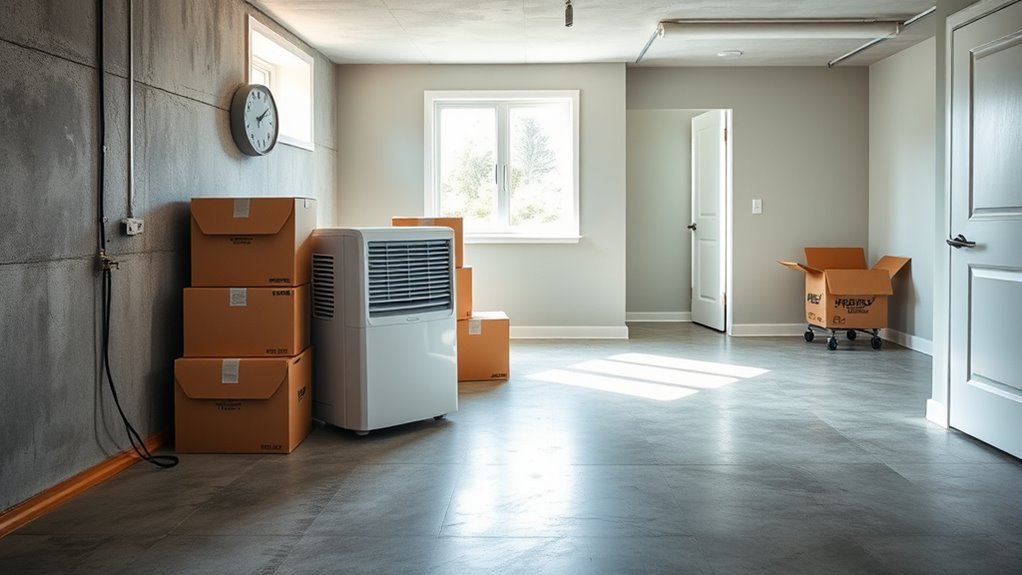
How many dehumidifiers per square foot? There is no reliable “one dehumidifier per X square feet” rule. For most homes, start with one correctly sized portable dehumidifier for each connected damp zone, then add another unit only when walls, doors, floors, or poor airflow keep a separate zone above the target humidity. Size each unit by room size, relative humidity, moisture sources, airflow, temperature, and its current pints-per-day capacity. If high humidity affects most of a well-sealed home with central air, a professionally sized whole-home dehumidifier may make more sense than several portable units.
Quick Answer
Most homes need one dehumidifier per connected damp zone, not a fixed number per square foot. Start with one properly sized portable unit when damp rooms share good airflow. Use multiple units when separated rooms, floors, or closed-off areas remain humid, or consider a whole-home system when humidity stays high throughout the house. A wet basement, crawl space, or divided floor plan may need its own moisture-control solution.
| Moisture Layout | Starting Setup | What Confirms It |
|---|---|---|
| One open, connected damp zone | One correctly sized portable dehumidifier | RH reaches the target throughout the connected area, including the farthest damp spot |
| Two or more separated damp zones | Improve airflow first; use a separate unit where a closed-off zone still stays humid | One location reaches target RH while another separated location remains above it |
| Humidity throughout most of the house | Consider professional sizing for a whole-home dehumidifier | Multiple rooms or levels repeatedly stay humid despite normal HVAC operation |
| Leaks, seepage, flooding, or standing water | Fix the water source before adding more dehumidifiers | The moisture source is repaired and remaining airborne humidity can be controlled normally |
Key Takeaways
- Use humidity readings, room layout, and damp zones instead of a fixed dehumidifier-per-square-foot rule.
- Aim for about 30–50% indoor relative humidity; stay below 60% to reduce mold risk.
- Modern pint ratings are different from many older sizing charts, so compare current product labels carefully.
- Use more than one unit when rooms are separated, airflow is poor, or one unit cannot keep every damp zone in range.
- Fix leaks, drainage problems, and poor ventilation first; a dehumidifier controls moisture but does not solve the source.
At a Glance
| Time Required | Measure the space and RH before buying; recheck several locations after 24–48 hours of operation |
| Difficulty | Easy for a single room or basement; moderate for crawl spaces, whole-home systems, or persistent water problems |
| Tools Needed | Tape measure, hygrometer, outlet access, product specification sheet, and a drain hose if you want continuous drainage |
| Cost | A hygrometer plus the dehumidifier; operating cost depends on watts, runtime, and your local electric rate |
How Many Dehumidifiers Per Square Foot? How to Size One
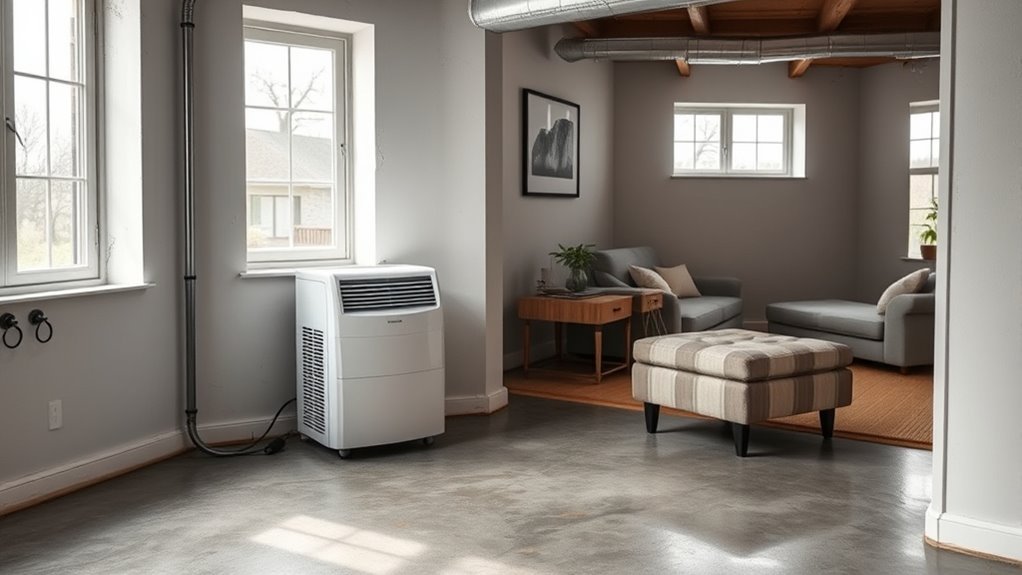
To size a dehumidifier, first measure the room’s square footage. Multiply the room length by the room width, then note whether the space is open, divided into rooms, or blocked by doors and walls. After that, measure the relative humidity with a hygrometer. This matters because a 700-square-foot dry-ish room and a 700-square-foot wet basement do not need the same machine.
- Measure the space: length × width = square feet. For connected rooms, measure each area and add them together.
- Check humidity: place a hygrometer in the damp zone for at least a few hours, then repeat the reading at another time of day.
- Classify the moisture level: slightly damp, very damp, or wet. Musty odor, condensation, damp spots, and seepage all raise the capacity you need.
- Match capacity to conditions: choose pints per day based on both square footage and moisture load.
- Account for unusual room volume: if ceilings are much higher than a typical residential room, use the higher end of the appropriate capacity range and verify performance with RH readings rather than using an unsupported pints-per-foot formula.
- Plan drainage: decide whether you will empty a bucket, use a gravity drain hose, or buy a unit with a pump.
- Verify performance: after installation, check whether the unit can hold the room near your target RH within 24–48 hours.
Note: The U.S. Environmental Protection Agency recommends keeping indoor relative humidity below 60%, ideally between 30% and 50%, when possible. ENERGY STAR also describes 30–50% RH as the general optimum range for buildings, with 30–40% often better in colder heating seasons to reduce window condensation.
Check Humidity Levels Before You Buy
Before you buy, measure the room’s relative humidity with a hygrometer. This small step prevents the biggest sizing mistake: buying for square footage while ignoring the actual moisture load.
Use these readings as a practical guide:
- Under 50% RH: you may not need a dehumidifier unless the room still smells musty or has condensation in specific spots.
- 50–60% RH: a dehumidifier may help, especially in basements, closets, storage rooms, and poorly ventilated areas.
- Above 60% RH: moisture control becomes more important because higher humidity can encourage mold, mildew, and dust mites.
- Above 75% RH: treat the space as very damp and look for leaks, seepage, poor drainage, or ventilation problems.
Measure more than once. Humidity can change after showering, cooking, laundry, rain, or air-conditioning cycles. In a basement or crawl space, take readings near outside walls, corners, and the most musty area.
A dehumidifier’s “size” is its moisture-removal capacity in pints per 24 hours, but the number of units you need depends on how many damp areas can actually exchange air with one another.
How Dehumidifier Capacity Matches Each Moisture Zone
After deciding how many separate moisture zones you have, size the dehumidifier for each zone. Capacity is measured in pints per day, meaning how much water the unit can remove from the air in 24 hours under test conditions. Use the chart below as a starting point. For a deeper pint-only comparison, see the dehumidifier size and pint-capacity guide.
| Condition Without Dehumidification | What It Looks Like | Small to Medium Space (<2,000 sq. ft.) |
Large Space (>2,000 sq. ft.) |
|---|---|---|---|
| Slightly to moderately damp | Feels damp; musty odor may come and go; roughly 50–75% RH | 20–30 pints/day | 30+ pints/day |
| Very damp | Consistently damp smell; damp spots on walls or floors; roughly 75–90% RH | 25–40 pints/day | 40+ pints/day |
| Wet | Sweating walls or floor, seepage, frequent laundry drying, or very high humidity | 30–50 pints/day | 50+ pints/day |
These ranges mirror ENERGY STAR buying guidance. They are a starting point, not a guarantee. A cold basement, poor airflow, high ceilings, active leaks, or a laundry area can push you toward the higher end. A well-sealed room with good air movement may need less.
Pro Tip: If you are between two sizes, ENERGY STAR recommends oversizing rather than undersizing. This is especially useful for damp basements, where an undersized unit may run for long periods and still fail to reach the target humidity.
New Vs. Old Dehumidifier Pint Ratings
If older guides mention 70-pint dehumidifiers, do not assume they match today’s product labels. The U.S. Department of Energy changed the dehumidifier test procedure associated with standards that took effect in 2019. Modern portable dehumidifiers are tested at 65°F instead of the older 80°F condition, which better reflects basement use and usually produces a lower labeled pint capacity for comparable equipment.
ENERGY STAR’s current dehumidifier specification took effect October 1, 2025. The current capacity definition still measures pints of water removed per 24 hours under specified test conditions. When comparing models, use the current product label, the manufacturer’s specification sheet, and the unit’s Integrated Energy Factor. ENERGY STAR certified dehumidifiers include a humidistat, so the unit can cycle on and off once the room reaches the set humidity.
How To Size A Dehumidifier By Room Type
Room type matters because moisture sources are different. A bedroom may only need help during humid weather, while a basement may need daily moisture removal and continuous drainage.
| Room Type | Best Starting Point | What To Watch |
|---|---|---|
| Bedroom or office | Small or medium portable unit if RH stays above 50–60% | Noise level, bucket size, and whether doors stay open for airflow |
| Basement | Choose based on dampness level; many basements need 30–50+ pints/day | Low temperature, floor drain access, seepage, and musty storage areas |
| Bathroom | Use an exhaust fan first; add a dehumidifier only if RH stays high after ventilation | Steam, splashes, electrical safety, and wet floors |
| Laundry room | Vent the dryer outdoors first; size the unit for measured RH after laundry cycles | Dryer vent leaks, indoor clothes drying, and heat buildup |
| Crawl space | Use a crawl-space-rated or professionally sized unit if moisture is persistent | Ground vapor, standing water, insulation, drainage, and sealed access |
| Whole house | Consider a whole-home dehumidifier if the entire home stays above your target RH | HVAC compatibility, ducting, installation cost, and professional sizing |
Recommended Products

【45-80 Pints for 4500 Sq.Ft Moisture Control】:This dehumidifier for basement and home features flexible 45–80 pints dehumidification output with an ultra-wide 4500 square feet coverage range, offering premium whole-space moisture control. No matter damp basement, humid bathroom, quiet bedroom for restful sleep, large living room, or compact RV traveling space, this multi-functional dehumidifier for home effortlessly sucks up excess moisture,, maintaining ideal humidity levels for all indoor environments.
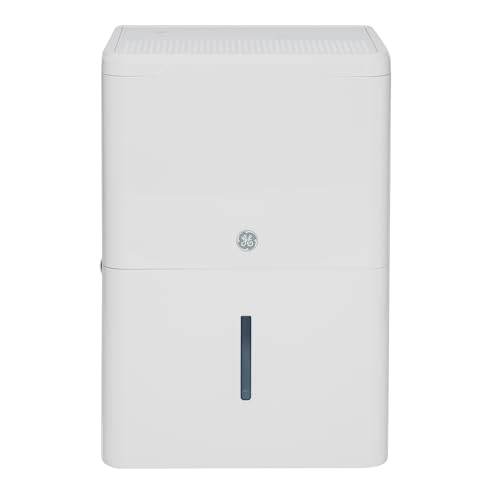
Remove up to 35 pints of moisture per day with this dehumidifier, perfect for bedrooms, basements, garages, and other humid spaces.

【Reduce humidity - Enhance comfort】:Massive Capacity + Wide Coverage. This dehumidifier has dehumidification capacity ranging 45- 80 pints—outperforming standard units while covering 4,500 sq. ft. of living space. Great dehumidifier for basements, large house, garages, bedroom, bathroom and gyms where excess humidity triggers cause unpleasant odors and discomfort. The result? A noticeably drier, fresher, and more comfortable environment for your entire family.
What Size Dehumidifier Works For Large Spaces?
For a connected large space, start with the dampness level. A slightly damp area over 2,000 square feet may start around 30+ pints per day, while a wet large space may need 50+ pints per day or a larger specialty unit. If the area is divided by walls, closed doors, storage rooms, or stairwells, one large unit may not move air well enough to dry the whole area evenly.
Recommended Products
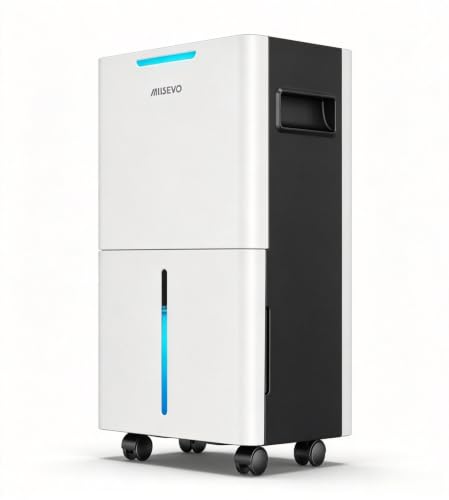
High Efficient Dehumidifier — Equipped with a high-performance compressor, Whether it’s your basement, bedroom, bathroom, living room, bathroom, crawlspace, or even an RV, this dehumidifier effectively keeps your environment dry, comfortable, and healthy.

【The Undisputed Champion — Industry-Leading Dehumidifier Brand】When you choose AEOCKY, you get double market validation. According to data independently verified by Stackline, a leading third-party data analytics company, AEOCKY was an industry‑leading dehumidifier brand on Amazon U.S. in 2025. This means you’re not just choosing a flagship product from a market leader, but a top-performing brand backed by independent market data and trusted by millions of real users, delivering the ultimate combination of performance, quality and trust.
Large-Space Capacity Needs
A large basement or open lower level usually needs a higher-capacity unit with a built-in humidistat and continuous drainage. Look for enough fan airflow to move damp air back to the unit, and place the dehumidifier where air can circulate freely around it.
- Use a larger unit when humidity stays above target after 24–48 hours.
- Use a drain hose or built-in pump if you do not want to empty the bucket daily.
- Keep doors and windows closed while the unit runs so it is not trying to dry outdoor air.
- Choose a low-temperature or auto-defrost model for cool basements below about 65°F.
Commercial Unit Considerations
Commercial dehumidifiers are for high-load spaces, restoration work, warehouses, large crawl spaces, and oversized basements where portable residential units cannot keep up. Do not choose one by square footage alone. Commercial sizing depends on temperature, air changes, water intrusion, building materials, drainage, and the target humidity level.
If you have seepage, standing water, recurring mold, or humidity that stays high after using a properly sized residential unit, treat that as a building-moisture problem. You may need drainage repair, sealing, ventilation changes, or a professionally sized whole-home or crawl-space system.
Warning: A dehumidifier is not a substitute for fixing leaks, flooding, wet drywall, or mold growth. If you see or smell mold, clean up the mold and fix the moisture source. For large mold areas, sewage water, flood damage, or breathing-risk concerns, call a qualified professional.
When To Use More Than One Dehumidifier
Use more than one dehumidifier when one unit cannot pull damp air from every part of the space. The question is not only “how many square feet?” It is also “how many independently damp moisture zones?”
Multiple units can make sense when:
- Rooms are separated by doors, walls, stairwells, or long hallways.
- One area reads 45% RH while another stays above 60% RH.
- A basement has a finished room, storage room, bathroom, and laundry area with poor shared airflow.
- A single unit short-cycles near itself but leaves far corners damp.
- Separate floors remain humid even when interior doors are open and the existing unit is correctly sized.
To test whether you need another unit, place hygrometers in the dampest separated locations. After the dehumidifier has operated for 24–48 hours, compare the readings. If the area near the unit is at target while another separated zone remains above 60% RH, improve airflow, reposition the unit, or treat the second location as its own moisture zone. For a whole-home count, see how many dehumidifiers you need for your home.
As a practical starting point, place one unit in each confirmed damp zone and check the hygrometer readings after a day or two. If every zone stays around 30–50% RH, the setup is working. If one zone stays high, move the unit, improve airflow, or add capacity.
Recommended Products

Semiconductor dehumidifiers use thermoelectric cooling to remove moisture from the air. They create a drier, more comfortable environment by reducing humidity and improving air quality.

Face Icon Comfort Indicator: Humidity temperature gauge features face icons to indicate DRY/COMFORT/WET air conditions, quickly informs you how to adjust your humidifier or dehumidifier to achieve optimal comfort.

1-【Widely Application】The digital LCD monitor can be used in home, office, garage, schools, hotels, laboratories, kindergartens, aquaculture, instrument workshop, warehouse, reptile tank terrarium, aquarium, hermit crab habitat, and other places where temperature/humidity measurement is required.
Placement, Drainage, And Maintenance Tips
Even the right size dehumidifier can perform poorly if it is placed badly or neglected. Use these checks before deciding the unit is too small.
- Give it airflow: keep side-discharge units away from walls and furniture so air can circulate.
- Close the space: keep windows and exterior doors closed while the unit runs.
- Use continuous drainage: a hose to a floor drain, sump, or condensate pump reduces bucket-emptying and helps the unit run consistently.
- Keep hoses safe: avoid long hoses that create trip hazards or run near electrical cords.
- Clean the filter: dust blocks airflow and reduces moisture removal.
- Clean the bucket: standing water can smell musty if the bucket is not washed regularly.
- Watch low temperatures: compressor units can frost in cool spaces, so use an auto-defrost or low-temperature model for chilly basements.
Warning: Plug the dehumidifier into a properly grounded outlet and follow the manufacturer’s electrical instructions. Keep drainage water and hoses away from cords, outlets, power strips, and extension cords.
What To Do If Humidity Stays High
If your dehumidifier runs but the room stays above 50–60% RH, do not assume the machine failed. Work through the common causes first.
- Check the hygrometer location: move it away from the dehumidifier outlet so it does not read artificially dry air.
- Look for water sources: check foundation seepage, plumbing leaks, roof leaks, wet carpet, clogged gutters, and dryer vent leaks.
- Improve airflow: open interior doors, use a fan to move damp air, or add a second unit in a separated area.
- Lower the humidity setting: try 45% RH and give the unit a full day to respond.
- Check the filter and coils: dirt, frost, or blocked grills reduce performance.
- Confirm the room temperature: cold air reduces moisture-removal performance for many compressor units.
- Re-size the unit: if the room is wet or over 2,000 square feet, you may need more capacity or a whole-home system.
How Much Does It Cost To Run A Dehumidifier?
Use this simple formula:
Watts ÷ 1,000 × hours used × electricity rate = daily cost
The U.S. Energy Information Administration reported an average residential price of 18.31 cents per kWh for July 2026. If a 500-watt dehumidifier runs for 12 hours at $0.1831 per kWh, the daily cost is:
500 ÷ 1,000 × 12 × $0.1831 = about $1.10 per day
At that same electricity rate and 12-hour runtime, a 300W unit would cost about $0.66 per day, while a 700W unit would cost about $1.54 per day. Your real cost depends on your local rate, the unit’s actual power draw, and how often the humidistat cycles the compressor off after reaching the target RH. For a longer-run view, see how much it costs to run a dehumidifier 24/7.
Frequently Asked Questions
How many dehumidifiers per square foot do I need?
There is no reliable dehumidifier-per-square-foot rule. Start with one correctly sized unit for each connected damp zone. Then use humidity readings, airflow, room layout, and moisture sources to decide whether another separated zone needs its own unit.
What size dehumidifier do I need for a 2,000 sq. ft. house?
For a 2,000 sq. ft. house, measure RH in each level or moisture zone first. For a connected space under 2,000 sq. ft., ENERGY STAR starts around 20–30 pints per day for slightly to moderately damp conditions, 25–40 pints for very damp conditions, and 30–50 pints for wet conditions. A divided or consistently humid whole house may need multiple zones or a professionally sized whole-home system.
Can one dehumidifier do a whole house?
A portable dehumidifier can sometimes control one large connected area, but walls, closed doors, stairwells, and multiple floors can prevent even a high-capacity portable unit from reaching every damp zone. If humidity stays high throughout a well-sealed home with central air, consider a professionally sized whole-home dehumidifier that works with the HVAC system.
Is three dehumidifiers too much?
Three dehumidifiers are not automatically too many if they serve separate damp zones and keep humidity in the target range. They may be unnecessary if the same result could be achieved with better airflow, one larger correctly sized unit, or a whole-home system. Avoid pushing indoor RH below about 30%.
How much does it cost to run a dehumidifier 12 hours a day?
Multiply the unit's watts by runtime and your electricity rate. At $0.1831 per kWh (the EIA U.S. residential average for July 2026), a 500W unit running 12 hours costs about $1.10 per day. At the same rate and runtime, 300W costs about $0.66 and 700W costs about $1.54, before humidistat cycling changes the actual runtime.
What humidity should I set my dehumidifier to?
For most homes, set the dehumidifier around 45–50% RH. EPA and ENERGY STAR guidance generally places the preferred indoor range around 30–50% RH. In colder climates during heating season, ENERGY STAR notes that 30–40% RH can help reduce window condensation.
Conclusion
So, how many dehumidifiers per square foot do you need? There is no trustworthy fixed number. Start with one properly sized dehumidifier per connected damp zone, then use hygrometer readings to prove whether another separated area needs additional capacity. Measure the space, check RH, match pint capacity to the moisture level, improve airflow, and fix leaks or drainage problems first. If humidity remains widespread across several rooms or floors, compare the cost and complexity of multiple portable units with a professionally sized whole-home system.
Sources
- ENERGY STAR: Dehumidifiers — current sizing ranges, buying guidance, placement, humidity targets, drainage, operating temperature, humidistats, and whole-home guidance.
- ENERGY STAR: Dehumidifier Testing and Capacity — DOE capacity ratings, pints-per-day definition, 2019 test changes, old-versus-new capacity comparisons, and Integrated Energy Factor explanation.
- ENERGY STAR: Dehumidifiers Key Efficiency Criteria — current criteria effective October 1, 2025.
- eCFR: 10 CFR Part 430, Appendix X1 — federal test method used for dehumidifier energy and capacity representations.
- U.S. EPA: A Brief Guide to Mold, Moisture and Your Home — indoor RH guidance and moisture/mold prevention.
- CDC: Mold — mold-health context and moisture-prevention guidance.
- U.S. Energy Information Administration: Electricity Monthly Update — July 2026 U.S. residential electricity-price example used in the operating-cost calculation.