Choosing the right dehumidifier for a 2×2 grow tent starts with solving a tight spatial puzzle: you only have four square feet of floor space (16 to 20 cubic feet of total volume), yet moisture levels can spike rapidly once mature plants transpire and lights turn off. For almost every 2×2 setup, the smartest approach is to condition the air entering the tent rather than crowding your plants with a hot, bulky compressor unit. The SPIDER FARMER 32 Pint Dehumidifier is the strongest direct match because its attachable duct hose and remote sensor probe support outside-the-tent placement. The VIVOSUN 10L/D is the best option for smart WiFi control in the surrounding lung room, while the GoGuess 21 Pint delivers straightforward compressor moisture removal with continuous gravity drainage.
Quick Comparison
| Product | Best Use | Listed Moisture Removal | Control & Drainage | Key Limitation | Amazon |
|---|---|---|---|---|---|
| SPIDER FARMER 32 Pint | Best overall for a 2×2 tent | Up to 32 pints/day (at 95°F, 90% RH) | Remote canopy sensor + duct; 2.1 L tank or drain hose | Higher wattage and larger external footprint | Check Price on Amazon |
| VIVOSUN 10L/D | Best smart control for the lung room | Up to 10 L (~21.1 US pints, marketed as 23 pints/day) | WiFi app control; 2.0 L tank or drain hose | No external probe or duct; adds heat if placed inside | Check Price on Amazon |
| GoGuess 21 Pint | Best straightforward compressor option | Up to 21 pints/day (at 95°F, 90% RH) | Onboard digital humidistat; tank or drain hose | No WiFi app, grow duct, or remote sensor probe | Check Price on Amazon |
Capacity rating note: Many dehumidifier manufacturers advertise maximum pints-per-day figures measured at saturation conditions (95°F and 90% RH) rather than standard US Department of Energy (DOE) room conditions (65°F and 60% RH). In a typical 72°F to 78°F grow room at 55% to 65% RH, actual moisture extraction is roughly 40% to 55% of the 95°F/90% RH headline rating—which makes a “21-pint to 32-pint” unit properly sized for a small grow space.
1. SPIDER FARMER 32 Pint Plant Dehumidifier
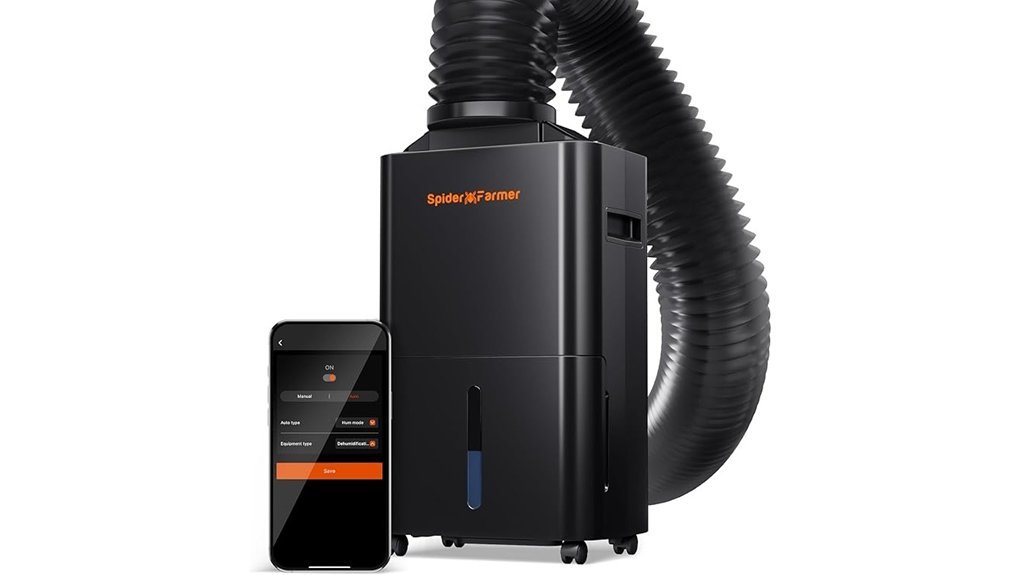
The SPIDER FARMER 32 Pint Plant Dehumidifier is the clearest match for a 2×2 grow tent because it is engineered specifically to operate from outside the enclosure. Its attachable air duct channels dry air directly into a tent intake port, while the wired remote temperature and humidity sensor probe hangs inside the tent near your plant canopy. This layout preserves every inch of your four-square-foot floor and keeps the bulk of the compressor motor heat outside the grow space.
Its manufacturer listing states a maximum moisture removal capacity of up to 32 pints per day at 95°F and 90% RH, paired with an adjustable humidistat range from 30% to 80% RH. It also includes a 2.1-liter internal bucket, a continuous drainage hose port, a 24-hour timer, automatic defrost, a washable air filter, and caster wheels. For a compact tent, its true advantage is not raw square-footage coverage—it is the combination of ducted delivery and in-canopy sensing.
Key Specifications:
- Rated Moisture Removal: Up to 32 pints/day (at 95°F, 90% RH)
- Adjustable Humidity Range: 30% to 80% RH
- Water Tank Capacity: 2.1 liters (approx. 0.55 gallons)
- Drainage Options: Internal removable tank or continuous gravity drain hose
- Grow-Specific Features: External duct hose adapter, wired remote temp/RH sensor probe, auto-defrost, 24-hour timer
Why You’ll Like It: It solves the two biggest headaches in a 2×2 tent—zero spare floor space and unwanted heat spikes from placing an appliance next to your plants.
Best For: Growers who want direct, targeted humidity control for a 2×2 to 5×5 tent and have floor space immediately outside the tent for the unit and ducting.
Who Should Avoid It: Growers whose ambient room humidity is already low enough to manage with an exhaust fan alone, or stealth closet growers without exterior room for the unit and duct hose.
Pros:
- Purpose-built grow-tent design with an included air duct and wired canopy sensor probe.
- Adjustable digital humidistat (30%–80% RH), continuous drain option, timer, and auto defrost.
- Sits completely outside the 2×2 tent, eliminating canopy crowding and minimizing heat buildup.
Cons:
- Higher electrical draw and physical footprint than lightly stocked 2×2 setups may require.
- Requires exterior floor clearance and a clean, kink-free path for the air duct and drain line.
- Note that ducting dry air directly from a compressor outlet is still slightly warmer than ambient room air.
Bottom-Line Verdict: If you want a dehumidifier that integrates directly with a 2×2 tent port and reads humidity right at canopy height, the Spider Farmer 32 Pint is the most complete purpose-built option.
2. VIVOSUN 10L/D Dehumidifier with Smart WiFi App
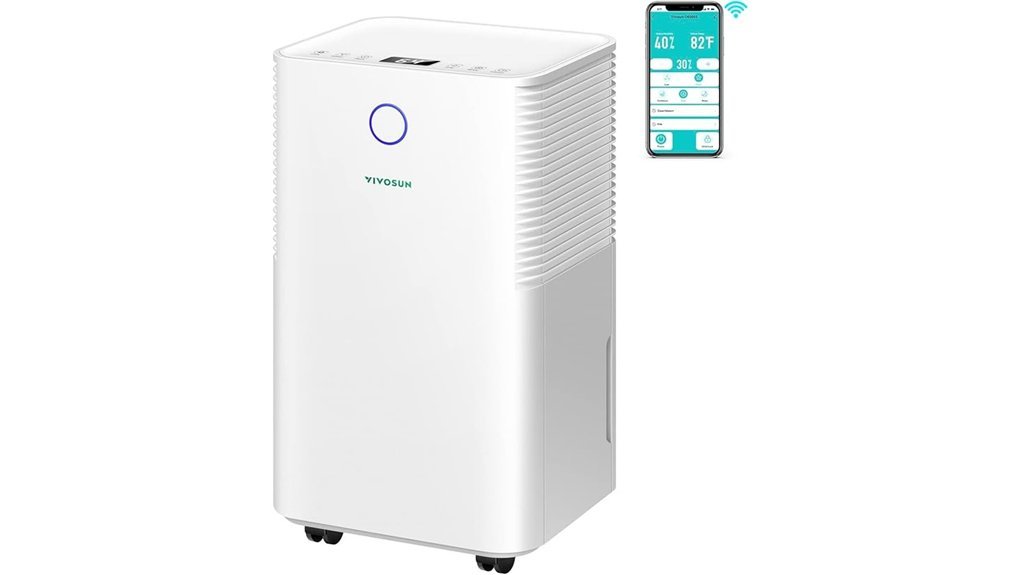
The VIVOSUN 10L/D is a practical choice when you prefer to condition the lung room (the bedroom, spare room, or walk-in closet) that supplies intake air to your 2×2 tent. The manufacturer markets it as a 10L/D (approx. 21.1 US liquid pints, advertised up to 23 pints/day) compressor model with an adjustable target range from 30% to 80% RH. Using its compatible smart mobile app (such as the Tuya Smart platform or the manufacturer’s designated app—verify on the current listing), you can check room humidity and adjust target percentages remotely without unzipping the tent during dark periods.
This unit packs a 2.0-liter water tank, a continuous drain hose connection, two fan speeds, three operating modes (Automatic, Continuous, and Sleep), a 24-hour timer, automatic defrost, and a child lock. While it has a slim profile for a compressor dehumidifier, it still exhausts warm air during operation. Always position it in the surrounding room outside your 2×2 tent so your inline exhaust fan can pull the conditioned air through the tent’s passive intake vents.
Key Specifications:
- Rated Moisture Removal: Up to 10 liters/day (~21.1 US pints, marketed as 23 pints/day)
- Adjustable Humidity Range: 30% to 80% RH
- Water Tank Capacity: 2.0 liters (approx. 0.53 gallons)
- Drainage Options: 2.0 L removable bucket or continuous gravity drain hose
- Control & Modes: WiFi app control, Auto/Continuous/Sleep modes, 2 fan speeds, 24-hour timer
Why You’ll Like It: Remote smartphone adjustments and continuous drainage make it easy to stay ahead of post-watering humidity surges or rainy weather without disturbing your plants’ light cycle.
Best For: Growers who want app-based monitoring and control in a small lung room or walk-in closet surrounding a 2×2 tent.
Who Should Avoid It: Anyone who wants a direct tent duct attachment, a wired canopy sensor probe, or a grow space located in a basement or shed without reliable 2.4 GHz WiFi coverage.
Pros:
- Convenient WiFi app control with an adjustable 30%–80% RH humidistat target.
- Supports continuous hose drainage and includes three practical operating modes.
- Slim, upright compressor footprint fits neatly into tight lung rooms or utility closets.
Cons:
- Does not include a grow-tent air duct adapter or an external wired canopy sensor probe.
- The 2.0-liter internal bucket fills quickly on humid days if you do not connect a gravity drain hose.
- Reads humidity at the unit’s intake inside the lung room rather than inside the tent canopy.
Bottom-Line Verdict: For growers who manage their 2×2 tent by conditioning a small surrounding room and want smartphone control on a budget, the VIVOSUN 10L/D hits the sweet spot.
3. GoGuess 21 Pint Dehumidifier with Drain Hose and Timer
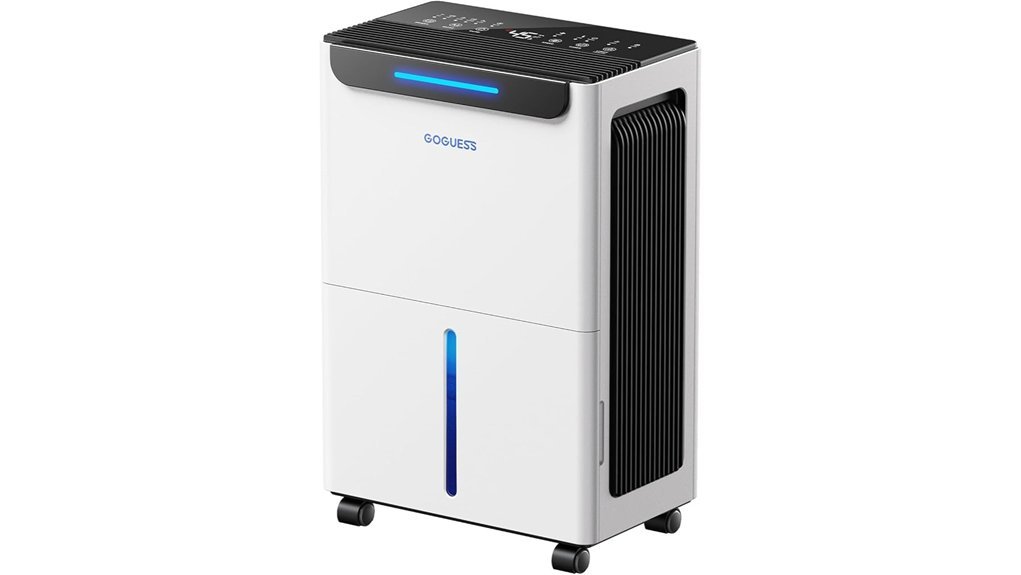
The GoGuess 21 Pint Dehumidifier is a no-frills compressor unit for growers who want reliable lung-room moisture extraction without pairing apps or navigating smart-home menus. Its product listing states moisture removal of up to 21 pints per day at 95°F and 90% RH and an adjustable humidistat range from 30% to 80% RH. Three onboard modes—DEHU (target humidity), TURBO (high-speed continuous extraction), and SLEEP (dimmed display and quiet fan)—cover everyday lung-room adjustments.
The included continuous drain hose is essential for indoor gardening, where plant transpiration can keep humidity elevated for 12 to 24 hours after watering. Place this model in the room or closet outside your 2×2 tent and let your tent’s inline exhaust fan draw the dried air inward. Because it relies on its built-in room sensor rather than a remote probe, verify your actual canopy humidity with an independent digital hygrometer hung inside the tent.
Key Specifications:
- Rated Moisture Removal: Up to 21 pints/day (at 95°F, 90% RH)
- Adjustable Humidity Range: 30% to 80% RH
- Drainage Options: Internal water tank with auto shut-off or included continuous drain hose
- Operating Modes: DEHU (Auto Humidistat), TURBO (High Fan), SLEEP (Low Noise)
- Convenience Features: 24-hour timer, top LED touch panel, caster wheels
Why You’ll Like It: It delivers true refrigeration-compressor dehumidification and continuous hose drainage with zero app setup or WiFi dependencies.
Best For: Growers who need a straightforward external dehumidifier for a small room around a 2×2 tent and prefer simple plug-and-play onboard buttons.
Who Should Avoid It: Growers who want smartphone alerts, a wired canopy probe, or a direct duct connection into their tent.
Pros:
- Simple 30%–80% RH humidistat adjustment with three straightforward operating modes.
- Includes a continuous drain hose to reduce manual bucket emptying.
- Modest power draw suited to conditioning a small spare room or closet.
Cons:
- Still too bulky and warm to sit inside a 2×2 tent floor alongside plants.
- Lacks WiFi app monitoring, an external sensor probe, and a grow-tent duct adapter.
- Actual daily moisture removal in a 75°F room will be lower than the 95°F/90% RH maximum rating.
Bottom-Line Verdict: When you just need an uncomplicated compressor dehumidifier to dry the air in a small room outside your 2×2 tent, the GoGuess 21 Pint gets the job done without extra complexity.
How to Choose a Dehumidifier for a 2×2 Grow Tent
1. Tent vs. Lung-Room Placement
A 2×2 grow tent has only four square feet of floor space—barely enough for one or two 3-gallon to 5-gallon fabric pots. Placing a compressor dehumidifier inside the tent steals critical root space and dumps sensible heat directly onto your plants, often raising internal tent temperatures by 3°F to 7°F. For almost all 2×2 setups, place the dehumidifier outside in the surrounding “lung room” and let your tent’s exhaust fan pull the conditioned, drier air through a bottom intake port. Alternatively, use a ducted unit like the Spider Farmer 32 Pint so the appliance stays outside while feeding dry air toward the tent.
2. Real-World Capacity and Plant Transpiration Load
Never size a grow-tent dehumidifier by advertised square-foot coverage alone. Up to 95% of the water you pour into your growing medium is eventually released back into the air through plant transpiration and surface evaporation. A single mature flowering plant in a 2×2 tent can transpire 2 to 6 pints (1 to 3 liters) of water every 24 hours. Because manufacturers frequently test and advertise capacities at extreme saturation conditions (95°F and 90% RH), a unit rated for “21 to 32 pints” will realistically extract around 8 to 15 pints per day at normal indoor grow temperatures (72°F to 78°F and 50% to 60% RH)—giving you the exact headroom needed to handle lights-off humidity spikes.
3. Humidistat Accuracy and Sensor Placement
A built-in digital humidistat is mandatory so the compressor cycles off once your target RH is reached rather than over-drying the room. If your dehumidifier has a wired remote probe, hang it at canopy height inside the tent, shaded from direct LED grow light radiation and away from the immediate blast of clip-on fans or intake ducts. If you use a lung-room dehumidifier without a remote probe, hang a calibrated standalone digital hygrometer inside the 2×2 canopy and set the lung-room dehumidifier 5% to 10% lower than your desired internal tent humidity to account for plant transpiration.
4. Growth Stage Targets and Vapor Pressure Deficit (VPD)
Plants require progressively drier air as they mature from delicate seedlings into dense, resinous late-stage flowers. Temperature and relative humidity work together to govern Vapor Pressure Deficit (VPD), which controls how rapidly plants transpire and uptake nutrients. Use the reference table below to dial in your dehumidifier settings across each stage of growth:
| Growth Stage | Canopy Temp (Lights On) | Target Relative Humidity (RH) | Target VPD Range | Dehumidifier Priority |
|---|---|---|---|---|
| Seedlings & Clones | 75°F – 80°F (24°C – 27°C) | 65% – 75% RH | 0.4 – 0.8 kPa | Usually off (humidifier often needed instead) |
| Vegetative Stage | 72°F – 82°F (22°C – 28°C) | 55% – 65% RH | 0.8 – 1.2 kPa | Moderate control after watering and at lights-off |
| Early to Mid Flowering | 70°F – 79°F (21°C – 26°C) | 45% – 55% RH | 1.2 – 1.5 kPa | High priority to prevent powdery mildew |
| Late Flowering (Ripening) | 68°F – 76°F (20°C – 24°C) | 40% – 45% RH | 1.3 – 1.6 kPa | Critical 24/7 control to prevent bud rot (Botrytis) |
| In-Tent Harvest Drying | 60°F – 68°F (15°C – 20°C) | 55% – 60% RH | 0.7 – 0.9 kPa | Steady control during the first 72 hours of drying |
5. Continuous Drainage Setup
Compact dehumidifiers typically have small 2.0-liter to 2.5-liter internal buckets that can fill up in 6 to 10 hours during peak flowering—shutting the machine down right in the middle of the night when humidity is highest. Attaching the continuous drain hose bypasses the internal bucket entirely. Because all three models on this list use gravity drainage rather than an internal condensate pump, route the hose downward on a continuous slope into a floor drain or a 5-gallon external reservoir placed lower than the dehumidifier’s drain port. Elevate the dehumidifier on a sturdy milk crate or stand if you need extra height to feed a 5-gallon bucket.
6. Compressor vs. Mini Semiconductor (Peltier) Units
Many shoppers are tempted by ultra-small $35 to $60 “mini dehumidifiers” designed to fit inside a 2×2 tent. Almost all of those compact units use thermoelectric Peltier (semiconductor) cooling plates that extract only 10 to 25 ounces (less than 1.5 pints) of water per day under ideal conditions—and barely anything below 68°F. Once a plant enters flowering and transpires several pints of water daily, a mini Peltier unit is completely overwhelmed. Always invest in a true refrigeration-compressor dehumidifier placed outside the tent.
7. Airflow Balancing, Heat, and Electrical Safety
To get the best results in a 2×2 tent, coordinate your dehumidifier with your 4-inch inline exhaust fan:
- Avoid short-cycling conditioned air: If your 4-inch exhaust fan runs at 100% speed continuously, it exchanges the entire air volume of a 2x2x4 tent (16 cubic feet) several times per minute, pulling humid house air into the lung room faster than the dehumidifier can dry it. Run your inline exhaust fan on a lower speed setting or on an automated temperature/humidity controller.
- Maintain 8 to 12 inches of clearance: Never press the dehumidifier’s air intake grille or exhaust outlet tight against tent fabric or closet walls.
- Keep electrical connections elevated: Plug the compressor dehumidifier directly into a grounded wall outlet or heavy-duty surge protector rated for appliance loads, and keep all power strips off the floor away from drain hoses and watering runoff.
8. Energy Use, Auto-Restart, and Noise
A 20-pint to 32-pint compressor dehumidifier typically draws between 180W and 320W while the compressor is actively engaged—often matching or exceeding the wattage of the LED grow light in a 2×2 tent (usually 100W to 150W). Look for units that cycle their fan and compressor off once target humidity is reached, include automatic defrost to prevent coil icing in cooler basements, and support auto-restart after brief power outages.
9. Notable Alternatives to Consider
If any of the featured models above are temporarily out of stock, or if you want to explore well-known household appliances for conditioning a larger lung room around your 2×2 tent, consider these proven alternatives:
- Midea Cube 20-Pint Smart Dehumidifier: Uses a nested lift-and-twist design with a large 3-gallon bucket (up to 3x larger than standard compact tanks), WiFi app support, and reliable DOE-rated compressor output for lung rooms.
- GE 22-Pint Dehumidifier with Smart Dry: A widely available household compressor model that automatically adjusts fan speed based on ambient room humidity and supports standard garden-hose continuous drainage.
- AC Infinity Controller 69 Pro + Cloudline Pro T4 Inline Fan: Before buying a dehumidifier, remember that if the room outside your tent already sits at 40% to 50% RH, upgrading to a VPD-controlled 4-inch inline exhaust fan can often vent excess tent moisture without needing a dedicated compressor unit.
- Measure your available floor space outside the 2×2 tent, including 8–12 inches of airflow clearance and your duct route.
- Confirm where collected condensate water will drain and whether you need a stand to gravity-drain into a 5-gallon bucket.
- Log your lung room’s baseline temperature and relative humidity; below 65°F, ensure your unit has reliable auto-defrost.
- Decide whether you want direct tent ducting with a wired probe (Spider Farmer), WiFi app control (Vivosun), or basic manual controls (GoGuess).
- Coordinate your 4-inch inline exhaust fan speed so it draws conditioned air through the canopy without overwhelming the lung room.
- Double-check the exact included accessories (drain hose diameter, duct adapter, or app compatibility) on the current Amazon listing before ordering.
Frequently Asked Questions
What Size Dehumidifier Do I Need for a 2×2 Grow Tent?
For most 2×2 grow tents housing one or two mature plants, a compressor dehumidifier rated between 20 and 32 pints per day (under manufacturer 95°F/90% RH ratings, or 10 to 20 pints under DOE standards) placed in the surrounding lung room is ideal. Size your unit based on how much water you feed daily (typically 0.5 to 1.5 gallons every 1–2 days in flower) and the baseline humidity of the room surrounding your tent, rather than the tent’s four-square-foot floor area.
Should I Put the Dehumidifier Inside or Outside a 2×2 Grow Tent?
Always place a compressor dehumidifier outside a 2×2 grow tent whenever possible. Putting it inside takes up 25% to 40% of your floor space and releases compressor heat that can push canopy temperatures above 85°F. Instead, dry the air in the surrounding lung room and let your inline exhaust fan pull that dry air through the tent’s bottom intake port, or use a ducted unit like the Spider Farmer 32 Pint.
Will a Mini Dehumidifier Work in a 2×2 Grow Tent?
No, a mini thermoelectric (semiconductor/Peltier) dehumidifier is rarely strong enough for an active 2×2 grow tent once plants reach late vegetative or flowering stages. Mini units typically remove less than 1 pint of water per 24 hours, whereas a single mature flowering plant often releases 2 to 6 pints of water daily through transpiration.
Why Does Humidity Spike When the Grow Lights Turn Off?
Relative humidity is a measure of how much moisture the air holds relative to its maximum capacity at a given temperature. When your LED grow lights turn off, internal tent temperatures typically drop by 5°F to 10°F. Because cooler air holds significantly less water vapor, relative humidity spikes upward immediately—even while plants continue transpiring moisture for the first hour of darkness.
Where Should I Place the Humidity Sensor in a 2×2 Tent?
Hang your humidity sensor or remote probe near the top of the plant canopy in gentle airflow, shaded from direct grow light beams and away from the immediate airstream of intake ducts, exhaust fans, or wet fabric pots. Cross-check its reading with a secondary standalone hygrometer placed in the middle of the canopy to spot humid microclimates.
How Do I Maintain a Grow-Room Dehumidifier?
Rinse and dry the washable air intake filter every two to four weeks so plant dust, perlite dust, and pet hair do not restrict airflow over the coils. Flush the internal tank and continuous drain hose monthly with warm water and a splash of white vinegar or hydrogen peroxide to prevent algae or biofilm clogs, and inspect the hose line regularly to ensure there are no kinks or upward loops.
Are Square-Foot Coverage Claims Reliable for Grow Tents?
No. A manufacturer’s “up to 1,500 or 2,000 sq ft” claim assumes a normal living space with sealed floors and minimal moisture sources. A 4-square-foot grow tent filled with heavily watered fabric pots and transpiring foliage generates far more moisture per cubic foot than a standard bedroom, so focus on pints-per-day removal, continuous drainage, and humidistat control.
Final Recommendation
Choose the SPIDER FARMER 32 Pint Dehumidifier for the most direct 2×2 grow-tent solution; its included air duct and wired remote sensor allow you to keep the unit outside the tent while controlling humidity right at the plant canopy.
Choose the VIVOSUN 10L/D Smart Dehumidifier when WiFi app monitoring is your priority and you plan to condition the small lung room or closet supplying air to your tent.
Choose the GoGuess 21 Pint Dehumidifier for a straightforward, manual compressor setup with a continuous drain hose and simple onboard buttons.
Whichever model you select, attach the continuous drain hose and track your canopy humidity before watering, two hours after watering, and 30 minutes after lights-off. Dialing in your dehumidifier alongside your inline exhaust fan will keep your VPD on target and protect your harvest from mold from seedling to cure.