A garage dehumidifier with a drain hose can control moisture without forcing you to empty a bucket every day. The four models below are listed to remove 21 to 34 pints per day and advertise coverage from 1,500 to 3,000 sq. ft. The best choice still depends on your garage’s actual size, temperature, air leakage, and moisture load. Prioritize a secure gravity-drain connection, adjustable humidity control, auto-defrost for cooler conditions, and enough capacity to maintain a practical target without running nonstop.
Quick Comparison
| Model | Listed Capacity | Advertised Coverage | Best For | Drainage | Amazon |
|---|---|---|---|---|---|
| Aiusevo 21-Pint | 21 pints/day | Up to 1,500 sq. ft. | Smaller or moderately damp garages | 2L tank or 3.28-ft hose | Check Price |
| Tehanld 30-Pint | 30 pints/day | Up to 3,000 sq. ft. | Larger garages and workshops | 0.7-gal tank or 60-in hose | Check Price |
| VEAGASO 34-Pint | 34 pints/day | Up to 2,500 sq. ft. | Best overall feature balance | 2L tank or included hose | Check Price |
| PLUSCENT 32-Pint | 32 pints/day | Up to 2,500 sq. ft. | Controls, auto-restart, and mobility | 2L tank or 39.4-in hose | Check Price |
Aiusevo 21-Pint Dehumidifier With Drain Hose
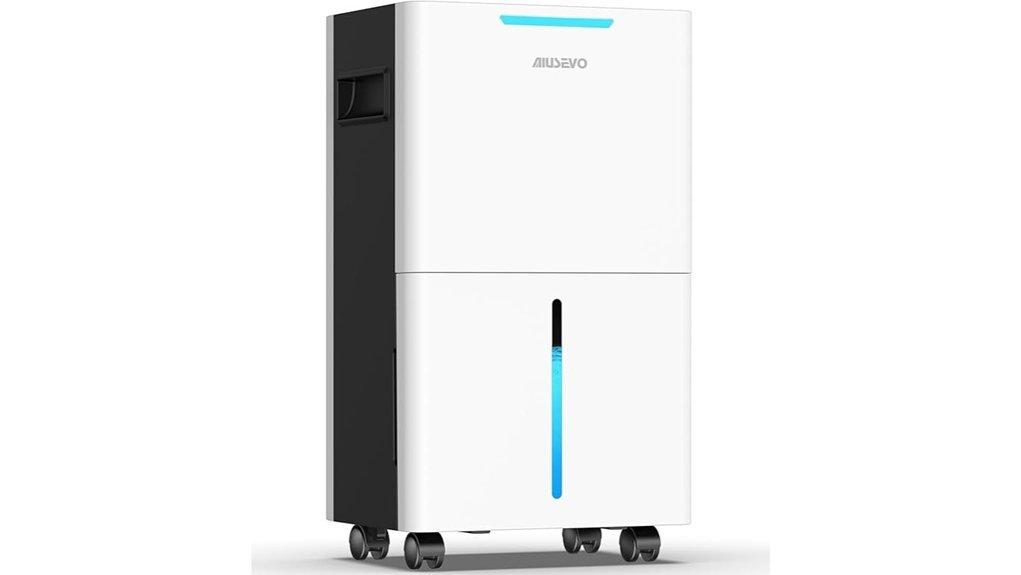
Best for Smaller Garages
If your garage is modest in size or only moderately damp, the Aiusevo 21-pint model may be a better fit than a larger compressor unit. It advertises coverage up to 1,500 sq. ft. and includes DEHU, DRY, and CONT modes for normal humidity control, faster clothes drying, or extended operation. You can set the target humidity from 30% to 80%, choose between two fan speeds, and schedule operation with the timer.
The 2L tank has automatic shutoff when full, while the included 3.28-foot hose supports gravity drainage when the outlet remains below the drain port. Its lower listed capacity means it may take longer in a very wet, leaky, or cold garage, but it avoids buying more capacity than a smaller space may need.
Best For: Small to medium garages, storage rooms, and other moderately damp spaces where compact size and continuous drainage matter.
Why You’ll Like It: It offers three useful operating modes, automatic humidity control, wheels, handles, and a supplied drain hose in a lower-capacity package.
Who Should Avoid It: Buyers dealing with standing water, major air leakage, severe dampness, or a large workshop may need more capacity and should address the moisture source first.
Pros:
- Listed to remove up to 21 pints of moisture per day under the manufacturer’s stated test conditions
- Offers DEHU, DRY, and CONT modes with adjustable humidity and two fan speeds
- Includes a 2L tank, automatic shutoff, timer, wheels, handles, and a 3.28-foot drain hose
Cons:
- Lower capacity than the other three models in this guide
- The 2L tank may fill quickly if continuous drainage is not used
- The listing does not make this the strongest choice for a very cold or persistently wet garage
Tehanld 30-Pint Dehumidifier With Drain Hose
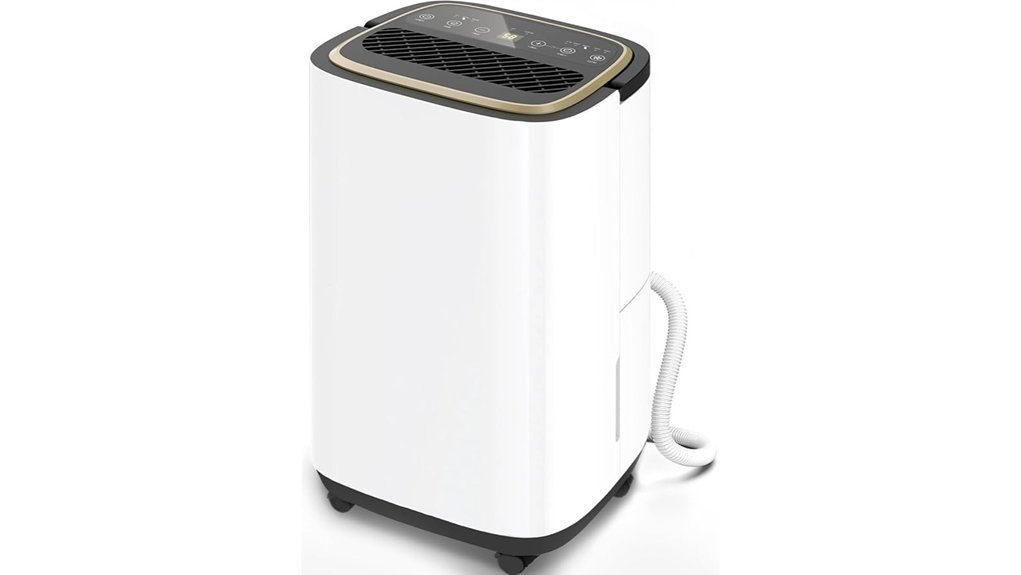
Best Advertised Coverage
The Tehanld 30-pint dehumidifier is aimed at larger garages, workshops, basements, and open rooms. It advertises coverage up to 3,000 sq. ft. and lets you select a target humidity between 30% and 80%. Humidity-control, laundry-drying, and air-circulation functions add flexibility, while the real-time display and two fan speeds make it easier to adjust operation as conditions change.
You can use the 0.7-gallon tank or connect the included 60-inch hose for continuous gravity drainage. Wheels, a carrying handle, a washable filter, a child lock, and auto-defrost improve everyday usability. The listing states operation in conditions down to 42°F, but that is still a manufacturer claim and does not mean the unit will remove moisture effectively near freezing.
Best For: Larger residential garages, workshops, or open storage areas where a longer included hose and broad advertised coverage are priorities.
Why You’ll Like It: Its 60-inch hose and 0.7-gallon tank provide more placement and collection flexibility than the shorter-hose models in this list.
Who Should Avoid It: It may be unnecessary for a small one-car garage with mild seasonal humidity, and buyers should not treat the 3,000 sq. ft. claim as guaranteed performance.
Pros:
- Advertises coverage up to 3,000 sq. ft. with a 30-pint daily rating
- Includes adjustable humidity, two fan speeds, laundry drying, air circulation, timer, and child lock
- Provides a 0.7-gallon tank, 60-inch drain hose, washable filter, wheels, handle, and auto-defrost
Cons:
- Advertised coverage does not guarantee equal performance in every garage
- The tank may still require frequent emptying in wet conditions
- No verified ENERGY STAR certification is stated on the linked product page
VEAGASO 34-Pint Dehumidifier for Garage Moisture Control
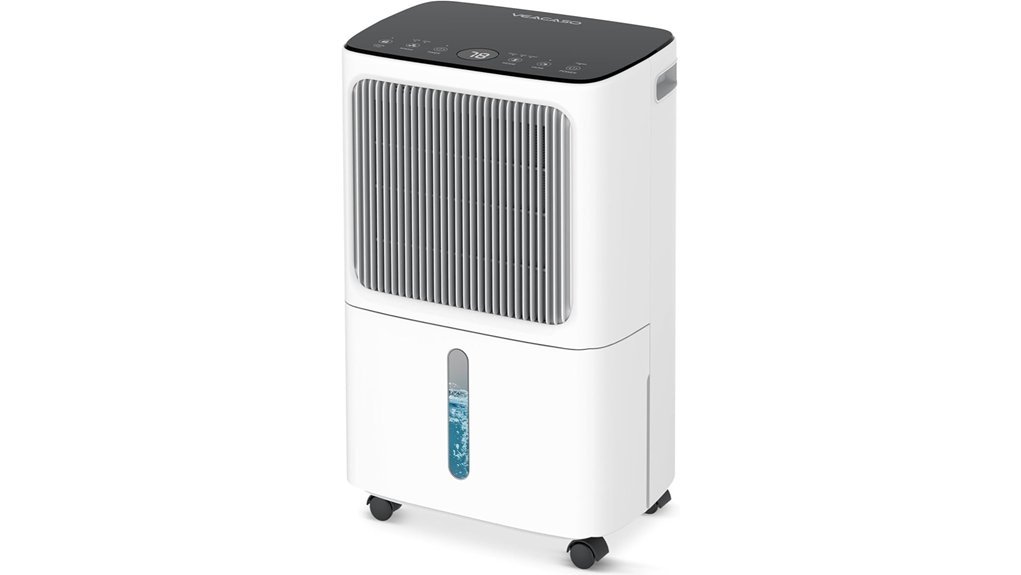
Best Overall
The VEAGASO 34-Pint Dehumidifier has the highest listed removal capacity in this comparison and advertises coverage up to 2,500 sq. ft. It offers DEHU, DRY, and CONT modes, allowing you to choose a target humidity, speed up clothes drying, or run continuously during a short period of heavy dampness.
The 2L tank shuts the unit off when full, or you can connect the included hose for continuous gravity drainage. The LED touch panel controls humidity, fan speed, and timer settings, while the handle, swivel casters, washable filter, auto-defrost, and power-failure memory make it practical for a working garage. The manufacturer lists sound at up to 40 dB in low-speed operation; actual noise will vary with placement, fan setting, compressor cycling, and room acoustics.
Best For: Homeowners who want the strongest listed capacity in this comparison with simple controls and both tank and hose drainage.
Why You’ll Like It: It has a balanced feature set, the highest listed pint rating here, and automatic restart without relying on unnecessary smart-home functions.
Who Should Avoid It: Buyers with a drain located above the dehumidifier will need a separate condensate pump rather than gravity drainage alone.
Pros:
- Highest listed moisture-removal capacity in this four-product comparison
- Offers DEHU, DRY, and CONT modes with adjustable humidity, fan speed, and timer controls
- Includes a 2L tank, automatic shutoff, drain hose, washable filter, casters, auto-defrost, and power-failure memory
Cons:
- The 2L tank may need frequent emptying without continuous drainage
- The current product page does not clearly state the included hose length
- The 40 dB figure is manufacturer-listed rather than an independent test result
PLUSCENT 32-Pint Dehumidifier for Large Rooms
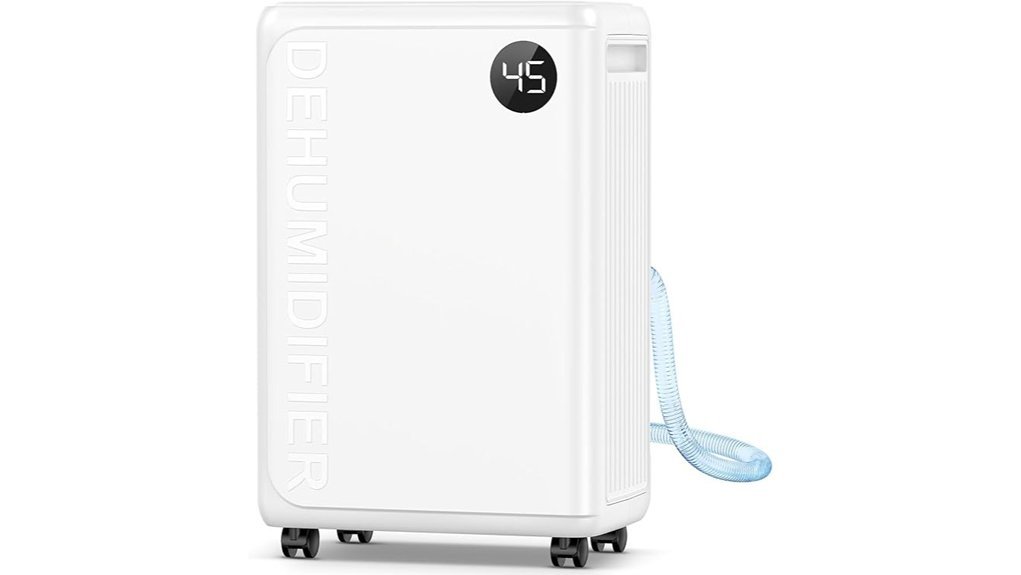
Best Controls and Mobility
The PLUSCENT has a listed 32-pint daily capacity and advertises coverage up to 2,500 sq. ft. Its three modes include DEHU for a chosen humidity target, CONT for extended operation, and DRY for faster clothes drying. A 24-hour timer helps limit unnecessary runtime, while auto-restart restores the previous settings after a power interruption.
The included 39.4-inch hose supports gravity drainage, and the 2L tank has automatic stop protection. The manufacturer lists a 39–42 dB noise range. A child lock, washable filter, wheels, handles, and auto-defrost make it practical for garages where the unit may need to be moved or left operating for long periods.
Best For: Buyers who value easy movement, automatic restart, three operating modes, a washable filter, and straightforward controls.
Why You’ll Like It: Its control set is easy to understand, and the auto-restart feature is useful in areas with occasional outages.
Who Should Avoid It: Buyers who need a long drain run may find the included 39.4-inch hose restrictive.
Pros:
- Listed to remove up to 32 pints per day and cover up to 2,500 sq. ft.
- Includes three modes, a 24-hour timer, auto-restart, child lock, and auto-defrost
- Provides continuous drainage, automatic tank stop, washable filter, wheels, and handles
Cons:
- The 2L tank may fill quickly when the hose is not connected
- The included hose is shorter than the 60-inch hose supplied with the Tehanld model
- The listed noise range has not been independently verified here
Factors to Consider When Choosing a Garage Dehumidifier With Drain Hose
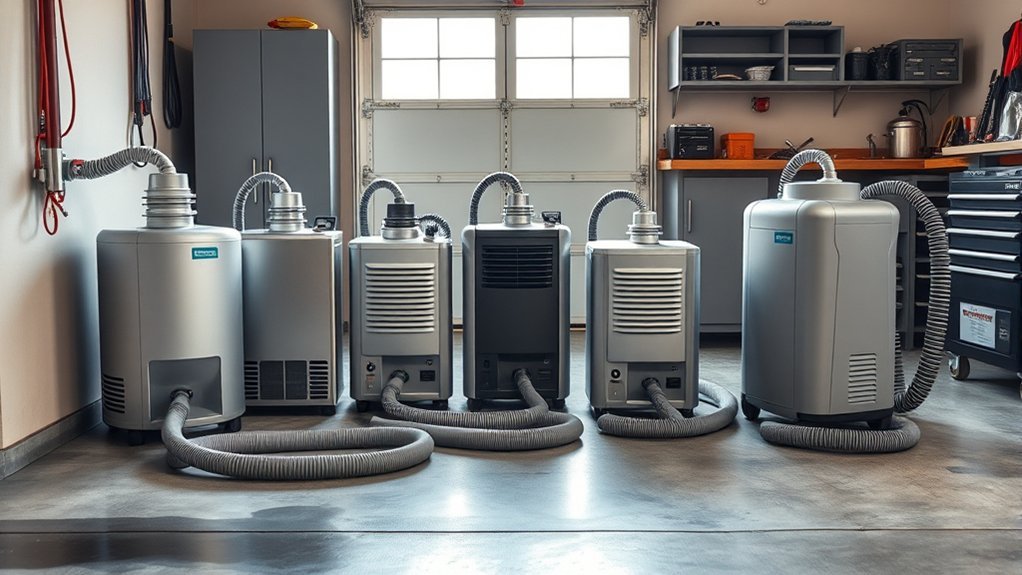
Choose a garage dehumidifier by matching its moisture-removal capacity to the actual floor area, temperature, and dampness of your space. Then confirm that the drain route slopes correctly, the operating-temperature range suits your garage, and the controls are practical for unattended use.
Garage Size and Moisture Load
Measure the garage’s length and width to calculate its square footage, then consider ceiling height, open doors, air leaks, wet vehicles, and stored materials. Manufacturer coverage figures such as 1,500 or 3,000 sq. ft. are broad comparison claims and often exceed the size of a typical residential garage. A larger coverage label does not automatically mean faster or better moisture control.
For a smaller garage with mild seasonal humidity, a 21-pint model may be sufficient. A larger, leakier, or persistently damp workshop may benefit from a 30- to 34-pint model. Prioritize the pint-per-day rating, test conditions, and actual moisture load over the largest advertised square-foot number.
Moisture Removal Capacity
The pint-per-day rating describes how much water the unit can remove under stated test or manufacturer conditions. It is useful for comparing models, but real output changes with temperature and relative humidity. A cold garage generally produces less condensate than a warm, humid test environment, and frequent door opening adds a fresh moisture load.
Choose enough capacity to reach and maintain your target without forcing the compressor to run continuously. If the garage has active leaks, standing water, or water entering through walls or the slab, repair that source before relying on a portable dehumidifier.
Continuous Drainage Options
Gravity drainage works only when the hose runs continuously downhill from the dehumidifier to an approved drain point. Keep the hose straight, supported, and free of kinks, loops, and submerged ends. A loose connection can leak, while an upward section can stop flow and send water back to the tank.
If the nearest drain is above the unit, use a compatible condensate pump instead of trying to force water uphill. Confirm the hose diameter, connection method, maximum practical run, and approved drain location in the product manual before buying an extension.
Humidity Control Modes
DEHU or Auto mode is the best everyday choice because it cycles the unit around a selected humidity target. DRY mode is useful for wet gear or laundry but may use more energy if left on unnecessarily. Continuous mode can help during a short period of severe dampness, though it should not replace fixing leaks or ventilation problems.
For general moisture control, start near 50% relative humidity and adjust based on condensation, odor, stored materials, and the manufacturer’s guidance. Use a separate hygrometer if you want to compare the dehumidifier’s display with another reading location in the garage.
Noise Level Considerations
Noise ratings are helpful but do not tell the whole story. Compressor cycling, fan speed, a vibrating concrete floor, nearby walls, and loose panels can make the same unit sound different from one garage to another. If you use the garage as a workshop, gym, or office, compare the manufacturer-listed dB figure and look for multiple fan speeds.
Place the unit on a level, stable surface with the required clearance around its air inlet and outlet. A thin anti-vibration mat may reduce transmitted hum, provided it does not block airflow or make the unit unstable.
Portability and Mobility
Casters and a sturdy handle make filter cleaning, drain setup, and seasonal storage easier. Check the unit’s dimensions as well as its coverage claim, especially when vehicles, shelving, or workbenches limit floor space. Leave enough clearance for unrestricted airflow and easy tank removal.
Also confirm that the power cord and drain hose reach their destinations without extension cords or trip hazards. Follow the manufacturer’s electrical instructions, use a properly grounded outlet, and avoid placing the unit where it can be splashed or struck by a vehicle.
Safety and Auto Shutoff
Automatic tank shutoff helps prevent overflow when manual collection is used. Auto-restart and power-failure memory are useful for continuous drainage because the unit can resume its previous settings after an outage. A child lock reduces accidental control changes, while a washable filter helps maintain airflow when cleaned on schedule.
Do not treat auto shutoff as protection against every drainage problem. Inspect the hose connection, drain path, filter, and surrounding floor periodically, especially during the first few days after installation.
Low-Temperature Operation
Compressor dehumidifiers lose effectiveness as air temperature drops, and frost can form on the coils. Auto-defrost helps manage frost, but it does not guarantee strong moisture removal in a near-freezing garage. Check the exact minimum operating temperature in the manual for the model you are considering.
If the garage regularly approaches freezing, consider improving insulation or heat, or compare a dehumidifier technology designed for colder spaces. Never assume that an auto-defrost label makes a standard compressor model suitable for freezing conditions.
Energy Use and Certification
A dehumidifier may run for many hours during humid weather, so energy efficiency can affect long-term operating cost. Look for a current ENERGY STAR certification when efficiency is a priority, and verify the exact model number in the official product database rather than assuming that every product from a brand is certified.
A timer can reduce unnecessary operation, but a humidistat is more useful for routine control because it cycles the compressor around the selected relative-humidity target.
- Measure the garage and note the usual temperature and humidity.
- Identify a safe drain point lower than the dehumidifier, or plan for a condensate pump.
- Confirm the included hose length, connection size, minimum operating temperature, and required clearance.
- Check whether listed noise, coverage, and capacity figures are manufacturer claims or certified ratings.
- Verify ENERGY STAR status by exact model number when efficiency matters.
- Address roof, wall, door, or slab leaks before expecting a dehumidifier to solve the problem.
Frequently Asked Questions
How Often Should a Garage Dehumidifier Drain Hose Be Cleaned?
Inspect the hose about once a month during heavy use and clean it when you notice slow flow, buildup, or odor. Follow the product manual, disconnect power before maintenance, flush the line as directed, and make sure it remains kink-free and continuously sloped.
Can a Garage Dehumidifier Run in Freezing Temperatures?
Most standard compressor dehumidifiers are not intended to remove moisture effectively in freezing conditions. Auto-defrost can help with coil frost within the approved operating range, but you should check the manual’s minimum temperature and avoid operating the unit outside that limit.
Do Drain Hose Dehumidifiers Need a Floor Drain?
No. A gravity-drain model can discharge to another approved drain point as long as the hose outlet stays below the dehumidifier and the line slopes downward. If water must travel uphill, use a compatible condensate pump. Avoid draining unattended into an open bucket that can overflow.
How Noisy Are Garage Dehumidifiers During Operation?
Expect a steady fan sound plus occasional compressor cycling. The models in this article carry manufacturer-listed noise claims from about 39 to 42 dB where a figure is stated, but actual sound depends on fan speed, placement, vibration, and room acoustics.
Should I Size a Dehumidifier for Attached or Detached Garages?
Size it for the actual floor area, moisture load, air leakage, and temperature rather than the attached or detached label alone. Detached garages are often colder or leakier, but an attached garage with poor seals, wet vehicles, or water intrusion may require just as much capacity.
What Humidity Setting Is Best for a Garage?
Start around 50% relative humidity, observe condensation, odor, rust risk, and stored materials, then adjust within the manufacturer’s recommended range. Very low settings can increase runtime and energy use without solving an active leak.
Can I Use a Longer Drain Hose?
Possibly, but first confirm the connection size and maximum recommended run in the manual. A longer hose must still slope continuously downward, remain free of kinks, and avoid creating a trip hazard. Use a condensate pump when the drain route cannot rely on gravity.
Conclusion
The VEAGASO 34-Pint Dehumidifier is the best overall choice in this lineup for buyers who want the highest listed capacity and a straightforward mix of humidity modes, tank drainage, auto-defrost, and an included hose. The Aiusevo 21-Pint Dehumidifier is a more proportionate option for smaller garages. The Tehanld 30-Pint Dehumidifier stands out for its 60-inch hose and broad advertised coverage, while the PLUSCENT 32-Pint Dehumidifier offers a strong combination of controls, auto-restart, and portability.
Whichever model you choose, measure the garage, confirm the minimum operating temperature, verify the current product listing, and plan the drain route before ordering. A secure downhill hose, realistic humidity target, clean filter, and repaired water source will matter more than an oversized square-foot claim.