If you want one compact appliance to help manage light moisture while filtering some airborne particles, this 2026 guide compares two relevant HEPA dehumidifier combos: the Tenergy Sorbi 1000ml and the Hyintell DH16. Both are thermoelectric, small-room appliances intended for mild condensation, closets, bathrooms, bedrooms, offices, and similar enclosed spaces. They are not substitutes for a high-capacity compressor dehumidifier in a wet basement or a dedicated high-CADR purifier in a large room.
Quick Verdict
Best Overall: The Tenergy Sorbi 1000ml is the stronger starting point because its product identity, extraction test conditions, controls, and replacement-filter support are better documented. Best for Continuous Drainage: The Hyintell DH16 offers a larger tank and drain-hose connection for buyers who want fewer manual emptying breaks. Choose separate full-size appliances when the room is large, moisture is persistent, or fast air cleaning is a priority.
Key Takeaways
- Both products have maximum extraction claims of only about 1.6–1.7 pints per day under warm, highly humid test conditions.
- The Tenergy is the better-documented choice and has clearly identifiable replacement filters.
- The Hyintell is more convenient for longer operation because it supports a drain hose.
- Neither product publishes enough verified air-cleaning data to replace a properly sized, CADR-rated purifier.
- Leaks, standing water, established mold, and chronically wet basements require moisture-source correction and higher-capacity equipment.
Quick Comparison
| Product | Best For | Filter | Tank | Claimed Maximum Extraction | Drainage | Main Limitation | Amazon |
|---|---|---|---|---|---|---|---|
| Tenergy Sorbi 1000ml | Buyers who want the better-documented compact option | True HEPA | 1 liter | Up to 750ml/day at 86°F and 80% RH | Manual tank emptying | No continuous-drain connection | Check Details |
| Hyintell DH16 | Small rooms where continuous gravity drainage is useful | Claimed H13 HEPA plus negative-ion function | 54 oz / 1.6 liters | 700–800ml/day at 86°F and 80% RH | Tank or included drain hose | Filter support, emissions certification, and seller availability need confirmation | Check Availability |
How These Products Were Compared
The recommendations prioritize verified product identity, moisture-removal test conditions, tank and drainage design, filter information, replacement-filter support, controls, safety cautions, and suitability for the buyer’s actual room. Manufacturer extraction figures are treated as maximum claims rather than typical household results.
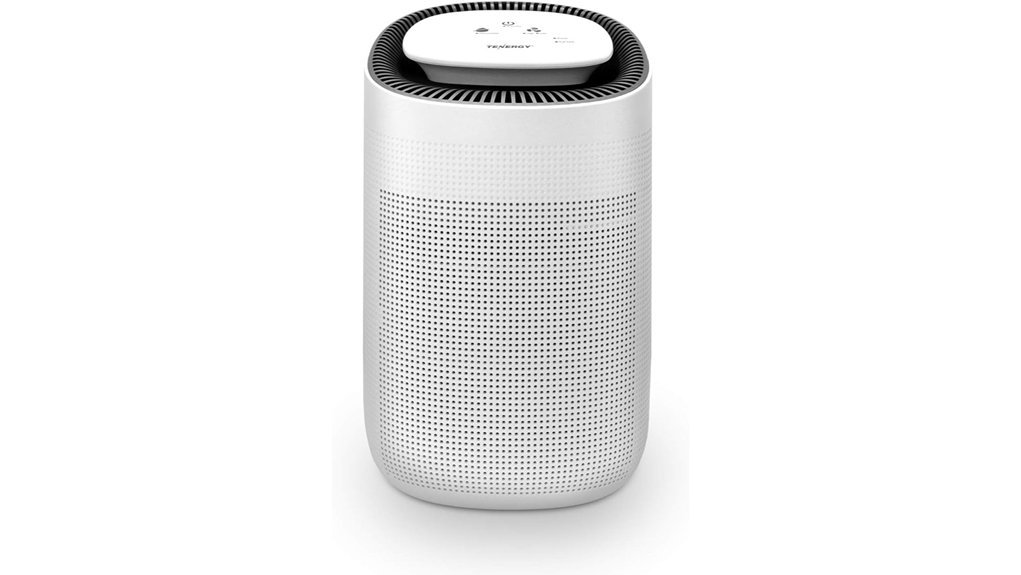
Tenergy Sorbi 1000ml Air Dehumidifier with HEPA Filter
Best Overall
The Tenergy Sorbi is the strongest all-around choice in this comparison for buyers who want a compact unit with clearer product documentation and identifiable replacement filters. It combines Peltier dehumidification with a True HEPA filter, a removable 1-liter tank, touch controls, two fan-speed settings, and automatic shutoff.
Tenergy claims moisture removal of up to 750ml per day, which is about 1.6 U.S. pints. However, that maximum is measured at approximately 86°F and 80% relative humidity. Expect less water collection in a cooler room, during winter, or when humidity is only moderately elevated.
The Sorbi is most practical for a closet, small bathroom, compact bedroom, home office, or similarly enclosed area with light condensation or mild mustiness. It does not have the moisture-removal capacity required for seepage, standing water, or a chronically wet basement.
| Tank Capacity | 1 liter | Rated Power | Up to 45 watts |
| Maximum Extraction | 750ml/day at 86°F and 80% RH | Drain Hose | No |
| Filter | Replaceable True HEPA filter | Fan Settings | Low and high |
Why You’ll Like It: It provides light-duty moisture collection and particle filtration in one compact footprint, while its replacement filters are easier to identify than those for many generic combination models.
Best For: Buyers with a small enclosed room, light condensation, limited floor space, and a preference for straightforward controls.
Who Should Avoid It: Buyers who need continuous drainage, automatic humidity targeting, high-capacity moisture removal, or fast air cleaning in a large room.
Main Trade-Off: The product is convenient and compact, but its 750ml maximum extraction is small compared with a full-size compressor dehumidifier.
Pros:
- Combines thermoelectric moisture removal and True HEPA filtration
- One-liter removable tank with full-tank indicator and automatic shutoff
- Low and high fan settings support quieter or faster operation
- Compatible replacement filters are identifiable
- Compact footprint suits closets, bathrooms, and small offices
Cons:
- Maximum extraction requires warm, highly humid conditions
- No continuous-drain hose connection
- No independently verified high-volume CADR is provided
- Replacement filters create an ongoing ownership cost
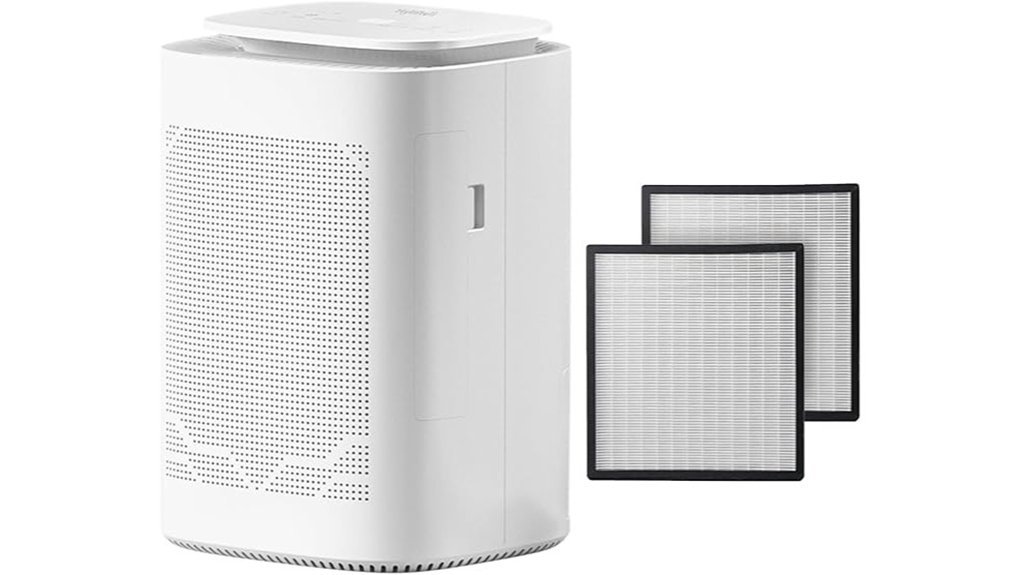
Hyintell DH16 Dehumidifier and Air Purifier Combo
Best for Continuous Drainage
The Hyintell DH16 combines compact thermoelectric dehumidification with a claimed H13 HEPA filter, a 54oz or 1,600ml water tank, two operating speeds, a 24-hour timer, automatic shutoff, and an included drain hose. The larger tank and drainage connection are its main advantages over the Tenergy.
The manufacturer claims extraction of 700–800ml per day, or approximately 1.5–1.7 U.S. pints, at 86°F and 80% relative humidity. This remains light-duty capacity. Real collection will normally fall when the room is cooler or less humid.
For occasional operation, you can collect water in the tank. For longer operation, the hose can be routed to an appropriate lower drain. Because this is gravity drainage, the hose must descend continuously without loops, upward sections, or kinks.
| Tank Capacity | 54 oz / 1.6 liters | Rated Power | 75 watts |
| Maximum Extraction | 700–800ml/day at 86°F and 80% RH | Drain Hose | Yes, included |
| Filter | Claimed H13 HEPA | Controls | Two speeds and 24-hour timer |
Ionizer Caution: The listing describes a negative-ion function. Confirm whether it can be switched off and whether the exact model has recognized zero-ozone-emissions validation, such as UL 2998. Buyers who prefer filtration without ionization may find the Tenergy easier to evaluate.
Why You’ll Like It: Its larger tank and drain-hose option reduce the need to stop and empty the reservoir during regular operation.
Best For: Buyers who want compact moisture control, particle filtration, a timer, and continuous gravity drainage in a small enclosed space.
Who Should Avoid It: Buyers who require independently verified CADR data, clearly documented zero-ozone performance, readily available replacement filters, or heavy-duty basement drying.
Main Trade-Off: It offers more convenience features than the Tenergy, but its current seller availability, replacement-filter supply, and emissions documentation require closer checking.
Pros:
- Combines compact moisture removal and claimed H13 HEPA filtration
- Larger 1,600ml tank with automatic shutoff
- Includes a drain hose for continuous gravity drainage
- Two operating speeds and a 24-hour timer
- Low-speed mode is intended for quieter bedroom operation
Cons:
- Daily extraction depends heavily on room temperature and humidity
- No independently verified high-volume CADR is published
- Negative-ion function requires additional emissions and control checks
- Replacement-filter availability should be confirmed before ordering
- Amazon seller availability may change
Which HEPA Dehumidifier Combo Should You Choose?
Choose the Tenergy Sorbi 1000ml when you want the more clearly documented option, identifiable replacement filters, simple touch controls, and manual tank operation. It is the safer default recommendation for light-duty use.
Choose the Hyintell DH16 when a larger tank, timer, and continuous drain-hose connection are more important. Before ordering, verify the current seller, replacement-filter supply, ionizer controls, and emissions certification.
Choose neither product when the room has seepage, standing water, damp walls, flood damage, recurring visible mold, or persistent high humidity across a large area. Those conditions call for moisture-source repair and a properly sized compressor dehumidifier.
Factors to Consider When Choosing a HEPA Air Purifier and Dehumidifier
Choose a combination unit by comparing dehumidification capacity, extraction test conditions, air-cleaning performance, room layout, tank and drainage design, noise, power use, filter cost, and safety documentation. Compact combination models save space, but their moisture removal and airflow are usually more limited than those of separate full-size appliances.
Filtration Efficiency and CADR
Look beyond the word “HEPA.” Check the exact filter grade, replacement schedule, replacement-filter availability, fan airflow, and whether the manufacturer publishes independently verified Clean Air Delivery Rate (CADR) results.
A HEPA filter may capture fine particles that pass through it, but the amount of clean air delivered also depends on how much air the fan moves through the filter. A small filter paired with weak airflow will not clean a room as quickly as a properly sized dedicated purifier.
EPA recommends selecting a portable air cleaner with CADR appropriate for the room. Learn more in the EPA Guide to Air Cleaners in the Home.
Dehumidification Capacity
Daily extraction is normally stated in pints or milliliters, but the maximum figure is measured under specified temperature and humidity conditions. Compact thermoelectric models commonly collect much less water in cool rooms or at moderate humidity.
The two products in this guide claim no more than about 1.7 pints per day under favorable conditions. By comparison, full-size portable dehumidifiers are commonly rated in tens of pints per day. Treat these compact models as light-condensation appliances rather than general replacements for full-size equipment.
Match the appliance to the actual problem. Occasional window condensation and mild mustiness are different from seepage, wet floors, laundry-related moisture loads, or a basement that remains damp throughout the day.
Room Size and Layout
Measure the room and consider whether it can be closed off. Compact thermoelectric units work best in contained spaces with doors and windows shut during operation. An open-plan room allows moisture and airborne particles from adjoining spaces to enter continuously.
Do not rely only on a broad square-foot claim. For dehumidification, compare extraction capacity with the room’s temperature and dampness. For purification, look for verified CADR or air-change information.
Noise Level
Check the published sound level for the exact operating mode you plan to use. Low or sleep modes are usually better for bedrooms, but maximum extraction and airflow generally occur at a higher fan speed.
Place the unit on a stable, level surface. Leave open space around its intake and outlet, and avoid setting it against a wall, curtain, bed, or upholstered furniture that could restrict airflow or increase vibration.
Energy Consumption
Compare rated wattage rather than relying on a general “energy efficient” claim. Actual electricity use depends on power draw, fan speed, daily operating time, humidity, and local electricity rates.
To estimate operating cost, multiply watts by hours of daily operation, divide by 1,000 to obtain kilowatt-hours, and multiply by your electricity rate. For example, a 45-watt appliance running for eight hours uses approximately 0.36 kWh before the local rate is applied.
Tank and Drainage
A larger tank means fewer emptying breaks, while automatic shutoff helps prevent overflow. Clean and dry the reservoir regularly so stagnant water and residue do not create odors.
Continuous drainage is useful only when the hose can run downhill to a safe drain. Confirm the required hose size, whether the hose is included, and whether the appliance uses gravity drainage or a pump. Gravity-drain hoses cannot push water upward into a sink or elevated drain.
Controls and Timers
Fan-speed controls and timers can make a compact unit easier to use. A timer limits unnecessary operation, while a lower fan speed may be preferable at night.
Neither convenience feature compensates for inadequate extraction or airflow. Capacity, filter support, and room suitability should come before decorative displays or extra operating modes.
Replacement-Filter Availability
Confirm the replacement-filter model before buying the appliance. A functioning dehumidifier with an unavailable or unidentified filter may eventually become difficult to use as an air purifier.
Follow the manual for inspection, cleaning, and replacement. Do not wash a disposable HEPA filter unless the manufacturer expressly identifies it as washable. Replace it sooner when it becomes heavily loaded, damaged, or causes a noticeable reduction in airflow.
Safety and Emissions Information
Verify safety testing for the exact model rather than assuming that every product from the same seller or brand has identical certification. When a product includes ionization, confirm whether the feature can be disabled and look for recognized zero-ozone-emissions validation.
Keep the appliance on a stable surface and away from tubs, showers, sinks, splash zones, and standing water. Do not block the vents, use a damaged power adapter, or operate the unit contrary to its manual.
When Separate Devices Make More Sense
Choose separate appliances when you have a large room, severe dampness, recurring mold, flood damage, wildfire smoke, or a need for rapid allergen removal. A full-size compressor dehumidifier offers substantially greater moisture extraction, while a dedicated purifier with verified CADR makes air-cleaning performance easier to compare.
A compact combo is most valuable when saving space and handling a mild, localized problem matter more than maximum performance.
Before You Buy
- Measure the enclosed room instead of relying on a broad coverage claim.
- Use a separate hygrometer to confirm whether humidity is actually elevated.
- Identify whether the problem is light condensation, persistent dampness, or active water intrusion.
- Check the extraction rating and the temperature and humidity used to produce it.
- Confirm tank size, automatic shutoff, drain-hose support, and drain position.
- Find the exact replacement-filter model before ordering.
- Look for verified CADR when purification is a major buying reason.
- Review electrical and emissions certifications for the exact model.
Humidity Target
A practical target for many homes is approximately 30% to 50% relative humidity. Keep humidity below 60% where possible, but do not rely on a compact appliance to conceal leaks, water damage, or established mold. EPA guidance emphasizes controlling the moisture source as well as indoor humidity. See the EPA guide to mold and moisture control.
Frequently Asked Questions
How Often Should HEPA Filters Be Replaced in Combo Units?
Follow the schedule in the current manual for the exact filter. Inspect the filter regularly and replace it when it becomes heavily loaded, damaged, or noticeably restricts airflow. Smoke, pets, dust, construction debris, and long daily operating hours can shorten its usable life. Confirm replacement-filter availability before buying the appliance.
Do HEPA Purifier-Dehumidifiers Increase Electricity Bills Significantly?
They use electricity whenever they run, but compact thermoelectric models usually draw less power than full-size compressor dehumidifiers. The total cost depends on wattage, daily operating time, fan speed, and your local electricity rate.
Multiply the product’s wattage by daily operating hours, divide by 1,000, and multiply the result by your electricity price per kilowatt-hour. Clean filters and sensible timer settings help prevent unnecessary run time.
Can These Units Help With Mold Spores and Dust Mites?
A HEPA filter can capture some airborne particles that pass through it, while reducing excess humidity can make the room less favorable for mold and dust mites. However, a combo unit does not remove established mold, repair leaks, dry water-damaged building materials, or replace proper cleaning and moisture-source control.
Are Combo Units Suitable for Bedroom Use?
Many compact models are suitable for bedrooms on a low fan setting, but sound sensitivity varies. Noise increases at higher fan speeds, and a quiet setting may also reduce airflow and moisture collection.
Place the unit on a level surface away from the bed, and make sure its intake and outlet remain unobstructed.
Which Rooms Suit Compact HEPA Dehumidifier Combos Best?
These models are best suited to small, enclosed spaces such as closets, compact bedrooms, bathrooms outside the splash zone, home offices, and storage rooms with light moisture. Large rooms and open layouts generally need separate higher-capacity equipment with clearly published moisture-removal and CADR ratings.
Can a Compact Dehumidifier Dry a Wet Basement?
No. A compact unit rated at approximately 1.6–1.7 pints per day is not suitable for a wet basement, seepage, standing water, or a large persistent moisture load. Correct the water source and choose a properly sized compressor dehumidifier.
Does a HEPA Label Guarantee Good Air Cleaning?
No. The filter grade describes particle capture at the filter, but room-cleaning speed also depends on fan airflow, air leakage, operating speed, and run time. Verified CADR is a more useful comparison when air purification is the main reason for buying.
What Indoor Humidity Level Should You Target?
A practical target for many homes is approximately 30% to 50% relative humidity, with humidity kept below 60% where possible. Use a separate hygrometer when the appliance does not provide an accurate humidity reading, and avoid over-drying the room.
Conclusion
Final Recommendation
The Tenergy Sorbi 1000ml is the best starting point for most buyers because it has clearer documentation, simple controls, a one-liter tank, and identifiable replacement filters. Choose the Hyintell DH16 when its larger tank and continuous drain-hose option outweigh the need to verify ionizer controls, filter supply, and current seller availability.
Both products are designed for light-duty humidity management and secondary particle filtration in small enclosed spaces. Their maximum extraction figures are measured under warm, highly humid conditions, so ordinary household collection may be substantially lower.
For a wet basement, large living area, recurring visible mold, water intrusion, or serious smoke and allergen concerns, separate full-size appliances will usually deliver clearer, stronger, and more measurable performance.