The best travel dehumidifier depends on where moisture is building up. Passive silica-gel models are usually the easiest choices for suitcases, storage bins, cars, closets, and RV cabinets because they absorb moisture without needing power during use. Small electric units can collect more water, but they require an outlet and enough space around their vents.
This guide compares six compact moisture-control options for 2026. For luggage and enclosed storage, the FURWEY packs and Eva-Dry E-333 are the easiest to carry. For vehicle condensation, the Zarpax LV-A300 is the most purpose-built option. For a hotel room, camper, boat cabin, or other compact living space with reliable power, the CLEVAST CL-DH04 and Eva-Dry EDV-1100 offer active water collection.
These products are intended for light dampness and small-space moisture control. They should not be treated as substitutes for ventilation, leak repair, mold remediation, a vehicle defogger, or a full-size dehumidifier in a persistently damp room.
- Best for luggage and storage bins: FURWEY Rechargeable Desiccant Packs
- Best cordless set with a heating base: Afloia Mini TOP-Z (2+1)
- Best for a car or RV cab: Zarpax LV-A300 Car Dehumidifier
- Best silent closet pick: Eva-Dry E-333
- Best compact powered pick: CLEVAST CL-DH04
- Best powered option for an RV or compact room: Eva-Dry EDV-1100
Quick Comparison of the Best Travel Dehumidifiers
| Product | Type | Best Use | Power or Renewal | Main Limitation | Amazon |
|---|---|---|---|---|---|
| FURWEY 2-Pack | Rechargeable silica-gel bags | Suitcases, bins, closets, and cars | Cordless in use; renew according to the included heating instructions | Only suitable for small enclosed spaces | View on Amazon |
| Afloia TOP-Z (2+1) | Cordless silica-gel absorbers with heating base | RV cabinets, wardrobes, luggage, and storage compartments | Cordless in use; renew on the powered heating base | The base adds packing bulk | View on Amazon |
| Zarpax LV-A300 | Microwave-renewable vehicle moisture absorber | Cars, trucks, vans, and RV cabs | Cordless in use; microwave renewal according to the label | Needs periodic drying and cannot replace a defogger | View on Amazon |
| Eva-Dry E-333 | Renewable silica-gel unit | Closets, cabinets, safes, boats, and RV storage | Cordless in use; plugs into an outlet for renewal | Designed for enclosed cubic-foot spaces, not whole rooms | View on Amazon |
| CLEVAST CL-DH04 | Powered thermoelectric unit | Warm hotel rooms, campers, bathrooms, and bedrooms | Requires a standard 120V AC outlet | Performance drops in cool or mildly humid spaces | View on Amazon |
| Eva-Dry EDV-1100 | Powered thermoelectric unit | RVs, boats, bathrooms, and compact rooms | 110–120V AC; optional 12V cord may be sold separately | Small tank and no continuous drain hose | View on Amazon |
FURWEY Rechargeable Silica Gel Dehumidifier Bags (2-Pack)
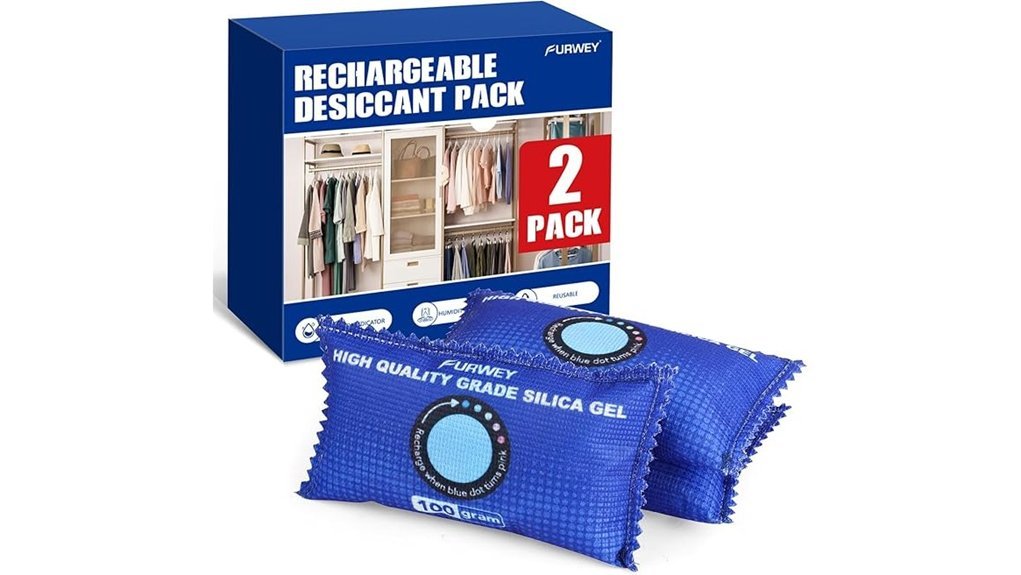
Best for luggage and compact storage. The FURWEY two-pack is a practical portable moisture absorber for a suitcase, storage bin, closet, camera case, or vehicle. The slim bags use color-indicating silica gel, allowing you to check their status without opening or weighing them.
The bags need no power while absorbing moisture and can be divided between two suitcases or storage areas. When the indicator shows saturation, renew each pack only by the method printed on the current product label. Heating times, temperature limits, and recommended replacement intervals can vary by configuration, so do not rely on instructions for a different desiccant bag.
Why you’ll like it: The packs take up little room, contain no collection tank that can spill, and are easy to move between luggage, bins, closets, and vehicles.
Who should buy it: Travelers who want to protect clothing, documents, electronics accessories, or stored gear inside a small enclosed space.
Who should avoid it: Anyone trying to reduce humidity throughout a hotel room, bathroom, camper interior, or other occupied living space should choose a powered dehumidifier with a water tank.
Pros:
- Compact two-pack: Easy to divide between luggage or storage areas.
- Color indicator: Shows when the silica gel is approaching saturation.
- Cordless operation: Uses no electricity while absorbing moisture.
- Reusable design: Reduces reliance on disposable moisture absorbers.
Cons:
- Small-space performance: Not suitable for dehumidifying an entire room.
- Heat-based renewal: Requires careful adherence to the included instructions.
- Limited verification: Check the current listing and label for exact capacity and renewal-cycle guidance.
Afloia Mini Gun Safe Dehumidifier TOP-Z (2+1)
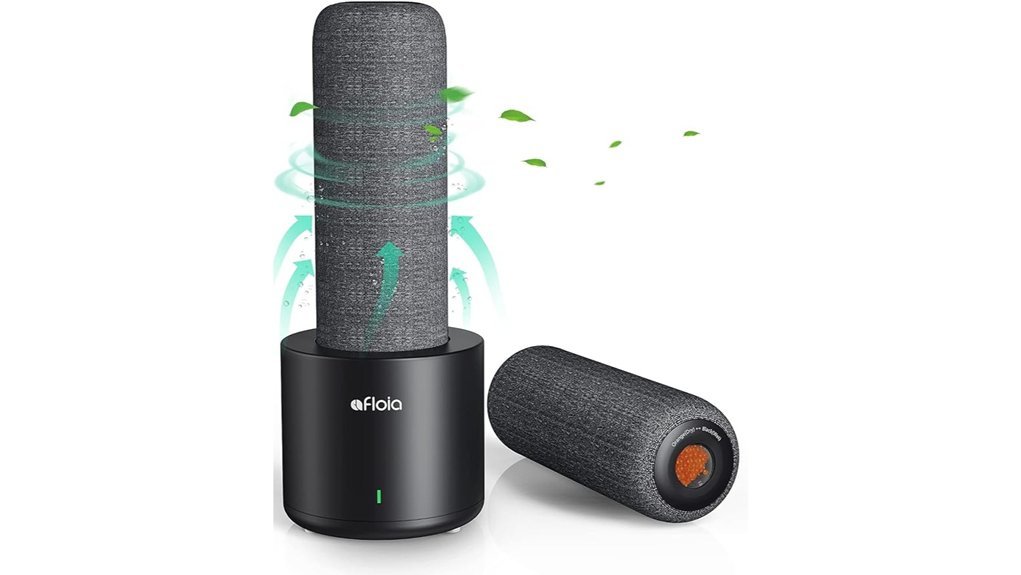
Best cordless set with a dedicated renewal base. The Afloia TOP-Z is designed for gradual moisture control in enclosed areas such as RV cabinets, wardrobes, luggage, storage compartments, bookcases, and vehicle trunks. It uses a silica-bead desiccant and remains cordless and silent during the moisture-absorption phase.
The linked model is marketed as a TOP-Z 2+1 configuration. Because package contents can change, confirm the number of absorber units and heating bases shown on the current Amazon listing before ordering. When the indicator shows that an absorber is saturated, it is placed on the powered base for renewal. Afloia currently describes a typical renewal time of approximately one to two hours.
Why you’ll like it: The separate base provides a simpler renewal process than microwave-heated bags, while the absorber itself remains cordless during use.
Who should buy it: RV travelers, boat owners, or road-trippers who want reusable absorbers for one or more small compartments and have space to carry the heating base.
Who should avoid it: Ultralight travelers may find the base unnecessarily bulky, and the passive absorber will not keep up with a steamy bathroom or persistently damp room.
Pros:
- Cordless during use: No outlet or battery is needed while it absorbs moisture.
- Dedicated heating base: Avoids the need to place the absorber in a microwave.
- Color-changing indicator: Makes it easier to judge when renewal is needed.
- Silent operation: Suitable for cabinets and sleeping areas where fan noise would be distracting.
Cons:
- Small-space only: Intended for enclosed compartments rather than full rooms.
- Extra packing bulk: The heating base and its power connection must travel with you if renewal will be needed.
- Package variation: Buyers should verify the current 2+1 contents before purchasing.
Zarpax LV-A300 Reusable Car Dehumidifier
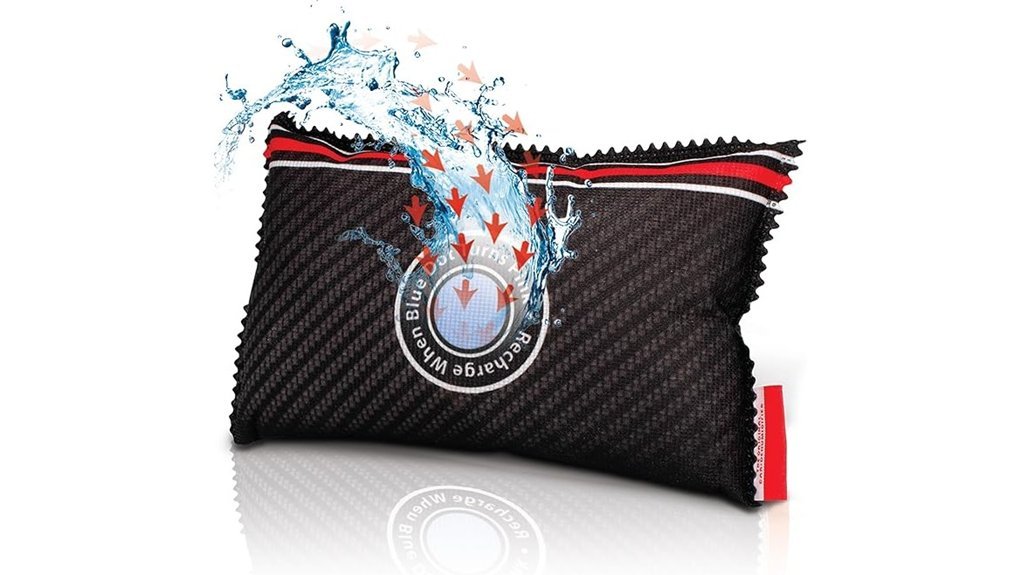
Best for cars, trucks, vans, and RV cabs. The Zarpax LV-A300 is a reusable car dehumidifier designed to absorb moisture that collects after wet-weather driving, temperature changes, damp clothing, or carrying wet outdoor gear. It works without wires or batteries and includes an indicator that shows when renewal is needed.
Zarpax describes the LV-A300 as microwave-renewable. Follow the instructions supplied with the exact bag, use the specified power level and heating cycle, and let the bag cool completely before returning it to the vehicle. Do not continue heating a damaged, contaminated, or incorrectly functioning bag.
Place the absorber where it cannot slide under the pedals, block an air vent, interfere with controls, obstruct an airbag, or become a projectile during sudden braking.
Why you’ll like it: It is compact, reusable, designed specifically for vehicle interiors, and does not contain a liquid collection tank.
Who should buy it: Drivers who regularly deal with light condensation, damp floor mats, wet-weather gear, or musty odors in a parked vehicle.
Who should avoid it: It cannot instantly clear a fogged windshield, remove standing water, or solve an active leak. Use the vehicle’s defogger, heater, air conditioning, and ventilation whenever immediate visibility is required.
Pros:
- Vehicle-focused design: Made for cars, trucks, vans, and similar interiors.
- No operating power: Absorbs moisture passively between renewal cycles.
- Moisture indicator: Shows when the bag is ready to be renewed.
- Reusable construction: Does not require disposable refills during normal use.
Cons:
- May need frequent renewal during very damp weather.
- Not powerful enough for active water intrusion or a large, continuously occupied cabin.
- Microwave instructions must be followed carefully to prevent damage.
Eva-Dry Wireless Mini Dehumidifier E-333
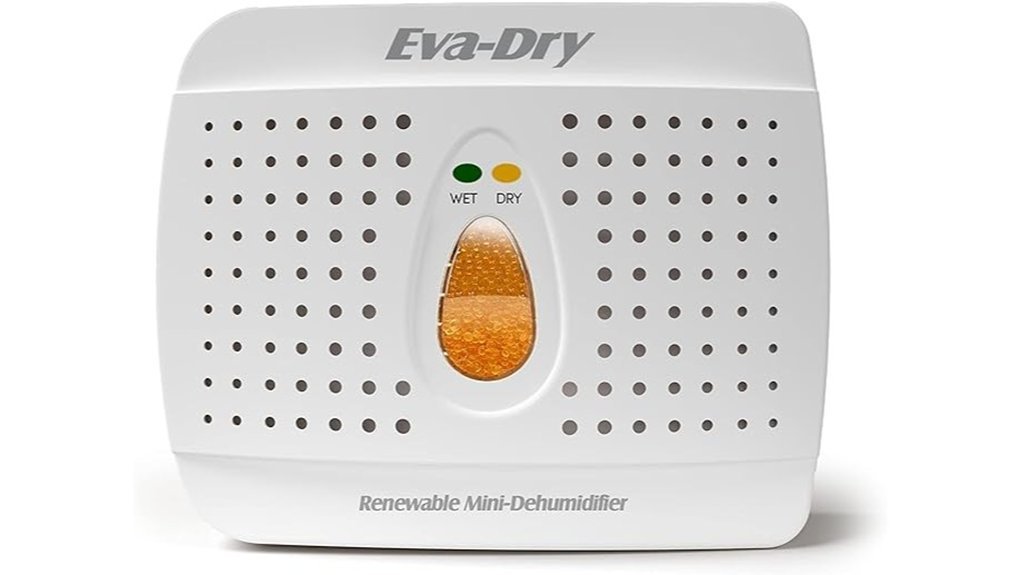
Best silent option for closets and cabinets. The Eva-Dry E-333 is a renewable silica-gel unit designed for enclosed spaces of up to approximately 333 cubic feet. Manufacturer documentation states that it absorbs about four to six ounces of moisture before renewal, making it useful in wardrobes, cabinets, safes, boats, and RV storage compartments.
The E-333 needs no cord or battery while absorbing moisture. When its indicator changes from the dry color to the saturated color, the unit plugs into an outlet for approximately 10–12 hours to release the collected moisture as vapor. Renew it in a dry, well-ventilated area rather than inside the damp space you are trying to protect.
The unit becomes warm during renewal. Keep it upright and uncovered, follow the manufacturer’s placement instructions, and keep it away from children, pets, fabrics, and luggage until it has cooled. Eva-Dry lists a five-year limited warranty, but buyers should check the current warranty terms and registration requirements.
Why you’ll like it: It is compact, spill-free, silent, reusable, and does not require a separate heating base.
Who should buy it: Travelers who need reliable moisture control in a closet, cabinet, safe, boat compartment, or RV storage area and have access to an outlet when renewal is required.
Who should avoid it: Buyers expecting fast moisture removal from an occupied hotel room, bathroom, or bedroom should choose an active tank-style unit.
Pros:
- Cordless absorption: Needs no power during normal use.
- Four-to-six-ounce capacity: Provides more verified absorption capacity than many small desiccant packs.
- Color indicator: Shows when renewal is required.
- Five-year limited warranty: Longer published warranty coverage than many compact alternatives.
Cons:
- Designed for enclosed cubic-foot spaces, not an entire room.
- Renewal takes approximately 10–12 hours.
- The body becomes warm while plugged in and must cool before repacking.
CLEVAST CL-DH04 Mini Quiet Dehumidifier
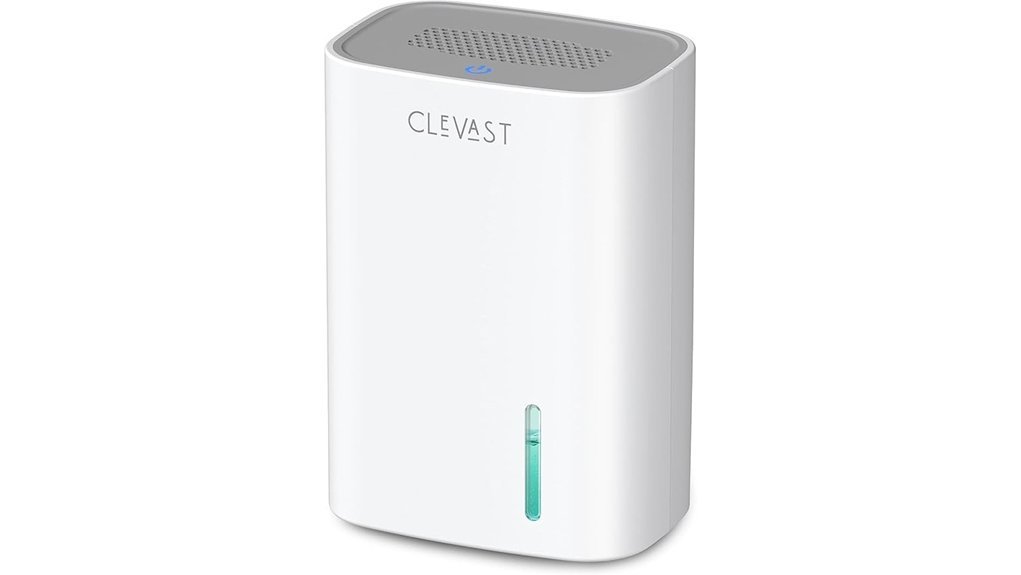
Best compact powered pick. The CLEVAST CL-DH04 is a small thermoelectric dehumidifier for travelers who have access to a standard 120V outlet and want active water collection. It weighs approximately 2.1 pounds, has a 30-ounce removable tank, includes a built-in handle, and shuts off automatically when the tank is full.
The advertised extraction rate is up to approximately 10 ounces per day at 86°F and 85% relative humidity. Real-world collection will normally be lower in cooler rooms, at moderate humidity levels, or when doors and windows remain open. The claimed coverage of up to 285 square feet should therefore be treated as a maximum placement guideline, not a promise that this mini unit will control serious dampness throughout a room of that size.
The CL-DH04 has efficient and quiet operating modes. The quiet-mode claim is approximately 24 dB under specified conditions, while the documented operating range is approximately 68°F to 86°F. Leave adequate clearance around the air intake and outlet, and place the unit on a flat, stable surface.
Why you’ll like it: It combines a compact footprint, two operating modes, a removable tank, automatic shutoff, and active collection in a travel-friendly body.
Who should buy it: Road-trippers, RV travelers, or hotel guests who need more moisture removal than a passive desiccant can provide and expect warm, humid conditions.
Who should avoid it: It is not suitable for luggage, cordless use, cold spaces, severe water intrusion, or destinations where the available voltage is incompatible.
Pros:
- Active collection: Can remove more water than a small passive absorber under suitable conditions.
- Two modes: Offers efficient and quieter operation settings.
- 30-ounce tank: Provides more holding capacity than the EDV-1100.
- Auto shutoff: Stops operation when the tank reaches its full level.
Cons:
- Requires continuous 120V AC power while operating.
- Performance drops outside warm, highly humid test conditions.
- The tank must be removed, emptied, and cleaned manually.
- The 285-square-foot figure may create unrealistic expectations in very damp rooms.
Eva-Dry EDV-1100 Petite Electric Dehumidifier
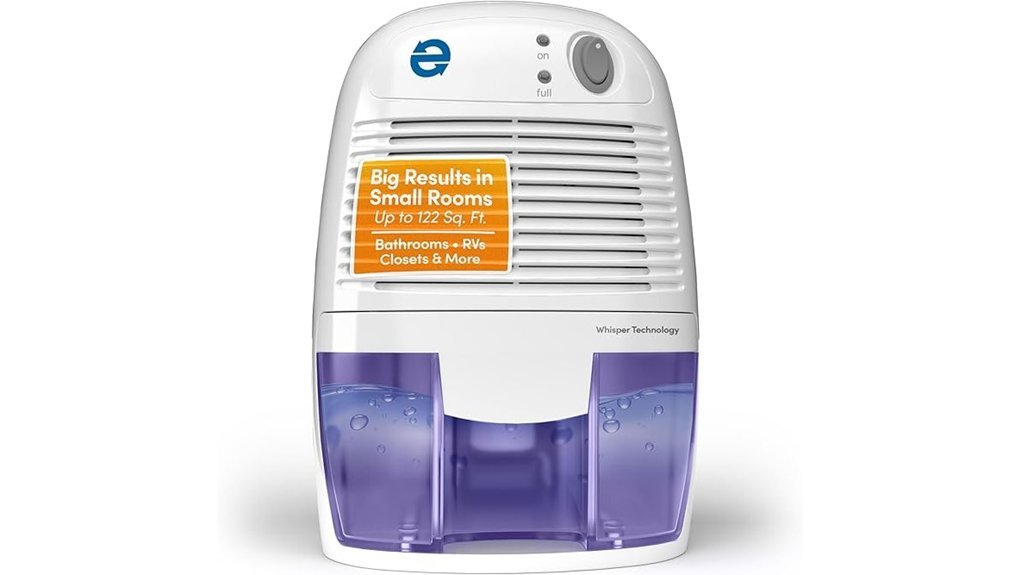
Best powered option for an RV or compact room. The Eva-Dry EDV-1100 is a petite thermoelectric dehumidifier with a 16-ounce removable reservoir and automatic full-tank shutoff. Manufacturer documentation lists moisture collection of approximately eight ounces per day at 86°F and 80% relative humidity.
The manual specifies an operating environment above approximately 59°F and 40% relative humidity. As with other Peltier dehumidifiers, collection will usually be slower in cooler or less humid spaces. Eva-Dry currently lists power use at about 22 watts, a noise level of approximately 33 dB, and a coverage guideline of up to 1,100 cubic feet.
The standard setup operates on 110–120V household power. Eva-Dry offers an optional 12V vehicle power cord for compatible RV, boat, vehicle, or camping setups, but that accessory may be sold separately. Confirm the current package contents and voltage before purchasing, especially for international travel.
Why you’ll like it: It provides active moisture collection in a compact body and can suit longer RV, boat, or hotel stays where reliable power is available.
Who should buy it: Travelers who want a small, continuously operating unit for a bathroom, RV, boat cabin, office, or compact room and do not need a large reservoir.
Who should avoid it: It is bulkier than a passive absorber, has a relatively small tank, and is not a practical suitcase option for travelers without reliable power.
Pros:
- Compact powered design: Suitable for smaller occupied spaces.
- Verified test-condition output: Approximately eight ounces per day at 86°F and 80% relative humidity.
- Automatic shutoff: Stops when the 16-ounce reservoir is full.
- Optional 12V compatibility: May be useful in compatible RV and vehicle setups.
Cons:
- The optional 12V power cord may not be included.
- Standard operation is limited to 110–120V power.
- Moisture-removal performance depends heavily on temperature and humidity.
- No continuous drain hose is provided, so the tank must be emptied manually.
Factors to Consider When Choosing a Travel Dehumidifier
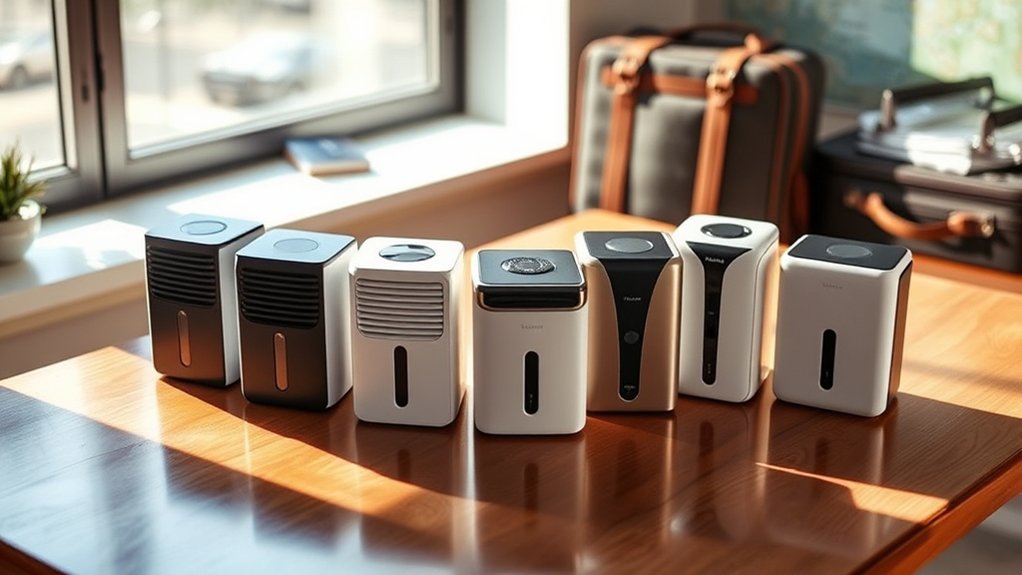
A travel dehumidifier should match the size and type of space, the available power source, the expected temperature, and the amount of moisture you need to manage. A passive silica-gel unit is usually enough for luggage or a cabinet. A powered thermoelectric unit makes more sense for a warm, humid room or RV when you can keep it plugged in and empty its tank.
Passive vs. Powered Models
Passive desiccant units are silent and cordless while absorbing moisture. They are best for enclosed areas where moisture builds gradually, including suitcases, drawers, cabinets, safes, and parked vehicles.
Powered thermoelectric units use a fan and a cooled surface to condense water into a tank. They can collect more moisture, but they require electricity, ventilation clearance, suitable temperatures, and regular tank emptying. They are generally more practical for road trips, RVs, boats, and longer hotel stays than for air travel.
Size and Portability
Check the packed dimensions and total weight of every component, including a heating base, AC adapter, power cord, or optional vehicle cable. Slim silica-gel bags are easiest to carry in luggage. A powered mini dehumidifier may be movable, but its tank, power supply, and ventilation requirements make it less convenient inside a suitcase.
Moisture Absorption and Collection Capacity
Passive and powered products report capacity differently. Passive models usually state how much moisture they can hold before renewal. Powered models normally state how much water they may collect per day under specific temperature and humidity conditions.
Do not compare these numbers directly. A daily extraction figure measured at 86°F and very high relative humidity will not represent performance in a cool, mildly humid room. Collection also falls when a space is open to outside air, larger than recommended, or poorly positioned around the unit.
Cubic Feet vs. Square Feet
Renewable desiccant products such as the Eva-Dry E-333 are often rated in cubic feet because they are designed for enclosed storage volumes. Powered units may be advertised using square feet, but floor area alone does not account for ceiling height, airflow, moisture sources, room temperature, or how often doors are opened.
Treat every coverage number as a placement guideline. A mini dehumidifier with a high advertised room-size figure can still be overwhelmed by a leak, wet building materials, an unvented shower, or a persistently damp basement.
Power and Voltage Compatibility
For international travel, check both the input voltage and plug type before buying. A plug adapter changes the shape of a plug but does not convert voltage. The CLEVAST CL-DH04 documentation specifies a standard 120V outlet, while the Eva-Dry EDV-1100 is listed for 110–120V operation.
Also confirm whether a 12V vehicle cord is included, optional, or unavailable. Never connect a product to a power source that falls outside the range printed on its label or adapter.
Renewal Method
Rechargeable silica-gel products may use a microwave, wall outlet, or dedicated heating base. These methods are not interchangeable. Follow the instructions supplied with the exact model, use the stated heating time and power level, and stop using any product that is torn, leaking, scorched, swollen, or otherwise damaged.
Allow a renewed absorber to cool completely before placing it near clothing, upholstery, documents, children, pets, or other belongings. Do not seal a hot absorber inside luggage.
Noise Level During Operation
Passive models make no operational noise. Powered thermoelectric models are usually quieter than compressor dehumidifiers, but their fans remain audible in a silent bedroom. Treat decibel claims as test-condition figures and choose a model with a quiet mode if it will be used beside a bed.
Cleaning and Maintenance
Empty a powered unit before moving or packing it. Clean the reservoir with mild soap and water as directed by the manufacturer, rinse it thoroughly, and let it dry before storage. Keep dust and lint away from the air inlet and outlet, but unplug the unit before cleaning.
Do not drink collected water or give it to a pet. It may contain dust, microorganisms, or residue collected from the surrounding air and tank.
Safety Features
For powered models, look for full-tank automatic shutoff, overheat protection, a stable base, and clear operating-temperature guidance. Keep air openings unobstructed and do not operate the unit on bedding, deep carpet, or another surface that could block ventilation.
In cars and RVs, secure every absorber or appliance so it cannot interfere with pedals, controls, vents, airbags, or visibility. During renewal, keep heated units and bags away from children, pets, fabrics, and enclosed luggage until fully cooled.
- Are you protecting belongings in an enclosed space or reducing humidity in a living area?
- Will you have a compatible outlet, microwave, or renewal base?
- Can you carry every adapter, base, and cable the product requires?
- Will the operating temperature be warm enough for a thermoelectric model?
- Can you safely empty, clean, renew, and cool the product during the trip?
- Does the current listing include every accessory you need?
Frequently Asked Questions
How Do Travel Dehumidifiers Help Protect Belongings?
They absorb or collect excess moisture around clothing, documents, electronics accessories, tools, and other stored belongings. This can make a small enclosed space feel less damp and may help reduce musty odors. A mini dehumidifier does not filter airborne particles, remove existing mold, repair water damage, or solve a leak.
Can I Use a Travel Dehumidifier in My Car?
Yes. A passive car dehumidifier bag can absorb moisture between drives, especially after wet weather or when damp gear has been carried in the vehicle. Secure it away from pedals, steering controls, vents, airbags, and moving parts. Use the vehicle’s defogger and climate-control system whenever immediate windshield visibility is required.
Can a Mini Dehumidifier Dry a Hotel Room?
A powered mini unit may collect some moisture in a small hotel room, particularly when the room is warm and humid. It should not be expected to solve severe dampness, active leaks, or moisture across a large room. Passive silica-gel products are better for a suitcase, wardrobe, drawer, or cabinet than for the room itself.
Should I Choose a Passive or Powered Travel Dehumidifier?
Choose a passive model for luggage, cabinets, safes, storage bins, or a parked vehicle. Choose a powered model for a small occupied room, bathroom, camper, or boat cabin where compatible electricity is available and you can empty the water tank. Passive products are easier to pack, while powered products normally collect more water.
How Long Does a Travel Dehumidifier Last?
There is no single lifespan for every model. Reusable silica-gel products can lose effectiveness after repeated renewal cycles or improper heating. Powered units depend on the condition of their fan, Peltier module, electronics, power adapter, reservoir, and shutoff sensor. Follow the manufacturer’s cleaning, renewal, warranty, and replacement guidance for the exact product.
Are Travel Dehumidifiers Safe Around Pets?
Do not assume every model is safe for unsupervised pet access. Keep the unit, cord, silica-gel indicator, collected water, and heated surfaces out of reach. Recharge renewable products in a ventilated area where a pet cannot touch or chew them, and discontinue use if the housing or bag is damaged.
Do Travel Dehumidifiers Use Much Energy?
Passive silica-gel models use no electricity while absorbing moisture, although energy is required during renewal. Powered thermoelectric models generally use less electricity than full-size compressor dehumidifiers, but they may run continuously. Check the wattage, expected runtime, voltage, and local electricity system before traveling.
Can I Pack a Travel Dehumidifier for a Flight?
A dry passive silica-gel unit is generally easier to pack than a powered model because it has no water tank, fan, or loose power adapter. Pack the product so it cannot be punctured or damaged, and never pack it while hot from renewal. Airline and airport rules can change, so check the current baggage requirements for your carrier, especially if a device contains a battery, heating component, unusual liquid, or detachable electrical accessory.
Can I Use a Plug Adapter With a Powered Dehumidifier?
Only when the product’s input-voltage range already supports the destination’s electrical system. A plug adapter changes the plug shape but does not convert voltage. If the destination voltage falls outside the range printed on the product or power supply, do not connect it without an appropriate manufacturer-approved solution.
Conclusion
For most travelers, the best choice is a compact passive unit matched to a specific enclosed space. Choose the FURWEY two-pack for luggage and storage bins, the Zarpax LV-A300 for vehicle moisture, or the Eva-Dry E-333 for a closet, safe, boat compartment, or RV cabinet. The Afloia TOP-Z is a useful alternative when you prefer a dedicated renewal base and can accommodate the additional packing bulk.
Choose the CLEVAST CL-DH04 or Eva-Dry EDV-1100 when you need active water collection and have reliable, compatible power. The CLEVAST offers the larger tank, while the EDV-1100 provides a compact design and optional 12V compatibility for certain vehicle and RV setups.
For the easiest general travel option, select a passive absorber that fits the exact suitcase, cabinet, or vehicle area you need to protect. Move up to a powered model only when the space itself feels humid and you can meet its voltage, temperature, ventilation, and tank-maintenance requirements.
Whichever model you choose, verify the current package contents, renewal method, voltage, and safety instructions before your trip. Small travel dehumidifiers can protect belongings and manage light dampness, but they are not replacements for ventilation, safe windshield defogging, leak repair, mold remediation, or a correctly sized full-room dehumidifier.