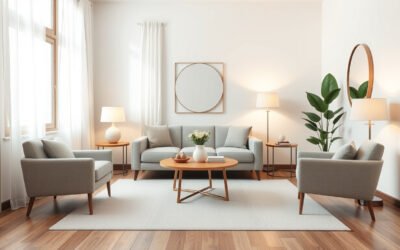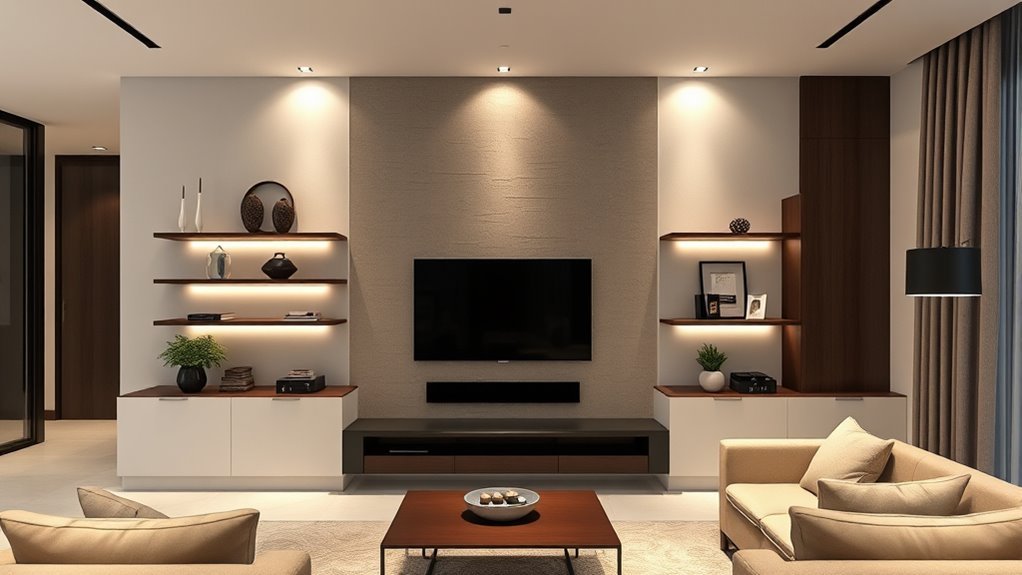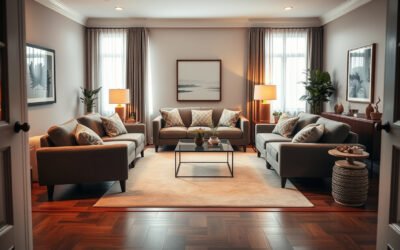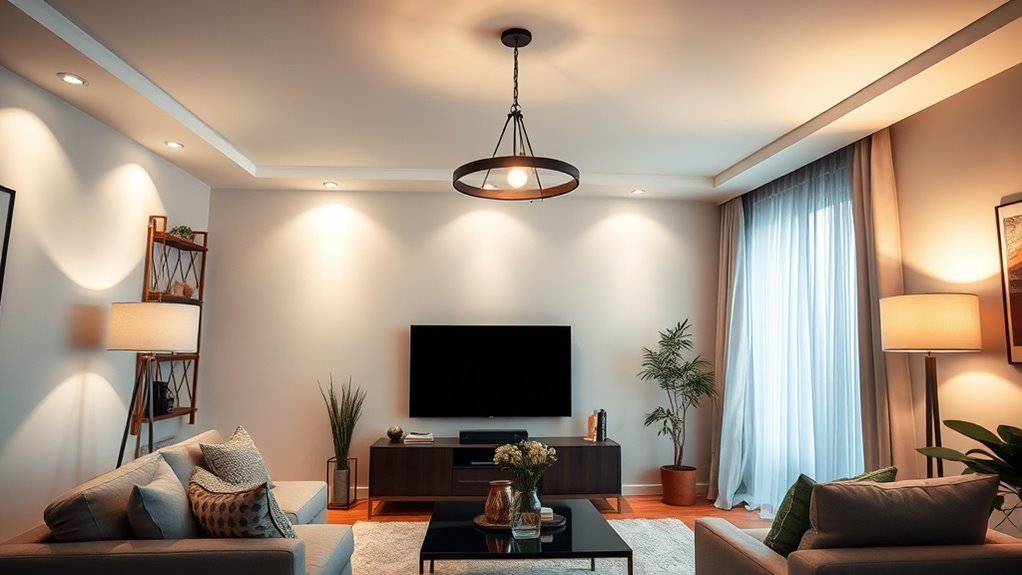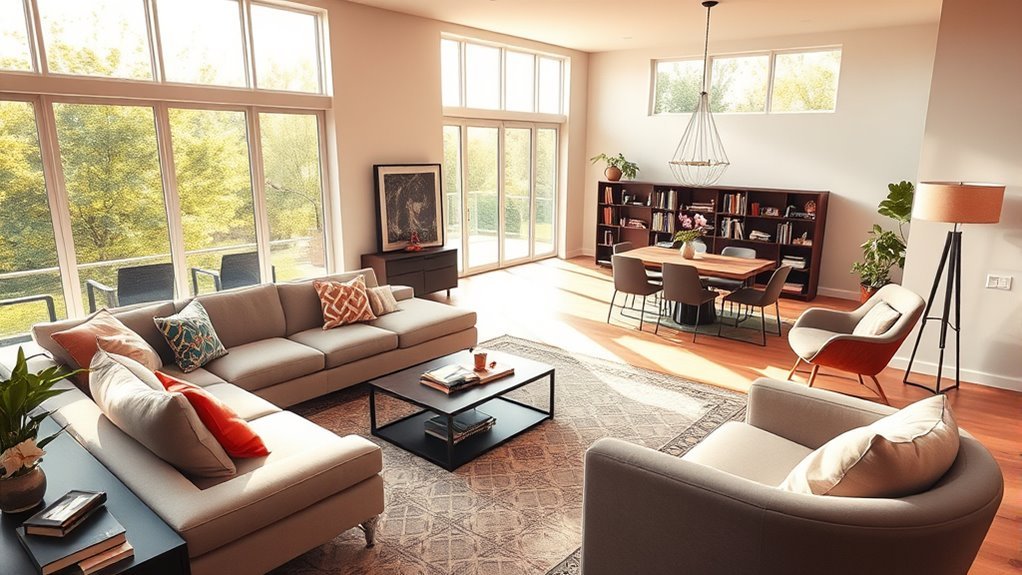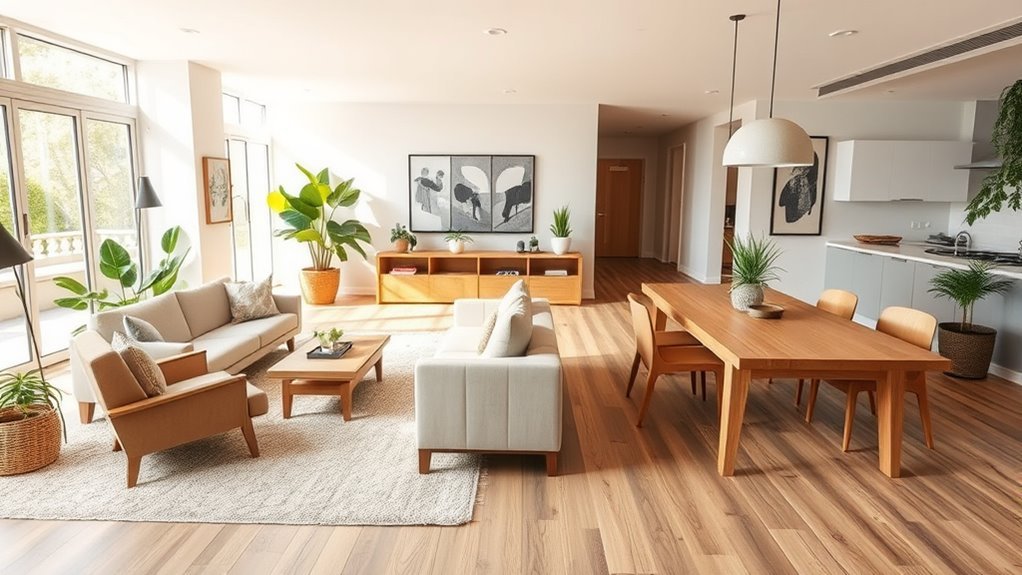
An open concept living room gives you daylight and spacious sightlines, but without walls, furniture can easily float like disconnected islands while kitchen clatter echoes into your seating area. Zoning solves this by dividing one large shell into purposeful areas for lounging, dining, working, and storage. By pairing exact clearance measurements with visual boundaries, you can give every activity its own home without sacrificing openness.
Quick Answer
To zone an open concept living room, limit the space to three or four functions, float your largest seating pieces to form soft boundaries, and anchor each area with a properly sized rug and dedicated light fixture. Maintain 30- to 36-inch walkways between zones and repeat two or three colors and finishes for flow.
At a Glance
| Time Required | 1 to 3 hours for measuring, taping, and rearranging; longer if adding rugs, lighting, or storage |
| Difficulty | Easy to moderate |
| Tools Needed | Tape measure, blue painter’s tape, floor plan sketch, non-slip rug pads, lamps, cord covers, storage baskets |
| Cost | $0 if rearranging existing pieces; $50 to $500+ if adding rugs, lamps, shelving, or dividers |
What Is Zoning in an Open Concept Living Room?
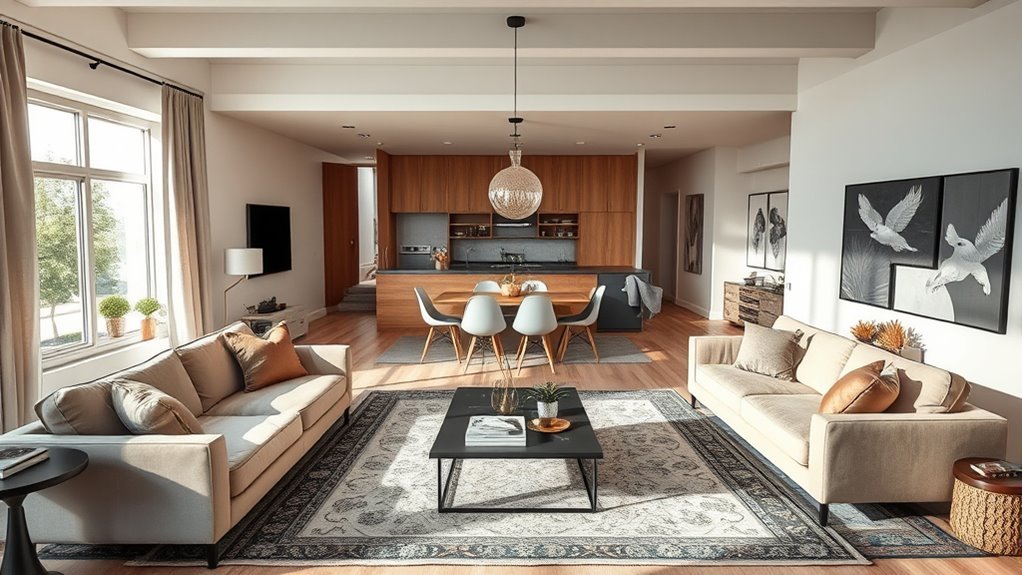
Zoning in an open concept living room is the practice of organizing one large, wall-free floor plan into smaller functional areas using visual and physical cues. Instead of building partitions, you rely on furniture backs, area rugs, lighting layers, and millwork to show where one activity ends and the next begins.
The goal is not to chop up the room or block daylight. Good zoning gives every square foot a clear assignment so family members and guests immediately know where to sit, walk, dine, read, or set down their keys.
When each area has a defined boundary and focal point, a quiet reading corner, a central conversation pit, and a dining area near the kitchen can operate at the same time without visual chaos.
Why Is Zoning Important for Open Layouts?
Zoning prevents a large open floor plan from feeling like an echoing furniture warehouse. Without defined zones, seating groups drift too far apart, foot traffic cuts straight across the television view, and daily clutter spreads across every surface.
Enhanced Functionality and Flow
Assigning specific footprints to each activity stops different household routines from colliding. Rather than expecting one oversized room to handle everything at once, each zone is sized and lit for its exact job.
Use the target benchmarks below to plan the core zones in your layout:
| Zone Type | Primary Anchor | Key Clearance or Sizing Rule | Target Lighting |
|---|---|---|---|
| Main Lounge & TV | Sofa or sectional + 8×10 ft or 9×12 ft rug | 14–18 in. sofa to coffee table; seats within 8–9 ft for conversation | 10–20 lumens/sq. ft. (warm 2700K–3000K) |
| Dining Area | Dining table + centered pendant or chandelier | 36 in. behind chairs for walkways; rug extends 24–30 in. past table edges | 30–40 lumens/sq. ft. on a dimmer switch |
| Work or Study Nook | Desk (48–60 in. wide) + ergonomic chair | 36–48 in. behind desk for chair pushback | 50–70 lumens/sq. ft. (neutral 3500K–4000K task lamp) |
| Reading Corner | Accent armchair + 4×6 ft or 5×8 ft rug | Side table within 12 in. of chair arm | 400–800 lumen directional floor or reading lamp |
| Storage & Drop Zone | Console table, bench, or low credenza | 12–16 in. deep cabinet to keep 36 in. walkway clear | Accent lamp or wall sconce (2700K) |
Clear Activity Differentiation
A shared living space often has to handle TV watching, dinner hosting, homework, remote work, and kids’ play in the same afternoon. Distinct boundaries keep these activities from spilling into one another.
For example, placing a 14-inch-deep console table behind a floating sofa marks the edge of the lounge area and creates a natural corridor or desk spot behind it. A low, backless bookcase separates a reading chair from the dining table while allowing daylight to pass right through. Hanging a pendant 30 to 36 inches above the dining tabletop makes the table feel like an intimate room of its own.
Improved Visual Harmony
Zoning also solves two of the biggest complaints in open layouts: visual clutter and noise reverberation. Grouping furniture tightly around anchors creates intentional negative space—the empty floor that lets the eye rest.
- Tighten seating clusters: Keep sofas and chairs within 8 to 9 feet of one another so conversations feel natural and the grouping reads as one unit.
- Scale rugs to the furniture footprint: Connect all main seating pieces on a single large rug rather than scattering small mats.
- Absorb sound across zones: Hard floors and bare walls bounce noise between the kitchen and television area. According to U.S. General Services Administration indoor acoustics guidance, soft floor finishes, lined drapery, upholstered seating, and filled bookshelves help halt sound reverberation in open areas.
- Unify hardware and wood tones: Repeat at least one wood species and one metal finish in every zone so the room looks curated from every angle.
Essential Elements for Zoning Your Open Concept Living Room
Every successful open-plan layout relies on five building blocks: anchors, boundaries, pathways, layered lighting, and material repetition. Before moving heavy furniture, rank the activities your room must support and build each zone using these core elements.
- Anchors: Area rugs, coffee tables, dining tables, ceiling pendants, and fireplace walls give each zone an unmistakable center of gravity.
- Soft boundaries: Sofa backs, L-shaped sectionals, console tables, low open shelving, folding screens, and tall indoor plants divide floor space while keeping sightlines above waist level open.
- Pathways: Dedicate clear circulation lanes that route foot traffic around seating clusters rather than between the sofa and the TV. A 30-inch gap works between smaller accent pieces, while main thoroughfares need 36 inches.
- Layered lighting: Combine whole-room illumination with focused task lamps and decorative highlights. The U.S. Department of Energy defines these core layers as ambient, task, and accent lighting in its guide to lighting principles and terms.
- Repetition: Carry two or three colors, textures, or metal finishes across every zone so the individual areas still belong to the same room.
Note: While private homes do not have to follow commercial building codes, planning main walkways with the U.S. Access Board’s 36-inch minimum clear width for accessible routes makes your layout far easier to navigate for guests carrying trays, children, pets, strollers, and mobility aids.
Recommended Products

Privacy & Blackout: AJAZZ room divider curtain 100 % blackout curtains, studio or office into an instant private zone without drilling walls.


Decorative Arched Room Divider : This arched room divider combines a Shoji screen look with diamond wood accents, making it useful as a privacy screen and decorative accent for living rooms, bedrooms, or apartment corners
Step-by-Step: How to Zone an Open Concept Living Room
To zone an open concept living room effectively, plan your floor footprint and traffic lanes before choosing decor. Follow these five steps in order to establish structure, scale, and visual flow.
1. Map Your Main Activities
Write down every activity that happens in your shared living space, then narrow your list to the top three or four priorities. Trying to squeeze five or six zones into an average 300- to 500-square-foot room leaves no room for walkways.
Common zone combinations include:
- Main conversation and media lounge
- Dining area adjacent to the kitchen
- Compact work-from-home or homework desk
- Quiet reading corner or music nook
- Kids’ play zone with low closed storage
- Entryway drop zone for coats, shoes, and bags
2. Place the Largest Furniture First
Position your sofa, sectional, dining table, and media console first because their footprints dictate the rest of the room. Resist the urge to push every piece flat against the perimeter walls, which leaves an awkward empty dance floor in the middle.
Instead, float your sofa or sectional 3 to 5 feet inside the room with its back toward the dining area or kitchen island. For a 4K television, set your primary seating at 1.2 to 1.6 times the screen diagonal—roughly 6.5 to 8.5 feet away for a 65-inch TV—and center the screen near seated eye level (about 42 inches off the floor).
3. Anchor Each Zone
Give every zone a floor anchor and a vertical focal point so no furniture piece looks stranded. In the living zone, pair an 8×10 or 9×12-foot area rug with a coffee table placed 14 to 18 inches from the sofa seat.
In the dining zone, center a chandelier or pendant fixture 30 to 36 inches above the tabletop. In a reading nook, group an armchair, a small side table, and a floor lamp on a smaller rug or beside a tall bookcase.
4. Check the Walkways
Outline proposed furniture and rug dimensions on the floor with blue painter’s tape and test your daily routes. Walk from the entryway to the kitchen and from the kitchen to the sofa while imagining someone else is already seated.
Verify that you have 30 to 36 inches of clear passage along main paths and at least 36 inches behind dining chairs so people can walk past while diners are seated. If you hip-check a table corner during the tape test, shift the zone or swap in a narrower piece now.
5. Repeat Materials for Cohesion
Tie your newly separated zones together by echoing materials across the room. Follow the classic 60-30-10 proportion rule: use one dominant neutral across 60% of the space (walls and large rugs), a secondary color across 30% (upholstery and drapery), and an accent color across 10% (pillows, art, and accessories).
Repeat physical finishes too, such as pairing matte black dining pendant hardware with black picture frames in the office nook and a black floor lamp by the sofa.
How to Use Area Rugs for Zoning Your Space
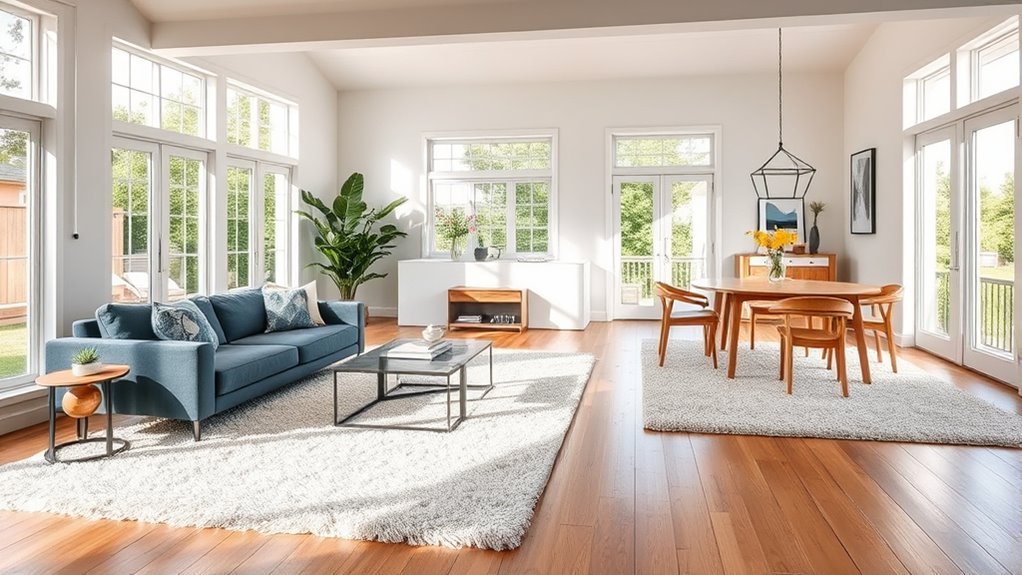
Area rugs act as instant floor plans in an open concept living room, framing each furniture grouping without blocking a single inch of sightline or daylight. The right rug size pulls seating inward and absorbs footstep noise across hard flooring.
Use these sizing and placement rules so your rugs look proportional:
- Size up for the living zone: An 8×10-foot rug fits most standard 84-inch sofas, while sectionals over 100 inches usually require a 9×12 or 10×14-foot rug. Place at least the front 8 to 12 inches of the sofa and accent chairs on the rug, and let the rug extend 12 to 18 inches past each end of the sofa.
- Add chair-pull clearance under dining tables: Measure your dining tabletop and add 24 to 30 inches on all sides so chair legs stay on the rug when pulled out. A standard 6-person rectangular table (36×72 inches) needs at least an 8×10-foot rug.
- Match pile to the zone’s workload: Choose plush wool or high-pile weaves for acoustic comfort in the lounge zone, and stick to flat-weave, sisal-look, or washable low-pile rugs under dining chairs and rolling office chairs.
- Leave bare floor borders: Keep 12 to 18 inches of exposed flooring between different area rugs and along perimeter walls so each zone has a clean frame.
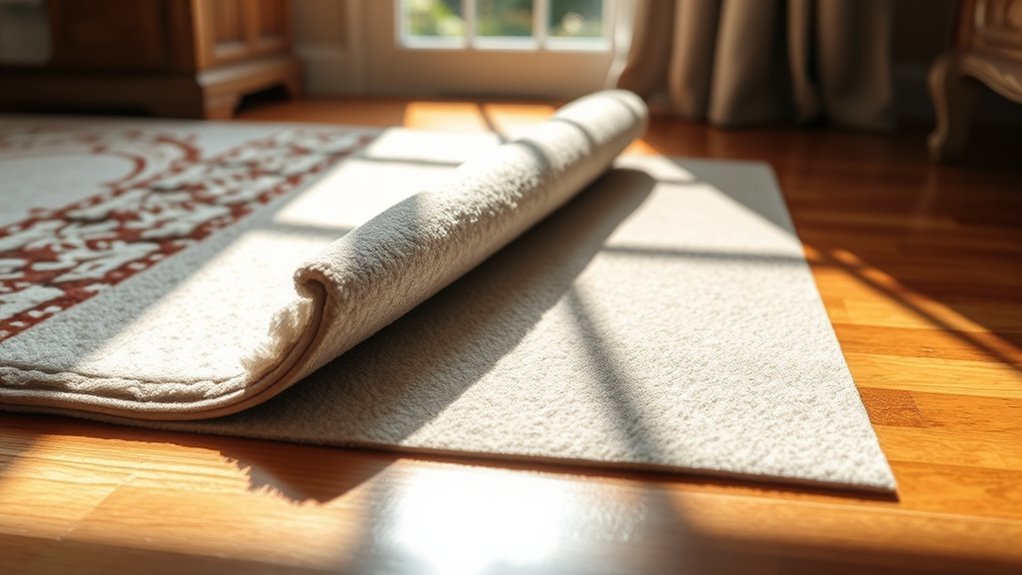
- Anchor with a rug pad: Place a felt-and-rubber pad sized 1 inch smaller than the rug perimeter underneath to stop curling corners in walkways and boost sound absorption.
Pro Tip: When placing two rugs side by side in an open room, pair one patterned statement rug in the lounge with a solid textured neutral (like braided wool or flat-weave jute) under the dining table. If both rugs are patterned, pick one large-scale geometric design and one small-scale motif in the same color family so they never compete.
Recommended Products

Machine Washable Area Rugs: Our living room rug, one of the 8x10 area rugs, surfaces is resistant to stains and dirt, and can be easily cleaned with a rag or vacuum cleaner; for deep cleaning, use a washing machine

Machine Washable & Easy to Clean: The surface features water-repellent performance for simple cleanup when drinks spill accidentally, reducing the chance of liquid soaking deep into fibers. You can wipe spills quickly with a towel, remove local stains via spot cleaning with a damp cloth, or regularly vacuum for daily upkeep. The whole rug supports machine washing for deeper cleaning

Ultra Soft & Non-slip: Featuring a shaggy carpet surface, the Ophanie soft area rug is highly soft with a high-density sponge interlayer. This rug effectively reduces shedding, and the non-slip bottom with small, durable anti-slip dots enhances friction to prevent sliding.
Using Creative Furniture Arrangements to Define Distinct Areas
Strategic furniture placement builds waist-high architectural lines that organize an open room without closing it in. Turning the back of a sofa, sectional, or pair of armchairs toward an adjacent zone creates an unmistakable boundary while preserving open views across the top.
Try these proven layout configurations:
- The floating sofa and console bridge: Pull your sofa away from the wall and tuck a narrow console table (12 to 15 inches deep and 1 to 2 inches shorter than the sofa back) right behind it. Top the console with a low lamp and tucked stools to bridge the lounge and walkway.
- Back-to-back sofas in long rooms: In a long rectangular great room, place two sofas back-to-back in the center—one facing the fireplace for quiet conversation and the other facing the media wall.
- Swivel chairs as flexible connectors: Place a pair of swivel armchairs between the living and dining zones so guests can face the sofa during conversation and turn toward the rest of the room when entertaining a crowd.
- Open-back shelving dividers: Position a low cubby bookcase (30 to 42 inches tall) perpendicular to a wall to shield a desk or play area while letting natural light filter through.
Warning: Never leave a tall, narrow bookcase free-standing in the middle of a walkway where children, pets, or guests can bump or climb it. Follow U.S. Consumer Product Safety Commission Anchor It! guidance by securing shelving units to wall studs at the perpendicular wall end, or choose wide-base, low-profile credenzas (under 36 inches high) tested to the ASTM F2057 stability standard when floating storage behind a sofa.
Recommended Products

3-Tier Storage Spaces console table: The 3-tier narrow console table includes 2 dense mesh shelves and 2 spacious non-woven fabric drawers below the wooden tabletop. 2-tier open shelf design allows you to place books, vases, DVDs, storage boxes, etc. assuring your desktop is more tidy and satisfying your various needs

Fusion That Delights: From the BELLAH Collection, this console table fuses steel, engineered wood, and non-woven fabric for a perfect blend of strength, softness, and storage. Pair it with chest of drawers for a cohesive space that feels just right

Farmhouse Flair: This entertainment center features a wood-look finish, charming barn doors, and sleek metal knobs, creating a cozy and inviting atmosphere in your living space
How Color Can Help Define Your Open Spaces
Color defines open spaces best when it shifts gradually in tone or placement rather than chopping continuous walls into contrasting paint blocks. A cohesive palette lets you highlight individual zones while keeping the overall architecture calm and spacious.
Choose a Connected Color Palette
Keep one continuous wall color across the shared envelope of the room—representing the 60% foundation of the 60-30-10 rule—and vary how your 30% secondary and 10% accent shades appear in each zone.
For instance, if warm alabaster covers the main walls, you might use sage green on the living room throw pillows, hang large sage-and-ochre artwork beside the dining table, and paint a built-in desk alcove in a muted olive tone.
Use Bold Accent Shades Carefully
Bold accent shades work best inside recessed architectural pockets rather than along a flat, uninterrupted drywall run. Painting the back wall of built-in bookcases, a recessed window seat, or a painted arch behind a floating desk carves out a clear focal point.
If your walls have no natural stopping point, introduce bold color through movable boundaries instead: an indigo velvet armchair in the reading corner, terracotta dining chairs, or a patterned folding screen.
Use Subtle Hue Variations
Shifting paint Undertones by just one or two steps on the same paint strip—or changing surface textures from matte plaster to fluted wood—creates quiet separation without visual clutter. Lighting color temperature also changes how both wall colors and room comfort feel.
A controlled *PLOS ONE* study on the hue-heat effect found that warm vs. cool illumination shifts perceived room temperature by 2°C to 3°C (3.6°F to 5.4°F) within five minutes. Using warm 2700K–3000K bulbs over warm neutrals makes a lounge zone feel physically cozier, while neutral 3500K–4000K task light keeps a work corner feeling crisp and alert.
Using Lighting for Zoning Your Space
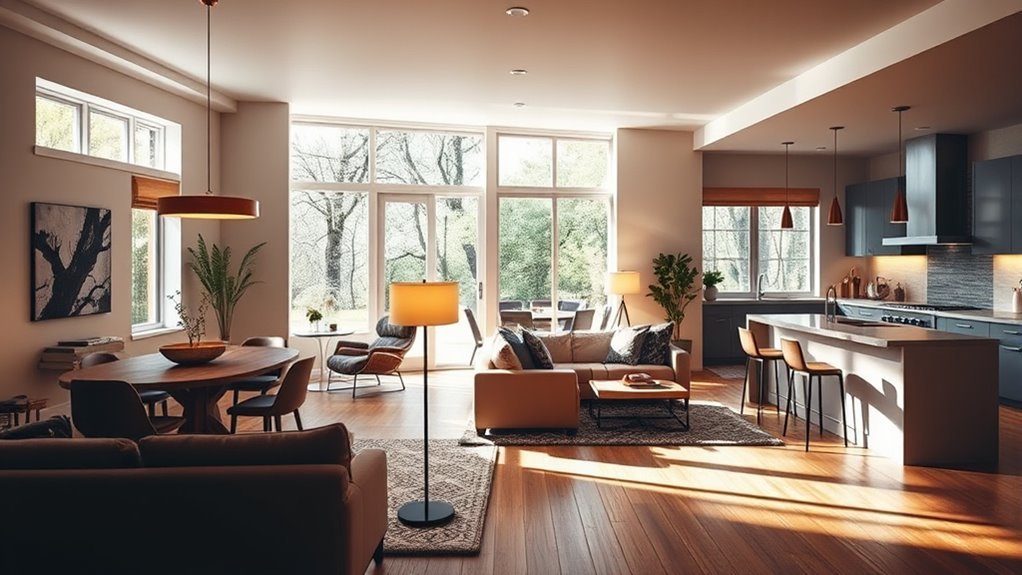
Lighting is your most powerful tool for zoning an open concept living room after dark, allowing you to dim unused areas while spotlighting the zone you are using. Putting each zone on its own switch, dimmer, or smart plug lets a bright daytime workspace disappear into the background during dinner or movie night.
Layer three types of light inside every major zone:
- Ambient lighting: Soft overhead or bounce light that provides baseline visibility (aim for 10 to 20 lumens per square foot in the lounge and 30 to 40 in the dining zone).
- Task lighting: Focused illumination positioned right where your eyes work—an articulated desk lamp delivering 50 to 70 lumens per square foot for a home office, a 400–800 lumen floor lamp beside a reading chair, or a pendant hung 30 to 36 inches above the dining table.
- Accent lighting: Low-wattage LED strip lights inside shelving, picture lights over artwork, or uplights behind tall plants that draw the eye to zone boundaries.
The Department of Energy’s lighting design guidance recommends matching light quantity and quality directly to the task performed in each area rather than over-lighting the entire room from a single ceiling grid.
Warning: Before wiring dimmer switches or grouping zones on smart controls, verify bulb and switch compatibility. As noted in the U.S. Department of Energy lighting controls guidance, pairing non-dimmable LEDs or mismatched trailing-edge dimmers causes buzzing, flickering, or premature driver failure. Also never run lamp extension cords underneath area rugs where foot traffic can fray insulation and create a fire hazard.
Leveraging Architectural Features for Effective Zoning
Existing structural details—ceiling beams, support columns, fireplace bump-outs, window bays, and flooring transitions—give you built-in lines to align your zones. Working with these architectural cues makes your furniture layout feel custom-built for the house.
Utilizing Ceiling Beams Strategically
Exposed beams, coffered ceilings, and soffits act as invisible walls overhead. When your furniture edges line up with ceiling transitions, the brain automatically reads the space below as a self-contained room.
- Align the back edge of a floating sofa or the edge of an area rug directly beneath a structural ceiling beam or soffit drop.
- Center your dining table under a ceiling medallion, beam intersection, or tray ceiling detail.
- Echo the wood stain of overhead beams in your coffee table, picture frames, or dining chair legs to link the ceiling plane to the floor.
Creating Visual Interest With Lighting
Architectural lighting turns structural quirks into intentional zone markers. Grazing a textured stone fireplace with recessed eyeballs anchors the main seating group, while wall sconces flanking a window alcove frame a reading or homework nook.
In open walkways where no table sits underneath, keep any hanging chandelier or pendant at least 84 inches (7 feet) above the finished floor so tall guests never brush against the fixture.
Incorporating Built-In Storage Solutions
Built-in storage solutions anchor activity zones while hiding the everyday clutter that quickly overwhelms open floor plans. Combining open upper display shelves with closed lower cabinetry gives you personality at eye level and concealed storage below.
- Frame a television or fireplace with floor-to-ceiling built-ins to lock in the media zone.
- Install a custom window bench with hinged or drawer storage to carve out a reading nook or kids’ toy zone.
- Build a shallow 12-inch-deep mudroom cabinet or floating wall bench near the front door to establish an entry drop zone without narrowing the walkway.
- Use matching woven baskets or lidded linen boxes on open shelves so cords, remotes, and paperwork stay out of sight.
Renter-Friendly Zoning Ideas
You can zone an open concept apartment or rental home without drilling into ceilings or altering walls. The secret is choosing freestanding, multi-purpose pieces that establish vertical height and localized lighting while moving easily when your lease ends.
- Cube bookcases as two-sided dividers: Place a sturdy horizontal 2×4 cube shelf behind a sofa or beside a desk; style alternating cubbies with fabric bins (accessible from both sides) and books.
- Hinged folding screens: Unfold a 3- or 4-panel woven wood or upholstered screen behind a work desk during video calls, then fold it flat behind a door on weekends.
- Plug-in swag pendants and arc lamps: If your rental lacks a junction box over the dining table, use an overarching floor lamp or a plug-in pendant hung from removable adhesive cord clips to drop light right over the tabletop.
- Tall planter groupings: Cluster a 5- to 6-foot indoor tree (such as a rubber plant or parlor palm) with two medium floor planters on a rolling caddy to form a leafy screen between the lounge and desk area.
- Removable peel-and-stick backing: Apply peel-and-stick wallpaper or wood-slat acoustic panels to the back of a bookcase or inside a 4-foot desk niche to visually frame a micro-zone without painting the whole apartment.
Tips for Keeping Flow in Your Zoning
A well-zoned open concept living room balances clear separation with effortless movement from the entry to the kitchen and patio doors. Use the quick reference guide below to verify that your zones feel connected rather than cramped.
| Flow Principle | Why It Matters | Exact Benchmark to Follow |
|---|---|---|
| Protected Traffic Lanes | Stops walkers from blocking the TV or bumping chairs | Keep 30–36 in. main walkways around (never through) the seating group |
| 2/3 Proportion Rule | Keeps furniture scale balanced across zones | Choose a coffee table or artwork about two-thirds the length of the sofa |
| Low Center Sightlines | Preserves daylight and spaciousness | Keep center-of-room dividers at or below 36–42 in. high; put tall shelves on walls |
| Independent Zone Switching | Lets unused zones recede at night | Put each zone on a separate dimmer, smart bulb group, or smart plug |
| Repeated Material Thread | Connects separate areas into one whole room | Echo 1 wood tone, 1 metal finish, and 2–3 palette colors in every zone |
Common Mistakes to Avoid While Zoning Your Living Room
Even with quality furniture, a few common layout errors can make an open floor plan feel choppy, dark, or obstacle-filled. Watch out for these seven pitfalls when arranging your space:
- Buying “postage-stamp” rugs: A 5×7-foot rug floating strictly under the coffee table disconnects your seating group; size up so the front legs of all main seats rest on the rug.
- Lining all furniture against the walls: Pushing every sofa and chair to the drywall perimeter creates an awkward 12-foot gap in the middle that destroys conversation intimacy.
- Routing walkways in front of the TV: If family members must walk between the sofa and media console to reach the kitchen, float the sofa forward so the traffic path runs behind it.
- Blocking windows with tall solid dividers: Placing a solid 6-foot wardrobe or closed bookcase in the center of the room cuts off natural light and makes the space feel half its size.
- Mixing clashing bulb temperatures: Putting 5000K daylight bulbs in the kitchen pendants alongside 2700K warm lamps in the living zone makes the room look disjointed at night.
- Cramming in too many zones: Limit a small or medium open living room to two or three hard-working zones rather than forcing five cramped micro-areas.
- Skipping acoustic softness: Leaving bare floors, unlined windows, and leather seating with no textiles causes every kitchen dish clink to echo across the lounge.
Troubleshooting Zoning Problems
If your open concept living room still feels awkward after moving the main pieces, match what feels wrong in the table below to apply a targeted layout fix.
| Problem | Likely Cause | Exact Fix |
|---|---|---|
| The room feels cluttered and noisy | Too many small accent pieces, open clutter, and hard surfaces | Remove 1 small piece per zone, add closed storage bins, and add a plush rug pad plus lined curtains to absorb echo |
| Zones look like unrelated mini-rooms | No shared colors, wood tones, or metal finishes across areas | Repeat your 10% accent color and one hardware finish (e.g., matte black or brass) in all zones |
| The seating group feels cold or awkward | Seats are more than 9 feet apart or pushed against perimeter walls | Pull seating within 8–9 ft, set the coffee table 14–18 in. from the sofa, and anchor front legs on an 8×10 or 9×12 ft rug |
| Zones disappear at night | Relying on a single grid of recessed ceiling lights | Add a floor lamp to the lounge, a task lamp to the desk, and a dimmed pendant 30–36 in. over the dining table |
| People bump into dining or desk chairs | Less than 36 inches of clearance behind pulled-out chairs | Slide the sofa group 6–12 in. closer to the media wall or switch to a narrower console or round dining table |
Key Takeaways
- Cap most open concept living rooms at three or four functional zones so you never sacrifice 30- to 36-inch walkways.
- Size living room rugs so at least the front 8 to 12 inches of your sofa and chairs sit on the rug, and add 24 to 30 inches of rug overhang around dining tables.
- Keep center-of-room dividers (sofa backs, console tables, low shelving) under 36 to 42 inches tall to preserve daylight and sightlines.
- Follow the 60-30-10 color rule and repeat one wood tone and one metal finish across every zone for visual continuity.
- Match lighting and acoustics to each zone: 10–20 lumens/sq. ft. (2700K–3000K) for lounging, 30–40 for dining, 50–70 for work, plus soft textiles to absorb echo.
Frequently Asked Questions
How do you zone an open plan living space?
Zone an open plan living space by choosing three or four core activities, floating your sofa to create a soft boundary, and anchoring each area with its own rug and light fixture. Leave 30 to 36 inches for main walkways and repeat two or three colors and finishes so the room feels connected.
What does zoning mean in interior design?
Zoning in interior design means dividing a large, wall-free room into smaller functional areas assigned to specific daily activities. In an open concept living room, zoning separates lounging, dining, working, and storage using furniture placement, area rugs, layered lighting, color shifts, and low dividers instead of solid walls.
What is the 2/3 rule for living rooms?
The 2/3 rule is a proportion guideline stating that a coffee table, wall art arrangement, or pendant fixture looks best when it spans roughly two-thirds the width of the furniture piece it pairs with. For an 84-inch sofa, for example, a 54- to 56-inch coffee table feels balanced and intentional.
What size rug do I need to zone an open concept living and dining room?
Most open concept living zones require an 8×10-foot rug for a standard sofa or a 9×12-foot rug for a large sectional so the front legs of all seats rest on the rug. For the dining zone, add 24 to 30 inches to each side of your tabletop—typically an 8×10-foot rug for a six-person table.
How do you reduce noise and echo in an open concept living room?
You can reduce noise and echo by layering soft, sound-absorbing materials across every zone. Pair thick wool rugs with felt rug pads, hang lined fabric curtains over windows, choose upholstered seating, and place open bookcases filled with unevenly stacked books between the lounge and kitchen to break up sound waves.
Why are some builders and designers moving away from fully open-concept homes?
Many homeowners want better noise control, remote-work privacy, and out-of-sight kitchen mess without losing natural light. That demand has popularized “broken-plan” living, which keeps the layout open and bright but adds partial dividers like half-walls, glass partitions, built-in bookcases, ceiling beams, and defined furniture zones.
Can you zone a small open concept living room?
Yes, you can zone a small open concept living room by sticking to two or three zones and using slim, dual-purpose boundaries. Anchor the seating group with one appropriately sized rug, tuck a 12-inch-deep console table or drop-leaf desk behind the sofa, and use wall-mounted sconces or plug-in pendants instead of bulky floor dividers.
Conclusion
Zoning your open concept living room turns one oversized floor plan into a calm, organized home where every activity fits naturally. Grab a roll of blue painter’s tape today, mark out your primary seating rug and 36-inch walkways on the floor, and float your sofa to test your new layout before buying a single new piece.
Sources
- U.S. Department of Energy — Lighting Principles and Terms: Definitions for ambient, task, and accent lighting layers, color temperature, and light quality.
- U.S. Department of Energy — Lighting Design: Guidance on matching lighting quantity and placement to specific room functions.
- U.S. Department of Energy — Lighting Controls: Best practices for dimmers, occupancy controls, and LED dimmer compatibility.
- U.S. Access Board — ADA Chapter 4: Accessible Routes: The 36-inch minimum clear-width benchmark for comfortable walking surfaces.
- PLOS ONE — Effect of Illumination on Perceived Temperature: Experimental evidence on the hue-heat effect showing warm vs. cool illumination shifts perceived room temperature by 2°C to 3°C.
- U.S. General Services Administration — Buildings and Health: Guidance on using soft floor finishes, drapery, and absorptive surfaces to reduce sound reverberation in open areas.
- U.S. Consumer Product Safety Commission — Anchor It!: Safety standards and anchoring guidance for preventing furniture and bookcase tip-overs.