Updated August 2026.
A 30-pint-class compressor dehumidifier can be a practical choice for an enclosed garage with moderate seasonal humidity, condensation, or musty storage conditions. The best model is not simply the one with the largest advertised square-foot number. Garage temperature, air leakage, wet vehicles, ceiling height, drainage access, and the severity of the moisture problem all affect real-world performance.
Among the models reviewed here, the Waykar PD160B is the best overall pick because it combines practical drainage with verified ENERGY STAR certification. The Shinco SDL-30P is the strongest choice for a cooler garage that stays within its operating-temperature range, while the WHOY is the best option for Wi-Fi control. Buyers who want a simpler setup should compare the AIRPLUS AP1907, LUKO D010, and Uhome UDL5-30P.
Quick Verdict
Choose Waykar for the best balance of efficiency, capacity, and drainage. Choose Shinco when the garage gets cooler and you need a clearly stated low-temperature limit. Choose WHOY for remote monitoring. Whichever model you select, plan the drain route first and do not expect a compressor dehumidifier to perform at its headline rate in cold air.
Important Capacity Note
Most products in this roundup advertise a 30- to 34-pint maximum measured in very warm, humid conditions. Current standardized dehumidifier ratings use cooler test conditions, so actual water removal in a garage can be substantially lower. Compare temperature limits, drainage, controls, and certification instead of treating headline pint and square-foot claims as directly comparable.
Quick Comparison
| Model | Best For | Listed Capacity | Drainage | Standout Feature | Details |
|---|---|---|---|---|---|
| Waykar PD160B | Best Overall | 34-pint seller-listed max | 0.66 gal + hose | ENERGY STAR, auto defrost | Check Amazon |
| Shinco SDL-30P | Cooler garages | 30-pint seller-listed max | 0.33 gal + hose | About 41°F minimum, timer | Check Amazon |
| PLUSCENT PD10 | Larger garage | 32-pint seller-listed max | 2 L + hose | 3 modes, auto restart | Check Amazon |
| WHOY Smart | Remote control | 30-pint seller-listed max | 1.6 L + 4.9 ft hose | Wi-Fi app, 3 modes | Check Amazon |
| NEWBULIG | Quiet newer option | 30-pint seller-listed max | 0.53 gal + 3.28 ft hose | Humidity ring, Sleep mode | Check Amazon |
| LUKO D010 | Mobility | 30-pint seller-listed max | 68 oz + 3.3 ft hose | Casters, laundry mode | Check Amazon |
| AIRPLUS AP1907 | Simple controls | 30-pint seller-listed max | 50 oz + hose | Timer, 3 modes | Check Amazon |
| Uhome UDL5-30P | Carbon filter | 30-pint seller-listed max | 1.7 L + hose | Humidity sensor, sleep mode | Check Amazon |
Waykar 34 Pints Energy Star Dehumidifier
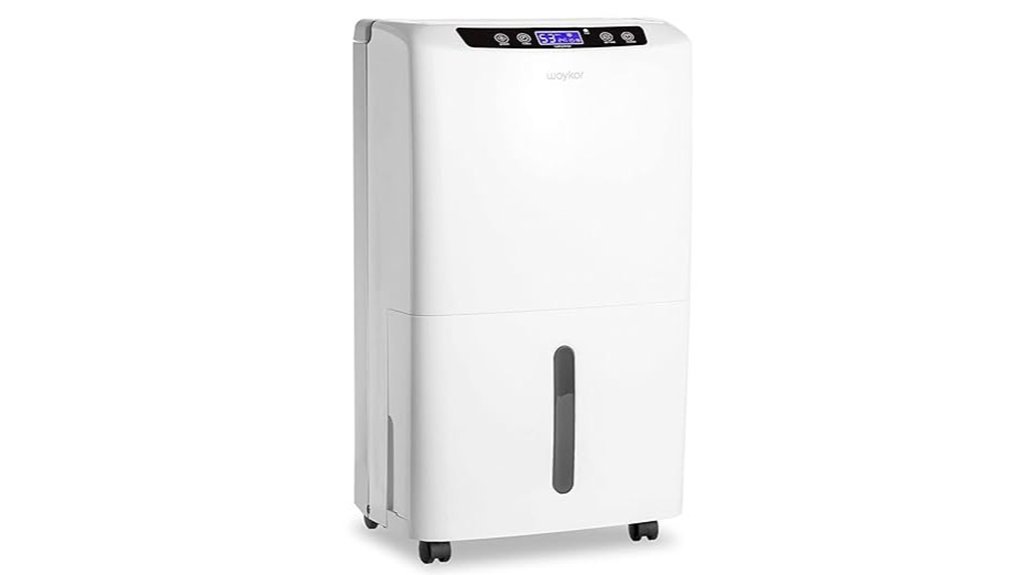
The Waykar PD160B is the strongest all-around choice in this group for a typical enclosed garage. The listing describes a maximum 34-pint daily removal rate in hot, humid test conditions, adjustable humidity control, two fan speeds, automatic defrost, and a 0.66-gallon tank with a continuous-drain option. Its ENERGY STAR certification is a meaningful advantage for buyers who expect frequent seasonal use.
The square-foot figure should be treated as a rough marketing guide rather than a guarantee. In a cool garage, actual water collection can be much lower than the maximum headline rating. This model makes the most sense when you have a nearby floor drain and want an established, straightforward compressor dehumidifier.
Best For: A one- or two-car enclosed garage with moderate dampness, regular summer humidity, and access to gravity drainage.
Why You’ll Like It: It balances verified energy certification, practical controls, a larger tank than most models here, and flexible drainage.
Who Should Avoid It: Buyers who need a built-in pump, reliable operation in near-freezing conditions, or commercial-scale drying.
Pros:
- ENERGY STAR certified model with adjustable humidity control.
- 34-pint seller-listed maximum gives some extra headroom over exact 30-pint models.
- 0.66-gallon tank, drain hose support, casters, washable filter, and automatic defrost.
Cons:
- The headline capacity is measured under warmer, wetter conditions than many garages experience.
- Continuous drainage is gravity-fed, so the outlet must be lower than the drain port.
- No Wi-Fi control or built-in condensate pump.
Shinco 30-Pint Dehumidifier for Home and Basements
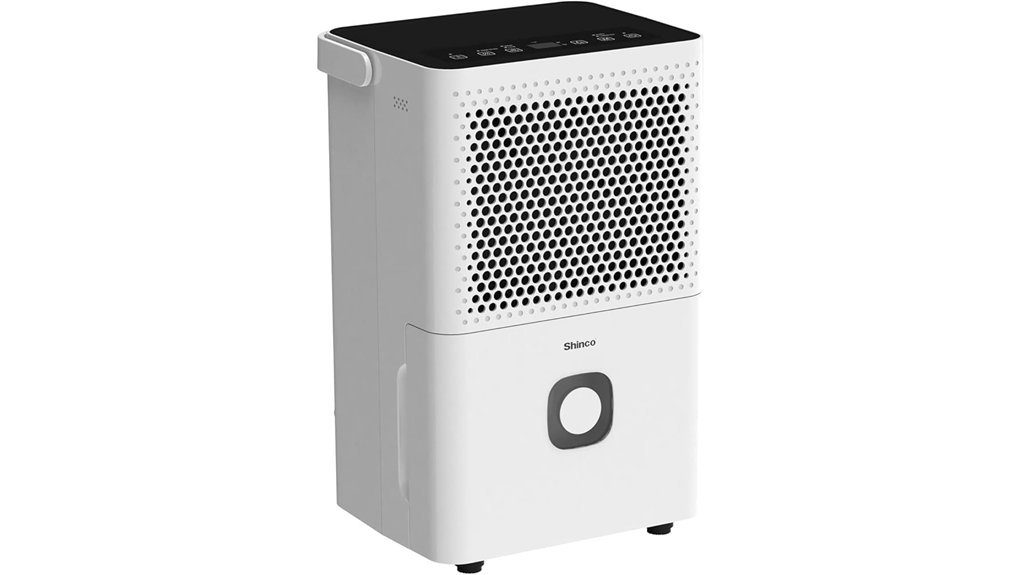
The Shinco SDL-30P is a sensible garage pick when temperatures may dip below normal living-room conditions. The seller lists a 30-pint maximum at 90°F and 90% relative humidity, operation down to about 41°F, automatic defrost, two fan speeds, a 24-hour timer, auto restart, and both tank and hose drainage.
Its 0.33-gallon tank is small, so continuous drainage is the better setup in a damp garage. The activated carbon filter may help with some odors and larger airborne particles, but it does not turn the unit into a full air purifier.
Best For: A smaller or medium garage that gets cool but generally stays above the model’s minimum operating temperature.
Why You’ll Like It: It combines low-temperature operation guidance, automatic defrost, timer control, and an established model number.
Who Should Avoid It: Garages that remain below about 41°F, spaces with standing water, or buyers who cannot provide a downward drain route.
Pros:
- Seller-listed 30-pint capacity with adjustable humidity control.
- Automatic defrost and a stated low-temperature operating limit near 41°F.
- Auto restart, timer, two fan speeds, drain hose, and activated carbon filter.
Cons:
- Small 0.33-gallon tank can fill quickly without hose drainage.
- Rated extraction is a warm, high-humidity maximum and will fall in colder air.
- The included filter is not a substitute for ventilation or a dedicated air cleaner.
PLUSCENT 32 Pint Dehumidifier for Home & Basement
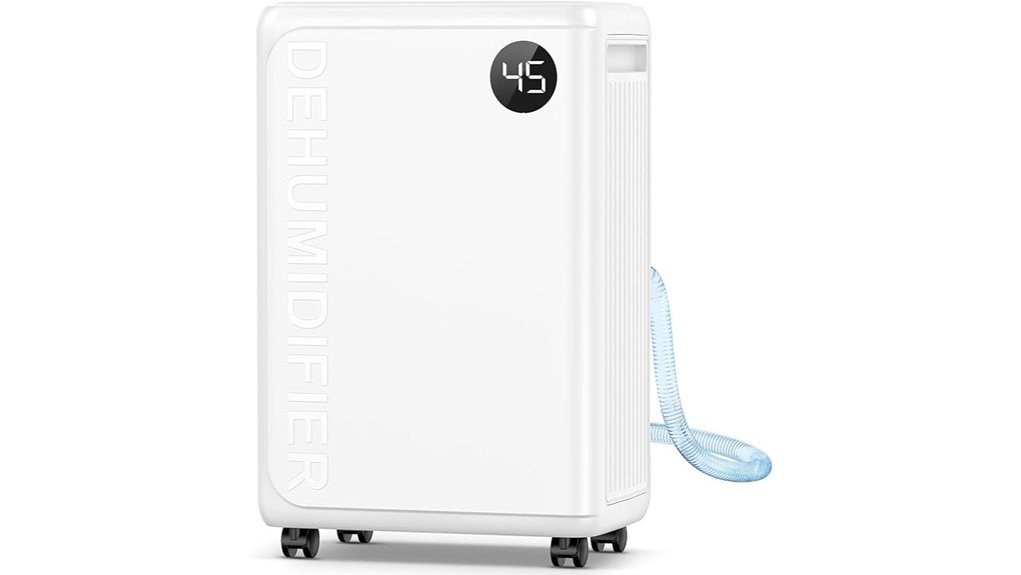
The PLUSCENT PD10 is a 32-pint-class option for buyers who want a little more seller-listed capacity without moving to a bulky high-capacity machine. It offers DEHU, continuous, and laundry modes, adjustable humidity control, auto restart, automatic defrost, a 24-hour timer, child lock, and a 2-liter tank.
The included 39.4-inch hose is useful when the unit can sit close to a floor drain. The 2,500-square-foot claim should not be used by itself to size the machine. Garage ceiling height, outdoor air leakage, wet vehicles, and temperature can matter more than floor area.
Best For: A medium or larger enclosed garage with moderate moisture and a drain located close to the unit.
Why You’ll Like It: It offers a practical control set, quiet-operation positioning, and slightly more listed capacity than a basic 30-pint model.
Who Should Avoid It: Very wet garages, open workshops, or installations that need pumping uphill to a sink or window.
Pros:
- Seller-listed maximum of 32 pints per day under hot, humid conditions.
- Three modes, adjustable humidistat, timer, auto restart, and automatic defrost.
- Compact 2-liter tank plus continuous-drain connection.
Cons:
- Newer model with less long-term product history than Waykar, Shinco, or AIRPLUS.
- The short drain hose limits placement unless a compatible longer hose is used.
- The 2-liter bucket is best treated as backup rather than the main drainage method.
WHOY 30 Pint Smart Dehumidifier with WiFi App
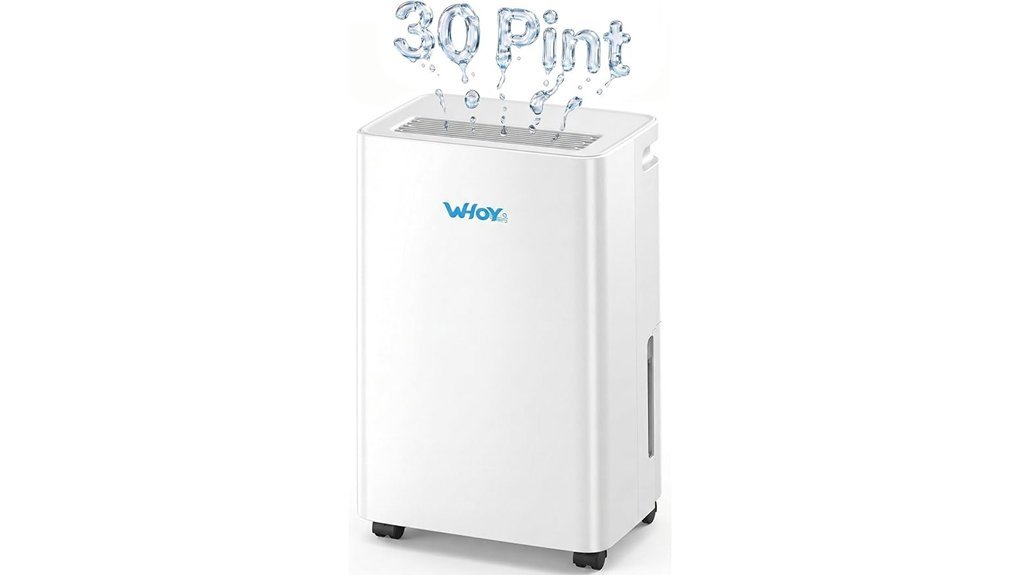
The WHOY model is the most convenient choice for checking a detached or seldom-visited garage from your phone. The listing describes Wi-Fi app control, a 30-pint daily maximum at 86°F and 80% relative humidity, adjustable humidity from 30% to 80%, three operating modes, automatic defrost, child lock, a 1.6-liter tank, and a 4.9-foot gravity drain hose.
Smart control is useful for scheduling and status checks, but it does not solve drainage, freezing, or connectivity problems. Confirm that the app supports your phone and home Wi-Fi setup before ordering.
Best For: A connected garage where remote scheduling and humidity checks are more important than a large tank.
Why You’ll Like It: The app can reduce unnecessary trips to the garage and makes it easier to adjust the target humidity.
Who Should Avoid It: Anyone who wants simple offline controls, has unreliable Wi-Fi, or is uncomfortable depending on a lesser-known app ecosystem.
Pros:
- Wi-Fi app control with timer and remote humidity adjustment.
- Seller-listed 30-pint maximum and 4.9-foot continuous-drain hose.
- Auto, custom humidity, and laundry-dry modes with automatic defrost.
Cons:
- Small 1.6-liter tank needs frequent attention without continuous drainage.
- Smart features depend on Wi-Fi, app compatibility, and continued software support.
- Newer brand with less established long-term service history.
NEWBULIG 30Pints Dehumidifier with Drain Hose
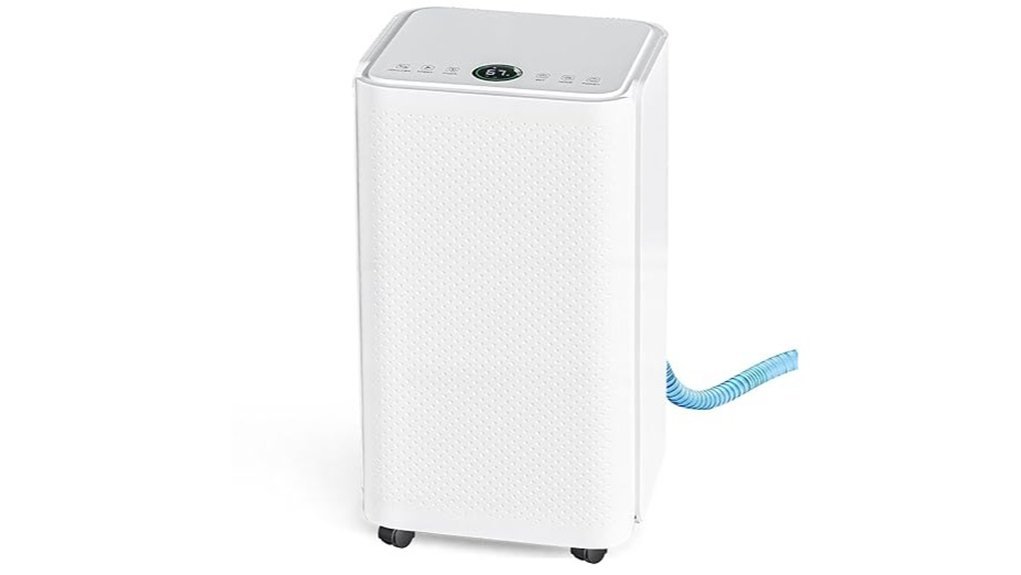
The NEWBULIG model is a newer 30-pint option built around quiet operation and easy visual monitoring. Its listing includes a color humidity ring, Auto, Drying, Sleep, and Fan modes, a washable filter, automatic defrost, 360-degree casters, a 0.53-gallon tank, and a 3.28-foot drain hose.
The under-38 dB claim is seller-provided and may vary with fan speed, room acoustics, and compressor cycling. It is a good fit when the garage shares a wall with a bedroom or office, but long-term brand support is less established than with older models.
Best For: A small or medium garage where lower listed noise and a clear humidity indicator are priorities.
Why You’ll Like It: The humidity ring makes conditions easy to read at a glance, while four modes cover normal use, sleep, and drying.
Who Should Avoid It: Buyers who prioritize a long product track record, official energy certification, or built-in pump drainage.
Pros:
- Seller-listed 30-pint maximum for spaces up to 2,000 square feet.
- Under-38 dB listed operation, Sleep mode, and color humidity indicator.
- 0.53-gallon tank, continuous-drain hose, washable filter, casters, and automatic defrost.
Cons:
- Newer listing with limited long-term reliability information.
- Coverage and noise figures are seller claims, not guarantees for every garage.
- Short gravity hose may restrict placement.
LUKO 30 Pint Dehumidifier for Large Rooms and Basements
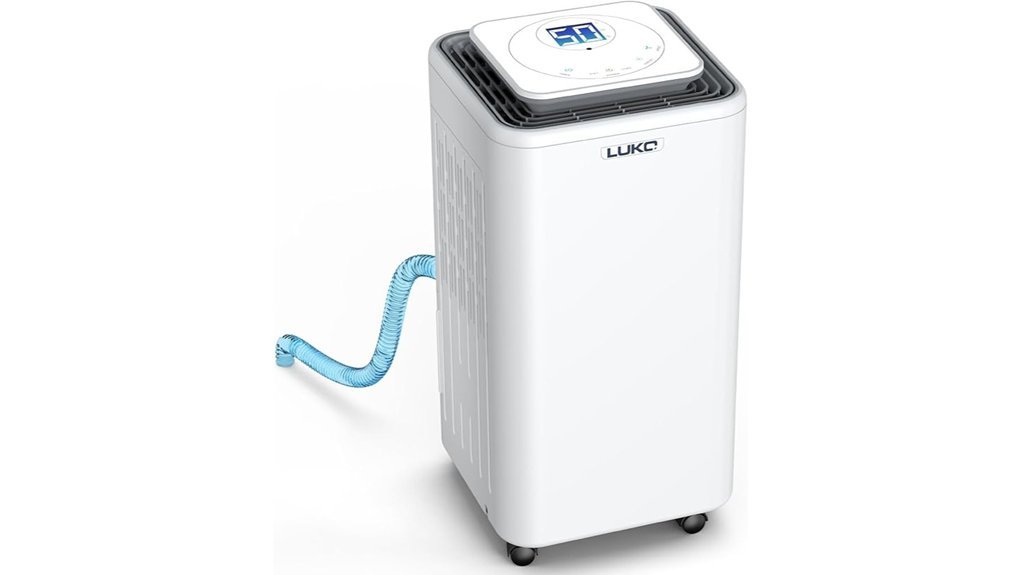
The LUKO D010 is an established 30-pint model with a 68-ounce tank, 3.3-foot drain hose, adjustable humidity control, automatic defrost, laundry drying, night mode, washable filter, handles, and 360-degree wheels. The listing bases its 30-pint maximum on 95°F and 90% relative humidity.
Its controls are simple and the machine is easy to reposition, making it useful in a garage that doubles as a workshop or storage area. The seller-listed 45 dB sound level is higher than several quieter models in this guide.
Best For: A multipurpose garage where the unit may need to move around vehicles, tools, or work zones.
Why You’ll Like It: Large casters, handles, multiple modes, and a 68-ounce bucket make it practical for flexible placement.
Who Should Avoid It: Noise-sensitive attached garages or buyers who want app control or verified ENERGY STAR certification.
Pros:
- Seller-listed 30-pint maximum with humidity adjustment from 30% to 80%.
- 68-ounce tank and included drain hose for manual or continuous drainage.
- Night, laundry, continuous, and automatic modes with washable filter and casters.
Cons:
- 45 dB listed sound is more noticeable than the quietest options here.
- Maximum capacity is based on very warm, humid conditions.
- No Wi-Fi control, pump, or verified ENERGY STAR listing identified.
AIRPLUS 30 Pint Dehumidifier for Home (AP1907)

The AIRPLUS AP1907 is a straightforward model for buyers who do not need Wi-Fi or complicated programming. The seller lists a 30-pint maximum at 86°F and 80% relative humidity, coverage up to 1,500 square feet, Drying, Raining, and Sleep modes, a 1-to-24-hour timer, a 50-ounce tank, full-tank shutoff, and hose drainage.
The manufacturer guidance warns that performance drops when the room is cold, so this is a better summer or conditioned-garage choice than a deep-winter solution. Keep adequate clearance around the intake and exhaust so the compressor can move air properly.
Best For: A smaller enclosed garage where simple buttons, a timer, and basic drainage matter more than smart features.
Why You’ll Like It: The mode layout is easy to understand and the compact cabinet is simple to move and store.
Who Should Avoid It: Unheated winter garages or buyers who need verified low-temperature performance.
Pros:
- Established AP1907 model with seller-listed 30-pint maximum.
- Drying, Raining, and Sleep modes plus a 1-to-24-hour timer.
- 50-ounce tank, automatic shutoff, casters, handle, and hose drainage.
Cons:
- Small bucket can require frequent emptying.
- Cold-room performance is limited and can be much lower than the headline rating.
- No Wi-Fi, pump, or verified ENERGY STAR certification.
Uhome 30 Pint Dehumidifier with Activated Carbon Filter
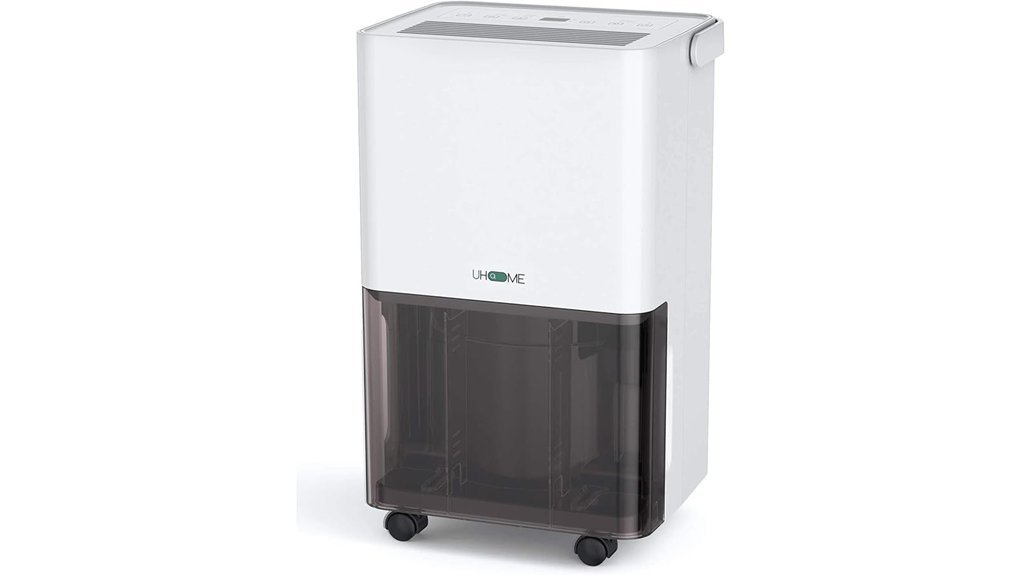
The Uhome UDL5-30P combines seller-listed 30-pint moisture removal with a 1.7-liter tank, continuous drainage, a humidity sensor, automatic shutoff, child lock, sleep mode, wheels, and an activated carbon filter. It is designed for spaces up to 1,500 square feet and is listed at 39 dB.
The carbon filter can be a useful extra in a musty storage garage, but moisture-source control remains more important. Fix leaks, dry wet materials, and ventilate fuel or chemical fumes instead of relying on the filter.
Best For: A medium garage used for storage where musty odors and routine humidity are both concerns.
Why You’ll Like It: It adds a carbon filter and quiet-operation positioning without complicating the basic controls.
Who Should Avoid It: Garages with combustion fumes, solvent vapors, active water intrusion, or a need for true air purification.
Pros:
- Seller-listed 30-pint capacity for spaces up to 1,500 square feet.
- Activated carbon filter, humidity sensor, sleep mode, child lock, and automatic shutoff.
- 1.7-liter bucket plus included hose connection for continuous drainage.
Cons:
- The carbon filter does not replace source control or safe garage ventilation.
- Small tank is best used as a backup to continuous drainage.
- No app control, built-in pump, or verified ENERGY STAR certification.
Factors to Consider When Choosing a 30 Pint Dehumidifier for Garage
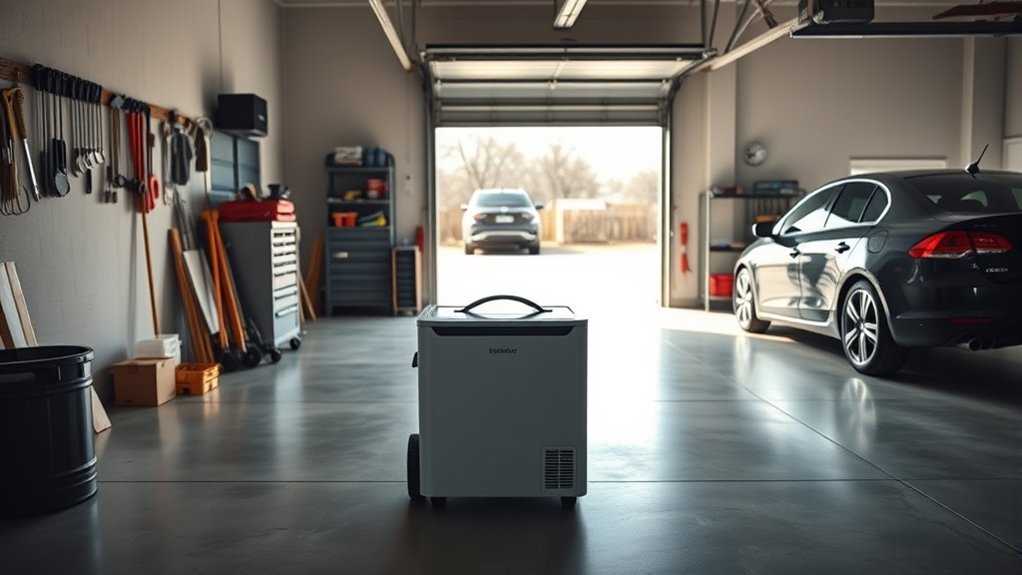
A garage is harder to dehumidify than a typical bedroom because outdoor air enters whenever the door opens, surfaces may be cold, and wet cars or equipment can add moisture quickly. Use the checklist below to decide whether a 30-pint-class unit is appropriate.
Garage Size and Moisture Load
Do not size a garage dehumidifier from square footage alone. A tight one-car garage with mild summer humidity may be easier to control than a smaller but leaky garage with a wet slab, poor drainage, or frequent vehicle entry. Look for condensation, musty odors, damp cardboard, visible rust, and how quickly relative humidity rises after the door closes. If there is standing water or an active leak, repair the source before expecting a portable dehumidifier to solve the problem.
Capacity and Test Conditions
A product advertised as 30 pints per day may reach that number only in warm, very humid air. Cooler air contains less moisture and can cause frost on the coils, reducing output. Compare the exact test conditions in the listing or manual whenever possible. A model with automatic defrost can protect the system, but defrost cycles do not create full warm-weather performance in a cold garage.
Garage Temperature
Temperature is one of the most important buying factors. Many portable compressor dehumidifiers lose efficiency below about 65°F, even when they are permitted to operate at lower temperatures. Check the manufacturer’s minimum operating temperature and choose a model with automatic defrost. For garages that stay close to freezing, consider a product specifically designed for low-temperature use rather than relying on a standard residential compressor unit.
Drainage Options
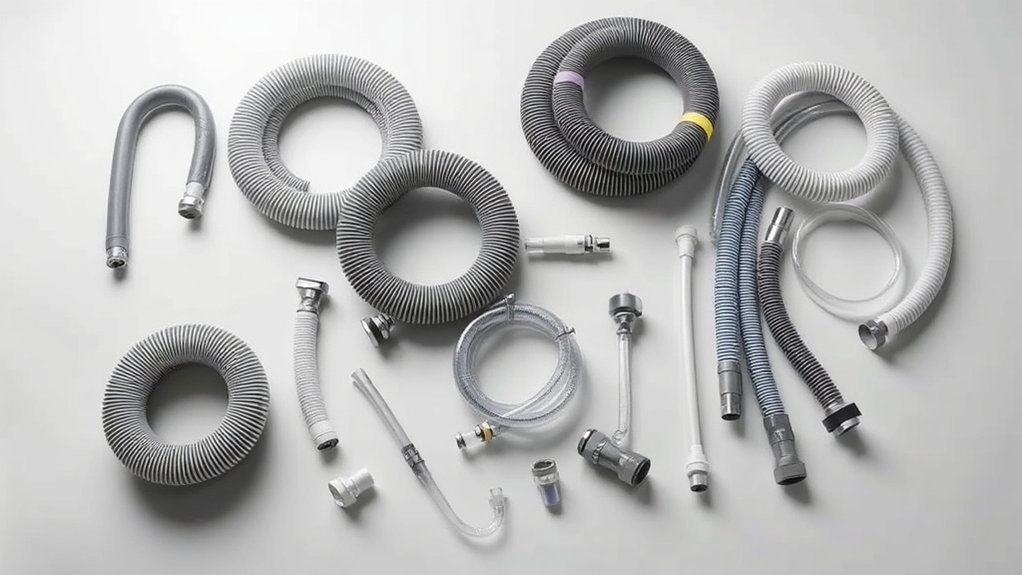
Continuous drainage is usually the best garage setup. The hose must run downhill from the dehumidifier to a floor drain, sump, or approved outlet without kinks or upward loops. None of the retained models has a confirmed built-in pump, so they cannot push water uphill. If the drain is higher than the machine, use a compatible external condensate pump or select a model that includes a pump.
Humidity Control
A practical starting point is around 45% to 50% relative humidity, then adjust based on condensation, stored materials, and the manufacturer’s guidance. Avoid running the machine continuously at the lowest possible setting unless the garage conditions require it. A working humidistat lets the compressor cycle off after reaching the target, which can reduce noise and energy use.
Energy Efficiency
Look for verified ENERGY STAR certification and compare the integrated energy factor when available. To estimate operating cost, multiply the unit’s wattage by daily operating hours, divide by 1,000, and multiply by your electricity rate per kilowatt-hour. Keep the filter clean, maintain airflow clearance, close exterior doors, and use the humidistat so the machine does not run longer than necessary.
Noise and Placement
Seller-listed sound levels are useful for comparison but may not reflect compressor cycling, vibration, or garage acoustics. Place the unit on a level surface with the clearance required by the manual. Keep it away from sawdust, paint spray, solvents, fuel vapors, and areas where it may be splashed. Plug it into a suitable grounded outlet and follow the manufacturer’s electrical-safety instructions.
Before You Buy
- Measure the garage and note ceiling height, door gaps, and moisture sources.
- Check the lowest winter temperature where the unit will operate.
- Plan a downward gravity-drain route before choosing a model.
- Confirm the listing’s pint-rating test conditions and current warranty.
- Verify that the circuit and outlet meet the manufacturer’s requirements.
Frequently Asked Questions
Is a 30-Pint Dehumidifier Enough for a Two-Car Garage?
It can be enough for a reasonably sealed two-car garage with moderate humidity, but floor area alone cannot answer the question. A wet vehicle, open door, unsealed slab, high ceiling, or active leak can overwhelm a 30-pint-class unit. Use a hygrometer and check whether the machine can hold the target humidity after several days of normal use.
Can I Run a Dehumidifier in an Unheated Garage in Winter?
Only when the garage stays within the model’s stated operating range. Compressor dehumidifiers lose performance in cool air and may spend more time defrosting. If the space regularly approaches freezing, select equipment designed specifically for low-temperature conditions.
Should I Use the Tank or Continuous Drainage?
Continuous drainage is usually more convenient in a garage because the small tanks on these models can fill quickly. Keep the hose short, sloped downward, and free of kinks. Inspect the hose and drain periodically to prevent leaks or backups.
What Humidity Level Is Best for a Garage?
Many homeowners start around 45% to 50% relative humidity. The best setting depends on temperature, condensation, stored items, and local climate. The main goal is to keep humidity low enough to limit condensation and dampness without forcing the machine to run continuously.
Will a Dehumidifier Stop Rust and Mold?
Lower humidity can reduce conditions that encourage condensation, corrosion, and mold, but it cannot guarantee prevention. Repair leaks, dry wet materials promptly, improve drainage, and ventilate fumes. Visible mold or major water intrusion may require professional assessment.
Does a Carbon Filter Make a Dehumidifier an Air Purifier?
No. A basic carbon filter may reduce some odors and capture larger particles, but it is not a substitute for source control, safe ventilation, or a dedicated air purifier. Never use a dehumidifier to manage gasoline, solvent, exhaust, or combustion fumes.
How Often Should I Clean the Filter?
Follow the manufacturer’s schedule and inspect it more often in dusty garages. A clogged filter reduces airflow and moisture removal. Also clean the tank, wipe the intake and exhaust grilles, and inspect the drain hose for buildup or kinks.
Conclusion
The Waykar PD160B is the best overall choice for most buyers because it combines practical drainage, an established model, and verified ENERGY STAR certification. Choose the Shinco SDL-30P when cooler-garage operation and automatic defrost are priorities, or the WHOY when remote app control will save you repeated trips to the garage.
For simpler controls, the AIRPLUS AP1907, LUKO D010, and Uhome UDL5-30P remain relevant 30-pint options. Whichever model you choose, confirm the current Amazon listing, read the operating-temperature limits, and plan a safe gravity-drain route before purchase.