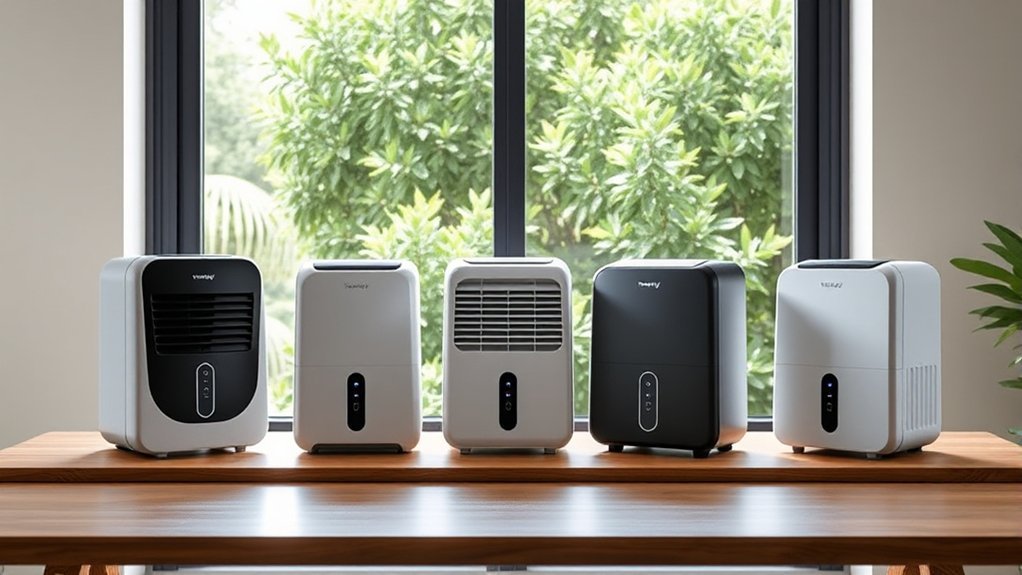
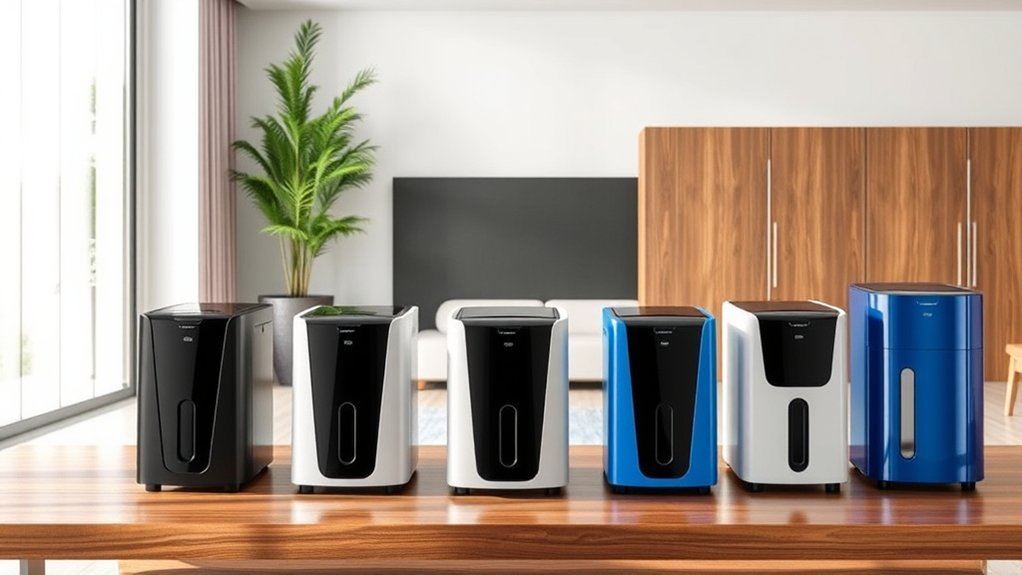
If you need a portable dehumidifier for a Canadian home, start with the room’s measured humidity, temperature, drainage access, and moisture load. A large square-foot claim alone does not show how quickly a unit will control a damp basement or how often its bucket will need emptying.
The models below range from 22-pint options for bedrooms and medium rooms to 35- and 50-pint units for larger spaces. The Waykar is marketed at up to 80 pints per day under high-temperature, high-humidity conditions, while its listing also describes a lower standard-condition rating. That distinction matters when comparing it with conventional 22-, 35-, and 50-pint models.
The Hisense 50-Pint with Built-In Pump is the most convenient option when water must be lifted to a sink or another elevated drain. The Frigidaire 22-Pint is the strongest smart-control choice, while the Waykar provides the highest listed extraction capacity for demanding spaces.
Canadian purchase note:
The product links in this article lead to Amazon.com. Before ordering from Canada, confirm delivery to your postal code, the seller’s return terms, Canadian warranty coverage, import charges, and the exact model number. A 115-volt rating alone is not enough: confirm that the appliance itself bears a recognized Canadian electrical certification mark, such as CSA, cUL, or cETL.
Quick verdict
- Best overall: Hisense 50-Pint with Built-In Pump
- Best high-capacity option: Waykar Max 80-Pint / Standard 62-Pint Listing
- Best smart option: Frigidaire 22-Pint with Wi-Fi
- Best simple 22-pint option: Midea 22-Pint ENERGY STAR
- Best mid-capacity option: Hisense 35-Pint
- Best gravity-drain 50-pint option: Keystone 50-Pint
How these models were compared
The comparison focuses on listed moisture-removal capacity, drainage method, room-size guidance, low-temperature operation, smart controls, portability, maintenance, and suitability for Canadian cross-border purchase. No hands-on testing, live price, customer rating, or current stock claim is made.
Quick Comparison of Portable Dehumidifiers
The capacity and coverage figures below are based on the linked product listings and manufacturer information where available. Actual performance depends on temperature, starting humidity, ceiling height, room layout, airflow, and the amount of moisture entering the space. Coverage claims are best treated as maximum guidance rather than guaranteed results.
| Model | Best For | Listed Capacity | Listed Coverage | Drainage Highlight | Details |
|---|---|---|---|---|---|
| Hisense 50-Pint with Pump | Large basements and elevated drains | 50 pints per day | Up to 4,500 sq. ft. | Built-in lift pump | Check Amazon Listing |
| Waykar Max 80-Pint / Standard 62-Pint | High moisture loads and large open areas | Up to 80 pints/day at 95°F (35°C) and 90% RH; listing also states 62 pints/day under standard conditions | Up to 5,000 sq. ft. | Drain hose connection | Check Amazon Listing |
| Frigidaire 22-Pint Wi-Fi | Smart control and medium rooms | 22 pints per day | Up to 1,500 sq. ft. | Bucket or gravity drain | Check Amazon Listing |
| Midea 22-Pint | Bedrooms, bathrooms, and medium rooms | 22 pints per day | Up to 1,500 sq. ft. | Bucket or gravity drain connection | Check Amazon Listing |
| Hisense 35-Pint | Medium-to-large rooms | 35 pints per day | Up to 3,000 sq. ft. | Removable bucket; verify hose setup | Check Amazon Listing |
| Keystone 50-Pint | Large rooms with a nearby floor drain | 50 pints per day | Up to 4,500 sq. ft. | Garden-hose gravity drain | Check Amazon Listing |
Hisense 50-Pint Portable Dehumidifier with Pump
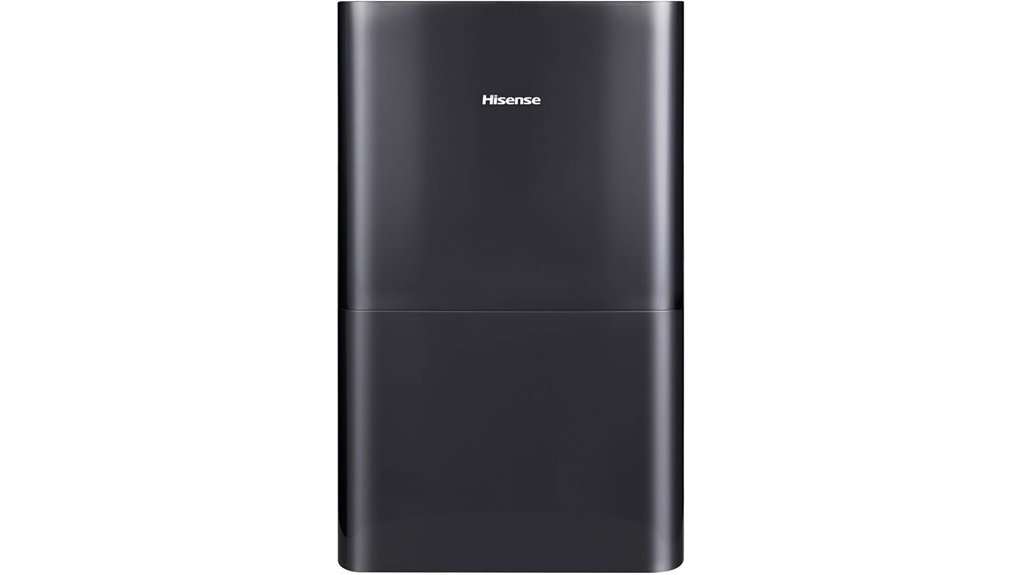
The Hisense 50-Pint Portable Dehumidifier with Pump is the most versatile choice in this group for a damp basement or other large residential space. Its linked product listing identifies a 50-pint daily capacity, three operating speeds, and coverage of up to 4,500 square feet.
The main advantage is the built-in lift pump. A standard gravity drain must run continuously downhill, but a pump can move collected water upward toward a suitable sink or drain. That can make installation easier in a basement without a conveniently positioned floor drain.
Who Should Buy It: Basements, garages, large living areas, and drainage setups where water must be lifted above the unit.
Why You’ll Like It:
- The 50-pint capacity is better suited to persistent dampness than a compact mini unit.
- The built-in pump reduces dependence on a downhill gravity-drain route.
- Three speed settings provide more control over airflow and operating sound.
- The tall, narrow cabinet can be easier to place than a wider appliance.
Who Should Avoid It:
- A 50-pint compressor model is substantially heavier than a desktop dehumidifier.
- A pump adds convenience but also introduces another component that may eventually need maintenance.
- The advertised square-foot figure should be treated as a maximum guideline, not guaranteed performance in every basement.
Waykar Max 80-Pint / Standard 62-Pint Home Dehumidifier
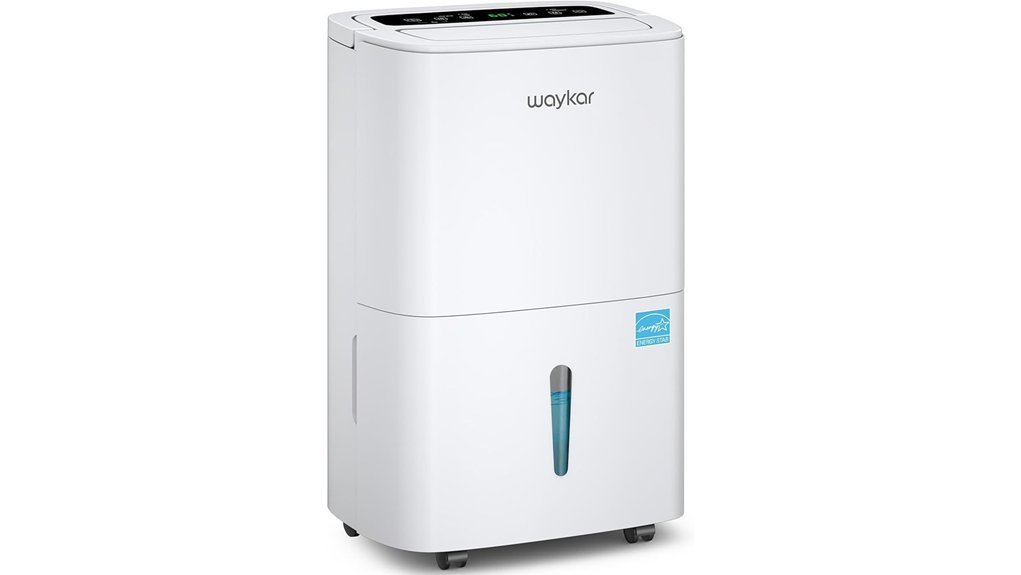
The Waykar Home Dehumidifier has the highest marketed extraction figure in this comparison. The linked listing presents it as an ENERGY STAR model for spaces up to 5,000 square feet, with a drain hose, adjustable humidity control, auto-defrost, and a self-drying function.
The important comparison detail is the test condition. Waykar describes this model as removing up to 80 pints per day at 95°F (35°C) and 90% relative humidity, while also identifying a 62-pint-per-day standard-condition rating. Use the standard-condition figure when comparing it with models rated under conventional test conditions.
This higher-capacity design is most useful when humidity returns quickly after a smaller unit switches off. It may suit a large basement, open lower level, workshop, or another space with a substantial moisture load. Actual extraction will fall as room temperature and relative humidity decrease.
Who Should Buy It: Large open areas, persistently damp basements, workshops, and homeowners who prioritize moisture-removal capacity.
Why You’ll Like It:
- The 62-pint standard-condition listing still offers more capacity than the 50-pint models in this comparison.
- A drain-hose connection supports continuous gravity drainage.
- Auto-defrost is useful when the coils become cold enough for frost to form.
- Casters and a top handle make room-to-room repositioning more manageable.
- The washable filter reduces the need for frequent replacement filters.
Who Should Avoid It:
- It requires more floor space than a 22-pint or 35-pint model.
- Gravity drainage still requires a lower drain unless a separate condensate pump is added.
- Confirm the exact model number, current ENERGY STAR listing, and Canadian electrical certification mark for the unit being shipped.
Frigidaire 22-Pint Portable Dehumidifier with Wi-Fi
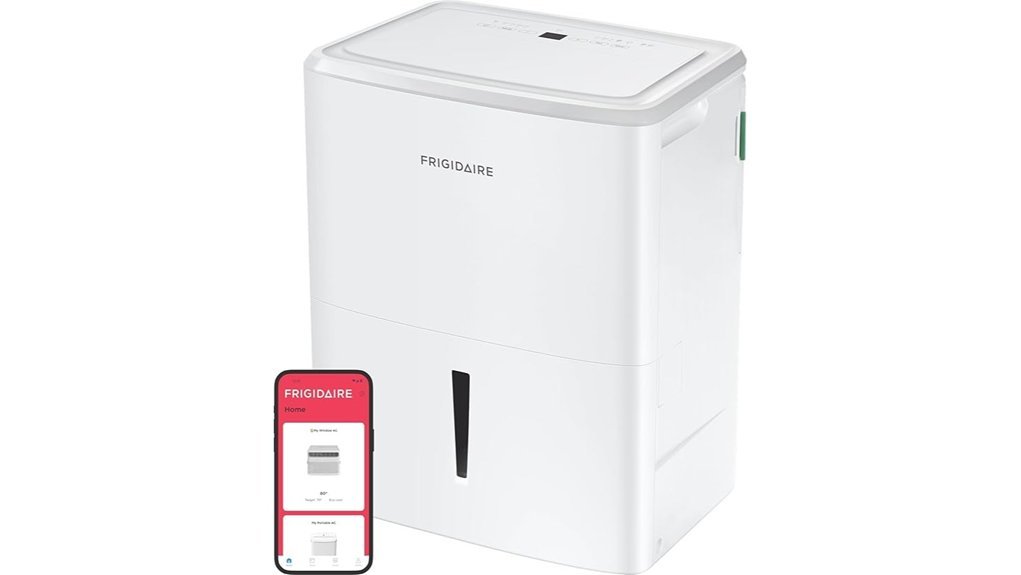
The Frigidaire 22-Pint Portable Dehumidifier is the best match here for buyers who want Wi-Fi functionality without moving to a high-capacity machine. Model FHDD2234W1 is listed at approximately 22 pints per day, is ENERGY STAR certified for the United States and Canada, and includes custom humidity control, automatic shut-off, continuous drainage, and coverage guidance up to 1,500 square feet.
Wi-Fi controls can be useful when the unit is placed in a basement or another room you do not visit frequently. You can review the seller’s current app requirements and supported control features before buying, since software compatibility can change.
Who Should Buy It: Bedrooms, medium living areas, finished basements, and buyers who value remote humidity control.
Why You’ll Like It:
- Wi-Fi capability offers more convenient access to operating controls.
- The 22-pint capacity is appropriate for moderate moisture rather than severe water intrusion.
- The listed 1.7-gallon bucket reduces emptying frequency compared with compact tabletop units.
- Continuous gravity drainage is available when a suitable lower drain is nearby.
- Custom humidity settings allow the unit to cycle instead of running continuously.
Who Should Avoid It:
- Wi-Fi setup requires a compatible network, the current Frigidaire app, and an account; app-dependent features can change.
- This model does not advertise a built-in lift pump.
- A 22-pint unit may work slowly in a very wet unfinished basement.
Midea 22-Pint ENERGY STAR Dehumidifier
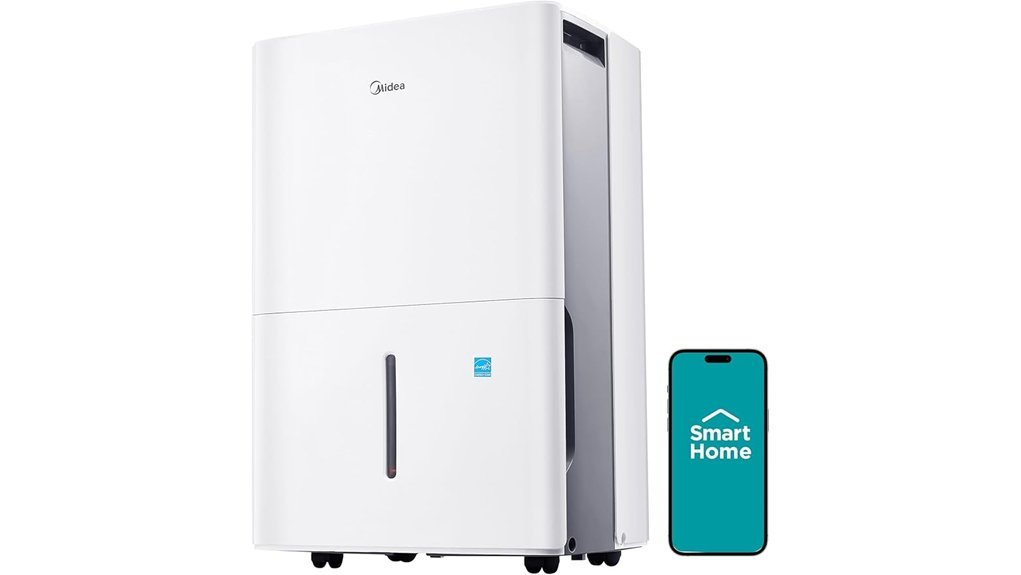
The Midea 22-Pint ENERGY STAR Dehumidifier is a straightforward option for medium rooms, bathrooms, bedrooms, and moderately damp finished areas. Midea identifies model MAD22C1AWS as a 22-pint unit for spaces up to 1,500 square feet, with a reusable filter, timer, automatic humidity control, four wheels, no built-in pump, and no smart control. The model is listed as ENERGY STAR certified for the United States and Canada.
Unlike the Frigidaire model above, the linked Midea model is not presented as a Wi-Fi dehumidifier. It is better suited to buyers who prefer conventional onboard controls and do not need an app.
Who Should Buy It: Moderate humidity in bedrooms, bathrooms, living areas, and smaller finished basements.
Why You’ll Like It:
- The controls are simple and do not depend on a wireless connection.
- The 22-pint capacity offers substantially more moisture removal than a small thermoelectric device.
- The reusable air filter can be cleaned instead of routinely replaced.
- Four wheels make the unit easier to reposition on one floor.
- A timer and automatic humidity control can reduce unnecessary operation.
Who Should Avoid It:
- The linked model does not advertise Wi-Fi control.
- There is no built-in pump, so continuous drainage requires a downhill route.
- Confirm whether a suitable drainage hose is included; the package contents can vary by seller.
- The listed coverage is a maximum guideline and should not replace capacity-based sizing.
Hisense 35-Pint Portable Dehumidifier for Home
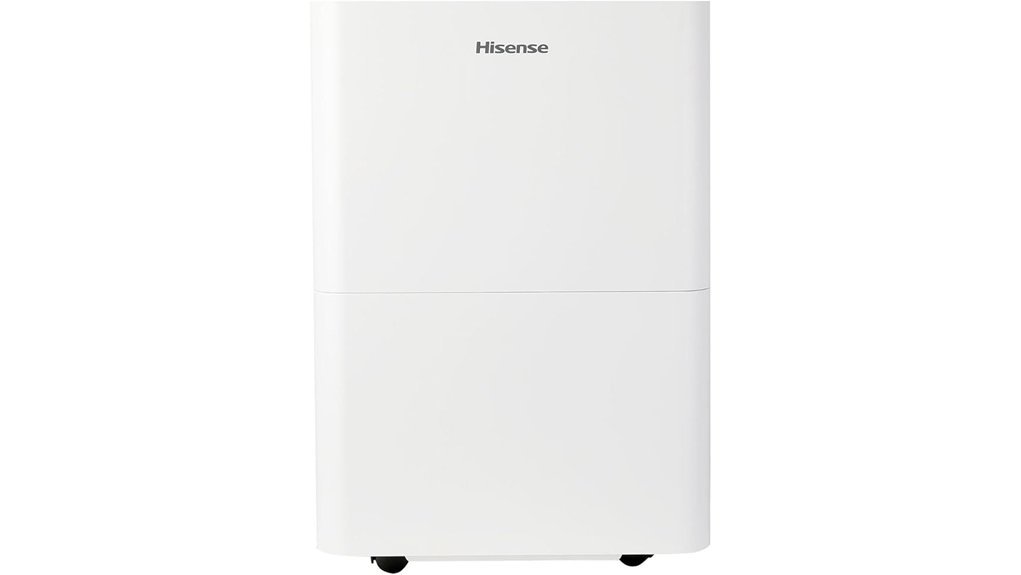
The Hisense 35-Pint Portable Dehumidifier fills the gap between compact 22-pint models and larger 50-pint machines. The linked model is listed with a 35-pint daily capacity, three speeds, continuous operating mode, a 115-volt power requirement, low-temperature operation down to 38°F, and coverage guidance up to 3,000 square feet.
This model may be a practical choice when a 22-pint unit appears undersized but a 50-pint machine would take up more space than necessary. Its approximately 32.6-pound listed weight and built-in carrying features still require careful handling on stairs.
Who Should Buy It: Medium-to-large bedrooms, living areas, finished basements, garages, and home offices with persistent humidity.
Why You’ll Like It:
- The 35-pint capacity offers a useful middle ground for moderate-to-heavy humidity.
- Three fan speeds help balance moisture removal and operating sound.
- Automatic shut-off protects against bucket overflow when the tank fills.
- The compact cabinet is smaller than many high-capacity alternatives.
- The listing describes low-temperature operation for cooler residential spaces.
Who Should Avoid It:
- The 3,000-square-foot figure is a maximum coverage claim, not a guarantee for a cold or very wet basement.
- The linked model does not advertise a built-in drainage pump.
- Confirm the included drainage accessories before planning continuous operation.
Keystone 50-Pint Portable Dehumidifier for Large Rooms
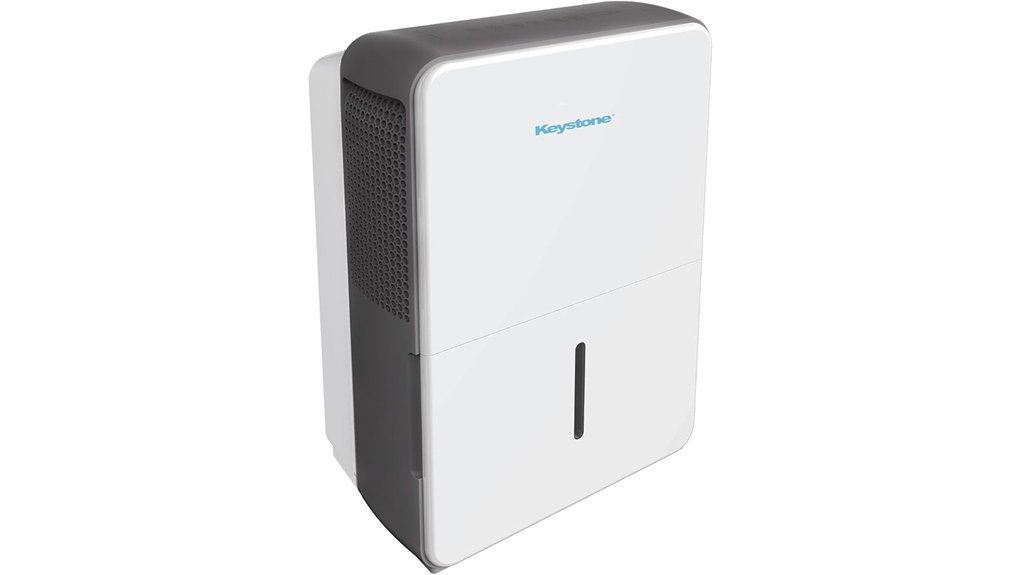
The Keystone 50-Pint Portable Dehumidifier is a practical alternative to the pump-equipped Hisense. Model KSTAD504F is listed with a 50-pint daily capacity, coverage guidance up to 4,500 square feet, a 1.8-gallon tank, four casters, normal and turbo settings, auto-defrost, auto-restart, a washable filter, and a full-bucket shut-off system.
It also supports continuous gravity drainage through a standard garden hose. This is useful when the unit can sit above a floor drain or sump opening, but the hose must maintain a steady downward slope because the model does not advertise a built-in lift pump.
Who Should Buy It: Large rooms and basements with a nearby floor drain positioned below the dehumidifier.
Why You’ll Like It:
- The 50-pint capacity is suitable for heavier household moisture loads.
- Four casters improve portability on level floors.
- Normal and turbo modes offer a choice between routine and faster operation.
- Auto-defrost and auto-restart support more convenient long-term operation.
- A washable filter and full-bucket alert simplify routine maintenance.
Who Should Avoid It:
- The listed 51 dB operating sound may be noticeable in a quiet bedroom or office.
- Continuous drainage requires a downhill hose route.
- A standard garden hose may not be included.
- Moving a full-size compressor unit between floors can be difficult despite its casters.
Factors to Consider When Choosing a Portable Dehumidifier in Canada
A useful dehumidifier should control the moisture load without running continuously, filling its bucket too quickly, or freezing in a cool room. Consider the following points before choosing a model.
Choose Capacity Before Square Footage
Daily capacity, measured in pints per day under stated test conditions, is generally more useful than a large coverage number. A 22-pint model may be enough for a moderately humid bedroom or finished room, while a damp basement may benefit from a 35-, 50-, or higher-capacity model.
Manufacturer coverage figures assume particular test conditions and room layouts. Reduce your expectations when the space has high ceilings, open stairways, several connected rooms, active water intrusion, wet laundry, or poor exterior drainage. Do not directly compare capacity numbers that were measured under different temperature and humidity conditions.
Measure Relative Humidity
Use a separate digital hygrometer to check the actual relative humidity. A general indoor target is approximately 30% to 50% RH. During a cold Canadian heating season, a lower range around 30% to 40% may help reduce condensation on windows and other cold surfaces.
Setting a dehumidifier unnecessarily low can waste electricity and make the room feel overly dry. For many basements, starting near 45% to 50% RH is reasonable, followed by small adjustments based on condensation and comfort.
Consider Low-Temperature Operation
Standard compressor dehumidifiers can lose efficiency when room temperatures fall. Frost may form on the evaporator coil, causing the compressor to cycle without removing much water.
If your basement, garage, cottage, or storage room regularly drops below approximately 18°C, confirm the manufacturer’s minimum operating temperature and look for effective auto-defrost protection. Do not operate a unit in freezing conditions unless its documentation specifically permits it.
Compare Drainage Options
Manual bucket drainage offers the simplest setup but requires regular emptying. It works well when the unit collects only a modest amount of water or when no drain is nearby.
Gravity drainage uses a hose that runs continuously downhill to a floor drain, sump opening, or another approved drain point. Avoid loops, upward sections, pinches, and loose connections.
Pump drainage can move water upward or over a longer route. It is often the better choice for a basement where the only suitable drain is a sink above the dehumidifier.
Look for Energy Efficiency
Dehumidifiers may operate for many hours during humid weather, so efficiency matters. Look for a current ENERGY STAR certification and compare the Integrated Energy Factor, expressed as litres of water removed per kilowatt-hour. A higher IEF indicates greater moisture removal for the electricity consumed.
Automatic humidity control, timers, clean filters, unobstructed airflow, and correctly sized capacity can also reduce unnecessary running time.
Evaluate Operating Noise
Full-size compressor dehumidifiers normally produce fan noise, compressor vibration, and changes in sound when they cycle. A low fan setting may be suitable for a bedroom, but it may also remove moisture more slowly.
For a sleeping area or home office, review the listed decibel level and return policy. Place the unit on a firm, level surface and keep it from touching walls, furniture, or loose objects that could amplify vibration.
Check Portability
Casters make a unit easier to move across one level, but they do not make a 30- to 50-pound appliance easy to carry upstairs. Check the weight, cabinet dimensions, handle placement, and stair route before buying.
After transporting a compressor dehumidifier on its side, follow the manufacturer’s instructions regarding how long it should remain upright before being switched on.
Check Canadian Purchase Details
Before placing a cross-border order, verify:
- Delivery availability for your Canadian postal code
- Canadian warranty coverage and authorized service locations
- Return shipping responsibility
- 115-volt electrical compatibility and a recognized Canadian certification mark on the appliance
- Applicable safety and energy certifications
- Import fees, taxes, and brokerage charges
- Whether the hose, pump tube, or other drainage accessories are included
Address the Moisture Source
A dehumidifier controls airborne moisture but does not repair a leak. Check gutters, grading, foundation cracks, plumbing, sump operation, dryer venting, bathroom exhaust, and window condensation. Correcting the moisture source can reduce operating costs and prevent the dehumidifier from running continuously.
Before you buy
- Measure the room with a separate hygrometer.
- Choose bucket, gravity-drain, or pump drainage before selecting a model.
- Confirm the minimum operating temperature for the intended room.
- Check the exact model number, included hose or pump tubing, and warranty terms.
- For a Canadian order, confirm delivery, import costs, returns, and a Canadian electrical certification mark.
Safety note:
Keep the dehumidifier and its electrical connection away from showers, tubs, standing water, and splash zones. Use a grounded outlet, keep the air intake clear, secure the drain hose, and follow the manufacturer’s placement and maintenance instructions.
Frequently Asked Questions
What Size Dehumidifier Do I Need?
A 22-pint unit may be suitable for moderate humidity in a bedroom or medium room. A 35-pint model offers more capacity for larger areas, while a 50-pint or higher-capacity unit is generally more appropriate for a persistently damp basement. Use the room’s measured humidity and moisture conditions rather than square footage alone.
Can I Use a Dehumidifier During a Canadian Winter?
Yes, but first check the room temperature and the model’s minimum operating limit. Compressor dehumidifiers can frost up in cold spaces. During winter, also avoid lowering indoor humidity excessively; approximately 30% to 40% RH may be more suitable in many heated Canadian homes.
Is a Built-In Pump Worth It?
A pump is useful when the water must travel upward to a sink or through a route that cannot remain continuously downhill. If you already have a nearby floor drain below the unit, a less expensive gravity-drain model may be sufficient.
How Often Should I Clean the Filter?
Inspect the filter every two to four weeks during frequent operation and clean it according to the manual. Dust, pet hair, and blocked airflow can reduce moisture removal, increase operating time, and contribute to coil icing.
Why Is My Dehumidifier Running Without Collecting Water?
The room may already be near the selected humidity level, the temperature may be too low, the filter or airflow path may be blocked, or frost may have formed on the coils. Confirm the reading with a separate hygrometer and inspect the unit according to its troubleshooting guide.
Can One Portable Dehumidifier Handle Several Rooms?
It may help adjoining rooms when doors remain open and air circulates freely, but walls and closed doors reduce performance. A portable dehumidifier is usually most effective in one open area rather than several separated rooms.
How Long Do Portable Dehumidifiers Last?
Service life varies with operating hours, room conditions, maintenance, drainage setup, and component quality. Regular filter cleaning, unrestricted airflow, correct storage, and keeping the unit away from freezing conditions can help reduce premature failure.
Does an 80-Pint Rating Always Beat a 50-Pint Rating?
Not automatically. Capacity figures must be compared under the same test conditions. A rating measured at very high temperature and humidity can look larger than a standard-condition rating for the same machine. Check the stated test condition or standard-capacity figure before comparing models.
What Electrical Certification Should Canadian Buyers Check?
Confirm that the appliance itself bears a recognized Canadian certification mark, such as CSA, cUL, or cETL. A U.S. plug and a 115-volt rating do not by themselves confirm compliance with Canadian electrical safety requirements.
Final Recommendation
For a large Canadian basement where gravity drainage is difficult, the Hisense 50-Pint with Built-In Pump offers the most convenient overall setup. Choose the Waykar when maximum listed capacity is the priority, but compare its 62-pint standard-condition figure rather than relying only on the 80-pint high-humidity claim. Choose the Keystone 50-Pint when you have a nearby lower drain and do not need a pump.
For bedrooms and medium rooms, the Frigidaire 22-Pint stands out for Wi-Fi control, while the Midea 22-Pint provides simpler conventional controls. The Hisense 35-Pint is the balanced middle option when 22 pints seems too small but a 50-pint unit is more than the space requires.
Whichever model you select, verify Canadian delivery, electrical certification, warranty details, minimum operating temperature, and drainage accessories. Those checks are more valuable than choosing a unit solely because it advertises the largest square-foot number.