Affiliate disclosure: As an Amazon Associate, we may earn a commission from qualifying purchases made through links in this article, at no extra cost to you.
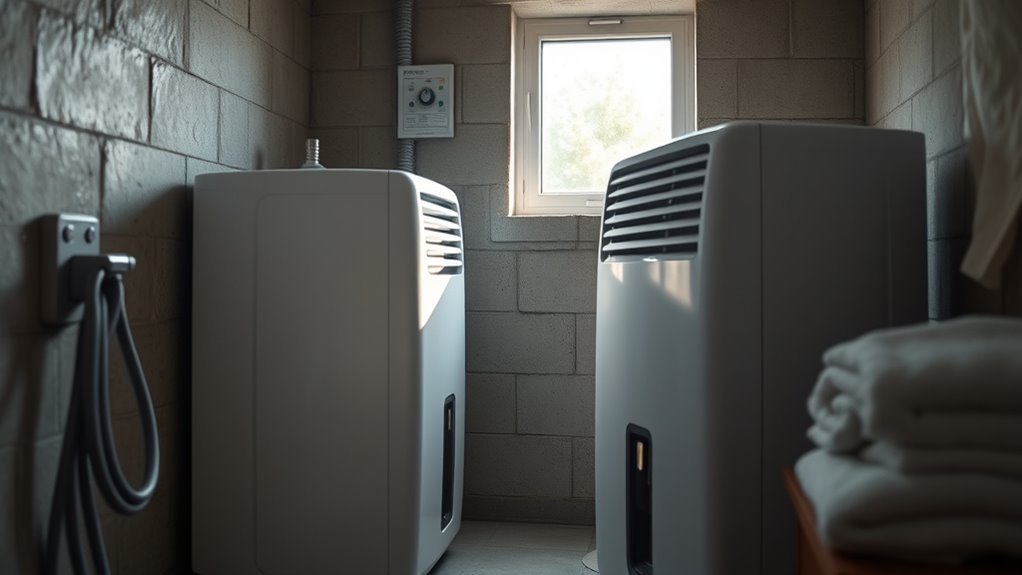
Choosing the best dehumidifier for home use depends on more than a seller’s square-foot claim. A damp basement usually needs a compressor dehumidifier with meaningful water-removal capacity and continuous drainage, while a compact thermoelectric model is better suited to mild, localized moisture in a bedroom, bathroom, closet, or RV. This guide compares seven relevant options for 2026 and helps you choose based on moisture-removal capacity, room conditions, drainage, noise, and operating style. Recommendations are based on available specifications and use-case fit; no hands-on testing is claimed.
Quick verdict
- Best overall for stronger moisture control: PLUSCENT PD10 32 Pint Dehumidifier for larger rooms and continuous household use.
- Best for medium rooms: Aiusevo AS280 for buyers who want compressor-based moisture removal, a drain hose, and adjustable humidity control.
- Best compact option: TABYIK 35 OZ for mild humidity in small, enclosed bedrooms, bathrooms, closets, or RVs.
- Important: Thermoelectric mini dehumidifiers are not substitutes for compressor units in wet basements or areas with leaks.
Quick Comparison of the Best Home Dehumidifiers
| Pick | Product | Type | Best Use | Stated Capacity | Drainage | Main Limitation | Details |
|---|---|---|---|---|---|---|---|
| Best Overall | PLUSCENT PD10 32 Pint | Compressor | Large rooms and damp areas | Seller-rated 32 pints per day; test conditions not clearly stated | Tank or continuous drain hose | Larger and louder than mini units | Check on Amazon |
| Medium-Room Pick | Aiusevo AS280 | Compressor | Bedrooms, living rooms, and moderately damp basements | Up to 21 pints at 95°F and 90% RH | Tank or continuous drain hose | Capacity uses warm, humid test conditions | Check on Amazon |
| Auto-Control Mini | NovaLivin 68 OZ | Thermoelectric | Small, warm rooms needing automatic settings | Up to 34 oz (about 1.0 liter) per day at 86°F and 80% RH | Removable tank only | Not intended for wet basements | Check on Amazon |
| Compact Pick | TABYIK 35 OZ | Thermoelectric | Bedrooms, closets, bathrooms, and RVs | Up to 0.45 liter per day at 86°F and 80% RH | Removable tank only | Single-speed localized moisture control | Check on Amazon |
| Custom-Control Pick | BeOkay 58 OZ | Thermoelectric | Small bedrooms and bathrooms | Seller-rated at 0.3 liter per day | Removable tank only | Slow extraction in severe humidity | Check on Amazon |
| Auto-Defrost Mini | NeedDuck 44 OZ | Thermoelectric | Closets, RVs, and small rooms | No verified daily extraction figure | Removable tank only | No standardized high-capacity rating | Check on Amazon |
| Large-Tank Mini | BEDRED 95 OZ | Thermoelectric | Localized moisture control with fewer tank checks | 95-ounce tank; daily removal not verified | Removable tank only | Do not rely on the square-foot claim alone | Check on Amazon |
How these products were selected: We compared identifiable model specifications, moisture-removal claims, operating type, tank size, drainage options, controls, portability, and realistic use cases. No hands-on testing is claimed.
Important: Seller-stated capacities and coverage figures may use different test conditions, so they are not perfectly standardized. The orange Amazon buttons are affiliate links, and listing details can change; confirm the current model, manual, warranty, and included accessories before ordering.
Best Overall: PLUSCENT PD10 32 Pint Dehumidifier for Large Rooms
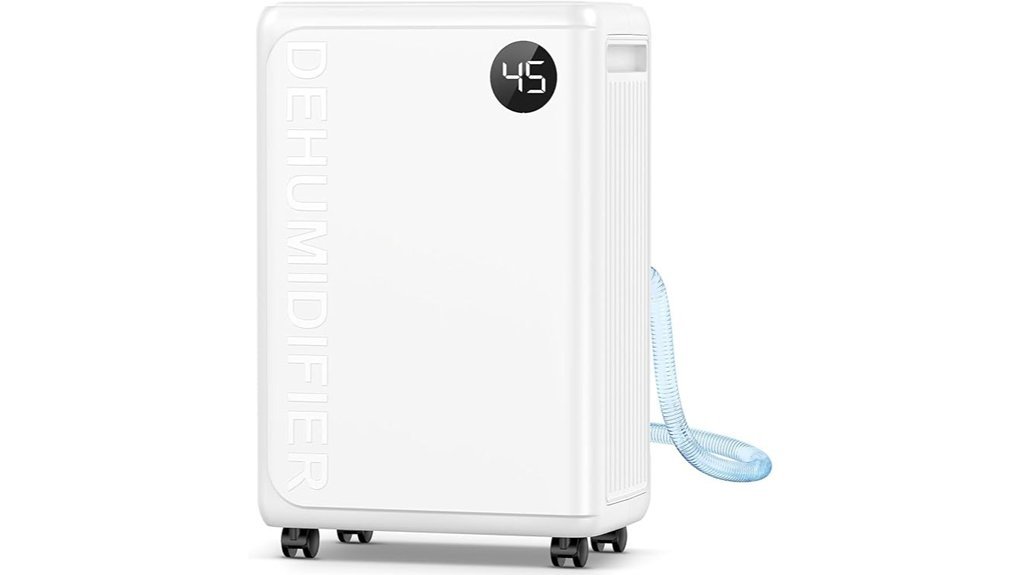
The PLUSCENT PD10 32 Pint Dehumidifier is the most suitable all-around option in this roundup for buyers dealing with persistent humidity in a larger bedroom, living area, laundry room, or basement. It is a compressor model with a seller-rated removal capacity of up to 32 pints per day, a 2-liter tank, and marketed coverage of up to 2,500 square feet. Because the available listing does not clearly identify the test conditions behind the 32-pint figure, treat it as a seller rating rather than a directly standardized DOE comparison.
Its DEHU, CONT, and DRY modes let you choose between normal humidity control, continuous operation, and laundry drying. The unit also includes adjustable humidity settings, automatic shutoff, automatic restart, a washable filter, a 24-hour timer, and both tank and hose drainage options.
Best For: Homeowners who need meaningful humidity control in a medium or large room and have access to a suitable drain for continuous operation.
Pros:
- Seller-rated removal capacity of up to 32 pints per day.
- Continuous drainage connection reduces tank-emptying work.
- Multiple modes, adjustable humidity control, timer, child lock, and automatic restart.
- Washable filter helps simplify routine maintenance.
Cons:
- The advertised square-foot figure and 32-pint claim should not replace an assessment of the room’s actual moisture level and test conditions.
- The 2-liter tank can fill quickly when the drain hose is not used.
- It is larger and less convenient to move than compact thermoelectric units.
Best for Medium Rooms: Aiusevo AS280 Dehumidifier
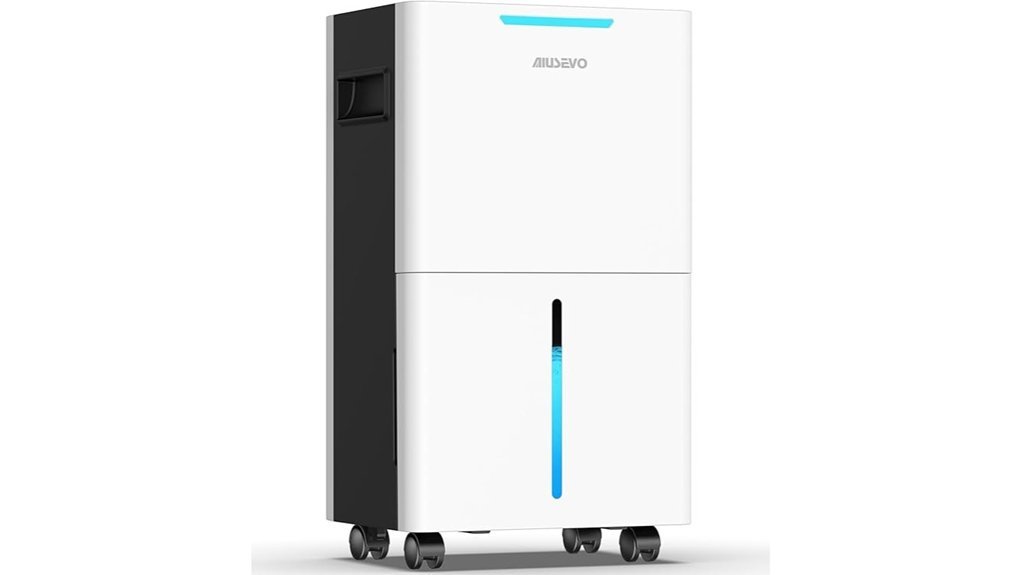
The Aiusevo AS280 is a compressor dehumidifier designed for buyers who want more effective moisture removal than a mini thermoelectric unit but do not necessarily need a larger 32- or 50-pint machine. The manufacturer rates it to remove up to 21 pints per day at 95°F and 90% relative humidity.
Those warm, humid test conditions can produce a higher capacity figure than current DOE Appendix X1 testing, so real-world extraction will vary. Even with that limitation, the AS280 offers useful household features, including DEHU, DRY, and CONT modes, adjustable humidity control from 30% to 80%, automatic defrost, automatic restart, a 24-hour timer, a 2-liter tank, wheels, and a drain-hose connection.
Best For: Bedrooms, living rooms, laundry areas, and moderately damp basements where continuous drainage is available.
Pros:
- Compressor design provides stronger moisture removal than thermoelectric mini models.
- Three operating modes cover routine control, laundry drying, and continuous use.
- Includes automatic defrost, automatic restart, a timer, wheels, and hose drainage.
- Adjustable humidity control helps prevent unnecessary continuous operation.
Cons:
- The 21-pint figure is based on 95°F and 90% RH rather than standard DOE test conditions.
- The marketed 1,500-square-foot coverage may be optimistic in a very damp room.
- The tank still requires frequent attention when continuous drainage is unavailable.
Best Mini With Automatic Humidity Control: NovaLivin 68 OZ Dehumidifier
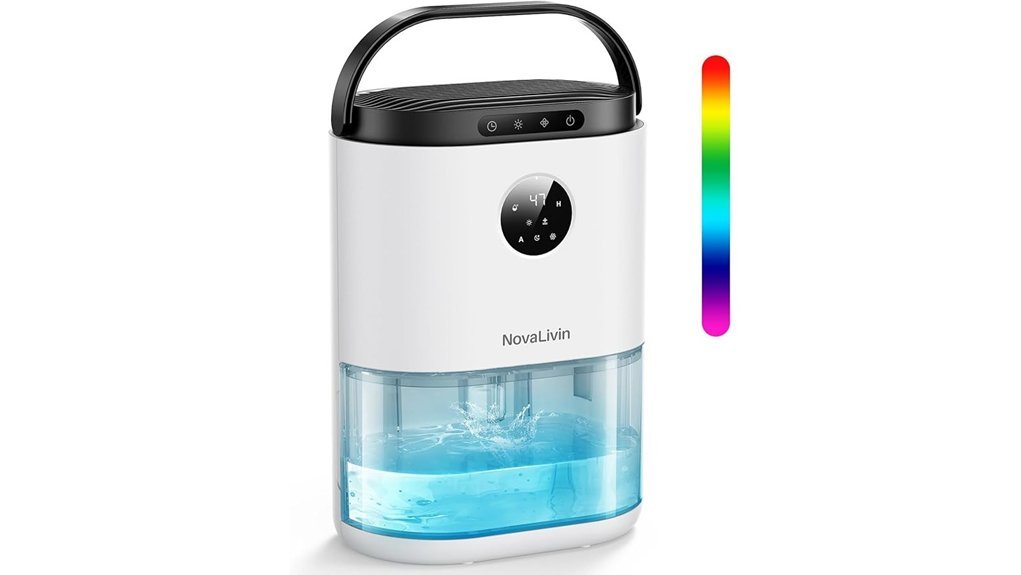
The NovaLivin 68 OZ dehumidifier is a compact thermoelectric option for a small, warm, enclosed room. Its main advantage over basic mini models is its automatic humidity control and digital display, which provide more feedback than a simple nonstop on-and-off design. Control details can vary by listing version, so confirm the exact mode labels for the color and ASIN you select.
Available specifications identify a 68-ounce tank, multiple operating modes, automatic shutoff, a digital display, timer controls, and seller-rated extraction of up to 34 ounces, or about 1.0 liter, per day at 86°F and 80% relative humidity. As with most thermoelectric units, that is a warm, highly humid test condition. Expect considerably slower collection in cooler or only mildly humid rooms.
Best For: Small rooms where automatic humidity presets matter more than high-capacity water removal.
Pros:
- Automatic humidity control and a digital display offer more feedback than a basic mini unit.
- Large 68-ounce tank reduces the number of tank checks compared with smaller models.
- Compact body is easier to move between rooms.
- Automatic shutoff helps prevent tank overflow.
Cons:
- Not a suitable replacement for a compressor dehumidifier in a wet basement.
- Mode and timer details can vary across listing versions, so the exact control panel should be confirmed before purchase.
- The 34-ounce daily-removal claim depends on warm, highly humid test conditions.
- Thermoelectric performance falls in cooler conditions.
Best Compact Pick: TABYIK 35 OZ Dehumidifier
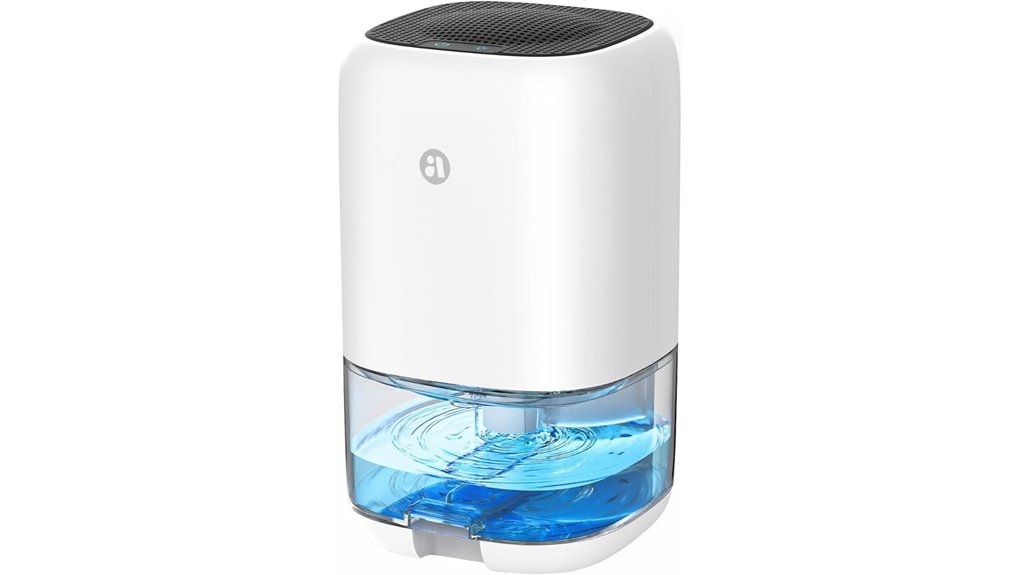
The TABYIK 35 OZ Dehumidifier is designed for localized moisture control in a small bedroom, bathroom, closet, office, or RV. It weighs about 2.2 pounds and measures approximately 5.9 by 5.9 by 10.1 inches, making it one of the easiest options here to place on a counter, shelf, or bedside surface with adequate airflow.
The manufacturer rates it to collect up to 0.45 liter, or roughly 16 ounces, per day at 86°F and 80% relative humidity. That is a best-case warm-weather figure, not a promise of daily collection in every home. The unit has a 35-ounce transparent tank, automatic shutoff, a carrying handle, and optional seven-color lighting.
Best For: Small enclosed spaces with mild seasonal dampness and no need for continuous drainage.
Pros:
- Compact dimensions and low weight make placement and transport easy.
- Transparent tank lets you see when water is collecting.
- Automatic shutoff helps prevent overflow.
- Simple controls are suitable for buyers who do not need advanced programming.
Cons:
- Slow moisture removal compared with a compressor model.
- Performance depends strongly on room temperature and humidity.
- No continuous drain connection.
- The decorative lighting does not improve dehumidification performance.
Best Custom Controls: BeOkay 58 OZ Dehumidifier
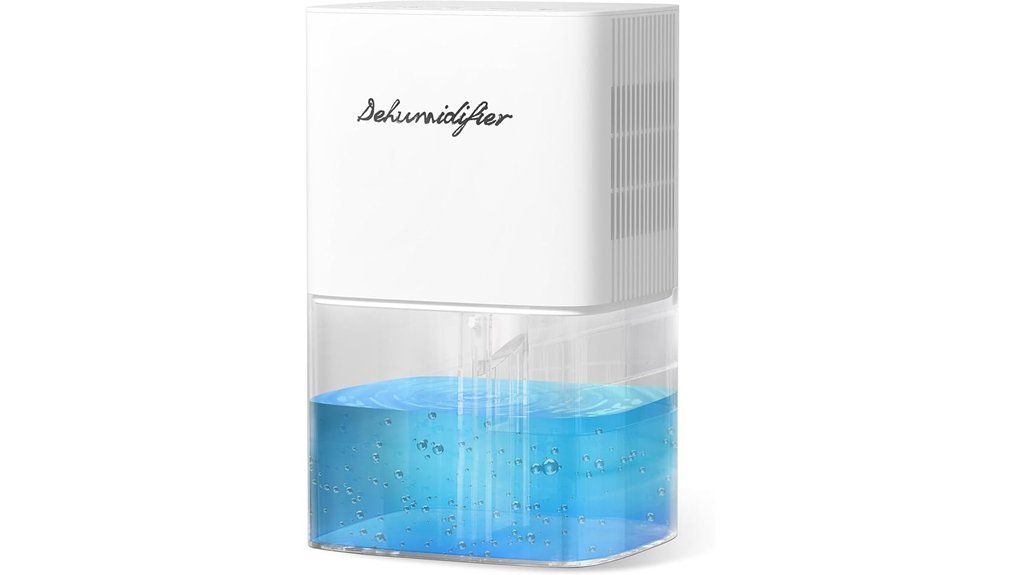
The BeOkay DH-A2 combines a 58-ounce tank with several operating modes, timer settings, automatic shutoff, and adjustable lighting. Its rated extraction capacity is approximately 0.3 liter per day, so it is intended for gradual moisture control rather than rapid drying.
The unit weighs a little over 2.3 pounds and is marketed for small spaces around 230 square feet. That figure should be treated as a placement guide rather than a guarantee. A closed bathroom or bedroom with mild humidity is a more realistic use than an open 230-square-foot area with active water intrusion.
Best For: Buyers who want a small thermoelectric dehumidifier with timers, multiple modes, and a relatively large tank.
Pros:
- Three operating modes provide more flexibility than a single-speed unit.
- 58-ounce tank reduces emptying frequency under mild conditions.
- Timer, automatic shutoff, and defrost functions improve convenience.
- Compact size works well in bedrooms, bathrooms, and similar enclosed spaces.
Cons:
- A 0.3-liter daily rating is not enough for severe dampness.
- The room still needs ventilation and leak control when moisture has a structural source.
- Lighting options may add little value for buyers focused only on performance.
Best Auto-Defrost Mini: NeedDuck 44 OZ Dehumidifier
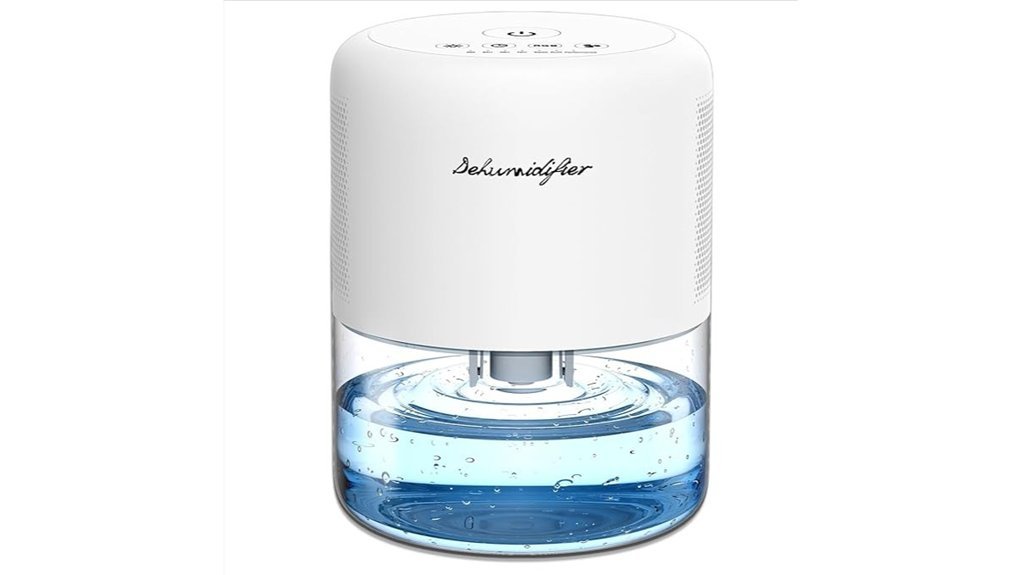
The NeedDuck 44 OZ model is a low-wattage thermoelectric dehumidifier for closets, RVs, small bedrooms, and bathrooms. It weighs about 2.6 pounds, measures approximately 5.91 inches wide by 8.46 inches high, and uses 28 watts according to available specifications.
Its features include automatic shutoff, automatic defrost, three operating modes, four timer options, and ten optional light colors. The listing markets the unit for spaces around 215 square feet, but no standardized high-capacity water-removal rating was available. It is therefore best viewed as a compact spot-control appliance.
Best For: Buyers seeking a simple, portable unit for localized humidity with timers and automatic defrost.
Pros:
- Compact footprint and low weight simplify placement.
- Automatic defrost can help protect operation when the cooling surface begins to frost.
- Multiple modes and timer settings offer useful control.
- 44-ounce tank is larger than many entry-level mini units.
Cons:
- No verified standardized daily moisture-removal capacity.
- Not suitable for high-volume basement dehumidification.
- Tank drainage requires regular manual attention.
Best Large-Tank Mini: BEDRED 95 OZ Dehumidifier
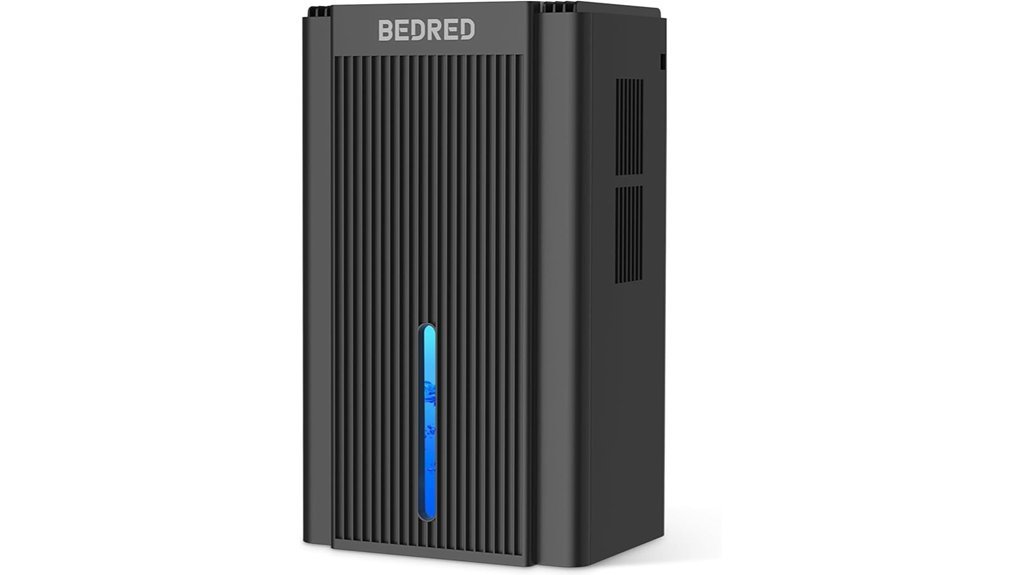
The BEDRED CT11 has a 95-ounce tank, automatic shutoff, sleep operation, and seven-color ambient lighting. Its larger tank can be convenient when a smaller thermoelectric unit would require frequent emptying.
Although the listing promotes coverage of up to 1,000 square feet, a standardized daily water-removal capacity was not available for verification. Buyers should not assume that the large tank or coverage claim gives it performance comparable to a 21- or 32-pint compressor unit. It is more appropriately used for gradual moisture control in a smaller enclosed area.
Best For: Buyers who prefer a large collection tank and quiet thermoelectric operation for localized household dampness.
Pros:
- 95-ounce tank can reduce how often the reservoir needs to be emptied.
- Automatic shutoff helps prevent overflow.
- Compact design is easier to position than a full-size compressor unit.
- Sleep operation and switchable lighting suit bedroom use.
Cons:
- No verified daily extraction figure for an objective performance comparison.
- The promoted 1,000-square-foot coverage should be treated cautiously.
- Not suitable for structural moisture, leaks, or severe basement dampness.
- No continuous drainage connection is identified.
Factors to Consider When Choosing a Home Dehumidifier
A dehumidifier should be selected according to the severity of the moisture problem, room temperature, extraction capacity, drainage arrangement, and intended operating schedule. Decorative lighting and app-style controls are secondary considerations.
Compressor vs. Thermoelectric Dehumidifiers
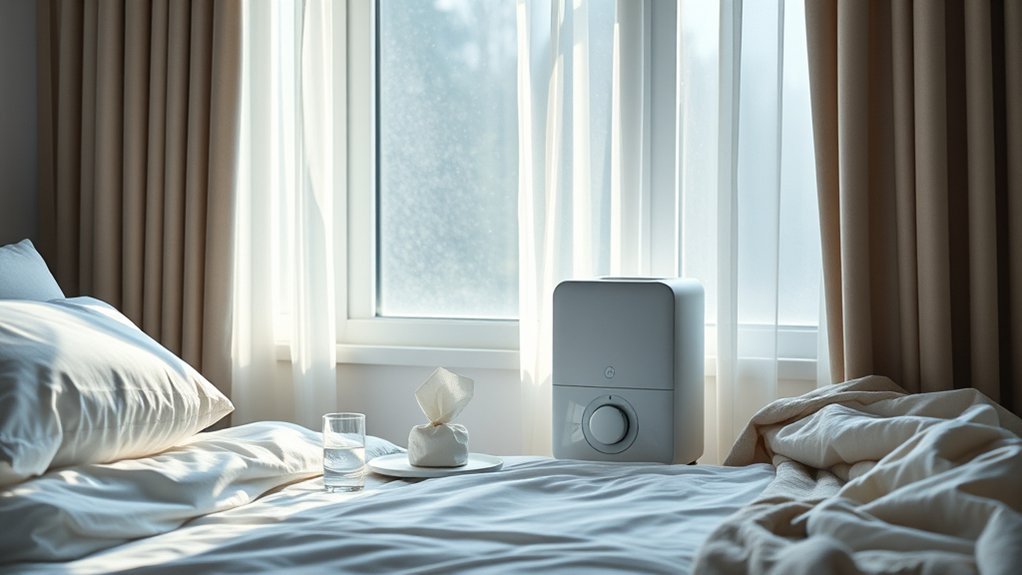
A compressor dehumidifier circulates refrigerant through cold coils and generally removes much more water than a small thermoelectric model. It is the more appropriate choice for a damp basement, laundry room, or large living area. A thermoelectric unit uses a Peltier cooling plate and is usually smaller, lighter, quieter, and slower. It works best for mild moisture in a small, warm, enclosed room.
Coverage Area and Dampness Level
Do not choose a unit using square footage alone. A 500-square-foot room with wet walls or seepage can need more capacity than a much larger room that only feels slightly musty. Check the room with a hygrometer and consider whether it is mildly damp, consistently damp, or visibly wet. When comparing compressor models, choosing slightly more capacity is usually safer than choosing too little.
Moisture-Removal Capacity
Full-size dehumidifiers are commonly described in pints per 24 hours, but the test conditions matter. A capacity measured at 95°F and 90% relative humidity should not be assumed to equal a capacity measured through the current U.S. Department of Energy procedure. Look for DOE Appendix X1 capacity when available and treat seller-rated warm-condition figures as maximum performance claims.
Noise Level
Thermoelectric models are generally quieter because they do not use a refrigerant compressor. Compressor units move more air and may produce noticeable fan, compressor, or vibration noise. For a bedroom, look for a sleep setting and compare published decibel information, but remember that seller-stated noise figures may not represent every fan speed or room surface.
Energy Efficiency
For a compressor dehumidifier that may run for many hours each day, check whether the exact brand and model number appears in the official ENERGY STAR certified dehumidifier database. Certification should be confirmed by model number rather than assumed from general marketing language. Mini thermoelectric models may draw fewer watts, but they can also remove much less water, so wattage alone does not measure efficiency.
Tank and Continuous Drainage Options
A removable tank is adequate for mild or occasional use. For persistent humidity, continuous drainage can save considerable work. Gravity drainage requires the hose to slope downward from the unit to a lower drain without kinks. If water must travel upward, choose a unit with a built-in pump or use an appropriate condensate pump.
Tank Size vs. Moisture-Removal Capacity
A large reservoir does not automatically mean a dehumidifier removes water quickly. Tank size tells you how much collected water the unit can hold before shutoff; daily extraction tells you how much moisture it may remove under stated conditions. This distinction is especially important when comparing large-tank thermoelectric models with smaller-tank compressor units.
Room Temperature and Defrost
Cool air contains less moisture, and dehumidifiers generally collect less water as the temperature drops. A compressor unit with automatic defrost is usually a better basement choice than a basic thermoelectric model. Avoid operating a product outside the temperature range stated in its manual.
Size and Portability
For occasional movement, look for wheels, a secure handle, and a tank that locks firmly into place. Small thermoelectric units are easier to carry, but their portability comes with much lower extraction capacity. A larger compressor model may be worth the additional space when the humidity problem is persistent.
Useful Operating Features
A humidistat, automatic restart, automatic defrost, full-tank shutoff, washable filter, timer, and continuous mode can improve daily use. Prioritize these features before decorative lights. Automatic restart is particularly useful after a power interruption, while a child lock may help in family living areas.
Safety note: Place the dehumidifier upright on a stable surface, keep the intake and exhaust clear, use the required electrical outlet, and keep the unit away from direct splashing or standing water. Unplug it before cleaning or moving it, and follow the model manual’s clearance and operating-temperature instructions.
Before-you-buy checklist
- Measure the room’s humidity with a separate hygrometer.
- Fix leaks, seepage, and poor bathroom or dryer ventilation first.
- Choose a compressor model for a wet or consistently damp room.
- Confirm how the capacity was tested.
- Plan where the tank or drain hose will discharge.
- Check the operating-temperature range and defrost function.
- Confirm the exact model’s warranty and certification on the current listing.
Frequently Asked Questions
How Often Should I Empty the Water Tank?
Check the tank at least once a day when first using the dehumidifier. A tank can fill in a few hours in a very damp room, while it may take several days in a mildly humid space. Most units stop automatically when full, but leaving a full tank in place prevents further moisture removal. Use continuous drainage when possible for persistent humidity.
What Indoor Humidity Level Should I Use?
A practical target for many homes is approximately 30% to 50% relative humidity. Keeping humidity below 60% helps reduce conditions that support mold growth. Extremely low humidity can also be uncomfortable, so use a hygrometer instead of running the unit continuously without checking the room.
Can a Dehumidifier Help With Allergens?
Lower humidity can make the environment less favorable for dust mites and mold growth, but a dehumidifier does not capture airborne particles like an air cleaner and does not remove existing mold. Fix leaks, clean or replace contaminated materials appropriately, improve ventilation, and use suitable filtration when needed.
Can a Mini Dehumidifier Dry a Basement?
A small thermoelectric unit may help with localized moisture in a warm finished basement, but it is usually not suitable for a large, cool, or visibly wet basement. Choose a compressor model with adequate capacity, automatic defrost, and continuous drainage for serious basement humidity.
Are Dehumidifiers Energy-Efficient Appliances?
Efficiency varies by design and model. For full-size units, compare the exact model’s Integrated Energy Factor and current ENERGY STAR certification. A low-wattage mini unit may consume less electricity per hour, but it may need much longer to remove a relatively small amount of water.
What Maintenance Is Required?
Empty and wash the tank regularly, clean the air filter according to the manufacturer’s instructions, keep the intake and exhaust clear, inspect the drain hose, and remove dust from accessible grilles. Unplug the unit before cleaning and allow washable parts to dry fully before reinstalling them.
How Do I Determine the Right Size?
Measure the room, note its temperature, check the relative humidity, and assess whether the area is slightly damp, very damp, or wet. Choose capacity according to the moisture load rather than relying only on a promoted coverage number. For an actively wet area, correct the water source before expecting a dehumidifier to solve the problem.
Final Recommendation
For meaningful humidity control in a larger room or basement, the PLUSCENT PD10 32 Pint Dehumidifier is the strongest overall option in this group based on its seller-rated capacity, adjustable humidity control, and continuous drainage. The Aiusevo AS280 is a practical alternative for a medium-size room, provided you understand that its 21-pint rating uses warm, highly humid test conditions.
For mild dampness in a bedroom, bathroom, closet, or RV, the TABYIK 35 OZ, NovaLivin, BeOkay, NeedDuck, and BEDRED models offer compact operation, but they should be treated as localized moisture-control devices rather than full replacements for compressor dehumidifiers.
Whichever model you choose, use a hygrometer, aim for roughly 30% to 50% relative humidity, clean the unit regularly, and address leaks or ventilation problems at their source. A dehumidifier can help control airborne moisture, but it cannot repair the condition creating that moisture.