Affiliate disclosure: As an Amazon Associate, we may earn from qualifying purchases made through links in this article, at no extra cost to you.
Last updated: August 2, 2026.
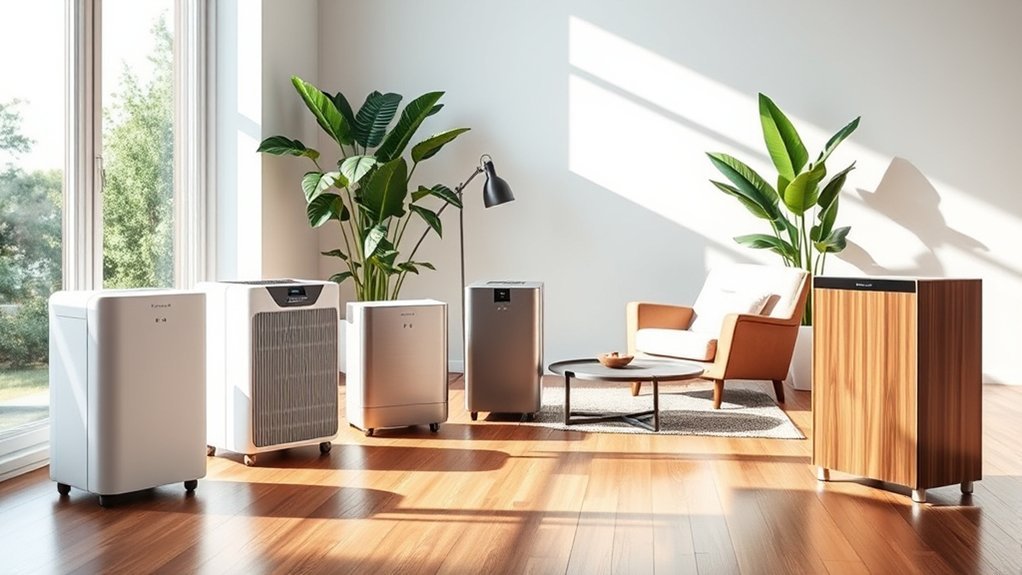
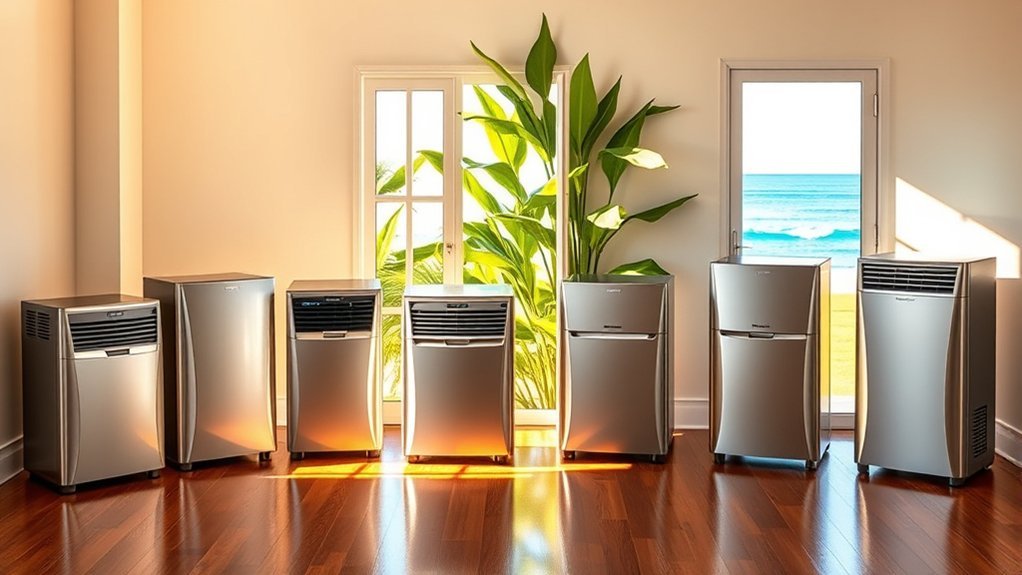
If you are comparing the best window air conditioners for dehumidifying, start with the correct BTU capacity for your room, a genuine Dry or Dehumidify mode, and a design that fits your window safely. The five models below are identifiable window-mounted or slider/casement air conditioners with a dedicated moisture-control function or a published dehumidification specification. Models without dependable documentation or clear current lifecycle support were excluded so the recommendations stay focused on the buyer intent.
Quick verdict
- Best overall: Whirlpool 10,000 BTU, with a published moisture-removal rate of up to 2.1 pints per hour while cooling.
- Best for small rooms: Midea 6,000 BTU for rooms up to 250 sq. ft. with Cool, Fan, and Dehumidify modes.
- Best smart-control option: LG 8,000 BTU with Dry mode, Wi-Fi, app control, and compatible voice-assistant support.
- Best for specialty windows: Keystone 10,000 BTU for compatible sliding or casement windows.
- Best straightforward alternative: ROVSUN 8,000 BTU with cooling, Dry mode, fan operation, a remote, and timer controls.
How these picks were screened
Selection is based on published manufacturer, manual, and listing information, not claimed hands-on testing. Each retained model had to be an identifiable window-mounted unit and offer a Dry or Dehumidify function or published moisture-removal data. Confirm the current Amazon listing, exact model number, window dimensions, electrical requirements, included installation hardware, warranty, and return terms before ordering.
Quick Comparison of Window Air Conditioners With Dehumidifying Modes
| Model | Cooling Capacity | Suggested Coverage | Moisture Feature | Best Fit | Amazon |
|---|---|---|---|---|---|
| Whirlpool | 10,000 BTU | Up to 450 sq. ft. | Up to 2.1 pints/hour while cooling | Medium rooms with substantial summer humidity | Check Price |
| Midea | 6,000 BTU | Up to 250 sq. ft. | Dehumidify mode | Small bedrooms, offices, and studies | Check Price |
| LG | 8,000 BTU | Up to 350 sq. ft. | Dry mode | Wi-Fi, app, and voice control | Check Price |
| Keystone | 10,000 BTU | Up to 450 sq. ft. | Published 0.9 pints/hour rate | Compatible slider or casement windows | Check Price |
| ROVSUN | 8,000 BTU | Up to 350 sq. ft. | Dry or dehumidifier mode | Straightforward 3-in-1 control | Check Price |
Important: Published coverage assumes typical room conditions. Strong sun, high ceilings, poor insulation, open doorways, kitchens, and extra occupants can change the capacity you need. A unit that is too large may cool the room quickly but remove less humidity because the compressor cycles off too soon.
Whirlpool 10,000 BTU Window Air Conditioner with Dehumidifier
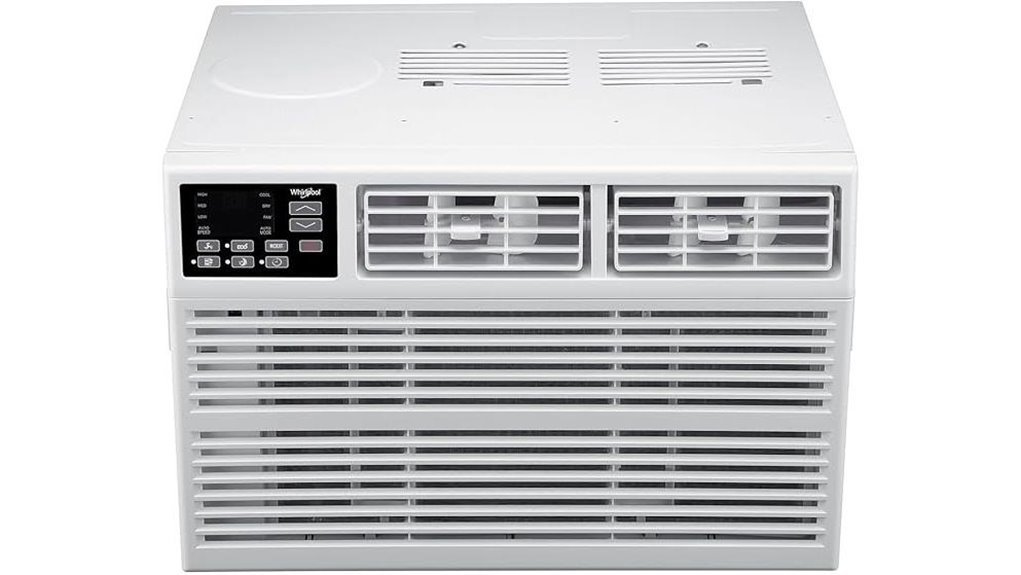
Best Overall
The Whirlpool 10,000 BTU window air conditioner is designed for rooms listed up to 450 square feet and publishes dehumidification of up to 2.1 pints per hour while cooling. Three cooling speeds, an Auto option, Eco mode, Sleep mode, a 24-hour timer, remote control, eight-way airflow, Auto Restart, and a washable filter make it the clearest all-around choice in this comparison.
Why you may like it: Whirlpool provides a specific moisture-removal figure rather than relying only on a general dehumidifier claim. That gives buyers a more useful comparison point when cooling and summer humidity are equally important.
Best For: Properly sized medium rooms that become hot and humid during summer.
Who Should Avoid It: It may be oversized for a small bedroom. Short compressor cycles can cool an undersized room quickly without allowing enough runtime for effective moisture removal.
Pros:
- Publishes moisture removal of up to 2.1 pints per hour while cooling.
- 10,000 BTU capacity for rooms up to the listed 450-square-foot coverage.
- Eco mode, Sleep mode, timer, Auto Restart, remote, directional airflow, and washable filter.
Cons:
- Can be too large for small rooms.
- Compressor and fan noise may be noticeable in very quiet sleeping spaces.
- Window opening, support, voltage, and circuit compatibility must be checked before installation.
Midea 6000 BTU 3-in-1 Window Air Conditioner
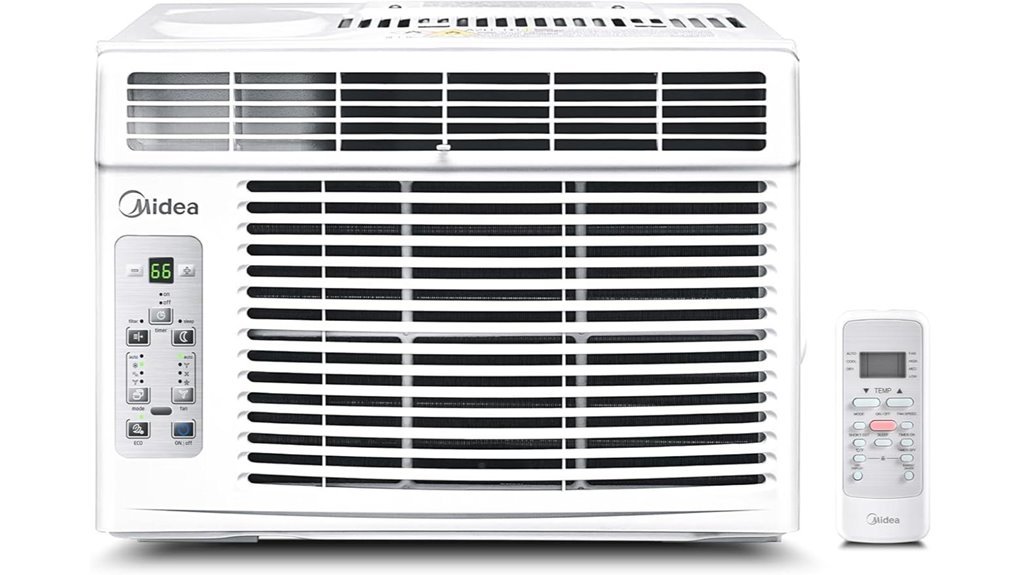
Best for Small Rooms
The Midea 6,000 BTU EasyCool is a 3-in-1 window air conditioner with Cool, Fan, and Dehumidify modes for spaces listed up to 250 square feet. It also includes Eco mode, a programmable timer, a remote, an LED display, a reusable filter, and straightforward side-panel installation for a compatible window.
Why you may like it: It provides an identifiable Midea model, a dedicated dehumidifying function, and an appropriate capacity for many small bedrooms, studies, and home offices. Choosing a properly sized 6,000-BTU model can also provide longer moisture-removing cycles than installing an unnecessarily large unit.
Best For: Small enclosed rooms up to the listed coverage where simple cooling and humidity control are the main priorities.
Who Should Avoid It: Buyers cooling open-plan spaces, connected rooms, or areas larger than the stated coverage should move to a properly sized 8,000- or 10,000-BTU option.
Pros:
- Cool, Fan, and Dehumidify modes directly support the intended use.
- Compact capacity is better suited to small rooms than an oversized medium-room unit.
- Remote, timer, Eco mode, and reusable filter improve everyday convenience.
Cons:
- Not intended for spaces beyond the listed small-room coverage.
- Requires a compatible window opening and secure installation.
- Dehumidify mode still uses the refrigeration system and may lower room temperature.
LG 8000 BTU Smart Window Air Conditioner
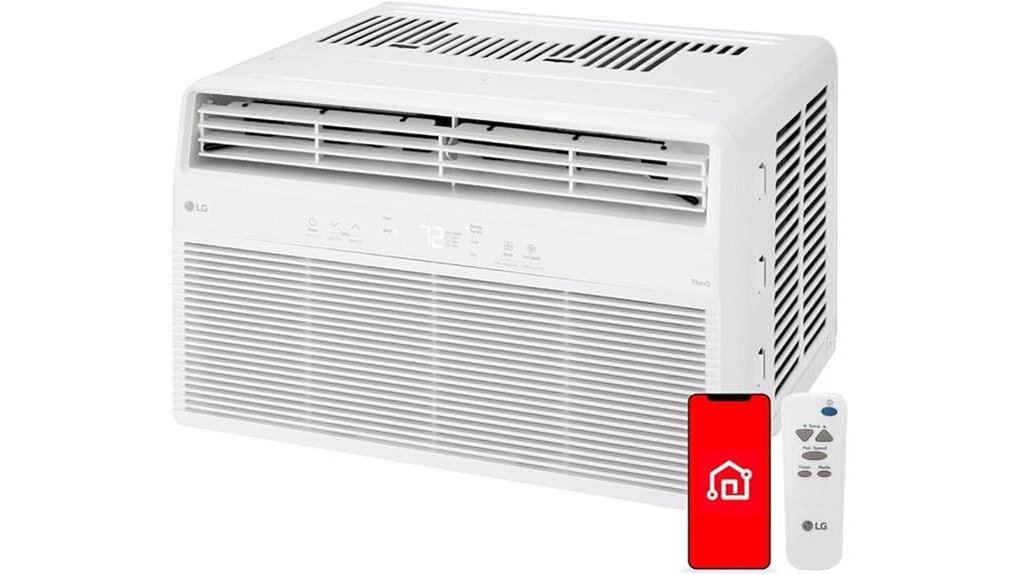
Best Smart Pick
The LG 8,000 BTU smart window air conditioner is designed for rooms listed up to 350 square feet. Its available operating functions include cooling, fan circulation, and moisture-control operation, while LG ThinQ, Alexa, Google Assistant, a remote, Auto Restart, a 24-hour timer, Sleep mode, Energy Saver mode, and adjustable airflow provide flexible control.
Why you may like it: App control makes it easier to adjust operation or create a schedule before a room becomes hot and muggy. The connected features improve convenience, while the 8,000-BTU size fits many bedrooms, offices, and medium rooms when correctly matched.
Best For: Medium rooms where remote app access, scheduling, voice control, and a dehumidifying function are useful.
Who Should Avoid It: Buyers who prefer basic controls or do not want to connect an appliance to Wi-Fi can choose a simpler non-smart model.
Pros:
- LG ThinQ app control with compatible Alexa and Google Assistant support.
- 8,000 BTU capacity for rooms up to the listed 350-square-foot coverage.
- Auto Restart, timer, Sleep mode, Energy Saver mode, remote, and adjustable airflow.
Cons:
- Smart features may be unnecessary for basic cooling and moisture control.
- Dry or dehumidifying operation may still lower the room temperature.
- Confirm the exact model, operating modes, window dimensions, and warranty on the current listing.
Keystone 10,000 BTU Slider Window Air Conditioner
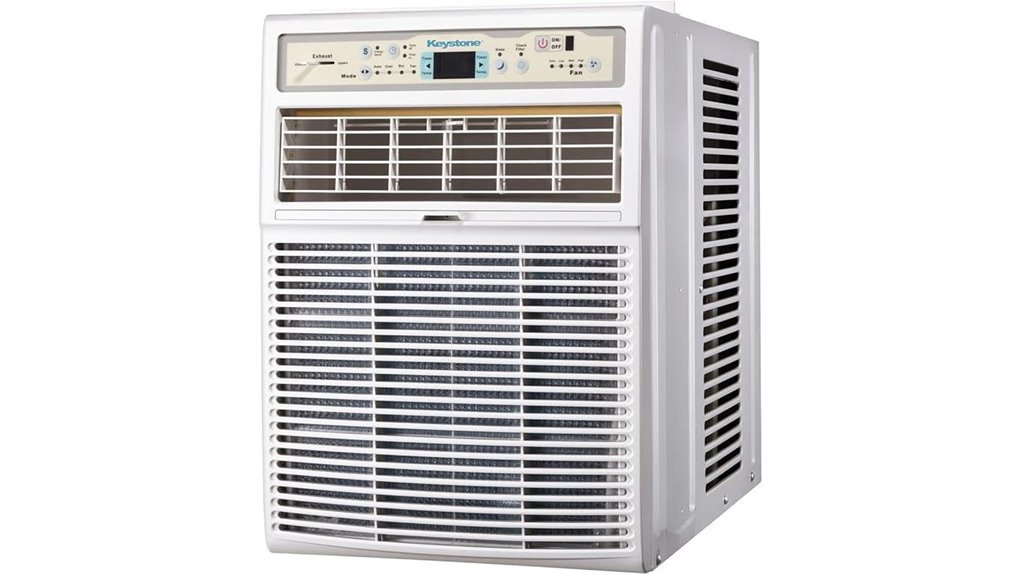
Best for Slider or Casement Windows
The Keystone 10,000 BTU model is made for compatible sliding and casement windows, where a conventional double-hung window air conditioner may not fit. It is listed for rooms up to 450 square feet and publishes moisture removal of 0.9 pints per hour. Multiple cooling and fan settings, adjustable louvers, Energy Saver mode, Sleep mode, a remote, and a washable slide-out filter complete the package.
Why you may like it: Its specialty-window design solves a genuine installation problem while still providing a published dehumidification rate. That makes it more relevant than trying to adapt a standard double-hung-window model to an unsuitable opening.
Best For: Medium rooms with a compatible horizontal slider or casement window opening.
Who Should Avoid It: Do not order it before checking the installation diagram, required opening dimensions, unit weight, support requirements, and the direction in which your window opens.
Pros:
- Designed specifically for compatible slider and casement windows.
- Publishes a 0.9-pint-per-hour dehumidification rate.
- Multiple operating settings with adjustable airflow and remote control.
Cons:
- Specialty dimensions limit window compatibility.
- Its weight and vertical installation may require a second person or additional support.
- Its published moisture-removal rate is lower than Whirlpool’s retained figure.
ROVSUN 8000 BTU Window Air Conditioner with Remote
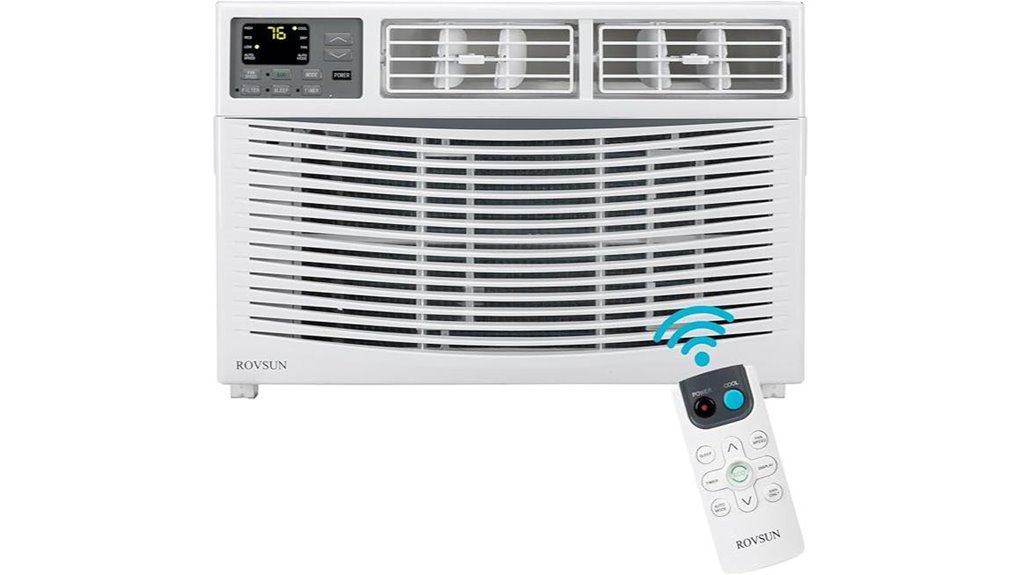
Best Straightforward Alternative
The ROVSUN combines 8,000 BTU cooling, a Dry or dehumidifying setting, and fan circulation in one window-mounted unit for rooms listed up to 350 square feet. Its remote, LED display, Sleep mode, ECO mode, timer, adjustable settings, and washable filter provide the main controls buyers expect from a medium-room window air conditioner.
Why you may like it: It covers the popular 8,000-BTU room-size range without making smart-home features the main selling point. It is a practical alternative for buyers who want cooling, moisture control, and fan circulation in one unit.
Best For: Buyers who want an uncomplicated medium-room window air conditioner with cooling, Dry, and fan functions.
Who Should Avoid It: Buyers who need a clearly published pints-per-hour rate or established app integration should prioritize another option.
Pros:
- Cooling, Dry or dehumidifying, and fan functions in one window unit.
- Remote control, LED display, Sleep mode, ECO mode, timer, and washable filter.
- 8,000 BTU capacity is suitable for many bedrooms and medium-size rooms when correctly sized.
Cons:
- The exact dehumidification rate is not clearly published for this ASIN.
- Window opening, support, voltage, and circuit compatibility must be confirmed.
- Confirm the exact current listing if app control or voice support is important to you.
Factors to Consider When Choosing a Window Air Conditioner for Dehumidifying
A window air conditioner can remove heat and moisture together, but good results depend on correct sizing, operating mode, room conditions, installation, and sufficient compressor runtime. Use the checklist below before comparing convenience features.
Match BTU Capacity to the Room
Start with room area, then adjust for strong sun, high ceilings, kitchens, poor insulation, open doorways, and extra occupants. As a general shopping guide, many 6,000 BTU models are marketed for up to 250 square feet, 8,000 BTU models for up to 350 square feet, and 10,000 BTU models for up to 450 square feet. Treat those figures as starting points rather than guarantees. An undersized unit may run constantly without reaching the set temperature, while an oversized unit can cool too quickly and cycle off before removing enough moisture.
Look for a Real Dry or Dehumidify Mode
Do not assume every window air conditioner has a dedicated dehumidifying setting. A true Dry mode normally operates the refrigeration system with reduced or controlled airflow to condense moisture while limiting, but not eliminating, cooling. Fan-only mode does not dehumidify because the compressor is not removing moisture from the air. Confirm the available modes in the current manual for the exact model or ASIN.
Compare Published Moisture Removal Carefully
Moisture removal may be reported in pints per hour, pints per day, or liters per hour. Compare figures only when the operating mode and test conditions are reasonably clear. A large daily number without a stated temperature or humidity condition can be misleading. Whirlpool and Keystone publish hourly figures in the information reviewed for this article, while the other retained models confirm a Dry or dehumidifying function without presenting an equally clear rate.
Use CEER, EER, and EnergyGuide Information
For room air conditioners, CEER and EER are more relevant shopping metrics than the seasonal SEER rating commonly used for central systems. Higher efficiency can reduce operating cost, but only when the unit is correctly sized, sealed, and installed. Check the yellow EnergyGuide label, estimated annual energy use, and ENERGY STAR status for the exact model instead of assuming every unit in a product family has the same certification.
Consider Noise in the Room Where It Will Run
Published decibel figures can help, but fan speed, compressor cycling, window vibration, outdoor sound, and wall construction affect real-world noise. For bedrooms and offices, compare the lowest operating sound, Sleep mode behavior, and whether the fan continues after the compressor stops. Secure installation and careful gap sealing can also reduce rattles and outside noise.
Confirm Window Type, Opening, and Support
Measure the opening width, opening height, sill depth, and nearby wall clearance. Standard units are usually made for double-hung windows, while the Keystone model is intended for compatible slider or casement windows. Also check unit weight, bracket requirements, sash security, exterior clearance, and whether your building or lease restricts window-air-conditioner installation. Ask for help with heavier models rather than lifting them alone.
Plan for Condensate and Drainage
Moisture removed from the room becomes condensate. Install the unit exactly as the manual directs so water drains or is managed by the unit’s intended design. Keep drain paths clear, watch for water entering the room, and never drill the base pan unless the manufacturer specifically instructs you to do so. Incorrect tilt, blocked drainage, or an unstable installation can cause leaks, vibration, or poor performance.
Keep the Filter and Coils Clean
A washable mesh filter mainly catches dust and larger debris; it is not a substitute for a high-efficiency air purifier. Inspect the filter at least monthly during heavy use and clean it as the manual directs. More frequent cleaning may be needed with pets, smoke, construction dust, or noticeably weaker airflow. Keep the front grille, outdoor coil, and drainage area unobstructed.
Know When a Standalone Dehumidifier Is Better
A window air conditioner is most useful when the room is both hot and humid. If a basement or room stays damp when it is already cool, a dedicated dehumidifier usually provides better humidity control without overcooling the space. Consider one if indoor humidity remains above your target after the window air conditioner is correctly sized, installed, cleaned, and operated.
Before you buy
- Measure the room and the exact window opening.
- Confirm the model has Dry or Dehumidify mode in its current manual.
- Check voltage, plug type, circuit requirements, unit weight, and support hardware.
- Compare CEER or EER, EnergyGuide use, published moisture rate, and warranty.
- Review drainage instructions and landlord, association, or building rules.
- Check the exact ASIN and model number before completing the order.
Frequently Asked Questions
How Often Should I Clean the Filter for Best Dehumidifying Performance?
Inspect the filter at least once a month during regular use and follow the model’s manual. Clean it more often if you run the unit daily, have pets, notice dust buildup, smell musty odors, or see weaker airflow. Let a washable filter dry as directed before reinstalling it.
Can a Window Air Conditioner Dehumidify Without Significantly Cooling the Room?
A dedicated Dry mode can reduce humidity while limiting cooling, but it still uses the refrigeration system and may lower the room temperature. Fan-only mode does not remove moisture. If you need dehumidification in a cool room, a standalone dehumidifier is normally the more suitable appliance.
What Indoor Humidity Level Should I Aim For?
A practical target is generally 30% to 50% relative humidity, while keeping it below 60% when possible. Use a separate hygrometer because many basic window units do not display a precise room-humidity reading.
Do Smart Controls Improve Dehumidifying Efficiency or Just Convenience?
They mostly improve convenience. Scheduling, remote mode changes, and energy monitoring can help you avoid unnecessary runtime or operate the unit before humidity builds, but Wi-Fi does not increase the compressor’s underlying moisture-removal capacity.
How Much Electricity Does Dry Mode Use?
There is no reliable universal wattage because Dry mode behavior varies by model, room temperature, humidity, fan operation, and compressor cycle. Since the refrigeration system normally operates, expect meaningful power use. Check the unit’s rated input, CEER or EER, EnergyGuide estimate, and your local electricity rate for a better cost estimate.
Can an Oversized Window AC Leave a Room Feeling Clammy?
Yes. An oversized unit may reach the thermostat setting quickly and shut the compressor off before it has removed enough moisture. Choose capacity for the room and its conditions instead of automatically buying the highest BTU rating.
Does Lower Fan Speed Help Remove More Moisture?
It can. Slower airflow may keep room air in contact with the cold coil longer, which can support moisture removal under humid conditions. Use the manufacturer’s Dry mode or low-fan guidance rather than forcing settings the manual does not recommend.
Is a Window Air Conditioner a Replacement for a Dehumidifier?
Not always. A correctly sized window air conditioner can reduce humidity while cooling, but a dedicated dehumidifier is usually better for cool, persistently damp spaces or situations where you need tighter humidity control.
Conclusion
The best window air conditioner for dehumidifying is the one that fits your room and window, offers a genuine Dry or Dehumidify mode, and runs long enough to remove moisture without short cycling. The Whirlpool 10,000 BTU is the strongest overall choice in this comparison because it publishes moisture removal of up to 2.1 pints per hour for a properly sized medium room. The Midea 6,000 BTU is the clearest small-room option, the LG 8,000 BTU provides the strongest smart-control package, the Keystone 10,000 BTU solves the slider or casement-window problem, and the ROVSUN 8,000 BTU offers straightforward three-function operation.
Final recommendation
Choose by room size first, window compatibility second, and convenience features third. Before ordering, verify the live Amazon listing, exact model number, available operating modes, opening dimensions, electrical needs, warranty, support requirements, and drainage instructions. Correct sizing and installation matter as much as the feature list when your goal is a room that feels both cooler and less humid.