Affiliate disclosure: This article contains Amazon affiliate links. We may earn a commission from qualifying purchases at no extra cost to you.
Last updated: August 2026
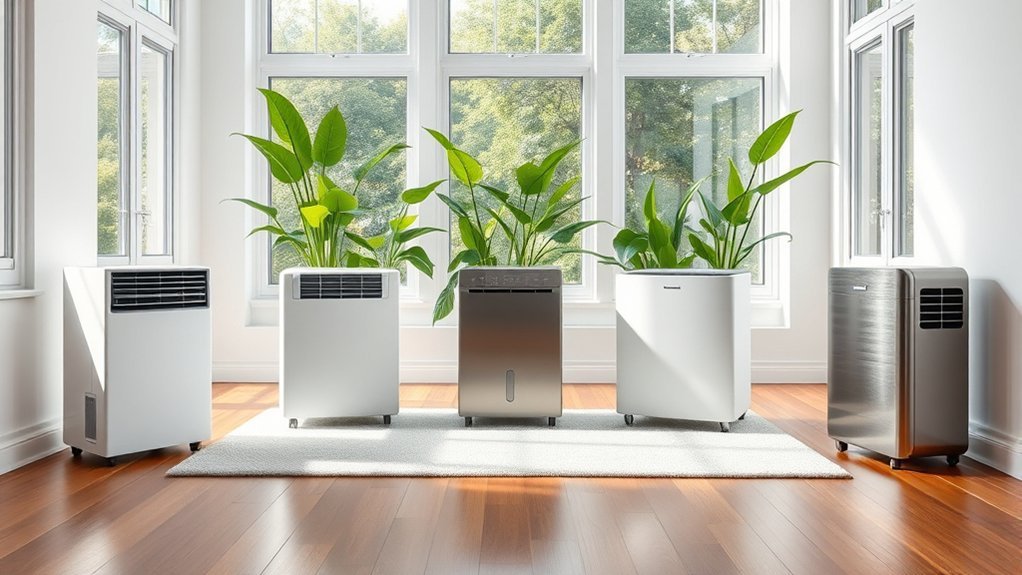
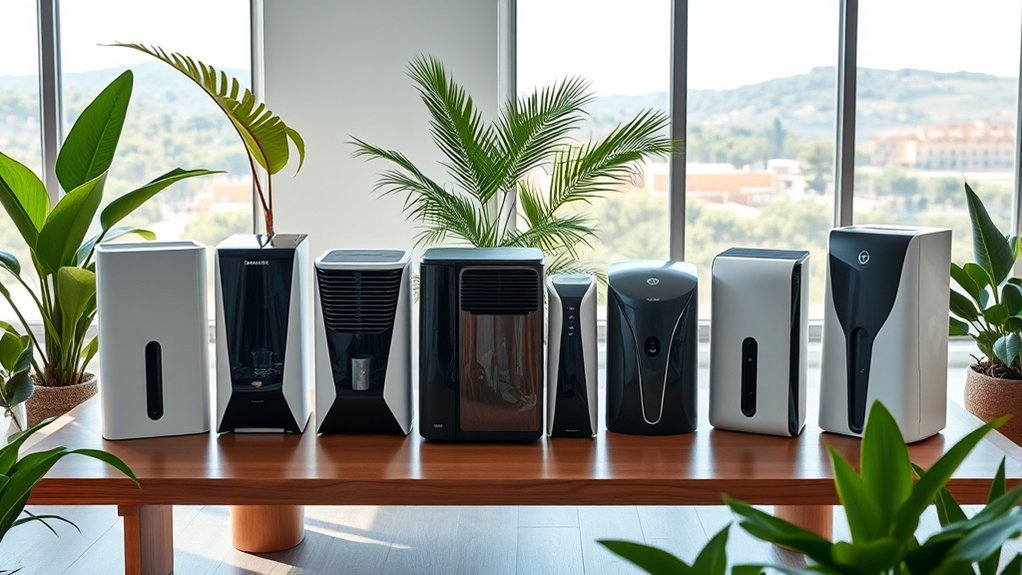
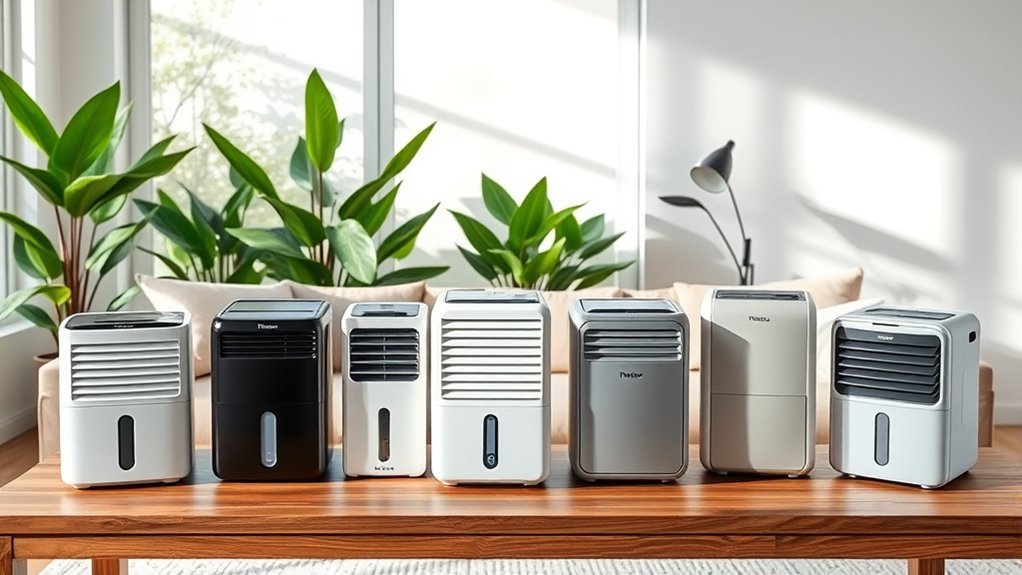
If excess humidity is contributing to musty odors, condensation, dust mites, or recurring mold concerns, the right dehumidifier can help you keep indoor moisture under control. The best choice depends on the size and dampness of your space, drainage access, operating temperature, and comparable pint capacity—not just the largest advertised coverage number. For 2026, the four models below offer useful options for moderate moisture loads, larger areas, smart control, and energy-conscious operation.
Important: A dehumidifier can make conditions less favorable for mold growth by lowering humidity, but it does not remove existing mold, repair leaks, or filter every airborne allergen. Clean visible mold safely, correct the moisture source, and consider a suitable air cleaner when pollen, smoke, or pet dander is the main concern.
How These Picks Were Compared: We reviewed room-use fit, comparable moisture-removal data, drainage options, humidity controls, energy certification, maintenance needs, and the limits of each model for mold and allergen concerns.
Quick Verdict
- Best Overall for Large Areas: hOmeLabs Wi-Fi Dehumidifier
- Best Efficiency-Focused Pick: AEOCKY 4500 Sq.Ft Energy Star Dehumidifier
- Best for Medium Spaces: PLUSCENT 32 Pint Dehumidifier
- Best for Broad Airflow: Waykar 80 Pints Energy Star Dehumidifier
Quick Comparison
| Product | Best For | Comparable Capacity / Maximum Claim | Drainage | Key Advantage | Amazon |
|---|---|---|---|---|---|
| PLUSCENT 32 Pint | Medium rooms and moderately damp basements | Up to 32 pints/day as listed; standardized test capacity not clearly published | Tank or included gravity drain hose | Compact compressor design with three modes | Check Current Amazon Availability |
| hOmeLabs Wi-Fi | Large areas and remote humidity control | 50 pints/day at 80°F/60% RH; up to 120 pints/day at 95°F/90% RH | Tank or hose connection; hose may be sold separately | Wi-Fi monitoring and control | Check Current Amazon Availability |
| AEOCKY 4500 Sq.Ft | Moderate-to-large areas where verified efficiency matters | 24.5 pints/day on the current ENERGY STAR record; up to 80 pints/day in extreme humidity | Tank or continuous drain hose | Efficiency-focused compressor and humidistat | Check Current Amazon Availability |
| Waykar 80 Pints | Open basements and rooms that benefit from auto-swing airflow | 24.93 pints/day on the current ENERGY STAR record; up to 80 pints/day in hot, humid conditions | Tank or included drain hose | Auto-swing airflow and verified ENERGY STAR certification | Check Current Amazon Availability |
Capacity note: Pint ratings can be measured under different temperature and humidity conditions. The AEOCKY and Waykar rows include their current ENERGY STAR water-removal capacities, while the hOmeLabs and PLUSCENT rows use manufacturer-listed conditions. Compare only ratings measured under the same conditions, then consider room dampness, drainage, and operating temperature.
PLUSCENT 32 Pint Dehumidifier for Home
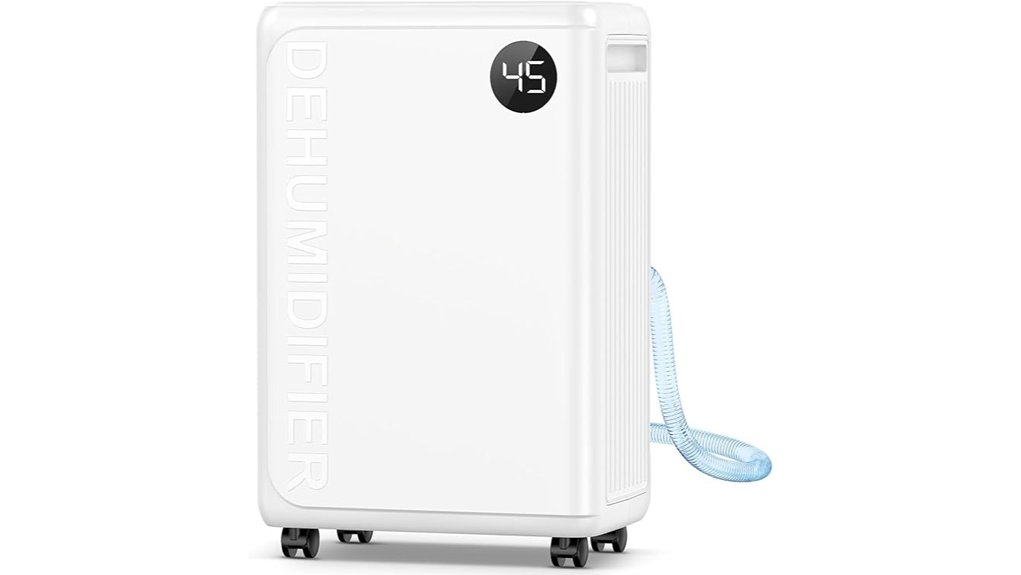
Best for medium spaces: The PLUSCENT 32 Pint Dehumidifier is a practical choice for a bedroom, living area, laundry space, or moderately damp basement where a larger high-capacity unit would be unnecessary. Its listing markets moisture removal of up to 32 pints per day and coverage up to 2,500 sq. ft., but a directly comparable standardized test rating was not clearly published. Treat both figures as listing claims and size the unit according to your actual humidity load.
It offers DEHU, CONT, and DRY modes, an adjustable humidistat, a 24-hour timer, automatic defrost, automatic restart, a child lock, and a washable filter. The included gravity drain hose is especially useful in a basement or laundry area because it reduces the need to empty the 2-liter tank manually.
Why You’ll Like It: It combines compressor-style moisture removal, continuous drainage, and a relatively compact cabinet for buyers who need more capability than a mini thermoelectric unit.
Who Should Buy This: Buyers managing moderate humidity in a medium-size room, apartment area, or basement section with access to a low drain.
Who Should Avoid This: Owners of very large or severely wet basements, anyone who needs a built-in pump, or buyers who want verified ENERGY STAR certification for this exact model.
Pros:
- Three operating modes and adjustable humidity control.
- Included gravity drain hose for continuous operation.
- Auto-defrost, auto-restart, timer, child lock, and washable filter.
- Smaller footprint than many high-capacity compressor models.
Cons:
- The listing does not clearly provide a directly comparable standardized pint rating.
- The 2-liter tank may fill quickly when humidity is high.
- Gravity drainage requires a drain below the hose outlet.
- Coverage claims should not replace proper capacity sizing.
hOmeLabs Wi-Fi Dehumidifier for Home and Office
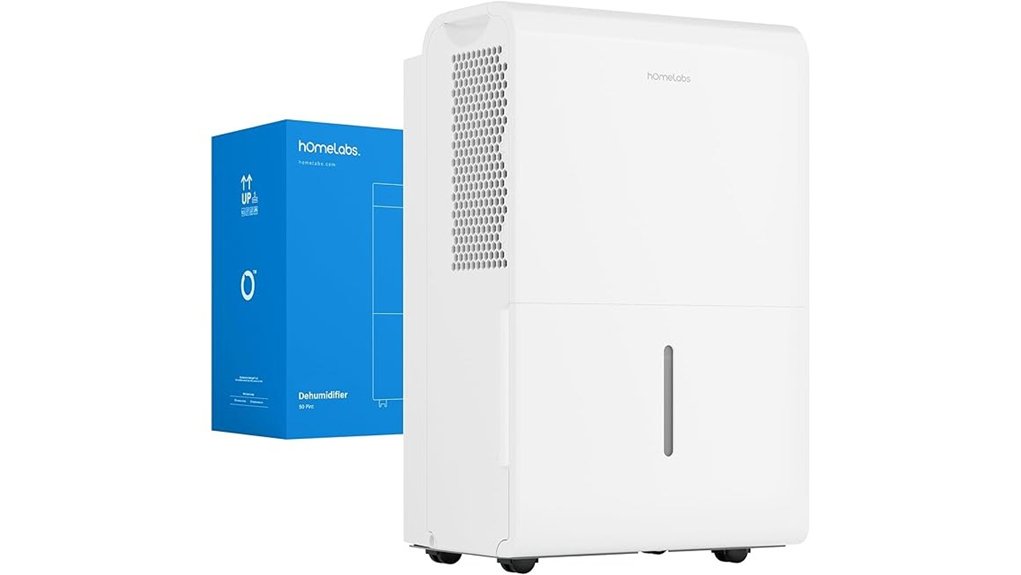
Best overall for large areas: The hOmeLabs Wi-Fi Dehumidifier is designed for buyers who want substantial moisture removal plus remote monitoring. The manufacturer lists 50 pints per day at 80°F and 60% RH, with a maximum claim of 120 pints per day at 95°F and 90% RH. Its advertised 7,000 sq. ft. coverage is a ceiling rather than a sizing guarantee, especially in divided or severely damp spaces.
Wi-Fi control, adjustable humidity settings, automatic shut-off, auto-defrost, wheels, handles, a washable filter, and a hose connection make it convenient for a large basement, office, or open living area. Current product descriptions are inconsistent about whether a drain hose is included, so confirm the package contents before ordering.
Why You’ll Like It: Remote monitoring is helpful when the unit runs in a basement, storage area, or office that you do not visit frequently.
Who Should Buy This: Buyers with a large basement, office, or open living area who need substantial moisture removal and value Wi-Fi control, automatic operation, and easy mobility.
Who Should Avoid This: Anyone with unreliable Wi-Fi, a small bedroom where fan noise may be distracting, or a setup that requires a built-in pump.
Pros:
- Wi-Fi-enabled monitoring and control.
- Manufacturer-listed 50-pint output at 80°F/60% RH, with higher extraction in extreme humidity.
- Auto shut-off, washable filter, wheels, handles, timer, and continuous-drain connection.
- Suitable for larger moisture-control jobs than compact units.
Cons:
- The maximum 120-pint claim uses much hotter and more humid conditions than the standard 50-pint rating.
- Package descriptions conflict on whether a drain hose is included, so confirm the current box contents.
- Its large advertised coverage does not guarantee equal performance in divided rooms or severe moisture conditions.
- Wi-Fi setup adds complexity for buyers who prefer simple manual controls.
AEOCKY 4500 Sq.Ft Energy Star Dehumidifier
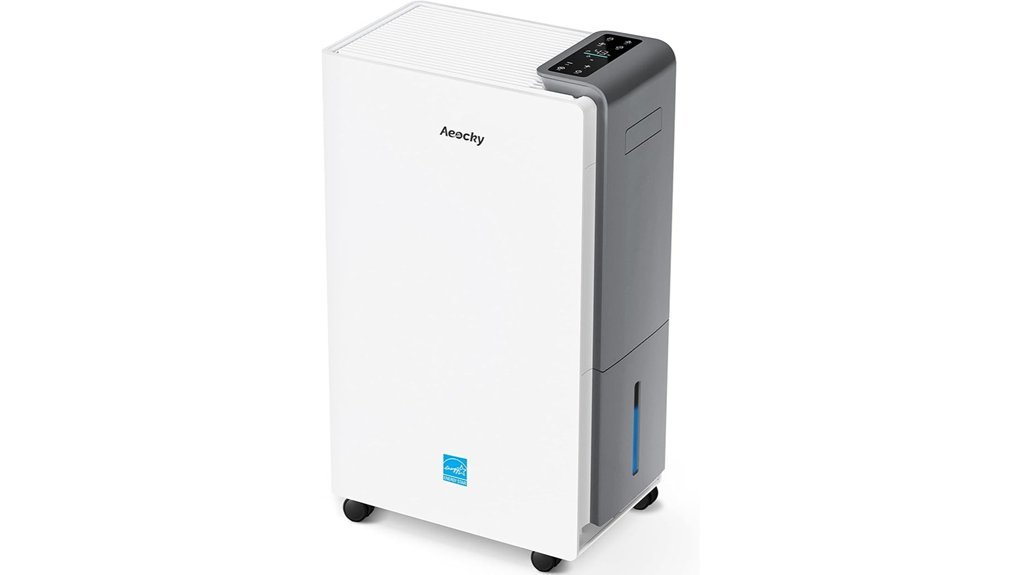
Best efficiency-focused pick: The AEOCKY 4500 Sq.Ft Dehumidifier is aimed at rooms and basements where the appliance may run for long periods. The listing advertises up to 80 pints per day in extreme humidity, while the current ENERGY STAR record associated with model RHEA-001 lists 24.5 pints per day under its standardized Appendix X1 test. This model also offers an intelligent humidistat, continuous drainage, automatic defrost, and a low-noise design.
The current ENERGY STAR record lists RHEA-001 as an additional model and marks the certified family as ENERGY STAR Most Efficient 2025. Buyers should still match the model number or UPC on the product label to the current certification record before purchase. Avoid fixed annual savings promises because actual cost depends on electricity rates, runtime, humidity, and the unit being replaced.
Why You’ll Like It: It is designed for buyers who expect frequent operation and want a compressor unit that prioritizes humidity accuracy and energy efficiency.
Who Should Buy This: Homeowners with a large basement, living area, or persistent seasonal humidity who want an efficiency-oriented model with continuous drainage.
Who Should Avoid This: Buyers who only need occasional moisture control in a small room or anyone who cannot confirm the exact certification and package details before purchase.
Pros:
- Efficiency-focused design with automatic humidity control.
- Verified ENERGY STAR record plus a higher maximum-condition moisture-removal claim.
- Continuous drainage, auto-defrost, and low-temperature protection features.
- Suitable for longer operating periods in large spaces.
Cons:
- The 80-pint figure is an extreme-condition claim and is not comparable to the 24.5-pint ENERGY STAR rating.
- Buyers should confirm that the model number or UPC matches the current certification record.
- Higher-capacity compressor units take more floor space than compact models.
- No dehumidifier can replace leak repair or professional mold remediation.
Waykar 80 Pints Energy Star Dehumidifier for Home
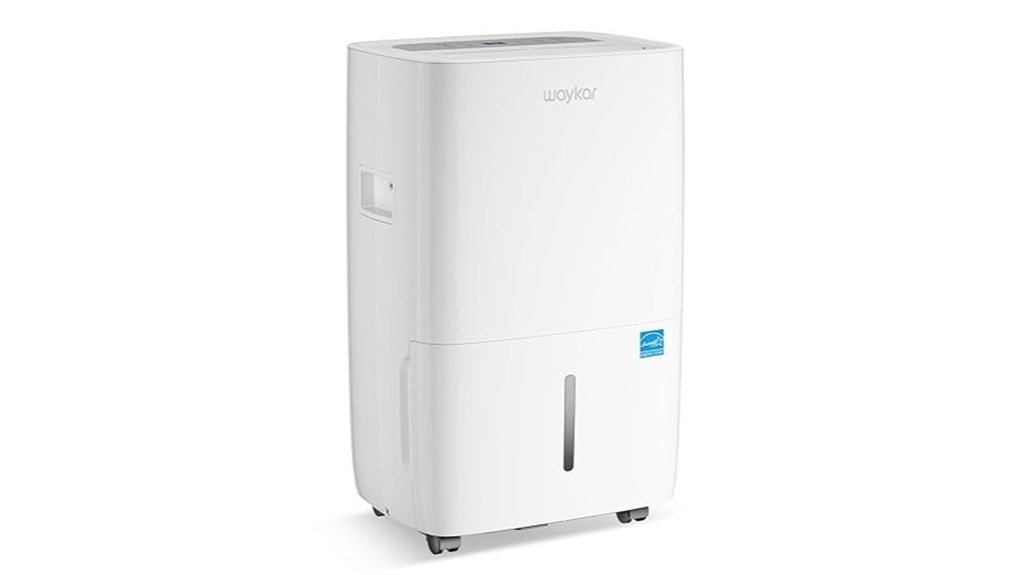
Best for broad airflow: The Waykar 80 Pints Energy Star Dehumidifier is marketed for spaces up to 5,000 sq. ft. and up to 80 pints per day in hot, highly humid conditions. The current ENERGY STAR record for model JD025CE-80 lists a standardized water-removal capacity of 24.93 pints per day. Its 90-degree auto-swing outlet can help distribute drier air across an open area, while the adjustable humidistat supports target humidity settings from 30% to 80%.
It includes a washable filter, automatic defrost, timer, overheat protection, removable tank, and drain hose. The listing states operation around 42 dB under a specified condition, but perceived noise still depends on fan speed, room acoustics, vibration, and placement.
Why You’ll Like It: Continuous drainage and auto-swing airflow make it easier to manage humidity across an open basement or broad living area without relying only on the tank.
Who Should Buy This: Buyers with an open basement, storage area, or open-plan room who value broad airflow and can use continuous drainage.
Who Should Avoid This: Buyers with a small room, limited floor space, or a need to pump water upward to a sink or window.
Pros:
- Verified ENERGY STAR certification for model JD025CE-80.
- 90-degree auto-swing airflow for broader circulation.
- Drain hose, washable filter, timer, auto-defrost, and humidity control.
- Compact footprint relative to many large-coverage compressor models.
Cons:
- The 80-pint claim is not comparable to the 24.93-pint ENERGY STAR rating.
- A gravity drain cannot move water upward.
- The unit may be oversized for a small bedroom or bathroom.
- Regular filter and drainage maintenance are still required.
Factors to Consider When Choosing Dehumidifiers for Mold Prevention and Allergy-Prone Homes
A dehumidifier should be chosen according to room size, current relative humidity, signs of moisture, operating temperature, and drainage access. The following checks make it easier to avoid an undersized unit, an unnecessarily expensive unit, or misleading capacity comparisons.
Start With Humidity, Not Only Square Footage
Use a hygrometer to measure relative humidity before choosing a model. A practical target for many homes is around 30% to 50% RH, while keeping indoor humidity below 60%. A room that is only slightly damp needs less capacity than a room with visible condensation, seepage, wet floors, or a constant musty odor, even when both rooms have the same square footage.
Compare Standardized and Maximum Pint Ratings
Manufacturers may publish both a standardized rating and a much larger maximum rating measured at hotter temperatures and higher humidity. Those numbers are not interchangeable. When comparing models, look for the capacity at the same test condition, preferably the standardized capacity shown by ENERGY STAR or the product’s current technical documentation.
Treat Coverage Claims as a Starting Point
Advertised coverage such as 2,500, 4,500, 5,000, or 7,000 sq. ft. does not account for closed doors, ceiling height, air leakage, groundwater, laundry drying, climate, or the severity of dampness. A unit may manage an open dry area more easily than a smaller but very wet basement. Choose enough capacity for the moisture load and provide airflow between connected areas.
Choose the Right Drainage Method
A removable tank is convenient for occasional use, but high humidity can fill it quickly. Gravity drainage is better for continuous operation when a floor drain or sump is below the outlet. A built-in pump is needed when water must travel upward to a sink or window. Check whether the hose, adapter, and pump are included rather than assuming they come in the box.
Understand What the Filter Can and Cannot Do
A washable pre-filter mainly protects the dehumidifier’s coils from dust and lint. It is not the same as a true HEPA air purifier and should not be expected to capture fine smoke, pollen, or pet dander efficiently. For allergy control, combine sensible humidity management with source control, cleaning, ventilation, and an appropriate air cleaner when needed.
Check Energy Efficiency and Runtime
ENERGY STAR certification is valuable when a dehumidifier will run for many hours, but verify the exact model number. Timers, accurate humidistats, auto-stop, and auto-restart can also reduce wasted runtime. Avoid unsupported annual savings claims because actual cost depends on wattage, humidity, operating hours, and local electricity rates.
Consider Noise and Placement
Compressor dehumidifiers produce fan and compressor noise. A stated decibel figure is useful, but bedroom comfort also depends on fan speed, vibration, wall distance, and room acoustics. Place the unit on a level surface with the required clearance around the air intake and outlet, and avoid pressing it against furniture unless the manual specifically allows wall placement.
Check Low-Temperature Operation
Basements can be cool enough for frost to form on the coils. Auto-defrost helps, but every model has an operating-temperature range. Verify the minimum temperature in the manual before using a standard compressor model in an unheated basement, garage, or seasonal property.
Maintenance and Mold Safety
Clean the filter on the manufacturer’s schedule, wash and dry the tank, inspect the drain hose for blockage, and keep the intake free of dust. If visible mold is already present, fix leaks and water intrusion first. Large, recurring, or health-sensitive mold problems may require professional assessment and remediation. Do not place a portable electrical appliance where it can be splashed or submerged, and follow the manual’s outlet and grounding requirements.
Before You Buy Checklist
- Measure the room and check actual relative humidity.
- Identify whether the space is slightly damp, very damp, or wet.
- Compare pint ratings measured under the same conditions.
- Confirm the exact model’s ENERGY STAR status, noise level, and minimum operating temperature.
- Choose tank, gravity drain, or pump drainage before ordering.
- Check included hose length, filter type, warranty, and required clearance.
- Plan to repair leaks and clean existing mold separately.
Frequently Asked Questions
What Humidity Level Helps Discourage Mold and Dust Mites?
Aim for roughly 30% to 50% relative humidity in many living spaces and keep it below 60%. Conditions vary by climate and season, so use a hygrometer and watch for condensation, dry air discomfort, or excessive runtime.
Can a Dehumidifier Remove Existing Mold?
No. It can reduce the moisture that supports future growth, but existing mold still needs to be cleaned or remediated and the water source must be repaired. Do not use a dehumidifier as a substitute for fixing leaks, drying wet materials, or addressing contaminated building materials.
How Do I Choose the Right Size Dehumidifier?
Match capacity to both room size and dampness. A small or moderately damp room may need a lower-capacity model, while a wet basement or laundry area needs more moisture removal. Use standardized pint ratings when possible and choose slightly more capacity when the room has seepage, frequent condensation, or open connections to other spaces.
Why Do Some Models Have Two Different Pint Ratings?
One figure may be measured at a standardized warm-room condition, while the larger figure is measured in hotter and much more humid air. A machine naturally collects more water in extreme humidity, so compare products only when the ratings use the same test conditions.
Do I Still Need an Air Purifier?
Possibly. A dehumidifier controls moisture, while a true air purifier is designed to capture airborne particles. If pollen, smoke, fine dust, or pet dander is the main trigger, a suitable HEPA air cleaner may be more relevant. Many dehumidifier filters are washable pre-filters rather than HEPA filters.
How Often Should I Empty the Water Tank?
Check it at least daily during the first few days of use. In very humid conditions, a tank can fill within hours. Auto shut-off prevents most overflows, but continuous drainage is more convenient for unattended operation when installed correctly.
How Do I Maintain My Dehumidifier for Optimal Performance?
Clean the filter, tank, intake, and outlet according to the manual. Keep the unit level, inspect the hose for kinks or buildup, allow proper airflow, and check the coils for frost. Disconnect power before cleaning and never rinse the appliance body or electrical components.
Conclusion
The best dehumidifier for mold prevention and an allergy-prone home is the one that can maintain the right humidity in your actual space without constant tank emptying or excessive runtime. The hOmeLabs Wi-Fi Dehumidifier is the strongest all-around option for large areas and remote control, the AEOCKY 4500 Sq.Ft model is the best efficiency-focused choice, the Waykar 80 Pints model stands out for auto-swing airflow, and the PLUSCENT 32 Pint model is a more compact option for moderate moisture loads.
Final Recommendation
Choose by standardized capacity, humidity load, drainage access, and exact model certification. Keep indoor humidity controlled, repair water sources promptly, and remember that moisture control supports mold prevention but does not replace mold cleanup or air filtration.