Affiliate disclosure: As an Amazon Associate, we may earn from qualifying purchases made through links on this page, at no extra cost to you.
Choosing an energy-efficient dehumidifier means comparing the current standard moisture-removal rating—not only the largest square-foot or “maximum pint” claim. The best model should also match your moisture level, drainage route, noise tolerance, tank-emptying routine, and preferred controls. This updated guide compares eight compressor dehumidifiers for bedrooms, basements, living areas, garages, and other damp spaces.
Important market and voltage note:
The Amazon links below point to Amazon.com, and many listed models are marketed for the United States or Canada. Before ordering for another country, verify the voltage, plug type, warranty coverage, drainage accessories, and local electrical compliance. Do not use a simple plug adapter with a voltage-incompatible appliance.
Quick Answer: The Midea MAD22C1AWS is the most balanced straightforward pick, the hOmeLabs HME0088 is the best verified Wi-Fi option, the Midea Cube is best when bucket capacity matters, and the DECIUU pump model is the strongest choice when condensate must be lifted to a higher drain.
Capacity warning: Current ENERGY STAR Appendix X1 ratings can be far lower than retail “maximum” ratings measured in very hot, humid air. Compare standard ratings with standard ratings.
Key Takeaways
- Use the current standard pint-per-day figure as the main performance comparison.
- Choose continuous gravity drainage for long runtimes when a lower drain is available.
- Pay extra for a pump only when water must travel upward.
- Wi-Fi is useful for remote adjustment, but it does not increase moisture-removal capacity.
- Treat advertised coverage as guidance because temperature and moisture severity change real performance.
Quick Comparison
| Product | Best For | Capacity Note | Drainage | Smart Features | Amazon |
|---|---|---|---|---|---|
| Midea 22 Pint | Best Overall | 22.31 pints/day current standard | Tank or continuous drain | Timer and automatic controls | Check Price |
| Waykar PD160B-PRO | Best Compact Efficient Pick | 10.16 standard; up to 34 in hot, humid air | 0.62-gallon tank or included hose | Digital controls; no Wi-Fi | Check Price |
| Midea Cube 20 Pint | Best Large Bucket | 20.16 pints/day current standard | Large adjustable-fill bucket or included hose | App and compatible voice control | Check Price |
| hOmeLabs Wi-Fi | Best Wi-Fi Option | 24.48 standard; higher maximum in hot, humid air | Tank or gravity drain | Verified Wi-Fi control | Check Price |
| Wellsle PD21MA | Best Large-Tank Value | 16 standard; up to 52 in hot, humid air | 1.59-gallon tank or hose | Humidistat, timer, child lock | Check Price |
| Yaufey JD025Q-80 | Best for Large Open Areas | 24.93 standard; up to 80 in hot, humid air | 1.06-gallon tank or included hose | Modes, timer, humidistat | Check Price |
| AEOCKY RHEA-001 | Best Most-Efficient Pick | 24.5 standard; up to 80 in hot, humid air | Tank or drain hose | Humidistat, sleep and continuous modes | Check Price |
| DECIUU Pump Model | Best Pump Option | 32 standard; up to 100 in hot, humid air | Tank, gravity drain, or pump | Humidistat and timer | Check Price |
How these picks were assessed
The comparison prioritizes current standard moisture-removal capacity, ENERGY STAR status where the exact model could be matched, drainage flexibility, useful controls, bucket practicality, portability, and clearly stated limitations. Manufacturer coverage claims and hot-condition maximums are treated as secondary guidance.
Why the pint figures may look different from retail listings
The table uses current standard ratings where they could be matched to the exact model. Retail pages may also show a larger maximum measured around 95°F and 90% relative humidity. Those figures are useful for context but should not be compared directly with standard ratings. You can verify certified models through the ENERGY STAR dehumidifier product finder.
Midea 22 Pint ENERGY STAR Dehumidifier
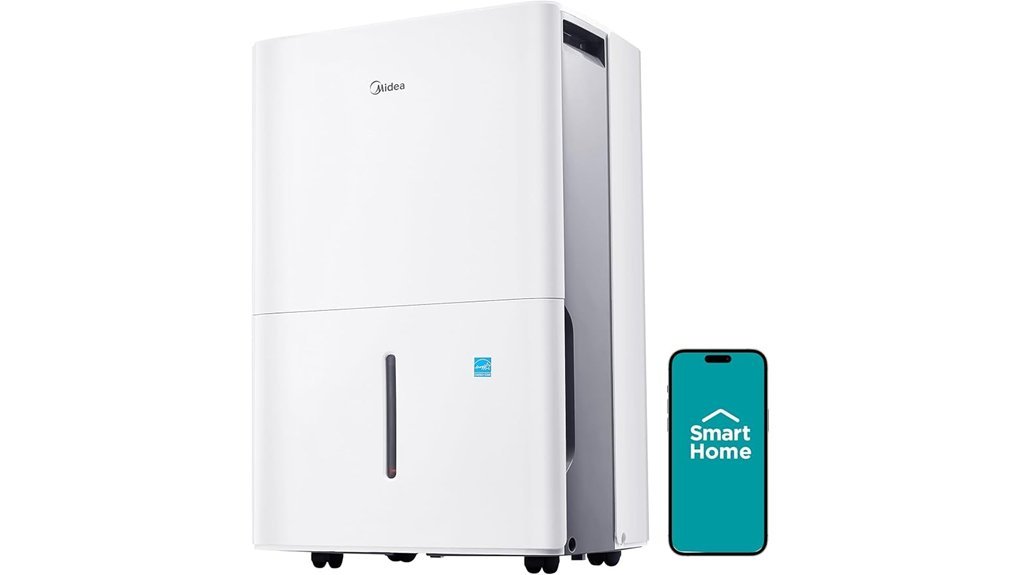
Best Overall: The Midea MAD22C1AWS is a practical choice for bedrooms, offices, living areas, and moderately damp basement zones. Its current standard capacity is about 22.31 pints per day, giving buyers a reliable apples-to-apples figure for comparison. Adjustable humidity, automatic defrost, auto restart, a timer, caster wheels, and continuous-drain support cover the everyday basics without adding unnecessary complexity.
Why You’ll Like It: The controls are straightforward, the washable filter reduces routine replacement needs, and the compact cabinet is easier to move than many larger-capacity machines.
Who Should Buy This: Buyers who want a recognized-brand dehumidifier with verified standard capacity and simple household controls.
Who Should Avoid This: Choose a larger current-standard capacity when the space has severe water intrusion, repeated flooding, or a very heavy whole-basement moisture load.
Pros:
- Approximately 22.31-pint current standard capacity.
- Adjustable humidistat, timer, auto restart, and automatic defrost.
- Washable filter, caster wheels, and continuous-drain support.
Cons:
- This exact model is not verified as a smart or voice-controlled unit.
- A drain hose may need to be purchased separately.
- The bucket still requires manual emptying when gravity drainage is not used.
Waykar PD160B-PRO ENERGY STAR Dehumidifier
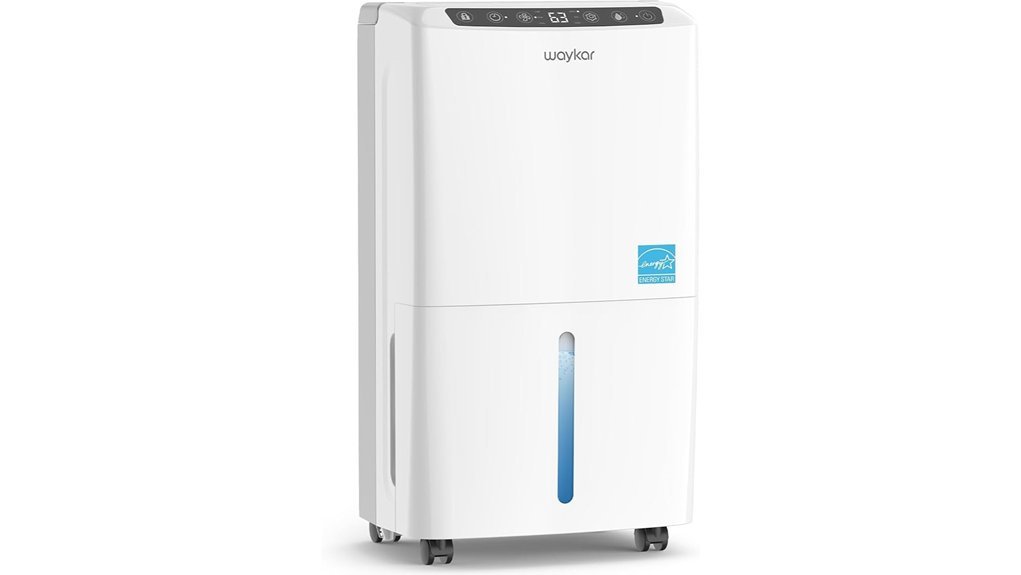
Best Compact Efficient Pick: The Waykar PD160B-PRO is a small ENERGY STAR Most Efficient model designed for bedrooms, offices, living areas, and other moderate-moisture spaces. Its current standard rating is about 10.16 pints per day, while the larger 34-pint claim applies to much hotter and more humid conditions.
Why You’ll Like It: The compact footprint, built-in handle, washable filter, child lock, timer, automatic defrost, and included gravity-drain hose make it easy to place and maintain. The 0.62-gallon tank is manageable to lift, although it will fill faster than a large bucket.
Who Should Buy This: Buyers who prioritize a compact cabinet, efficient operation, and flexible tank-or-hose drainage for a smaller or moderately damp area.
Who Should Avoid This: Skip it for a severe basement moisture load or when you need a built-in pump or a substantially higher standard capacity.
Pros:
- ENERGY STAR Most Efficient recognition for the current model listing.
- Compact design with humidistat, timer, child lock, and washable filter.
- Includes a drain hose for continuous gravity drainage.
Cons:
- The current standard capacity is about 10.16 pints per day, not 34.
- The 0.62-gallon tank can fill quickly in a damp room.
- No built-in pump or verified Wi-Fi control.
Midea Cube 20 Pint Smart Dehumidifier
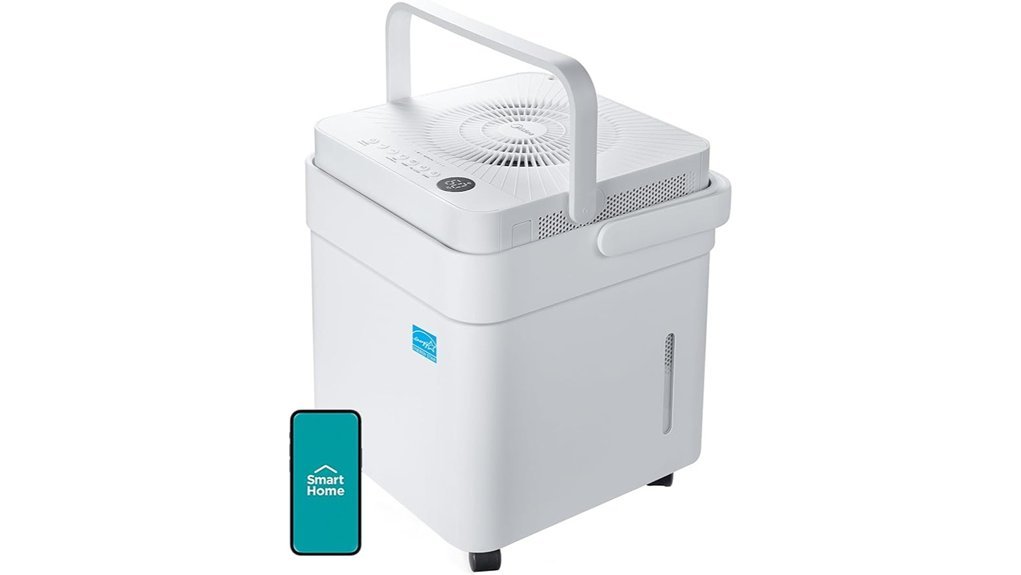
Best Large Bucket: The Midea Cube MAD20S1QWT combines a current standard capacity of about 20.16 pints per day with a large adjustable-fill bucket. The user can select a lower fill level for easier lifting or allow roughly 3 gallons before emptying, which is useful when no floor drain is available.
Why You’ll Like It: The lift-and-twist design nests for storage, while the SmartHome app and compatible voice-assistant controls support remote adjustments. An included drain hose, automatic defrost, automatic restart, fan-speed control, and a washable filter add everyday convenience.
Who Should Buy This: Smart-home users who value fewer trips to the sink and want a flexible unit for a living room, bedroom, garage, or medium-size basement zone.
Who Should Avoid This: The 20.16-pint standard capacity is not the best match for the heaviest whole-basement moisture loads.
Pros:
- Large adjustable-fill bucket with compact nesting storage.
- SmartHome app and compatible voice-assistant control.
- Included hose for continuous drainage, plus auto defrost and restart.
Cons:
- Lower standard capacity than several larger models in this guide.
- A fuller bucket becomes heavy to lift, even with selectable fill levels.
- Smart features require network and app setup.
hOmeLabs HME0088 Wi-Fi Dehumidifier
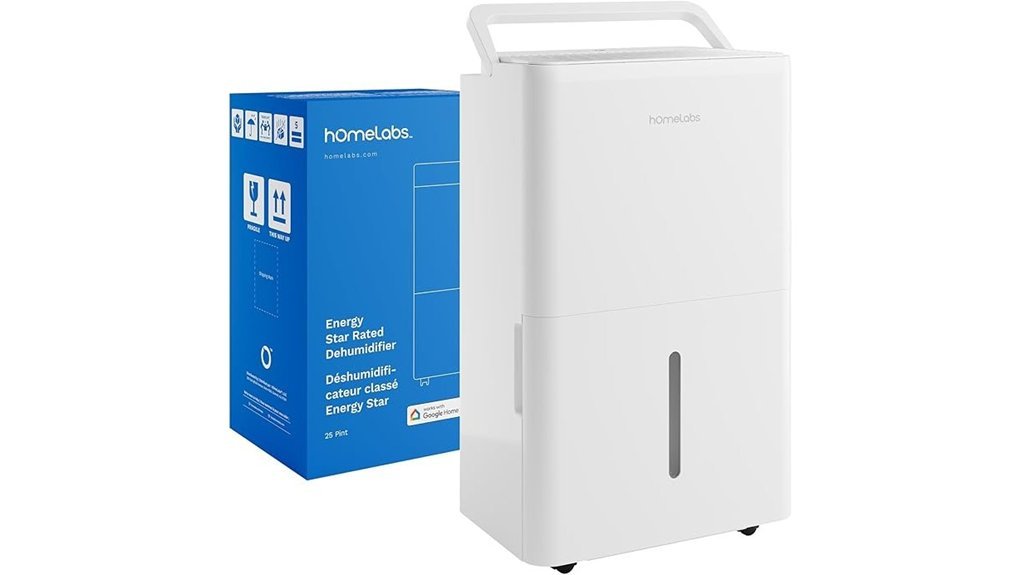
Best Wi-Fi Option: The hOmeLabs HME0088 has a current standard capacity of about 24.48 pints per day and is listed as a connected, Wi-Fi-capable dehumidifier. Larger retail maximums use hotter and more humid conditions, so the current standard figure is the better comparison point.
Why You’ll Like It: Wi-Fi control is useful for checking or changing operation from another room. Adjustable humidity control, automatic defrost, automatic shut-off, a timer, a removable tank, a washable filter, wheels, and a gravity-drain outlet cover the features most households expect.
Who Should Buy This: Buyers who want verified Wi-Fi control and a mid-capacity unit for regularly damp living spaces or basement zones.
Who Should Avoid This: Do not choose it only because of a large square-foot claim; actual moisture load, room temperature, and airflow matter more.
Pros:
- Approximately 24.48-pint current standard capacity.
- Verified Wi-Fi connectivity with adjustable humidity control.
- Washable filter, timer, auto shut-off, wheels, and gravity drainage.
Cons:
- The tank may require frequent emptying in very damp conditions.
- Voice-assistant support was not verified for this exact model.
- Remote control depends on app and network setup.
Wellsle PD21MA ENERGY STAR Dehumidifier
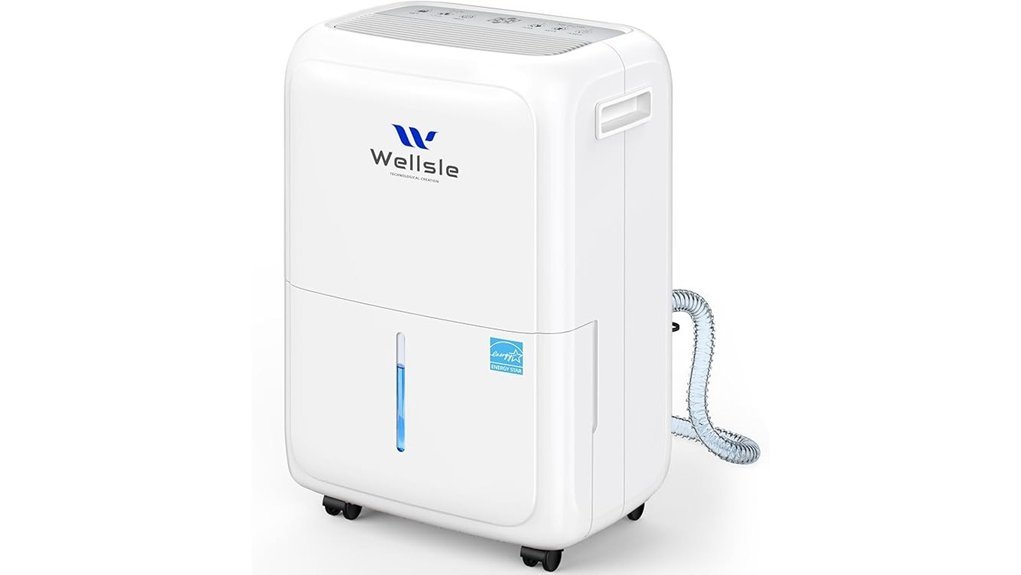
Best Large-Tank Value: The Wellsle PD21MA has a current standard rating of about 16 pints per day. Its larger 52-pint claim applies to very hot, highly humid air and should not be compared directly with current standard ratings from other models.
Why You’ll Like It: The 1.59-gallon tank can reduce emptying frequency when a drain is unavailable. It also supports continuous gravity drainage and includes a humidistat, timer, child lock, washable filter, handle, caster wheels, automatic defrost, and multiple operating modes.
Who Should Buy This: Buyers dealing with moderate humidity who value a large bucket and ENERGY STAR Most Efficient recognition more than maximum standard capacity.
Who Should Avoid This: Skip it for severe basement dampness when you need a genuinely higher current-standard moisture-removal rate.
Pros:
- ENERGY STAR Most Efficient model with a 16-pint current standard rating.
- Large 1.59-gallon tank and continuous-drain support.
- Humidistat, timer, child lock, washable filter, wheels, and handle.
Cons:
- The standard rating is 16 pints per day, not the 52-pint maximum.
- Large coverage wording may overstate suitability for heavily damp spaces.
- No verified app or voice control.
Yaufey JD025Q-80 Dehumidifier with Drain Hose
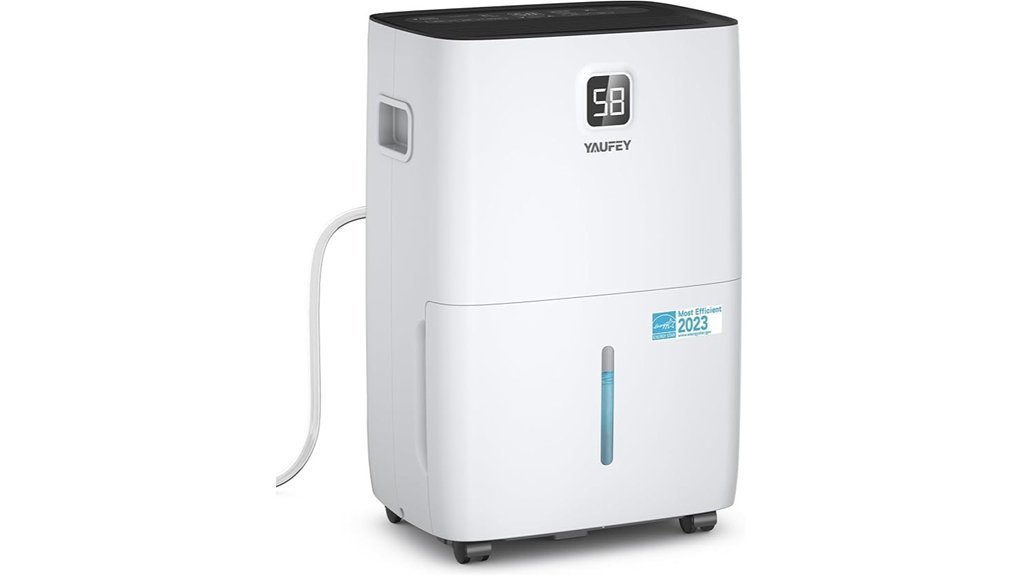
Best for Large Open Areas: The Yaufey JD025Q-80 is an ENERGY STAR-certified model with a current standard capacity of about 24.93 pints per day. Its 80-pint headline applies to hot, very humid air, so use the standard figure when comparing it with other certified models.
Why You’ll Like It: The included drain hose supports continuous gravity drainage, while the 1.06-gallon tank provides a manual option. Multiple modes, three fan speeds, a timer, adjustable humidity control, automatic shut-off, auto defrost, memory restart, and caster wheels make it flexible for open living areas, garages, and basement zones.
Who Should Buy This: Buyers who want a roughly 25-pint current-standard model with a hose included and controls suited to a larger open area.
Who Should Avoid This: Smaller bedrooms may not need its cabinet size or airflow, and it is not a pump model.
Pros:
- Approximately 24.93-pint current standard capacity.
- Included hose for continuous gravity drainage.
- Multiple modes, fan speeds, timer, humidistat, and restart memory.
Cons:
- The 80-pint headline is a hot-condition maximum.
- The 1.06-gallon tank may fill quickly without continuous drainage.
- Not listed as an ENERGY STAR Most Efficient model for the current certification year.
AEOCKY RHEA-001 ENERGY STAR Dehumidifier
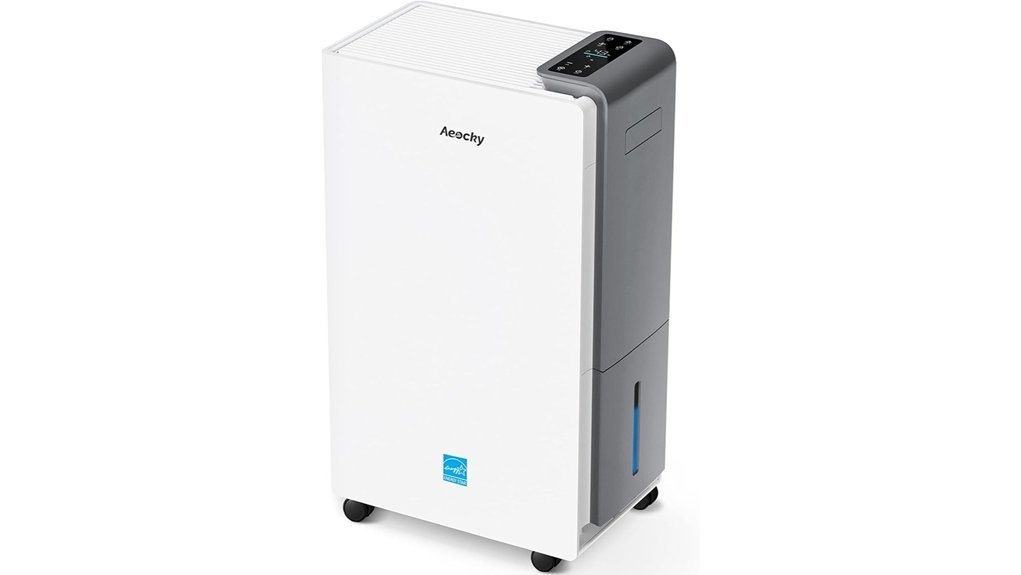
Best Most-Efficient Pick: The AEOCKY RHEA-001 is matched to a current ENERGY STAR Most Efficient listing with a standard capacity of about 24.5 pints per day. The larger 80-pint claim is measured in extreme heat and humidity and should be presented as a maximum, not as the standard rating.
Why You’ll Like It: Adjustable humidity control, automatic operation, continuous mode, sleep mode, a timer, child lock, drain-hose support, and a washable filter cover the features most households need. The current efficiency recognition is a stronger trust signal than an unsupported promise of a fixed annual cash saving.
Who Should Buy This: Buyers who want roughly 25-pint standard capacity with current ENERGY STAR Most Efficient recognition for a damp basement zone or large living area.
Who Should Avoid This: It may be unnecessarily large for a lightly damp closet or small bathroom, and it does not include a built-in pump.
Pros:
- Approximately 24.5-pint current standard capacity.
- ENERGY STAR Most Efficient recognition for the matched model listing.
- Multiple operating modes, child lock, timer, and drainage support.
Cons:
- The 80-pint headline applies to harsher test conditions.
- Larger and heavier than compact models.
- No verified basis for claiming the same annual dollar saving for every household.
DECIUU High-Capacity Dehumidifier with Pump
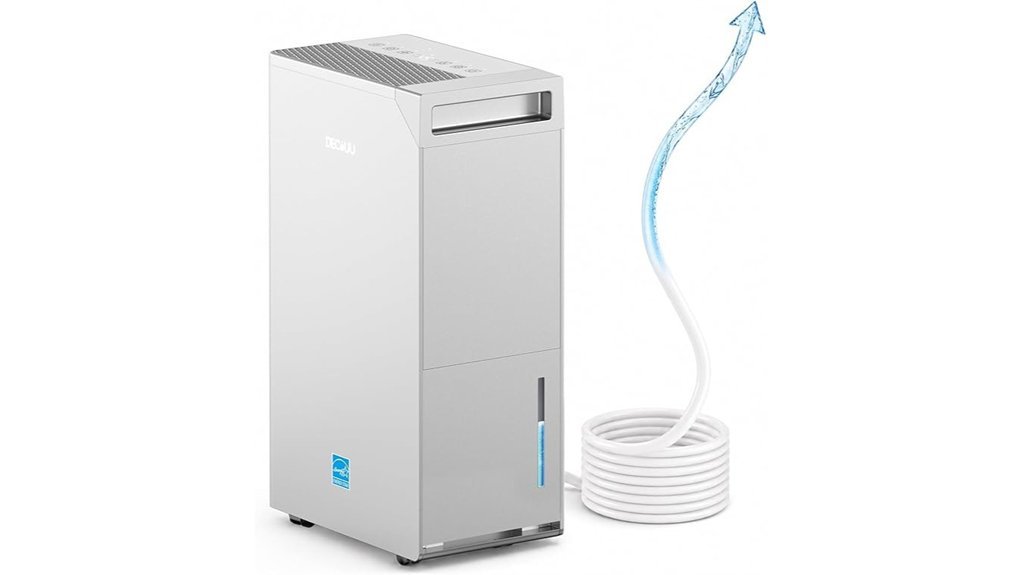
Best Pump Option: The DECIUU pump model is designed for basements and other locations where condensate must travel upward to a sink or higher drain. The matched current model family has a standard capacity of about 32 pints per day, while the 100-pint headline applies to hot, very humid conditions.
Why You’ll Like It: A built-in pump gives more placement freedom than gravity drainage alone. The machine also offers tank collection, gravity drainage, adjustable humidity control, a timer, digital controls, automatic shut-off, automatic defrost, and caster wheels.
Who Should Buy This: Buyers with a large damp basement where a convenient lower drain is unavailable.
Who Should Avoid This: A pump adds cost and maintenance complexity, so it is unnecessary when a reliable gravity drain is nearby.
Pros:
- Built-in pump supports upward condensate removal.
- Approximately 32-pint current standard capacity for the matched model family.
- Tank, gravity drain, timer, humidistat, automatic defrost, and wheels.
Cons:
- The 100-pint headline is a hot-condition maximum.
- Pump systems add components that may require more maintenance.
- Bulky and excessive for small or mildly damp rooms.
Factors to Consider When Choosing an Energy-Efficient Dehumidifier
The right dehumidifier is the smallest efficient model that can control the actual moisture load without running needlessly. Compare the current standard moisture-removal rating first, then consider room conditions, drainage, tank size, noise, controls, portability, refrigerant and electrical compatibility.
Standard Capacity Versus Maximum Capacity
Do not compare a current standard rating from one product with a hot-condition maximum from another. In this guide, the current standard figures range from about 10.16 to 32 pints per day, even though retail headlines range from 34 to 100 pints. The larger numbers are often measured around 95°F and 90% relative humidity. Use the current standard figure for product-to-product comparison, then use the hotter-condition maximum only as secondary context.
ENERGY STAR Certification
ENERGY STAR is a U.S. efficiency certification program. Certification verifies that a matched model meets the applicable efficiency requirements, but it does not prove suitability for every country, room size, or electrical system. Also distinguish ordinary ENERGY STAR certification from the separate ENERGY STAR Most Efficient recognition for a specific year and exact model.
Coverage Area and Moisture Load
Square-foot coverage is only a rough manufacturer guideline. Ceiling height, air leakage, temperature, laundry drying, open doors, water intrusion, and initial humidity all affect performance. A moderately damp bedroom needs less capacity than a cool basement with wet walls, even when both have similar floor area.
Drainage Options
A removable tank works when you can empty it regularly. Continuous gravity drainage is better for long runtimes, but the hose must slope downward without kinks. Choose a built-in pump only when water must travel upward or across a location where gravity drainage is impossible. Always secure the hose and test for leaks before leaving the machine unattended.
Noise Level
Low fan mode is usually the best setting for bedrooms and offices, while high fan mode removes moisture faster but creates more sound. Manufacturer decibel claims may be measured under ideal conditions, so also consider vibration, floor type, distance from the bed, and whether the compressor cycles on and off.
Smart Controls
App control, timers, auto restart, automatic defrost, child locks, and adjustable humidistats can reduce unnecessary runtime or make monitoring easier. Smart control does not increase extraction capacity, and features vary by exact model. Set a realistic target rather than forcing the lowest possible humidity; for many occupied homes, a moderate setting is more comfortable and efficient than continuous maximum operation.
Portability and Maintenance
Check the weight, wheels, handle design, filter access, bucket shape, and cord storage. Clean the washable filter according to the manual, inspect the drain hose, and keep the air intake and outlet clear. A model that is easy to maintain is more likely to keep its efficiency over time.
Electrical and Country Compatibility
Before importing a dehumidifier, confirm the input voltage and frequency on the rating label and manual. A plug adapter changes only the plug shape; it does not convert voltage. Also check local warranty support, replacement parts, certification requirements, and whether the manufacturer permits use in your country.
Running Cost Efficiency
Estimate running cost with a simple formula: watts ÷ 1,000 × hours used × your electricity tariff. Actual cost depends on compressor cycling, fan speed, humidity target, room temperature, and how well the space is sealed. Avoid fixed yearly savings claims unless they are based on your own tariff and expected usage.
Before You Buy Checklist
- Confirm the standard pint-per-day rating and test conditions.
- Match capacity to moisture severity, not square footage alone.
- Choose tank, gravity drain, or pump drainage based on placement.
- Verify voltage, plug, warranty, and local compliance.
- Check noise, tank size, filter access, dimensions, and weight.
Frequently Asked Questions
What Does Pints per Day Mean?
It is the amount of water a dehumidifier removes during a specified test. Always check the temperature and relative humidity used for that figure. Standard-condition and extreme-condition ratings are not directly interchangeable.
Is ENERGY STAR Relevant Outside the United States?
It can help compare energy efficiency, but it is a U.S. program and does not confirm local voltage, plug compatibility, warranty support, or legal compliance. Verify those points separately before importing a unit.
How Noisy Are Energy-Efficient Dehumidifiers at Night?
Most compressor models produce both fan noise and a cycling compressor sound. A low or sleep setting can help, but light sleepers should place the unit farther from the bed and check the return policy before relying on a claimed decibel figure.
Do Dehumidifiers Work in Cool Basements?
Yes, but compressor models usually collect less water as temperature falls. Choose a unit with automatic defrost, keep airflow clear, and compare its stated operating-temperature range with your basement conditions.
How Often Should I Clean a Dehumidifier Filter?
Follow the manual. For frequent use, inspect the filter every couple of weeks and clean it when dust reduces airflow. A dirty filter can increase noise, reduce moisture removal, and make the unit run longer.
Can I Use a Dehumidifier With a Smart Plug?
Only when the dehumidifier automatically resumes operation after power is restored, the manufacturer permits that use, and the smart plug is properly rated for the appliance load. Avoid rapid power cycling because compressor models normally need a restart delay. Built-in timers or verified app controls are safer choices when available.
What Size Dehumidifier Do I Need?
Start with the standard pint-per-day capacity, then increase capacity for cooler rooms, high humidity, laundry drying, open layouts, or persistent dampness. A drain hose can be as important as capacity when the machine will run for long periods.
Final Recommendation
Choose the Midea 22 Pint for the best balance of verified current-standard capacity, straightforward controls, and everyday usability.
Choose the hOmeLabs HME0088 when verified Wi-Fi control is a priority.
Choose the Midea Cube 20 Pint when a large adjustable-fill bucket and smart-home control matter more than maximum capacity.
Choose the AEOCKY RHEA-001 when you want roughly 25-pint standard capacity with current ENERGY STAR Most Efficient recognition.
Choose the DECIUU pump model only when your drainage route must travel upward.
Conclusion
An energy-efficient dehumidifier can control dampness without wasting electricity, but the largest headline number is not always the most useful one. Compare current standard capacity, test conditions, drainage, bucket size, controls, noise, maintenance, and electrical compatibility before buying. A correctly sized model with a realistic humidity target and dependable drainage will usually serve the buyer better than a unit chosen only by square-foot marketing.