If you are searching for the best no-freeze dehumidifier, the more accurate feature to look for is automatic defrost. An auto-defrost compressor dehumidifier detects normal frost buildup on its cold coils, pauses moisture removal, clears the frost, and then resumes operation.
This feature can help in cool basements, storage rooms, laundry areas, and other spaces that stay colder than normal living areas. However, automatic defrost does not make a dehumidifier freeze-proof, and it does not guarantee efficient moisture removal below the model’s rated operating temperature.
Quick verdict:
- AEOCKY 74-Pint: Best overall for a large basement with a floor drain or another downward drainage point.
- PLUSCENT 32-Pint: Best value for moderate-size rooms where portability and simple controls matter.
- DREO 110-Pint Smart: Best for large spaces where app monitoring, scheduling, and a larger tank are priorities.
Important cold-room note:
Auto-defrost reduces frost buildup; it does not guarantee continuous moisture removal in near-freezing conditions. Check the exact model’s minimum operating temperature before placing any compressor dehumidifier in an unheated basement, garage, crawl space, or cabin. Moisture-removal capacity normally falls as room temperature drops.
Quick Comparison of the Best Auto-Defrost Dehumidifiers
| Product | Best For | Advertised Capacity | Drainage | Key Limitation | Check Details |
|---|---|---|---|---|---|
| AEOCKY 74-Pint | Large basements and open areas | 74 pints/day at 95°F and 95% RH; 52 pints/day at 86°F and 80% RH | 1.45-gallon tank and gravity hose | No pump; verify the minimum operating temperature | Check Amazon |
| PLUSCENT 32-Pint | Moderate rooms and portable use | 32 pints/day at 95°F and 90% RH | 2-liter tank and gravity hose | Small tank and no clearly published minimum temperature | Check Amazon |
| DREO 110-Pint Smart | Large rooms needing app control | Up to 110 pints/day at 86°F and 90% RH | 2-gallon tank and gravity hose | Large maximum is not directly comparable with a standardized rating | Check Amazon |
Drainage warning: The three models below use a collection tank or gravity drainage. A gravity hose must slope continuously downward. If water must travel upward to a sink, window, or elevated drain, choose a different model with a verified built-in pump.
How We Selected These Dehumidifiers
We retained models whose current product information clearly identifies them as compressor dehumidifiers with automatic defrost. We compared published capacity conditions, drainage methods, tank size, humidity controls, portability, smart functions, and the type of room each model is designed to serve.
This guide is based on current product listings, manufacturer information, published specifications, and buyer-use-case comparison. It is not presented as a laboratory test or a claim that we personally measured each unit’s moisture removal, noise, or energy consumption.
Advertised pint ratings are not always directly comparable. Some brands publish a maximum measured in very warm, highly humid air, while standardized ratings use specified test conditions. Treat coverage figures as planning estimates rather than guarantees, especially in spaces with active leaks, open stairways, poor air circulation, or unusually high moisture loads.
AEOCKY 74 Pint Energy Star Version 6.0 Dehumidifier
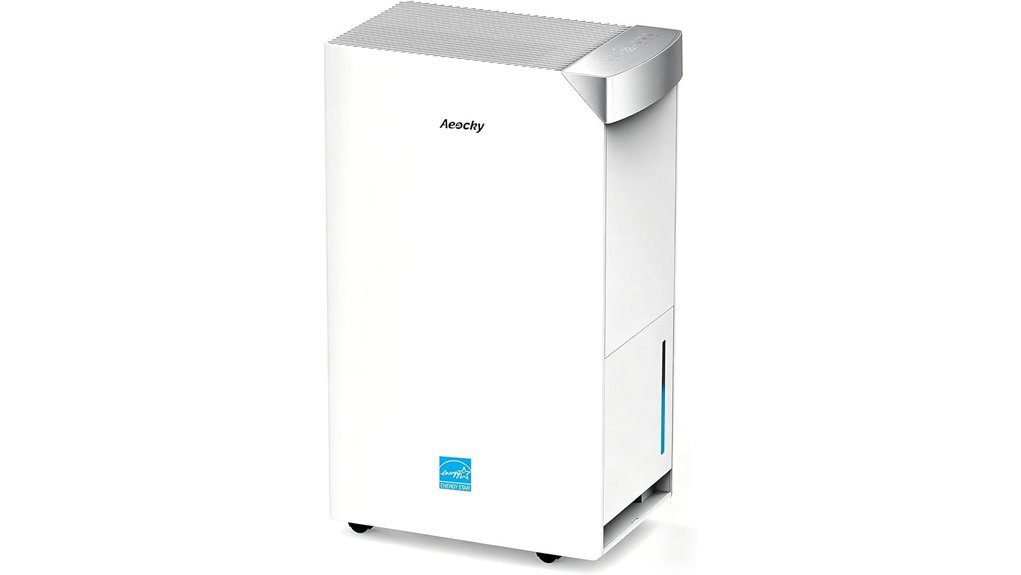
The AEOCKY 74 Pint Dehumidifier is the strongest all-around choice in this guide for a large basement, storage area, or open living space with access to a floor drain. It combines automatic defrost, adjustable humidity control, power-off memory, bucket collection, and continuous gravity drainage.
The manufacturer lists maximum removal of 74 pints per day at 95°F and 95% relative humidity and 52 pints per day at 86°F and 80% relative humidity. Those test conditions are much warmer and wetter than many basements, so the actual amount collected in a cool room will normally be lower.
The current listing confirms an automatic-defrost system for cooler environments, but it does not clearly publish a precise minimum operating temperature. Check the manual for the exact model before using it in a basement or storage room that becomes very cold in winter.
Best For: Large damp basements and open rooms where water can drain continuously through a downward-sloping hose.
Why You’ll Like It: It offers a useful balance of capacity, a relatively large 1.45-gallon tank, automatic humidity management, and hands-off gravity drainage without requiring an app.
Who Should Avoid It: Buyers who need water pumped upward or who cannot verify that their room remains within the model’s rated temperature range.
Pros:
- Automatic defrost for normal frost buildup in cooler rooms.
- Published output at two warm, humid test conditions.
- Large tank, continuous gravity drainage, and power-outage memory.
Cons:
- No built-in pump is listed for this version.
- The 74-pint headline should not be treated as a standardized cool-basement rating.
- The minimum operating temperature should be confirmed in the current manual.
PLUSCENT 32 Pint Dehumidifier for Home
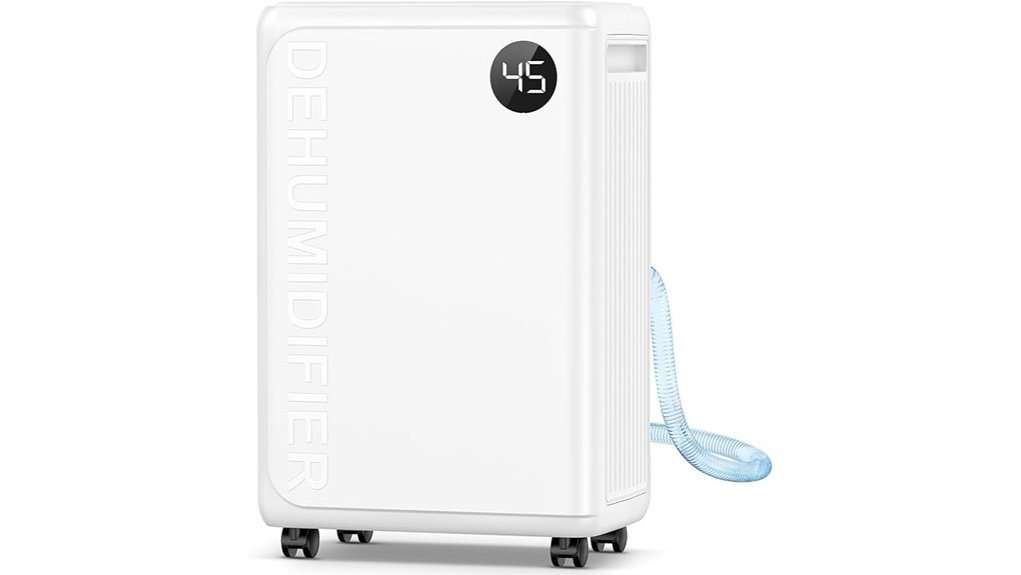
The PLUSCENT 32 Pint Dehumidifier is a practical option for buyers who want automatic defrost, straightforward controls, and easy room-to-room movement without paying for a pump or smart-home platform. It offers DEHU, CONT, and DRY modes, adjustable humidity control, a child lock, caster wheels, a washable filter, automatic restart, and continuous gravity drainage.
Its advertised 32-pint capacity is measured at 95°F and 90% relative humidity. That is a hot, highly humid test environment, so output will be lower in a typical bedroom, office, or cool basement. The advertised 2,500-square-foot coverage should also be treated as an estimate rather than a guarantee.
The listing confirms automatic defrost but does not clearly state the minimum operating temperature. Buyers planning to use it in a cold basement, garage, or seasonal property should check the current manual before purchasing.
Best For: Moderate-size rooms where portability, simple controls, and gravity drainage are more important than maximum capacity or app connectivity.
Why You’ll Like It: Its compact cabinet, wheels, handle, washable filter, three modes, and easy-to-read controls make everyday operation uncomplicated.
Who Should Avoid It: Anyone who needs pumped drainage, a large collection tank, or a clearly documented low-temperature limit.
Pros:
- Automatic defrost, auto-restart, and adjustable humidity control.
- Three operating modes, child lock, timer, and portable design.
- Bucket shutoff and continuous gravity drainage.
Cons:
- The 2-liter tank may fill quickly in a very damp room.
- The included gravity hose is only about 39 inches long.
- The current listing does not clearly establish the minimum operating temperature.
DREO 110-Pint Smart Dehumidifier for Large Rooms
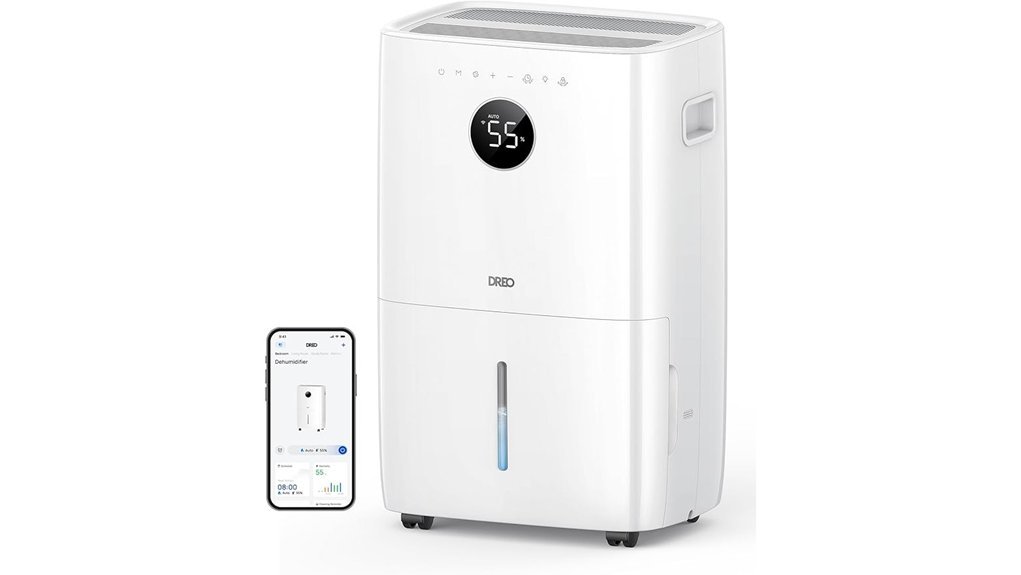
The DREO 110-Pint Smart Dehumidifier is the most feature-rich option in this guide. It provides remote monitoring and control through the DREO app, along with scheduling and compatibility with Alexa and Google Home. It also includes three fan speeds, automatic humidity modes, a large 2-gallon tank, gravity drainage, and automatic defrost.
The 110-pint headline is a maximum measured at 86°F and 90% relative humidity. It should not be compared directly with a lower standardized pint rating. Buyers should check the current energy label or manual when comparing it with another brand that uses different test conditions.
The listing states that its automatic-defrost system activates around 41°F. That describes the frost-control function, not a promise that the unit will continue removing moisture efficiently below 41°F or in a freezing room.
Best For: Large basements and living areas where remote humidity monitoring, scheduling, voice control, and a larger tank justify the added cost and setup.
Why You’ll Like It: The app can reduce trips to a basement or storage room, while the 2-gallon tank provides more time between manual emptying than the smaller models.
Who Should Avoid It: Buyers who prefer simple physical controls, need a compact lightweight unit, or require pumped drainage.
Pros:
- App control, schedules, humidity monitoring, and compatible voice control.
- Large tank, three fan speeds, and continuous gravity drainage.
- Automatic defrost activates around 41°F.
Cons:
- The 110-pint maximum can be misleading when compared with standardized ratings.
- Wi-Fi and app setup add complexity.
- The larger cabinet is less convenient to move between floors.
Factors to Consider When Choosing a No-Freeze Dehumidifier
The best automatic-defrost dehumidifier is not necessarily the model with the largest advertised pint number. Focus on the verified operating-temperature range, capacity test conditions, drainage path, tank size, noise, controls, and maintenance requirements.
Auto-Defrost and Operating Temperature
Automatic defrost uses temperature or coil sensors to detect frost. The compressor pauses while the fan helps clear the ice, and moisture removal resumes after the coil is ready. This protects the refrigeration system, but no water is removed during part of the defrost cycle.
Frost can begin affecting compressor dehumidifiers in rooms considerably warmer than freezing. Review the model manual and the ENERGY STAR dehumidifier buying guidance before using a unit in a cold space. If the room falls below the model’s rated range, warm the room or consider equipment specifically designed for lower temperatures, such as an appropriate desiccant dehumidifier.
Capacity and Test Conditions
Capacity means the quantity of water a dehumidifier removes over 24 hours under stated test conditions. A large number measured in hot, saturated air can be much higher than output in a cool basement.
Check the current product label, manual, or certified listing rather than comparing only the largest number in the product title. The ENERGY STAR capacity guide explains why ratings produced under different test procedures may not be directly comparable.
Room Size and Moisture Load
Square-foot coverage is only a planning estimate. Ceiling height, open doors, stairways, air leakage, temperature, standing water, foundation seepage, laundry drying, and connected rooms can all increase the moisture load.
A dehumidifier can manage water vapor in the air, but it is not a substitute for repairing plumbing leaks, foundation seepage, roof damage, or poor exterior drainage.
Energy Efficiency Ratings
For ENERGY STAR models, efficiency is expressed as an Integrated Energy Factor in liters of water removed per kilowatt-hour. A higher IEF indicates more moisture removal for the energy consumed under the applicable test procedure.
Avoid relying on broad percentage-savings claims unless the manufacturer identifies the comparison model, capacity class, and test method.
Noise Levels
Published decibel ratings may be measured at a particular fan speed and distance. Low mode is normally quieter, while high fan speed, compressor cycling, vibration, and water movement can increase perceived noise.
Place the unit on a solid, level surface and maintain the clearance specified in the manual. Avoid placing it directly against a wall, curtain, box, or furniture that can restrict airflow or amplify vibration.
Drainage Options
Bucket collection is flexible but requires regular emptying. Choose a model with a full-tank alert and automatic shutoff to reduce overflow risk.
Gravity drainage is simple and reliable when the drain is lower than the outlet. The hose must run continuously downward without high points, kinks, or crushed sections.
Pump drainage is needed when water must move upward or across a route that cannot maintain a downward slope. None of the three retained products in this guide is confirmed as having a built-in pump.
Smart Features
Wi-Fi control is most useful when the dehumidifier is in a basement, vacation property, storage area, or another location that is inconvenient to check. Useful functions include current humidity readings, schedules, full-tank alerts, filter reminders, and power-outage memory.
Smart features do not improve cold-weather performance by themselves. Verify automatic defrost and the operating-temperature range before prioritizing app control.
Warranty and Service
Read the current warranty terms rather than relying only on a headline number. Check whether the compressor, electronics, drainage components, replacement labor, and shipping are covered and whether product registration is required.
Save the receipt, model number, serial number, manual, and photographs of the product label after purchase.
Before You Buy
- Measure the room and note whether doors to connected spaces remain open.
- Record the lowest winter temperature in the intended location.
- Confirm the exact model number and minimum operating temperature.
- Compare capacity test conditions instead of relying only on the headline pint number.
- Choose gravity drainage only when the hose can slope continuously downward.
- Choose a different model with a pump if water must travel upward.
- Check the tank size if you plan to empty the bucket manually.
- Allow the intake and outlet clearance required by the manual.
- Use a separate hygrometer to confirm the room’s actual relative humidity.
- Repair active leaks or water intrusion instead of relying only on a dehumidifier.
Frequently Asked Questions
Are No-Freeze Dehumidifiers Really Freeze-Proof?
No. “No freeze” is usually marketing shorthand for automatic defrost. Frost can still form on the coils in cool air. The unit detects the frost condition, pauses normal compressor operation, clears the frost, and then resumes dehumidifying.
How Do Auto-Defrost Dehumidifiers Work in Cold Climates?
They use temperature or coil sensors to detect conditions that can cause frost buildup. During defrost, moisture removal slows or stops temporarily while the coil clears. Defrost cycles usually become more frequent as the room approaches the model’s lower operating limit.
Can These Dehumidifiers Be Used in Unheated Spaces?
Only when the room remains within the exact model’s rated operating range. An automatic-defrost feature does not make a portable compressor dehumidifier suitable for a garage, cabin, crawl space, or basement that falls below its minimum temperature.
Which Model Is Best for the Coldest Room?
The DREO listing gives the clearest frost-control detail by stating that automatic defrost activates around 41°F. However, that should not be interpreted as approval for operation below 41°F. The AEOCKY and PLUSCENT listings confirm automatic defrost but do not clearly publish a minimum temperature, so their manuals should be checked before cold-room use.
Do I Need a Dehumidifier With a Pump?
You need a pump when the drain is higher than the dehumidifier or when the hose cannot maintain a continuous downward slope. If a floor drain is lower than the unit, gravity drainage is usually simpler and requires less maintenance. The three models in this guide are best suited to bucket collection or downward gravity drainage.
What Maintenance Is Required?
Clean the air filter according to the manual, keep the intake and outlet clear, wash and dry the bucket, and inspect the drain hose for kinks, algae, dirt, or buildup. Unplug the dehumidifier before cleaning or maintenance.
Are Auto-Defrost Dehumidifiers Energy Efficient?
They can be efficient when correctly sized and controlled by a humidistat. However, frequent defrost cycles and continuous operation in a cold, wet room can increase runtime. Compare the current ENERGY STAR listing and Integrated Energy Factor instead of relying on an unsupported savings percentage.
What Humidity Level Should I Set?
A practical target around 40% to 50% relative humidity works well for many homes. General EPA guidance recommends keeping indoor humidity between 30% and 50% when practical. Avoid setting the unit lower than necessary because a lower target can increase runtime and energy use.
Use a separate hygrometer if precise humidity control matters. You can also review the EPA indoor-air guidance for general humidity recommendations.
How Long Does a Dehumidifier Last?
There is no guaranteed lifespan. Longevity depends on runtime, room temperature, moisture load, airflow, maintenance, storage, electrical conditions, and component quality. Regular filter cleaning, unobstructed airflow, correct drainage, and prompt attention to icing or unusual noise can reduce avoidable wear.
Final Recommendation
Choose the AEOCKY for a large damp basement with a floor drain and no need for Wi-Fi. Choose the PLUSCENT for simpler portable use in a moderate-size room. Choose the DREO when app monitoring, scheduling, voice control, and a larger tank are worth the added size and setup.
None of these three models is the right choice when condensate must be pumped upward. In that situation, select a different automatic-defrost model with a verified built-in pump.
Whichever unit you select, confirm the exact model number, operating-temperature range, drainage requirements, and capacity test conditions before buying. Automatic defrost is valuable protection against normal coil frost, but it is not a guarantee of efficient operation in freezing conditions.