If you want a quiet 30-pint dehumidifier for a basement, bedroom, living area, or laundry space, focus on more than the capacity printed in the product title. Noise mode, drainage setup, humidity controls, tank size, room conditions, and the test conditions behind the pint rating all affect real-world performance.
After checking the listed daily moisture-removal capacity, room-coverage claims, operating modes, drainage options, and quiet-use information, four products remain direct matches for this guide. The WHOY 30-Pint Smart Dehumidifier stands out for app control, the Nexaro 30-Pint Dehumidifier carries the largest seller-rated coverage and lowest listed noise figure, the VEVOR 30-Pint Dehumidifier provides the clearest capacity test conditions and a listed 38 dB low-noise claim, and the Dravonic 30-Pint Dehumidifier offers simple controls with a listed 40 dB low-speed claim.
Quick verdict
Choose WHOY for Wi-Fi control, Nexaro for the largest advertised coverage and a seller-listed 35 dB claim, VEVOR for clearer test-condition details and a listed 38 dB claim, and Dravonic for simple controls with a listed 40 dB low-speed claim. Treat every coverage and noise figure as a seller or manufacturer claim, not a directly comparable laboratory guarantee.
How these models were compared
The comparison prioritizes a stated 30-pint-per-day rating, quiet-use information, adjustable humidity control, tank and continuous-drain options, room-fit guidance, and clear limitations. No hands-on testing is claimed, and seller-listed square-foot and decibel figures should be verified on the current product page and manual.
Quick Comparison of Quiet 30-Pint Dehumidifiers
| Product | Best for | Seller-listed coverage | Quiet-use information | Drainage | Amazon |
|---|---|---|---|---|---|
| WHOY 30-Pint Smart Dehumidifier | Wi-Fi control | Up to 2,000 sq. ft. | Advertised as ultra quiet; no exact dB figure confirmed | 1.6 L tank or gravity-drain hose | Check Availability |
| Nexaro 30-Pint Dehumidifier | Larger rooms | Up to 3,000 sq. ft. | Seller-listed 35 dB; test method not stated | Internal tank or gravity-drain hose | Check Availability |
| VEVOR 30-Pint Dehumidifier | Smaller basements | Up to 1,500 sq. ft. | Seller-listed as low as 38 dB; includes Sleep mode | Internal tank or gravity-drain hose | Check Availability |
| Dravonic 30-Pint Dehumidifier | Simple everyday use | Up to 2,000 sq. ft. | Seller-listed 40 dB on low speed | Internal tank or gravity-drain hose | Check Availability |
Important: Pint capacity and room coverage are not interchangeable. Moisture load, temperature, starting humidity, ceiling height, doors, airflow, and rating conditions can substantially change results. None of the four listings clearly confirms a built-in condensate pump, so plan on tank emptying or a continuously downward-sloping gravity drain unless the current manual says otherwise.
WHOY 30-Pint Smart Dehumidifier With Wi-Fi App
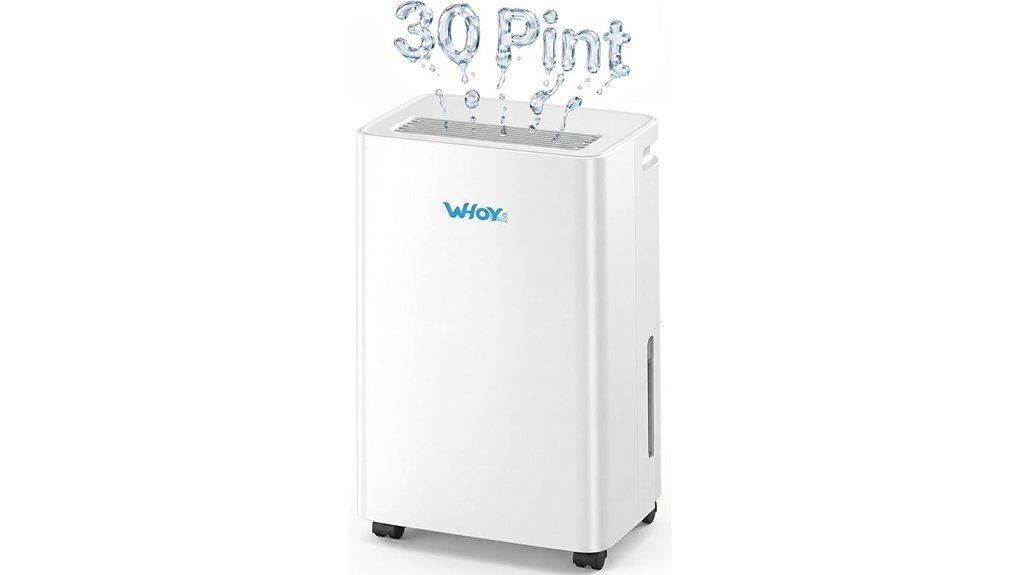
Best Smart Controls
The WHOY model is the strongest fit for buyers who want to monitor and adjust humidity from a phone. Its listing describes Wi-Fi app control, target-humidity adjustment, a 24-hour timer, laundry-dry functionality, a child lock, a 1.6-liter tank, and continuous drainage.
The listing title and feature bullets describe moisture removal of up to 30 pints per day for spaces up to 2,000 square feet. However, one structured capacity field on the product page may display a different capacity figure, so buyers should confirm the current model number, daily-removal rating, and manual before ordering. Real room coverage will also depend on temperature, starting humidity, airflow, and moisture load.
Why you may like it: Remote monitoring reduces the need to walk to the unit to check humidity or change settings.
Who should buy it: Smart-home users who want scheduling, app control, and two drainage options.
Who should avoid it: Buyers who prefer basic manual controls, need a large tank, or require a clearly documented and directly comparable noise rating.
Pros:
- Wi-Fi app control for remote humidity monitoring and adjustments.
- Continuous-drain option reduces manual tank emptying.
- Laundry-dry mode, timer, child lock, and automatic full-tank shutoff add convenience.
Cons:
- The “ultra quiet” description is not paired with a clearly confirmed dB figure.
- The 1.6-liter tank may fill quickly in damp conditions when the gravity-drain hose is not used.
- Capacity fields on the listing are not fully consistent, so confirm the exact daily-removal rating and model before buying.
Nexaro 3,000 Sq. Ft. 30-Pint Dehumidifier
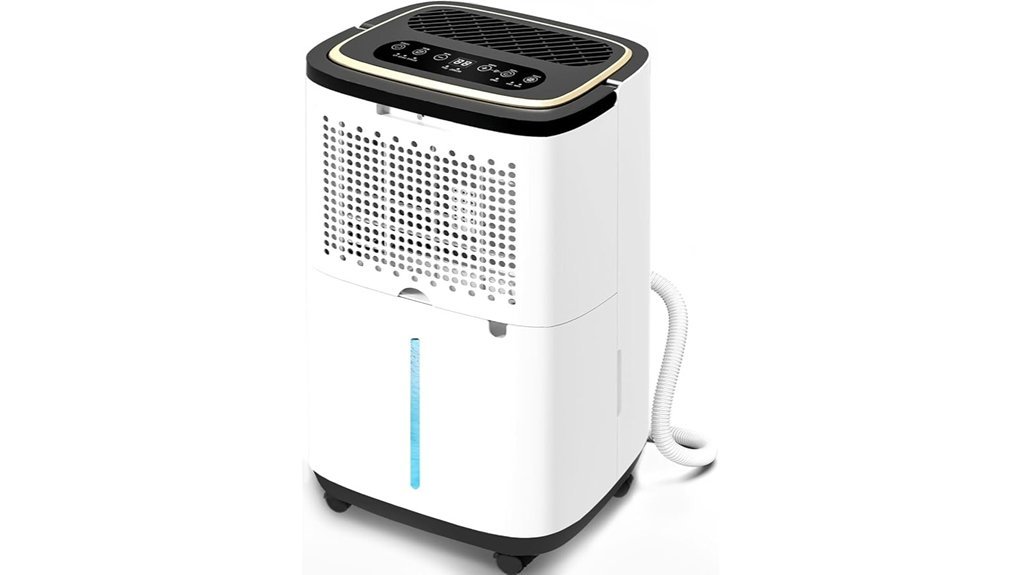
Best Advertised Coverage
This Nexaro model is aimed at buyers with a larger room, basement, garage, or open-plan area. The seller describes a 30-pint daily capacity under very warm, humid conditions, coverage up to 3,000 square feet, three modes, adjustable humidity control, a 24-hour timer, child lock, auto-defrost, an internal tank, and gravity-hose drainage.
Its seller-listed 35 dB operating claim is the lowest stated number in this comparison. Use that figure only as a rough guide because the measurement method is not stated, and brands may test at different fan speeds, distances, and room conditions. Some secondary listing fields also conflict on technical details such as tank size and refrigerant, so those specifications should be checked in the current manual rather than assumed.
Why you may like it: It combines a large advertised coverage area with quiet-use positioning and flexible drainage.
Who should buy it: Buyers comparing 30-pint units for a larger room and willing to verify current listing details before ordering.
Who should avoid it: Buyers who need independently verified room coverage, refrigerant information, or long-term brand support details.
Pros:
- Largest seller-rated coverage in this comparison.
- Three operating modes, timer, humidity setting, child lock, and auto-defrost.
- Tank and continuous-drain options support both portable and longer unattended use.
Cons:
- The 3,000-square-foot figure may be optimistic in very damp or divided spaces.
- Some seller and secondary listing details conflict, so confirm the current Amazon page, model number, and manual.
- A lesser-known brand may offer less documentation than established dehumidifier manufacturers.
VEVOR 30-Pint Dehumidifier for Home and Basement
Best Verified Noise Detail
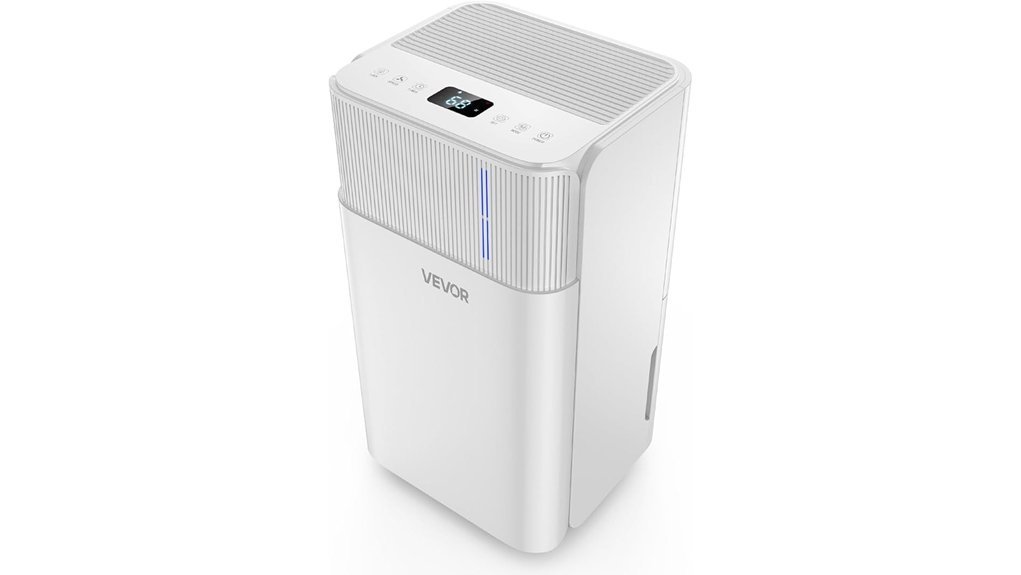
The VEVOR model is rated for spaces up to 1,500 square feet, making it easier to match to a smaller basement, bedroom, storage room, or workshop than products with very broad coverage claims. It includes Auto, Continuous Drying, and Sleep modes, plus adjustable humidity control, an LED panel, a 0.53-gallon tank, and gravity-hose drainage. The current listing also describes operation as low as 38 dB.
Capacity conditions deserve attention. The Amazon listing states that the unit can remove about 24 pints per day at 86°F and 80% relative humidity, rising to 30 pints per day at 95°F and 90% relative humidity. This is a useful reminder that the “30-pint” label may describe performance in hotter and more humid conditions than a typical room.
Why you may like it: The narrower coverage claim and published test conditions make comparison easier, while Sleep mode and the listed 38 dB figure help buyers judge quiet-use suitability.
Who should buy it: Buyers with a smaller basement or storage area who want automatic humidity control and continuous drainage.
Who should avoid it: Buyers with a very wet area above 1,500 square feet or anyone who needs an independently standardized dB rating.
Pros:
- Clear 1,500-square-foot seller rating is easier to compare with smaller spaces.
- Auto, Continuous Drying, and Sleep modes cover common use cases.
- Continuous drainage helps in spaces with ongoing moisture.
Cons:
- The full 30-pint claim applies to very hot, humid conditions.
- The 38 dB figure is a seller/manufacturer claim and may apply only to a low fan or specific test setup.
- The hose outlet requires a continuously downward route to a drain unless a separate compatible condensate pump is used.
Dravonic 30-Pint Dehumidifier for Home and Basement
Best Simple 30-Pint Option
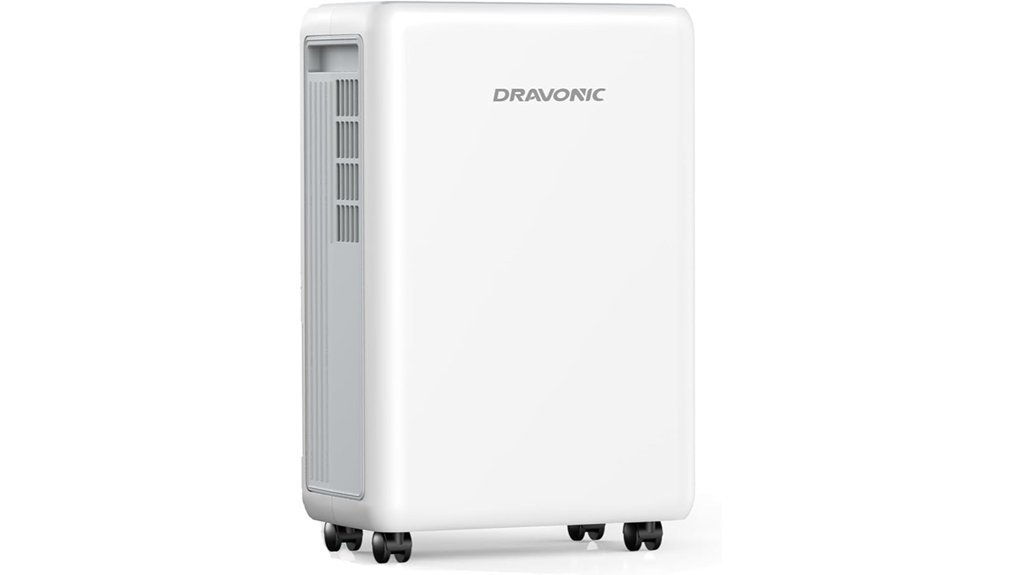
The Dravonic model is a straightforward choice for buyers who want automatic humidity control without relying on an app. Its seller listing describes a 30-pint capacity, coverage up to 2,000 square feet, three modes, a 24-hour timer, a washable filter, portability features, an internal tank, and a drain hose for continuous operation.
Seller information lists operation at about 40 dB on low speed, but that number should still be treated as a product-specific claim rather than directly compared with another brand’s measurement. The model is better judged by room fit, drainage setup, and control simplicity as well as its stated noise level.
Why you may like it: It covers the core functions many buyers need: humidity setting, timer, multiple modes, mobility, and continuous drainage.
Who should buy it: Buyers who want a conventional portable dehumidifier for a bedroom, bathroom, basement, or living area.
Who should avoid it: Buyers who need independently verified laboratory noise data, built-in pump drainage, or extensive manufacturer documentation.
Pros:
- Simple control set with three modes and a 24-hour timer.
- Continuous-drain hose and washable filter reduce routine upkeep.
- Portable design makes it easier to move between rooms.
Cons:
- The listed 40 dB low-speed figure was not independently verified under a shared test method.
- Seller-rated 2,000-square-foot coverage may be reduced by heavy moisture, closed rooms, or poor airflow.
- Brand support and warranty terms should be checked before purchase.
Factors to Consider When Choosing a Quiet 30-Pint Dehumidifier
A quiet dehumidifier still needs enough moisture-removal capacity for the room. Use the following factors to avoid buying a unit that sounds suitable on paper but struggles in your space.
Capacity and Test Conditions
A 30-pint rating means the unit can collect up to a stated amount of water over 24 hours under specified test conditions. It does not mean every model will remove 30 pints in a cooler bedroom or basement. Compare the temperature and relative-humidity conditions behind the claim whenever the listing provides them.
Older and newer dehumidifier labels may not be directly comparable because federal test procedures and efficiency metrics have changed over time. Compare the stated test standard and ambient conditions rather than assuming that two products with the same or different pint labels will perform identically.
Room Size and Moisture Load
Square-foot coverage is only a starting point. A slightly damp open room is easier to manage than a wet basement with seepage, laundry drying, high ceilings, closed rooms, or poor air circulation. For a very damp or wet area, choosing more capacity is usually safer than relying on the largest coverage number printed in a listing.
Noise Information
Look for a Sleep or low-fan mode, but compare dB claims cautiously. A 35 dB, 38 dB, or 40 dB claim is not automatically an apples-to-apples comparison when brands use different fan speeds, distances, rooms, or test methods. Compressor cycling can also sound different from steady fan noise. Keep the unit level, leave the recommended clearance around the intake and exhaust, and prevent the cabinet or hose from vibrating against a wall.
Drainage Options
An internal tank is convenient for occasional use, but it may need frequent emptying in a damp room. A gravity-drain hose is better for extended operation when a floor drain or sink is lower than the outlet. None of the four compared models clearly confirms a built-in pump, so use a compatible external condensate pump when water must move upward or across a long distance.
Humidity Control and Operating Modes
Useful controls include an adjustable humidistat, Auto mode, Continuous mode, Sleep mode, laundry-dry mode, and a timer. Auto mode is generally the best everyday setting because it cycles the compressor to maintain the selected humidity instead of running continuously.
Cold-Room Performance
Compressor dehumidifiers can collect frost on their coils in cool spaces. Auto-defrost helps protect performance, but it does not make every unit suitable for freezing rooms. Check the manufacturer’s operating-temperature range before using a dehumidifier in an unheated basement, garage, or crawl space.
Energy Efficiency
Power consumption varies by compressor, fan speed, room conditions, and run time. Instead of relying on a generic wattage estimate, check the product label and look for an ENERGY STAR certification and a higher Integrated Energy Factor when available. Correct sizing and automatic humidity control can also reduce unnecessary run time.
Maintenance Requirements
Clean the washable filter according to the manual, empty and rinse the tank, inspect the hose for kinks or buildup, and keep the intake and exhaust clear. Do not spray water into the cabinet or use the unit with a damaged cord. After moving the appliance, follow the manufacturer’s instructions before restarting it.
Safety and Placement
Use a grounded wall outlet that matches the product instructions, keep the cord away from standing water, and avoid extension cords unless the manufacturer expressly permits one. A child lock helps prevent setting changes, but it does not replace safe placement or supervision around the tank, hose, cord, and warm exhaust air.
Portability and Design
Casters and a recessed handle are useful if the unit will move between rooms. Check the weight, cabinet dimensions, hose-exit location, tank-removal direction, and required wall clearance before buying. A compact cabinet is not helpful if it blocks a walkway or cannot drain correctly where you plan to use it.
Before you buy
- Measure the room and judge whether it is slightly damp, very damp, or wet.
- Confirm the capacity test conditions and current model details.
- Decide whether you will empty a tank or use a gravity drain.
- Check the lowest operating temperature for basements or garages.
- Verify warranty, return policy, replacement-filter needs, and current Amazon availability.
Frequently Asked Questions
How Much Energy Does a 30-Pint Dehumidifier Use?
There is no single wattage for all 30-pint models. Consumption changes with the compressor, fan speed, humidity, temperature, and how long the unit runs. Check the product label or manual, and compare ENERGY STAR certification and Integrated Energy Factor when available.
How Long Does a 30-Pint Dehumidifier Last?
There is no guaranteed lifespan. Service life depends on build quality, operating hours, room temperature, filter cleaning, coil condition, drainage, and compressor cycling. Regular maintenance and correct sizing can reduce strain, while the warranty provides a better comparison point than a broad lifespan estimate.
Can a Dehumidifier Improve Indoor Air Quality?
It can help control excess moisture and reduce conditions that support mold and dust mites. However, a dehumidifier is not an air purifier, does not remove all airborne pollutants, and cannot fix an active water leak or existing mold problem by itself.
What Humidity Level Should I Set?
A practical indoor target is generally around 30% to 50% relative humidity. Avoid setting the unit unnecessarily low, because very dry air can be uncomfortable and can increase energy use.
Is a 30-Pint Dehumidifier Enough for 2,000 Square Feet?
It may be enough for a slightly or moderately damp space under 2,000 square feet, but a very damp or wet basement may need more capacity. Room layout, ceiling height, airflow, temperature, and ongoing moisture sources are as important as floor area.
What Maintenance Does a Dehumidifier Need?
Clean the filter on the schedule in the manual, wash and dry the tank, check the drain hose, remove dust from accessible vents, and keep clearance around the unit. Unplug it before cleaning and never open the sealed refrigeration system yourself.
How Do I Know If I Need a Dehumidifier?
Common signs include persistent indoor humidity above the recommended range, musty odors, condensation, damp surfaces, slow-drying laundry, or recurring moisture in a basement. Fix leaks and drainage problems first, then use a dehumidifier to manage remaining airborne moisture.
Are 35 dB, 38 dB, and 40 dB Claims Directly Comparable?
Not necessarily. Noise can be measured at different fan speeds, distances, and room conditions, and some listings do not state the test method. Use the numbers as product-specific guidance, then check return terms and place the unit on a level surface away from vibrating walls or furniture.
Do These 30-Pint Dehumidifiers Have Built-In Pumps?
A built-in pump is not clearly confirmed for the four models in this guide. Their continuous-drain setups should be treated as gravity drainage unless the current manual states otherwise. The hose must run continuously downward, or you will need a separate compatible condensate pump.
Final Recommendation
Best fit by use case:
- WHOY: best for Wi-Fi monitoring and app-based control.
- Nexaro: best for the largest advertised coverage and lowest seller-listed noise figure, provided you verify inconsistent technical fields.
- VEVOR: best for buyers who want clearer capacity test conditions, a smaller coverage claim, and a listed 38 dB figure.
- Dravonic: best for buyers who want standard controls, a timer, gravity drainage, and a listed 40 dB low-speed claim without an app.
The right quiet 30-pint dehumidifier is the one that matches your moisture load, drainage route, temperature, and tolerance for fan and compressor noise. Confirm the current Amazon listing, exact model number, operating-temperature range, warranty, included drain-hose details, and capacity test conditions before ordering. After setup, use a hygrometer to confirm that the unit can maintain your target humidity in the actual room.