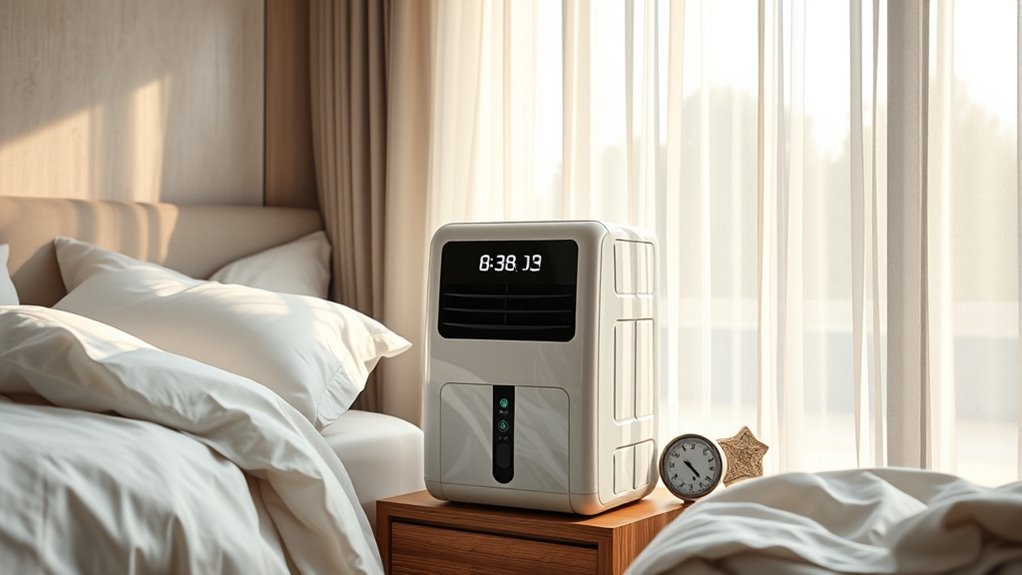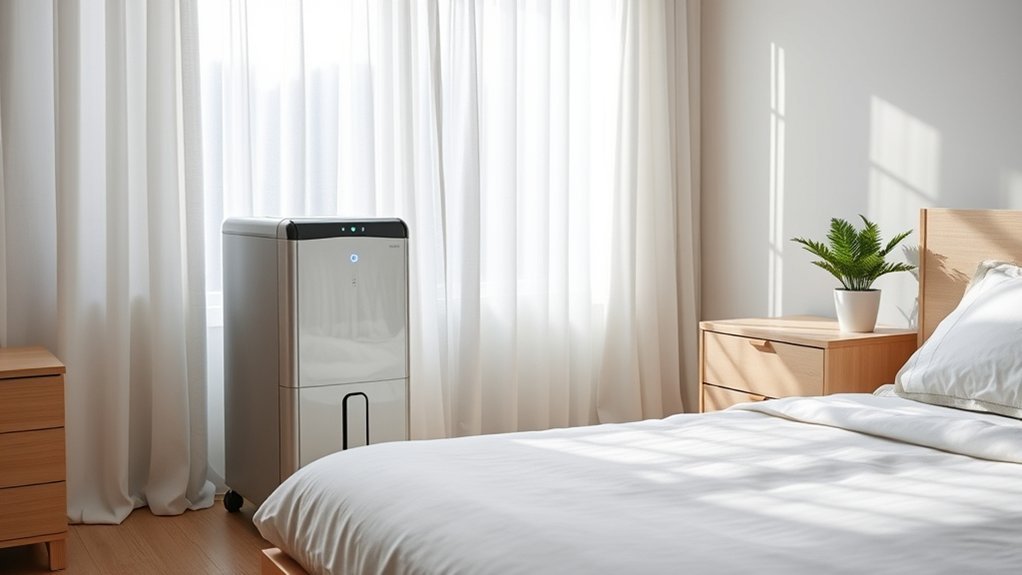
Sleeping with a dehumidifier running can make a damp bedroom feel less sticky and more comfortable. It is generally suitable for overnight use when the room is actually humid, the appliance is in good condition, and you follow its safety instructions. The goal is not to make the air as dry as possible. It is to maintain a steady, comfortable humidity level without creating extra noise, heat, or electrical risk.
Quick Answer
Yes, you can sleep with a dehumidifier running overnight if it is not recalled or damaged, is plugged directly into a grounded wall outlet, has clear airflow, and uses a humidistat. Start around 45% to 50% relative humidity, and stop if the room becomes too dry or the appliance behaves unusually.
Key Takeaways
- Measure the room with a hygrometer before deciding whether overnight use is necessary.
- A starting target of 45% to 50% relative humidity works well for many bedrooms.
- Plug the appliance directly into a properly grounded wall outlet unless its manual clearly allows another setup.
- Keep bedding, curtains, furniture, and other objects away from the intake and outlet.
- A dehumidifier can control moisture, but it does not replace ventilation, air conditioning, mold cleanup, or medical care.
At a Glance
| Time Required | About 10 to 15 minutes for the first safety check and setup |
| Difficulty | Easy |
| Tools Needed | Hygrometer, appliance manual, and a properly grounded wall outlet |
| Cost | Electricity cost varies by the unit’s wattage, runtime, fan setting, and local energy rate |
Can You Sleep With a Dehumidifier in Your Bedroom?
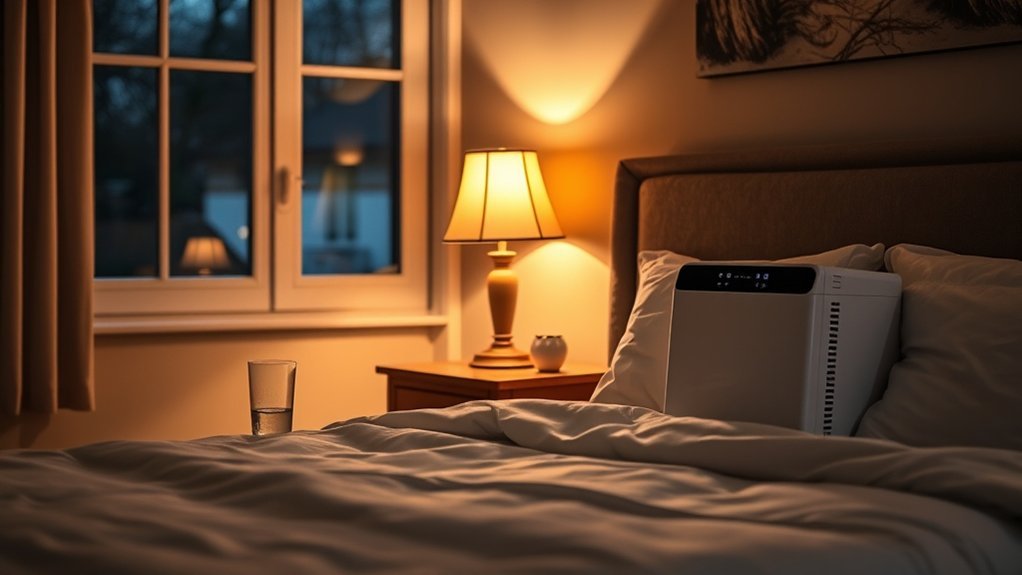
Yes, you can sleep with a dehumidifier running in your bedroom when excess humidity is present. The U.S. Environmental Protection Agency recommends keeping indoor relative humidity below 60% and, when possible, between 30% and 50%. This range helps limit condensation and conditions that support mold and dust mites.
For overnight use, start with the humidistat around 45% to 50%. A unit with automatic humidity control will cycle on and off after reaching the setpoint, rather than running at full power throughout the night. Auto shutoff for a full bucket is also important.
A dehumidifier does not clean up existing mold, repair leaks, cool the room like an air conditioner, or guarantee better sleep. It only removes water from the air. You still need to address plumbing leaks, wet materials, poor ventilation, or building defects that keep adding moisture.
Warning: Check the brand, model number, and date code before running an older dehumidifier overnight. The U.S. Consumer Product Safety Commission has warned that some recalled models can overheat, smoke, or catch fire. Stop using any recalled, damaged, leaking, sparking, or unusually hot unit.
How Bedroom Humidity Affects Sleep
Bedroom humidity affects how warm and comfortable you feel. Sweat cools your skin as it evaporates. When the air is hot and very humid, evaporation slows, which can leave you feeling sticky and overheated.
A peer-reviewed review of the thermal environment and sleep found that humid heat can increase thermal strain, increase wakefulness, and affect normal sleep stages. However, this does not mean that every person will sleep better after turning on a dehumidifier. Temperature, bedding, noise, health, airflow, and personal comfort also matter.
High humidity can also encourage condensation, mold growth, and dust mites. These conditions may worsen symptoms for people who are sensitive to indoor allergens. A dehumidifier can make the environment less favorable to these problems, but it does not remove every allergen or replace proper cleaning and moisture-source repair.
A dehumidifier is useful when the bedroom is too humid. Running one when the air is already dry can create new discomfort instead of solving a problem.
Signs Your Bedroom May Be Too Humid
- The hygrometer regularly reads above 55% to 60% relative humidity.
- Windows or cold walls collect condensation.
- The room smells musty or feels clammy.
- Bedding and towels take a long time to dry.
- Mold repeatedly appears even after cleaning.
- The room is next to a shower, laundry area, damp basement, or known leak.
Signs the Air May Be Too Dry
- The hygrometer falls below about 30% relative humidity.
- You wake with a dry throat, nose, eyes, or skin.
- You notice more static electricity than usual.
- Wood furniture or flooring begins to shrink or develop gaps.
How a Bedroom Dehumidifier Helps You Sleep Better
A bedroom dehumidifier may improve comfort by making humid air feel less heavy and helping perspiration evaporate more normally. It may also reduce window condensation and slow the return of moisture-related odors.
The benefit is most noticeable when relative humidity is genuinely high. If the bedroom is already near 40% to 50%, additional dehumidification may provide little benefit and could make your nose, throat, eyes, or skin feel dry.
Automatic humidity control is especially useful at night. Once the room reaches the selected level, the compressor and fan can cycle as needed instead of operating continuously. Sleep mode may lower fan speed and dim the control lights, although it can also reduce the rate of moisture removal.
Recommended Products
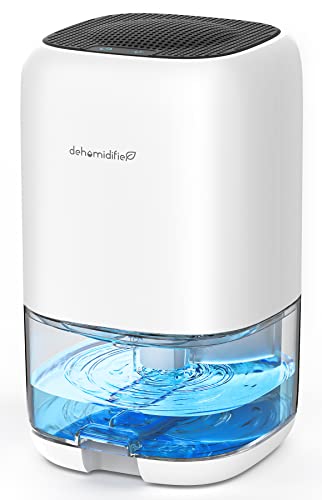
High Efficient Dehumidifiers for Home: Still annoyed about the muggy weather? Just Take it easy! have a try at TABYIK 35OZ Peltier dehumidifier, in a closed small room with humid environment of 86°F and 80% RH, it can collect a max of 16oz(450ml) of water in 24 hours, and with very low energy consumption (no more than 1-kilowatt hour a day).

High Efficient Dehumidifiers for Home: This compact 44oz dehumidifier efficiently removes excess moisture in rooms with 86°F and 80% RH, collecting up to 11.8oz (349ml) of water in 24 hours. It maintains an ideal humidity level of 45%-55% while operating at ultra-low energy consumption (24W/hour, 576W/day). Perfect for bedrooms, bathrooms, and small spaces.

Upgrade High Efficient Dehumidification: Dehumidifier utilize semi conductor condensation technology, ensuring quiet operation while effectively extracting moisture from the air. This advanced feature helps keep humidity levels below 45%
What Humidity Should You Set at Night?
Try a setting of 45% to 50% relative humidity first. Check the room with a separate hygrometer because the sensor inside the dehumidifier may read differently from the air near your bed.
- Above 60%: Investigate excess moisture and consider running the dehumidifier.
- 45% to 50%: A practical starting range for many bedrooms.
- 30% to 40%: Sometimes useful during cold weather when window condensation is a problem.
- Below 30%: The air may be unnecessarily dry, so reduce the runtime or increase the setpoint.
Note: Relative humidity changes with temperature. A reading can rise overnight as the room cools, even when the actual amount of water vapor changes very little.
How to Run a Dehumidifier Safely Overnight
- Check the model and condition. Confirm that the appliance is not recalled. Inspect the plug, power cord, housing, bucket, and drain connection for damage.
- Measure the room. Use a hygrometer to confirm that humidity is high enough to justify running the unit.
- Read the manual. Follow the model’s required wall, furniture, temperature, and airflow clearances.
- Use a suitable outlet. Plug the unit directly into a properly installed, grounded wall outlet. Do not use a power strip, adapter, or extension cord unless the manufacturer specifically permits it.
- Prepare the water system. Empty and reinstall the bucket correctly. When using continuous drainage, secure the hose and route it exactly as the manual describes.
- Select automatic mode. Start around 45% to 50% RH instead of using continuous mode all night.
- Test it before sleeping. Run the unit while you are awake and check for unusual heat, smells, vibration, leaking, sparking, or repeated electrical trips.
- Check the morning result. Compare the hygrometer reading with your comfort. Raise the setpoint or shorten the runtime if the room becomes too dry.
Where to Place a Bedroom Dehumidifier
Place the dehumidifier on a flat, firm, stable surface where its intake and outlet remain open. There is no universal rule requiring it to sit exactly 6 or 10 feet from the bed. The correct clearance depends on the unit’s design, so follow the manual.
Keep the appliance as far from your bed as practical to reduce fan noise and prevent dry air from blowing directly toward your face. However, do not use an extension cord simply to gain more distance.
- Keep curtains, blankets, clothing, and bedding away from the unit.
- Do not push the intake against a wall, dresser, or upholstered furniture.
- Keep it away from heaters, radiators, and direct sunlight.
- Do not place it where water can splash onto the appliance or outlet.
- Do not place objects on top of it.
- Keep the power cord where it cannot be pinched, covered, or tripped over.
- Make sure children and pets cannot tip the unit or pull the drain hose loose.
ENERGY STAR placement guidance notes that some top-discharge models can operate near a wall, while units with other discharge arrangements need more open space. This is why the manufacturer’s instructions should take priority over a fixed distance found online.
Pro Tip: If the unit is too loud beside the bed, run it before bedtime. You may also place it outside the bedroom with the door open if the appliance is sized for the combined space and its cord still reaches a suitable wall outlet.
How to Choose a Bedroom Dehumidifier
Choose a bedroom dehumidifier by considering room area, starting humidity, moisture severity, operating temperature, noise, and drainage. Do not rely only on a large square-foot coverage number printed on the box.
Recommended Products

【The Undisputed Champion — Industry-Leading Dehumidifier Brand】Choose AEOCKY, getting double market validation. According to data independently verified by Stackline, a leading third-party data analytics company, AEOCKY was an industry‑leading dehumidifier brand on Amazon U.S. in 2025. Meanwhile, it stands as a technology-leading rotary desiccant dehumidifier brand on Amazon. This isn’t just an appliance—it’s a complete humidity-control solution for small spaces. Skip low-performance alternatives and trust a brand recognized by the market.

Semiconductor dehumidifiers use thermoelectric cooling to remove moisture from the air. They create a drier, more comfortable environment by reducing humidity and improving air quality.
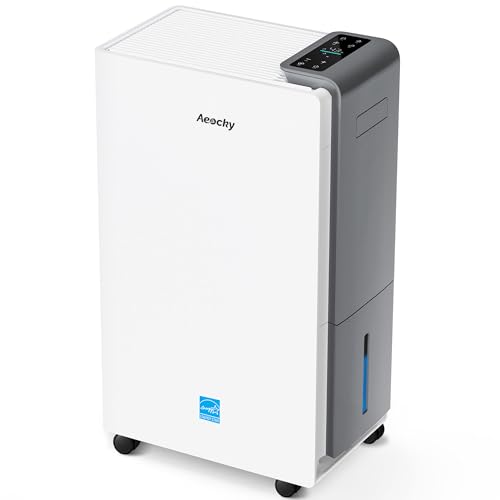
【ENERGY STAR 25 ≠ ENERGY STAR Most Efficient 2025】Don't fall for competitors' word games. With only 2.6% of ENERGY STAR models earning "Most Efficient 2025" title, these options are exceptionally rare on the market. RHEA-001 is one of the few to truly hold this top-tier certification. Many brands use misleading phrases like "Energy Star Efficient 25" or "Energy Star 25" to imply a standard they haven't met. Choosing them is a risk.With AEOCKY, you get verified performance and the peace of mind of authentic, top-tier efficiency.
Match Capacity to the Moisture Load
Dehumidifier capacity is measured in pints of water removed per 24 hours under standardized test conditions. Current labels should not be compared directly with much older products because the Department of Energy changed the test procedure around 2020.
For portable units serving spaces under 2,000 square feet, current ENERGY STAR guidance gives these broad starting ranges:
- Slightly to moderately damp: About 20 to 30 pints per day.
- Very damp: About 25 to 40 pints per day.
- Wet or subject to seepage: About 30 to 50 pints per day.
A normal bedroom may fall at the lower end, while a bedroom connected to a damp basement, bathroom, or leak may need more capacity. Correct the moisture source before buying a much larger appliance.
Features That Matter in a Bedroom
- Built-in humidistat: Lets the unit maintain a target instead of running continuously.
- Low fan setting or sleep mode: Reduces sound when full-speed operation is unnecessary.
- Display-off option: Prevents bright control lights from disturbing sleep.
- Auto shutoff: Stops operation when the bucket is full or incorrectly installed.
- Continuous drainage: Useful when a safe, manufacturer-approved drain route is available.
- Washable filter: Makes routine airflow maintenance easier.
- Automatic defrost: Helps in cooler rooms where frost might form on the coils.
- ENERGY STAR certification: Certified models remove moisture more efficiently than comparable conventional units.
- Accessible model and serial labels: Makes recall checks and service requests easier.
Do not assume that every model advertised as “silent” or “sleep friendly” will suit you. Compare the noise rating at the lowest fan speed, read how the manufacturer measured it, and consider the distance from the unit to your bed.
When You Should Not Run It Overnight
Turn the dehumidifier off and investigate the cause when:
- The unit is recalled, damaged, leaking, sparking, or producing a burning smell.
- The plug, cord, outlet, or wall plate becomes unusually hot.
- The circuit breaker repeatedly trips.
- Relative humidity is already below about 30%.
- The appliance rocks, vibrates heavily, or sits on an unstable surface.
- The intake or outlet cannot remain clear.
- The room contains a water leak that has not been repaired.
- You develop new or worsening breathing symptoms while it operates.
Medical Note: A dehumidifier is not a treatment for COPD, asthma, allergies, sleep disorders, or other health conditions. Seek medical advice for persistent breathing problems, chest pain, wheezing, severe coughing, or symptoms that worsen at night.
Tips for Quiet Overnight Use
Noise depends on the compressor, fan speed, floor surface, room acoustics, and distance from your bed. A fixed decibel limit does not guarantee that a unit will feel quiet to every sleeper.
- Run the unit before bedtime to remove the heaviest moisture load.
- Use automatic humidity control instead of continuous mode.
- Select the lowest fan speed that can maintain the target humidity.
- Place the appliance on a hard, level surface so the cabinet does not rattle.
- Make sure the bucket and filter are seated correctly.
- Clean the filter at the interval specified in the manual.
- Turn off display lights or use the manufacturer’s sleep mode.
- Direct the outlet toward open space rather than the bed.
- Keep the unit outside closets, under furniture, and away from soft items that block airflow.
Empty the water tank before sleep if it is likely to fill overnight. A full bucket normally activates auto shutoff, but the resulting alert, sudden silence, or restart cycle may disturb light sleepers.
Recommended Products

🍃Advanced Small Dehumidifier for Home: Designed for lasting home use, our bathroom dehumidifier works gently and steadily to maintain a balanced humidity level. The large 44 OZ (1.3L) water tank minimizes emptying frequency. Suitable for dorm room, camper, apartment, room, office and living room. No more dampness-just fresh, comfortable air everywhere

🍀 1657ML Larger Capacity: The water tank of this dehumidifier can hold of water at most 1657ml(58 OZ), you don’t need to pour water frequently and don’t worry about the water overflow or water leaking. Please read the instruction manual before using the product!

High Efficient Dehumidification: this dehumidifier for home is equipped with Thermo-Electric Peltier semiconductors & a 25 oz (750 ml) water tank, dehumidifier could absorb up to 16 oz(450 ml/D) of water in a humid environment of 86°F and 80% RH. You no longer need to endure humid days and just enjoy a comfortable living environment
Troubleshooting Overnight Problems
The Humidity Is Not Dropping
- Confirm the reading with a separate hygrometer.
- Close windows when the outdoor air is more humid than the bedroom.
- Check for a bathroom, laundry area, leak, wet carpet, or other moisture source.
- Clean the filter and unblock the intake and outlet.
- Make sure the unit is not undersized for the room’s moisture load.
- Allow enough time for walls, bedding, and furniture to release stored moisture.
The Room Feels Warmer
Compressor dehumidifiers release heat into the room while operating. The air may feel less sticky but become slightly warmer. Run the unit before bed, lower the fan setting after reaching the target, or use air conditioning when temperature is the main comfort problem.
The Unit Turns On and Off Frequently
Normal cycling occurs near the selected humidity level. Very rapid cycling may indicate blocked airflow, frost, a poor sensor location, a setpoint too close to the current reading, or a mechanical problem. Follow the troubleshooting section in the manual.
The Bucket Fills During the Night
Empty it before bed or use continuous drainage only when the unit supports it. Keep the hose secure, free of kinks, and routed to an approved drain. Many gravity-drain systems require the hose to slope downward continuously.
Frost Forms on the Coils
Portable compressor units can struggle in cool rooms. ENERGY STAR advises checking the model’s low-temperature rating when the space regularly falls below about 65°F. Turn the unit off and allow it to defrost if the manual directs you to do so.
The Unit Becomes Louder
Check the filter, bucket, floor level, fan setting, and nearby objects. A curtain, loose panel, hose, or piece of furniture may vibrate when the compressor starts. Stop using the appliance if the sound is harsh, metallic, or suddenly different from normal operation.
Frequently Asked Questions
Is It Okay to Sleep With a Dehumidifier in Your Room?
Yes, provided the bedroom is humid, the unit is suitable for extended operation, and you follow its safety instructions. Use a humidistat, keep the airflow open, plug it into the correct wall outlet, and stop using it if you notice overheating, leaking, electrical problems, or excessive dryness.
Do Air Purifiers Dry Indoor Air?
A standard air purifier does not remove meaningful amounts of water from the air. It moves air through filters or other cleaning systems to reduce certain particles or gases. Use a dehumidifier to remove moisture and a humidifier to add moisture.
Should You Use a Dehumidifier if You Have COPD?
High humidity can trigger symptoms for some people with COPD, so correcting measured excess humidity may improve comfort. However, very dry air can also irritate the airways. Follow your clinician’s advice, track the humidity, and do not treat a dehumidifier as a replacement for prescribed care.
Will a Dehumidifier Help With Gnats?
It may help slightly when the entire room is unusually damp, but fungus gnats normally breed in moist potting soil. Let the soil surface dry as much as the plant safely allows, improve drainage, empty standing water, and use yellow sticky traps. Addressing the plant pot is more effective than relying on room dehumidification alone.
Can a Dehumidifier Make a Bedroom Too Dry?
Yes. Continuous operation or an unnecessarily low setpoint can push humidity below a comfortable level. Use automatic mode, monitor a separate hygrometer, and increase the setpoint or shorten the runtime if humidity approaches 30% or you develop dryness.
Should the Bedroom Door and Windows Be Open?
Close windows when outdoor air is more humid than the bedroom. Closing the bedroom door can make a portable unit work more efficiently in that one room, but a dehumidifier does not provide fresh-air ventilation. Maintain normal ventilation and follow any building, heating, or cooling requirements.
Conclusion
Yes, you can sleep with a dehumidifier running in your bedroom when humidity is high and the appliance is set up correctly. Measure the room first, start near 45% to 50% relative humidity, keep the airflow clear, and use automatic humidity control instead of drying the room continuously.
Before overnight use, inspect the unit, check for recalls, empty the bucket, and plug it into the correct wall outlet. Stop using it if you notice overheating, leaking, electrical trouble, unusual noise, or excessive dryness. Used carefully, a dehumidifier can control unwanted moisture without trading comfort for avoidable risk.
Sources
- U.S. Environmental Protection Agency: Mold, Moisture and Your Home — supports indoor humidity and moisture-control guidance.
- ENERGY STAR: Dehumidifiers — supports capacity, placement, humidistat, operating-temperature, and efficiency guidance.
- U.S. Consumer Product Safety Commission: Recalled Dehumidifier Warning — supports the recall and fire-safety warning.
- Effects of Thermal Environment on Sleep and Circadian Rhythm — supports the discussion of humid heat, thermoregulation, wakefulness, and sleep stages.
- American Lung Association: Prevent a COPD Flare-Up — supports the qualified discussion of humidity as a possible COPD trigger.
- University of Minnesota Extension: Managing Insects on Indoor Plants — supports fungus-gnat identification and control guidance.