A grand piano needs stable relative humidity, not the driest room possible. The ToLife Dehumidifier TZ-C2 can be a practical compact option when a smaller, enclosed piano room has mild seasonal moisture and quiet operation matters. This is a single-product suitability review, not a claim that the unit can control every room covered by its advertised square-foot rating. It is not a universal solution for large studios, open floor plans, basements, leaks, or persistently high humidity.
The linked product is marketed for rooms up to 1000 sq.ft., but that coverage figure should not be treated as a performance guarantee. Its published dehumidification capacity is approximately 1 liter per day, and TZ-C2 documentation specifies that figure under warm, highly humid test conditions of about 86°F and 80% RH. Real-world collection can be substantially lower in a normal piano room. Use a separate digital hygrometer and judge the unit by the room’s measured relative humidity rather than advertised square footage alone.
Quick Verdict
Best for: A smaller bedroom, studio, or enclosed piano room with mild seasonal humidity and a need for quiet operation.
Skip it if: The room is large, open-plan, consistently damp, affected by water intrusion, or requires automatic target-humidity control and continuous drainage.
Key Takeaways
- The TZ-C2 makes the most sense for mild excess humidity in a smaller enclosed piano room.
- Its approximately 1 L/day maximum published extraction is based on warm, very humid conditions, so expect less collection in many real rooms.
- It does not appear to provide a user-set target humidistat, so a separate hygrometer is important.
- The claimed sub-30 dB Sleep Mode favors noise-sensitive spaces, but quieter operation also means slower moisture removal.
- Choose a higher-capacity solution if measured RH remains above the range recommended for your piano.
Editorial note: This assessment is based on published product specifications, control features, extraction limitations, and established piano-care guidance. It is not based on hands-on testing.
ToLife TZ-C2 Review: Best for Mild Humidity in a Small Piano Room
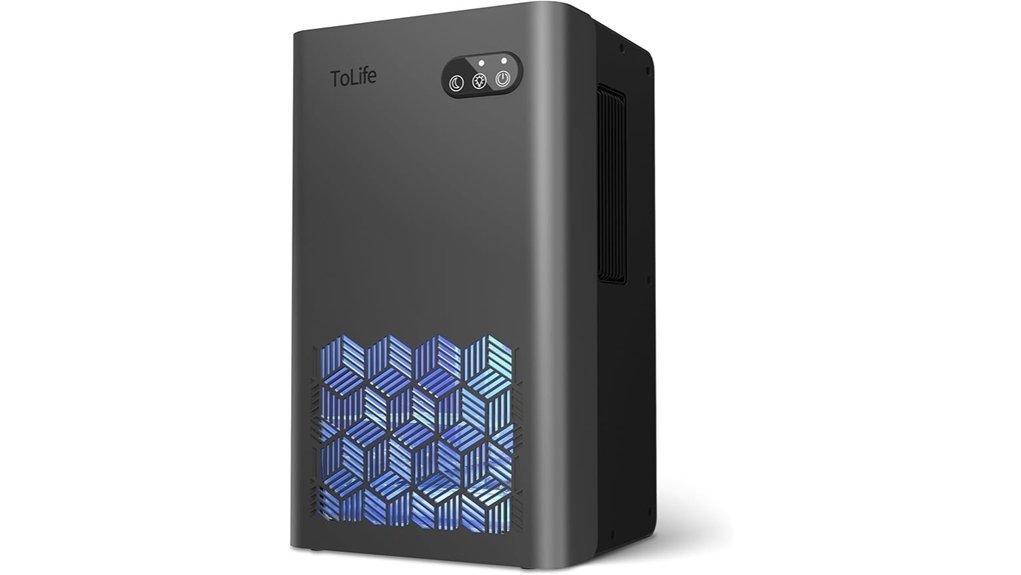
The ToLife Dehumidifier TZ-C2 uses semiconductor condensation technology, also commonly described as thermoelectric or Peltier-style dehumidification. This design avoids a full-size compressor, helping the unit remain relatively compact and quiet.
The current linked listing identifies a 95-ounce removable tank, two operating modes, a built-in carrying design, Sleep Mode, and automatic shutoff protection. Product literature claims that Sleep Mode operates below 30 dB. That can be useful in a piano practice room, teaching studio, or bedroom where low operating noise matters.
The most important limitation is moisture-removal capacity. Published specifications list approximately 1 liter per day, while TZ-C2 documentation gives that figure at about 86°F and 80% relative humidity. Those are much warmer and more humid conditions than many piano rooms. At moderate temperatures and as RH approaches the range recommended for the instrument, daily water collection can be considerably lower.
| Feature | Published Detail | What It Means for a Piano Room |
|---|---|---|
| Dehumidification type | Semiconductor or Peltier-style condensation | Compact and quiet, but normally better suited to light moisture loads than high-capacity room dehumidification. |
| Tank capacity | 95 ounces, approximately 2.8 liters, on the linked product listing | Provides a comparatively large collection tank for a compact unit, although tank size does not determine extraction speed. |
| Maximum extraction | Approximately 1 liter per day; TZ-C2 documentation specifies about 86°F and 80% RH | Expect less collection in cooler rooms and as humidity approaches the desired piano range. |
| Operating modes | Higher-output mode and Sleep Mode | Sleep Mode favors quieter operation, while the normal higher-output setting favors faster moisture removal. |
| Noise | Product literature claims below 30 dB in Sleep Mode | Potentially useful for practice and teaching spaces where operating noise matters. |
| Target humidistat | No user-set target-RH control identified | A separate hygrometer and regular monitoring are important around a piano. |
| Drainage | Removable collection tank; no continuous-drain feature identified | Better for attended, light-duty use than severe or unattended moisture control. |
Best For: Piano owners who need quiet, portable moisture control for a smaller enclosed room with mild excess humidity.
Why You’ll Like It:
- Low-distraction operation: The compressor-free design and claimed sub-30 dB Sleep Mode can make it easier to use around practice, lessons, or quiet rooms.
- Large tank for its category: The linked listing specifies a 95-ounce tank, which can reduce how often it needs attention during light moisture removal.
- Overflow protection: Automatic shutoff is designed to stop operation when the tank is full or not correctly installed.
- Portable design: Its compact body makes it easier to reposition within an appropriate room location.
- Simple controls: Two operating modes provide a straightforward choice between stronger collection and quieter operation.
Who Should Avoid It:
- Owners whose room remains above the piano manufacturer’s recommended humidity range after regular operation.
- Large studios, open-plan living areas, basements, halls, or rooms with substantial moisture loads.
- Anyone dealing with leaks, visible condensation, mold, flooding, or structural dampness.
- Buyers who require an adjustable humidistat, continuous drain hose, condensate pump, or high daily extraction capacity.
- Anyone who wants a unit that can automatically cycle around a selected room-humidity target.
Pros:
- Quiet-focused design: The claimed sub-30 dB Sleep Mode is intended for noise-sensitive spaces.
- Automatic tank shutoff: Helps reduce the risk of collection-tank overflow.
- Portable: Compact construction supports flexible room placement.
- Simple maintenance: The removable tank is straightforward to empty and reinstall.
Cons:
- Modest extraction: It may be unable to control a large or persistently damp piano room.
- No user-set target RH identified: Full-tank shutoff does not prevent the room from becoming drier than intended.
- No continuous drainage identified: The tank must be checked and emptied manually.
- Coverage claim requires context: Advertised square footage does not guarantee adequate performance under real room conditions.
- Published noise figure: The below-30 dB claim is based on product literature rather than independent testing for this article.
Why Humidity Control Matters for a Grand Piano
A grand piano contains wood, felt, leather, metal components, and glued joints that react to changing moisture levels. Extended high humidity can contribute to swelling, sluggish action, corrosion, musty odors, and tuning instability. Air that remains too dry can cause wooden components to shrink and may increase the risk of cracks, loose joints, and other costly problems.
The main goal is humidity stability. A practical room target is often approximately 40% to 55% relative humidity, with around 45% serving as a useful reference point. For example, Yamaha’s piano-care guidance recommends 35% to 55% RH and identifies 45% as optimal. Recommendations can differ, so consult the manual for your piano or ask a qualified piano technician before choosing a permanent target.
Piano safety note: Never aim a dehumidifier’s exhaust directly at the soundboard, action, keyboard, legs, or cabinet. Do not place the unit on, beneath, or against the piano. Make humidity changes gradually and confirm the result with a reliable digital hygrometer.
Factors to Consider When Choosing a Dehumidifier for a Grand Piano
The right dehumidifier for a grand-piano room is not automatically the model with the largest advertised coverage. Start with the room’s measured humidity and then compare extraction capacity, target controls, drainage, noise, room layout, and seasonal conditions.
Measure the Room Before Buying
Place a reliable digital hygrometer near the piano but outside the direct airflow of heating, cooling, humidifying, or dehumidifying equipment. Record daily high and low readings for at least several days. Longer monitoring across changes in weather and HVAC operation provides a more useful picture.
This process helps distinguish a mild seasonal spike from a persistent moisture problem. It also gives you a baseline for evaluating whether a compact thermoelectric dehumidifier is making a meaningful difference.
Humidity Range and Stability
A dehumidifier should reduce excessive moisture without producing an unusually dry area around the instrument. Focus on keeping the room stable within the range recommended by the piano manufacturer. Large daily or seasonal swings can be more troublesome than a small, steady difference from a generic target.
Extraction Capacity Over Coverage Claims
Square-foot ratings are only a starting point. Extraction capacity, room temperature, starting RH, outdoor climate, air leakage, ceiling height, and room enclosure all affect performance.
A small Peltier-style dehumidifier may help in a closed bedroom or compact studio with mild humidity. It can struggle in a large studio, basement, open floor plan, or room that repeatedly receives humid outdoor air. Compare moisture removal under stated test conditions rather than relying on coverage language alone.
Built-In Humidistat and Controls
A dehumidifier with a dependable user-set humidistat can cycle around a selected RH target. This reduces unnecessary operation after the room reaches the desired range and makes automatic humidity management easier.
The ToLife TZ-C2 does not appear to provide a user-adjustable target-RH setting. Its automatic shutoff protects against a full or incorrectly seated collection tank rather than regulating the room to a selected humidity percentage. Pair it with an independent hygrometer, check readings frequently during setup, and use a deliberate operating schedule.
Tank Size and Drainage
A larger tank reduces interruptions, but tank volume does not indicate how quickly a machine can remove moisture. The linked TZ-C2 listing specifies a 95-ounce tank, yet its published extraction rate remains modest compared with higher-capacity room dehumidifiers.
This model does not appear to include continuous drainage. That makes it more appropriate for attended, light-duty use than for a severely damp room that requires round-the-clock water removal.
Noise Levels and Operation
Quiet operation matters in a practice, teaching, or recording space. Check the noise figure for the mode you will actually use and remember that manufacturer noise claims may be measured under controlled conditions.
Sleep Mode lowers the sound level but can also reduce dehumidification performance. A quiet machine still needs enough extraction capacity to control the room, so use measured RH rather than noise level alone to decide which mode works.
Placement and Airflow
Set the dehumidifier on a stable, level, water-resistant surface with the intake and exhaust clear. Keep it away from curtains, heating vents, direct sunlight, spills, foot traffic, and the piano itself.
Position the unit so that it conditions the room evenly. Do not create a concentrated stream of warm, dry exhaust around the soundboard, action, keys, finish, or one side of the cabinet.
Seasonal Two-Way Control
A dehumidifier can only remove moisture. Homes with humid summers and dry heating seasons may also need a room humidifier or a professionally installed piano-specific humidity-control system.
Do not operate a humidifier and dehumidifier against each other. Establish a clear target, use accurate monitoring, and adjust equipment as the season changes.
Room Problems a Portable Dehumidifier Cannot Fix
A portable unit should not be used as a substitute for repairing roof leaks, plumbing leaks, foundation seepage, poor drainage, malfunctioning air conditioning, or major ventilation problems. Visible mold, recurring condensation, damp building materials, or standing water calls for professional investigation.
Before You Buy: Grand Piano Dehumidifier Checklist
- Confirm the humidity range recommended by the piano manufacturer.
- Record the room’s high and low RH readings for several days.
- Measure the enclosed room rather than estimating the entire floor area.
- Compare daily extraction capacity and stated test conditions, not only square-foot coverage.
- Check whether the unit has a true adjustable humidistat.
- Determine whether you need a removable tank, drain hose, or condensate pump.
- Choose a maintenance schedule that matches how often the tank can be checked.
- Plan a location that does not direct intake or exhaust airflow at the piano.
- Monitor the room closely during the first week of operation.
- Seek professional help for leaks, mold, structural dampness, or severe seasonal swings.
How to Use the ToLife TZ-C2 in a Piano Room
- Establish a baseline: Record the room RH before operating the dehumidifier.
- Position it safely: Place it upright on a stable, level surface away from the piano and outside direct traffic paths, with the air inlet and outlet unobstructed.
- Begin gradually: Run it for a limited period rather than continuously on the first day.
- Check the hygrometer: Review the reading during and after operation to see how quickly the room changes.
- Adjust the schedule: Reduce operating time as the room approaches the piano manufacturer’s recommended range.
- Inspect the tank: Empty and clean it regularly, even when it is not completely full.
- Follow operating guidance: TZ-C2 documentation advises against uninterrupted continuous use and recommends disconnecting the unit after 48 hours of operation and allowing it to rest for at least 10 minutes.
- Reassess performance: Choose a higher-capacity solution if the RH remains excessive despite appropriate use.
Frequently Asked Questions
Can a Dehumidifier Damage a Grand Piano?
It can contribute to problems if it makes the room too dry or directs concentrated exhaust at the instrument. Use a separate hygrometer, avoid rapid humidity changes, and reduce or stop operation when the room reaches the range recommended by the piano manufacturer.
What Is the Ideal Humidity Level for a Grand Piano?
Many owners and technicians aim for a stable range of approximately 40% to 55% RH, often near 45%. Yamaha, for example, recommends 35% to 55% and identifies 45% as optimal. Recommendations vary, so follow the manual for your piano or advice from a qualified piano technician as the final authority.
Where Should I Place a Dehumidifier Near a Piano?
Place it in the same room on a stable, level surface with adequate intake and exhaust clearance. Do not put it on the piano, beneath the piano, against the cabinet, or anywhere its dry exhaust blows directly toward the soundboard, action, keyboard, or finish.
How Often Should I Check the Humidity?
Check it several times a day while establishing an operating schedule or during a major seasonal weather change. Once the room is stable, continue regular checks and review the reading after meaningful changes in heating, cooling, rainfall, ventilation, or outdoor humidity.
Is a Small Portable Dehumidifier Enough for a Grand Piano Room?
It may be enough for mild excess humidity in a smaller, enclosed room. It is less likely to control a basement, large studio, open floor plan, or space with a heavy moisture load. If measured RH remains high, move to a properly sized higher-capacity dehumidifier or consult an HVAC professional.
Should a Piano Room Dehumidifier Run All Day?
Only when measured conditions and the equipment’s operating instructions support extended use. The ToLife TZ-C2 does not appear to offer a user-set humidistat, and TZ-C2 documentation advises against uninterrupted continuous operation. It recommends disconnecting the unit after 48 hours of use and letting it rest for at least 10 minutes. Around a valuable piano, continue monitoring RH with a separate hygrometer rather than relying on runtime alone.
Does the ToLife Automatic Shutoff Prevent Over-Drying?
No. Its automatic shutoff is designed primarily to stop operation when the collection tank is full or not correctly installed. It does not appear to stop the dehumidifier because the room has reached a user-selected RH target. A separate hygrometer is still important.
Do I Need a Piano-Specific Humidity-Control System?
A room dehumidifier may be sufficient when the entire room can be maintained within a stable range. A piano-specific system may make more sense when room conditions are difficult to control or seasonal swings are severe. Installation and ongoing maintenance should be discussed with a qualified piano technician.
Final Recommendation
Best fit from this review: The ToLife TZ-C2 is a practical compact choice for mild excess humidity in a smaller, enclosed piano room where quiet operation matters.
Most important limitation: Its thermoelectric extraction is modest, and it does not appear to include a user-set target humidistat or continuous drainage.
Buy it when: Your hygrometer shows a manageable seasonal moisture problem and you are prepared to monitor the room. Choose a higher-capacity or professionally installed solution when the space remains damp, experiences large swings, or requires unattended automatic humidity control.
A grand piano benefits most from steady conditions, gradual adjustments, and accurate monitoring. Choose equipment based on measured moisture rather than an advertised coverage number, keep direct airflow away from the instrument, and follow the humidity guidance for your specific piano. That approach is more dependable than simply running a compact dehumidifier continuously and assuming its square-foot rating guarantees adequate control.